Article Contents:
- Unified finish: the principle of coordinating baseboard and door casings
- Why baseboard and door casing should 'know' about each other
- Three levels of coordination
- Start from one point: the 'anchor' principle
- White baseboard and white doors: a classic that always works
- Why the white system is the standard of universality
- Three whites: how not to miss the mark
- White doors: three types and their compatibility with white baseboard
- White baseboard profile to white doors: coordinating scale
- Natural wood baseboard matching the door panel color
- When natural wood is the best choice
- Why door and baseboard 'don't match' in tone
- Three pairs: baseboard + door in natural wood
- Wooden lace: when door casing becomes a work of art
- Baseboard profile and door casing profile: how they relate
- The principle of scale rhyme
- Horizontal and vertical: the geometry of coordination
- Connecting elements: 'shoe' and 'cap'
- Wooden interior door handle: continuation of the decor
- Handle - the final point in the system
- Why a wooden handle is more logical than a metal one in a wooden interior
- Handle and baseboard: direct color connection
- Complete set order: baseboard, door casing and handle from one series
- Why order from one source
- Project specification: how to compile an order
- FAQ: answers to popular questions about coordinating baseboard and doors
- About the Company STAVROS

There is a special type of mistake in interior design - those you don't notice immediately but feel constantly. Something is 'off', something 'catches the eye', but it's unclear what exactly. Most often the reason is the lack of coordination between wooden elements: baseboard, door casings, door panel, and handle. Each element is high-quality on its own, but together they speak different languages.
Wooden baseboard and doors— it's not just two objects in one room. It's a system that either works as a unified statement or falls apart into a set of random details. And the difference between a 'cohesive interior' and 'just a renovated apartment' is often defined right here: in how the baseboard converses with the door casing, how the casing profile rhymes with the baseboard profile, and how the wooden handle completes this ensemble — or destroys it.
This article is about a systematic approach to coordinating wooden finishing elements. Not about 'rules of good taste' in an abstract sense, but about specific principles that yield a specific result: an interior that looks designed, not assembled piecemeal.





Unified Finishing: The Principle of Coordinating Baseboard and Door Casings




Why Baseboard and Door Casing Should 'Know' About Each Other
Wooden Baseboard and Door Casings— are 'relatives' in an interior. Both are horizontal and vertical wooden molding elements, both frame planes (the floor and the door opening), and both are visible simultaneously when looking at any wall with a door.
It is this simultaneous visibility that makes their coordination fundamental. When the eye glides along a wall, it doesn't look at the baseboard and casing separately — it sees them as a system of elements. And the system either 'sings in unison' or creates dissonance.
What 'Coordinated' Means:
-
Unified material or wood species: oak baseboard + oak casing = obvious. Oak baseboard + pine casing = less obvious, but can work with the same finish. Wooden baseboard + MDF casing 'under wood' = will never look like a unified whole — the different surface character reveals incompatibility.
-
Unified finish: one oil, one varnish, one enamel. The tone is coordinated within one finishing system.
-
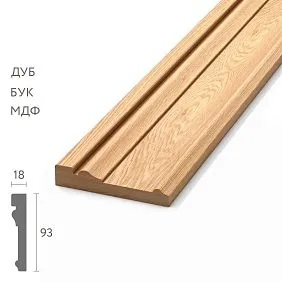
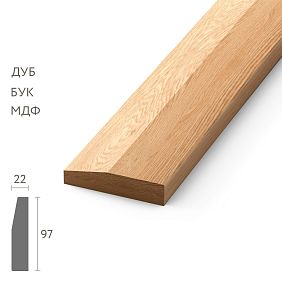
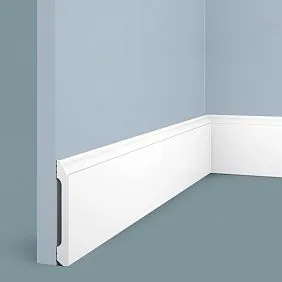
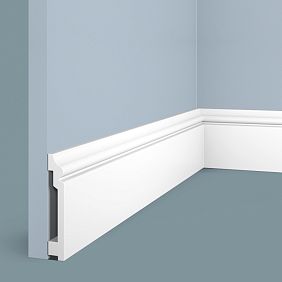
Coordinated profile: baseboard and casing from the same 'profile family' — similar scale, similar form logic.
Our factory also produces:
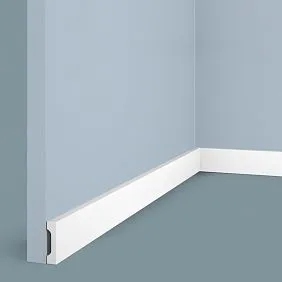
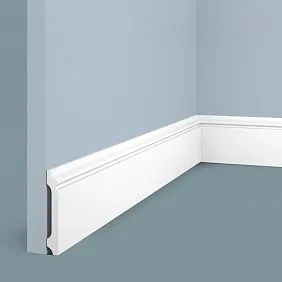
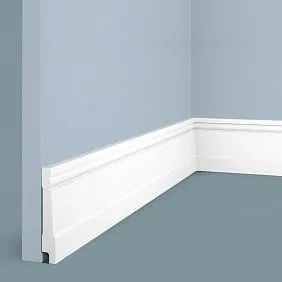
Three Levels of Coordination
Professional designers distinguish three degrees of coordination for wooden elements:
Level 1 — Basic (minimum). Same color and tone. Baseboard and casing can be from different profiles, but in the same tone (both white, or both dark brown) — the interior looks cohesive in color, even if the profiles differ.
Level 2 — Good. Unified tone + coordinated profile scale. Baseboard height 60 mm + casing width 50–60 mm from the same series. Both from the same wood species with the same finish.
Level 3 — Architectural precision. Tone + scale + unified 'profile family' (baseboard K-009, casing from the same K-series) + unified wooden handle. All wooden elements are from one source, one batch. This is what distinguishes an architect's project from a DIY renovation 'by parts'.
Get Consultation
Start from One Point: The 'Anchor' Principle
A practical tip that changes the order of work: don't match the baseboard to already purchased doors, and don't match doors to an already installed baseboard. Choose an 'anchor' element — the one that defines everything else — and build the system from it.
Most often, the floor covering serves as the 'anchor'. It is the largest wooden surface in the interior. Parquet is chosen → baseboard is coordinated with the parquet in tone →wooden casingcasing is coordinated with the baseboard in tone and profile family → door leaf is coordinated with the casing → handle completes the system.
When doors serve as the 'anchor' (e.g., ordered in advance or purchased with the apartment) — the same logic in reverse order: door → casing → baseboard.
White Baseboard and White Doors: A Classic That Always Works
Why the White System is the Benchmark of Versatility
white wooden skirting boardwhite baseboard + white casing + white or light doors — this is not 'lack of a solution'. It is a system that works in 90% of typical interiors without risk of error. White unifies everything: any wall color, any parquet tone, any furniture.
But 'white' is a subtle story. An error in the shade of white between baseboard, casing, and door is more noticeable than the difference between white and beige. Why? Because the brain 'expects' identical white and immediately registers any deviation as a mismatch.
Three Whites: How Not to Miss
Wooden elements for white enamel — you need to choose the shade:
RAL 9010 (pure white): neutral, without a pronounced warm or cool undertone. A universal choice — suits any lighting, any floors. The standard for modern housing.
RAL 9001 (creamy white): with a warm milky undertone. For classic interiors with warm wood floors, walnut-toned parquet, warm lighting (2700–3000K). RAL 9001 next to cool 5000K lamp light — looks yellow.
RAL 9003 (signal white): brighter and cooler than 9010. For designer interiors with cool accents (gray, anthracite), with cool white daylight LEDs. Next to warm parquet — sharply contrasts.
Practical tip: order a sample skirting board painted in the desired RAL color, then hold it against the installed door casing under both evening and daytime lighting in your apartment. Only under your own lighting—not in the store or on a monitor.
White doors: three types and their compatibility with white skirting boards
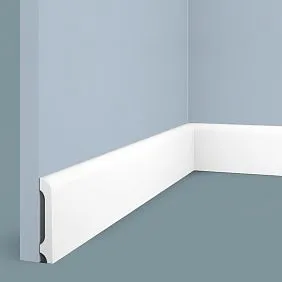
Enameled white doors: surface is even, smooth, glossy or matte. Perfect with a white matte solid wood skirting board. With a white glossy skirting board next to a matte enamel door, a difference in sheen may arise, which is best coordinated (both matte or both semi-gloss).
MDF doors with white veneer: surface has a barely visible wood-like texture. Good with a white solid wood enameled skirting board; natural wood is 'richer' than veneer, but this is neutralized in white.
Glass doors with white frame: frame is painted metal or MDF. White wooden skirting board and white casing are the only correct choice: all white elements create an 'invisible' frame, with the focus on the glass.
White skirting board profile for white doors: coordinating scale
Another nuance of a white system: the skirting board and casing profiles should be 'in harmony'—an ornate casing with moldings + a simple flat skirting board = imbalance. An ornate casing requires a skirting board with corresponding 'richness' of profile.
| Door type | Casing | Skirting board | Profile |
|---|---|---|---|
| Classical white with paneling | Ornate with molding | K-009, K-018 height 80–100 mm | Classic |
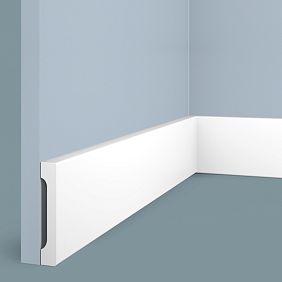
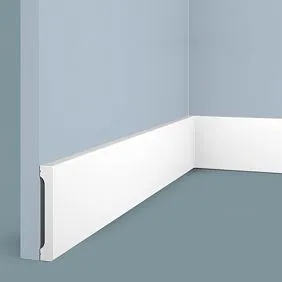
| Modern white smooth | Flat rectangular | K-034, K-006 height 60 mm | Minimalist |
| Scandinavian with glazing bars | Flat with bevel | K-034 height 40–60 mm | Minimalist |
| Italian concealed door | No casing or thin casing | K-034 40 mm or no skirting board | Zero |
Natural wood skirting board matching the door leaf color
When natural wood is the best choice
Wooden baseboardIn the natural wood tone—with oil or clear varnish—and a door in the natural tone of the same wood: this is the most 'honest' and simultaneously the most complex solution. Honest because it doesn't hide the material under paint. Complex because precise matching of the tone of two natural wood surfaces requires systematic work.
Why the door and skirting board 'don't match' in tone
It would seem: both are oak, both with oil finish—they should match. But:
-
Different wood grain cuts: parquet—tangential cut, door—radial cut. The same oak looks different depending on the direction of the cut.
-
Different ages of wood: fast-growing oak for door panels and slow-growing oak for baseboards (like STAVROS — kiln-dried) — different densities, different tones under the same finish.
-
Different finishes: a door with oil from a Danish manufacturer and a baseboard with oil from another brand — different chemical compositions yield different color results on the same wood.
Solution: coordinating finishes. If the baseboard is finished with Osmo Polyx-Oil 3101, then the door should be finished with the same oil. If it's not possible to refinish the door with your oil, then a tinting oil for the baseboard is selected to 'match the door' using a sample: keep a door sample when ordering the baseboard finish.
Three pairs: baseboard + door in natural wood.
Oak + oak: the most organic pair. Oakbaseboard K-series STAVROS+ solid oak or oak veneer door. Under the same oil — perfect material 'language' match with a possible slight tonal variation that only adds 'liveliness' to the interior.
Oak + walnut: an acceptable pair in interiors with a warm palette. Oak is warmer, walnut is richer in tone. To 'harmonize' them: a tinting oil on the baseboard towards a 'walnut' tone (Osmo 3166 Hazelnut) brings the shades closer.
Beech + oak: a controversial pair. Beech — pinkish, fine-pored. Oak — warm brown, with a large grain pattern. Under the same oil — different results. To coordinate: both under the same enamel (then the difference in species is not visible) or both under a tinting oil of the same tone.
Wooden lace: when a door casing becomes a work of art
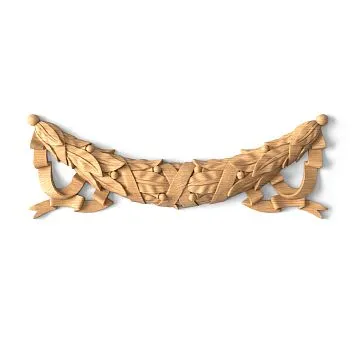
wooden lace— carved casings with openwork ornamentation — a special category deserving separate attention. This is not just a profiled overlay at the door opening: it is an architectural decorative element with history.
In traditional Russian wooden architecture, casings were the main 'face' of the house: carved ornamentation — solar symbols, plant motifs, geometric patterns — each house had its own 'handwriting'. Today, carved wooden casings are experiencing a renaissance in interior design: not as historical reconstruction, but as a conscious choice of natural texture and artisanal decor.
Carved casings STAVROS— made from solid oak and beech with milled ornamentation: classic patterns, geometric patterns, plant motifs. For them — a baseboard from the same wood species, possibly with a more restrained profile: a rich casing 'leads', the baseboard 'accompanies'. Balance: the casing is the soloist, the baseboard is the accompaniment.
Baseboard profile and casing profile: how they relate
The principle of scale rhyme
This is one of those design principles that is easy to feel but difficult to explain until you know its formula. The formula is: the baseboard profile and the casing profile should be 'in the same profile family' — have a similar scale of decorative elements and coordinated complexity of form.
What this means in practice:
-
A casing 60 mm wide with a three-step shaped profile → a baseboard 70–100 mm high with similar profile complexity (K-009, K-018). Both — 'classic middle register'.
-
A casing 80 mm wide with a large classic molding → a baseboard 100–140 mm with a rich profile (K-066). Both — 'heavy classic'.
-
A casing 40 mm, flat with one bevel → a baseboard 40–60 mm with the same flat geometry (K-034). Both — 'pure minimalism'.
Violation of scale rhyme: a wide, rich casing + a narrow, flat baseboard = the casing 'overpowers' the thin strip of baseboard. Or: a thin, minimalist casing + a tall, figured baseboard = the baseboard 'shouts' louder than the door framing.
Horizontal and vertical: the geometry of coordination
The baseboard is a horizontal element. The casing is vertical. At the meeting point (the wall corner at the door opening) they 'collide'. The quality of this junction is a separate topic.
Option 1: The baseboard butts against the casing. The baseboard reaches the casing and is cut flush with its plane. The casing is 'dominant', the baseboard is subordinate to it. A simple and correct option. Requires precise 90° cutting and good fit.
Option 2: The baseboard goes under the casing. The casing is installed over the baseboard — the lower part of the casing overlaps the end of the baseboard. Hides the junction gap. Requires installation in the correct order: first the baseboard, then the casing.
Option 3: The baseboard 'bypasses' the door opening. A continuous baseboard line runs along the entire room perimeter, including the wall sections by the door — but is interrupted only by the width of the door leaf. This creates a sense of architectural completeness: the horizontal line 'bypasses' the entire perimeter.
Junction elements: 'plinth block' and 'cap'
Professional installation of casing on baseboard involves using special junction elements:
'Plinth block': a small rectangular block made of the same wood, installed at the meeting point of the baseboard and casing. Its task is to solve the problem of incompatibility between horizontal and vertical profiles: the plinth block acts as an 'adapter', with which both the baseboard and the casing join with a straight cut (90°), not a complex profile cut.
Especially appropriate when profiles don't match: when the baseboard and door casing are from different series or have significantly different width/height.
"Cap" (door plinth cap): a small decorative element in the top corner of the casing (where the vertical casing meets the horizontal). In classic interiors - a figured corner rosette.
Wooden interior door handle: continuation of the decor
Handle - the final point in the system
If the baseboard and casing coordinate the larger context (wall, floor, door opening), then the handle is the final detail that a person touches with their hands. The handle is tactile contact with the wooden interior. And it's precisely here that inconsistency is felt literally: with the fingers.
STAVROS wooden furniture handlesmade from solid oak and beech - 32 surface-mount models of various geometries: from minimalist rectangular and oval to asymmetrical triangular and classic U-shaped. Production: 3D milling from hardwood with sanding and coating. Colors: black, white, brown, clear coating (natural wood under oil).
This is not just hardware for a kitchen set. A wooden handle on an interior door is a conscious design choice that continues the "wooden language" of the baseboard and casing.
Why a wooden handle is more logical than a metal one in a wooden interior
Metal handles (steel, brass, chrome) are the standard for interior doors in most apartments. They are functional, durable, and affordable. But in an interior with wooden baseboards, carved casing, and natural-tone parquet - a metal handle is a "foreign" material.
Wood + wood = material consistency. A handle made from the same solid oak or beech continues the uninterrupted "wooden narrative" of the interior. A person opens the door, touches wood - and tactilely enters the same material system as the entire interior.
Practical advantages of a wooden handle:
-
Warm to the touch (unlike metal - doesn't feel "cold" in winter)
-
Doesn't slip in wet hands
-
Doesn't scratch upon accidental contact
-
Environmentally neutral (especially for children's rooms)
Handle and baseboard: direct color connection
If the baseboard is oak with natural oil finish, and the handle is oak with clear coating: a direct material rhyme. Visually and tactilely - the same wood in different configurations.
If the baseboard is white enamel - a handle in white finish completes the "white system" of baseboard-casing-handle. This is the level of architectural precision where the interior is perceived as designed from foundation to details.
Dark baseboard (wenge, anthracite) - wooden handle in black finish: a strong, clear system with a unified dark accent. With light doors - the contrast between handle and door panel works as an intentional design technique.
Complete order: baseboard, casing, and handle from one series
Why order from one source
Can you buy baseboard in one place, casing in another, handle in a third - and get a coordinated result? Theoretically - yes, provided careful selection of tones and samples. Practically - this takes three times as long and in half the cases ends with a mismatch that's discovered only after installation.
A complete order from one source solves this problem at the root:
-
One wood species (oak or beech) → same "language" of texture and density
-
One batch of coating → identical tone without sample matching
-
One production line → coordinated dimensions and tolerances (baseboard and casing from one series "meet" in the corner without gaps)
-
One manager → coordination of the entire assortment for a specific project
STAVROS in Moscowoffers exactly this logic: K-series baseboards, carved and smooth casings, KZ-series cornices, furniture handles - all from the same solid wood, in a unified coating system, from one warehouse.
Project specification: how to place an order
For a designer or client working on a complete apartment design with wooden elements:
-
Parquet/flooring — specified: wood species, tone, finish
-
Baseboard — same or coordinated wood species, profile matching the style, finish matching the parquet tone → linear footage specification for the perimeter of all rooms
-
Door casings — same wood species, profile coordinated with baseboard in scale, same finish → specification by number of door openings
-
Handles — wooden, same wood species, same finish → quantity by number of doors
-
Cornices (for high ceilings and classic style) — same wood species, profile coordinated with baseboard → linear footage along ceiling perimeters
Such a specification is the "wooden passport" of the apartment: all elements are described within a unified coordinate system.
FAQ: answers to popular questions about coordinating baseboards and doors
Must the door casing be made from the same wood as the baseboard?
Not necessarily — but desirable. With the same wood species, it's easier to achieve tonal matching. With different species — only if both are under the same enamel (then the wood species is hidden) or when stained "to the same tone."
Can wooden baseboards be installed with metal doors?
Yes. For metal entrance doors — baseboard at the base of the door frame, wooden door jamb, wooden door casing: this creates a "wooden frame" for the metal door, visually "domesticating" it. The tone of the casing and baseboard at the metal door is coordinated with the overall interior, not with the door's metal.
How to match a wooden handle to already installed metal hinges?
Metal hinges are an "invisible" detail (hidden from the end). A wooden handle on a door with metal hinges is a normal combination. It's more important to coordinate the handle with the door casing and baseboard, not with the hinges.
Is a door casing needed if the door opening is "clean" (without a frame, hidden door)?
Hidden doors without a visible frame — no casing. In this case, the baseboard should "wrap around" the door opening, creating a continuous line along the room's perimeter. If the baseboard is interrupted at the opening — a neat end with a chamfer. No casings — they would ruin the idea of an "invisible" door.
Is it worth ordering wooden handles for a kitchen set from the same series as the door handles?
Yes — if the kitchen set is wooden or veneered to the same tone. A unified handle on kitchen fronts and interior doors creates a "through" wooden motif in an open floor plan (kitchen-living room).
How to avoid tone errors when ordering online?
Order samples before the final order. STAVROS sends samples of baseboards and door casings for 180 rub./set. Place the sample next to samples of parquet, door casing, door — under your lighting. Only live evaluation under your light gives a reliable result.
About the company STAVROS
Wooden interior from foundation to details — this is exactly what STAVROS offers.Solid oak and beech furniture handles— 32 models, 4 colors, manufactured by 3D milling with perfect grip geometry.carved wooden casings— classic and modern solid wood ornament.K-series baseboards— over 30 profiles, height from 40 to 200+ mm, made from kiln-dried oak and beech.KZ-series cornicesfor the ceiling zone.
The entire line — from a single source, from the same solid wood, within one finishing system. Warehouses in Moscow and St. Petersburg, same-day shipping. Samples — 180 rub./set. Consultation on project selection — 8 (800) 555-46-75.
STAVROS — because wooden interior is a system, not a set of parts.