












































































Article Contents:
- Features of the linoleum-to-wall joint
- Why the linoleum-to-wall joint is a special case
- Expansion gap for linoleum: is it necessary?
- Three functions of baseboard with linoleum
- Wooden baseboard for linoleum: profiles and height
- Which profile suits linoleum
- Baseboard height for linoleum: recommendations
- Wood species for baseboard with linoleum
- Internal and external wooden baseboard
- Wooden internal baseboard: where it works
- Wooden external baseboard: columns, pilasters, protrusions
- Factory corner elements: internal and external corner
- Wooden baseboard with cable channel: reality or myth
- Problem statement
- Wooden baseboard and cables: three options
- Fire safety standards for cables in baseboard
- Installing wooden baseboard on linoleum: mounting nuances
- Main question: through the linoleum or around it?
- Mounting method: screws into wall through anchors
- Adhesive mounting: specifics with linoleum
- Finishing details: sealing the bottom gap
- Wall-mounted wooden baseboard: use in bathrooms and kitchens
- What is wall baseboard and where it's needed
- Wooden wall baseboard in interiors
- Wall baseboard in kitchen: practical requirements
- Solid wood wall baseboard in bathroom: is it acceptable?
- Selecting color and finish for wooden baseboard with linoleum
- Logic of color solutions
- Gloss, semi-matte, matte for linoleum
- FAQ: answers to common questions about wooden baseboard and linoleum
- About the Company STAVROS

Linoleum is a no-fuss flooring. Practical, durable, affordable. But it's often paired with the most unsuitable skirting board: cheap PVC with a thin 'wood-look' film that wears off within a year. Or, even worse, nothing is installed at all, leaving the edge of the sheet exposed against the wall.
Meanwhile,a wooden skirting board for linoleumis not a luxury or a contradiction. It's a conscious choice that transforms a budget floor into a finished, neat surface with character. Solid wood next to linoleum creates a contrast that works: natural texture enlivens the uniform surface, adding warmth and scale.
And purely technically, a wooden skirting board works differently with linoleum than with parquet. Here, there are different rules, different installation nuances, a different understanding of the joint. We'll cover everything—from the joint geometry to the cable channel issue that troubles everyone installing new wiring during renovation.





Features of the linoleum-to-wall joint




Why the linoleum-to-wall joint is a special case
Linoleum is a soft, elastic, roll flooring. When installed, it adheres to the floor across its entire area, but behaves differently at the wall compared to wooden or laminate flooring: linoleum doesn't 'spring' toward the wall due to deformation; instead, it tends to 'pull away' from it during drying or under mechanical stress.
Result: near the wall, linoleum can lift at the edge, form a 'wave,' or wrinkle. In this situation, the skirting board not only serves a decorative role—it physically presses the edge of the sheet against the floor, securing the edge.
This is a fundamental difference from parquet, where the skirting board doesn't touch the parquet. With linoleum, the skirting board actually 'holds' the edge. And here arises the first technical question: what to attach the skirting board to—the wall or through the linoleum to the floor?
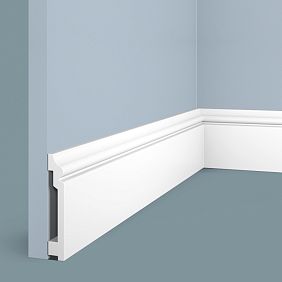
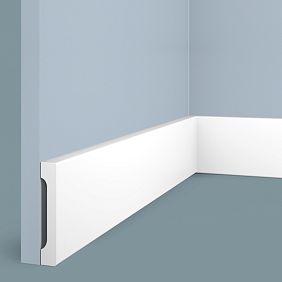
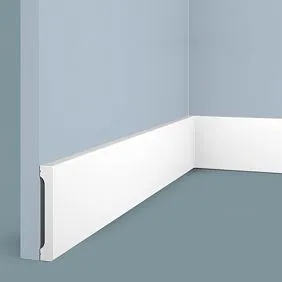
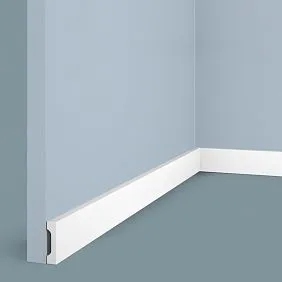
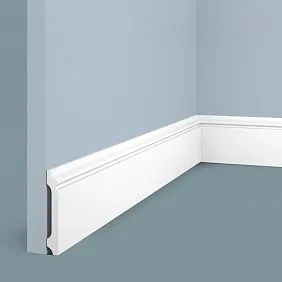
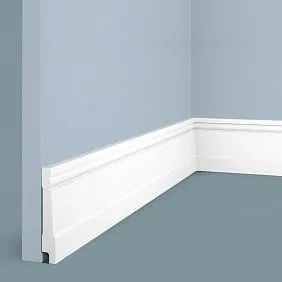
Our factory also produces:
Expansion gap for linoleum: is it needed?
Unlike parquet, linoleum doesn't have significant humidity-related deformations in the plane of the floor. Linoleum doesn't 'expand' seasonally like parquet boards. However:
-
Freshly laid linoleum has residual stresses from the roll and slightly shrinks during the first 2–3 weeks
-
When heated (underfloor heating, direct sunlight)—linoleum expands slightly: 1–3 mm in length per 4 m of sheet
-
When installed without adhesive (loose-lay)—linoleum can shift from accidental mechanical impacts
Recommended gap between the edge of the linoleum and the wall: 5–8 mm. This is the minimum that covers most deformations. For underfloor heating: 10 mm. A wooden skirting board with a horizontal shelf wider than 10–12 mm covers this gap with a margin.
Get Consultation
Three functions of skirting board with linoleum
| Function | Explanation |
|---|---|
| Edge clamping | The lower part of the skirting board presses the edge of the linoleum against the floor, preventing edge lifting |
| Decorative | Covers the unsightly cut edge of the sheet and the gap at the wall |
| Dust and moisture protection | Seals the gap at the base of the wall from dust; in kitchens and bathrooms—from splashes |
Wooden skirting board for linoleum: profiles and height
Which profile suits linoleum
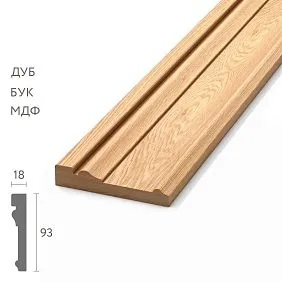
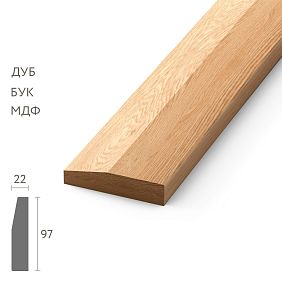
a wooden skirting board for linoleum—profile choice depends on room style and ceiling height, but geometrically, almost all profile types work with linoleum under one condition: the horizontal 'shelf' or lower end of the skirting board must cover the linoleum gap (5–10 mm) with a margin.
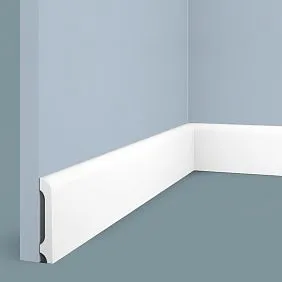
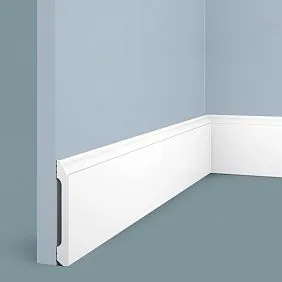
Straight (flat) profile—a concise vertical strip with or without a bevel. Character: minimalism, loft, modern office. Perfect for linoleum in industrial, commercial, or contemporary residential interiors.
Classic shaped profile (K-006, K-009, K-018 K-series) — S-shaped or stepped profile with molding. Adds 'order' and architectural weight to a classic room with linoleum. Works surprisingly well in Soviet high-rises with high ceilings: oak classic skirting board under white enamel + 'stone-look' linoleum = neoclassical effect on a modest budget.
Cove (quarter round) — triangular profile with a concave front face. Minimal height, soft transition of the corner. For linoleum in low rooms (up to 2.5 m), storage rooms, utility rooms.
Boot — L-shaped profile. For linoleum — in wooden houses and bathhouses with linoleum on the floor (in the anteroom, technical rooms). The lower shelf of the boot presses the edge of the linoleum.
Skirting board height for linoleum: recommendations
| Ceiling Height | Recommended skirting board height | K-series profiles |
|---|---|---|
| Up to 2.5 m | 40–60 mm | K-034, K-006 |
| 2.5–3 m | 60–100 mm | K-006, K-016, K-009 |
| 3–3.5 m | 100–140 mm | K-009, K-018 |
| Above 3.5 m | 150–200 mm and more | K-066, K-104 |
For living rooms with standard linoleum — K-006 (60 mm oak, from 480 rub./lm) is the 'workhorse': high enough to cover the gap and be a noticeable accent, but not overwhelming for low rooms.
Wood species for skirting board with linoleum
Linoleum is not a wooden flooring, so the rule 'wood species to match wood species' does not apply here. The logic is different: the skirting board is selected to match the color scheme of the entire room, not the texture of the floor.
-
'Stone-look' linoleum (gray, beige) + white walls → white beech skirting board under enamel RAL 9010
-
Dark gray (anthracite) linoleum + light walls → oak skirting board under natural oil or dark tone
-
'Parquet-look' linoleum (wood imitation) → oak skirting board under oil — creates the illusion that the entire floor surface is wooden
-
Commercial space, office → white skirting board, height 80–100 mm — neutral strict line
Internal and external wooden skirting board
Wooden internal skirting board: where it works
Wooden internal skirting board— this is the standard situation: skirting board in the corner between the floor and the wall (90° angle 'into' the room). This is most often what is meant when saying 'skirting board'.
For an internal corner during installation — a 45° miter cut on each plank, which are joined in the corner. This is the classic method, which we covered in detail in the topic of joints. The peculiarity with linoleum: in the corner, the lower part of the skirting board must tightly press the edge of the linoleum from both walls. With a poor-quality miter cut of the corner joint — the edge of the linoleum may 'come out' from under the skirting board in the corner. Solution: precise 45° miter cut + a pressing lower part of the skirting board of sufficient width.
Wooden external skirting board: columns, pilasters, protrusions
Wooden external skirting board— skirting board on an external corner (90° angle 'outward': column, wall protrusion, pilaster, pipe casing). Installation is more complex: both planks are cut at 45° 'towards' each other, forming an external corner joint.
Peculiarity of external skirting board for linoleum:
-
The edge of the linoleum at the base of the external corner is especially vulnerable — it can easily be caught by a foot or furniture
-
External skirting board with a wide horizontal shelf more reliably fixes the edge at the corner
-
It is recommended to use factory-made corner decorative caps (external corner element) — then mitering is not needed, installation is faster and without risk of error
Factory corner elements: internal and external corner
Most manufacturers of wooden moldings (including STAVROS) offer factory corner elements for skirting boards: ready-made 90° internal corner and 90° external corner. These are milled parts made from the same solid wood as the skirting board strip.
Advantages:
-
No cutting error: the corner element already has the required geometry
-
Quick installation: a ready-made element is inserted into the corner, the skirting boards are joined with a straight 90° cut
-
Perfect profile and tone match (from the same batch)
For installation on linoleum, corner elements are especially practical: the external corner at the linoleum edge is tightly and reliably covered, without gaps.
Wooden skirting board with cable channel: reality or myth
Problem statement
The query 'wooden skirting board cable' is one of the most popular in the topic of floor skirting boards. It's clear why: during apartment renovation, it's often necessary to run new cables (internet, TV, telephone, charging lines), and the logical place for them is at the base of the wall, behind the skirting board.
Is a wooden skirting board with a cable channel real? Or is wood not intended for this?
Wooden skirting board and cable: three options
Option 1: Space behind the skirting board (without cable channel)
A standard wooden skirting board, nailed to the wall, has a space behind its back surface of 5–15 mm thick (depending on wall curvature and mounting method). Small-diameter cables (2–4 mm) — twisted pair, antenna cable, charging cables — are laid directly behind the skirting board without a special channel. The skirting board conceals them.
Limitation: there is no access to the cables after skirting board installation (only during dismantling). For permanent cable routes (twisted pair for internet) — acceptable. For cables that need periodic changing — inconvenient.
Option 2: Wooden skirting board with a plastic cable channel behind it
A plastic cable channel is first mounted to the wall, then the wooden skirting board is installed over it. The channel is hidden, cables are inside. If necessary — the skirting board is removed, the cable is changed.
This is the most common solution forwooden skirting board with cableson linoleum. A cable channel 20–25 mm wide fits behind a skirting board with a height from 60 mm with proper installation: the skirting board is fastened with a pitch of 600–800 mm, between fastening points — space for the channel.
Option 3: Wood with built-in cable channel (specialized profile)
There are wooden skirting boards with a milled longitudinal recess on the back side — a cable channel within the profile body. These are specialized products, not included in the standard catalog of most manufacturers of K-series moldings.
Alternative: polyurethane skirting board with cable channelKPU-series STAVROS— absolutely stable, paintable in any RAL color, with a built-in recess for cable. This is a technically more suitable solution for cable routes than solid wood.
Fire safety standards for cables in skirting boards
An important point often ignored: power cables (220V) behind a skirting board require placement in a protective corrugated tube or cable channel made of non-combustible material. Laying a power cable directly behind a wooden skirting board is a violation of the Electrical Installation Code.
Low-voltage system cables (twisted pair, HDMI, antenna) — less strict requirements, but corrugated tube is recommended.
Conclusion: for power cables behind a wooden skirting board — plastic corrugated tube or a cable channel inside the wood is mandatory. For low-voltage cables — acceptable without a channel provided the cable is not pinched by the skirting board.
Installation of wooden skirting board on linoleum: mounting nuances
Main question: through the linoleum or past it?
To parquet: skirting board to the wall, not touching the parquet from below. To linoleum: fundamentally different situation.
The linoleum needs to be pressed against the wall. For this, the lower part of the skirting board must lie on the surface of the linoleum — and it is this pressing load that fixes the edge. Skirting board when installing on linoleum:
-
The lower horizontal part or lower end lies on the surface of the linoleum (light pressure, not heavy load)
-
Pressed against the wall with its rear vertical plane
-
Fastening — to the wall (not through the linoleum to the floor)
Diagram: baseboard → wall with light pressure of the lower part against the linoleum surface. Fastening to the floor through the linoleum is strictly undesirable: puncturing the linoleum with fasteners compromises the sheet's integrity, and edge lifting begins at the puncture point.
Installation method: screws into the wall using wall plugs
Standard for brick, aerated concrete, and concrete walls:
-
Place the baseboard against the wall in its working position — lower part on the linoleum
-
Mark the fastening points through the rear surface (spacing 400–600 mm)
-
Remove the baseboard, drill holes in the wall ∅6 mm, depth 40–50 mm
-
Insert wall plugs
-
Place the baseboard, screw in the finishing screws with countersunk heads
-
Sink the heads with a punch, fill with wood filler
For drywall walls: screw into the metal stud of the frame (hitting the stud is mandatory — won't hold in empty space). If necessary — chemical anchor in drywall for heavy baseboards.
Adhesive installation: specifics with linoleum
Construction adhesive (liquid nails) on the rear vertical plane of the baseboard — acceptable on even walls. Specifics with linoleum:
-
Do not allow adhesive to get on the linoleum surface near the wall: when removing the baseboard, the adhesive may peel off the linoleum's surface layer
-
Adhesive — only on the rear (vertical) surface of the baseboard, the lower horizontal part — without adhesive
Tape method for adhesive installation: before applying adhesive to the lower plane of the baseboard, apply painter's tape to the linoleum near the wall (strip 15–20 mm). After installation and pressing — carefully remove the tape. Linoleum is protected from adhesive.
Finishing details: sealing the bottom gap
After installing the baseboard on linoleum, a small gap often remains between the lower end of the baseboard and the linoleum surface — due to wall curvature or linoleum unevenness. This gap is not an installation defect, it's normal.
Closing the gap: acrylic sealant in neutral colors (white, 'wood-like' to match the baseboard) is applied along the lower end of the baseboard in a thin line and smoothed with a wet finger. After drying — painted over completely when painting. With a transparent finish — the sealant is noticeable, so the shade should be matched.
Wall-mounted wooden baseboard: use in bathrooms and kitchens
What is a wall-mounted baseboard and where it's needed
Wooden wall-mounted baseboard— a profile that is mounted not at the base of the wall (floor), but at a certain height on the wall: as a 'horizontal strip' on the wall, separating the lower and upper finishing zones.
This is a classic architectural element: panel cladding of the lower part of the wall (wood, tile, paint of a different color) is finished with a wall-mounted baseboard as a 'cornice' at a height of 80–120 cm from the floor. Above — different finishing.
In the kitchen: the lower part of the wall is covered with tile (backsplash), the upper part — painted plaster. At the transition — a wooden wall-mounted baseboard as a decorative molding. Elegant, clean, functional.
In the bathroom: a similar scheme — tile below, wooden molding at the transition, paint above. But — with an important caveat: in wet rooms, solid wood wall-mounted baseboard is used only with reliable moisture protection (oil-wax, waterproof varnish) or replaced with a polyurethane equivalent.
Wooden wall-mounted baseboard in interiors
Art Deco / retro style study: wall-mounted baseboard at a height of 100–120 cm (one-third of the wall height), lower zone — dark paint or wooden panel, upper — light wallpaper. Oak molding — a boundary creating a visual 'belt' for the interior.
Children's room: wall-mounted baseboard at a height of 80–90 cm — boundary of the 'children's zone' (lower) and 'adult zone' (upper). Practical: the lower part of the wall is painted with washable paint (they draw, smear), the upper — delicate wallpaper.
Hallway with linoleum: linoleum + wooden wall skirting at 90–100 cm height + wooden floor skirting K-006 = "hallway set" in wood material. Surprisingly rich result with economical flooring.
Wall skirting in the kitchen: practical requirements
Kitchen — an area of active use: grease, steam, splashes from washing cycles. Wooden wall skirting in the kitchen has increased requirements:
-
Coating: waterproof polyurethane varnish (2–3 layers) or oil-wax with high water-repellent properties
-
Mounting: secure to the wall, without gaps at the wall (gaps are grease accumulators)
-
Bottom joint with tile backsplash: seal with sanitary silicone matching the tile color
-
Top joint with finish: paintable acrylic sealant
Optimal wood species for wall skirting in the kitchen: oak (dense structure, takes coating well, resistant to mechanical impacts) or beech (smooth surface, paints well).
Solid wood wall skirting in the bathroom: is it acceptable?
A controversial issue. Most designers advise polyurethane wall molding in the bathroom — it is completely moisture-resistant, does not swell, does not crack during humidity-temperature cycles.
But wooden wall skirting in the bathroom is acceptable under conditions:
-
Good ventilation (not a "sealed" bathroom)
-
Coating — at least 3 layers of waterproof yacht varnish or polyurethane varnish
-
Sealing all joints (silicone) — not a single open end
-
Not in the direct water splash zone (not near the shower cabin)
Wood species for wet wall skirting: larch (natural moisture resistance) or teak (elite — maximum moisture resistance among available species).
Matching color and coating of wooden skirting to linoleum
Logic of color solutions
Linoleum — often neutral, background flooring. Skirting can be:
Tonal (blends with floor or wall):
-
White skirting → to white/light walls, any floor → skirting "disappears" into the wall
-
Skirting matching linoleum color → if linoleum imitates wood — oak skirting in a similar tone creates the illusion of "wooden floor with wooden skirting"
Accent (stands out):
-
Dark oak skirting → to light linoleum → black "calligraphic" line at the floor
-
Light beech skirting → to dark linoleum → "air" at the floor
Neutral (classic):
-
White enamel → to any linoleum in a room with white walls. The most universal solution.
Gloss, semi-matte, matte to linoleum
Commercial linoleum (office, store) — often glossy or semi-glossy. Wooden skirting for it — semi-matte or matte varnish: texture contrast (flat gloss floor + structural matte skirting) works well.
Residential linoleum ("stone-like", "wood-like", matte) — wooden skirting with oil finish (natural matte finish). Both materials — matte, warm, "alive" — combine well.
A glossy skirting board next to matte linoleum is undesirable: the skirting will 'shout' and attract attention.
FAQ: answers to common questions about wooden skirting boards and linoleum
Can a wooden skirting board be installed on linoleum — will it crack from pressure?
A wooden skirting board presses the edge of the linoleum with light weight, not mechanical pressure. Linoleum 2–3 mm thick withstands the load without deformation. The main thing is not to screw fasteners through the linoleum into the floor: this damages the sheet.
How to hide cables behind a wooden skirting board near linoleum?
Low-voltage cables (internet, TV, telephone): run behind the skirting board, which is attached to the wall with a spacing of 600–800 mm — there is space for cables between the attachment points. 220V power cables: must be in a plastic corrugated conduit behind the skirting board or first mount a plastic cable channel to the wall, then the skirting board over it.
Does a wooden skirting board on linoleum in the hallway need to be coated?
Yes, definitely. The hallway is an area of mechanical wear (shoe impacts, moisture from outside). Minimum: 2 coats of waterproof polyurethane varnish or oil-wax. A coated skirting board withstands mechanical impacts without darkening or scratches.
What skirting board to install with gray linoleum?
Depends on the walls. If the walls are white → white skirting board RAL 9010 made of beech in enamel. If the walls are gray / light gray → oak skirting board with natural oil finish (warm contrast to cool gray). If the walls are dark → white skirting board as a 'light border' at the floor.
Can a wooden skirting board be installed in the kitchen over linoleum?
Yes. Requirements: skirting board coating — waterproof varnish or oil-wax, sealing all joints with acrylic or silicone sealant. The linoleum at the wall is pressed by the lower part of the skirting board — no exposed edge, no moisture accumulation.
Is a gap needed between linoleum and the wooden skirting board at the bottom?
No, unlike parquet: the skirting board 'rests' on the linoleum with its lower part, pressing its edge. No gap at the bottom is needed.
About the company STAVROS
Wooden skirting board K-series STAVROS— this is over 30 profiles made from kiln-dried solid oak and beech, milled with a tolerance of 0.2 mm and hand-sanded to P180. For any floor covering — parquet, linoleum, laminate, tile — the catalog has the right profile: from minimalist K-034 (from 230 rub./lm) to monumental K-104 (from 6,060 rub./lm).
For wet areas, kitchens, and bathrooms —KPU-series polyurethane moldingwith the same classic profiles: absolute moisture resistance, painting in any RAL, stability when heated. For skirting boards —KZ-series cornices, Carved Mouldings, Furniture legsandstaircase components— a unified material system for wooden interiors.
Samples: 180 rub./set. Warehouse in Moscow and St. Petersburg — same-day shipping. Delivery across Russia and CIS. Consultation: 8 (800) 555-46-75.
STAVROS — because even linoleum deserves a worthy finish.


