












































































Article Contents:
- Why baseboard and molding should be in the same style — principles of unified decor
- A room is not a sum of surfaces, but a unified space
- Three principles of ornamental unity
- Why you can't just 'take any baseboard and any cornice'
- Wooden floor baseboard — profile, height, wood species for classic style
- Baseboard height: the main parameter of proportion
- Wooden baseboard profile: from simple to complex
- Wood species for floor baseboard: what to choose
- Chamber drying: not an option, but a mandatory requirement
- Wooden ceiling baseboard and cornice — transition to ceiling decor
- Ceiling cornice: the upper 'frame' of the space
- Coordinating ceiling cornice with floor baseboard
- Transition moldings — the connecting thread between floor and ceiling
- Polyurethane decorative molding — rosettes, cornices, moldings as an extension of the baseboard theme
- Polyurethane as the 'architectural language' of the ceiling
- Ceiling rosettes: the center around which everything is organized
- Ceiling cornices: horizontal molding under the cornice
- STAVROS decorative wall panels and their connection to the baseboard
- Color and proportional coordination — baseboard height vs. molding scale
- Color: three working strategies
- Proportional table: baseboard and molding for one ceiling
- Visual effects of correct and incorrect proportions
- Ready-made solutions: what to order as a set
- Basic classic set for ceilings 2.7–3.0 m
- Extended classic set for ceilings 3.0–3.5 m
- Luxury set for high ceilings (3.5 m and above)
- FAQ: Answers to Popular Questions
- About the Company STAVROS

Imagine: the renovation is almost complete. The parquet is laid, the walls are plastered, the ceiling is leveled. The furniture is chosen — with classic lines, with dignity. And now you stand in the middle of the room and feel: something is missing. There is space. The materials are good. But the room doesn't 'sound'. It's beautiful — but mute.
This is exactly the moment when you realize: a classic interior doesn't live by walls or furniture. It lives by the details that unite the floor, walls, and ceiling into a single architectural story.Wooden baseboardFloor molding and ceiling plasterwork are not two separate tasks. They are two parts of the same conversation. And if you want the room to finally speak — you need to understand their language.
In this article, we will cover everything: how to choose the right profile and height for a wooden baseboard, how to transition from it to a ceiling cornice and plaster decor, how to coordinate proportions and color — and what to ultimately order as a set to achieve a flawless result.





Why baseboard and plasterwork should be in the same style — principles of unified decor




A room is not the sum of its surfaces, but a unified space
A classical interior has an internal logic. It is called the 'order' — a system of relationships between elements inherited from Greek and Roman architecture. The floor is the foundation. The wall is the body. The ceiling is the culmination. And each of these zones has its own 'framing' element: the floor baseboard closes the transition between 'floor and wall'; the ceiling cornice orRelief Decorationcompletes the transition between 'wall and ceiling'.
If both elements are executed in a unified ornamental and proportional system — the room is perceived as a complete whole. If they are mismatched — the eye 'stumbles': one style at the bottom, another at the top, and between them — a wall that doesn't know what it belongs to.
This is precisely why professional designers, when working with classical and neoclassical interiors, choose floor and ceiling decor simultaneously — as a unified set, not two independent tasks.
Our factory also produces:
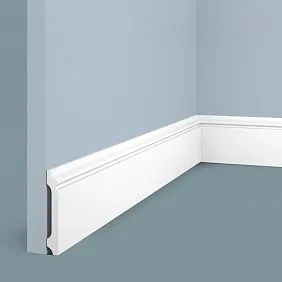
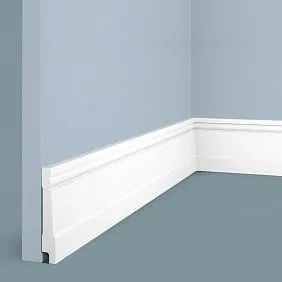
Three principles of ornamental unity
First principle: a common ornamental language. If the floorWooden baseboardhas a floral profile with leaves — the ceiling molding or cornice should have similar floral motifs, not geometric ones. If the baseboard is strict and geometric — the cornice should also be restrained.
Second principle: proportional correspondence. A tall, wide baseboard of 120–150 mm requires a substantial ceiling cornice. A thin baseboard of 60–80 mm pairs with a light ceiling molding. Disproportion — too heavy a cornice with a thin baseboard or vice versa — creates a feeling of 'lopsided' space.
Third principle: color coordination. Traditional classicism — white baseboard, white plasterwork, white ceiling molding on a white or very light ceiling. Modern neoclassicism allows for 'tone-on-tone': baseboard the same color as the wall, plasterwork the same color as the ceiling — without contrasting accents. In both cases, the baseboard and plasterwork exist in a unified color space.
Get Consultation
Why you can't just 'take any baseboard and any cornice'
This is the most common mistake during renovation: the baseboard is bought at a construction hypermarket 'by size', the cornice is chosen 'by price'. The result — a baseboard with a classical profile and a cornice with modernist geometry. Or a baseboard 60 mm high and a ceiling molding 120 mm high — and the room visually 'tilts' downward.
A classical interior does not forgive such inconsistencies. Its beauty lies in the system, in the precision of relationships. This is precisely why the STAVROS catalog is built on the principle of compatible series: wooden millwork,decorative elementsfor moldings and polyurethaneMoldingsare developed as a unified system with coordinated profiles and ornaments.
Wooden floor baseboard — profile, height, wood species for classicism
Baseboard height: the main parameter of proportion
The height of a floor baseboard is not a matter of taste. It is the mathematics of space. The correct baseboard height is determined by the ceiling height and the overall scale of the room.
For ceiling heights of 2.5–2.7 m (standard in Soviet and modern mass construction): baseboard height 60–80 mm. This is a 'modest' baseboard that does not dominate but clearly marks the transition. A taller baseboard with a low ceiling visually 'presses down' — occupying a proportionally too large part of the wall.
For ceiling heights of 2.8–3.2 m (improved layouts, country houses, pre-revolutionary buildings): baseboard 80–120 mm. This is a 'full-fledged' classical baseboard that creates a sense of solidity and completion. In Soviet Stalin-era houses with ceilings of 3–3.2 m, the historical standard for baseboards was exactly this — 100–120 mm.
For ceiling heights of 3.5 m and above (mansions, country villas, restoration of historical buildings): baseboard 140–200 mm. This is a monumental baseboard, reproducing the proportions of 19th-century aristocratic interiors. Its profile often consists of several steps or levels of relief.
Profile of a wooden baseboard: from simple to complex
The profile is the cross-section of the baseboard. It is the profile that determines which style the baseboard belongs to.
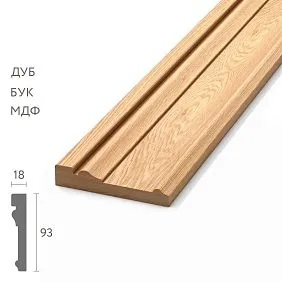
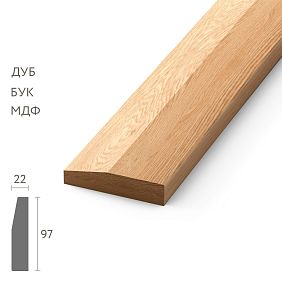
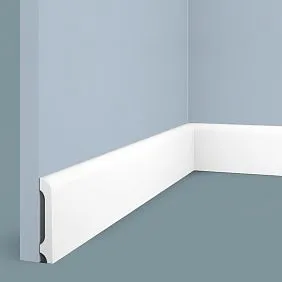
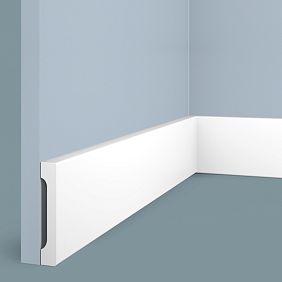
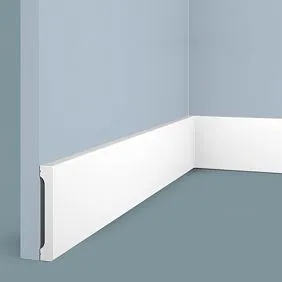
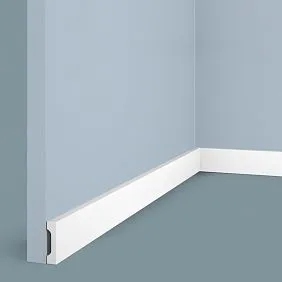
Straight profile with a bevel — the simplest. A rectangle with a slight slope or rounding at the top edge. This profile is for minimalism and Scandinavian style. It does not fit into a classical interior.
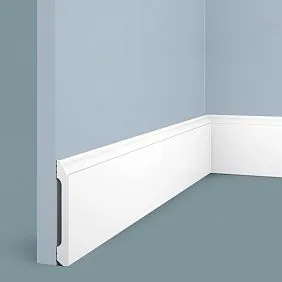
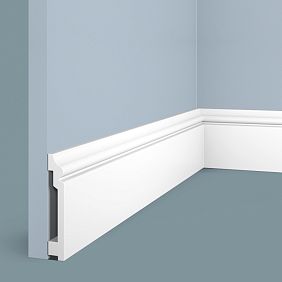
Profile with a 'shelf' (cavetto, ogee) — classical. A horizontal shelf at the top with a slight projection and bevel. This is the most common profile for moderate classicism. Pairs well with light ceiling moldings.
Profile with multiple bevels and a reverse curve — complex classical. Multiple levels of relief, a characteristic 'S-shaped' curve (cavetto or ogee combined with a straight shelf). This profile is for rich classicism — the kind that reproduces architectural order in detail.
Profile with an ornamental overlay — the most opulent option. A carved or milled overlay with floral or geometric ornamentation is added to the wooden base of the baseboard. Maximum decorativeness — for Baroque and Empire interiors.
Wood Species for Floor Skirting Boards: What to Choose
FloorFloor wooden skirtingexperiences specific loads: it stands right at floor level, where impacts from furniture, vacuum cleaners, and feet are possible. This determines the requirements for wood hardness.
Oak is the best choice for floor skirting boards in a classic interior. Hardness, pronounced grain pattern, good resistance to mechanical impacts, durability with a transparent finish or under paint. An oak skirting board finished with oil or varnish is a detail that will last 30–50 years without restoration.
Beech is a good alternative to oak for painting. Fine, uniform texture provides a perfectly smooth surface for white enamel. Slightly softer than oak, but within the acceptable range for the skirting board zone.
Pine is acceptable for skirting boards under opaque paint in areas with moderate load. Softer than oak and beech, more vulnerable to dents. Significantly cheaper — this is its main advantage in projects with a limited budget.
Larch is recommended for rooms with high humidity (kitchen, hallway, veranda). The resinous nature of larch provides natural protection against moisture and fungus. Comparable in hardness to beech.
Kiln Drying: Not an Option, but a Mandatory Requirement
A wooden skirting board made from raw or under-dried wood is money thrown away. During installation, it looks excellent. After 3–6 months, when the wood dries to equilibrium moisture content in a heated room, it will shrink, warp, or crack — and uneven gaps will appear between it and the wall/floor.
This is precisely why all STAVROS wooden products, including millwork, undergo kiln drying to a moisture content of 8–10%. This guarantees dimensional stability after installation — the skirting board does not 'move' or change geometry in the conditions of a heated room.
Wooden Ceiling Skirting Board and Cornice — Transition to Ceiling Decor
Ceiling Cornice: The Upper 'Frame' of the Space
If the floor skirting board is the 'foundation' of the interior, then the ceiling cornice is its 'crown'. It is what completes the vertical of the wall and creates a transition to the horizontal of the ceiling. In a classic interior, without a ceiling cornice or molding, the wall ends 'on nothing' — an abrupt, unfinished look.
wooden ceiling moldingis a wooden profile mounted at the junction of the wall and ceiling. It can be simple (a rectangular molded profile) or complex (multi-level with reverse curves and straight shelves). A wooden ceiling skirting board is appropriate in interiors where the emphasis is on the tactile naturalness of the material: eco-style, rustic, organic, Scandinavian classic.
For traditional classic and neoclassical styles with rich ornamentation, the wooden ceiling skirting board often gives way to a polyurethane cornice: it allows for the reproduction of complex multi-level profiles with ornaments that are difficult and expensive to make from solid wood.
Coordinating the Ceiling Cornice with the Floor Skirting Board
Proportion Rule for Combining Floor Skirting Board with Ceiling Cornice:
For rooms with a ceiling height of 2.5–2.7 m:
-
Floor skirting board: 60–80 mm
-
Ceiling cornice: 50–80 mm
-
Height ratio: the cornice is approximately equal to or slightly smaller than the skirting board
For rooms with a ceiling height of 2.8–3.2 m:
-
Floor skirting board: 80–120 mm
-
Ceiling cornice: 80–120 mm
-
Height ratio: approximately equal — the space looks balanced
For rooms with a ceiling height of 3.5 m and above:
-
Floor skirting board: 120–200 mm
-
Ceiling cornice: 120–180 mm
-
The cornice can be slightly lighter than the skirting board: the gaze moves from bottom to top, and the 'lightening' of the decor towards the ceiling creates a sense of height.
Transitional Moldings — The Connecting Thread Between Floor and Ceiling
For the skirting board and cornice to form a system, and not just two isolated elements, 'connecting' decorative horizontals are needed between them. These are wall moldings — horizontal profile strips that divide the wall into zones.
Classical three-part wall division scheme:
-
Lower zone (from floor to molding at 80–110 cm height) — "baseboard"
-
Middle zone (from molding to next molding at 220–250 cm height) — "wall body"
-
Upper zone (from molding to ceiling cornice) — "frieze"
Each zone can be finished differently: baseboard — with wooden panels or darker paint; body — with wallpaper or main wall color; frieze — with a lighter shade. Moldings in this scheme serve both as dividers and decorative accents.
Fordecorative elementsFor STAVROS — corner blocks and central overlays of the MLD series — this three-part scheme is the primary application area. Moldings with decorative corner blocks create each of these horizontal lines flawlessly.
Polyurethane molded decor — rosettes, cornices, moldings as an extension of the baseboard theme
Polyurethane as the "architectural language" of the ceiling
When the floor baseboard is chosen, the profile determined, and the style — classical or neoclassical — approved, the next step is to translate this same language to the ceiling. And here polyurethaneRelief Decorationfrom the STAVROS catalog becomes the perfect tool.
Why polyurethane for ceilings? There are several arguments.
Weight. A wooden cornice of significant size (120 mm and above) is heavy enough to require additional fastening beyond adhesive during installation. A polyurethane equivalent of the same size weighs 3–5 times less — it holds solely on adhesive without risk of slipping.
Pattern precision. Polyurethane allows reproduction of the finest details of molded patterns — leaves, scrolls, pearls, petals — with an accuracy that wood milling achieves only on expensive five-axis equipment. This is why rich ornamental cornices are always made from polyurethane or plaster, not wood.
Surface uniformity. A polyurethane cornice for white painting provides an absolutely smooth surface without texture — pure white "like chalk." A wooden cornice under white enamel may "show through" with wood grain patterns under oblique lighting. For strict classicism, this is undesirable.
Ceiling rosettes: the center around which everything is organized
A ceiling rosette is an independent architectural accent that organizes the ceiling around itself. With a rosette, the ceiling ceases to be just a white plane — it gains a center relative to which lighting fixtures are placed, space is zoned, and symmetry is built.
In the STAVROS catalog, ceiling rosettes are presented in a wide range: from small (diameter 25–35 cm) with concise ornamentation — for neoclassicism and modern interiors — to large multi-level (diameter 60–100 cm) with rich floral and geometric decor — for high-level classicism.
Principle of coordinating rosette with baseboard: the rosette's ornament should contain the same motifs as the baseboard profile. If the baseboard has leaf ornamentation — the rosette should include leaves, shoots, or flowers. If the baseboard is strictly geometric — a rosette with geometric ornamentation.
Ceiling cornices: horizontal molding under the cornice
A ceiling cornice is a horizontal strip of molded ornament running along the ceiling perimeter and creating a visual "border" between the wall and ceiling plane. Unlike a cornice, a cornice is flatter and less voluminous: its task is not to create a "shelf" but to mark a boundary.
In luxurious classical interiors, cornice and cornice are used together: the cornice is attached to the wall/ceiling at the junction, the cornice runs along the ceiling parallel to the cornice with a 30–50 cm offset. This creates a double horizontal line — a standard of palace interiors.
For more modest spaces, the cornice is used without a cornice — only as a decorative frame along the ceiling plane perimeter. This simple solution creates a sense of completeness and "architectural quality" of the ceiling.
STAVROS wall decorative panels and their connection to baseboard
Wall decorative overlays from thestucco decorationSTAVROS catalog — models NPU.VRS-006, NPU.VRS-002-3 and others — are used in the wall space between baseboard and cornice. They fill precisely that "wall body" mentioned above in the section on three-part division.
Principle of "ornamental vertical": baseboard (bottom) — wall molding frames or overlays (middle) — cornice (top) — rosette (on ceiling). Each of these four elements speaks the same ornamental language. Together they create an interior that could be described with one word: "complete."
Color and proportional coordination — baseboard height vs. molding scale
Color: three working strategies
Strategy "all white" — classicism in its pure form. White baseboard, white walls, white molding on white ceiling. Ornamental decor is read only through chiaroscuro — relief creates shadows that make the form visible. This is the most "architectural" approach: decor exists as sculpture, not as a color accent.
Execution requirement: with "all white," surface quality and installation precision are visible perfectly. Any gap in joints, any unevenness — immediately noticeable. Therefore, this strategy requires maximum careful installation and finishing.
The 'tone-on-tone' strategy is modern neoclassicism. The baseboard is the same color as the wall (gray to gray, beige to beige, cashmere to cashmere). The cornice and molding are the same color as the ceiling. The decor dissolves into the surface by color but is present as volume. This is a soft, non-aggressive way to apply stucco decor.
The 'contrast' strategy is an oak wood baseboard with a natural texture against white walls and white ceiling stucco. The lower zone is 'natural', warm. The upper zone is 'architectural', white. This is a technique highly in demand in modern projects combining naturalness and classicism.
Proportional table: baseboard and stucco for one ceiling
| Ceiling Height | Floor baseboard | Ceiling cornice | Rosette (diameter) | Wall molding |
|---|---|---|---|---|
| up to 2.7 m | 60–80 mm | 50–70 mm | 25–35 cm | Thin, 20–30 mm |
| 2.8–3.0 m | 80–100 mm | 80–100 mm | 35–50 cm | Medium, 30–50 mm |
| 3.1–3.4 m | 100–140 mm | 100–130 mm | 50–70 cm | Medium–wide, 40–60 mm |
| 3.5 m and above | 140–200 mm | 130–180 mm | 70–100 cm | Wide, from 60 mm |
Visual effects of correct and incorrect proportions
Correct proportions give a 'floating' effect—a feeling that the space is elongated and airy. This is achieved when the baseboard and cornice are comparable in height and form symmetrical 'frames' at the bottom and top.
A too-high baseboard with a light cornice 'pulls' the space downward—the room seems grounded. A too-heavy cornice with a thin baseboard 'presses down'—the ceiling feels overhanging. This is precisely why the proportional table is not an academic exercise but a practical tool.
Ready-made solutions: what to order as a set
Basic classic set for ceilings 2.7–3.0 m
This is the most in-demand scenario: a standard living room or bedroom in a modern house with ceilings 2.7–3.0 m, classic or neoclassical style, white painting of all decorative elements.
What is included in the set:
-
Wooden floor baseboard height 80–100 mm, profile with a 'goose' shape, wood species—oak or beech
-
Ceiling cornice made of polyurethane, 80–100 mm high, profile coordinated with the skirting board
-
Wall molding made of wood or polyurethane, 30–40 mm high, at a level of 90 cm from the floor (base line)
-
Corner blocks for wall molding — MLD-1U-1 or MLD-2U-1 at the corners
-
Ceiling rosette with a diameter of 35–50 cm for a chandelier
What to cover and with what: everything in white — matte or semi-matte acrylic enamel. Wooden elements — primer + 2 coats of enamel. Polyurethane — 2 coats of enamel without primer.
Extended classic set for ceilings 3.0–3.5 m
For more spacious rooms with a pronounced classical character, elements are added that create a richer ornamental program.
What is included in the set:
-
Floor wooden skirting board 100–120 mm, species — oak, profile — complex multi-level
-
Ceiling cornice made of polyurethane 120–140 mm with floral ornament
-
Wall moldings on two levels: base line at 90–100 cm + frieze line at 240–260 cm
-
Corner blocks MLD-2U-1 and MLD-2U-2L/2R for the corners of both levels
-
Central overlays MLD-2-1 or MLD-2-2 in the piers between windows
-
Ceiling rosette with a diameter of 50–70 cm
-
DecorativeSTAVROS overlaysNPU.VRS-006 or NPU.VRS-002-3 within the framework of wall decor
Luxury set for high ceilings (3.5 m and above)
For high-level projects — mansions, country villas, restorations — the decorative system is deployed to its full potential.
What is included in the set:
-
Floor skirting board made of solid oak 140–180 mm, profile — three-level with ornamental overlay, 'Prestige' level
-
Ceiling cornice made of polyurethane 160–200 mm with rich floral ornament
-
Ceiling molding — an additional decorative strip along the perimeter of the ceiling with an offset from the cornice
-
Pilasters made of wood or polyurethane on walls with capitals
-
Three-level wall articulation: skirting board → molding at 100 cm → molding at 260–280 cm → cornice
-
Corner blocks MLD-3U-2L/2R on all corners
-
Central overlays N-416 or N-383 at key points on the walls
-
Ceiling rosette with a diameter of 70–100 cm — in a system with molding and cornice
FAQ: Answers to popular questions
Is it necessary to make the ceiling cornice from the same material as the floor skirting board?
No. Moreover — a professional approach involves different materials: wooden skirting board at the bottom (tactility, warmth, strength) and polyurethane cornice at the top (lightness, precision of ornament, ease of installation). The main thing is the coordination of profile and ornamental language, not the same material.
How to calculate the amount of wooden skirting board for a room?
Measure the perimeter of the room. Subtract the width of all door openings. Add 10–15% for reserve (corner cuts and possible defects). Convert to linear meters — this is the required amount of skirting board.
Can a wooden floor skirting board be combined with polyurethane wall molding?
Yes, this is standard practice. Backside characteristics are not important—what matters are the front-facing ones: profile height, ornamental language, finish color. When painted in a uniform white color, the difference in material visually disappears completely.
How to attach a wooden baseboard to the wall?
Three methods: finish nails every 40–50 cm (traditional, reliable); liquid nails + finish nails for temporary fixation (for uneven walls); special plastic clips that the baseboard snaps into (demountable installation). For classic style with high solid oak baseboard, the first method is optimal: nails provide reliable fastening without risk of peeling.
In what order should baseboard and molding be installed?
First—ceiling cornice (installation is easier before final wall painting). Then—final painting of walls and ceiling. Then—flooring installation. Last—floor baseboard (it covers the expansion gap between the flooring and the wall).
How to join wooden baseboard in corners?
Internal corners: 45° miter cut on a miter saw, on-site fitting with light sanding. Alternative—'butt joint': one baseboard enters the corner with a butt end, the second overlaps with a profiled end—no miter cuts, but requires precise profile trimming. External corners: 45° miter cut on both sides, joined with glue.
What is the minimum budget for decorating a classic room with baseboard and molding?
Minimum 'classic' budget: 80 mm beech wooden baseboard (Standard grade) + medium-height polyurethane cornice + medium-sized ceiling rosette. For a 20 m² room—approximate material consumption: baseboard 20 lm, cornice 20 lm, rosette 1 pc. Detailed calculation—when contacting STAVROS specialists.
About the company STAVROS
Renovation is a moment of choice. A choice not only of finishing materials, but also of what your home will be like in five, ten, twenty years. Solid oak wooden baseboard, beautifully coordinated with ceiling molding—is a choice in favor of quality that does not lose value over time.
STAVROS is a manufacturersolid wood productsandpolyurethane molding decorationfor classic and modern interiors. The range includes wooden millwork (baseboards, casings, moldings),molding decorative elements, furniture legs and supports,House Carving, polyurethane cornices, moldings, rosettes, overlays—more than 4,000 items in 39 product groups.
Two quality grades—Standard and Prestige—allow selecting a product for a specific task and budget. The stock program ensures shipment from 1 piece on the order day. Delivery—throughout Russia and CIS countries.
STAVROS is a manufacturer that understands: the beauty of an interior is born in the details. And every detail must be in its place.


