Article Contents:
- Why it's important to coordinate wooden baseboard with furniture finish
- Furniture and architecture — two different worlds that should speak the same language
- Three contact points between baseboard and furniture
- Why 'just a beautiful baseboard' is not a sufficient condition
- Baseboard height and profile — how they depend on furniture leg height and facades
- Furniture plinth height and baseboard height: a critical parameter
- Baseboard profile and facade molding profile: the matching principle
- Furniture moldings — the same profiles as in baseboards: the repetition principle
- What are STAVROS furniture overlays and moldings
- MLD-series decorative elements: from baseboard to facade
- Connection between furniture decor and wall decor
- Tall wooden baseboard + kitchen set with moldings — kitchen in classic style
- Kitchen as the most complex space for unified decor
- Classic kitchen: how the system is built
- Tall wooden baseboard in the kitchen: when it works
- Color and wood species: oak, pine, beech — what to choose for baseboard and furniture overlays
- Oak — for natural finish and 'furniture' tone
- Beech — the best choice for white painting
- Pine — for projects with limited budget
- Larch — for kitchen and hallway
- Complete order: baseboard + overlays + moldings from one collection
- The logic of 'assembling' the set
- Ready-made complete scenarios
- How to calculate order volume
- FAQ: Answers to Popular Questions
- About the Company STAVROS

Here's a scene that anyone who has ever done a renovation from scratch will recognize. Everything is bought, everything is arranged. Tile or parquet is laid. The furniture has arrived, assembled, taking its place. And you stand in the middle of the room — and something is wrong. Not with the furniture. Not with the floor. But with how one transitions into the other. Between the kitchen set and the wall — a gap. Between the cabinet and the floor — an awkward gap. The wooden baseboard stands separately, the furniture — separately, and they clearly don't know each other.
This is not an aesthetic whim — it's an architectural task. The floor and furniture must be 'connected': through unity of wood species, through repetition of ornamental profile, through color coordination. This is exactly howMoldings for furniturework in conjunction withwooden floor baseboard— as a visual 'bridge' between the horizontal plane of the floor and the vertical facades.
This article provides a complete practical breakdown: how to choose the height and profile of a baseboard considering furniture, what furniture overlays and moldings are, how they relate to the baseboard profile, and how to order everything as a kit from one catalog — so the result is not a collection of parts, but a system.





Why it's important to coordinate wooden baseboards with furniture finishes




Furniture and architecture are two different worlds that must speak the same language
Historically, furniture and interior architecture were created in the same workshop. The cabinetmaker who made chairs and chests of drawers carved profiles from the same wood species and with the same ornaments as the baseboards, cornices, and panels. The result was absolute unity. Today, furniture is bought in one place, baseboards in another, overlays in a third. And it is precisely this separation that destroys the unity of the interior.
Whenbuy wooden skirting boardand furniture overlays from one catalog — from one production system — unity is restored automatically. No need to guess 'will it look similar' or 'will it fit'. One wood species, one milling technology, one ornamental vocabulary — and the issue is resolved.
Our factory also produces:
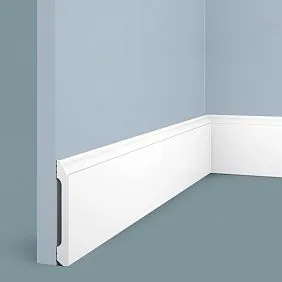
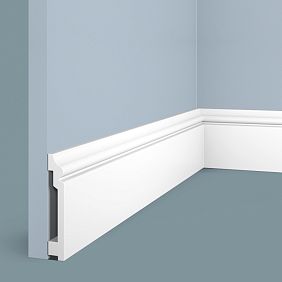
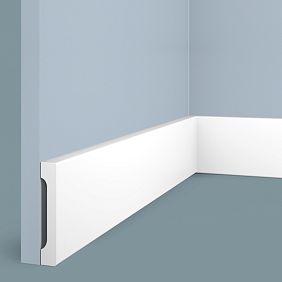
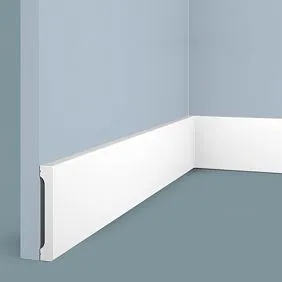
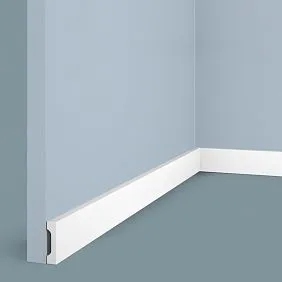
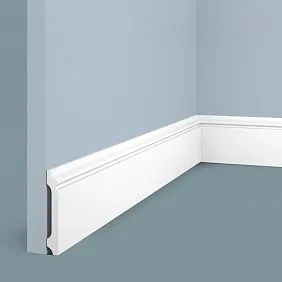
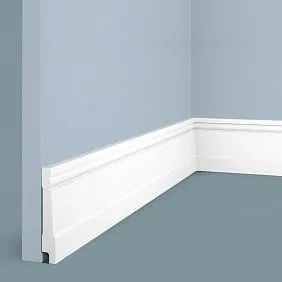
Three points of contact between baseboard and furniture
In every room, furniture comes into contact with the baseboard in three scenarios:
Scenario one: furniture stands flush against the wall. A wardrobe, sideboard, kitchen base unit — they abut the wall, and the baseboard goes around them or goes behind them. If the baseboard is tall — 100 mm or more — and the furniture has a low plinth (50–60 mm), a conflict arises: the baseboard 'doesn't fit' behind the furniture without trimming. This needs to be considered in advance.
Scenario two: furniture stands next to the baseboard, but not flush against the wall. A sofa, bed, armchair. The baseboard is visible next to the furniture legs. If the baseboard and legs are made from the same species and in the same tone — that's unity. If the furniture is dark and the baseboard is white — a question arises: is this a deliberate contrast or an accidental mismatch?
Scenario three: furniture with decorative facades. A kitchen unit with molding frames on the facades, a wardrobe with profiled overlays, a chest of drawers with decorative handles and milled panels. If the profile of the facade molding 'rhymes' with the profile of the baseboard — a system emerges. If not — furniture and architecture exist in parallel worlds.
Get Consultation
Why 'just a beautiful baseboard' is not a sufficient condition
It's very common: a person chooses a wooden baseboard based only on its own appearance. 'Beautiful profile', 'good wood', 'I like it'. But in a room with furniture, it turns out to be 'alien': a different level of ornamentation, a different scale of profile, a different wood tone.
The correct approach is the opposite: first, the style of the furniture and its ornamental level are determined, then the baseboard is chosen to match it. Furniture is the main thing. The baseboard is the frame.
Height and profile of the baseboard — how they depend on the height of furniture legs and facades
Height of furniture plinth and height of baseboard: a critical parameter
A kitchen base unit has a plinth — the lower 'leg' under the cabinets — usually 100–150 mm high. A sliding wardrobe has a plinth of 60–100 mm. A classic chest of drawers on legs has legs 80–150 mm high.
The baseboard should not be taller than the furniture plinth. Why? Because if the baseboard is 120 mm and the kitchen unit plinth is 100 mm — the baseboard physically cannot go behind the unit without trimming. And if it does go — it protrudes 20 mm beyond the unit and creates a 'step'.
Practical rules:
-
Kitchen unit with a 100 mm plinth: baseboard no more than 80–90 mm (with allowance for trimming)
-
Sliding wardrobe with a 60 mm plinth: baseboard no more than 50–60 mm or trimming is applied in the wardrobe area
-
Furniture on high legs 150 mm: baseboard up to 120 mm without conflicts
-
Built-in furniture without legs (installed directly on the floor): baseboard is mounted up to the built-in wardrobe, not going behind it
A tall wooden baseboard — 120 mm or more — is a choice for spaces where furniture either has high legs, is built-in, or is completely absent from the walls (as in a living room with central furniture arrangement).
Baseboard profile and facade molding profile: the principle of matching
A facade molding — a horizontal profiled strip on a kitchen or wardrobe door — has its own profile. This profile defines the 'style' of the furniture facade: a classic ogee, a straight cavetto shelf, a complex multi-level profile with floral ornamentation.
When the profile of the floor baseboard and the profile of the facade molding belong to the same ornamental family — 'visual rhyming' occurs. The baseboard at the floor repeats the motif of the molding on the facade — and the furniture seems to 'grow' from the floor, they are united.
Example: a kitchen facade with a 'cavetto with shelf' profile molding + a wooden baseboard K-006 or K-043 with a similar profile — that's a system. The same kitchen facade + baseboard K-104 with monumental multi-level ornamentation — that's a conflict of scales.
Moldings for furniture — the same profiles as in the baseboard: the principle of repetition
What are STAVROS furniture overlays and moldings
In the STAVROS catalog, the sectionwooden appliqués— are decorative wooden elements designed for installation on furniture fronts: cabinet doors, drawer fronts, side panels, decorative panels.
Functionally, these are wooden relief profiles that:
-
Are attached to a smooth MDF or wooden front using adhesive (PVA D3 or liquid nails)
-
Create a relief 'framing' effect — transforming a smooth front into a front with a molding frame
-
Can be painted the same color as the baseboard — thus creating a unified decorative vertical line from the floor to the front
Varieties of furniture overlays in the STAVROS catalog:
Straight-line profiles — used to create horizontal and vertical 'ribs' on the front, imitating a frame structure. Mounted around the perimeter of the door with mitered joints at 45°.
Corner overlays — ready-made corner blocks for molding frame corners. Eliminate the need for precise 45° miter cuts in corners — significantly simplify installation and improve the appearance of the joint.
Central decorative overlays — relief ornamental elements attached to the center of a panel or the middle of a molding frame. Create a 'focal point' on the front.
Cornice overlays for upper sections — profile strips imitating a mini-cornice above the upper fronts of a kitchen or cabinet. A direct visual 'echo' of the room's ceiling cornice.
Decorative elements of the MLD series: from baseboard to front
In the STAVROS catalog, the seriesof decorative elements for MLD moldings— are wooden corner blocks and central overlays designed for use in both wall molding systems and furniture decor.
Corner blocks MLD-1U-1, MLD-2U-1, MLD-3U-1 — are solutions for molding frame corners. They are attached to the corner, after which straight-line profiles are glued to their side faces — forming a complete 'frame' on the front without manual mitering.
Central overlays MLD-1-1, MLD-2-1, MLD-3-1 — are ornamental accents for the center of the frame. A rosette, floral overlay, geometric element — they take their place in the middle of the molding frame and turn a simple 'frame' into a decorative panel.
Connection of furniture decor with wall decor
Here lies the most sophisticated level of a unified interior: when molding frames on furniture fronts repeat the molding frames on the walls. Wall molding panels — rectangular 'frames' dividing the wall into zones — and similar frames on cabinet doors. The same MLD corner blocks, the same profiles, the same wood species.
This is what in professional interior projects is called 'integrated built-in furniture': a cabinet is so 'built into' the room's architecture that it seems not like furniture, but part of the wall. Frames on doors = frames on walls. Baseboard = lower framing of this entire system. Cornice above the cabinet = upper framing. A unified whole.
Tall wooden baseboard + kitchen set with moldings — kitchen in a classic style
Kitchen as the most complex space for unified decor
The kitchen is a room where architectural finishing and functional furniture collide head-on. The set occupies all the perimeter wall space. The baseboard either hides behind it or is visible only in open sections — between the set and the refrigerator, between the set and the door. It is precisely these 'open' sections that determine whether there is unity in the kitchen.
In these sections,Wooden baseboardmust 'rhyme' with the decor of the kitchen set fronts. If the fronts have moldings — the baseboard also has a pronounced profile. If the fronts are smooth — the baseboard is also laconic. A mismatch in an 'open' section — is in plain sight for everyone and impossible to ignore.
Classic kitchen: how the system is built
A classic kitchen with molding fronts requires a comprehensive approach:
Lower tier (floor — set plinth):
-
Wooden baseboard 80–100 mm high — on open wall sections
-
In the set area, the plinth is a 'continuation' of the baseboard concept: same color, same height
-
Optimal choice: K-070, K-071, K-006 — moderately ornamented profiles that do not 'compete' with a rich facade but create a visual connection
Middle tier (lower cabinet facades):
-
Molding frames on facades with MLD corner blocks — or overlay profiles without corner blocks
-
Molding frame width: 20–30 mm — delicate
-
Central overlays on doors: MLD-1-1 or MLD-2-1 — in the center of each frame
Upper tier (cornice above upper cabinets):
-
Cornice strip above the upper sections of the kitchen unit — a direct 'echo' of the room's ceiling cornice
-
The profile of the cornice strip is coordinated with the skirting board profile: same wood species, same tone
-
From the STAVROS catalog: wooden molding K-034, K-125, or K-006 as a cornice strip above the kitchen unit
Tall wooden skirting board in the kitchen: when it works
A tall wooden skirting board 100–120 mm in the kitchen is a bold and correct solution under several conditions:
-
The kitchen is spacious — from 10–12 m². In a small kitchen, a tall skirting board 'overwhelms'.
-
Ceiling from 2.8 m. The proportion of skirting board height to ceiling height must be maintained.
-
The plinth of the kitchen unit is higher than the skirting board — so the skirting board fits freely under the unit without conflict.
-
Facades with pronounced molding decor — a tall skirting board is organic with rich facade design.
When these conditions are met, a tall wooden skirting board in the kitchen creates a sense of 'substantiality' and noble solidity — something no 60 mm plastic skirting board can provide.
Color and wood species: oak, pine, beech — what to choose for skirting boards and furniture overlays
Oak — for natural finishing and 'furniture' tone
Oak is the undisputed leader for wooden floor skirting boards paired with furniture made of the same material. If the kitchen unit or cabinets are made of oak or oak-like — oak skirting boards automatically resolve the issue of wood species unity.
Characteristics of oak important for skirting boards:
-
Brinell hardness: 3.7–4.0 kN/mm² — high resistance to mechanical impacts
-
Pronounced grain with medullary rays — 'living' natural texture
-
Excellent acceptance of oil, varnish, tinting compounds
-
Stable with proper kiln drying to 8–10% moisture content
For transparent finishing (oil under oak): oak skirting board K-070 + oak furniture overlays + 'natural' or 'light oak' oil coating — an absolutely unified system.
For solid white painting: oak under white enamel provides an even surface but requires more thorough preparation (primer + sanding) than beech — due to the coarse grain pattern.
Beech — the best choice for white painting
Beech is a fine-textured wood species with a homogeneous structure. Under white matte enamel, beech provides a perfectly smooth surface without a translucent grain pattern. This is why most STAVROS products for painting are made of beech or MDF.
Beech is slightly softer than oak, but for floor skirting boards in areas with moderate load — it is quite sufficient. In kitchens with high traffic — oak or larch is recommended in intensive passage zones.
Ideal combination for a white kitchen: beech skirting board K-006 (from 440 rub./lm) + beech furniture overlays + white acrylic matte enamel on all elements = a unified white system with a classic profile.
Pine — for projects with a limited budget
Pine is the most affordable coniferous wood. For floor skirting in living areas with moderate load — acceptable. The main requirement: a glued panel without knots — it is significantly more stable than solid pine timber.
When painted white — excellent results with proper preparation. Under oil or varnish — an expressive pattern with growth rings, which is favored in rustic style and Scandinavian classic.
Important: pine paired with pine furniture overlays — fine. Pine skirting next to unpainted oak furniture — a texture conflict.
Larch — for kitchen and hallway
Larch is a resinous wood with natural moisture resistance. For skirting in the kitchen and hallway — the best choice among domestic conifers. Resins form a natural barrier against moisture, bacteria, and fungus.
The texture of larch — expressive, with clear rings and small knots — creates a characteristic 'Scandinavian' pattern. Under light-toned tinting oil — very decorative.
For furniture overlays in the kitchen area — also recommended. With unified 'bleached larch' oil treatment — both skirting and overlays form a Scandinavian-laconic system.
Complete order: skirting + overlays + moldings from one collection
The logic of 'assembling' a set
For skirting and furnituredecor for furnitureto form a system, three conditions are needed:
-
One wood species — skirting, overlays, moldings from one source
-
One ornamental level — laconic with laconic, classic with classic
-
One finish — painting all decor from one can of paint or treatment with one oil
The STAVROS catalog allows fulfilling all three conditions in one order:wooden K-series millwork, Decorative InsertsandMLD elements— all are made from solid beech and oak using 3D milling, all are supplied without coating, all — from a unified production system.
Ready complete scenarios
Scenario 1: White classic kitchen, ceiling 2.7 m
-
Skirting: K-006 (from 440 rub./lm) × kitchen perimeter = business classic profile
-
Overlays on lower tier facades: straight profiles + corner blocks MLD-1U-1
-
Cornice strip above upper cabinets: K-034 (from 230 rub./lm) or K-125 (from 270 rub./lm)
-
Finish: white matte acrylic enamel, unified for all elements
-
Result: a white kitchen with a classic profile, where skirting, facades, and cornice are a unified whole
Scenario 2: Classic living room with display cabinets, ceiling 3.0 m
-
Skirting: K-070 (from 950 rub./lm) — moderately rich profile
-
Overlays on cabinet facades: MLD-1U-1 corner blocks + central overlays MLD-2-1
-
Wall molding frames next to cabinets: the same MLD elements, only on the wall
-
Cornice above cabinets and above the wall: K-009 (from 1,420 rub./lm) or K-018 (from 1,630 rub./lm)
-
Finish: natural oil 'light oak' for all elements
-
Result: a living room where cabinets are 'built-in' to the wall architecture through unity of profile and color
Scenario 3: Bedroom with classic sliding wardrobes, ceiling height 2.8 m
-
Baseboard: K-001 or K-043 (from 570–590 rub./lm) — moderate profile, sufficient for the ceiling height
-
Cabinet side overlays: straight vertical profiles creating 'pilasters'
-
Cornice above the cabinet: K-125 or K-006 (270–440 rub./lm)
-
Finish: 'tone-on-tone' with the wall — gray-beige semi-matte enamel
-
Result: the cabinet dissolves into the wall, becoming part of the architecture
How to calculate order volume
Baseboard: room perimeter (in meters) minus total width of door openings + 10% for reserve and corner trimming.
Example: room 4×5 m, one door 0.9 m: (4+5+4+5) − 0.9 = 17.1 lm × 1.1 = ~19 lm of baseboard.
Overlays for fronts: perimeter of each door × number of doors + 10% for reserve of corner joints. MLD corner blocks — 4 pieces for each rectangular frame.
MLD central overlays: 1 piece for each door or panel.
Cornice strips above the cabinet/wardrobe: length of the cabinet/wardrobe + 5% for reserve.
FAQ: Answers to popular questions
Is it necessary to buy baseboard and furniture overlays from the same manufacturer?
For solid painting in white or another tone — acceptable from different sources if the profiles are ornamentally compatible. For transparent finishing (oil, varnish) — mandatory same manufacturer and same wood species: otherwise color and texture will differ.
Is it possible to install wooden overlays on already finished painted MDF furniture?
Yes. Wooden overlays are glued to any smooth surface: MDF, chipboard, solid wood — using PVA D3 glue or water-based liquid nails. After gluing — filling joints with acrylic sealant, sanding, painting.
How to cut corners of molding frames on fronts precisely?
Use MLD corner blocks — they completely eliminate manual mitering. If corner blocks are not available — miter saw with 45° adjustment. A deviation of even 0.5° creates a visible gap in the corner for planks longer than 30 cm.
What glue to use for wooden overlays on furniture fronts?
PVA D3 (moisture-resistant wood glue) — optimal with good clamping and dry environment. Water-based liquid nails — when good clamping is not possible (vertical surfaces). Important: solvent-based adhesives may damage the front's paint finish.
Tall wooden baseboard — how to properly mount it flush against kitchen cabinets?
In the area adjacent to the cabinet, the baseboard is trimmed in height 'to the level of the cabinet plinth' — if the plinth is lower than the baseboard. Or the baseboard fits flush against the cabinet without trimming — if the plinth is higher than the baseboard. The gap between the baseboard end and the cabinet side is filled with color-matched acrylic sealant.
Can STAVROS wooden overlays be used not only on furniture but also on door architraves?
Yes. Door architraves are one of the typical application areas for furniture decorative profiles. Overlays are installed around the door leaf, creating frame decoration in a unified style with baseboard and furniture.
Which baseboard to choose for a kitchen with white glossy fronts without moldings?
For smooth minimalist fronts without ornament — laconic baseboard: K-034 (from 230 rub./lm) or K-125 (from 270 rub./lm). Complex profiled baseboard next to smooth glossy fronts creates a style conflict.
About the company STAVROS
An interior where baseboard and furniture decor exist in one system — this is not a privilege of expensive projects. It's a matter of correct choice of material source. When everything — baseboard, overlays, moldings, cornice, frames — is produced to uniform standards, from the same wood species, on the same production equipment, ornamental unity is achieved automatically.
STAVROS produces a complete line of wooden products for creating a unified decorative ensemble:
-
wooden K-series millwork— over 30 profiles of baseboards and ceiling moldings from 230 to 6,060 rub./lm
-
decorative inlays for furniture— facade overlays, rails, profile strips
-
Decorative elements MLD— corner blocks and center overlays for molding frames
-
Picture and mirror frames RM series— over 30 models from 14,610 to 133,740 rubles
-
Polyurethane cornices KPU— for ceiling design in a unified system
All wooden products are made from solid beech and oak, chamber-dried to 8–10%, 3D milling, manual finish sanding. Supplied unfinished — for uniform finishing painting of the entire set.
Stock program — shipping from 1 piece on the order day. Delivery across Russia and CIS countries.
STAVROS is whenbuy wooden skirting boardmeans buying a system, not just a single part.