Article Contents:
- Metaphysics of quality baseboard: philosophy of perfection in details
- Psychology of space perception through the prism of details
- Genealogy of materials: from seed to masterpiece
- Oak — monarch of the wooden kingdom
- Ash — northern elegance
- Beech — classic of European quality
- Technological alchemy: from raw material to masterpiece
- Art of proper drying
- Precision processing: when every micron matters
- Architectural geometry: dimensions as the basis of harmony
- Mathematics of beauty in baseboard proportions
- Profile as expression of style
- Color symphony: shades as design tools
- Natural wood palette
- Art of toning
- Functional evolution of modern baseboard
- Cable channels: technologies hidden in beauty
- Integrated lighting: light as part of architecture
- Installation Technologies: The Art of Flawless Mounting
- Fastening systems: reliability for decades
- Fastening Systems: Reliability and Aesthetics
- Corner joints: mastery in details
- Protective coatings: beauty tested by time
- Oil-based coatings: breath of nature
- Varnish coatings: strength and durability
- Wax coatings: elegance of touch
- Economic rationale of quality selection
- Analysis of total cost of ownership
- Impact on property value
- Ecological aspects and impact on health
- Naturalness as Foundation of Healthy Home
- Antibacterial properties of wood
- Design trends and stylistic solutions
- Integration with architectural elements
- Contrast and tonal solutions
- Regional characteristics and climatic requirements
- Adaptation to the Russian Climate
- Seasonal Interior Adaptation
- Innovative technologies and the future of baseboards
- Integration with "smart home" systems
- New Materials and Processing Technologies
- Professional secrets of selection and use
- Criteria for assessing quality
- Rules of storage and transportation
- Maintenance and Care: Extending Service Life
- Regular Maintenance
- Updating Finishes
- Repair of damage
- Frequently asked questions and expert answers
- Conclusion

When an architect enters a newly completed space, their gaze involuntarily sweeps across the junctions of different surfaces. It is precisely here, in these seemingly insignificant transitions between floor and walls, that true design mastery is revealed.with a classic profile creates a sense of solidity, reliability.becomes the element that transforms an ordinary space into a work of architectural art.
Why do some interiors remain memorable for a long time, while others appear bland and temporary? The secret lies in understanding that beauty emerges in details, while functionality must be unobtrusive yet flawless. Modernwith a classic profile creates a sense of solidity, reliability.is not merely a decorative strip, but a complex engineering system that unifies aesthetics, functionality, and durability into a single solution.


The metaphysics of premium skirting boards: the philosophy of perfection in details
What causes us to pause in admiration before an interior where every detail is in its place? The answer lies in the harmony of proportions, quality of materials, and attention to the finest nuances.Wooden baseboardsIn this context, they serve as the connecting link between architecture and design, between functionality and beauty.
Imagine a string quartet — each instrument is important, but the cello creates the depth and foundation of the sound. Similarly, a high-quality wooden skirting board in an interior: it does not draw attention to itself, but without it, the entire composition loses its completeness and nobility.




Psychology of spatial perception through the prism of details
The human eye is structured such that it automatically seeks boundaries and transitions between different surfaces. Poorly executed junctions between floor and wall create a subconscious sense of disharmony, even if we cannot precisely identify the cause of discomfort.
with a classic profile creates a sense of solidity, reliability.Premium-quality skirting boards resolve this psychological challenge on a deep level. Smooth transitions of profile, ideal geometry, noble texture of natural wood create a sense of stability and reliability throughout the entire space.
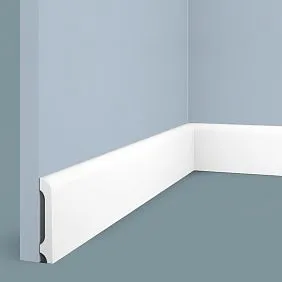
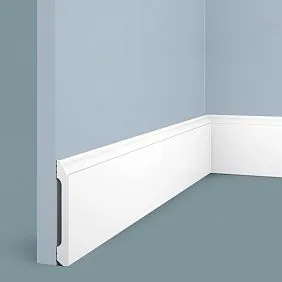
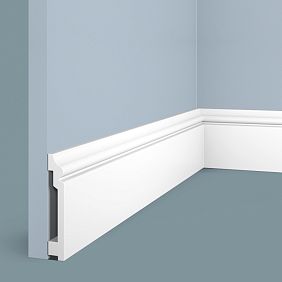
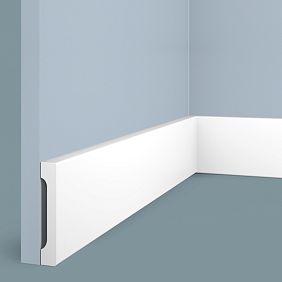
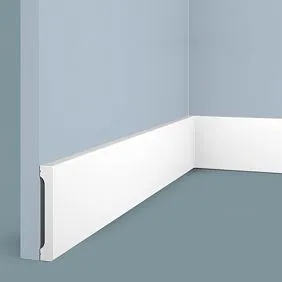
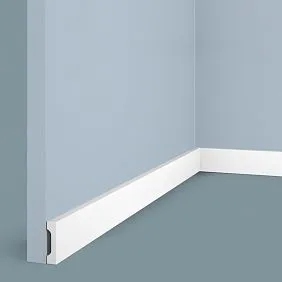
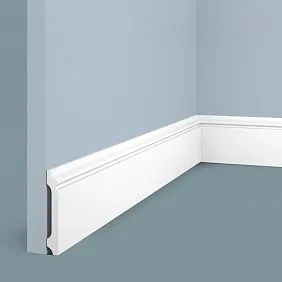
Our factory also produces:

Genealogy of materials: from seed to masterpiece
Get Consultation
Oak — monarch of the wooden kingdom
There is no material in nature more suitable for creating an elite skirting board than oak. Its density of 650-750 kg/m³ ensures exceptional strength and durability. But the main value of oak lies not in its physical properties, but in its ability to become even more beautiful over time.
Tannins contained in oak wood not only impart its characteristic aroma and antiseptic properties, but also ensure a unique play of tones. Young oak shines with golden hues, mature oak acquires rich brown tones, while stained oak displays a noble dark palette with greenish reflections.
The characteristic radial structure with medullary rays creates an unparalleled texture, which becomes the basis for creating truly unique interior solutions.Wooden Skirting BoardsMade from select oak — it is an investment not only in beauty, but also in heritage for future generations.
Ash — northern elegance
Ash represents an ideal balance between the strength of oak and the decorative qualities of exotic species. Its light wood with clearly defined texture creates a sense of freshness and dynamism. Ash’s high elasticity allows creating complex profiles without the risk of cracking.
The special value of ash lies in its ability to beautifully accept staining. From natural cream-white to deep dark shades — the range of possibilities is practically limitless, making ash skirting boards a universal tool for designers.
Beech — classic European quality
European craftsmen have used beech for centuries to create furniture and finishing materials of the highest quality. Its uniform structure, warm honey tones, and excellent workability make beech an ideal material for skirting boards in both classic and modern interiors.
The characteristic feature of beech wood is its ability to maintain profile clarity even in the most complex configurations. This allows creating skirting boards with refined multi-step profiles that become true masterpieces of joinery art.
Technological alchemy: from raw material to masterpiece
The art of proper drying
Production of trim elementsIt begins long before the wood reaches the production line. The process of kiln drying is not merely removing moisture — it is the art of transforming living material into a stable foundation for a future masterpiece.
Modern drying kilns allow control not only of temperature and humidity, but also of air exchange rate, temperature gradient, even the composition of the atmosphere inside the kiln. Slow, multi-stage drying with intermediate conditioning ensures that the finishedwith a classic profile creates a sense of solidity, reliability.will retain its geometry regardless of climatic changes.
Precision processing: when every micron matters
Modern CNC routers allow achieving precision in processing unattainable by manual labor. But technology is merely a tool. True mastery is revealed in understanding how different wood species behave during processing, and how to select optimal cutting parameters for each profile.
Cutting heads are made from special steels, each blade is sharpened to within fractions of a millimeter. The material feed system ensures uniform movement of the workpiece, eliminating vibrations and unevenness in processing.
Final polishing is performed in several stages with gradually decreasing abrasive grain size. Each subsequent operation removes micro-traces from the previous one, creating a mirror-like surface.
Architectural Geometry: Dimensions as the Basis of Harmony
Mathematics of Beauty in Baseboard Proportions
Choosing baseboard dimensions is not an arbitrary decision, but an exact calculation based on the laws of architectural harmony. The height of the baseboard should correspond to the room's height according to the golden ratio or other classical proportional systems.
For standard residential rooms with ceilings 2.7–3.0 meters high, an optimal baseboard height is 80–120 mm. This ensures visual stability of the composition and creates a sense of correct proportions.Wide Wooden Skirting BoardA height of 150–200 mm is suitable for rooms with high ceilings and creates a sense of grandeur.
Profile as Expression of Style
Each historical style has its characteristic baseboard profiles. Baroque tends toward complex multi-step profiles with abundant decorative elements. Classicism prefers strict yet elegant forms with clear geometric transitions. Modernism creates smooth, flowing lines reminiscent of natural forms.
Modern minimalism demands extreme simplicity — often a rectangular profile or a profile with minimal rounding. Yet even in such simplicity lies complexity: every line must be perfectly straight, every angle precisely aligned.
Color Symphony: Tones as Design Tools
Natural Wood Palette
Each wood species possesses its unique color palette, which may vary depending on growing conditions, time of year of harvesting, drying method, and finishing treatment.Wooden moldingsAnd baseboards in natural finish showcase the full beauty of the natural palette.
Oak may vary from light straw to dark brown with a greenish tint. Ash displays a spectrum from cream-white to light brown with pinkish undertones. Beech delights with warm honey and pinkish-brown tones.
Art of Staining
Modern staining technologies allow expanding the natural wood palette without hiding its natural texture. Oil stains penetrate deeply into the wood structure, creating an even color and highlighting the beauty of growth rings and medullary rays.
Water-based stains provide lighter, more transparent tones, allowing the wood to "breathe" and preserving its tactile properties. Alcohol-based stains ensure rapid drying and intense, saturated colors.
Functional Evolution of the Modern Baseboard
Cable Channels: Technology Hidden in Beauty
Modern life is unthinkable without numerous electronic devices, each requiring connection to a network. Traditional wall wiring disrupts interior aesthetics and creates problems when rearranging furniture.
Baseboards with integrated cable channels elegantly solve this problem. The internal cavity of the baseboard securely hides wires, while a removable cover provides access for maintenance and communication upgrades. It is important that the cable channel size be sufficient not only for current needs but also for potential future system expansion.
Integrated Lighting: Light as Part of Architecture
LED technologies have opened new possibilities for integrating lighting into architectural elements.with a classic profile creates a sense of solidity, reliability.With built-in backlighting, it creates a "floating" floor effect, softly outlines room boundaries, and can serve as night lighting.
A quality lighting system includes not only LED strips but also diffusers ensuring even light distribution, drivers with dimming capability, and control systems with remote controls or integration into "smart home" systems.
Installation Technologies: The Art of Flawless Installation
Preparatory work: the foundation of quality
The quality of baseboard installation depends 80% on proper surface preparation. Walls must be not only flat but also dry, clean of dust, paint splatters, and construction material residues.
Special attention is required to check wall verticality. Deviations from verticality exceeding 3–5 mm per baseboard length will result in gaps that cannot be eliminated without dismantling and redoing the work.
The floor must be fully prepared — final finish installed, grout applied (for tiles), thresholds set. The technological gap between the floor and wall should be 10–15 mm to compensate for thermal deformations.
Fastening systems: reliability and aesthetics
The choice of mounting method depends on wall material, baseboard weight, and usage conditions. For brick and concrete walls, optimal fasteners are self-tapping screws, ensuring maximum mounting reliability.
Modern concealed mounting systems use special clips that attach to the wall, and the baseboard snaps onto them. This ensures a perfect external appearance without visible fasteners and allows for removal if necessary.
Adhesive mounting is suitable for perfectly flat walls and small baseboards. Special polyurethane adhesives are used, providing an elastic connection that compensates for minor temperature deformations.
Corner joints: mastery in details
The quality of corner joints is the litmus test of the installer's professionalism. Internal corners require precise 45° beveling according to the baseboard profile. Even the slightest angular or room geometry errors result in gaps.
For complex profiles, it is recommended to use pre-made corner elements — internal and external corners, made from the same wood species and with the same finish. This ensures perfect joint geometry and color harmony.
Protective coatings: beauty proven by time
Oil-based coatings: the breath of nature
Oil-based coatings are chosen by those who appreciate the natural beauty of wood and are willing to invest effort into proper care. Oil penetrates into the wood pores, protecting it from within, but does not form a surface film.
Advantages of oil-based coatings: highlight the natural wood texture, preserve tactile sensations, easily locally renewed, allow wood to 'breathe', creating a healthy microclimate.
Disadvantages: require regular renewal (every 2-3 years), less resistant to moisture and dirt, may change color under UV exposure.
Lacquer coatings: strength and durability
Modern polyurethane lacquers create a strong protective film on the wood surface. They provide high wear resistance, moisture resistance, and resistance to chemical exposure.
Two-component polyurethane lacquers form the strongest coating, capable of withstanding intensive mechanical loads. One-component lacquers are easier to apply but less durable.
Water-based lacquers are environmentally safe, odorless when drying, and allow for both matte and glossy finishes. They are ideal for living rooms and children's rooms.
Wax coatings: elegance of touch
Wax is the oldest protective coating for wood, still one of the most refined. Wax coating gives wood a soft silk-like sheen, highlights its texture, and creates unique tactile sensations.
Modern wax compositions contain natural waxes (carnauba, beeswax) and synthetic additives that improve performance. They provide water-repellent properties, protection against dirt, and an anti-static effect.
Economic rationale for quality selection
Analysis of total cost of ownership
When choosing baseboards, many focus only on initial cost, ignoring expenses over the entire service life.Wooden baseboards pricewhich may seem high, turn out to be the most economical solution in the long run.
An inexpensive MDF baseboard costing 200-300 rubles will need replacement after 5-7 years. A medium-quality baseboard costing 500-800 rubles will last 8-12 years. A high-quality wooden baseboard costing 2000-4000 rubles per meter will last 30-50 years, and with proper care — even longer.
Additional advantages of wooden baseboards: possibility of restoration, renewal of finish, color change without full replacement, high residual value when selling real estate.
Impact on property value
Quality finishing, including premium wooden baseboards, significantly increases property value. Potential buyers appreciate attention to detail, use of natural materials, and craftsmanship quality.
In the premium real estate segment, quality finishing can increase property value by 15-25%. This fully offsets additional costs for materials and labor.
Ecological aspects and health impact
Naturalness as the foundation of a healthy home
In an era of growing attention to ecology and healthy living, choosing natural materials becomes a conscious necessity.Trimming ItemsWooden baseboards made from solid wood do not contain formaldehyde, phenolic resins, or other chemical compounds that may evaporate and pollute indoor air.
Natural wood has a unique ability to regulate air humidity, absorbing excess moisture during high humidity and releasing it during low humidity. This creates a comfortable microclimate, especially important for children's rooms and bedrooms.
Antibacterial properties of wood
Many wood species possess natural antibacterial properties. Oak contains tannins that suppress the growth of pathogenic microorganisms. Coniferous species release phytoncides — volatile substances that purify air from bacteria and viruses.
These properties are especially valuable in modern urban environments, where air is polluted by exhaust gases, industrial emissions, and household chemicals. Wooden interior elements create a unique natural filter, improving indoor air quality.
Design trends and stylistic solutions
Integration with architectural elements
Modern approaches to using baseboards imply their close integration with other interior architectural elements.CasingsDoor and window openings, cornices, moldings must be executed in a unified style, from the same type of wood, with identical finish.
This creates interior cohesion, highlights attention to detail, and demonstrates understanding of architectural harmony. This is especially important in classical interiors, where each element must conform to the overall stylistic concept.
Contrasting and tonal solutions
Choosing the color of the skirting board is one of the most important design decisions affecting the perception of the entire interior. The traditional approach involves using the skirting board in the same tone as the floor covering or 1-2 tones darker.
Modern designers often use contrasting solutions: a dark skirting board with a light floor visually raises the ceiling, while a light skirting board with a dark floor creates a sense of lightness and spaciousness in the room.
Regional characteristics and climatic requirements
Harsh climatic conditions in most regions of Russia impose special requirements on materials and installation technologies for ceiling moldings. Sharp temperature fluctuations, high humidity, and long heating seasons — all these factors must be considered when selecting decorative solutions.
The Russian climate, with sharp temperature and humidity fluctuations, imposes special requirements on wooden finishing materials. Proper kiln-drying of wood to a moisture content of 6-8% becomes critically important for ensuring dimensional stability.
Heating systems in Russian homes often create extremely low air humidity in winter (20-30% against the norm of 40-60%). This can lead to drying and cracking of poorly prepared wood.
Seasonal adaptation of interiors
Wooden interior elements allow creating a sense of seasonal change without major renovations. Warm tones of natural wood create a cozy atmosphere in winter, while in summer the same elements are perceived as fresh and natural.
The ability to change the skirting board's shade through toning allows adapting the interior to changing homeowner preferences without significant renovation costs.
Innovative technologies and the future of skirting boards
Integration with "smart home" systems
Modern skirting boards can integrate various technologies: motion sensors for automatic lighting, temperature and humidity sensors for climate control, built-in USB ports for charging mobile devices.
Wireless technologies allow creating hidden signal boosting Wi-Fi systems, Bluetooth beacons for navigation, and security sensors within skirting boards. All this transforms a simple finishing element into part of a smart home management system.
New materials and processing technologies
Thermal modification of wood allows obtaining material with improved performance characteristics: increased dimensional stability, resistance to biological damage, and an attractive dark color.
Impregnation (pressure-treated) with special compounds can impart fire resistance, water-repellency, and UV resistance to wood. These technologies expand the application range of wooden skirting boards.
Professional secrets for selection and use
Criteria for quality assessment
When selecting skirting boards, pay attention to the following criteria: wood moisture content (should not exceed 8-10%), absence of defects (knots, cracks, resin pockets), geometric accuracy of dimensions, and surface finish quality.
Check the straightness of the skirting board by placing it on a flat surface — gaps should not exceed 1-2 mm. The profile should be sharp, without chips or scratches. Ends should be neatly cut at a right angle.
Rules for storage and transportation
Wooden skirting boards require careful handling at all stages — from production to installation. Storage must be in a dry room with a temperature of 18-22°C and humidity of 45-60%.
Skirting boards must be stored horizontally on flat supports with a spacing of no more than 1 meter. Stacking is allowed up to 10 layers with spacers between layers.
Transportation must exclude mechanical damage, moisture exposure, and sharp temperature fluctuations. Quality packaging protects products from damage and contamination.
Maintenance and Care: Extending Service Life
Regular Maintenance
Proper care is the key to a long service life of wooden skirting boards. Daily dry cleaning with a soft cloth removes dust and prevents its accumulation in profile grooves.
Weekly wet cleaning is performed with slightly damp cloth using special wood care products. Avoid excessive moisture — excess water may damage the wood and finish.
Coating renewal
Oil finishes require renewal every 2-3 years depending on usage intensity. Before renewal, the surface is cleaned and lightly sanded to improve adhesion of the new oil layer.
Varnish finishes are more durable — renewal is required every 7-10 years. For localized damage, partial repair is possible followed by applying varnish to the entire surface to achieve uniform coverage.
Repair of damage
The advantage of solid wood is the ability to repair most damage. Minor scratches are removed by light sanding and reapplying the finish. Dents can be lifted using a damp cloth and iron — steam causes wood fibers to restore their shape.
More serious damage requires professional restoration using special putties matched to the wood's color and grain.
Frequently Asked Questions and Expert Answers
What should be the optimal height of the skirting board?
The height of the skirting board depends on ceiling height and interior style. For standard apartments with ceilings 2.7-3.0 m, a height of 80-120 mm is recommended. For high ceilings, skirting boards up to 200 mm in height can be used.
Can wooden baseboard be used in a bathroom?
It is possible with proper treatment using moisture-resistant compounds and good ventilation. It is better to choose wood species resistant to moisture (larch, teak) and quality protective coatings.
How to choose the color of the skirting board?
Classic solution — skirting board in the same tone as the floor or 1-2 tones darker. Contrasting solutions (dark skirting board with light floor) visually increase the room's height.
How long does a high-quality wooden baseboard last?
With proper material selection, quality installation, and maintenance — 30-50 years. Solid wood can be restored, extending its service life.
How to correctly calculate the amount of skirting board?
Measure the room's perimeter, subtract door opening widths, add 5-10% for trimming. Consider standard plank lengths (2-3 m) for optimal cutting.
Is it necessary to prime baseboard before painting?
Yes, priming ensures better adhesion of the coating and more even application. Especially important for resinous wood species.
What fasteners to choose for installation?
For brick and concrete walls — screws with 6-8 mm anchors. For gypsum board — special anchors for hollow structures. For wooden walls — wood screws.
Can you install skirting boards yourself?
Simple profiles can be installed by yourself if you have tools and skills. Complex profiles and expensive materials are better left to professionals.
How to care for wooden baseboard?
Regular dry cleaning, weekly wet cleaning with special agents, periodic renewal of protective coating according to manufacturer recommendations.
Does the quality of skirting board affect property value?
Yes, quality finishing, including wooden skirting boards, increases property value, especially in the premium segment. The increase may be 15-25% of the cost of materials and work.
Conclusion
with a classic profile creates a sense of solidity, reliability.— is an investment in beauty, comfort, and health for many years. The correct choice of wood species, dimensions, profile, treatment method, and installation determines not only the aesthetic qualities of the interior, but also the longevity of the entire finishing.
In the world of synthetic materials and mass production, natural wood remains a symbol of authentic quality, ecological responsibility, and connection to natural traditions. Each wooden skirting board is unique — with its own distinctive texture, tone, character. This makes the interior alive and dynamic, capable of changing with lighting and mood.
Modern manufacturing technologies allow creating products of exceptional quality, combining traditional advantages of natural wood with innovative functional capabilities. Integration of cable channels, lighting systems, and "smart home" elements transforms the skirting board into a high-tech element of modern interior design.
The economic justification of a quality wooden skirting board is not only in its long service life, but also in the possibility of multiple renewals, restorations, and adaptation to changing needs. This makes it the most cost-effective solution in the long term.
Choosing wooden skirting board is choosing a conscious consumer who values quality, beauty, eco-friendliness, and durability. It is an investment in creating a space that will delight with beauty and comfort for many decades, passing down from generation to generation as a symbol of good taste and understanding of true values.
Based on decades of experience producing premium solid wood products, STAVROS offers a full range of solutions for the most discerning clients. Our production uses only carefully selected raw materials from ecologically clean regions, advanced processing technologies, and strict quality control at every stage of production.
The STAVROS team of specialists is ready to provide professional consultations on choosing optimal solutions, assist with designing unique profiles, ensure quality logistics, and provide comprehensive after-sales service. Choosing STAVROS products means choosing reliability proven over time, innovative solutions, and flawless quality — qualities highly valued by industry professionals and demanding customers worldwide.