












































































Article Contents:
- Why wooden stair skirting is needed — aesthetics and protection
- Staircase without skirting: what exactly catches the eye
- Two functions in one strip
- Why stair skirting is a special product
- Types of stair skirting: stringer, riser, corner
- Stringer skirting (false stringer)
- Riser skirting
- Corner skirting for stairs
- "Boot": combined tread skirting
- How to select profile and skirting height for the tread
- Key dimensions: height and width
- Principle of coordinating profile with staircase elements
- Table: profile selection by staircase style
- Importance of precise miter angle
- Coordinating skirting with wooden handrails and balusters
- Staircase as an architectural system
- How balusters and skirting are coordinated
- Handrail and skirting: unity through wood
- Color strategies for the staircase
- When balusters and skirting should match in color
- Installing skirting on stairs: nails, glue, liquid nails
- Complexity of installing stair skirting
- Tools and Materials
- Step-by-step installation of stringer skirting
- Installation of riser skirting
- Painting and varnishing to match the treads
- Three basic finishing scenarios
- How to refresh stair skirting coating without removal
- Anti-slip properties: when coating affects safety
- FAQ: Answers to Popular Questions
- About the Company STAVROS

A staircase is the only architectural element that moves. Not literally—functionally: it transports a person from one spatial plane to another while itself remaining static. And precisely because a staircase is a trajectory, every detail of it is on display. Not instantly, like a wall panel that is grasped by the eye as a whole. But gradually—step by step, revealing a new detail with each stride.
Baseboard for a wooden staircase—is one of those details that is almost always noticed but rarely named. The gap between the tread and the wall. The joint where the stringer meets the landing floor. The transition from the riser to the tread. All these are points requiring decorative and technical closure. And that is precisely where the staircase baseboard lives.
This article is a detailed professional breakdown: why it is needed, what types exist, how to choose a profile for a specific staircase, how to coordinate it withwooden handrails and newels, and how to install it yourself with a result you won't be ashamed to show.


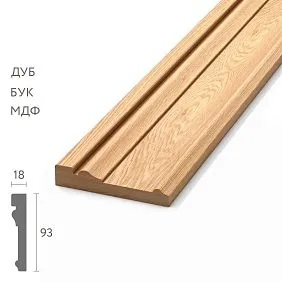

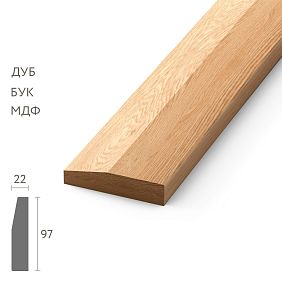


Why a baseboard is needed for a wooden staircase—aesthetics and protection




A staircase without a baseboard: what exactly catches the eye
Imagine a wooden staircase without a baseboard. The treads are laid, the railings are installed, the finish is applied. And yet, at the base of each step—where its end meets the wall—a gap is visible. Sometimes 3–5 mm, sometimes 15–20 mm. Technically, this is an expansion gap, mandatory for wood: it 'breathes'—expanding and contracting with changes in humidity. But visually—it's incompleteness. A boundary that calls for framing.
This is exactly what a wooden staircase baseboard does. It doesn't hide a technical 'error'—it completes an architectural 'phrase'. This is a fundamental difference in the attitude towards the detail.
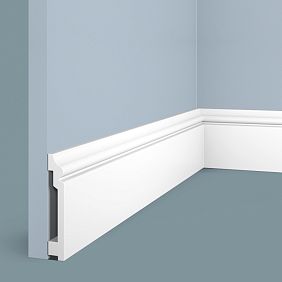
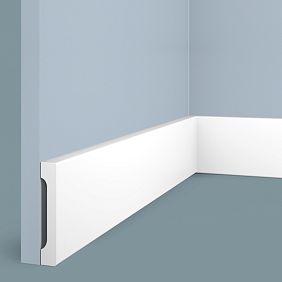
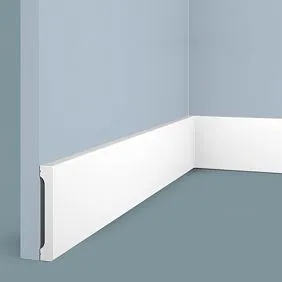
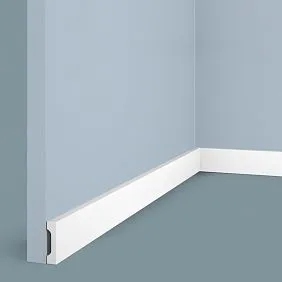
Our factory also produces:
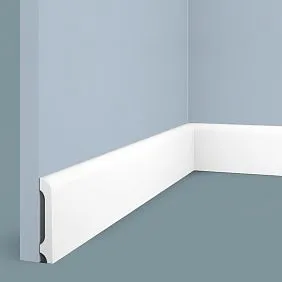
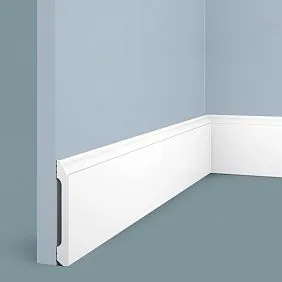
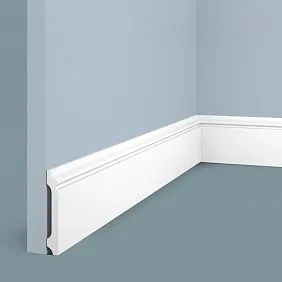
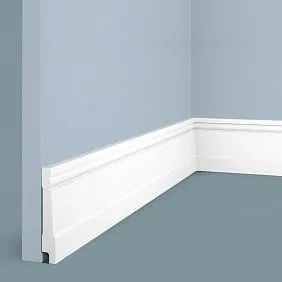
Two functions in one strip
First function—technical. The baseboard closes gaps and joints. The gap between the tread and the wall, between the stringer and the floor, between the riser and the wall tile—all these are points of entry for dust, moisture, and mechanical dirt. An unprotected joint in the staircase area is an accumulation of grime in a hard-to-reach place that cannot be properly cleaned. The baseboard isolates these zones and protects the structure of the staircase.
Second function—architectural. The baseboard creates a visual 'contour' for the staircase. It outlines its silhouette: a thin decorative line along the flight, following the angle of ascent, emphasizing the rhythm of the steps. In a well-designed staircase, the baseboard is the 'stroke' that makes the image complete.
Get Consultation
Why a staircase baseboard is a special product
A wooden staircase baseboard is not the same as a floor baseboard against a wall. Three fundamental differences:
First: angle of inclination. A floor baseboard is installed strictly horizontally—along the floor. A staircase baseboard runs at the angle of the flight: 30–45° depending on the slope of the staircase. This means the profile must either be specially designed for slanted installation or be cut at the bottom and top points of the flight at the correct angle.
Second: load. A staircase is a zone of active movement. People's feet, moving furniture, accidental impacts. A staircase baseboard operates under significantly higher mechanical loads than a baseboard against a wall in a bedroom. The wood species, strength of fastening, quality of finish—all are more critical.
Third: visibility. A floor baseboard against a wall is largely hidden by furniture. A staircase baseboard is always in view. It runs along the entire flight, and everyone who goes up or down looks at it from arm's length.
Types of baseboard for a staircase: stringer, riser, corner
Stringer baseboard (false stringer)
A staircase stringer is the side beam or board to which the treads are attached. Depending on the staircase construction, the stringer can be load-bearing (treads rest on it from below) or decorative (treads are inset into the stringer from the side).
In both cases, a gap remains between the stringer and the wall—where the stringer meets the wall surface. This gap is closed by a stringer baseboard, sometimes called a false stringer or wall strip.
Construction of a stringer baseboard: a wide board (80–200 mm high) with a profiled front face, mounted vertically along the wall—parallel to the staircase flight at its slope angle. The top edge is profiled, decorative. The bottom edge adjoins the stringer or treads.
From the catalog ofcomponents for staircases STAVROS a stringer baseboard is selected from wide molding profiles that provide the necessary height to cover the gap.
When to use:on flight stairs where the stringer meets the wall. The most common situation in private homes: one side of the staircase runs along a wall — and the stringer on that side requires trim.
Riser baseboard
A riser is the vertical panel that covers the space between horizontal treads. Most classic wooden staircases have risers — they create a 'solid' appearance for the flight. Modern 'floating' staircases lack risers: the space between steps is open.
Where the riser meets the wall, a gap appears — this is covered by the riser baseboard. It is a narrow strip (30–50 mm) installed vertically between the riser and the wall.
Feature:the riser baseboard on a staircase runs in a stepped pattern — following the shape of the flight. Each riser is a separate vertical segment. Between them (in the tread area) the baseboard runs horizontally. The result is a characteristic 'toothed' contour framing the side of the flight from the inside (against the wall).
Corner baseboard for staircase
A corner baseboard covers the joint in the area where the stair flight meets the horizontal landing—either the upper or lower one. This is a G-shaped or L-shaped transition: the flight ends, the landing floor begins, and at this point an angle appears that requires decorative framing.
A corner staircase baseboard is a more complex product than a straight one: it has a transition element that changes the direction of the strip from slanted (along the flight) to horizontal (along the landing). It is made either from a single bent element or from two strips with a precisely cut joint at an exact angle.
'Boot': combined step baseboard
'Boot' is a specific name for a baseboard that simultaneously covers both the riser and the lower gap at the base of the step. Its shape resembles a boot last in cross-section: an L-shaped profile, one edge runs along the riser, the other — along the landing floor or the tread of the lower step.
This is the most cohesive and 'premium'-looking solution: an oak 'boot' under varnish on the final steps of a staircase is a high-quality finish that immediately signals professional work.
How to choose the profile and height of baseboard for a step
Key dimensions: height and width
When selecting a profile for a staircase baseboard, two parameters are considered:
Baseboard height.Should cover the gap between the step/stringer and the wall with a margin of at least 5–10 mm on each side. For a typical gap of 10–20 mm — a 40–60 mm baseboard. For large gaps (up to 40 mm in old houses) — 60–80 mm.
Cross-section profile.On a staircase, the profile is viewed literally up close — from a distance of 30–50 cm when moving along the flight. Therefore, the quality of milling and the clarity of the pattern are critical. A rough or blurry profile will be glaringly obvious with every step.
Principle of coordinating the profile with staircase elements
The profile of the staircase baseboard should 'rhyme' with the profile of the steps and risers themselves. Three levels of coordination:
Ornamental level.If the steps have a milled nosing (capinos) with a decorative profile — the baseboard should also have a comparably rich profile. A smooth rectangular baseboard next to a richly profiled capinos — conflict.
Scale level.The height of the baseboard should be proportional to the height of the riser. A standard riser is 160–200 mm. A baseboard of 60–80 mm constitutes 35–50% of the riser height — this is the correct proportion. A 120 mm baseboard with a 160 mm riser — too 'heavy'.
Wood species level.Baseboard made from the same wood species as the steps. Oak steps — oak baseboard. Beech — beech. This rule is only broken when painting: under white enamel, the difference in wood species is not noticeable.
Table: profile selection based on staircase style
| Staircase style | Baseboard Height | Profile | Species |
|---|---|---|---|
| Modern minimalism | 30–50 mm | Straight, without ornamentation | Beech, oak, ash |
| Scandinavian | 40–60 mm | Slight bevel or heel | Beech, ash |
| Neoclassical | 60–80 mm | Gusek, shelf | Oak |
| Classic | 70–100 mm | Multi-level, with floral element | Oak |
| Baroque, empire | 100–150 mm | Rich multi-profile | Oak, walnut |
Importance of precise cutting angle
The main technical difficulty when installing skirting boards on a staircase is the correct trimming of the ends. On a straight wall, skirting boards are cut at 45° in the corners — and that's it. On a staircase, the situation is more complex:
-
Lower end of the flight skirting board: cut at an angle equal to the slope angle of the staircase (usually 30–40°)
-
Upper end: at the same angle, but in the opposite direction
-
Transition from flight to horizontal landing: double angle cut
For precise cutting, a miter saw with a tilting worktable is necessary. Manual cutting at an exact angle is extremely difficult and prone to gaps in joints.
Coordinating skirting boards with wooden railings and balusters
Staircase as an architectural system
A staircase is an ensemble: treads, risers, stringer, railings, balusters, skirting board, handrail. All these elements are visible simultaneously — a person standing by the staircase takes them in at a glance. And that is precisely why any inconsistency among them immediately catches the eye.
In this ensemble, the skirting board occupies the 'lower register' — like a room's skirting board. Railings and handrails are the 'upper register'. Balusters are the 'vertical rhythm'. And all of them must be connected by a unified ornamental and material code.
How balusters and skirting boards are coordinated
wooden handrails and balusters from the STAVROS catalog are turned or carved elements made of solid beech or oak. Turned balusters have a characteristic decorative silhouette: alternating spheres, cones, cylinders, and 'vases'. This 'turning language' is the ornamental code of the staircase's vertical elements.
The stringer skirting board must carry the same ornamental code — but in a horizontal direction. Specifically: if a baluster has a pronounced classical turned profile with several spherical elements — the skirting board must have a comparably rich profile. A minimalist rectangular skirting board next to a rich turned baluster is like a pencil signature under an oil painting.
Handrail and skirting board: unity in wood
The handrail in the STAVROS catalog is made of solid beech or oak — the same species as the K-series skirting board. This is a key advantage of ordering the entire set from one manufacturer: with a transparent finish (oil, varnish) — one wood species yields one tone, with no mismatch.
With unified oil treatment in 'natural' or 'light oak':
-
Oak treads → tone A
-
Oak stringer skirting board → tone A
-
Oak balusters → tone A
-
Oak handrail → tone A
Result: an absolutely unified system. Not 'similar', but 'one'.
Color strategies for a staircase
Monochromatic natural— the entire wood under 'natural' oil. The most organic strategy. Works for Scandinavian, classic, and contemporary styles.
Two-tone— dark treads (tobacco or walnut oil), skirting and balusters — white (enamel). A characteristic solution for 'French country' and Provence. The combination of a dark step and white verticals is very graphic and energetic.
Patinated classic— dark wood with patina on balusters and skirting. Baroque or Empire character. Requires rich profiles — both for the skirting and balusters.
Scandinavian white— everything in white: treads, risers, skirting, balusters, handrail. A monochrome white staircase is very modern and yet classic. Works perfectly with solid painting from a single batch of paint.
When balusters and skirting should be color-matched
Rule: if balusters are painted one color — the stringer skirting must also be the same color. There is nothing worse than white balusters and 'natural oak' skirting on the same staircase — unless part of a specific designer's intent.
If balusters are natural under oil — skirting under the same oil, from the same wood species. If balusters are white — skirting is white. If balusters are dark — skirting is dark or patinated.
Installing skirting on a staircase: nails, glue, liquid nails
Complexity of installing stair skirting
Installing skirting on a staircase is technically more complex than installing floor skirting. Four key complications:
Inclined geometry.The skirting runs at an angle, ends are cut at non-standard angles, joints at the start and end of the flight require precise fitting.
Vibration.The staircase experiences dynamic loads during use — from footsteps, from movement. The adhesive joint must withstand these loads without peeling.
Accessibility.Installation is performed on the staircase flight, often in cramped conditions, requiring working 'overhead' or 'at a sharp angle'.
Different base materials.Stringer — wood. Wall — plaster, concrete, or drywall. The joint between them requires different types of fasteners.
Tools and materials
-
Miter saw with adjustable table tilt (for the working angle of the staircase flight)
-
Protractor or angle finder — for precise measurement of the flight angle
-
Water-based liquid nails (solvent-free)
-
Finish nails 40 and 50 mm
-
Nail set
-
D3 PVA mounting adhesive (for attaching wood to wood — to the stringer)
-
Acrylic sealant in the color of the skirting
-
Dowel plugs and screws (for attaching to the wall)
Step-by-step installation of stringer skirting
Step 1. Measuring the flight angle.
Place the protractor against the steps and measure the exact angle of the staircase slope. Record this — it is the cutting angle for the bottom and top ends of the flight's skirting board.
Step 2. Determining the skirting board length.
Measure the distance along the flight — from the bottom point (junction with the floor skirting board or landing) to the top point (junction with the ceiling, landing, or floor slab). Add a 50 mm allowance.
Step 3. Cutting the skirting board.
Set the miter saw to the angle equal to the staircase slope angle. Cut the bottom and top ends at this angle. Place the skirting board at the installation location and check the fit of the ends against the horizontal surfaces — there should be no gaps.
Step 4. Pre-coating.
Apply the first coat of varnish or paint to the skirting board before installation. Include the back side and ends — especially the bottom end, which will be close to the floor.
Step 5. Mounting to a wooden stringer.
Apply PVA D3 adhesive in a 'snake' pattern on the back of the skirting board with a 20 cm spacing. Press the skirting board in place. Secure with 50 mm finishing nails spaced 40–50 cm apart. Sink the nail heads using a nail set.
Step 6. Mounting to the wall (in areas where the skirting board runs along the wall).
On a drywall wall: use a chemical anchor + screw, or liquid nails with prolonged pressure (tape + braces for 24 hours). On a concrete or brick wall: use a 6×40 mm anchor bolt through the skirting board + nail set to sink the head.
Step 7. Sealing the joints.
Acrylic sealant in a matching color: along the top edge of the skirting board (skirting-to-wall seam), along the bottom edge (skirting-to-stringer or step seam), and on all end joints. Smooth with a wet finger. Drying time — 24 hours.
Step 8. Final coating.
Apply the second (and if necessary — third) coat of varnish or paint to the installed skirting board. Thoroughly paint all joints and areas around the sealant.
Installation of the riser skirting board
The riser skirting board is installed on each riser separately. Algorithm for one riser:
-
Measure the width of the gap between the riser and the wall
-
Cut a strip to the required length — exactly the height of the riser (horizontal cut)
-
Apply adhesive to the back side
-
Press it into place at the joint
-
Secure with 2–3 finishing nails
-
Seal the top and bottom joints with the treads using sealant
In total: for a staircase with 12 steps on one side — 12 riser strips. Installation of one strip takes about 10 minutes. For the entire staircase — 2–2.5 hours.
Painting and varnishing to match the steps
Three basic finishing scenarios
Scenario A: Varnish 'to match' the steps.
The most logical solution for natural wooden staircases. Skirting board and steps made from the same wood species, coated with the same varnish from the same can. The result is absolute tonal unity.
Technology for the skirting board: sanding P150 → P240 → P320. Varnish (water-based polyurethane, matte or satin): 3 coats with intermediate sanding P400 between coats. The final coat — no sanding. Full curing before pedestrian load: 72 hours.
Scenario B: Oil to match the steps.
Maslovosk or pure wood oil — a more 'lively' appearance compared to varnish. The shade is selected based on the same oil sample used for the steps.
Technology for skirting: sanding P240. Oil: 1–2 coats with curing and wiping. Key rule: use oil from the same can as for the steps — then the shade is guaranteed to match.
Scenario B: Enamel (white or colored).
For two-tone staircases (dark steps + white elements) or completely white staircases. Technology: acrylic primer 1 coat → sanding P240 → matte enamel 2–3 coats with sanding P320 between coats.
Important: the entire 'white set' (skirting, balusters, risers, handrail if white) — paint from the same can. Different batches of white paint produce different shades — from cool to warm. On a staircase where all elements are visible simultaneously, this discrepancy will be noticeable.
How to update stair baseboard finish without removal
Staircase — a high-traffic area. Skirting coating needs refreshing sooner than in other areas: typically after 5–7 years under normal load.
For varnish coating:
-
Light sanding P320 without removing all varnish — only matting the surface
-
Dust removal
-
Applying 1–2 coats of the same varnish over the old one
-
Result: surface refreshed without complete sanding down
This method works if there are no deep scratches or chips. For serious damage — complete sanding down to bare wood and three coats of varnish anew.
For oil coating:
-
Sanding P400 'dry' — light matting
-
Applying a new coat of maslovosk
-
Wiping with a clean cloth
-
Polymerization 24 hours
Maslovosk coating is refreshed significantly easier than varnish. This is precisely why for private homes with active staircase use, maslovosk is often preferable.
Anti-slip properties: when coating affects safety
Staircase — a high-risk area for injuries. Too smooth skirting at the base of a step can cause slipping. This is especially dangerous on lower steps where the 'boot' skirting forms a horizontal projection at the floor.
Recommendations:
-
Use matte or satin coating, not glossy — lower slip coefficient
-
On horizontal surfaces of the 'boot' — coating with added anti-slip filler (special additives for varnish)
-
On children's staircases — mandatory
FAQ: Answers to popular questions
How does staircase skirting differ from regular floor skirting?
Three things: it is mounted at the angle of the flight (not horizontally), operates under higher mechanical loads, and is always in view — therefore requirements for profile and coating quality are higher.
Is skirting needed on an 'open' type staircase (without risers)?
No — in the riser area. But stringer skirting is still needed: the gap between the stringer and wall exists in any construction.
How to measure flight angle for correct skirting cut?
With a protractor — place it on two consecutive steps and take the angle. Or more precisely: measure flight height (vertical distance from floor to landing) and horizontal projection (horizontal distance). Tangent of angle = height / projection. Standard staircase flight angle: 30–40°.
Can stair skirting be installed on sealant without nails?
Only on small, lightweight strips (up to 500 mm in length). On long flight skirting boards, mechanical fastening (nails or dowels) is mandatory: the staircase vibrates, and over time, adhesive without mechanical fastening may peel off.
STAVROS wooden handrails and balusters — which skirting boards do they pair best with?
With oak skirting boards from the K-series for a unified oil finish. Balusters and handrails from the STAVROS components catalog are oak or beech. With the same wood species and the same treatment — absolute tonal unity.
Which stair skirting profile should be chosen for a modern interior?
A concise rectangular one or with a minimal chamfer. Height 40–60 mm. Finish — matte varnish or 'natural' oil-wax. From the STAVROS K-series: K-034 or K-125 are suitable basic profiles for a modern staircase.
How to calculate the linear meters of skirting board needed for a staircase?
Add up: the length of the stringer skirting along the flight (the flight's hypotenuse, not the horizontal projection) + the total height of all risers × 2 (if the staircase is between two walls) + the length of skirting on the landings. Add 15% extra for cutting.
About the company STAVROS
A staircase is not just a structural element of a building. It is an architectural space that lives its own life: it bears load every day, reveals itself to the eye with every step, and defines the first impression of a home. Details on a staircase operate in a mode not found in any other room: they are always in view and always under load.
STAVROS manufactures a complete ensemble of wooden products for the staircase —Staircase Components and Elements: treads, risers, stringers, balusters, handrails, newel posts, and decorative elements made from solid beech and oak. In a unified system withthe K-series wooden moldings — skirting boards from 230 to 6,060 rubles per linear meter — this is a complete kit for the professional design of stair space.
Additionally —Furniture legs for consoles and pedestals on the stair landing,Mirror frames RM-series for mirror decor in the stair area,Decorative Inserts for finishing risers and stringers.
All wooden products — kiln-dried to 8–10% moisture content, 3D milling, hand sanding. Supplied unfinished for a unified final finish of the entire staircase kit from a single can of varnish or oil.
Stock program — shipment on the day of order. Delivery throughout Russia and CIS countries.
STAVROS is when a staircase becomes not just a 'transition between floors,' but an architectural statement. Every detail — from a single source. Every step — on the right material.


