Article Contents:
- What is a Floor Skirting Board and Why is it Actually Needed
- Why Wooden, Not Plastic
- Types of Wooden Floor Skirting Boards: Wide, Narrow, Ornamental
- Narrow Skirting: Minimalism in Action
- Medium Skirting: Universal Solution
- Wide Skirting: Classic and Status
- Ornamental Skirting: Decorative Architecture
- Heel Skirting
- Wood Species for Skirting: Oak, Beech, Pine — Honest Comparison
- Oak: First Choice for Those Who Choose Once and for All
- Beech: elegance and versatility
- Pine: Budget Option with Limitations
- Comparative Table of Wood Species
- How to Properly Buy a Wooden Floor Skirting Board: Measurement, Calculation, Selection
- Step One: Measure the Perimeter
- Step Two: Add Margin for Trimming
- Step Three: Decide on the Profile Before Ordering
- Step Four: Ensure Batch Uniformity
- What Skirting Sizes are Available in the STAVROS Catalog
- Installing Wooden Skirting Board Yourself: Step-by-Step Guide
- Tools and Materials
- Foundation Preparation
- Marking and Cutting Corners — The Most Critical Stage
- Fastening: Three Options for Different Bases
- Final Finishing and Gap Sealing
- Painting and Final Treatment of Wooden Skirting Board
- Varnish: Preserve the Natural Wood Color
- Stain + Varnish: Change Color, Preserve Texture
- Enamel: RAL Color for White or Colored Skirting
- Oil-Wax: For Connoisseurs of Naturalness
- Caring for Wooden Skirting Board: Simple Rules for Years
- Wooden skirting board in interior decor system
- Wooden skirting boards in special conditions
- Underfloor heating
- Bathroom
- Bathhouse and sauna
- FAQ: most common questions about wooden skirting boards
- STAVROS: wooden skirting board of own production

A skirting board is a detail most people don't notice until it's done poorly. A crookedly cut corner, a gap between the profile and the floor, plastic that 'warped' from heat - and that's it: the entire renovation, which took months and considerable money, gets a splinter. Small, but irremovable.
Wooden baseboardsis a completely different story. It's not just about 'closing a gap'. It's the finishing of the floor covering, the lower architectural line of the room, an element that either brings the space together or destroys it. In this article - everything you need to know: types, wood species, how to measure, how to buy, and how to install. Honestly, without fluff and technical jargon.





What is a floor skirting board and what it's actually needed for
Before going to the catalog, it's worth understanding the function. A skirting board is not a mandatory structural element - a house won't collapse without it. But it solves three tasks, each of which is quite specific.
The first task is technological. Floor covering made of any material - parquet, laminate, tile, linoleum - is laid with an expansion gap from the wall. This is not the installer's sloppiness, but a mandatory requirement: wood, laminate, and even ceramics expand and contract with changes in temperature and humidity. An 8-12 mm gap around the entire perimeter of the room is the norm. The skirting board covers this gap.
The second task is protective. The lower part of the wall is the most vulnerable. A mop, vacuum cleaner, furniture legs when rearranging - all of this hits exactly here. A solid oak skirting board with a density of 700-800 kg/m³ withstands mechanical impacts where plaster or drywall would have cracked long ago.
The third task is aesthetic. The skirting board is the lower 'frame' of the room. It is what visually separates the wall from the floor and creates completeness. A thin, elegant profile in a Scandinavian interior, a powerful molded skirting board in a classic living room - these are polar opposite solutions, and both are correct. Each in its own context.




Why wooden, not plastic
A question almost everyone asks. Plastic skirting board is cheaper - that's a fact. But it has fundamental limitations that outweigh the savings with any thoughtful approach to interior design.
Plastic reacts to heat: when heated by a radiator or underfloor heating, it deforms, forming a 'wave' along the wall. Plastic cannot be repainted: faded or tiresome white PVC cannot be refreshed - only replaced. Plastic cannot be filled and restored if damaged. And finally, a plastic skirting board next to parquet, solid wood flooring, or natural stone looks as organic as nylon curtains in a palace interior.
Floor wooden skirtingis free from all these shortcomings. It can be repainted, restored, matched exactly to the tone of the floor covering. It is stable with temperature fluctuations. It lasts for decades. And it looks the way an element of quality renovation should look.
Our factory also produces:
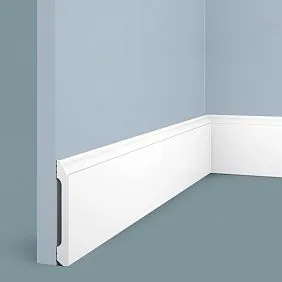
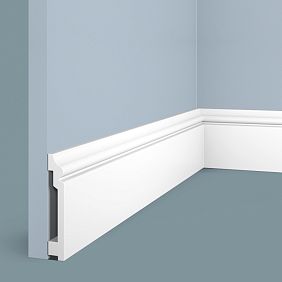
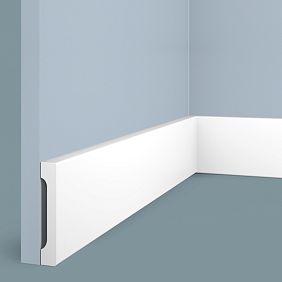
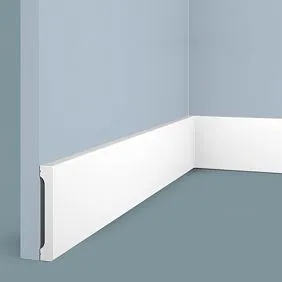
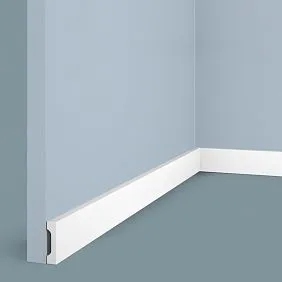
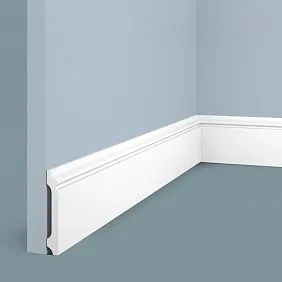
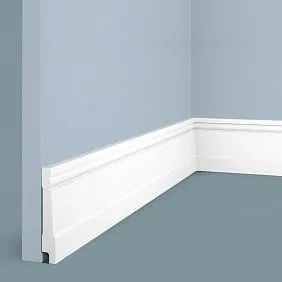
Types of wooden floor skirting boards: wide, narrow, molded
Classifying skirting boards by profile is not an academic abstraction. It's a working selection tool. The correct profile determines 70% of the visual result.
Get Consultation
Narrow skirting board: minimalism in action
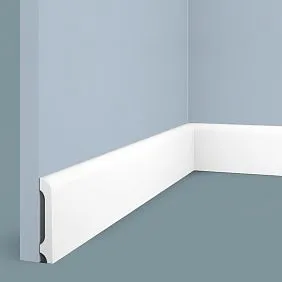
Narrow skirting board - height 40-60 mm, thickness 12-16 mm - is a tool for minimalist interiors. Scandinavian style, Japanese minimalism, functional modernism - everywhere where the rule 'less is more' is an aesthetic principle, not a compromise. A thin line, slightly protruding above the floor, creates a barely noticeable transition between the vertical and horizontal planes.
Narrow skirting board works well in apartments with ceilings of 2.5-2.7 m: a wide profile in such a space would disrupt the proportions, 'pressing' the space to the floor. A profile with sharp edges - for interiors with geometric furniture and flat surfaces. A profile with a rounded front edge - slightly softer, suitable for living rooms.
Medium skirting board: universal solution
Height 70-100 mm - the most in-demand range. This is the 'workhorse' for standard apartment interiors: living rooms, bedrooms, children's rooms, kitchens. Such a skirting board is noticeable enough to create an architectural line, and restrained enough not to draw excessive attention to itself.
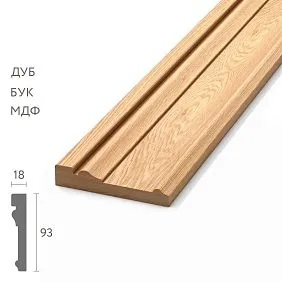
In the STAVROS catalog, profiles PLT-001-1 and PLT-003 belong to this range: moderate relief, working well with both classic and modern floor coverings. PLT-003 from 3,230 rubles per linear meter - a profile with an expressive bevel and ogee, which simultaneously looks rich and doesn't overload the space.
Wide skirting board: classic and status
Widewith a classic profile creates a sense of solidity, reliability. - height from 100 mm and above - is an element of classic and neoclassical interiors. In rooms with ceilings from 3 m and above, a wide skirting board with a height of 120-140 mm creates the necessary architectural 'plinth', without which the wall seems to 'grow' chaotically from the floor.
Proportion rule: the height of the skirting board should be 3-5% of the room's height. With a ceiling of 3.2 m, the optimal skirting board height is 96-160 mm. This is not a strict standard - it's a proportion developed over several centuries of architectural practice.
PLT-001 from STAVROS - a wide profile with a classic Baroque cross-section, from 4,580 rubles per linear meter. PLT-001-006 - an extended version with an enlarged shelf, from 7,088 rubles. Both products are made from solid oak or beech with multi-layer lacquer or oil coating.
Figurative skirting board: decorative architecture
A figurative profile is when a skirting board ceases to be just a 'cover' and becomes an architectural element. Covings, stepped bevels, decorative grooves, pearl bands — all these are variants of figurative profiles. Such skirting boards are used in classic interiors, where they 'rhyme' withceiling cornices, decorative moldingson the walls and carved furniture elements.
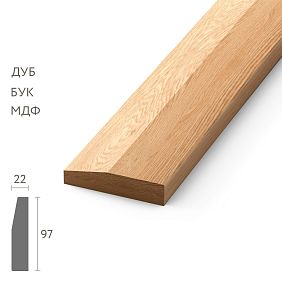
In the STAVROS catalog, figurative profiles include PLT-005 (from 1,610 rub.), PLT-007 with a 'heel' (from 1,630 rub.), PLT-006 with a cornice profile (from 1,350 rub.). A characteristic feature: the PLT-006 and PLT-007 profiles are 'dual-purpose': they can be used both as a floor skirting board and as a door casing. This provides design flexibility — a single profile around the entire perimeter of the room, including door reveals, creates a convincing sense of interior integrity.
Skirting board 'heel'
A separate category is the skirting board 'heel' (GLT, quarter-round). This is not a standalone skirting board, but an addition to the main one: a small quarter-round profile that is laid on top of the main skirting board right at the floor, covering the gap between the skirting board and the floor covering. It is used when it is not possible to press the main profile tightly against the floor — for example, on an uneven subfloor. PLT-007 from STAVROS is precisely such a multifunctional profile.
Wood species for skirting boards: oak, beech, pine — an honest comparison
Wood species is not a marketing parameter. These are physical properties that directly determine the service life, appearance, and behavior of the skirting board under real operating conditions.
Oak: the first choice for those who choose once and for a long time
The density of European oak is 650–750 kg/m³. This is a hard wood that is not marked by cleaning equipment, and a chair leg does not 'dent' it. Oak contains natural tannins — tannic substances that act as a built-in antiseptic, suppressing the development of fungus and mold. This is especially important in rooms with variable humidity.
The texture of oak is expressive. Characteristic medullary rays in radial cuts create a lively, unique surface. Two oak skirting boards are never identical — and this is not a manufacturing defect, it's the nature of the material.
The service life of an oak skirting board with proper care is from 30 to 50 years. This means that a properly installed and treated PLT-001 oak skirting board from STAVROS will outlast more than one cosmetic renovation and several changes of floor covering. It can be re-sanded and repainted when needed — it will withstand this without losing its geometry.
Beech: Elegance and Universality
Beech is denser than pine but somewhat softer than oak — 620–680 kg/m³. Its main advantage is a homogeneous, fine-pored structure without a pronounced grain pattern. This makes beech ideal for tinting and painting: it accepts any color evenly, without 'striping' or color blotches.
If you need a white skirting board, milk-white, anthracite, or a custom RAL color — choose beech. It will provide an even coating that does not 'show through' the paint with its natural grain.
A special property of beech is its formability. After steaming at 100–110°C, beech blanks bend without fiber breakage. This opens up the possibility of manufacturing radius elements — skirting boards for bay windows, rounded walls, arched openings. The minimum bending radius is 8–10 times the thickness of the blank.
The service life of beech products is 25–35 years. An important caveat: beech is more hygroscopic than oak. With humidity fluctuations of more than ±10% from the norm, beech may deform slightly. Recommended operating conditions are stable humidity of 45–65% at a temperature of 18–24°C.
Pine: a budget option with limitations
Pine is a soft wood with a density of 380–550 kg/m³. A pine skirting board is 1.5–2 times cheaper than oak or beech, and that is its main argument. But behind the price lie limitations: pine is softer, wears out more from mechanical impact, and resinous inclusions create problems with painting (resin 'bleeds' through the paint when heated). Without high-quality priming under a sealer, a pine skirting board in a kitchen or hallway will require repair significantly earlier than an oak one.
Pine is suitable for country houses, temporary premises, utility spaces — where cost is more important than durability. For a full-fledged residential interior — oak or beech.
Comparative table of wood species
| Parameter | Oak | Beech | Pine |
|---|---|---|---|
| Density | 650–750 kg/m³ | 620–680 kg/m³ | 380–550 kg/m³ |
| Hardness | High | Medium | Low |
| Expressiveness of texture | High | Low | Medium |
| Uniformity of coloring | Medium | High | Low |
| Moisture resistance | High (tannins) | Medium | Medium |
| Service life | 30–50 years | 25–35 years | 10–20 years |
| Formability (radius) | Limited | High | Medium |
| Price | High | Medium | Low |
How to properly buy wooden floor skirting: measurement, calculation, selection
Between 'I want wooden skirting' and 'I ordered the correct amount of the right profile' are several specific steps. Let's go through them in order.
Step one: measure the perimeter
Measure the perimeter of all rooms where skirting installation is planned. For each room: add up the lengths of all walls, then subtract the width of door openings (skirting is usually not installed under a door opening — or is installed on both sides of the door frame without extending beyond it).
Record the result for each room separately — this will simplify the calculation and help sort the skirting boards by room when receiving the order.
Step two: add a margin for cutting
Skirting is cut at a 45° angle in corners. Each corner means a small material consumption. Add to the calculated perimeter:
-
5% — for rooms with simple geometry (4 right angles)
-
10–12% — for rooms with niches, columns, door reveals
-
15% — for rooms with rounded corners or bay windows
If in doubt — add 10%. Excess skirting is stored as a repair reserve; a shortage means reordering, and a new batch may slightly differ in shade from the first.
Step three: decide on the profile before ordering
Beforebuy wooden floor skirting, formulate answers to three questions:
Ceiling height? This determines the skirting height range (rule of 3–5% of the room height).
Interior style? Minimalism/Scandinavian → narrow flat profile. Classic/neoclassical → wide figured profile. Modern/transitional → medium profile with moderate relief.
Color and tinting? Matching the floor covering color — maximally organic. Contrasting white on dark floor — intentional accent. Neutral 'natural wood' — universal solution.
Step four: ensure batch uniformity
When ordering a large volume (several rooms), ensure that all skirting is produced from the same batch of wood of the same species. Different batches may show slight shade variations — unnoticeable in one room but striking when moving from room to room. STAVROS produces blanks from selected graded wood, and when ordering the entire volume at once, color uniformity is guaranteed.
What skirting sizes are available in the STAVROS catalog
| Article | Height, mm | Profile type | Price from |
|---|---|---|---|
| PLT-006 | ~45 | Cornice/casing | 1,350 rub./linear m |
| PLT-007 | ~45 | Heel/casing | 1,630 rub./linear m |
| PLT-005 | ~50 | Flat/casing | 1,610 rub./linear m |
| PLT-004 | ~60 | Profile | 2,050 rub./linear m |
| PLT-001-1 | ~60 | Classic | 1,710 rub./linear m |
| PLT-003 | ~80 | Decorative | 3,230 rub./linear m |
| PLT-001 | ~100 | Wide Classic | 4,580 rub./linear m |
| PLT-001-006 | ~120 | Wide Representative | 7,088 rub./linear m |
All profiles are made from solid oak or beech, supplied in lengths of 2.0–3.0 m, in white primer or ready for the customer to apply a finishing coating.
DIY Wooden Skirting Board Installation: Step-by-Step Guide
Installing skirting boards is a job you can realistically do yourself. It requires care, a few tools, and an understanding of three or four key principles. No magic—just technique.
Tools and materials
For DIY installation you will need:
-
Miter saw (electric) or miter box (manual) — for cutting corners
-
Electric drill with a set of bits for wood and concrete
-
Screwdriver
-
Spirit level or laser level
-
Tape measure and pencil
-
Nail set (for countersinking nails)
-
Wood filler for patching fastener holes
-
Acrylic sealant — for filling the gap between the skirting board and the floor (if the floor is uneven)
-
6×40 mm wall plugs and screws or finishing nails (brads) 50–60 mm
Foundation Preparation
Before installation, the walls must be completely finished: painted, wallpapered, or otherwise finished. The floor covering must also be laid. The skirting board is the final finishing element that covers the expansion gap around the perimeter of the floor.
Inspect the wall base. If the wall deviates from vertical or has a horizontal 'wave' — this is important: the skirting board will not fit tightly. Small gaps (up to 3–4 mm) can be filled with acrylic sealant after installation. Serious unevenness requires preliminary leveling.
Marking and cutting corners is the most critical stage
A proper cut is 80% of the final quality. A 1-degree error in the miter cut will create a gap in the external corner that no sealant can make invisible.
Internal corners (90°): each of the two converging skirting boards is cut at a 45° angle in opposite directions. On a miter saw, this is done by rotating the support table 45° to the right and left for each board. With well-prepared walls, the internal corner becomes tight and gap-free.
External corners (protruding corner): both pieces are also cut at 45°, but 'mirrored' — the front surface is made longer, and the back shorter. The external corner is a critical spot: it is visible from all sides, and any inaccuracy is immediately noticeable. After cutting, it is recommended to dry-fit both pieces and, if necessary, sand the end with sandpaper.
Lengthwise joints: in long runs of several meters, two skirting board sections are joined at a 45° angle (not butt-jointed end-to-end) — a mitered joint is less noticeable and does not 'open up' due to shrinkage.
Fastening: three options for different substrates
To a brick or concrete wall: drill a 6 mm diameter hole in the wall through the body of the skirting board, insert a nylon wall plug, and screw in a 4×50 mm screw. Fastening spacing — 400–500 mm. On a smooth, straight wall, this spacing ensures a tight fit.
To a drywall wall: use 6×50 mm toggle bolts — they open up behind the drywall and hold without an anchor in the profile. Spacing — 250–300 mm (drywall is softer than brick and holds less load).
To wooden walls or lathing: brads (headless finishing nails) 50–60 mm, driven at a slight angle — a traditional carpentry method. Use a nail set to sink the nail 1–2 mm below the surface, then fill the hole with wood putty to match the tone. Spacing — 400 mm.
Final finishing and gap sealing
After installation, all holes from screws and nails are filled with putty, sanded, and painted over. The gap between the baseboard and the floor (if the floor is uneven) is filled with acrylic sealant, applied from a tube, smoothed with a finger or putty knife, and touched up to match the color. A gap between the baseboard and the wall is usually unnecessary — the baseboard should fit tightly against the wall.
Painting and finishing treatment of wooden baseboard
STAVROS supplies baseboards primed with white acrylic paint, ready for painting. This is convenient: the primer is applied evenly, and the surface is prepared for the final coat. The specific finish to apply depends on the task.
Varnish: preserve the natural wood color
Clear water-based polyurethane varnish is the optimal choice if you want to retain the natural color and texture. Apply with a brush or roller in 2–3 coats, sanding with P320 abrasive between coats. Full drying time — 12–24 hours.
Stain + varnish: change the color, preserve the texture
Stain penetrates the surface layer of the wood and colors it without hiding the grain pattern. It allows light beech to be stained 'to resemble walnut' or gives the baseboard a Scandinavian gray tone. After the stain dries, apply 2–3 coats of clear varnish for protection.
Enamel: RAL color for white or colored baseboards
Acrylic enamel completely covers the texture — the baseboard becomes uniformly white, gray, black, or any other color from the RAL scale. For beech baseboards, this is the most common option: beech accepts paint evenly without 'showing through' the grain. Apply in 2 coats, with the final coat applied using fine-grain spray painting equipment for a perfectly smooth surface.
Oil-wax: for lovers of naturalness
Oil-wax coating does not create a film on the surface — it penetrates the wood structure and polymerizes inside. It provides a matte finish with a 'velvety' tactile quality. Suitable for oak baseboards in interiors with a natural material theme: loft, eco, biophilic design. Requires renewal once a year in high-traffic areas.
Caring for wooden baseboard: simple rules for years
Wooden baseboard does not require special care. It requires — reasonable care.
Daily: during wet floor cleaning, do not pour water onto the baseboard or near its base. A well-wrung mop is fine. A puddle near the baseboard left un-wiped will cause the lower edge to darken and swell within a month or two.
Weekly: if necessary — dry wiping with a soft cloth or using a vacuum cleaner brush attachment. Dust in the relief of a profiled baseboard is removed with a soft brush.
Annually: inspect for scratches and wear. Minor damage is covered with a wax crayon matching the tone. Significant damage — local sanding and application of repair coating.
Every 5–7 years (for varnish coating): preventive varnish renewal — light sanding with P400, application of one coat of finishing varnish. This restores the coating's original shine and protection.
Absolutely prohibited: using aggressive cleaning agents with chlorine or solvents. Allowing regular wetting of the base. Using steam cleaning.
Wooden baseboard in interior decor system
A baseboard never exists alone. It is part of a system. For the interior to look cohesive, the baseboard profile should echo other wooden elements in the same space.
In classic interiorsolid wood baseboardworks in ensemble withceiling cornicesof the same profile family, wallmoldingsfor creating panels,door casingsandfurniture overlays. These are three horizontal elements — baseboard at the floor, molding at mid-wall, cornice at the ceiling — that make the wall 'architectural,' not just a painted surface.
In modern interiors, the same principle works in a simplified version: baseboard and casing from the same profile — already sufficient for visual connection. Different profiles on the baseboard and casing in the same room — noticeable discomfort that is hard to articulate but impossible not to feel.
Practical tip: if you order finishing materials from one manufacturer — inform your manager about your plans. STAVROS produces baseboards, cornices, moldings, and door casings — alla complete molding setfrom the same wood, same color, same style line. This is much easier than selecting elements from different manufacturers and later discovering that beech from one factory and beech from another give different shades under the same varnish.
Wooden baseboards in special conditions
Heated floor
Wooden baseboard and heated floor — a compatible combination under one condition: the baseboard should not lie directly against the heating element. A 2–3 mm expansion gap between the back wall of the baseboard and the floor (provided by a hidden mounting clip or a small spacer) allows hot air to escape without overheating the wooden profile.
Additional measure: a varnish coating with 2–3 layers is more resistant to thermal impact than oil-wax. For baseboards over heated floors, polyurethane varnish is recommended.
Bathroom
Wooden baseboard in the bathroom — not a taboo, but a requirement: moisture-resistant coating. Not one layer of varnish, but a full system: primer-isolator (shellac for oak, acrylic primer for beech) plus 3–4 layers of polyurethane moisture-resistant varnish. The lower edge of the baseboard — an additional layer of sealant along the contact with the floor.
Oak wood: its natural tannins provide additional protection against fungus. Beech in the bathroom requires more thorough and regular coating maintenance.
Bathhouse and sauna
That's a different story. In steam rooms with temperatures up to 100°C and humidity close to 100% — only thermowood or specially treated species (thermoash, thermospruce). A standard oak baseboard in a steam room will crack and deform after one or two seasons. This is not a flaw of oak — it's physics: at 100°C and 100% humidity, any untreated solid wood will deform.
FAQ: the most common questions about wooden baseboards
How to calculate the amount of baseboard for a 60 m² apartment?
Measure the perimeter of each room, subtract the width of door openings. For a 60 m² apartment with three rooms, an entrance hall, and a kitchen, the total perimeter is usually 80–100 linear meters. Add 10% reserve — total 88–110 l.m.
Can you glue a wooden baseboard with liquid nails instead of screws?
Yes, but with caveats. Liquid nails provide good adhesion to a flat surface. On uneven walls — the fastening is unreliable: the baseboard will "pull away" in places where the wall doesn't adhere. For guaranteed results — a combination of adhesive and mechanical fasteners.
What is the difference between a baseboard and a door casing?
Functionally: a baseboard covers the joint between the floor and the wall, a casing — the joint between the door frame and the wall. Visually: often it's the same profile, applied in different places. That's why in the STAVROS catalog, a range of profiles is labeled "baseboard/casing" — they are universal.
How to choose the color of the baseboard: to match the floor or to match the wall?
Both options are correct — it's a matter of design concept. A baseboard matching the floor "extends" the flooring upward and makes the room visually taller. A baseboard matching the wall makes it inconspicuous and "gives" all attention to the floor. A contrasting white baseboard on a dark floor — a deliberate architectural accent.
Which baseboard to choose for oak parquet?
The ideal option — a baseboard made of oak with the same tint as the parquet. This gives a sense of a monolithic wooden space. If an exact match is hard to find — a baseboard one shade darker than the parquet: slight contrast looks deliberate and elegant.
How much does an oak baseboard cost per linear meter?
In the STAVROS catalog — from 1,350 rubles (PLT-006) to 7,088 rubles (PLT-001-006) per linear meter. The range depends on the profile height and complexity of milling. The average price for a standard residential interior (profile 60–80 mm) — 1,710–3,230 rubles per linear meter.
Is the wooden baseboard supplied painted or not?
STAVROS products are supplied with white acrylic primer for painting. This gives the customer freedom to choose the final color and coating. The primer is applied in several layers — the surface is ready for paint or varnish without additional preparation.
STAVROS: wooden baseboard of own production
When it comes to finishing materials that will be in your home for decades, choosing a manufacturer is not a formality.
STAVROS — a Russian manufacturer of millwork and wooden decor from solid oak and beech. Own production on modern equipment, four-sided planers of German production with a tolerance of ±0.1 mm per linear meter, chamber drying of wood to 8–12% moisture content. Each batch — incoming control for species, grade, and moisture.
In the STAVROS production program — a full rangesolid wood trim: floor baseboards of eight profiles,Ceiling Moldingover 30 standard sizes,Wall moldingsfor panel systems, door architraves, decorative battens and bars. All from the same material, in a unified style, with guaranteed color consistency for complete orders.
Delivery across Russia and CIS. Minimum order — from one linear meter for standard profiles. Custom profile production — from 50 linear meters. Warranty against manufacturing defects — 5 years.
Wooden skirting board is the last thing installed during renovation. It's what puts the finishing touch. Let that touch be made of oak.