Article Contents:
- What is a Wooden Architrave: Function, History, Meaning
- Beginning: From a Gap to a Work of Art
- Architrave in Modern Interior: New Life for an Old Form
- Types of Wooden Architraves: From Minimalism to Carved Lace
- By Profile Shape: Flat, Shaped, Carved
- By Construction: Telescopic and Non-Telescopic
- By Installation Location: For Doors and For Windows
- Wooden Lace and Patterns on Architraves: Carving Techniques
- Fretwork Carving: Lace from a Board
- Applied Relief Carving
- Geometric Three-Sided Notch Carving
- Machine Milled Carving
- How to Choose a Wooden Architrave to Match Your Home's Style
- For Wooden and Frame Houses
- For an Apartment in Classic or Neoclassical Style
- For an Apartment in 'Modern Classic' Style
- For a Log House or Timber-Framed House
- For Russian Style, Ethno, Neo-Folk
- Table: How to Select Architrave Width
- Installation of Wooden Architrave: Precise, Reliable, Beautiful
- Tools
- Step-by-Step Installation
- Common mistakes
- Painting Wooden Architraves: Systems and Technologies
- White Enamel: A Classic Choice
- Wood Toning
- Weather-Resistant Protection for Facade Architraves
- Care for Wooden Mouldings
- STAVROS Architrave Catalog: What's in Stock
- FAQ: Answers to Common Questions About Wooden Architraves
- STAVROS: Wooden Architraves Since 2002 — From Palace Restoration to Your Home

There are things that need no introduction. You see a patterned wooden plank on a window frame—and you already feel: people who love their home live here. A wooden window surround is not just a plank. It is the face of the house. Its first phrase, addressed to the street and to guests. Its business card, by which one reads the character of the owner, their taste, their attitude towards space.
wooden casing— is one of the few decorative elements that is simultaneously an architectural and an ethnographic phenomenon. In Russia, carved window surrounds are an entire civilization of ornament, accumulated over centuries by folk craftsmen. Today, this ornament lives in two worlds: in the tradition of wooden architecture and in modern interior design, where wooden door surrounds are back in fashion—in precise, conscious, and expensive taste.


What is a wooden window surround: function, history, meaning




Beginning: from a gap to a work of art
The word 'nalichnik' (window surround) comes from 'nalichie'—that which is on the face, in plain sight. Literally—an overlay plank on the 'face' of the opening. Technically, its task is simple: to close the gap between the door or window frame and the wall. It is precisely at this joint—the gap—which in a wooden structure opens up over time due to shrinkage and thermal movement of the log. The surround conceals it.
But the Russian craftsman never stopped at the technical task. Having solved it—he went further. He decorated. He carved. He applied a fretwork pattern. He added an 'ochelie' (forehead piece) on top—a horizontal 'crown' board. He hung an 'apron' with a valance under the window. And what began as a functional plank turned into a sculptural object, in which one could read protective symbols, solar signs, plant ornaments—the entire symbolic program of the folk worldview.
In Russia, the window surround reached its peak in the 19th century—especially in the Volga region, the Urals, and Siberia. It is precisely here that houses with surrounds of such complexity and beauty have been preserved that today they serve as a benchmark for designers restoring the tradition of wooden decoration.
Our factory also produces:


The window surround in modern interiors: new life for an old form
Todaywooden casingis experiencing a true renaissance—and not only in the restoration of historical houses. It has entered modern interiors through the fashion for neo-classicism, Scandinavian restraint, and Russian style. Interior designers include it in projects of the most varied levels—from a country house to a city apartment with 3.5 m ceilings.
The reason is simple: a surround structures space. A door opening without a surround is a hole in the wall. With a surround—it is an architectural portal that gives the opening a frame, scale, and completeness. The same 60–80 mm width of the profile, nailed around the perimeter of the door, turns the door from a technical hole into a design element.
In a country house, at a dacha, in a wooden cottage—exterior window surrounds turn the facade from a set of windows and walls into a unified architectural statement. It is that detail which is noticed first and which is remembered.
Get Consultation
Types of wooden surrounds: from minimalism to carved lace
The classification of surrounds is a branching tree with several independent axes.
By profile shape: flat, shaped, carved
Flat rectangular surround—the most laconic. Rectangular cross-section, sharp or slightly chamfered edges. This is the language of minimalism: Scandinavian style, modern classic, loft. Width—50–120 mm, thickness—12–20 mm. Easy to install, affordable, works in any interior where there is no decorative excess.
Profiled surround—with a shaped cross-section: coves, beads, quarter-round and stepped elements. Creates relief and shadow without carving—through the geometry of the profile alone. This is the language of classicism and neoclassicism. The degree of profile complexity—from one simple cove to a multi-step Baroque cross-section with five–six elements.
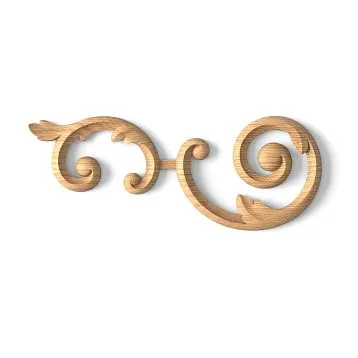
Fretwork carved surround—traditional Russian technique. Openwork pattern, cut all the way through the plane of the board. The silhouette of plants, scrolls, geometric figures is visible against the light. This iswooden lacein the most literal sense: wood from which a network of pattern is made. Used primarily on facades—inside, the fretwork pattern creates too 'ethnographic' an effect, which must be skillfully integrated.
Applied carved surround—relief carving on the surface of the board, not through-cut. More restrained than fretwork, richer than a simple profile. Characteristic of classical and Baroque styles.
By construction: telescopic and non-telescopic
Non-telescopic—standard width, installed for a specific wall thickness (typically 75–100 mm for interior doors).
Telescopic (sliding)—consist of two parts: a main plank and an extendable filler element. Allows covering any wall thickness—relevant in houses with thick brick or block walls, as well as when installing in openings with finishes of varying thickness. Produced with an adjustment step.
By installation location: for doors and for windows
Door surrounds—installed around the perimeter of the door opening: two vertical jambs and a horizontal lintel on top. Standard door opening width 700–900 mm, height 2,000–2,100 mm.
Window surrounds—installed outside (exterior) or inside. Exterior—wider (80–150 mm), often with an 'ochelie' (forehead piece). Interior—similar to door surrounds, but fitted to the window size.
Exterior window surrounds with an 'ochelie'—a full traditional construction: two side jambs, a lower 'apron', an upper 'ochelie' with ornament. This is the format of wooden architecture, which is actively used today in projects for wooden and frame houses.
Wooden lace and patterns on surrounds: carving techniques
wooden patterns—is a separate world where craft, art, and folk symbolism meet. Let's examine the main techniques.
Fretwork carving: lace from a board
Pierced (or openwork) carving is a technique where a pattern is cut completely through the plane of a board. Tools: historically - a bow saw, punches, chisels. Today - a band saw, a CNC jigsaw, a laser engraver for fine details.
The result is a lattice-like board where voids and wood are equal. The silhouette of the ornament is perceived simultaneously as a positive form (wood) and as a negative one (air). A pierced window casing in sunlight casts a lace-like shadow on the wall - an effect impossible in any other material.
Traditional motifs of pierced carving:
-
Solar symbols - circles with rays, rosettes, wheels. Symbols of the sun and light, protecting the home.
-
Floral ornaments - acanthus leaves, grapevine, hops, grasses. Symbols of life, fertility, growth.
-
Geometric ornament - diamonds, triangles, zigzags. The most archaic group of symbols.
-
Zoomorphic motifs - birds (rooster, firebird), horses, fish. Traditional protective charms.
-
Anthropomorphic motifs - stylized figures, mascaron faces. Found in window casings of the Baroque tradition.
Applied relief carving
Relief carving on the surface of a board - technically more complex, but visually more 'quiet'. The ornament is not pierced but protrudes above the plane. Shadows are created by the volume of the carving itself - with side lighting, the casing 'comes to life'.
Relief carving techniques:
-
Flat relief - the ornament slightly protrudes above the background plane. Delicate, jewelry-like work.
-
Bas-relief - more pronounced relief, up to 1/2 the depth from the board's thickness.
-
High relief - relief exceeds half the thickness, figures appear as separate objects against the background.
Geometric three-sided notch carving
The most ancient technique. Triangular-section three-sided notches, cut at a 45° angle. Create a play of light due to the inclined planes inside the notch. Characteristic of folk spinning wheels, window casings of the Russian North. Today experiencing a trend in 'neo-ethnic' style.
Machine-milled carving
Modern CNC milling machines allow reproducing any of the listed styles with an accuracy of up to 0.1 mm. This is not a 'cheap substitute' for handwork - it is a different tool with different capabilities. Repeatability, precision, speed. For serial production and standardized projects - indispensable.
How to choose a wooden window casing to match the style of the house
For a wooden and frame house
Here, the casing is an element of facade architecture. The main rule: casings on all windows must be in a unified system - one style, one width, one finish. Breaking the unity ruins the facade.
For a traditional wooden house - pierced casings with a pediment, painted white or in a color contrasting with the facade. Width of stiles - 80–120 mm. Pediment - 150–250 mm.
For a modern frame house in Scandinavian style - flat rectangular casings 60–80 mm, white or matching the facade color. No carving - strictness and precision of geometry.
For an apartment in a classical or neoclassical style
Profiled casing made of solid oak or beech, painted white. Width - 70–90 mm. Profile - with one or two coves. Installation: butt joints at corners at 45°. Combines with %s of the same profile series and with %s at the top of the wall.with wooden skirting boardsof the same profile series and withcrown moldingat the top of the wall.
For an apartment in a 'modern classic' style
Flat casing 70–80 mm made of solid wood, in white matte enamel. Corners - strictly at 45°, no gap. The entire system - casing + %s of a unified profile - creates an interior where a system is felt.wooden skirting board purchasea unified profile — creates an interior where a system is felt.
For a log cabin or timber-framed house
Solid wood casing with mandatory settlement consideration. Construction: sliding fastening on a casing box, which allows the wall to settle without damaging the casing. Width: 90–120 mm. Finish: oil with wax or weather-resistant varnish.
For Russian style, ethnic, neo-folk
Sawn casing with traditional motifs — solar symbol on the lintel, herbal ornament on the uprights. Pairs with carved balusters on the veranda, carved roof overhangs, carved overlays on posts.
Table: how to choose casing width
| Doorway height | Sticker Width | Style |
|---|---|---|
| Up to 2,100 mm | 50–60 mm | Minimalism |
| 2,100–2,300 mm | 60–80 mm | Modern Classic |
| 2,300–2,500 mm | 80–100 mm | Classic, neoclassic |
| Above 2,500 mm | 100–120 mm | Classical entrance |
Wooden casing installation: precise, reliable, beautiful
Tools
-
Miter saw (cutting angle 45° and 90°)
-
Laser level
-
Tape measure
-
Nail set + hammer or pneumatic nailer
-
Construction adhesive ("Liquid Nails")
-
Acrylic sealant in casing color
-
P240 sandpaper
Step-by-step installation
Step 1: Preparation. Condition casings indoors for 24–48 hours before installation. All surfaces must be even, without putty protrusions. Door frame is installed and secured.
Step 2: Marking. Draw a pencil line around the perimeter of the door frame — this is the guide for casing installation. Casing offset from frame edge: 5–8 mm (classical "gap", called "reveal").
Step 3: Cutting vertical uprights. Bottom end: horizontal cut at 90°. Top end: at 45° (for joint with horizontal crosspiece).
Step 4: Cutting horizontal crosspiece. Both ends: at 45°, mirrored. Length: door opening width plus two casing overhangs on the sides.
Step 5: "Dry fit". Assemble all three parts without adhesive and fasteners. Check corner joints: gap should not exceed 0.3 mm. If needed, adjust with miter saw or sanding on a block.
Step 6: Installation. Apply construction adhesive ("Liquid Nails") in a zigzag pattern across the entire back surface of the casing. Press against the wall and secure with finishing nails 1.4×40 mm (for thin casings) or 1.6×50 mm (for more massive ones). Sink nails with a nail set.
Step 7: Corner joints. After installing all three sides — check corner connections. Fill gaps up to 0.5 mm with acrylic sealant, smooth with a finger, wipe excess with a damp cloth.
Step 8: Final finishing. Cover nail heads with wood putty. After drying — sand with P240. Final coating — depending on the chosen system: white enamel, clear varnish, oil.
Typical mistakes
-
Installation without 'fitting': 45° joints separate after fastening
-
Fastening only with nails without glue: when the wall shrinks, nails become loose
-
Silicone sealant instead of acrylic: silicone cannot be painted, and the seam remains visible
-
Lack of acclimatization: wood changes size — and joints separate
Painting wooden architraves: systems and technologies
White enamel: a classic choice
White architrave is the most common choice. It visually 'opens up' the doorway, creates contrast with walls of any color, and fits any style.
Technology for solid oak:
-
Dust removal: dry brush or air blowout
-
Shellac primer-sealer: blocks oak tannins that bleed through white paint as yellow stains
-
Drying 2 hours
-
Sanding P240
-
Acrylic white enamel (first coat, diluted with 10% water)
-
Drying 4–6 hours
-
Sanding P320
-
Second final coat of white enamel
-
Drying 24 hours
Technology for solid beech: without shellac sealer — beech contains no tannins. Other steps are the same.
Wood toning
Stain + varnish — a system for those who want to preserve texture and change tone. Oak tones beautifully to any shade — from light 'honey oak' to dark 'wenge'. Beech under toning looks more neutral but accepts any color evenly.
Important: apply stain — along the grain, evenly, without circular motion. Remove excess with a dry cloth after 5–10 minutes. Seal with varnish 24 hours after the stain dries.
Weather-resistant protection for exterior architraves
For outdoor applications — only systems with UV and moisture protection. Alkyd yacht varnishes or specialized oils for exterior work. Renew protective layer — every 3–5 years depending on climate and facade orientation.
Exterior architraves on the north side last longer without renewal — they receive no direct UV exposure. Southern and western sides are the most aggressive: varnish fades faster.
Care for wooden casings
Proper care extends the life of any wooden architrave several times over.
Daily: requires nothing.
Weekly: dry wipe with a soft cloth or vacuum with a soft brush attachment. Removes dust that in carved crevices darkens over time and makes the pattern look dirty.
Monthly: damp wipe with a slightly moist cloth. Do not wet — wipe.
Every 1–2 years: apply a thin layer of maintenance oil (for oil finish) or polishing (for varnish finish).
If scratches appear: sanding with P320 grit, applying a finishing coat of coating. For white enamel — touch-up with a brush followed by sanding after drying.
Restorability of wooden architraves is a key advantage over MDF and PVC. After 10–15 years, a solid wood architrave can be sanded and repainted — and it looks like new. PVC or foam MDF in the same condition can only be replaced.
STAVROS Architrave Catalog: what's in stock
STAVROS assortment includes solid wood architraves made of oak, beech, and MDF:
-
Flat rectangular profiles — for modern styles
-
One-sided figured profiles — with curves and fillets for classic styles
-
Double-sided relief profiles — for through openings where the architrave is visible from both sides
-
Border architraves MLD-043 — combining the functions of an architrave and molding (from 1,380 rub.)
-
Custom production — based on customer sketches for runs of 50 linear meters or more.
All products — in white acrylic primer, moisture content 8±2%, geometric tolerance ±0.2 mm. Length: 2,400 mm (beech, MDF), 2,600 mm (MDF).
In addition to architraves:wooden baseboardin matching color,Wooden moldingsfor wall panels,decorative battensfor accent walls,Wooden Furniture Handles— the finishing touch to a unified wooden interior system.
FAQ: answers to common questions about wooden architraves
How is a wooden architrave better than PVC?
Wooden architraves can be restored multiple times, hold any fastener, can be painted any color, do not yellow over time, and do not become brittle. PVC — after 7–10 years, yellows from UV exposure and becomes brittle. Wooden ones last 30–50 years.
Which wood species is better — oak or beech?
For exterior application — oak (more resistant to moisture). For interior — both options are equally good. Beech is cheaper and accepts stains more neutrally. Oak has a more pronounced grain and status.
Can wooden architraves be installed on uPVC windows?
Yes — a wooden window architrave is mounted on the wall around the plastic frame, covering the installation gap. This is one of the popular ways to 'woodenize' an interior with plastic windows.
Is special hardware needed for architraves in a log house?
Yes — absolutely. In a log house, a sliding fastening through a casing box ('okosyachka') is used, allowing the wall to settle without tearing the architrave. Rigid fastening in a log house is a mistake that ends with the finish being destroyed in 2–3 years.
How to attach architraves if the wall is made of drywall?
Using mounting polyurethane adhesive + nails with butterfly anchors 6×50 mm. If wooden backing blocks are present — with screws through the backing blocks. Additionally — acrylic sealant around the perimeter to eliminate gaps.
Can architraves be ordered for non-standard door sizes?
Yes — STAVROS fulfills custom orders for non-standard widths, heights, and profiles for runs of 50 linear meters or more. Production time — 10–14 working days.
What wooden patterns on architraves are currently in fashion?
Trending — geometric patterns in the spirit of 1920s modernism, Scandinavian floral motifs in smooth forms, and traditional solar symbols reinterpreted in neo-ethnic style. Pierced window trims with large, airy designs are at the peak of popularity.
STAVROS: wooden window trims since 2002 — from palace restoration to your home
STAVROS's history began with restoration — and that's important. When the company's craftsmen restored the trims and wooden details of the Konstantinovsky Palace, the Hermitage, and the Alexander Palace — they worked with original pieces from the 18th–19th centuries. Learned from the best. Understood how a proper detail is constructed, how it holds up, how it ages, how it's preserved.
Today, this experience is in everywooden window trimin the STAVROS catalog. Oak and beech. Moisture content 8±2%. Geometric tolerance ±0.2 mm. White acrylic primer. Two sanding classes: 'Standard' and 'Prestige'. Custom production.
Alongside window trims — everything for a complete wooden interior system:Ceiling cornices, Solid wood skirting boards, moldings for wall panels, pilasters and columns, balusters for staircases, Classic Furniture— all within a unified system of material, proportions, and taste.
Shipping from 1 piece. Delivery across Russia and CIS. Showrooms in Moscow and Saint Petersburg. Free consultation on profile selection.
STAVROS is not just a wooden window trim. It's an understanding that a home begins with details. And that the right detail is one made with respect for the wood, for tradition, and for the person who will live alongside it for many years.