












































































Article Contents:
- The Magic of Wood: Why the Brain Prefers Naturalness
- Biophilic Design: The Scientific Basis for the Love of Wood
- Microclimate Regulation: Wood Breathes
- Acoustics: Wood Absorbs and Scatters Sound
- Vertical Accents: Slats as a Tool for Visual Correction
- The Physics of Vertical Perception
- Partial Application of Slats: Accent Wall
- Combining Slats of Different Widths: Rhythm and Scale
- Purchasing Materials: Professional Selection Criteria
- Wood Moisture Content: A Critical Parameter
- Wood Grade: Aesthetics and Price
- Surface treatment: from machining to finishing
- Wood Species: Choosing for Task and Style
- Floor Completion: Baseboard as an Architectural Element
- Baseboard Height: Proportion and Style
- Wood Species for Baseboard: Harmony or Contrast
- Baseboard Installation: Hidden Fasteners and Sealing
- Total Wood Look: Harmony of Different Species
- Dominance Rule: 70-20-10
- Texture Contrast: Expressive and Calm
- Tonal Gradation: From Light to Dark
- Geographic Logic: Local Species Together
- Care and Durability: Wood for Decades
- Choosing a Finish: Oil, Wax, or Varnish
- Moisture Protection: Risk Zones
- Seasonal Fluctuations: Preparing for Winter and Summer
- Frequently Asked Questions
- Wood as an Investment in Health and Status

Cold plastic, faceless synthetics, wood imitations — an environment where we lose our connection with nature.Internal wooden wall finishesThey restore this connection, creating a space where every surface breathes, lives, and responds to touch. Wood is not just a finishing material, but a philosophy of space where naturalness is more important than artificial shine, durability outweighs disposable cheapness, and tactility is more valuable than visual illusion.





The Magic of Wood: Why the Brain Prefers Naturalness
Humans evolved surrounded by wood. For millions of years, our ancestors built dwellings from timber, lit fires with branches, and crafted tools from tree trunks. Genetic memory retains a positive association with wood as safety, warmth, and home. This explains why a wooden interior creates an emotional comfort unattainable with synthetic materials.




Biophilic Design: The Scientific Basis for the Love of Wood
Environmental psychology research shows: the presence of natural materials in an interior reduces stress levels by 15-20%, improves concentration by 10-12%, and increases the subjective feeling of well-being. Wooden surfaces are perceived by the brain as a sign of the natural environment, activating the parasympathetic nervous system—responsible for relaxation and restoration.
The visual perception of wood grain is calming. The irregularity of the fiber pattern, the natural asymmetry of knots, the organic color variation—all this creates visual complexity without chaos. The brain processes such information easily, without expending energy trying to find meaning in random patterns, as it does when perceiving abstract designs.
The tactile perception of wood activates pleasant sensations. The warmth of solid wood under the hand, the slight roughness of a natural cut, the feeling of density and weight—these are sensory signals associated with quality, reliability, and permanence. Plastic is cold and smooth; wood is warm and textured.
The olfactory perception of a wooden interior creates an additional level of comfort. The natural oil or wax coating the wood emits a subtle organic aroma. This is not a perfumed fragrance, but the smell of a living material. The brain reads it as a sign of naturalness, enhancing the positive perception of the space.
Our factory also produces:



Microclimate Regulation: Wood Breathes
Wood is a hygroscopic material, absorbing excess moisture during high humidity and releasing it during low humidity. This is a natural regulation of a room's microclimate. In winter, when heating dries the air to 20-30% humidity, wooden surfaces release stored moisture, raising humidity to a comfortable 40-50%. In summer during high humidity—they absorb the excess.
This is a living material that reacts to conditions. MDF, plastic, polyurethane are inert—they do not absorb, release, or regulate. A wooden interior actively interacts with the air, creating a more stable and comfortable climate.
Get Consultation
Acoustics: Wood Absorbs and Scatters Sound
Hard, smooth surfaces—concrete, plastic, glass—reflect sound waves, creating echo and reverberation. The room sounds hollow, voices lose clarity. Wood, especially with a relief texture or installed with air gaps, absorbs some sound and scatters the rest.
Racks for internal wall claddingWooden slats installed with a 50-100 mm gap from the base wall work as resonant absorbers. Sound penetrates between the slats, is partially absorbed by the air gap, and partially scattered by the relief of the slats. The room sounds softer, cozier, conversations are more comfortable.
Vertical Accents: Slats as a Tool for Visual Correction
Typical apartments suffer from low ceilings of 2.5-2.7 meters. The room feels squat, visually oppressive. Vertical wooden slats are a simple and effective way to visually raise the height without changing the structure.
The Physics of Perceiving Verticals
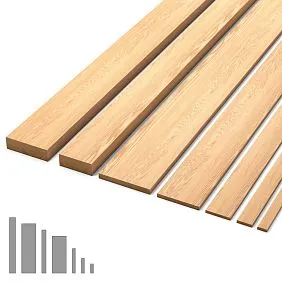
The eye follows lines. Horizontal lines expand space, vertical lines lift it. Wooden slats with a cross-section of 30×50 mm or 40×60 mm, installed strictly vertically from floor to ceiling with a spacing of 80-120 mm, create pronounced vertical lines.
The spacing of the slats influences the intensity of the effect. A dense spacing of 50-70 mm creates an almost continuous vertical texture—the effect is maximum, but the room may feel visually heavy. A medium spacing of 80-120 mm—a balance between expressiveness and lightness. A sparse spacing of 150-200 mm—a delicate effect, suitable for rooms where verticality is needed but should not dominate.
The color of the slats enhances or weakens the effect. Dark slats on a light background—contrasting verticals, read clearly, raising the height maximally. Slats matching the background color—a delicate play of relief without a pronounced graphic effect. A color gradient—dark at the bottom, light at the top—creates an illusion of the upper part of the wall receding, visually adding height.
Partial Application of Slats: Accent Wall
Slats around the entire perimeter of a room create visual unity but can overwhelm a small space. An accent wall with slats while the others are smooth and painted—a compromise. The wall opposite the entrance, the wall behind the sofa, the wall behind the headboard gets slats, the others remain plain.
The accent works as a visual focal point, attracting attention. The verticals of the slats on the accent wall pull the gaze upward, creating a sense of height for the entire room, even though the slats are only on one plane. The brain extrapolates the visual effect to the entire space.
Combination of Slats of Different Widths: Rhythm and Scale
The monotony of identical slats can be broken by combining different cross-sections. Main slats of 30×50 mm with 100 mm spacing create a basic rhythm. Every five main slats—an accent slat of 60×80 mm, protruding 30 mm further than the rest. This creates a large rhythm superimposed on a small one—visually more interesting than monotonous regularity.
Such a composition is more complex to install—requiring precise marking and cutting. But the visual effect justifies the effort—the wall turns into an architectural element with a thoughtful structure, not just a plane with slats.
Purchasing Materials: Criteria for Professional Selection
Decorative wall finishing with woodA successful project begins with a competent purchase of materials. Mistakes at this stage will manifest months later—through warping, cracking, loss of appearance. Knowing the selection criteria protects against disappointment.
Wood Moisture Content: A Critical Parameter
Freshly cut wood contains 40-80% moisture. For use in interiors, kiln drying to 8-12% is required—the so-called furniture moisture content. At this moisture level, the wood is stable and will not deform under normal air humidity fluctuations of 40-60%.
Wood with a moisture content of 15-20% is under-dried. After installation, it will continue to dry indoors, shrinking in size by 2-4%. The slats will warp, gaps will appear between them, joints will open up. Skirting boards will detach from the wall due to changes in geometry. This is defective material, but sellers often do not control moisture content, saving on drying costs.
How to check moisture when purchasing? The professional method is an electronic moisture meter, which measures moisture in seconds. The device costs 1500-3000 rubles and is accessible to everyone. Insert the moisture meter's needles into the end of the slat — the device shows the moisture percentage. The norm is 8-12%, up to 14% is acceptable. Higher — refuse the purchase.
Indirect signs of excessive moisture: wood feels cold to the touch, heavy relative to its size, and a thin slat bends easily without cracking when flexed. Dry wood is warm, light, and when attempting to bend a thin slat — it cracks and breaks.
Wood grades: aesthetics and price
Wood is divided into grades depending on the number and size of knots, presence of cracks, resin pockets, and color uniformity. The highest grade is clean wood without knots, uniform in color. First grade — rare small knots up to 10 mm in diameter, minor color variations are acceptable. Second grade — knots up to 30 mm, small cracks are acceptable, noticeable color non-uniformity.
For visible elements — slats on an accent wall, baseboards in the living room, door casings for main entrances — choose the highest or first grade. Visual cleanliness is critical. For hidden or secondary elements — framing under cladding, slats in utility rooms — second grade is acceptable. Saves 30-40% while maintaining strength properties.
Knots are not always a defect. In country, rustic, and Scandinavian styles, knotty wood creates authenticity and a connection with nature. Large knots 30-50 mm in diameter, contrasting with the main tone, add character. This is a conscious aesthetic choice, not a compromise on quality.
Surface Treatment: From Machine to Finish
Slats and baseboards are supplied in three conditions: sawn (rough surface after sawing), planed (smooth surface after planing machine), sanded (perfectly smooth surface after sanding). For interior applications, planed is the minimum requirement, sanded is better.
Planed slats have a smooth surface, but tool marks from the machine are visible under side lighting. For enamel painting — sufficient. For transparent coatings — oil, varnish, wax — additional sanding with 180-220 grit sandpaper is desirable.
Sanded slats are ready for any coating application. The surface is perfectly smooth, without processing marks. Cost is 15-25% higher than planed, but the time and effort saved on final preparation justifies the difference.
Geometry is critical for element joining. Slats must be straight — checked visually along the length. The cross-section must be consistent along the entire length — checked with calipers at the beginning, middle, and end. A tolerance of ±0.5 mm is acceptable for rough work, ±0.3 mm for precise interior solutions.
Wood species: selection based on task and style
Oak — the king of interior wood. Density of 700-750 kg/m³ provides high strength and resistance to mechanical damage. Pronounced grain with large pores creates a noble appearance. Color palette from light golden to dark brown allows matching any interior tone. Oak is 40-60% more expensive than other species, but durability and status justify the investment.
Ash — an alternative to oak with a lighter, more uniform grain. Density of 650-700 kg/m³ is close to oak, strength slightly lower. Light, coolish shade suits Scandinavian and modern interiors. Cost is on par with oak, but visually less expressive — a choice for those who value subtlety over brightness.
Beech — density 680-720 kg/m³, uniform grain with fine pattern. Pinkish tint adds warmth. Beech easily takes stains, accepting any color from light beige to dark chocolate. A universal species for any style. Cost is 20-30% lower than oak with similar strength characteristics.
Larch — a coniferous species with density 600-650 kg/m³. Natural resin content provides high resistance to moisture and biological damage. Used in wet areas — bathrooms, saunas, terraces. Amber-honey shade with contrasting annual rings creates an expressive texture. Cost is 30-40% lower than oak.
Pine — a budget species with density 500-550 kg/m³. Soft, easy to work with, but prone to mechanical damage. Light yellowish shade with noticeable knots creates a rustic look. For secondary rooms, dachas, children's rooms, where eco-friendliness is important on a limited budget. Cost is 2-3 times lower than oak.
Floor completion: baseboard as an architectural element
Perfect parquet with a plastic baseboard — destroys integrity.and paint it to the desired shade — standard practice in modern design. It is important to use special wood finishes that allow the material to breathe.— not an economy, but an investment in interior completion. A baseboard is not a technical detail hiding the gap between floor and wall, but an architectural element framing the space.
Baseboard height: proportion and style
Soviet apartments — baseboard 40-50 mm, minimalist and inconspicuous. Modern interiors require baseboards 80-120 mm, creating visual solidity. Height is chosen proportionally to ceiling height and interior style.
For standard apartments with 2.7-meter ceilings, an 80-100 mm baseboard is optimal. Visually sufficient, not overwhelming. For high ceilings 3.0-3.5 meters — baseboard 100-120 mm and above. A low baseboard in a tall room gets lost, a high one in a low room — visually oppressive.
Classical style requires profiled baseboards with beads, coves, and beads. Profile height 100-120 mm with pronounced relief creates historical authenticity. Modern style is satisfied with baseboards of rectangular cross-section without ornamentation. Purity of line, precision of geometry — the only decoration.
Wood species for baseboard: coordination or contrast
Traditional rule — baseboard matching the floor tone. Oak parquet — oak baseboard, ash floor — ash baseboard. This creates a visual extension of the floor onto the vertical, increasing perceived area.
Contrast approach — baseboard matching wall or door tone. Light whitewashed walls and doors, dark oak floor, light baseboard matching walls. Visually, the wall starts from the floor, creating a sense of height. The baseboard works as a boundary, not as a floor extension.
Economical compromise — baseboard made from a more affordable species, stained to match the floor color. Oak floor, beech baseboard stained to match oak. Visually close, cost 20-30% lower. Tactile difference is noticeable, but baseboards are rarely touched.
Baseboard installation: hidden fasteners and airtightness
Visible nails or screws ruin aesthetics. Modern wooden baseboard installation — hidden fastening with clips or adhesive. Clips are attached to the wall with screws, the baseboard snaps onto them. Dismantling is possible without damaging the baseboard — convenient for accessing utilities when needed.
Adhesive installation — polyurethane adhesive or liquid nails applied to the back of the baseboard, the baseboard is pressed against the wall. Fastening is invisible, holds securely, but dismantling destroys the baseboard. Used when confident that dismantling will not be required.
Corners are a critical zone. Cutting baseboards at a 45-degree angle in a miter box ensures a tight fit in corners. The slightest inaccuracy creates a gap that ruins the impression. Professionals cut corners on a miter saw with an accuracy of ±0.1 degrees. DIY cutting with a handsaw requires experience and patience.
Sealing joints — silicone sealant in a wood tone fills micro-gaps in corners and where the baseboard meets an uneven wall. After drying, the sealant is sanded with fine sandpaper, creating invisible seams.
Total Wood Look: harmony of different wood species
Single-species interior — all elements from one species — creates unity but can be perceived as monotonous. Combining different species adds visual interest while maintaining material unity.
Rule of dominance: 70-20-10
70% of wooden surface area — the main species. Floor, main part of wall slats, large furniture pieces. This is the visual foundation that sets the tone.
20% — the second species, contrasting or similar to the main one. Accent wall with slats of a different color, tabletop, door trims. This creates visual interest without breaking the unity.
10% — the third species or accent elements. Decorative overlays, picture frames, small furniture details. Pinpoint accents that add finishing touches.
Example: a living room with oak parquet (70%), ash slats on an accent wall (20%), walnut picture frames and overlays (10%). Three species, but visual harmony is achieved by adhering to proportions and a related color palette.
Texture contrast: expressive and calm
Oak with a large, pronounced texture is combined with beech with a fine, uniform texture. Oak slats create a bright texture, beech baseboards and trims provide a calm frame. Texture contrast creates dynamism without color clash — both species in their natural color are close in tone.
Ash with a straight, clear grain pattern is combined with walnut with chaotic swirls. Ash flooring creates a graphic foundation, walnut furniture provides organic accents. Visual diversity with material unity.
Tonal gradation: from light to dark
Floor — dark stained oak, creating a visual sense of solidity. Wall slats — oak in a natural honey shade, 2-3 tones lighter than the floor. Ceiling cornice — light whitewashed oak or ash, almost white. Gradation from dark at the bottom to light at the top visually raises the room's height, creating a sense of airiness.
Such a composition requires a single species or species with similar textures but different tones achieved through treatment. Staining, brushing, tinting, whitewashing — techniques that change the wood's color while preserving its texture.
Geographic logic: local species together
Oak, ash, beech — European species growing in the same climate. Their combination is natural. Exotic species — teak, wenge, mahogany — are better combined with each other or with neutral European species in light tones.
Mixing European oak with African wenge is visually possible but requires a precise sense of proportion. Wenge as a 10% accent with oak dominating at 70% — harmonious. Wenge at 40% and oak at 40% — a clash.
Care and durability: wood for decades
A wooden interior requires care, but minimal and logical care. Knowing the principles extends the service life of elements for decades without loss of appearance.
Choosing a finish: oil, wax, or varnish
Oil penetrates the wood, creating protection from within. The surface remains matte, pleasant to the touch, breathable. Oil emphasizes the natural texture without creating a film. Renewal is required every 1-2 years by applying a thin layer of oil to a cleaned surface. The procedure takes an hour per room and does not require professional skills.
Wax creates a matte protective film with a slight silky sheen. Pleasant to the touch, visually softer than varnish. Wear resistance is lower than varnish but higher than oil. Renewal every 2-3 years by polishing with a new layer of wax. Suitable for elements with moderate load — wall slats, cornices, decorative elements.
Varnish creates a hard protective film on the surface. Visually emphasizes texture, creates a sheen from matte to glossy. Maximum durability — withstands intensive loads, moisture, abrasion. Renewal is required every 5-7 years with complete re-sanding and re-varnishing — labor-intensive. Suitable for baseboards, floors, high-load elements.
Moisture protection: risk zones
Wooden elements near sinks, bathtubs, and shower cabins require enhanced protection. Water-based polyurethane varnish creates a waterproof film but allows vapor to pass through — the wood breathes without accumulating moisture inside. Additionally — silicone sealant in areas of direct contact with water.
Baseboards in the kitchen risk getting splashed with water, grease, and cleaning agents. Varnish finish or oil-wax with a high solid wax content protect against such impacts. Regular wet cleaning with neutral agents preserves the finish.
Seasonal fluctuations: preparing for winter and summer
In winter, air humidity drops to 20-30% due to heating. Wood releases moisture, slightly shrinking in size. Gaps of 0.5-1.5 mm may appear between slats. This is normal; in spring, when humidity increases, the gaps will close.
Critical — do not allow humidity to fall below 30%. Humidifiers, water containers on radiators, and regular ventilation maintain humidity. This protects not only the wood but also health — dry air irritates mucous membranes and reduces immunity.
In summer, humidity can rise to 70-80%. Wood absorbs moisture, expanding slightly. Gaps between slats decrease. Critical factors are room ventilation and the use of dehumidifiers in basements and first floors during excessive humidity.
Frequently asked questions
Can wooden boards be used in a bathroom?
Yes, with proper treatment and wood selection. Larch is the optimal choice due to its natural resinousness. Treatment with polyurethane varnish or oil-wax with a high wax content creates water-repellent protection. Installation with a 30-50 mm gap from the wall for ventilation of the back side of the slats. Forced room ventilation is mandatory.
After how many years does a wooden baseboard require replacement?
With proper use and care — 30-50 years. Oak baseboard is practically eternal in dry rooms. Refinishing the coating every 5-7 years extends its service life. Mechanical damage is the main reason for replacement, not material wear.
How to choose wood color to match an existing interior?
If the floor is wooden — baseboards and slats should match the tone or be 1-2 shades lighter/darker. If the floor is not wooden — look at doors and furniture. Consistency among wooden elements is more important than matching the floor. For neutral interiors — light ash or whitewashed oak. For warm ones — natural oak in a honey tone. For contrast — dark stained oak or walnut.
Is it worth buying pre-tinted slats or tinting them yourself?
Depends on the volume and color requirements. Pre-tinted slats guarantee a uniform shade for the entire batch — important for large areas. Self-tinting gives control over color saturation, but the risk of unevenness is high. A compromise — purchase several samples of tinted slats, choose a suitable shade, and order the entire batch in that shade.
Which wood species is most resistant to scratches?
Oak and ash — with a density of 700-750 kg/m³ — are maximally resistant to scratches among available species. Exotic species like merbau or iroko are even harder, but expensive and rare. Varnish coating provides additional protection. For baseboards in high-traffic areas — oak with polyurethane varnish.
Do wooden products need acclimatization before installation?
Yes, it is mandatory. Slats and baseboards delivered from the warehouse have the humidity of the warehouse environment. In the room, humidity and temperature are different. Unpack the products, lay them horizontally with gaps for air circulation, leave them for 3-7 days in the installation room. The wood will reach equilibrium moisture content, after which it can be installed without risk of deformation.
Is it possible to mix different species in one element?
Yes, and it creates a unique aesthetic. A baseboard with a body of beech and a decorative insert of walnut. A slat panel with alternating oak and ash slats. Important — similar density of species for uniform reaction to humidity fluctuations. Oak with ash — good, pine with oak — risk of different deformations.
What is the real cost of wooden finishing for a 15 square meter room?
Baseboards around the perimeter (approximately 18 meters) of oak at 1200 rubles per meter — 21,600 rubles. An accent wall of 8 square meters with slats — material 35,000 rubles, installation 16,000 rubles. Oil coating — 12,000 rubles. Total 84,600 rubles. This is the mid-range segment with oak. Budget option with pine — 45,000-55,000 rubles. Premium with carved elements — 150,000-200,000 rubles.
Wood as an investment in health and status
Synthetic materials are cheap to purchase, but require replacement in 5-10 years. A wooden interior is an investment for decades. One-time costs are offset by durability, no need for updates, and psychological and physical comfort.
The eco-friendliness of wood is not a marketing myth. Wood does not emit volatile organic compounds, formaldehyde, phenols — all of which are abundant in MDF, particleboard, and plastics. This is especially critical in bedrooms and children's rooms, where a person spends a third of their life.
The status of natural wood is understood on a subconscious level. A visitor perceives wooden surfaces as a sign of investment, taste, and long-term thinking. It is not the ostentatious luxury of gilded stucco, but the calm confidence of a person who has chosen quality.
The company STAVROS specializes in the production and supply of wooden interior elements made from solid oak, ash, beech, and larch. Slats of all sections from delicate 20×20 mm to massive 80×80 mm. Baseboards with heights from 60 to 150 mm in classic and modern profiles. Cornices, casings, moldings — a full range of millwork products for creating a wooden interior.
STAVROS production guarantees quality at every stage. Chamber drying of wood to 8-10% moisture content — stability of geometry for decades. Processing on Weinig four-sided planers — profile accuracy ±0.3 mm, perfect joining of elements. Multi-stage sanding — surface ready for any coating without additional processing.
Raw material sorting eliminates defective wood. For the highest grade, boards without knots, cracks, or color defects are selected. For the first grade — with minimal knots up to 10 mm in diameter. Quality control at the output checks the geometry, smoothness, and absence of defects of each product.
Finishing treatment with oils and varnishes from European manufacturers Osmo, Renner, Sayerlack guarantees durable protection. Natural oils based on linseed and soybean, with hard waxes and UV filters. Water-based acrylic varnishes — eco-friendly, odorless, fast-drying.
Custom production implements projects of any complexity. Slats of non-standard sections, baseboards according to author's sketches, hand-carved overlays. Minimum order from 10 linear meters, production time 7-14 days.
Logistics ensures delivery to Moscow, St. Petersburg, and all of Russia. Packaging in shrink film protects against moisture and mechanical damage. Long items up to 3 meters are transported by special transport without breakage.
Technical support consults at all stages. Selection of wood species for room specifics and style. Calculation of quantity considering trimming and reserve. Recommendations for installation and finishing. Problem-solving during operation.
Create interiors where wood is not just a finish, but the essence of the space. Where every surface breathes, lives, reacts to touch. Where naturalness is more important than imitation, durability over disposability, tactility over visual deception. STAVROS provides materials, knowledge, and technologies to embody such a philosophy of space, where wood restores the connection with nature in an urban environment.


