












































































Article Contents:
- Solid wood skirting - characteristics, pros and cons
- What is 'solid wood' in relation to skirting
- Technical characteristics of wooden skirting
- Advantages of solid wood skirting
- Disadvantages of wooden skirting
- Polyurethane skirting - lightness, moisture resistance, wood imitation
- What is two-component polyurethane and why it's 'European'
- Technical characteristics of polyurethane skirting
- Advantages of polyurethane skirting
- Disadvantages of polyurethane skirting
- Comparison table: wood vs polyurethane
- When to choose wooden skirting - dry rooms, parquet, classic style
- Mandatory scenarios for solid wood
- Rooms for wooden skirting
- When to choose polyurethane - bathroom, kitchen, wet rooms
- Absolute scenarios for KPU series
- Best KPU series profiles for different tasks
- Combination: wooden floor + polyurethane ceiling skirting
- Why this combination works
- Specific combinations for different styles
- What not to combine
- Combination within one apartment: room-by-room strategy
- FAQ: Answers to Popular Questions
- About the Company STAVROS

The question 'what to choose - wood or polyurethane?' is asked with every renovation. And most often it's answered incorrectly - out of habit, based on the principle 'wood is always better' or 'polyurethane is cheaper, so it's worse'. Both judgments are wrong. The correct answer depends on the room, style, budget and specific task.
Wooden baseboardSolid wood is a living natural material with character, texture and a lifespan of half a century.Polyurethane skirting boardPolyurethane is a high-tech product made from European two-component polyurethane that weighs several times less than wood, is not afraid of moisture, and installs faster and easier.
This is not competition. These are two different tools for different tasks. In this article, we'll examine both - honestly, with characteristics, prices and specific recommendations. At the end - the answer to the main question: can and should they be combined in one interior.


Solid wood skirting - characteristics, pros and cons




What is 'solid wood' in relation to skirting
When people say "wooden skirting board," they mean a millwork product cut from solid timber—not glued, not pressed, not laminated. Solid wood. Cedar, oak, beech, ash, larch—each species with its own physical properties, its own texture, and its own surface character.
STAVROSwooden K-series millwork— these are beech and oak, kiln-dried to 8–10% moisture content, 3D-milled, hand-sanded. Over 30 profiles—from the minimalist K-034 at 230 rub./lm to the monumental K-104 at 6,060 rub./lm.
Our factory also produces:


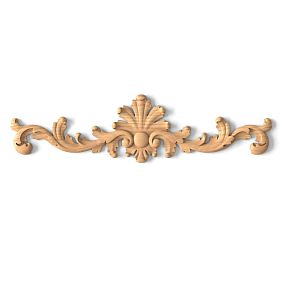


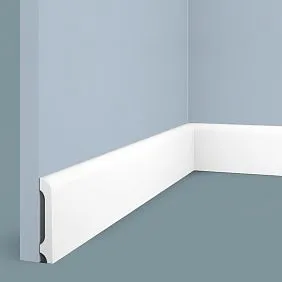
Technical specifications of wooden skirting board
Density: beech — 670–720 kg/m³, oak — 700–750 kg/m³. These are "living" figures: each log is slightly different. High density means high rigidity, excellent machinability with a router, and the ability to carve precise, fine profile details.
Moisture content after kiln drying: 8–10%. This is a critical parameter. A skirting board with higher moisture content (fresh "green" wood) will dry out and warp after installation. STAVROS supplies exclusively kiln-dried material.
Dimensional stability: wood "breathes"—it expands with increased air humidity and contracts with decreased humidity. This is precisely why the skirting board is installed with an expansion gap against the wall, and the back side is always treated during final painting—this reduces water absorption.
Mechanical strength: oak withstands a point load of 4.0 kN/mm² (Brinell hardness). Resistant to dents from furniture and mechanical impacts.
Service life with proper finishing: 30–50 years without loss of appearance under normal use.
Get Consultation
Advantages of solid wood skirting board
Living texture. No synthetic material reproduces the living pattern of wood with a transparent finish. Oak medullary rays, beech's uniform silky tone, ash's wavy fibers—these are what you see up close and what never gets old. A transparent finish for a wooden skirting board is an option unavailable for MDF or polyurethane.
Repairability. A wooden skirting board, if damaged, can be sanded and repainted or re-varnished. A scratch, chip, or scuff—all can be fixed without replacement. This is especially important with active use (children, pets).
Monumentality. The solid oak K-066 skirting board (from 2,580 rub./lm) with a rich profile is a substantial architectural element. Its "heaviness" is felt physically: it is indeed several times heavier than a polyurethane equivalent. And this heaviness is an asset in a classic interior. It creates a sense of solidity, permanence.
Eco-friendliness. Natural wood is a 100% natural material. When using water-based oils and varnishes—completely neutral in terms of emissions.
Unity with wooden flooring. Oak parquet + oak skirting board from the same batch—a unified natural ensemble. This cannot be achieved with any other material.
Disadvantages of wooden skirting board
Weight. The oak K-070 skirting board (80 mm × 20 mm × 2.4 m) weighs about 2.8–3.0 kg. This is noticeable during installation: you either need to hold the skirting board pressed until the adhesive sets, or additionally secure it with finishing nails. Working alone is more difficult than with lightweight polyurethane.
Price. Solid wood is more expensive than polyurethane for a comparable profile. K-066 at 2,580 rub./lm vs. KPU-series from 840 rub./lm—the difference is significant. For a large area, this translates into a noticeable budget difference.
Room requirements. Wood is for dry rooms. Bathroom, kitchen (by the sink), sauna—areas where wooden skirting board requires special treatment or is replaced with polyurethane.
Difficulty of corner installation. Dense solid wood when mitering corners requires precise work with a miter saw. Tear-out on the end grain is a typical error when working with a dull saw or when cross-cutting without support.
Polyurethane skirting board—lightweight, moisture-resistant, wood imitation
What is two-component polyurethane and why is it "European"
Polyurethane (PU) is a synthetic polymer obtained from the reaction of a polyol and an isocyanate. Two-component polyurethane involves mixing the two components immediately before casting the product, ensuring more complete polymerization and, consequently, higher hardness and chemical resistance of the final product.
"European" is not a marketing term, but a technical characteristic: the formula of European polyurethane producers ensures free isocyanate content below maximum permissible limits, which is important for living spaces. Cheap Asian polyurethane may have higher emissions.
In the STAVROS catalog—KPU-series: 30+ profiles made from two-component European polyurethane, from KPU-125 (840 rub./lm) to KPU-012 (20,590 rub./lm).
Technical specifications of polyurethane skirting board
Density: 300–450 kg/m³ (depends on the formulation). 1.5–2.5 times lighter than solid wood. The KPU-034 skirting board (analogous in shape to the oak K-034) weighs 2.5 times less than its wooden counterpart.
Moisture resistance: absolute with proper painting. Polyurethane does not absorb water. No swelling, no deformation. Critically important: an unpainted polyurethane skirting board is a "semi-finished product." It must be painted before installation: painting creates the final protective surface.
Temperature range: −40°C to +80°C without deformation. This allows the KPU-series to be used on verandas, in unheated rooms, in rooms with underfloor heating (floor temperature up to +40°C is normal).
Profile reproduction accuracy: exceptional. Polyurethane is cast in a mold with an accuracy of up to 0.1 mm. The most complex floral ornaments, which in wood would be extremely expensive (hand carving), are reproduced serially in polyurethane. KPU-012 (20,590 rub./lm) and KPU-062 (14,540 rub./lm) are monumental cornices with rich molding, which in hand-carved wood would cost 10–20 times more.
Service life: 20–30 years with proper use. Longer with timely repainting.
Advantages of polyurethane skirting board
Moisture resistance without additional conditions. KPU series — first choice for bathroom, kitchen, basement, balcony, hallway. No special coatings, no 'only if' conditions. Paint and install — works in any humidity.
Easy installation. Weight of KPU-125 (840 rub./lm) — about 0.3 kg/lm. One person installs without assistance. PVA D3 glue or liquid nails hold the lightweight polyurethane profile without finishing nails in most cases.
Rich profiles at an affordable price. KPU-077 (6,520 rub./lm) — a profile with floral ornamental richness that in wood can only be reproduced by custom hand carving for 30,000–50,000 rub./lm. In polyurethane, this is a serial product.
Bendability. Polyurethane profiles are softer than solid wood: they can be slightly bent for installation on uneven surfaces. For walls with 3–5 mm vertical deviation — polyurethane skirting board will 'press' against the wall, wooden may leave a gap.
Perfect corner geometry. 45° cut in polyurethane — clean, without material tearing. Joints in corners give minimal gap.
Disadvantages of polyurethane skirting board
Impossibility of transparent finish. Polyurethane is synthetic. Its surface is uniform, without texture. Only painting. For interiors with natural wood under oil or varnish — polyurethane is not applicable: it will look like 'plastic' next to 'live' wood.
Lower mechanical strength. Hardness of polyurethane is lower than oak. With direct impact (e.g., from moving furniture corner) — polyurethane may chip or dent. Oak in the same situation will only leave a scratch.
Limited repairability. Deep chip in polyurethane skirting board — only putty and repaint. With significant damage — section replacement. Wood in the same situation — sanding and varnish.
Need to paint before installation. This is both a plus (painting done in convenient conditions) and a minus (cannot install 'as is', white unpainted products are a temporary state, not finish).
Comparison table: wood vs polyurethane
| Parameter | Wooden skirting board | Polyurethane skirting board |
|---|---|---|
| Material | Solid beech / oak | Two-component polyurethane |
| Density | 670–750 kg/m³ | 300–450 kg/m³ |
| Weight per 1 lm (80 mm profile) | ~1.2–1.4 kg | ~0.4–0.6 kg |
| Transparent finish | Yes (oil, varnish) | No |
| Moisture resistance | When coated | Absolute |
| Mechanical strength | High | Medium |
| Installation difficulty | Medium | Low |
| Repairability | High | Medium |
| Richness of profiles | High | Maximum |
| Basic profile price | from 230 rub./lm | from 840 rub./lm |
| Rich profile price | from 2,580 rub./lm | from 6,520 rub./lm |
| Monumental price | from 6,060 rub./lm | from 13,500 rub./lm |
| Service life | 30–50 years | 20–30 years |
| For bathroom, kitchen | With special treatment | Yes, without restrictions |
| Unity with wooden floor | Complete | Only when painting |
When to choose wooden skirting — dry rooms, parquet, classic
Mandatory scenarios for solid wood
Scenario 1: Oak parquet or engineered wood flooring. The only correct choice isWooden baseboardoak of the same treatment. Oak K-006 or K-070 with 'natural' oil finish next to oak parquet with the same oil — indistinguishable unity. Polyurethane next to it — plastic next to living wood.
Scenario 2: Natural finish — oil, wax, clear lacquer. Transparent finish is only possible on solid wood. If the interior design decision involves transparent finish for all wooden elements (skirting, architrave, curtain cornice) — only solid wood.
Scenario 3: Classic study, library, director's office. Spaces where the 'solidity' of the material is part of the architectural message. Heavy oak skirting K-066 or K-104 is a 'statement' that polyurethane, despite its rich profile, cannot make on a physical level.
), woodenstaircase components— wooden skirting in this context is mandatory. Material unity is a systemic solution.Furniture legsScenario 4: High-end residential interior with wooden elements. Wooden doors, wooden staircase (
Scenario 5: Interior designed for 20+ years. With a planning horizon of 20–30 years, wooden skirting is the best investment: repairable, does not become morally obsolete (natural wood is timeless), with proper care retains its appearance for decades.
Rooms for wooden skirting
-
Living room ✓
-
Bedroom ✓
-
Study ✓
-
Children's room (with proper coating) ✓
-
Hallway-entrance (medium load) ✓
-
Kitchen (areas away from sink, with polyurethane lacquer) △
-
Bathroom ✗ (only larch with special coating — with major reservations)
When to choose polyurethane — bathroom, kitchen, wet rooms
Absolute Scenarios for KPU Series
Scenario 1: Bathroom. Unconditionally — polyurethane. KPU-125 (840 rub./lm) or KPU-034 (2,040 rub./lm) — a moisture-resistant skirting board that will withstand daily condensation, splashes, wet cleaning with detergents. Without limitations.
Scenario 2: Kitchen (entire area). For the kitchen as a space with moisture and grease — polyurethane is optimal. Especially in areas near the sink and stove. Acrylic enamel coating creates an easy-to-clean surface.
Scenario 3: Balcony, veranda, glazed loggia. Temperature fluctuations, occasional water exposure — difficult conditions for wood. Polyurethane operates from −40°C to +80°C without deformation.
Scenario 4: Basement, ground floor, garage. Elevated constant humidity — only polyurethane.
Scenario 5: Classic formal interior with rich molding on a limited budget. KPU-062 (14,540 rub./lm) — a monumental profile with floral ornamentation, which in wood would require hand carving for incomparably more money. To achieve the richest possible decor on a reasonable budget — the KPU series.
Scenario 6: Arched openings, columns, curved surfaces. Polyurethane bends. For skirting boards on a radius wall, around a semicircular column, on an arched slope — only polyurethane: bending wood without cutting is practically impossible.
Best KPU Series Profiles for Different Tasks
For the bathroom (moisture-resistant basic):
-
KPU-125 (840 rub./lm) — minimalist, for a modern bathroom
-
KPU-105 (860 rub./lm) — slightly more substantial
For the kitchen (mid-level):
-
KPU-034 (2,040 rub./lm) — moderately classical
-
KPU-020 (2,730 rub./lm) — substantial
For a classic hall (rich profile):
-
KPU-006 (3,060 rub./lm), KPU-003 (from 3,060 rub./lm) — expressive
-
KPU-077 (6,520 rub./lm), KPU-118 (6,880 rub./lm) — monumental
-
KPU-081 (13,500 rub./lm), KPU-064 (13,500 rub./lm) — executive level
-
KPU-012 (20,590 rub./lm) — the flagship of the KPU series
For a formal hall with molding:
-
KPU-074 (13,500 rub./lm), KPU-062 (14,540 rub./lm), KPU-011 (15,590 rub./lm) — palatial level
-
KPU-094L / KPU-094R (6,880 rub./lm each) — paired corner elements for a complete cornice ensemble
Combination: wooden floor + polyurethane ceiling
Why This Combination Works
Question: Can you combine a wooden floor skirting board and a polyurethane ceiling cornice?
Answer: Yes — provided one mandatory condition is met. Both elements must be painted in a unified color from the same can of paint.
The logic is simple: a wooden floor skirting board works in an area where physical strength and repairability are important. A polyurethane ceiling cornice works in an area where physical load is minimal, but ease of installation and the ability to create a complex ornamental profile without additional costs are crucial.
This is a working designer strategy actively used in professional projects.
Specific Combinations for Different Styles
White Neoclassicism:
-
Floor: K-006 (oak, white matte enamel)
-
Ceiling: KPU-006 (white matte enamel — same can)
-
Result: a unified white system with different ornamental levels (cleaner at the bottom, richer at the top). Works perfectly.
Classic with "golden patina":
-
Floor: K-070 (oak, acrylic enamel "ivory" + golden patina on the ornament)
-
Ceiling: KPU-077 (same enamel + same patina)
-
Result: a monumental classic ensemble. The ceiling cornice is richer than the floor baseboard — this is the correct proportion.
Scandinavian white:
-
Floor: K-034 (beech, white matte oil)
-
Ceiling: KPU-125 or KPU-034 (white matte enamel)
-
Result: visually indistinguishable with a unified white finish. An economical and correct solution.
What not to combine
Do not: wood under transparent oil / varnish + polyurethane in the same "natural" tone. Imitation wood in polyurethane always loses to real wood in direct comparison. Side by side — the contrast will be obvious.
Do not: different ornamental levels without intent. A laconic wooden K-034 at the bottom + a monumental KPU-081 at the top — chaos. The baseboard and cornice should belong to the same or adjacent ornamental registers.
Do not: different colors without a design solution. White baseboard + "wood" ceiling cornice — only if it is a conscious contrast, supported by other pairs of contrasts in the interior.
Combining within one apartment: a room-by-room strategy
Professional approach during a full apartment renovation:
| Room | Floor baseboard | Ceiling cornice |
|---|---|---|
| Living room | K-070 oak, oil | KPU-077 white enamel |
| Bedroom | K-006 oak, oil | KPU-034 white enamel |
| Office | K-066 oak, varnish | KPU-006 under patina |
| Children's room | K-034 beech, white enamel | KPU-125 white enamel |
| Kitchen | KPU-034 white enamel | KPU-020 white enamel |
| Bathroom | KPU-125 white enamel | KPU-125 white enamel |
| Corridor | K-006 oak, oil | KPU-004 white enamel |
Logic: in living spaces — solid wood at the bottom (durability, texture), polyurethane at the top (richness of profile, ease of installation). In wet areas — polyurethane everywhere. Unified painting — unity of the system.
FAQ: Answers to popular questions
Wooden or plastic baseboard — is there a third option?
Yes: polyurethane. This is not "plastic" in the common household sense — it is a two-component polyurethane of European production with fundamentally different technical characteristics. In the question "plastic or wooden skirting board," polyurethane is the third, and often the best choice for both wet and formal rooms simultaneously.
Is a polyurethane skirting board the same as polyurethane molding?
In terms of material — yes.Polyurethane moldingsand the KPU-series skirting board are made from the same material — two-component polyurethane. The difference is in the form: a skirting board is a linear profile, molding is three-dimensional decorative elements (rosettes, medallions, cartouches).
Can a wooden skirting board be installed on underfloor heating?
Yes, with chamber drying to 8–10%. The temperature of the underfloor heating at the skirting board is up to +30°C. This is safe for well-dried solid wood provided that the skirting board is not tightly pressed against the floor (a 2–3 mm expansion gap, sealed with sealant).
Buy wooden or polyurethane skirting board — which is more cost-effective for a large area?
Depends on the profile. Basic profiles: K-034 (230 rub./lm) vs KPU-125 (840 rub./lm) — wood is cheaper. Rich profiles: K-066 (2,580 rub./lm) vs KPU-077 (6,520 rub./lm) — wood is cheaper with comparable ornamentation. But monumental molding: KPU-012 (20,590 rub./lm) in hand-carved wood would cost 5–10 times more.
How to coordinate polyurethane decor on the ceiling with a wooden skirting board?
Unified painting. One color (RAL), one brand of paint, one can. Wood and polyurethane under the same white matte enamel are visually indistinguishable. Different colors — only with a deliberate design decision.
How securely does polyurethane molding hold on the ceiling?
On a concrete ceiling: liquid nails (acrylic) + 40 mm finishing nails. On drywall: liquid nails + screws into the backing. The load-bearing capacity of a KPU-series polyurethane cornice with proper installation is over 10 years without deformation.
About the company STAVROS
Choosing between a wooden skirting board and a polyurethane one is not a question of "what is better in general." It is a question of "what is right for a specific room, specific style, and specific budget." And there is always a correct answer — if you know the capabilities of both materials.
STAVROS produces both systems:wooden K-series millwork— over 30 profiles from solid beech and oak, from 230 to 6,060 rub./lm; andpolyurethane moldings of the KPU series— over 30 profiles from two-component European polyurethane, from 840 to 20,590 rub./lm.
This is a unified production system where profiles K-006 and KPU-006 are "twins" in form and "opposites" in material. This allows building any combinations within a single interior while preserving ornamental unity.
Additionally:Polyurethane Decorfor walls and ceilings,Furniture legssolid wood,wooden cornices KZ-seriesfor curtains,Architraves and moldingsfrom the unified K-series — a complete ensemble for any room from a single source.
Stock program. Shipment on the day of order. Delivery throughout Russia and CIS countries.
STAVROS is when you don't have to choose between beauty and practicality. You can have both — in the right places.


