Article Contents:
- Linear Elements as the Language of Modern Architecture
- Wooden Block: Structural Foundation and Decorative Element
- Wooden Batten: Verticals and Horizontals of Interior Space
- Wood Species: Oak vs. Beech in Interior Solutions
- Application of Blocks and Battens in Interior Architecture
- Frame systems
- Decorative panels
- Ceiling structures
- Furniture manufacturing
- Installation and Structural Features
- Acclimatization
- Fastening methods
- Compensatory gaps
- Finishing Treatment: From Natural Tone to Radical Transformations
- Oil finishes
- Lacquer systems
- Staining
- Painting
- Integration into various interior styles
- Scandinavian minimalism
- Japanese aesthetics
- Industrial loft
- Modern classicism
- Usage Economics and Material Calculation
- Technological Nuances of Working with Different Wood Species
- Oak: Strength Demands Respect
- Beech: Hygroscopicity as a Feature
- Modern Trends in the Application of Battens and Blocks
- Biophilic design
- Acoustic comfort
- Integration of Lighting
- Zoning without partitions
- DIY Installation or Professional Installation?
- Required Tools
- Typical mistakes of beginners
- Care and Maintenance of Wooden Elements
- Ecological sustainability and development
- Combination with other materials
- Wood and metal
- Wood and stone
- Wood and glass
- Custom solutions and customization
- Historical Perspective: From Log Cabins to Modern Interiors
- Psychological Impact of Wooden Elements
- Frequently Asked Questions
- Is It Possible to Combine Different Wood Species in One Project?
- Which Finish to Choose for High-Humidity Rooms?
- How Long Does It Take to Install Batten Wall Cladding?
- Can Wooden Battens Be Used on an Unheated Porch?
- How to Calculate the Required Amount of Linear Materials for a Project?
- Do Wooden Elements Require Special Care?
- Can Finished Products Be Painted in a Non-Standard Color?
- How do wooden elements affect room acoustics?
- Is Installation on Uneven Walls Possible?
- What Interval Between Planks is Optimal?
- Conclusion: Partnership with Professionals

Look at any high-status interior — be it a luxurious penthouse or a country residence — and you will see what unites these spaces: linear architectonics, the expressiveness of horizontals and verticals, meaningful geometry. Behind this visual harmony lies a system in whichWooden blockandWooden plankthey act not merely as finishing materials, but as tools for creating architectural space. These elements shape the tectonics of a room, organize wall and ceiling planes, and set the rhythm of perception.



Linear Elements as the Language of Modern Architecture
Why now, in the era of minimalist spaces and high technology, are wooden elements experiencing a renaissance? The reason is simple: amidst a sea of artificial materials, people yearn for the tactile warmth of natural wood, for its ability to breathe, age gracefully, and change hue under the sun's rays. Solid wood blocks and slats become carriers of natural aesthetics in the urban environment. They bring into the concrete boxes of modern apartments what no plastic can—the feeling of a living material.
Wooden boards in interiorThey work like a tuning fork, setting the space to a specific wavelength. When vertical slats rise from floor to ceiling at even intervals, they visually elongate the room, making it taller and more airy. Horizontal arrangement, on the contrary, expands narrow corridors and small rooms, creating an impression of spaciousness where it physically doesn't exist.
But it's not just about optical illusions. It's about a fundamental principle of architectural composition—rhythm. The human eye is designed to seek patterns, regularities, repeating elements. When we see a series of slats with identical spacing, the brain automatically perceives the space as ordered, thoughtful, harmonious. Chaos turns into cosmos—in the direct ancient Greek sense of the word.




Wooden block: structural foundation and decorative element
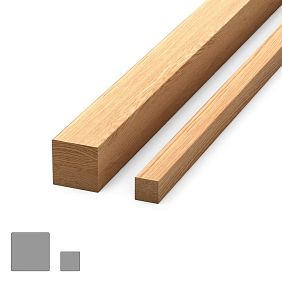
What is a wooden block from a construction standpoint? It is a millwork product of rectangular cross-section, made from solid wood by planing. The key difference from an ordinary board is the precise geometry of all four faces and dimensional stability along the entire length. The tolerance for deviation is no more than half a millimeter per meter of length, which is critically important when creating composite structures where parts must fit tightly together.
The cross-section of the block varies widely—from compact 20×30 millimeters to massive 60×80 millimeters. The choice of size is determined by the element's function in the project. Thin blocks are used to create elegant frame compositions, panel framing, and lightweight partitions. Thick blocks become the load-bearing frame for wall structures, the base for cladding attachment, and supporting elements for furniture.
Wood species for making blocks are selected based on requirements for strength, decorative appeal, and project budget. Oak holds a leading position due to its density of about 700 kilograms per cubic meter, expressive grain with contrasting annual rings, and natural nobility of hue. An oak block is perceived as a material with history and status—even a small oak detail adds weightiness to an interior.
Beech is an alternative for those who value uniformity and softness of texture. A beech block has a light, almost creamy tone with a slight pinkish hue, a fine-grained structure without sharp transitions. It is the perfect background for interiors where wood should be present but not visually dominate. Beech takes staining excellently, allowing for any color solutions from natural to exotic shades.
Our factory also produces:


Wooden slat: verticals and horizontals of interior space
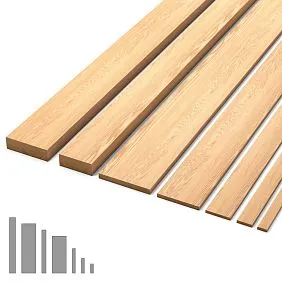
If a block is the foundation, the skeleton of a structure, then a slat is its visible face, its decorative shell. A slat is a thinner element compared to a block, typically with a cross-section from 15×40 to 30×60 millimeters. It is precisely slats that form those linear compositions seen today in every second project from leading architectural firms.
Mounting slats on walls has become a real trend in recent years. Why? Because this technique solves several problems at once. First, it masks surface defects—minor unevenness, cracks, old finishes. Slats are attached to a frame made of blocks, which is leveled, resulting in a perfectly even final surface. Second, a space is created between the slats and the base wall where soundproofing materials, hidden wiring, and LED strips for lighting can be integrated.
Third, and most importantly, slatted structures create volume where there was none. A flat painted wall is just a background. But a wall clad with wooden slats with gaps is a complex tectonic structure that changes depending on lighting. In the morning, when light falls at an acute angle, deep shadows form between the slats, emphasizing the relief. During the day under diffused light, the surface appears more uniform, and in the evening under artificial light, completely new effects are achieved, especially if lighting is built into the gaps between the planks.
Get Consultation
Wood species: oak versus beech in interior solutions
The choice of wood species is not only a budget question but a fundamental decision determining the character of the interior. Oak and beech products with the same cross-section create diametrically opposite visual impressions.
Oak is a material with pronounced individuality. Each oak slat is unique thanks to the pattern of annual rings, medullary rays (radial stripes on a tangential cut), and natural tannins that give the wood its yellow-brown range. When you assemble a wall from oak slats, each plank becomes a separate element of the composition. The eye distinguishes the texture, follows the transitions of hues, reads the natural code of the wood. This is a narrative interior, where the material speaks its own language.
Oak wood contains a large amount of tannins, which give it not only its characteristic color but also natural protection against fungus, mold, and wood-boring insects. Historically, oak was used in shipbuilding precisely because of its resistance to moisture and biological factors. In interiors, these properties translate into exceptional durability—oak finishes last for decades without changing performance characteristics.
Beech offers a completely different aesthetic—the aesthetic of uniformity and visual neutrality. Beech wood has a fine-grained structure without contrasting transitions, a light tone with a slight pinkish or creamy hue. When a wall is clad with beech slats, they are perceived not as a set of individual elements but as a single textured surface. What comes to the fore is not the material, but the form—the rhythm of verticals or horizontals, the geometry of the composition, the play of light and shadow between the planks.
Beech has high hygroscopicity—it more actively absorbs moisture from the air and just as readily releases it when humidity decreases. This property requires stable operating conditions. In rooms with constant temperature and humidity, beech behaves perfectly, maintaining geometry and surface finish. But under conditions of sharp fluctuations—for example, in unheated country houses or damp bathrooms—beech products can deform.
Application of blocks and slats in interior architecture
How exactly are these millwork elements used in real projects? The range of applications is impressively broad—from rough construction structures to delicate decorative details.
Frame Systems
The block becomes the basis for creating wall panels without using large-format sheet materials. A lattice frame is mounted on the wall with a spacing of 400-600 millimeters vertically and horizontally. Such a framework serves a dual function: it levels the plane, compensating for defects in the base wall, and creates an air gap for ventilation, preventing condensation buildup.
Sheets of plywood, MDF, drywall, or directly the final cladding—the same wooden slats—are attached to the frame. The rigidity of the structure is ensured by the correct spacing of the blocks and the quality of fastening. Screws are driven into pre-drilled holes—this prevents wood splitting, especially critical for oak blocks with their high density.
Decorative Panels
Slats on walls create a boiserie effect—classical French paneling with framed panels. The modern interpretation of this technique uses not carved elements but laconic rectangular slats forming geometric sections. The wall is divided into rectangles or squares, inside which there can be contrasting paint, wallpaper, fabric, or mirror inserts.
This solution is especially effective in high-ceilinged rooms—vertical and horizontal division reduces the pressure of large planes, making the space more intimate and cozy. Panel proportions are selected according to the golden ratio or modular systems with repeating sizes are used.
Ceiling structures
Wooden slats on the ceiling transform it from an unnoticed plane into an architectural element. Slats are mounted on a ceiling frame with gaps, between which LED strips or spotlights are integrated. Light filtering through the gaps creates a rhythmic pattern, visually structuring the ceiling.
An alternative option is coffered ceilings, where slats and blocks form recessed cells. This is a classical technique originating from ancient architecture, where coffers were a structural necessity. In modern interiors, coffers are purely decorative elements, adding volume and status to a room.
Furniture manufacturing
Blocks and slats are used in furniture making as both structural and decorative elements. The frame of a table, chair, or cabinet is assembled from blocks using mortise and tenon joints, ensuring strength and durability. Cabinet fronts are clad with slats, creating a relief texture instead of smooth panels.
Open shelving made of horizontal slats fixed to a metal frame has become a hit in minimalist interiors. The wood softens the coldness of the metal, adding warmth and naturalness to the industrial aesthetic.
Installation and structural features
Professional installation of wooden elements requires an understanding of wood physics and precision in measurements. Wood is a living material that continues to react to changes in humidity and temperature even after processing and installation.
Acclimatization
The first rule is that any wooden products must undergo acclimatization in the room where they will be installed. Molding is delivered from the factory in packaging where it was stored under specific conditions. A sudden change in environment will lead to deformations—bending, twisting, cracking.
The acclimatization procedure is simple: the products are unpacked, laid horizontally with spacers between layers for air circulation, and left for 2-3 days at a temperature of 18-22 degrees and humidity of 40-60 percent. During this time, the wood equalizes its internal moisture with the surrounding environment.
Mounting methods
There are three main methods for fixing slats and battens: adhesive, mechanical, and combined.
The adhesive method is used for thin slats on flat surfaces. Mounting adhesives for wood, liquid nails, and polyurethane compounds are used. The adhesive is applied in a zigzag line on the back of the slat, the element is pressed against the wall and fixed until the adhesive sets using painter's tape or temporary supports.
Mechanical fastening is necessary for massive elements and structures under high load. Finish nails without heads or with countersunk heads, screws, and hidden clips are used. An important point—pilot holes slightly smaller than the diameter of the nail or screw must be drilled for the fasteners. This prevents the wood from splitting, especially when working with oak.
The combined method combines adhesive and mechanical fastening. The adhesive ensures tight contact over the entire contact area, while the fasteners hold the element in the desired position until the adhesive fully sets and take on part of the load during use.
Expansion gaps
Wood expands and contracts with changes in humidity. The coefficient of linear expansion is about 0.3 percent, which for a three-meter slat results in a length change of up to a millimeter when humidity fluctuates from 40 to 60 percent. To avoid warping, expansion gaps of 1-2 millimeters are left between the ends of the elements.
These gaps are covered with decorative overlays, elastic wood putty, or silicone sealant matching the wood color. Rigid filling of gaps is unacceptable—it blocks the natural movement of the material, leading to internal stresses and cracks.
Finishing: from natural tones to radical transformations
The choice of finish coating determines not only the appearance of wooden elements but also their performance characteristics—resistance to moisture, dirt, and mechanical damage.
Oil finishes
Hard wax oil penetrates the wood structure, filling pores and fibers. This does not create a surface film like varnish but modifies the top layer of wood from within. The oil highlights the grain, makes shades more saturated, and gives the surface a matte silky sheen.
The main advantage of oil treatment is the possibility of local repair. If an area is damaged, it is enough to sand it with fine-grit abrasive and reapply oil. The updated fragment blends perfectly with the rest of the surface without repair marks.
Oil is applied in 2-3 coats with intermediate sanding. The first coat raises the wood grain—tiny fibers stand up. Sanding with 320-400 grit abrasive cuts this grain, making the surface smooth. Subsequent coats are absorbed without raising the grain, creating an even protective coating.
Urethane coatings create a wear-resistant, high-strength finish for heavily used surfaces. Acrylic formulations provide an eco-friendly coating for residential spaces with children.
Varnish forms a hard transparent film on the wood surface. This is a barrier that isolates the wood from external influences—moisture, dirt, ultraviolet light. Varnishes are divided into glossy, semi-matte, and matte depending on the degree of gloss.
Glossy varnish enhances the contrast of the grain, making the color deeper and more saturated. It is ideal for oak products, where the pronounced grain becomes the main decorative element. Matte varnish preserves the natural look of the wood, adding only a slight silky sheen and protection from dirt.
Varnish is applied with a spray gun to achieve an even coating without drips or runs. An alternative is application with a flat-bristle brush, requiring more skill. Each coat is sanded after drying to remove dust and minor defects.
Staining
Stains and tinting oils change the color of the wood while preserving the visibility of the grain. This is a way to imitate expensive exotic species or create non-standard color solutions. Oak can be tinted from light golden to almost black bog oak shade. Beech accepts any colors—from classic walnut to modern gray and graphite tones.
Tinting requires a preliminary test on a sample from the same batch of wood. The same composition gives different shades on oak and beech, on tangential and radial cuts. Stain is applied with a brush or sponge in an even layer along the grain, excess is immediately removed with a clean cloth.
Painting
Opaque paints completely hide the wood grain, turning it into a colored surface. This is a solution for modern minimalist interiors, where purity of form is important, not the display of material. Black, white, gray slats create graphic compositions where wood acts as a structural but not decorative element.
Painting requires thorough preparation—sanding, priming, filling minor defects. Paint is applied in two coats with intermediate sanding. Modern water-based compositions ensure environmental friendliness, quick drying, and no odor.
Integration into various interior styles
The versatility of wooden battens and slats is manifested in their ability to organically fit into a wide variety of stylistic concepts.
Scandinavian minimalism
Light beech or white-painted slats on walls and ceilings are the hallmark of Scandinavian style. A sparse rhythm of wide planks with large gaps creates a sense of air and light. The wood is treated with oil or white translucent paint through which the grain shows.
The Japanese philosophy of wabi-sabi, which recognizes the beauty of imperfection, is reflected in the modern approach to wooden decor. Natural imperfections of wood and its inherent asymmetry are increasingly viewed not as flaws, but as unique characteristics.
Thin slats with a frequent pitch form traditional Japanese shoji screens. In a modern interpretation, matte glass that diffuses light is used between the slats instead of rice paper. Light-toned wood is chosen, with the most natural treatment—clear oil without tinting.
Industrial loft
Rough, unpainted oak battens with pronounced grain and knots combine with brickwork, concrete surfaces, and metal structures. Wood softens the coldness of industrial materials, bringing warmth and naturalness. Treatment is minimal—brushing to emphasize texture and oil for protection.
Modern classic
Oak panels with frame construction, where battens form rectangular sections, refer to classic boiserie but executed in a laconic modern manner without carving or gilding. The wood is tinted in noble dark shades—walnut, wenge, bog oak. The coating is semi-matte varnish, highlighting the grain without excessive gloss.
Economics of use and material calculation
Planning a project budget requires an accurate calculation of the required amount of molding. For a standard room of 20 square meters with a ceiling height of 2.7 meters and a wall perimeter of about 18 meters, the following will be required:
For full wall cladding with vertical slats with gaps equal to the width of the slat (slat 40 mm, gap 40 mm), there are 12.5 slats per linear meter of wall height. For a room with a perimeter of 18 meters and a height of 2.7 meters, approximately 600 linear meters of slats will be needed.
When creating frame panels, where slats are used only for framing sections, the consumption is reduced to 80-120 linear meters depending on the size and number of panels.
The cost of wooden moldings varies widely depending on the wood species, cross-section, and finish. Planed pine battens start from 50 rubles per linear meter, beech from 200 rubles, and oak from 300 rubles. Battens with a final finish (oil, varnish, tinting) are 30-50 percent more expensive than unfinished ones.
The durability of high-quality wooden moldings with a protective coating is 30-50 years without the need for replacement. This makes the investment in natural wood economically justified in the long term compared to cheaper but less durable materials.
Technological nuances of working with different wood species
Each wood species has its own characteristics that must be considered during processing and installation.
Oak: Strength demands respect
The high density of oak makes it strong and durable but creates difficulties in processing. Sawing oak is more difficult than softer species—saws with carbide tips and sufficient tool power are required. Pre-drilling holes for fasteners is mandatory—attempting to hammer a nail or screw in a self-tapping screw without pre-drilling is highly likely to split the wood.
Tannins in oak wood react with iron, leaving dark stains around fasteners. To avoid this defect, stainless steel fasteners or hidden fixation systems without direct contact between metal and wood are used.
Beech: Hygroscopicity as a feature
Beech is easier to process due to its lower density and uniform structure. It saws, drills, and sands well. Fasteners hold securely without the risk of splitting.
The main feature of beech is its high hygroscopicity. Beech products actively react to changes in air humidity, which requires stable operating conditions. In rooms with a constant temperature of 18-22 degrees and humidity of 40-60 percent, beech behaves ideally. With sharp fluctuations, deformations—warping, cracking—are possible. Therefore, beech moldings are not recommended for damp rooms, unheated verandas, or open terraces without special hydrophobic treatment.
Modern trends in the use of battens and bars
The design community constantly finds new ways to use classic materials. Here are several relevant trends from recent years.
Biophilic Design
The concept of biophilia involves maximizing the saturation of interiors with natural elements to improve psychological comfort. Wooden battens on walls and ceilings create a visual connection with nature even in an urban environment. Vertical slats are associated with tree trunks in a forest, horizontal ones with wooden decking on terraces or boardwalks by the water.
Acoustic Comfort
Sparse cladding with battens and gaps functions as an acoustic element, partially absorbing sound and reducing echo. Sound-absorbing material—acoustic foam, mineral wool, specialized acoustic panels—is placed behind the battens. Sound waves pass through the gaps between the battens and are dampened within the absorber layer. This technique is especially effective in rooms with large volumes—living rooms, conference halls, home theaters.
Integration of lighting
Integrated lighting turns batten structures from static finishes into dynamic architectural elements. LED strips are mounted in the gaps between battens or behind sparse cladding, creating soft, diffused lighting. Light filtering through the gaps forms a rhythmic pattern on the ceiling or adjacent walls, visually structuring the space.
An alternative is recessed spotlights installed directly into the battens. For this, recesses for the fixtures are milled into the slats, and wiring is routed inside the battens or within the frame behind the cladding.
Zoning without partitions
Open floor plans require visual separation of functional zones without constructing permanent walls. A vertical structure made of battens is a solution to this task. It does not block light and air, preserves a sense of spaciousness, but clearly marks the boundary between zones. Such a partition can be stationary or sliding on tracks, allowing the space to be transformed as needed.
DIY installation or professional installation?
The technology for working with wooden moldings does not require complex specialized equipment, making DIY installation possible for those willing to delve into the details of the process.
Required tools
For quality installation, you will need: a miter saw with the ability to set precise cutting angles (preferably with a laser guide), a drill or screwdriver, a level at least one meter long, a tape measure, a pencil, wood glue or construction adhesive, fasteners (finish nails, self-tapping screws), a sander or sandpaper of various grits.
Professional level requires additional equipment—a miter saw on a stand for serial precise cuts, a pneumatic nail gun for driving finish nails (ensures speed and no hammer marks), a professional laser level for marking the frame.
Typical mistakes of beginners
Insufficient acclimatization of the material leads to deformations after installation. The molding must adapt to the room conditions for at least two days.
Inaccurate frame marking causes waviness on the finished surface. The frame must be leveled into a single plane using a level, shims, and spacers.
Lack of expansion gaps between element ends leads to warping due to natural wood movement.
Using low-quality fasteners—regular nails instead of finish nails, black screws instead of stainless ones—spoils the appearance and can cause corrosion with dark stains.
Care and operation of wooden elements
Wooden surfaces in interiors do not require complex special care but need adherence to basic operating rules.
Regular dry cleaning—removing dust with a soft cloth or a vacuum with a delicate surface attachment. Wet cleaning is permissible for items with a varnished finish—using a slightly damp cloth without excess water. Oil finishes do not like wet cleaning—water can leave stains on unprotected areas.
Refreshing the protective coating is done as it wears. Oil finishes require refreshing every 3-5 years depending on the intensity of use. Varnished finishes last 7-10 years, after which wear, matte areas may appear. Refreshing varnish requires sanding the old layer and applying a new one.
Maintaining a stable microclimate—temperature 18-22 degrees, humidity 40-60 percent—ensures the longevity of wooden elements without deformations. Sharp fluctuations in humidity provoke expansion and contraction of the wood, which can lead to cracks, warping, and coating delamination.
Ecological Sustainability
In an era of growing environmental awareness, choosing natural materials becomes not only an aesthetic but also an ethical decision.
Wood is a renewable resource under the condition of responsible forestry. FSC (Forest Stewardship Council) certification guarantees that the wood comes from legally managed forests where logging is compensated by planting and biodiversity is maintained.
The production of wooden products requires significantly less energy compared to metal, plastic, and ceramics. The carbon footprint of wooden moldings is minimal, and the wood itself acts as a carbon sink, storing carbon removed from the atmosphere by the tree during its growth.
The durability of high-quality wooden elements means they won't end up in a landfill after a few years, unlike cheap synthetic materials. And at the end of its life cycle, wood is biodegradable or can be used as fuel without releasing toxic substances.
Harmony with wooden elements
Wood interacts beautifully with a wide range of materials, creating interesting compositional solutions.
Wood and metal
The combination of the natural warmth of wood and the cold industrial feel of metal is the foundation of the loft style. Wooden slats against black metal structures, brass details on oak panels, steel brackets supporting wooden shelves—these combinations create a dynamic contrast.
Wood and stone
Natural stone or its imitation in the form of decorative plaster harmonizes with wood on the level of a shared natural aesthetic. A stone wall with wooden slats forming vertical accents, a wooden ceiling over a stone floor—classic techniques for creating a natural interior.
Wood and glass
The transparency of glass and the materiality of wood complement each other. Glass partitions in wooden frames, mirrors framed by wooden slats, glass shelves on wooden consoles—these combinations visually lighten the massiveness of wood and add airiness to the space.
Custom solutions and customization
Standard moldings are suitable for most projects, but unique spaces require an individual approach.
Non-standard cross-sections allow for creating profiles that perfectly match a specific design task. Wide, massive blocks for monumental classic interiors, thin, elegant slats for minimalist spaces—the choice of cross-section defines the character of the result.
Shaped profiles with chamfers, coves, and beads add an additional level of detail. The play of light on the profile's relief creates a dynamic surface that changes throughout the day.
Combined constructions combine different wood species, creating color and textural contrasts. Oak and beech slats alternating in a certain rhythm form a striped pattern, where each species contributes to the overall composition.
Historical perspective: from log cabins to modern interiors
The use of linear wooden elements in architecture spans millennia. The traditional Russian izba (log cabin) was built from horizontally laid logs—a prototype of modern horizontal cladding. European half-timbered houses displayed the wooden frame on the outside, turning the structure into decoration.
Classical architecture used wooden panels with frame construction for finishing formal halls. French boiserie of the 17th-18th centuries were complex systems of profiled blocks and slats forming ornamental compositions on walls.
The modernism of the 20th century simplified these systems to pure geometric forms. Japanese architects demonstrated how minimalist wooden lattices create a play of light and shadow, structuring space without excessive decoration.
Modern architecture integrates all these traditions, adapting historical techniques to contemporary aesthetics. The result is a diversity of approaches, from neoclassicism with traditional panels to ultra-modern slat systems with integrated technologies.
The psychological impact of wooden elements
Research in environmental psychology proves the beneficial influence of natural materials on human psychological state. The presence of wood in an interior reduces stress levels, improves concentration, and promotes relaxation.
Visual contact with wood texture activates the same areas in the brain as contemplating natural landscapes. This is the phenomenon of biophilia—the innate human need for connection with nature, evolutionarily ingrained in the psyche.
Tactile contact with wooden surfaces evokes a feeling of warmth and comfort due to the material's low thermal conductivity. Wood is perceived as warm even at room temperature, unlike metal, glass, or stone.
The acoustic properties of wood create a comfortable sound environment. Wood absorbs high frequencies, softening sharp sounds, but transmits low frequencies, preserving the fullness of the sound spectrum. Rooms with wooden finishes sound softer, without echo and resonance.
Frequently Asked Questions
Can different wood species be combined in one project?
Yes, contrasting species creates visual dynamics and emphasizes the uniqueness of each material. Oak accents against a background of beech cladding stand out with their dark, expressive texture. It's important to consider the difference in the coefficient of thermal expansion—the fastening must allow for independent movement of elements made from different species.
What finish coating should be chosen for rooms with high humidity?
For wet rooms, water-resistant polyurethane-based varnishes are optimal, creating a sealed film that isolates the wood from contact with water. Oil-based coatings are less reliable in a humid environment. An alternative is specialized oils with a high content of solid wax and hydrophobic additives.
How long does it take to install slat wall cladding?
For a standard wall with an area of 10 square meters with a pre-prepared frame, installation takes 6-8 hours of work for an experienced craftsman. Self-installation by a beginner will require 2-3 times more time. Preparing the frame takes another 4-6 hours depending on the evenness of the base wall.
Can wooden slats be used on an unheated porch?
Yes, but with mandatory protective treatment. Formulations with UV filters that protect against sun fading and hydrophobic components that prevent moisture absorption are required. Species with natural resistance to atmospheric influences are recommended—larch, oak. Beech is not suitable for outdoor use.
How to calculate the required amount of linear footage for a project?
For solid cladding with gaps: (room perimeter in meters) × (wall height in meters) / (slat width + gap width in meters) × (length of one slat in meters). Add 10-15 percent reserve for cuts and possible defects. For framed panels: perimeter of all sections + internal crosspieces + 10 percent reserve.
Is special care required for wooden elements?
Basic care is minimal — regular dust removal with a dry or slightly damp cloth. Products with oil finishes are recommended to be refreshed every 3-5 years by applying a fresh coat of oil after light sanding. Lacquer finishes last 7-10 years without renewal under normal use.
Can finished products be painted in a non-standard color?
Yes, wood accepts paints and stains well. For painting, the surface is sanded, primed with a wood primer, and after drying, paint is applied in two coats with intermediate sanding. Oil paints provide a richer texture, acrylic paints dry faster and are odorless.
How do wooden elements affect room acoustics?
Solid wood cladding reflects sound similarly to a smooth wall. A spaced structure with gaps and sound-absorbing material behind the slats works as an acoustic panel, reducing echo and reverberation. The effect depends on the ratio of slat width to gaps, and the thickness and type of sound absorber.
Is installation possible on uneven walls?
Yes, but preliminary leveling of the frame is required. Vertical or horizontal battens are attached to the wall and aligned into a single plane using a level and shims. The finish slats are mounted on the leveled frame. Direct installation of slats on an uneven wall will result in a wavy surface.
What is the optimal spacing between laths?
Depends on the desired visual effect. A frequent rhythm (gap smaller than the slat width) creates a dense texture with thin shadow lines. A sparse rhythm (gap equal to or greater than the slat width) accentuates each plank as an independent element. For acoustic effect, a gap of 30 millimeters is optimal.
Conclusion: Partnership with professionals
Creating a quality interior using wooden elements requires not only the correct choice of materials but also an understanding of their nature, processing technology, and installation nuances. This is an area where an amateur approach leads to costly mistakes — deformation, cracking, premature wear.
STAVROS company specializes in the production and supply of a full range of wooden linear products for professional application. The assortment includes bars and slats made of oak, beech, and other noble species in a wide range of cross-sections and lengths. In-house production ensures quality control at all stages — from raw material selection to finishing.
STAVROS products undergo multi-stage drying to a stable moisture content of 10-12 percent, guaranteeing geometric stability of the products during use. Planing is performed on CNC machines, ensuring dimensional accuracy and parallelism of faces. Finishing with eco-friendly oils and varnishes protects the wood and emphasizes its natural beauty.
The company's specialists provide consultations on material selection, calculation of required quantities, and choice of optimal installation technology. Technical support during the installation phase helps avoid typical mistakes and achieve a professional-level result.
Working with natural wood is an investment in durability, eco-friendliness, and aesthetics that does not become outdated with changing trends. Quality wooden linear products serve for decades, preserving and increasing their value. By choosing STAVROS products, you choose proven quality, a responsible approach to forestry, and partnership with professionals for whom wood is not just a material, but a living substance with its own character and possibilities.