Article Contents:
- What is a wooden border and why is it relevant in 2026
- Psychology of horizontal lines in interior design
- Types of wooden borders: variety of profiles and purposes
- Simple smooth borders: elegant minimalism
- Profiled borders: play of light and shadow
- Carved decorative borders: pinnacle of craftsmanship
- Combined borders: compositional complexity
- Materials for wooden borders: choosing consciously
- Solid oak: durability and prestige
- Solid beech: formability and affordability
- High-density MDF: geometric stability
- Where wooden borders are used: practical solutions
- Wall protection in furniture placement zones
- Visual separation of decorative zones
- Framing of panel systems
- Accentuating architectural features
- Decorating commercial interiors
- Installation of wooden borders: professional approach
- Surface preparation: foundation of reliability
- Marking horizontal lines: precision to the millimeter
- Fastening Methods: Adhesive and Mechanical Fixing
- Corner joints: mastery of connections
- Final finishing: perfecting the details
- 2026 trends: current solutions
- Contrasting color combinations
- Wide massive profiles
- Natural textures and finishes
- Integration of Lighting
- STAVROS company: manufacturer of quality wooden borders

Interior design is experiencing a true renaissance of decorativeness. After decades of minimalist austerity, designers and homeowners are returning to the beauty of details, surface relief, and the nobility of natural materials.Wooden wall borderbecomes that very element that transforms space with minimal means, adding sophistication without overloading the interior. This molding element combines the practical function of wall protection with the aesthetic task of structuring space. But how to choose the right border? Where to place it for maximum effect? Which materials are preferable? Let's examine these questions in detail, based on current 2026 trends and practical application experience.




What is a wooden border and why is it relevant in 2026
A wooden border is a horizontal decorative element of medium width (40-120 mm), installed at various heights on a wall for visual separation of surfaces, protection from mechanical damage, and creating architectural accents. Unlike baseboards, which are always positioned at floor level, and cornices that crown the wall under the ceiling, the border occupies an intermediate position, creating horizontal divisions.
Historically, borders were used in classical architecture to divide walls into functional zones. The lower part of the wall up to 90-100 cm in height was protected from furniture abrasion and damage, the middle part became the main decorative zone, and the upper part served as a transition to the ceiling. This three-part boiserie system is characteristic of palace interiors from the 17th-19th centuries.
Modern interior design reinterprets classical techniques. A border is used not only as a protective element but also as a tool for visual spatial correction. A horizontal line at a height of 100-120 cm visually expands a room, making a narrow space feel more spacious. A contrasting border on a monochrome wall becomes a graphic accent that draws attention.




The Psychology of Horizontal Lines in Interior Design
Horizontal lines are perceived as symbols of stability, tranquility, and reliability. A room with pronounced horizontal divisions appears more balanced and calm. This is especially valuable in bedrooms and relaxation areas where a relaxing atmosphere is important.
A border creates a natural stopping point for the gaze, structuring the perception of the wall. Without horizontal divisions, a tall wall is perceived as a uniform plane, which can cause discomfort. A border breaks up the monotony, making the surface more interesting.
The tactile aspect is also important. A relief wooden border is pleasant to the touch and creates a connection with the material world. In the era of digitalization, this connection acquires special value—people want to feel natural textures, the warmth of wood.
Our factory also produces:


Types of Wooden Borders: Variety of Profiles and Purposes
The modern market offers dozens of border options, differing in width, profile, and degree of decorativeness. Understanding the typology will help choose the optimal option.
Get Consultation
Simple Smooth Borders: Elegant Minimalism
Simple borders with a rectangular cross-section and no additional decoration are a universal solution for modern interiors. A width of 40-60 mm creates a delicate horizontal line that does not overload the space. Such borders are ideal for minimalism, Scandinavian style, and contemporary design.
A smooth surface emphasizes the wood's texture—annual rings, natural shade transitions become the main decorative element. Oak is characterized by an expressive texture with clear lines, while beech has a more uniform structure with delicate shades.
Installing simple borders is extremely straightforward—they can be attached with adhesive or screws without complex fitting. This reduces labor costs and allows for DIY installation.
Profiled Borders: Play of Light and Shadow
Profiled borders have a complex cross-section with alternating convex and concave elements. Beads, grooves, and chamfers create an expressive play of light and shadow, making the border three-dimensional and striking. The width of such elements is usually 60-90 mm.
Classical profiles include ovolos (egg-shaped elements), ogees (S-shaped curves), scotias (reverse curves), and cavettos (concave elements). The combination of these elements creates recognizable stylistic solutions—from strict classicism to refined Art Nouveau.
Profiled borders require more careful installation, especially at corners. A 45-degree miter joint must be perfectly precise so that the profiles align without steps or gaps.
Carved Decorative Borders: The Pinnacle of Craftsmanship
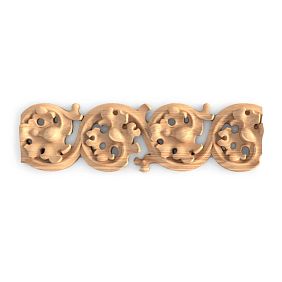
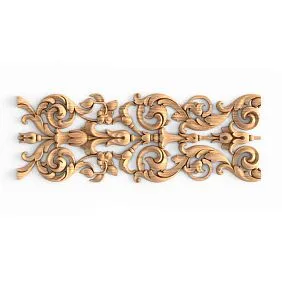
Carved borders with floral ornaments, geometric patterns, and stylized motifs are the choice for connoisseurs of classic interiors. The width of such elements reaches 100-120 mm, allowing for the placement of complex compositions.
Traditional ornaments include acanthus leaves, grapevines, palmettes, and rosettes. Geometric motifs are represented by meanders, braids, and diamonds. Carving can be flat (bas-relief) or deep (high-relief), creating maximum volume.
Manufacturing carved borders requires high skill and modern equipment. CNC machines allow for the reproduction of complex patterns with perfect precision, but final hand-finishing gives each element individuality.
Combined Borders: Complexity of Composition
Combined borders consist of several elements of varying widths, creating a multi-level composition. A wide lower plank serves as the base, the middle one carries the main decoration, and a narrow upper one provides the finishing touch. The total height of the composition can reach 150-180 mm.
Such solutions are characteristic of high-end classic interiors—mansions, penthouses, and representative spaces. The complexity of manufacturing and installation is compensated for by an impressive visual effect.
Buy Wooden Borderof the combined type is intended for interiors where maximum decorativeness and historically accurate styling are important.
Materials for Wooden Borders: Choosing Consciously
The material affects not only the appearance but also durability, cost, and maintenance complexity. Let's consider the main options.
Solid Oak: Strength and Prestige
Oak borders are the benchmark for quality and durability. Oak's density of 650-750 kg/m³ ensures high resistance to mechanical damage. The natural tannin content of up to 10% protects the wood from biological infestations—fungus, mold, insects.
Oak's texture is expressive and recognizable. Clear annual rings and medullary rays in radial cuts create a characteristic pattern. The color palette ranges from light golden to dark brown depending on the place of growth and processing method.
Oak borders can be restored multiple times—sanded, refinished, and local damage repaired. The service life of high-quality oak reaches 50-80 years, making it an economically viable solution despite the high initial price.
Solid Beech: Formability and Availability
Beech borders offer an optimal balance of price and quality. With a density of 620-680 kg/m³, beech provides sufficient strength at a lower cost compared to oak. Its uniform, fine-pored structure creates a calm texture with soft pinkish hues.
The main advantage of beech is its exceptional formability. After steaming at 100-110°C, the wood becomes plastic, allowing the creation of curved elements with a minimum radius of 400 mm. This is indispensable for arched openings, bay window areas, and radius walls.
Beech requires a more stable microclimate than oak. Deformations are possible with humidity fluctuations exceeding ±15%. It is recommended to use beech in rooms with controlled climate — humidity 45-65%, temperature 18-24°C.
High-Density MDF: Geometric Stability
MDF borders with a density of 750-850 kg/m³ ensure perfect geometric stability. The material is absolutely homogeneous, free from internal stresses, knots, or cracks. The coefficient of linear expansion for MDF is 10 times less than that of solid wood across the grain.
The MDF surface is covered with laminate, veneer, or paint. Modern 3D lamination technologies accurately mimic the texture of valuable wood species. Veneered borders have a thin layer of natural wood (0.6-1.0 mm), combining visual authenticity with geometric stability.
The eco-friendliness of high-quality MDF of class E0-E1 matches that of natural wood. Formaldehyde content does not exceed 0.1 mg/m³ — a level typical for wood itself, which also naturally releases small amounts of this substance.
Where Wooden Borders are Used: Practical Solutions
Interior Bordersfind numerous applications. Let's consider the main options.
Wall Protection in Furniture Placement Areas
The classic function of a border is to protect walls from damage by chair backs, armchairs, and tables. The border is installed at a height of 90-100 cm — precisely the level where most chair backs contact the wall when pushed up to a table.
In dining rooms, studies, and meeting rooms, the border absorbs mechanical impacts, safeguarding the main finish. Durable wood withstands repeated contact without damage and can be locally restored if necessary.
The border color can match the walls, creating subtle protection, or contrast, becoming a decorative accent. A dark border on light walls visually separates the protected zone and emphasizes horizontal division.
Visual Separation of Decorative Zones
A border divides the wall into parts, each receiving its own decorative treatment. The lower part up to the border is painted a dark color or clad with wooden panels, creating a sturdy baseboard. The upper part remains light, visually expanding the space.
The classic scheme involves a dark lower part and a light upper part with a height ratio of 1:2. With a ceiling height of 2.7 m, the border is installed at 90 cm. For 3.0 m ceilings, the optimal height is 100 cm. This creates harmonious, visually pleasing proportions.
An alternative option is a light lower part and an accent upper part. The lower part is painted in a neutral shade, while the upper part receives a rich color or decorative wallpaper. The border serves as a clear boundary between the zones.
Framing Panel Systems
Panel compositions of rectangular frames of various sizes structure the wall, creating rhythmic architecture. The border serves as a horizontal element, separating the upper and lower rows of panels or limiting the panel system from below.
In classic interiors, panels are arranged in two to three rows. The lower row, 80-90 cm high, is framed at the bottom by a wide baseboard and at the top by a border. The middle row, 100-120 cm high, is also bounded by borders. The upper zone up to the ceiling cornice can be smooth or contain large panels.
A modern interpretation is simpler — one row of large panels 100-120 cm high, framed at the bottom by a border. This creates elegant division without excessive complexity.
Accentuating Architectural Features
Bay windows, niches, alcoves, and arched openings are emphasized by horizontal borders, highlighting these areas within the general space. A border framing a niche at the level of its upper boundary creates a frame, turning the recess into an independent architectural object.
Columns and pilasters are traditionally divided into three parts — base, shaft, and capital. Borders mark the boundaries between these parts, emphasizing the classical order system even in modern interiors.
Stair flights are framed by borders running parallel to the slope of the stairs. This visually connects the stairs with the walls, creating a unified composition.
Decorating Commercial Interiors
In restaurants, hotels, and shops, borders solve utilitarian tasks. They protect walls from carts, luggage, and chair backs in high-traffic areas. Durable wood withstands intensive loads while maintaining a presentable appearance.
Simultaneously, borders create a recognizable style, emphasizing the establishment's status. Carved oak borders in a classic restaurant speak of commitment to tradition and quality. Concise beech borders in a Scandinavian café emphasize simplicity and honesty.
Borders serve as zoning elements in open spaces. Different heights, colors, and profiles of borders visually separate waiting areas from dining areas, VIP zones from the main hall.
Installation of Wooden Borders: A Professional Approach
Quality installation determines the durability and aesthetics of the result.
Surface preparation: the foundation of reliability
The wall must be level, dry, and cleaned of dust and grease stains. Irregularities exceeding 5 mm will cause problems—the border won't fit tightly, creating gaps. Use a long straightedge to check the wall plane and identify bumps and depressions.
Local irregularities are corrected with putty; significant level differences require leveling with plaster or drywall. The time spent on preparation pays off in the quality of the final result.
Primer improves the adhesion of adhesive compounds and strengthens the substrate. Use deep-penetration primer, especially for loose substrates. Drying time for primer is 4-6 hours depending on temperature and humidity.
Marking a horizontal line: accuracy to the millimeter
Precise leveling is critically important—even a deviation of 2-3 mm per meter is noticeable to the eye. Use a laser level to create a perfectly level line around the entire perimeter of the room. The laser projects the line onto the walls; you just need to mark it with a pencil.
If a laser level is unavailable, use a water level or a long spirit level (at least 120 cm). Mark several points at the same height and connect them with a chalk line or a long ruler.
The installation height of the border is determined by its function. For protection from chair backs—90-100 cm. For visual division of the wall—100-120 cm. For framing panels—according to the project, usually 80-100 cm.
Attachment methods: adhesive and mechanical fasteners
Light borders up to 60 mm wide and weighing up to 2 kg/m are attached with mounting adhesive like 'liquid nails.' Apply adhesive in a zigzag or dots spaced 15-20 cm apart on the back of the border. Press the element against the wall and secure it with painter's tape for 4-6 hours until the adhesive fully sets.
Heavy, wide borders require additional mechanical fastening. Use headless finishing nails 40-50 mm long or countersunk screws. Fasteners are installed at 40-50 cm intervals, countersunk 2-3 mm, and the holes are filled with wood-colored putty.
For particularly heavy carved borders, use combined fastening—adhesive plus hidden brackets installed in pre-milled grooves. This ensures maximum reliability with no visible fasteners.
Corner joints: the art of connections
Inside corners are joined by cutting at a 45-degree angle using a miter saw. Cutting accuracy is critical—even a 0.5 mm gap will be noticeable. Practice on scraps and adjust the saw angle as precisely as possible before making the final cut.
Outside corners are even more demanding in terms of precision. Any mismatch in profiles is glaring. For complex profiled borders, use templates—first cut one element, then use it as a guide to fit the second.
Joints are glued with wood glue and clamped. After drying, minor gaps are filled with acrylic sealant or wood putty tinted to match the main material.
Finishing: bringing to perfection
After installation, inspect all joints and fastener locations under side lighting—it reveals the slightest defects. Fill gaps with acrylic sealant, removing excess immediately with a damp sponge. Smooth the sealant with a finger dipped in soapy water.
Countersunk fastener locations are filled with special wood putty. After drying (2-4 hours), sand the puttied areas with fine-grit sandpaper P240-P320. If the putty color differs, perform local touch-ups with stain or a retouch marker.
Final cleaning—wipe the border with a dry, soft cloth to remove dust, adhesive, and sealant residue. Varnished surfaces can be polished with special compounds to create a light silky sheen.
Trends 2026: current solutions
Interior fashion is constantly evolving. What solutions with wooden borders are relevant now?
Contrasting Color Combinations
Monochromatic interiors in the style of 'total look' are giving way to contrasting solutions. A black border on white walls is a graphic solution that adds character to the interior. A gold or copper border on dark green walls creates a luxurious atmosphere.
Two-tone painting of the border itself—a trend for 2026. The protruding elements of the profile are painted one color, the recesses another. This creates a complex play of color and emphasizes the profile's relief.
Wide, massive profiles
After years of dominance by thin, minimalist elements, designers are returning to large-scale solutions. Borders 100-150 mm wide create powerful horizontals, adding monumentality to the interior. They look especially impressive in rooms with ceilings 3.2 meters or higher.
Wide borders allow for complex carved compositions and multi-level profiles. They become independent decorative objects, not just dividing elements.
Natural textures and finishes
Smooth, perfectly painted surfaces are giving way to textured ones. Brushed wood with pronounced grain structure, preserving natural irregularities, minimal processing—trends toward naturalness.
Oil finishes instead of varnish highlight the natural beauty of wood, preserve tactility, and create a matte, velvety surface. The wood remains 'alive,' breathes, and regulates humidity.
Integration of lighting
Borders with integrated LED lighting—a technological solution for 2026. A groove for an LED strip is milled into the top part of the border, creating soft lighting directed upward or downward. The lighting turns on automatically when light levels drop and is controlled via smartphone.
The lighting creates atmospheric illumination, works as a night light, and emphasizes the wall's relief. It combines functionality and aesthetics in one element.
Company STAVROS: manufacturer of high-quality wooden borders
STAVROS is a Russian manufacturer of premium solid wood moldings since 2002. Production facilities are equipped with European machinery, ensuring perfect geometry and impeccable processing quality.
The STAVROS range includes wooden borders in all popular profiles — from simple rectangular to intricate carved designs. Selected oak and beech wood with 8-12% moisture content is used, eliminating deformation after installation. For budget-friendly solutions, high-quality laminated MDF borders imitating various wood species are available.
Border widths range from 40 to 150 mm, with standard element lengths of 2000-3000 mm. Various finishing options are available: natural wood with oil finish, painted in any RAL color, patinated, or with an aged effect.
An extensive stock program ensures shipment of popular items on the day of order. Delivery across Russia and CIS countries via reliable transport companies. Own warehouses in Moscow and St. Petersburg with pickup options.
For professionals — designers, construction companies, furniture manufacturers — a loyalty program with individual terms is available. Priority production, technical support, and assistance with calculations.
Production capabilities allow for manufacturing custom-sized borders and profiles to order. High-precision CNC machines mill profiles of any complexity, bringing unique design ideas to life.
STAVROS consultants will help calculate the exact material quantity, select optimal profiles for your specific project, and provide installation recommendations. Call toll-free at 8 (800) 555-46-75.
Showrooms in Moscow and St. Petersburg are open for visits. Here you can see all border models, evaluate processing quality, feel the texture, and match colors to your own finishing samples.
ChoosingWooden wall borderChoosing STAVROS means choosing reliability tested by time. Quality confirmed by thousands of completed projects. Professionalism based on years of experience working with natural wood.
Create interiors that inspire! Spaces where every detail is thoughtful and precise. Interiors reflecting your individuality and taste. With wooden borders from STAVROS, it's easy, accessible, and reliable!