Article Contents:
- The Philosophy of Pattern: Why We Decorate Wood
- Symbolic Dimension: Pattern as Message
- Aesthetic Dimension: Beauty for Beauty's Sake
- Psychological Dimension: Pattern as Meditation
- Typology of Carved Patterns: From Geometry to Narratives
- Geometric Patterns: The Mathematics of Beauty
- Floral Patterns: Nature in Wood
- Zoomorphic Patterns: The Animal World in Carving
- Narrative Patterns: Carving as Storytelling
- Execution Techniques: From Handcraft to High Technology
- Bas-relief Carving: Playing on the Surface
- High-relief Carving: Volume and Drama
- Openwork (Fretwork) Carving: Lace in Wood
- Three-dimensional (Sculptural) Carving: Three-dimensional Art
- Modern Technologies: CNC and Hybrid Approaches
- Materials for Carving: From Pine to Exotic Woods
- Linden: The Ideal for Fine Work
- Oak: The Aristocrat of Wood
- Beech: The Golden Middle
- Ash: strength and beauty
- Pine: Accessibility and Compromises
- Applications of Carved Patterns: From Furniture to Architecture
- Furniture: When an Object Becomes Art
- Architectural Elements: Details That Create Character
- Interior Panels: Walls as Canvas
- Doors: Grand Entrance
- Styles and Cultural Traditions of Carved Patterns
- Russian Carving: From Pagan Symbols to Merchant Baroque
- European Carving: From Gothic to Art Deco
- Eastern Carving: From China to India
- Islamic Carving: Geometry and Calligraphy
- Frequently Asked Questions about Wooden Patterns
- How long does it take to create a carved pattern?
- Can a carved pattern be created from a photograph or sketch?
- What care do carved wooden items require?
- Are carved patterns only suitable for classic interiors?
- What is the difference between hand carving and machine carving?
- Can damaged carved elements be restored?
- What is the cost of carved patterns?
- Is Wood Carving Eco-Friendly?
- Can different pattern styles be combined?
- How to choose a master or company for ordering carved patterns?
- Conclusion: Create Your Space with the Masters of STAVROS

What transforms a piece of wood into something more than just material? When does a board cease to be a construction unit and become art? At the very moment when the master's hand touches the surface and begins to carve patterns—lines that turn into flowers, geometric shapes, narrative compositions.Carved wooden patterns—are not just a decorative element; it is a language through which wood tells stories, conveys emotions, and connects generations.
Wood carving has accompanied humanity for millennia. From primitive totems to luxurious palace interiors—wherever people wanted to express beauty, significance, or ritual meaning, carving appeared. And today, in the era of mass production and synthetic materials, wooden patterns are experiencing a renaissance. Why? Because living wood, processed by talented hands, provides what no imitation can: warmth, authenticity, connection with nature, tradition, and craftsmanship.


The Philosophy of Pattern: Why We Decorate Wood
Why carve patterns on wood? There is no utilitarian necessity—a smooth board will perform its function just as well as a carved one. But since ancient times, humans have sought to decorate objects, making them not only functional but also beautiful. This aspiration contains a deep philosophy.




Symbolic Dimension: Pattern as a Message
In traditional cultures, every pattern carried meaning. Carving was not arbitrary—it followed canons passed down from generation to generation. Geometric shapes symbolized cosmic order, the structure of the universe. Floral motifs embodied life force, fertility, and the constant renewal of nature. Zoomorphic images connected humans with the animal world and guardian spirits.
By carving a pattern on a house, furniture, or utensil, the master was not just decorating the object. They inscribed it into a symbolic system, endowing it with protective or blessing power. The pattern became a talisman, a prayer frozen in wood, a dialogue with higher powers.
Today, most people do not invest mystical meaning into patterns. But subconscious perception remains. Traditional motifs evoke a sense of rootedness, connection with ancestors, with something greater and eternal. Even without knowing the original meaning of a symbol, we feel its energy.
Our factory also produces:


Aesthetic Dimension: Beauty for Beauty's Sake
As civilization developed, the symbolic function of patterns receded, giving way to purely aesthetic purposes. Carving became art for art's sake, a way to demonstrate taste, skill, and cultural level.
In the Baroque and Rococo erasWood Carvingcarving reached incredible complexity. Palace interiors were covered with carved panels where patterns intertwined in endless labyrinths, with every centimeter of the surface meticulously worked. This was a demonstration of wealth and power: only very wealthy people could afford such labor-intensive finishing.
But carving was also present in modest homes. Peasant masters created simpler yet no less expressive patterns. Here, a different logic was at work: not excess and luxury, but precision, purity of lines, and harmony of proportions. Folk wood carving art possesses a special power—it is honest, direct, and free of pretentiousness.
Get Consultation
Psychological Dimension: Pattern as Meditation
There is another aspect rarely discussed: carving patterns on wood is a meditative process. The master, focused on working on the ornament, enters a special state where haste, bustle, and anxieties disappear. There is only wood, the tool, the hand, and the emerging pattern.
The same applies to contemplating carving. When examining a complex pattern, we disconnect from everyday life, immerse ourselves in the rhythm of lines, the play of light and shadow, and the endless repetitions and variations of the motif. This calms, organizes thoughts, and gives a respite to the information-overloaded brain.
Typology of Carved Patterns: From Geometry to Narratives
Wooden patterns are endlessly diverse, but they can be classified into several main types, each with its own characteristics, traditions, and areas of application.
Geometric Patterns: The Mathematics of Beauty
The most ancient type is geometric ornaments. Diamonds, triangles, circles, zigzags, spirals, meanders — these shapes were used even in the Neolithic period, long before the advent of writing. Why geometry? Because it is universal, intuitively understandable, present in nature (beehives, crystals, spider webs) and in the cosmos (planetary orbits, galaxy structures).
Geometric patterns possess special energy. Regular repeating shapes create rhythm, structure space, and bring order. They are perfect for modern interiors, where minimalism, clarity of lines, and lack of excess are valued.
The technique for executing geometric carving is relatively simple — straight chisels, corner chisels, and compasses for marking are used. But simplicity does not mean primitiveness. A master can create infinitely complex compositions by combining basic shapes, varying the depth of the carving, and creating multi-layered structures.
Application: geometric patterns are ideal forcarved appliqués furniture, for wall panels, for frames, for borders and friezes. They pair well with modern materials — glass, metal, concrete — creating interesting contrasts.
Floral Patterns: Nature in Wood
If geometry is cosmos, mathematics, order, then floral motifs are life, growth, organic matter. Leaves, flowers, branches, vines, fruits — all the richness of flora is reflected in wood carving.
Floral patterns can be naturalistic (recognizable plants, worked out with all botanical details) and stylized (conventional forms, only vaguely reminiscent of real plants). Naturalism is characteristic of classic European styles — Baroque, Rococo, Empire. Stylization is typical for folk art, for Eastern traditions, for Art Nouveau.
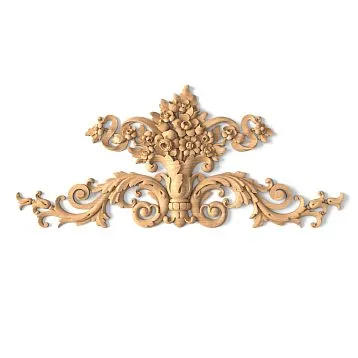
A special category —wooden ornaments with acanthus leaves. Acanthus is a Mediterranean plant, but its stylized leaves have become a universal motif in carving. Lush, with deep cutouts, they create a luxurious play of light and shadow, perfectly suited for volumetric relief carving.
The technique for executing floral patterns is more complex than geometric ones. Curved chisels capable of reproducing the smooth lines of leaves and petals are required. The master must understand plant anatomy, feel their plasticity, and convey the movement of growth.
Application: floral carving is universal. It adorns furniture (bed headboards, cabinet fronts, table legs), architectural elements (column capitals, cornices, pediments), decorative panels. It suits classic, eclectic, country interiors, for styles like Provence, shabby chic.
Zoomorphic Patterns: The Animal World in Carving
Depictions of animals in wood carving are less common, but they always attract attention. Horses, birds, fish, dragons, lions, eagles — each creature carries a symbolic charge.
In the Russian tradition, horses and birds hold a special place. The horse is a solar symbol, associated with the sun, light, and fertility. Stylized horses adorned roof ridges (hence the name), window frames, and gates. The bird is a mediator between heaven and earth, a symbol of the soul, freedom, and spring. Birds were often depicted in pairs — a symbol of family, fidelity.
In the European tradition, lions (strength, power, nobility), eagles (grandeur, spirituality), and dolphins (sea, travel, luck) are popular. In the Eastern tradition — dragons (wisdom, protection), cranes (longevity), carp (perseverance, overcoming).
The technique for executing zoomorphic patterns requires not only carving skill but also artistic talent. The master must convey not just the animal's anatomy, but its character, movement, emotion. It is sculpture in miniature.
Application: zoomorphic carving is used for accent elements — door handles in the shape of lion heads, armchair armrests in the shape of birds, decorative panels with narrative compositions.
Narrative Patterns: Carving as Storytelling
The most complex type is narrative compositions, where the carving tells a story. These can be religious scenes (in church carving), mythological subjects, historical events, everyday sketches.
Narrative carving requires from the master not only technical perfection but also compositional thinking, an understanding of perspective, and the ability to convey space on a flat surface. This is no longer a craft, but high art, bordering on painting and sculpture.
In modern interiors, narrative carving is rarely used — it requires an appropriate context, powerful, monumental architecture. But for exclusive projects, for museum interiors, for temples, narrative carving is indispensable.
Execution Techniques: From Manual Labor to High Technology
How are carved wooden patterns created? There are several techniques, each with its own tools, possibilities, and results.
Bas-relief Carving: Play on the Surface
The pattern protrudes slightly above the background — by 2-5 mm. The background can be smooth (rounded) or textured (chased). Bas-relief carving creates a subtle play of light and shadow without disrupting the plane of the object. It is the perfect technique for panels, overlays, furniture fronts.
Tools: flat and semicircular chisels, skew chisels, chasing tools for texturing the background. The work requires precision — the slightest mistake is noticeable on a smooth surface.
High-relief Carving: Volume and Drama
The pattern projects 5-15 mm or more, creating powerful chiaroscuro, an almost sculptural volume. Deep-relief carving is used for large elements — capitals, brackets, pediments, monumental panels.
The technique is labor-intensive. First, the background is removed (wood is excavated to the required depth), then the relief is formed, and details are worked out. It requires physical strength (excavating the deep background) and artistic intuition (modeling the volume).
Pierced (openwork) carving: lace in wood
The background is completely removed, leaving only the pattern. The wood turns into lace, light and airy.Lace carvingrequires virtuoso skill — the elements are thin, fragile, the slightest carelessness leads to breakage.
Tools: jigsaw (for cutting out the background), thin chisels (for detailing), needle files (for sanding). The work is jewelry-like, slow, but the result is impressive.
Application: window surrounds, decorative screens, inserts in furniture doors, screens, decorative panels.
Three-dimensional (sculptural) carving: three-dimensional art
The piece is worked from all sides, creating a full-fledged sculpture. These arecarved furniture elements— legs, balusters, rosettes, decorative figures.
The technique is maximally complex, requiring an understanding of anatomy, proportions, perspective. The master must see the future form in a block of wood, sequentially freeing it from excess material.
Modern technologies: CNC and hybrid approaches
The 21st century has brought revolutionary changes. CNC milling machines can reproduce the most complex patterns with micron precision. A computer program controls the milling cutter, which cuts the specified pattern.
Advantages of CNC: speed (dozens of times faster than manual work), repeatability (hundreds of identical elements can be made), the ability to create forms impossible by hand (complex three-dimensional geometry).
Disadvantages: lack of uniqueness, a certain mechanical feel, impossibility of the spontaneous improvisation characteristic of manual work.
The optimal solution is a hybrid approach, practiced in STAVROS production. Rough excavation, formation of the main relief is done by a CNC machine. Final detailing, sanding, and accentuation of nuances are done by a master by hand. This combines the efficiency of technology with the soul of craftsmanship, ensuring a balance between productivity and quality.
Materials for carving: from pine to exotic woods
The choice of wood is critically important. Different species have different properties — hardness, density, texture, color. Which wood is best for carving?
Linden (Lime/Basswood): the ideal for fine work
Soft, homogeneous, with an unpronounced texture, linden cuts easily, like butter. It does not split, does not crumble, allows for the creation of the smallest details. Linden is the choice for openwork carving, for sculpture, for iconostases.
Disadvantage: softness turns into vulnerability. Linden products require careful handling, are suitable for interiors, but not for exteriors.
Oak: the aristocrat of woods
Hard, dense, with an expressive texture. Oak carving lasts for centuries, darkening, acquiring a noble patina. Oak is ideal for deep-relief carving, for large architectural elements, for furniture passed down from generation to generation.
Disadvantage: difficulty of processing. Oak requires sharp tools, physical effort, experience. But the result is worth the effort.
Beech: the golden middle
Denser than linden, softer than oak. Beech holds carving details well, is stable, has a pleasant pinkish hue. Suitable for most types of carving, especially for furniturewooden appliqués.
Disadvantage: sensitivity to humidity. Requires protective treatment, stable operating conditions.
Ash: strength and beauty
Similar to oak, but lighter, with a more contrasting texture. Ash is strong, resilient, beautiful. Used for carved elements subjected to stress — stair balusters, railings, furniture legs.
Pine: affordability and compromises
The most accessible species, but problematic for carving. Knots, resin pockets, non-uniform density (soft spring wood, hard summer wood) create difficulties. The chisel either sinks in soft zones or hits hard ones.
The solution is a laminated pine panel, where defective sections are removed and quality parts are glued together. Such a panel is stable, uniform, and suitable for carving.
Application of carved patterns: from furniture to architecture
Where are carved wooden patterns used? Almost anywhere there is wood and a desire to decorate it.
Furniture: when an object becomes art
Carved furniture is a sign of luxury and taste. Patterns transform a utilitarian object into a work of art.
Cabinet, dresser, and sideboard fronts are decorated with applied carved elements—rosettes, frames, panels. This creates a play of volumes and visual richness.
Table, chair, and bed legs are turned or carved, becoming independent sculptural elements.
Chair and bed backs are ideal canvases for openwork carving, creating delicate, airy forms.
Tabletops are inlaid with carved inserts, creating complex decorative compositions.
Architectural elements: details that create character
Carved patterns on architectural details transform a standard building into a unique one.
Window and door casings are classic places for carving. They frame openings, create accents, and set the facade's style.
Cornices, friezes, and soffits are adorned with repeating ornaments, creating rhythmic horizontal lines.
Pediments and canopies become the building's crown, crowning the composition.
Columns and pilasters with carved capitals and bases give the structure monumentality, linking it to grand architectural tradition.
Interior panels: walls as a canvas
carved panelsturn walls into works of art. They can cover the entire surface (boiserie) or be used fragmentarily, creating accent zones.
Techniques are diverse: bas-relief carving with geometric or floral patterns, openwork inserts that let light through, deep relief with narrative compositions.
Panels are not only decorative but also functional—they improve acoustics, provide additional thermal insulation, and protect walls from damage.
Doors: Grand Entrance
A carved door is a statement of status, taste, and respect for tradition. Patterns can cover the entire surface or concentrate in the central panel, creating a medallion.
Technique depends on style: classic requires symmetrical floral ornaments, Art Nouveau—flowing asymmetrical lines, ethnic—geometric or zoomorphic motifs.
Styles and cultural traditions of carved patterns
Wood carving exists in all cultures, but each has created its own unique style.
Russian carving: from pagan symbols to merchant baroque
The Russian tradition is rich and diverse. The oldest layer is pagan symbolism: solar signs, geometric amulets, stylized animals. These motifs have survived in folk art, especially in the North.
With Christianization came church carving—iconostases, icon cases, royal doors. Here, complex floral ornamentation combines with Christian symbolism.
Merchant carving of the 19th century—lush, excessive, eclectic. Houses were lavishly decorated, showcasing the owner's wealth. Casings, cornices, and balconies were covered with a lace of carving.
European carving: from Gothic to Art Deco
Gothic carving—vertical, soaring upward, with pointed forms, geometric openwork.
The Renaissance brought classical motifs—acanthus, grapevines, putti, garlands. Carving became more restrained, harmonious.
Baroque and Rococo are the apogee of decorativeness. Carving covers everything, patterns intertwine in dizzying combinations, symmetry is broken for the sake of dynamism.
Classicism restored order — symmetry, clear proportions, antique motifs.
Art Nouveau created a new language — flowing lines, stylized plants, asymmetry, symbolism.
Art Deco — geometrization, stylization, luxury of materials.
Eastern carving: from China to India
Chinese carving — openwork, lace-like, often multi-layered (several layers of carving creating depth). Motifs: dragons, cranes, peonies, wish characters.
Japanese carving — restrained, minimalist, emphasizing the wood's texture. Emptiness, unfilled spaces are important.
Indian carving — abundant, detailed, often covering the entire surface. Motifs: deities, lotuses, elephants, peacocks, mandalas.
Islamic carving: geometry and calligraphy
Islam avoids depicting living beings, so carving focuses on geometric patterns (arabesques) and calligraphy (Quranic verses). Patterns are complex, mathematically precise, creating a sense of infinity.
Frequently Asked Questions about wooden patterns
How long does it take to create a carved pattern?
Depends on size, complexity, technique. A simple geometric overlay 20×20 cm — several hours of work on a CNC machine, plus an hour of manual finishing. A complex openwork panel 1×1 meter — several weeks of manual work. A monumental iconostasis — years of labor by a team of craftsmen.
Can a carved pattern be created from a photo or sketch?
Yes, this is common practice. You provide an image — a master or designer creates a technical drawing, adapts it for the carving technology, clarifies dimensions. Then a sample is made, approved, and put into production.
What care do carved wooden items require?
For interior elements: regular dusting with a soft brush (vacuum with a soft attachment), avoiding direct sunlight (fading), maintaining stable humidity (40-60%), periodic renewal of wax or oil coating (every 2-3 years).
For exterior ones: annual inspection, cleaning from dirt, checking the coating, renewing paint/varnish every 3-7 years depending on climate.
Are carved patterns only suitable for classic interiors?
No, that's a misconception. Geometric patterns are perfect for modern minimalism. Laconic carving suits Scandinavian style. Openwork panels work well in lofts (contrast of warm wood and industrial aesthetics). The main thing is to correctly choose the carving style, scale, and pattern density.
What is the difference between hand carving and machine carving?
Hand carving is unique — each piece is slightly different, carries the master's energy, has vitality. But it is expensive and slow.
Machine (CNC) carving is identical — one can make a hundred identical parts. It is fast and affordable. But lacks individuality.
A hybrid approach combines the advantages of both: the machine does the rough work, the master does the finishing. This is optimal for most projects.
Can damaged carved elements be restored?
Yes, restoration is a separate field of woodworking. A master restorer studies the damaged element, determines the wood species, carving style. Then creates missing fragments, matches the tone, ages new parts so they don't stand out. Good restoration is invisible — the item looks whole.
What is the cost of carved patterns?
The range is huge. A simple geometric pine overlay 10×10 cm — from 500 rubles. An openwork oak window casing — from 15,000 rubles. A carved panel 1×2 meters with deep relief — from 80,000 rubles. An exclusive carved iconostasis — millions.
Price factors: wood species, size, pattern complexity, technique (hand/machine), type of coating, urgency.
Is wood carving eco-friendly?
With a responsible approach — yes. Wood from legal logging is used, preferably with FSC certification (sustainable forestry). Processing is carried out with minimal waste, which is used for other products or disposed of in an environmentally friendly manner. Water-based coatings, natural oils, and waxes are safe for humans and the environment.
Can different pattern styles be combined?
Yes, but carefully. Eclecticism requires impeccable taste. A general rule: choose one style as the main one, use another as an accent. For example, classic furniture with plant carving + one or two details with geometric patterns in a modern style. Or a Scandinavian interior + an ethnic carved element as an exotic accent.
How to choose a master or company for ordering carved patterns?
Criteria: experience (ask for a portfolio of completed projects), customer reviews, possibility of making a trial sample, pricing transparency, availability of guarantees, willingness to engage in dialogue and make adjustments. Don't chase the lowest price — quality carving cannot be cheap. It's better to pay more but get a product that will last for decades.
Conclusion: create your space with the masters of STAVROS
Wooden patterns are more than just decor. They are a way to fill a space with meaning, beauty, and a connection to tradition. They are a bridge between the past and the present, between nature and culture, between the master and the owner. By choosing carved elements for your home, you choose quality over cheap mass production, authenticity over imitation, beauty over blandness.
In a world where everything is standardized, where houses look alike, where furniture rolls off assembly lines in millions of copies, carved wooden patterns are an act of cultural resistance. It's a statement: individuality matters to me. History matters to me. It matters to me to live in a space created with soul, with craftsmanship, with respect for the material and tradition.
STAVROS is a leader in the Russian market for solid wood products, combining years of experience, advanced technology, and impeccable quality. Creatingdecorative carved elements, STAVROS follows a simple principle: every product must be a work of art that will serve for decades, delight the eye, and be passed down to future generations.
STAVROS's production facilities are equipped with modern CNC milling machines, allowing for the creation of patterns of any complexity with micron precision. But technology is just a tool. The soul of production is the experienced masters, for whomWood Carvingis not just a job, but a calling. Every product undergoes final manual finishing, where the slightest imperfections are eliminated, details are emphasized, and the beauty of the wood is revealed.
The STAVROS catalog features hundreds of models of carved elements: overlays of all sizes and styles — from miniature rosettes to large panels, from simple geometric patterns to complex plant compositions. Window and door trims — traditional Russian, Scandinavian minimalist, classic European. Architectural details — brackets, consoles, capitals, friezes. Furniture elements — legs, balusters, backs, front overlays.
A special pride of STAVROS is the possibility of custom manufacturing. Don't see the model you need in the catalog? Provide a sketch, photo, description — the company's designers will develop a project, create a 3D model, and make a trial sample. After approval, they will launch production of exactly the product that will perfectly fit your interior or facade.
Only solid noble wood species are used for manufacturing: oak (strength, durability, expressive texture), beech (stability, pleasant shade), ash (beauty, load resistance), linden (for fine openwork carving). The wood undergoes chamber drying to a moisture content of 8-10%, which eliminates deformation and cracking during use. Careful selection excludes knots, resin pockets, defects — only clean, high-quality material.
Protective treatment is performed with professional compounds: deep-penetrating antiseptics protect against biological damage, primers ensure adhesion of the finishing coating, varnishes and paints preserve the beauty of the wood and protect against external influences. Various finishing options are possible: natural wood under varnish, tinted coatings (walnut, mahogany, wenge), patination (effect of noble antiquity), painting in any RAL color.
STAVROS works with clients all over Russia. A convenient online ordering system allows you to make a purchase from anywhere in the country. The detailed catalog on the website contains high-resolution photos of products, technical drawings with dimensions, descriptions of materials and coatings, and current prices. The filter system helps you quickly find what you need — by product type, style, wood species, size, price category.
Qualified STAVROS managers will assist with selection, answer questions, calculate the required amount of material, and suggest optimal fastening and processing options. This is not just a product sale — it's comprehensive consultation, a partnership at all stages from idea to implementation.
Delivery is organized by reliable transport companies. Products are carefully packaged — protective film, cardboard spacers, wooden crates for large-sized elements. This prevents damage during transportation. For Moscow, St. Petersburg, and other major cities, pickup from STAVROS warehouses is available, where you can see the products in person, talk with specialists, and get professional recommendations.
STAVROS collaborates not only with private clients but also with professionals — architects, interior designers, construction and furniture companies, restoration workshops. Special conditions, a flexible discount system, and the possibility of manufacturing large batches while maintaining high quality are provided for corporate customers.
By choosing STAVROS, you choose reliability, proven by time and thousands of completed projects. You choose quality, confirmed by certificates and guarantees. You choose beauty, embodied in every pattern, every line, every curve of the carving.
Create a space that inspires. Fill your home with beauty that will never go out of style. Invest in products that will serve for generations. Choose wooden patterns from STAVROS — and your interior will gain soul, character, a connection with the great art of wood carving, which has passed through the centuries, retaining its relevance, strength, and ability to make life more beautiful!