Article Contents:
- Living History in Wooden Lines
- The Symbolic Language of Wood
- Architectural Anatomy of a Carved House
- The Pediment as the Crown of Architecture
- Cornices and Valances
- Window Casings as Gates of Light
- Techniques and Technologies of Carving
- Blind Relief Carving
- Openwork Pierced Carving
- Applied Carving
- Contour and Geometric Carving
- Regional Schools of Russian Wooden Ornamentation
- Vologda Lace in Wood
- Arkhangelsk Power and Monumentality
- Kostroma Elegance
- Siberian Distinctiveness
- Symbolism and Semantics of Patterns
- Solar Symbolism
- The Water Element
- The Plant World
- The Tree of Life
- Wooden Patterns in Modern Architecture
- The Pull Towards Authenticity
- Technology in the Service of Tradition
- Integration with Modern Materials
- Ecology and healthy lifestyle
- How to Choose and Apply Wooden Patterns?
- Consistency with the Overall Style
- Scale and proportions
- Material Quality and Finishing
- Color palette
- Regional Identity Through Wooden Patterns
- The Volga Region: Volga Motifs
- The Urals: Synthesis of Traditions
- Far East: Meeting of Cultures
- Practical Aspects: Care and Restoration
- Regular Inspection
- Updating protective coating
- Restoration of Damaged Elements
- Wooden Patterns in Interior Design
- Decorating door and window openings
- Decorative Panels and Partitions
- Furniture with carved elements
- Ceiling Decorations
- Modern Interpretations of Traditional Patterns
- Minimalism and Carving
- Stylization and Abstraction
- Play of Scales
- Non-traditional Materials
- Masters and Workshops: Reviving the Craft
- Handmade vs CNC Machines
- Individual projects
- Economic Aspects
- Choosing Elements
- Standard or Custom Elements
- Long-term perspective
- Wooden Patterns and Ecology
- Wood as a Renewable Resource
- Durability vs. Disposability
- Locality and Reducing Carbon Footprint
- Psychology of Perceiving Wooden Patterns
- Rhythm and Repetition
- Natural Forms
- Tactility
- Connection with Tradition
- Frequently Asked Questions about Wooden Patterns
- What type of wood is best to choose for carved elements on a facade?
- How long do carved wooden elements last?
- Can carved elements be combined with modern architecture?
- How to Care for Carved Wooden Elements?
- Is decorating a house with carved elements expensive?
- Can carved elements be installed independently?
- Does climate affect the choice of carved elements?
- What modern technologies are used in creating carved elements?
- Can old carved elements be restored?
- How to combine wooden patterns with home energy efficiency?
- Wooden Patterns as an Investment in the Future
- Cultural Value
- Educational Significance
- Emotional connection
- Future of Wooden Patterns
- Digital Technologies in Service of Traditions
- Ecological trends
- Education and popularization
- Synthesis with other arts
- Choosing a master: what to look for
- Portfolio and experience
- Knowledge of traditions
- Material quality
- Guarantees and Support
- Conclusion: Returning to Roots

Looking at the old wooden houses of Russia, it is impossible to remain indifferent to the magic contained in every carved detail.Wooden patterns on houses– this is not just decoration, it is a chronicle of the folk soul, frozen in wood. Every curl, every ornament carries deep meaning, conveying through the centuries the wisdom of ancestors and their understanding of beauty.
Today, as we strive to return to our roots, to natural materials and authentic aesthetics, the patterns of wooden architecture are experiencing a rebirth. They organically fit into modern architecture, creating an amazing synthesis of tradition and innovation. But what lies behind these whimsical lines? What secrets do carved window frames and pediments hold? Let's embark on a journey into the world of wood carving to understand how ancient craftsmanship can transform the appearance of a modern house.


Living history in wooden lines
When speaking of Russian wooden architecture, the image of a hut with carved shutters, decorated like frost patterns, comes to mind. This is not a random comparison – our ancestors truly saw nature as a source of inspiration for creating ornaments.Carved Mouldingsbecame the hallmark of Russian wooden architecture, turning ordinary windows into works of art.
The history of wooden patterns dates back to pagan times, when every symbol had magical meaning. Solar signs protected the house from evil forces, plant ornaments invoked fertility and prosperity, and images of birds symbolized the connection between earthly and heavenly worlds. With the adoption of Christianity, many pagan motifs transformed but did not disappear, acquiring new meanings while preserving a deep connection with nature and the cosmos.
Master carvers passed down their skills from generation to generation, perfecting techniques and creating regional schools of carving. Each locality contributed its own features to the ornaments: Vologda wooden lace amazed with its delicacy, Arkhangelsk carving was distinguished by its power and monumentality, Kostroma patterns delighted with their elegance and diversity of motifs.




The symbolic language of wood
Understanding the symbolism of wooden patterns, we discover a whole communication system used by our ancestors. It was a kind of code understandable to every member of society. The sun – the central symbol of many compositions – was depicted as a circle with radiating rays or a rosette. It was placed in the most visible places: above the entrance, on pediments, in the center of window frames. The solar sign personified vital force, warmth, protection from darkness and cold.
The Tree of Life – another universal motif found in carvings throughout Russia. A vertical composition with a central trunk and symmetrical branches symbolized the connection of generations, the unity of earth and sky, material and spiritual worlds.Carved Elementswith depictions of the Tree of Life often adorned entrance groups, emphasizing the significance of the threshold as a boundary between external and internal space.
Plant ornaments – vines, leaves, flowers – filled compositions with life energy. The grapevine symbolized abundance and fertility, oak leaves – strength and longevity, birch branches – purity and feminine beauty. Masters skillfully intertwined plant motifs, creating endless patterns where one form flowed into another, symbolizing the continuity of life.
Zoomorphic images also played an important role in the decorative system. Birds – especially roosters and peacocks – personified the sun, vigilance, and protection of the home. Horses and deer symbolized the movement of the sun across the sky, strength and nobility. Even fantastic creatures – griffins, sirens, alkonosts – found their place in wooden carving, adding an element of mythological depth.
Our factory also produces:


Architectural anatomy of a carved house
To understand the scale of wooden pattern application in traditional architecture, one must consider the house as an integral artistic system, where each element plays its role in the overall composition. Let's start from the top and gradually descend to the building's foundation, studying the carved decoration.
Get Consultation
Pediment as the crown of architecture
Wooden carved pediment– is truly the crown of the house, its most noticeable and expressive part. The triangular or trapezoidal completion of the facade between the roof slopes is visible from afar and sets the tone for the entire architectural appearance of the building. It is on the pediment that masters could unfold the most complex and large-scale compositions, demonstrating their art in all its fullness.
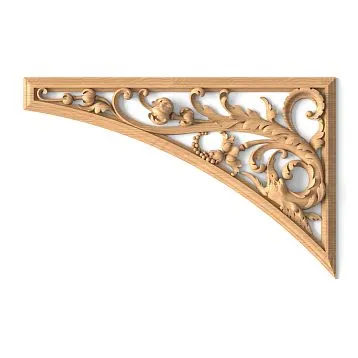
There are two main types of carved pediments: solid and openwork. A solid pediment is a continuous board on which a relief pattern is carved. Such carving creates a play of light and shadow, especially effective at certain times of day. An openwork pediment – is fretwork, where the pattern is cut through, forming a lace silhouette. In the evening, when light shines through from the attic, such aCarved pedimentturns the house into a glowing lantern, creating a truly fairytale spectacle.
Compositionally, pediment carving was often built on the principle of symmetry with a central axis. In the center was placed the main symbol – a solar sign, rosette, or Tree of Life, and additional motifs developed symmetrically on the sides. The edges of the pediment were framed by carved bargeboards – boards running along the roof slopes, which were also richly decorated with ornament. At the point where the bargeboards met on the ridge, a special detail was installed – a ridge or ohlupen, often having a zoomorphic form.
Cornices and friezes
Moving from the pediment to the main part of the facade, we encounterwooden carved cornices, which not only protect the walls from precipitation but also serve as an important decorative element. The soffit – the lower part of the cornice, often executed in fretwork technique – creates the effect of an openwork border separating the roof from the walls.
Patterns on soffits could be very diverse: from simple geometric repeating motifs to complex narrative compositions. Popular were wavy lines symbolizing water and heavenly streams, triangles as signs of earth and stability, circles and rosettes of solar significance. Rhythmic repetition of elements created dynamics, giving the building liveliness and movement.
It is important to note thatFacade Decorationincluded not only horizontal elements but also vertical blades, pilasters, and corner overlays, which were also decorated with carvings and helped structure the facade plane, giving it rhythm and proportionality.
Window casings as gates of light
If the pediment is the crown of the house, then the windows are its eyes, andCarved wooden mullions– their expressive framing. Special attention was paid to the casings, as windows were considered vulnerable points through which evil forces could enter the house. Therefore, the carving on the casings primarily served a protective function.
A classic window casing consists of several parts: the upper board – the lintel, the side boards – the wings, and the lower board – the windowsill part. The lintel was often the most richly decorated part, where the main protective symbols were placed. The central composition could include a solar sign surrounded by floral ornamentation, or a figure of a bird with outstretched wings.
The side parts of the casing were usually decorated with vertical ornaments – winding vines, columns with repeating elements, stylized plant motifs. The windowsill board could be more restrained in decoration or even smooth, although in wealthy houses it was decorated no less generously than the upper part.
The regional diversity of casings is astonishing.Beautiful casings for a wooden housefrom Vologda resemble the finest lace, where each element is worked with jeweler's precision. Arkhangelsk casings are more massive and austere, with clear geometric shapes and bright coloring. Kostroma craftsmen created casings with complex solar compositions and abundant floral decoration.
Carving techniques and technologies
Creating wooden patterns required not only artistic talent but also deep knowledge of wood properties, mastery of various tools and techniques. Let's consider the main types of carving used in wooden architecture.
Blind relief carving
This ancient type of carving involves selecting the pattern from the solid board, but the background remains solid. The depth of the selection can vary – from a few millimeters to several centimeters, creating different degrees of relief. With shallow selection, so-called flat relief carving is obtained; with deep selection – high relief.
The advantage of blind carving is its strength and durability. Since all elements are connected to the base, they do not break and withstand atmospheric influences well. The play of light and shadow on the relief surface creates a picturesque effect that changes throughout the day as the sun moves.
Openwork pierced carving
Pierced or through carving involves complete removal of the background, resulting in a pattern resembling lace. This technique requires special skill, as it is necessary to calculate the strength of the elements – too thin details may break, too thick ones will look crude.
Openwork carving is especially effective in cornices, pediments, and overlay elements, where the pattern is visible against the light. By combining pierced carving with a backing board of a contrasting color, craftsmen achieved additional expressiveness, creating multi-layered compositions.
Overlay carving
This type of carving involves creating separate carved elements that are then overlaid onto the main surface. This technique allowed for the creation of multi-level compositions, combination of different wood species, and achieving special depth and volume of decoration.
House Carvingoften used overlay elements to decorate corners, central parts of casings, and beam ends. Carved rosettes, garlands, and cartouches were created separately and attached to the base with nails or glue.
Contour and geometric carving
Simpler but no less expressive techniques – contour carving, where the lines of the pattern are incised into the wood surface, and geometric carving, based on the combination of simple geometric shapes – triangles, rhombuses, circles. These types of carving were often used as additional decoration or in regions with harsher climates, where maximum strength of elements was required.
Regional schools of Russian wooden ornamentation
Russia is a vast country, and in every corner of it, its own traditions of wooden architecture developed. Climatic conditions, available wood species, cultural ties with neighboring peoples – all this influenced the formation of unique regional styles.
Vologda lace from wood
Vologda wood carving is directly related to the traditions of Vologda lace-making – it is not by chance that it is called wooden lace. Craftsmen created amazingly thin, openwork compositions where carved elements intertwined like threads in lace. Favorite motifs – plant ornaments with winding stems, rosettes, floral garlands.
Technically, Vologda carving is extremely complex – it requires not only jeweler's precision but also a deep understanding of structural strength. Too thin bridges between pattern elements may not withstand the load, especially after the wood gets wet and dries. Therefore, Vologda masters virtuously balanced between the airiness of the pattern and its reliability.
Russian ornamentof the Vologda type is also distinguished by a special smoothness of lines, elegance of proportions, and meticulous detailing. Even a small casing could contain hundreds of small elements, each executed flawlessly.
Arkhangelsk power and monumentality
The Arkhangelsk carving has a completely different character – powerful, expressive, often painted in bright colors. The harsh northern climate dictated its own conditions: decorative elements had to be sufficiently massive to withstand winds and snow loads.
The Arkhangelsk style is characterized by large geometric forms, solar symbols of significant size, and relief carving with deep undercutting. Coloring was often used – white, red, blue, and green colors created a festive, cheerful impression, contrasting with the northern nature.
An interesting feature of the Arkhangelsk tradition is the combination of wood carving with painting. The carved relief served as the base, and the painting additionally emphasized the pattern, highlighted individual elements, and created color accents.
Kostroma Elegance
The Kostroma school of carving occupies an intermediate position between Vologda's refinement and Arkhangelsk's power. Here we see complex, meticulously detailed compositions, but executed more in relief than in Vologda, and less massive than in Arkhangelsk.
A characteristic feature of Kostroma carving is the abundant use of solar symbols in various variations. Rosettes, circles with rays, spirals of solar movement – all these elements were organically woven into plant ornaments, creating harmonious and symbolically rich compositions.
wooden ornamentThe decor of the Kostroma type often included zoomorphic motifs – birds, horses, fantastic creatures, which were placed in the central parts of compositions or at the corners of window surrounds.
Siberian Distinctiveness
Siberian traditions of wood carving were formed under the influence of both Russian settlers, who brought traditions from central regions, and the indigenous peoples of Siberia with their distinctive ornamental art. The result was a unique fusion, where Russian motifs coexist with elements of Buryat, Yakut, and Khanty decoration.
Siberian carving is distinguished by a particular solidity – the wood here is dense, resinous, requiring significant effort to process. The patterns are often simpler and more laconic than in the European part of Russia, but no less expressive.
An interesting feature of Siberian wooden architecture is the use of ochre tones for painting the decor, which is related to the availability of natural mineral dyes.
Symbolism and Semantics of Patterns
Every element of a traditional wooden pattern is not accidental – behind it lies deep symbolism, rooted in the most ancient worldviews. Understanding this symbolism allows one not only to admire the beauty of the carving but also to read the messages embedded within it.
Solar Symbolism
The sun is the central image of Slavic mythology and folk art. It gives light, warmth, life, and drives away darkness and evil. Solar signs in wood carving are extremely diverse: these include simple circles, rosettes with varying numbers of petals, and complex compositions with rotating elements symbolizing the movement of the celestial body across the sky.
The number of rays or petals in a solar sign also had meaning. Four rays corresponded to the four cardinal directions, the four seasons. Six – the doubling of trinity, a symbol of harmony and completeness. Eight – a particularly common number, signifying infinity, the eternal movement of the sun, the change of day and night, the seasons.
Placing a solar symbol above the entrance door or in the center of a window surround had an apotropaic meaning – it was believed that the sun protected the house from the penetration of evil forces, illness, and misfortune.
The Water Element
Wavy lines running along cornices and friezes symbolized water – celestial and earthly. Celestial water – rain, necessary for fertility. Earthly water – rivers, the source of life. Serpentine patterns were also associated with the water element and simultaneously with the earth, the underworld.
Interestingly, water motifs often neighbor solar ones – this reflects the ancient concept of the interaction of opposite principles, fire and water, sun and rain, from which life is born.
The Plant World
Plant ornaments are the most extensive group of motifs in wood carving. Leaves, flowers, fruits, branches – all this symbolized fertility, growth, prosperity, and vitality. The grapevine – a symbol of abundance and divine grace (after Christianization). Oak leaves and acorns – strength, longevity, the masculine principle. Birch branches – purity, feminine beauty, connection with the native land.
Floral rosettes often depicted not specific plants, but a generalized image of a flower as a symbol of beauty, blossoming, and fullness of life. Symmetrical compositions with four or eight petals, combining floral and solar symbolism, were especially popular.
The Tree of Life
The World Tree is a universal symbol, present in the mythology of practically all peoples. In Russian wood carving, it was often depicted as a vertical composition with a central trunk, from which branches symmetrically extend. At the base, roots or a conventional earth may be depicted; in the crown – birds, fruits, solar signs.
The Tree of Life symbolized the connection of three worlds – the underworld (roots), the earthly world (trunk), and the heavenly world (crown). It personified the clan, the continuity of generations, the unity of ancestors and descendants. Placing this symbol on the facade of a house emphasized the family's rootedness, its connection with the native land and heavenly forces.
Wooden Patterns in Modern Architecture
It would seem that in the era of glass, concrete, and high technology, traditional wood carving should have become a thing of the past. However, the opposite is happening – interest in wooden patterns in modern architecture is constantly growing. Why?
The Pull Towards Authenticity
In a globalized world where buildings are becoming increasingly uniform, people desire individuality, connection to roots, and cultural identity.Wooden House in Russian Stylewith carved elements allows expressing this need, creating unique housing that cannot be confused with others.
Modern architects and designers increasingly turn to traditional forms, adapting them to today's requirements. This is not blind copying – it is a creative reinterpretation of heritage, where the spirit of tradition is preserved, but the form acquires a modern sound.
Technology in Service of Tradition
If previously creating carved elements required months of manual labor by an experienced craftsman, today high-precision CNC machines allow reproducing the most complex patterns with perfect accuracy and in short timeframes. This does not mean that manual work has disappeared – on the contrary, it is valued more than ever. But technology has made wood carving more accessible, allowing the preservation and replication of the best examples of traditional art.
CompanySTAVROSuses modern equipment to create carved elements, ensuring high product quality while preserving traditional forms and proportions. This allows recreating historical samples or creating new designs based on traditional motifs.
Integration with modern materials
An interesting direction in modern architecture is the combination of wooden carved elements with materials such as glass, metal, stone. The contrast of warm wood with the cold shine of metal or the transparency of glass creates expressive compositions where tradition and modernity complement each other.
Wooden Framescan be used as accent elements in brick or concrete buildings, bringing warmth and humanity to the modern architectural environment. Carved window frames on panoramic windows, wooden gables on houses with flat roofs – such combinations create unexpected and memorable images.
Ecology and healthy lifestyle
Modern people increasingly recognize the importance of housing eco-friendliness and the use of natural materials. Wood is the ideal construction and finishing material from an ecological perspective. It breathes, regulates humidity, creates a comfortable microclimate, and does not emit harmful substances.
Wooden patterns are not just decoration; they are a way to emphasize the naturalness of the material, showcase its beauty, texture, and living structure. In interiors, carved wooden elements create an atmosphere of coziness, warmth, and connection with nature.
How to choose and apply wooden patterns?
When deciding to decorate your home with carved wooden elements, it is important to consider many factors so that the result is harmonious and durable. Here are several principles that will help make the right choice.
Compliance with overall style
The first and main rule – carved elements must correspond to the overall style of the building. If the house is built in traditional Russian style from logs or timber, classic carved window frames, gables with rich ornamentation, and eaves with openwork carving will be appropriate.
For a modern house made of laminated timber or a frame structure, it is better to choose more laconic forms – geometric patterns, stylized plant motifs, minimalist window frames with simple carving. It is important not to overdo the decoration – in modern architecture, the rule 'less is more' applies.
Scale and proportions
The size of carved elements must correspond to the scale of the building. Small details will get lost on a large house, while large elements on a small structure will look disproportionate. Professional architects and designers carefully calculate the dimensions of each element to achieve harmony.
It is also important to consider rhythm – the repetition of identical or similar elements creates a visual connection between parts of the facade. For example, if all windows are decorated with identical frames, this creates compositional unity.
Material quality and processing
The durability of carved elements directly depends on wood quality and its treatment. Hardwoods are preferable – oak, larch, which withstand atmospheric influences well. Coniferous species – pine, spruce – are more accessible but require thorough protective treatment.
The most important stage is wood drying. Carved elements made from insufficiently dried wood may deform, crack, or lose shape during shrinkage. Professional manufacturers, such asSTAVROS, use wood with 8-12% moisture content, which guarantees product stability.
Protective treatment – impregnations, primers, paints, or varnishes – is necessary to extend the service life of carved elements. Modern compositions not only protect wood from moisture, fungus, and insects but also emphasize its texture, preserve natural color, or impart desired shades.
Color palette
Traditionally, wooden carved elements were left in natural color, emphasizing the beauty of the wood. However, in some regions, especially in the North, bright painting was widespread – white, red, blue, and green colors created a festive impression.
The modern approach is more flexible. You can preserve the natural wood color by covering it with transparent varnish or oil. You can use tinting compositions that preserve texture but change the shade – from light honey to dark wenge. Or you can take the path of contrasts – for example, place white carved window frames on a dark facade, or vice versa.
It is important that the color of carved elements harmonizes with the color of walls, roofing, and other facade details, creating an integral composition.
Regional identity through wooden patterns
In Russia, with its vast territory and cultural diversity, wooden patterns have always been markers of regional affiliation. By the nature of carving, ornament motifs, and execution technique, one could determine where a craftsman came from or where a house was built. Today, as people move more frequently, this connection weakens, but the desire to preserve regional identity remains.
Volga region: Volga motifs
On the banks of the great Russian river, their own traditions of wooden ornamentation developed. Here, influences of Russian, Tatar, Mari, and Chuvash craftsmen intersected, creating a unique fusion of ornamental systems. Volga carving is distinguished by special decorativeness, abundance of plant motifs, and combination of carving and painting.
Characteristic elements – stylized flowers resembling tulips (influence of Eastern art), grape clusters, hop leaves. Geometric borders dividing various parts of the composition are also often encountered.
Ural: synthesis of traditions
Ural wooden carving is a combination of traditions of Russian settlers with elements of indigenous peoples' culture – Bashkirs, Komi, Mansi. The result is a distinctive style where European plant ornaments coexist with geometric patterns of the Finno-Ugric tradition.
Ural craftsmen were especially renowned for carving the butt end of wood, where the wood grain is most expressive. The large houses of Ural merchants and factory owners were often adorned with rich carvings combining traditional and Baroque elements.
The Far East: A Meeting of Cultures
In the Far East, the Russian tradition of wood carving encountered the art of the Amur region peoples and the influence of Chinese and Japanese cultures. The wooden architecture of Vladivostok, Khabarovsk, and Blagoveshchensk presents unique examples of the synthesis of various traditions.
Here one can see Russian carved window surrounds adorned with dragons and lotuses, pediments with depictions of tigers and pines, characteristic of Far Eastern art. This cultural hybridization created a special, unique appearance for Far Eastern wooden architecture.
Practical Aspects: Care and Restoration
Wooden patterns require attention and care. Proper maintenance allows carved elements to be preserved for decades, or even centuries – as evidenced by many old houses whose carvings still delight the eye.
Regular Inspection
At least once a year, preferably in spring after the snow melts, it is necessary to carefully inspect all carved elements on the facade. Special attention should be paid to joints, the lower parts of vertical elements where moisture can accumulate, and areas with damaged protective coating.
Signs of problems – darkening of the wood, appearance of cracks, peeling paint or varnish, deformation of elements. Upon discovering such signs, measures must be taken to eliminate the causes and restore the damaged areas.
Updating protective coating
Depending on the type of coating used and climatic conditions, the protective layer needs to be renewed every 3-7 years. Oils require more frequent renewal but are easy to apply locally. Varnishes last longer but require complete removal of the old coating if damaged.
Before applying a new layer, the surface needs to be cleaned, degreased, and lightly sanded if necessary. Work is best carried out in dry, warm weather so the coating dries well.
Restoration of Damaged Elements
Sometimes carved elements sustain mechanical damage – chips, cracks, breaks. Minor defects can be eliminated using special wood fillers followed by tinting to match the color of the main element. Serious damage may require replacement of individual parts.
When restoring historical buildings, it is important to preserve the authentic elements as much as possible, even if they require complex restoration. For modern buildings, it is quite acceptable to replace damaged parts with new ones made to the pattern of the original.
Wooden Patterns in Interior
If carved elements on the facade are exposed to weather and require special protection, then indoors wood is in more gentle conditions, allowing for even finer and more delicate carving.
Design of Door and Window Openings
Even indoors, doors and windows can be framed with carved surrounds, creating an accent and giving the room character. Unlike exterior ones, interior surrounds can be more refined, with fine detailing.
For a classic interior, surrounds with plant ornaments are suitable; for Art Nouveau – stylized lines and abstract forms; for Russian style – traditional carved patterns.Carved Door Casings for Windowsin the interior create a complete image and emphasize the stylistic concept of the space.
Decorative Panels and Partitions
Carved wooden panels are a wonderful way to zone space or create a decorative accent on a wall. Unlike a solid partition, an openwork carved panel allows light and air to pass through, maintaining a visual connection between zones while still marking a boundary.
Such panels can be made using traditional techniques – openwork carving with plant or geometric ornaments, or in a modern interpretation – stylized patterns, abstract compositions.
Furniture with Carved Elements
Carved furniture is a separate direction in the art of woodworking. Carving can adorn cabinet fronts, headboards and chair backs, armrests of armchairs, table legs. It is important to maintain a sense of proportion – furniture overly decorated with carving can look heavy.
Particularly effective are individual accent pieces – for example, a carved headboard or a buffet front, which become the focal point of the interior composition.
Ceiling Decorations
Carved ceiling rosettes, coffers, beams – traditional elements of classic interior design that are experiencing a revival today.Wooden cornicewith carving, framing the ceiling, creates a sense of completeness, adds height and elegance to the room.
In wooden houses with exposed ceiling beams, the latter are often adorned with carving, transforming from a structural element into a decorative one. Beam ends can be finished with carved corbels, and the beams themselves can be decorated with geometric or plant ornaments.
Modern interpretations of traditional patterns
How can traditional wood carving be organically integrated into a modern interior or exterior? Designers and architects find interesting solutions, adapting heritage to the requirements of today.
Minimalism and Carving
It might seem that richly decorated carving and a minimalist approach are incompatible. However, skillful use of one or two carved elements in a concise space creates a strong visual accent. For example, a single window in a white wall framed by a carved casing, or a simple facade decorated only with a carved pediment.
The minimalist principle 'less is more' works here too: one carefully chosen and placed carved element makes a greater impression than an abundance of decoration.
Stylization and Abstraction
Another approach is to take a traditional ornament and stylize it, simplify it, bring it to abstraction. For example, extract the basic geometric structure from a complex floral pattern and reproduce it in a simplified form. The result is a modern design that, upon closer inspection, reveals a connection to tradition.
This approach allows creating carved elements that look equally good in both historical and contemporary contexts, serving as a bridge between eras.
Play of scales
An interesting effect is achieved by changing the scale of traditional patterns. A small ornament, enlarged several times, acquires monumentality and a contemporary feel. Conversely, a large pediment pattern, reduced and repeated multiple times, creates a new rhythmic structure.
Non-traditional Materials
Wooden patterns do not necessarily have to be made of wood. Modern technologies allow reproducing carved forms in metal, composite materials, even concrete. A traditional Russian carved casing made of corten steel or white composite looks unexpected and modern, while still maintaining a connection to tradition.
Masters and Workshops: The Revival of the Craft
In recent decades, there has been a revival of interest in traditional crafts, including wood carving. Schools and workshops are opening where experienced masters pass on their knowledge to the younger generation. This is important not only for preserving cultural heritage but also for developing contemporary design, which draws inspiration from traditions.
Handmade vs CNC Machines
The debate about what is better – hand carving or machine carving – has no definitive answer. Each approach has its merits. Handmade work is unique, each piece is one-of-a-kind, bearing the imprint of the master's individuality. A machine ensures perfect precision, repeatability, and allows creating the most complex patterns in a short time.
The optimal option is a combination of technologies. The basic form is cut on a machine, and then the master refines the piece by hand, giving it vitality and individuality. This is how leading manufacturers, such as the company STAVROS, work, combining modern technologies with craft traditions.
Individual Projects
For those who want truly unique decoration for their home, there is the possibility of ordering a custom project for carved elements. A professional designer, having studied the building's style, the client's wishes, and regional traditions, creates sketches of unique carved elements, which are then realized in wood.
This approach allows creating a truly unique architectural object, where carving is not just decoration but an organic part of the building's artistic concept.
Economic Aspects
Beauty requires investment – this also applies to wood carving. However, the right approach allows optimizing costs without compromising quality.
Selection of Elements
It is not necessary to decorate the entire facade with carving – it is enough to place accents on key elements. Carved casings on the main windows facing the street, a decorated pediment, a decorated entrance group – this is enough to give the house individuality.
Windows on less visible sides of the building can be framed with simpler casings or even left without them. This approach allows significantly reducing costs while preserving the expressiveness of the facade.
Standard or Custom Elements
Standard carved elements, produced in series, are significantly cheaper than custom ones.Architectural decorationManufacturers' catalogs offer a wide range, allowing you to choose suitable options for most projects.
Custom development and manufacturing are justified for special objects – private residences, representative buildings, where uniqueness and exclusivity are required.
Long-term perspective
Quality carved elements made from properly processed wood last for decades, practically without needing replacement. Therefore, despite significant initial costs, in the long term, this is a profitable investment that pays off with durability and beauty.
Moreover, carved wooden elements increase the aesthetic and market value of a house. A building with quality carving stands out among standard construction and attracts more attention from potential buyers.
Wooden Patterns and Ecology
In an era of global warming and environmental challenges, the use of wood in construction and decoration takes on additional significance.
Wood as a renewable resource
With proper forest management, wood is a fully renewable material. Planted forests absorb carbon dioxide, compensating for emissions from wood processing. Unlike the production of cement, metal, and plastic, which require enormous energy and create significant emissions, wood processing is relatively environmentally friendly.
Durability versus disposability
Quality wooden carved elements last for many decades, and with proper care – for centuries. This is the opposite of modern disposable culture. By creating something truly beautiful and durable, we resist a consumerist attitude towards things.
Locality and Carbon Footprint Reduction
Using local wood species and working with local craftsmen reduces transportation costs and carbon footprint. By purchasing carved elements from regional producers, we support the local economy and traditional crafts.
Psychology of wooden pattern perception
Why does wood carving so attract the eye, creating a sense of coziness and harmony? This is related to the deep mechanisms of human perception.
Rhythm and Repetition
Ornamental patterns are based on the rhythmic repetition of elements. The human brain loves to find patterns and predictability. Rhythmic patterns are calming, creating a sense of order and harmony. At the same time, small variations in the repeating elements, characteristic of handcrafted work, add liveliness and prevent perception from becoming bored.
Natural forms
Most traditional wooden patterns are based on natural motifs – plants, sun, water. Evolutionarily, humans are attuned to perceive natural forms as safe, pleasant, and harmonious. Therefore, carved plant ornaments create a sense of connection with nature, even when we are in a man-made environment.
Tactility
Wood is a material that is warm to the touch, with a pleasant texture. Even just seeing wooden carved elements, we subconsciously imagine what they feel like, and this creates a sense of coziness. Unlike cold, smooth modern materials, wood seems alive.
Connection with Tradition
Wooden patterns evoke associations with childhood, fairy tales, a grandmother's house in the village – with something warm, safe, and reliable. This emotional connection with tradition creates a sense of rootedness, belonging to a culture, which is especially valuable in an unstable modern world.
Frequently Asked Questions about wooden patterns
Which wood is best to choose for carved elements on a facade?
For facade elements exposed to weather, hard and dense species resistant to moisture and rot are best. The ideal choice is oak, which combines beauty, strength, and durability. Larch is also excellent due to its high resin content, which protects against moisture.
Pine and spruce are more affordable but require thorough protective treatment. When using coniferous species, it is important to choose wood with a minimal number of knots and resin pockets, which can become a source of problems.
How long do carved wooden elements last?
With the right choice of wood, quality processing, and regular care, carved wooden elements can last 50-100 years or more. Many historical buildings with preserved original carvings, whose age exceeds 150-200 years, confirm this.
Key factors for durability – quality drying of the wood, impregnation with protective compounds, proper installation ensuring ventilation and moisture drainage, regular renewal of the protective coating.
Can carved elements be combined with modern architecture?
Absolutely! Modern architecture increasingly turns to traditional elements, reinterpreting them in a new context. The key to success is a sense of proportion and stylistic unity. Carved elements should not conflict with the overall concept of the building but complement it, creating an interesting dialogue between tradition and modernity.
Contrasts work especially effectively – carved wooden details against the backdrop of smooth modern facades, warm wood combined with cold metal or glass.
How to care for carved wooden elements?
Basic care involves regular inspection and timely renewal of the protective coating. In spring, after the snow melts, all carved elements should be inspected for damage and cleaned of dirt with a soft brush or sponge.
Every 3-7 years (depending on the type of coating and climatic conditions), it is necessary to renew the protective layer. Before applying a new coating, the surface is cleaned, lightly sanded if necessary, and dust is removed.
It is important to avoid prolonged contact of carved elements with water – ensure good roof drainage, do not place carvings in areas where water stagnates.
Is decorating a house with carved elements expensive?
The cost depends on many factors: wood species, pattern complexity, element sizes, whether it's a mass-produced item or a custom order. Standard carved window trims for one window can cost from several thousand to tens of thousands of rubles. Custom projects with exclusive carvings will be significantly more expensive.
However, it is important to understand that this is a long-term investment in the beauty and uniqueness of your home. Quality carved elements last for decades without requiring replacement and significantly increase the aesthetic value of the building.
Can carved elements be installed independently?
Installing trims and other not-too-large carved elements is quite feasible for a person with basic woodworking skills. It is important to correctly calculate dimensions, prepare the base, ensure reliable fastening and ventilation.
However, for installing large elements – pediments, cornices, especially at height – it is better to involve professionals. Improper installation can lead to element deformation, premature destruction, and working at height requires safety compliance.
Does climate affect the choice of carved elements?
Absolutely. In regions with harsh climates, strong winds, and heavy precipitation, it is better to choose more massive elements with fewer thin details that could be damaged by wind or accumulated snow. More thorough protective treatment is also required.
In southern regions, the main problem is intense solar radiation, causing fading and cracking of the protective coating. Here, it is especially important to use UV-resistant compounds and regularly renew the coating.
What modern technologies are used in creating carved elements?
Modern production uses computer numerical control (CNC) machines, which allow cutting the most complex patterns with perfect precision. A program created from drawings or a 3D model controls the movement of the cutting tool, reproducing the specified shape.
This does not eliminate manual labor – at the final stage, a craftsman refines the product, removes minor defects, sands, and prepares it for coating. The combination of technology and craftsmanship yields the optimal result – the precision and repeatability of the machine plus the individuality and quality of manual finishing.
Can old carved elements be restored?
In most cases – yes. The restoration of carved elements is an entire field within architectural heritage preservation. Restoration masters are capable of restoring even severely damaged elements, recreating lost parts while preserving the authentic fragments.
The restoration process includes a thorough study of the preserved elements, photographic documentation, and creating copies of the most damaged parts based on surviving samples. Sometimes it is necessary to study historical photographs, drawings, and similar buildings from the same period to understand what the lost element looked like.
Restoration requires the use of traditional wood species, as close in characteristics as possible to the original. It is also important to adhere to historical processing technologies so that new elements integrate organically into the old structure. After restoring the shape, patination is performed – artificially aging the new parts so they do not stand out against the background of the authentic ones.
How to combine wooden patterns with a home's energy efficiency?
Traditional carved elements are perfectly compatible with modern energy efficiency requirements.A house decorated with carvingscan be warm and economical thanks to the right approach to construction.
The key point is to ensure airtightness at the installation points of the carved elements. Trim should not create thermal bridges or gaps through which heat escapes. Modern installation technologies involve the use of seals, creating ventilation gaps between the carved element and the main wall, which prevents moisture condensation and ensures the structure's durability.
When installing carved gables on attic gables, it is important to properly organize insulation and vapor barrier. Openwork carving can serve as an element of attic space ventilation, which is provided for in traditional architecture and remains relevant today.
Wooden patterns as an investment in the future
By deciding to decorate your home with carved wooden elements, you are investing not only in today's beauty but also in the heritage you will pass on to future generations.
Cultural value
Every house with quality traditional carving is a contribution to preserving cultural heritage. In an era of unification and standardization, when cities are becoming more and more alike, such buildings become islands of uniqueness, reminders of the richness and diversity of traditions.
Owners of houses with carvings often note that their home becomes a local landmark, a place people want to photograph and show to guests. This creates a special atmosphere, making the house not just a place to live but part of the cultural landscape.
Educational value
Houses with traditional carvings serve as visual aids for studying history, folk art, and crafts. Children growing up in such a house or seeing it in their neighborhood gain an understanding of traditions, learn to appreciate manual labor and the beauty of natural materials.
Many owners of carved houses gladly talk about the symbolism of the patterns, the history of their creation, turning their home into a small museum of living tradition.
Emotional Connection
A house with unique carving creates a strong emotional connection to the place. It is not a faceless, standard dwelling that can easily be swapped for a similar one, but a unique space associated with memories, attachment, and pride in owning something special.
This connection is passed on to children and grandchildren, creating a sense of a family nest, a place where one can always return to their roots. In a world where people often change their place of residence, such rootedness becomes especially valuable.
The future of wooden patterns
What are the prospects for the tradition of wood carving in the 21st century? There is every reason for optimism.
Digital technologies in the service of traditions
Modern technologies – 3D scanning, digital modeling, CNC machines – do not kill tradition but give it new possibilities. Now it is possible to accurately copy and digitally preserve any historical carving sample, create its exact replica, or use it as a basis for new interpretations.
Virtual and augmented reality allow, even at the design stage, to see how carved elements will look on the facade, try different options, and evaluate proportions and combinations. This significantly simplifies the decision-making process and reduces the risk of errors.
Ecological trends
Growing environmental awareness works in favor of wooden architecture and decor. People increasingly value natural materials, strive to reduce their carbon footprint, and choose local producers. All these trends favor the revival of traditional crafts, including wood carving.
Wood is one of the few building materials that absorbs carbon dioxide during growth and, after use, can be fully recycled or decompose naturally without harming the environment.
Education and Popularization
The opening of wood carving schools, master classes, and educational programs facilitates the transfer of tradition to new generations. Many young people, trying their hand at carving, discover an aptitude for this craft and dedicate their lives to it.
Social media and video platforms play an important role in popularizing wood carving. Craftsmen share their experience, show the process of creating carved elements, inspiring others to try their hand at this art.
Synthesis with other arts
Wood carving is increasingly moving beyond the traditional framework of architectural decoration, synthesizing with contemporary art, design, and performance. Artists use carving techniques to create sculptures, installations, and contemporary art objects.
This synthesis enriches both the tradition, by introducing new ideas and forms, and contemporary art, which gains access to centuries of craftsmanship experience and symbolism.
Choosing a craftsman: what to look for
When deciding to decorate your home with carved elements, it is important to find a reliable partner – a craftsman or company that will perform the work with quality. Here are the key selection criteria.
Portfolio and experience
The first thing to study is the portfolio of completed works. The photographs should be of high quality, allowing you to see the details of the carving. It is good if there is an opportunity to see the works in person, to assess the quality of execution, the condition of the elements several years after installation.
Work experience is an important, but not the only criterion. A young talented craftsman may do a better job than someone with many years of experience but outdated approaches. More important is the ability to understand your task, offer interesting solutions, and work with modern materials and technologies.
Knowledge of traditions
To create truly high-quality carving in a traditional style, deep knowledge of symbolism, regional characteristics, and historical examples is necessary. A good craftsman does not simply copy pictures found on the internet, but understands the logic of constructing an ornament, the meaning of symbols, and can create a composition that corresponds to the tradition.
The responsible manufacturer provides complete information about the origin of the wood, drying methods, and processing. Quality and environmental certification confirm a serious approach to production.
Clarify what wood the craftsman or company uses, how it is dried, and what it is treated with. High-quality kiln-dried wood with a moisture content of 8-12% is more expensive but guarantees the stability of the elements. Protective treatment with professional compounds significantly extends the service life of the carving.
Guarantees and support
Serious companies provide a warranty on their products and installation work. This is an indicator of confidence in the quality of the products. The possibility of after-sales support is also important – consultations on care, assistance with restoration if necessary.
Conclusion: Returning to the Roots
Wooden patterns on houses are not archaic or a museum relic. It is a living tradition that continues to develop, adapting to modern realities while preserving a connection with centuries-old heritage. In each carved curl, in each solar sign, lies the wisdom of ancestors, their understanding of beauty, harmony, and the connection of man with nature and the cosmos.
Modern man, tired of the facelessness of standard construction, of the coldness of glass and concrete, is increasingly turning to wooden architecture and its carved decoration. This is not an escape into the past, but a search for balance between tradition and innovation, between technological progress and the preservation of cultural identity.
Decorating your homewith carved patterns of wooden architecture, you are not just making it beautiful. You are creating a connection of times, connecting the past and the future, becoming a keeper of the tradition that you will pass on to the next generations. You make your home unique, fill it with meaning, transform it from a simple place of residence into a space carrying cultural and spiritual value.
This is the magic of wooden patterns – they transform not only the appearance of the building but also the lives of its inhabitants, filling it with beauty, harmony, and a sense of belonging to a great cultural tradition.
The company STAVROS has been engaged for many years in creating high-quality carved elements from solid wood, combining the traditions of Russian architecture with modern production technologies. The assortment includes both classic samples reproducing historical forms and contemporary interpretations of traditional motifs. Using selected kiln-dried wood and modern equipment, the company creates durable and beautiful products capable of transforming any house, be it a traditional wooden estate or a modern cottage. Professional consultation by STAVROS specialists will help select optimal solutions for your project, taking into account the architectural style of the building, the climatic conditions of the region, and individual wishes. By turning to craftsmen working with the traditions of Russian wooden architecture, you receive not just decorative elements, but a piece of living culture that will delight you and your descendants for decades.