












































































Article Contents:
- Wood moisture: an invisible threat to your project
- Geometry: when a millimeter decides everything
- Surface treatment: from machining to finishing
- Wood species: oak, ash, beech, or coniferous
- Oak: classic for centuries
- Ash: light alternative to oak
- Beech: dense and uniform
- Coniferous species: budget option
- Slat dimensions: width, thickness, length
- Width
- Thickness
- Length
- Where to buy: market, store, or manufacturer
- Construction market: a game of roulette
- Construction hypermarket: breadth without depth
- Manufacturer: control at all stages
- Solid wood molding: more than just slats
- Advantages of STAVROS in St. Petersburg
- In-house full-cycle production
- Quality control at all stages
- Wide range of sizes and species
- Delivery across St. Petersburg and the region
- Competitive prices without intermediaries
- Professional consultation
- How to calculate the required number of slats
- Installation of wooden slats: basic principles
- Foundation Preparation
- Mounting rails
- Finishing
- Mistakes when selecting and purchasing slats
- Purchasing untested wood
- Ignoring humidity
- Insufficient material reserve
- Mixing batches
- Lack of acclimatization
- Wooden slats in STAVROS interior projects
- Frequently Asked Questions about Wooden Slats
- Which wood species is best for an accent wall in a living room?
- Is it necessary to use battens or can slats be glued directly to the wall?
- How much do oak wooden slats cost in St. Petersburg?
- Can wooden planks be used in a bathroom?
- How to care for a slatted wall?
- Can wooden slats be painted in a color?
- How long does it take to install a slat wall?
- Can slats be ordered in custom sizes?
- Conclusion: Why STAVROS is Your Reliable Partner

In Saint Petersburg, the market for lumber and millwork is saturated with offers, but the paradox is that finding truly high-quality wooden slats is becoming increasingly difficult. Resellers sell raw wood under the guise of a finished product, at construction markets the geometry varies from batch to batch, and there's no talk of moisture control. The result is predictable: a month after installation, the slats begin to warp, gaps appear between elements, and the entire project is put at risk. How to avoid this trap? How to chooseWooden planks SPBthat will last for decades without deformation and maintain perfect geometry?
The answer lies in understanding quality criteria and choosing the right supplier. Professionals know: you need to buy from a manufacturer with its own facilities, drying chambers, and multi-stage quality control. The company STAVROS in Saint Petersburg is exactly such a manufacturer, where each slat goes through a full cycle from wood selection to finishing, guaranteeing a result that won't disappoint in a month or a year.





Wood Moisture: The Invisible Threat to Your Project
Why are professional furniture makers and designers so obsessed with moisture? Because this very parameter determines whether the slats will remain stable after installation or turn into crooked sticks. Wood is hygroscopic—it absorbs and releases moisture depending on environmental conditions. Ifbuying wooden planks in St. Petersburgwith a moisture content of 18-20%, and the indoor air humidity corresponds to the standard 40-60%, the wood will begin to release excess moisture, dry out, and deform.
The optimal moisture content for interior wooden slats is 8-12%. This indicator is achieved only in industrial drying chambers, where the wood undergoes a multi-day cycle at controlled temperature and humidity. Natural air drying will never yield such a result—the wood will dry unevenly, with inner layers remaining moist. After a few months, such slats will inevitably warp.
What to look for when buying? First, ask the seller for a moisture certificate or request to check the slats with a moisture meter. A serious manufacturer always controls this parameter and is ready to confirm it. Second, inspect the ends of the slats—if the wood is dark, feels damp to the touch, has a characteristic 'raw' smell—you're looking at under-dried material. A quality slat has light, dry ends without coating or mold.
STAVROS production uses modern drying chambers with software control, where each batch of wood undergoes a full drying cycle until reaching a target moisture content of 8-10%. This guarantees geometric stability for many years, regardless of seasonal humidity fluctuations indoors.




Geometry: when a millimeter decides everything
Imagine: you're installing an accent wall of vertical slats, carefully marking the spacing, installing the battens. And suddenly you discover that some slats are 2-3 mm wider than others, some have a slight bend along their length, and the edges are beveled in places. The result? Instead of a smooth, rhythmic surface, you get chaos with varying gaps and misalignments. This cannot be fixed—only redone.
Quality wooden slats must have stable dimensions along their entire length and from element to element. The tolerance for width and thickness is no more than 0.5 mm. This is achieved only on precise four-sided planing equipment, where the slat is processed on all faces in one pass. Manual processing or simple planing on a thickness planer will not provide such accuracy.
Straightness is another critical parameter. Take a slat, place it on a flat surface, or look along its length with one eye, as if aiming. A quality slat is absolutely straight, without spiral twist, without sagging in the middle. If you see even the slightest curvature—set it aside. During installation, such a slat will either have to be forced into shape (creating internal stresses) or it will itself create an unevenness on the wall.
The edges of the slats must be strictly rectangular, without bevels or tapers. This is especially important if the slats are mounted flush against each other or with minimal gaps. A beveled edge will create a wedge-shaped gap that will be glaringly obvious.
The STAVROS production line includes modern German and Italian equipment for solid wood processing, ensuring geometric accuracy at the level of furniture production. Each batch of slats undergoes final inspection, where dimensions, straightness, and surface quality are checked.
Our factory also produces:


Surface Treatment: From Machine to Finish
Even a perfectly dried and geometrically precise slat can disappoint if its surface is poorly treated. Rough marks from planer knives, raised fibers, resin pockets, knots with cracks—all of this will show up after applying oil or varnish and hopelessly ruin the appearance.
A quality slat should have a cleanly planed or sanded surface. Run your hand along the grain—the surface should be smooth, silky, without snags or roughness. If you feel the slightest fuzz or burrs—it means the wood is insufficiently sanded or the planing was done with dull knives.
Inspect the surface at an angle to the light. There should be no longitudinal scratches, waves, or thickness transitions. This is especially critical for slats under transparent finishes—oil or clear varnish will not hide defects but will instead emphasize them.
Knots are a separate topic. It's impossible to completely avoid knots in natural wood, but they should be live (light, tight, without cracks), small in size, and evenly distributed. Black, loose, through knots are unacceptable for interior slats. If you plan to paint in dark tones, knots will be less noticeable, but for light stains or natural oil, choose slats of the highest or first grade with a minimal number of defects.
The STAVROS catalog features slats of various grades and levels of processing—from budget options for technical tasks to premium products sanded for oil. This allows selecting the optimal price-to-quality ratio for a specific project.
Get Consultation
Wood Species: Oak, Ash, Beech, or Softwood
The choice of wood species for slats is determined by aesthetic preferences, budget, and operating conditions. Each species has its own characteristics, and it's important to understand them before purchasing.
Oak: classic for centuries
Oak is the undisputed leader for premium interior slats. A pronounced grain with large pores, high hardness, a noble color ranging from light honey to dark brown—all this makes oak slats a favorite among designers. Oak takes stains and patinas excellently, creating effects from Scandinavian whitewashed wood to dark wenge.
The strength of oak is legendary—it's one of the hardest European species. Oak slats withstand mechanical loads, aren't afraid of accidental impacts, and serve for decades without visible wear. For accent walls in living rooms, bedrooms, studies, oak is the optimal choice.
The only downside is the price. Oak slats are 3-4 times more expensive than softwood. But it's an investment in durability and aesthetics that fully justifies itself.
Ash: light alternative to oak
Ash is close to oak in hardness but has a lighter, warmer hue and less contrasting grain. It's a good choice for modern Scandinavian interiors where wood texture is needed without excessive decorativeness. Ash slats pair well with light walls, white furniture, minimalist settings.
In price, ash is comparable to oak or slightly cheaper, but is less common in suppliers' assortments.
Beech: dense and uniform
Beech is distinguished by a very uniform, fine-pored texture without a pronounced grain pattern. The color is a warm pinkish-beige. Beech battens are good when you want the texture of wood but without the decorative grain of oak. Beech sands excellently, creating a perfectly smooth surface.
Beech has high strength but is more sensitive to humidity than oak. In rooms with unstable climates, beech may warp slightly, so it's better used in stable conditions.
Softwoods: budget option
Pine, spruce, larch — affordable species for economy-class battens. They are significantly softer than oak, easier to work with, and cheaper. The texture of softwoods is less expressive, with colors ranging from almost white to yellowish.
The main drawback of softwood battens is their resinousness. Under temperature influence, resin can seep to the surface, creating sticky spots. This is critical for battens near heating appliances or in rooms with high temperatures. Additionally, softwoods are softer, easier to scratch and dent.
For technical tasks, temporary structures, and budget projects, softwood battens are quite suitable. But for durable interior solutions, it's better to choose hardwoods.
At STAVROS, the main range of battens is represented by oak and beech — species tested by time that deliver predictable, stable results in any conditions.
Batten dimensions: width, thickness, length
Wooden battens are produced in a wide range of sizes, and the right choice depends on the task.
Width
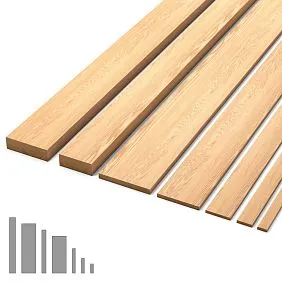
Narrow battens (20-30 mm) are used to create a frequent rhythm, thin decorative layouts, and visually increase room height. They work well in small rooms where wide battens would look coarse.
Medium battens (40-60 mm) — a universal option for most interiors. They create a balanced rhythm, are easily readable from a distance, and don't overload the space.
Wide battens (80-100 mm and more) — a choice for large rooms, lofts, industrial interiors. They create a powerful, expressive pattern and function as independent architectural elements.
Thickness
Thin battens (10-15 mm) are visually lighter, more airy, but less durable and may warp over long lengths without intermediate fastening.
Standard thickness (20-25 mm) — the optimal balance of strength and weight. Such battens hold their shape, fasten reliably, and look substantial.
Thick battens (30-40 mm) are rarely used, mainly for creating volumetric, sculptural relief.
Length
Standard batten length is 2000-3000 mm, which corresponds to ceiling heights in most apartments. For high rooms, battens up to 4000-6000 mm can be ordered, but transportation and installation of such elements are more difficult.
When purchasing, consider that it's better to buy battens with a 5-10% length allowance for trimming and possible installation errors.
Where to Buy: Market, Store, or Manufacturer
It might seem that wooden battens can be bought anywhere — at a construction market, in a large hypermarket, or online. But professionals know: the source is critically important.
Construction market: a game of roulette
Markets sell everything — from quality materials to outright defects. The problem is that it's difficult to visually distinguish a good batten from a mediocre one. Moisture isn't visible to the eye, minor geometry defects are only noticeable during installation. As a result, the buyer takes a risk: they might get lucky, or they might discover a month later that the battens have warped.
Moreover, markets rarely offer guarantees or accept returns upon defect discovery. Once you buy it — it's your problem.
Construction hypermarket: breadth without depth
Large chain stores offer a wide assortment, but there's no depth in each category. Battens are represented by 2-3 standard sizes, usually made from economy-class softwoods. Quality varies from batch to batch, as stores source materials from different suppliers.
The advantage of hypermarkets is convenience — you can pick up the goods immediately. The disadvantage is limited selection and lack of specialist consultation to help choose the optimal option for a specific task.
Manufacturer: control at all stages
Buying directly from the manufacturer guarantees quality, a wide selection, professional consultation, and competitive pricing without intermediary markups.Manufacturer of trimcontrols the entire cycle: from wood procurement to finishing.
STAVROS in St. Petersburg is exactly such a manufacturer. Own drying chambers, modern processing equipment, multi-stage quality control, a wide range of sizes and wood species. At the same time, prices are lower than in retail stores due to the absence of intermediaries.
Another advantage of working with a manufacturer is the ability to order non-standard sizes or a batch with custom parameters. If you need slats of non-standard width or with a specific degree of sanding, STAVROS production can manufacture them to order.
Solid wood millwork: more than just slats
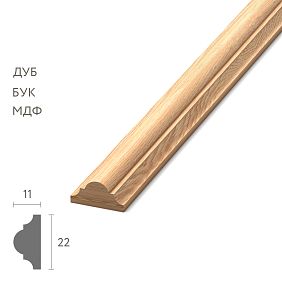
When we talk about slats, it's important to understand that they are part of a broader category —Molding SPB. Solid wood millwork includes moldings, baseboards, casings, cornices, baguettes, friezes — everything sold by the linear meter and used for finishing and decoration.
Buying slats from a millwork manufacturer gives you access to the entire range of related products. This is convenient when you need a comprehensive solution: for example, slats for an accent wall plus baseboards and casings in the same color and texture. A single supplier guarantees matching wood tones, degree of processing, and profile geometry.
STAVROS produces dozens of millwork items from oak and beech, allowing for harmonious interior solutions with a unified material and style.
Advantages of STAVROS in St. Petersburg
Why do professional designers, furniture makers, and builders choose STAVROS as their supplier of wooden slats and millwork? Here are the key advantages.
Own full-cycle production
STAVROS is not a trading company reselling others' products, but a full-fledged production facility. This means control at every stage: from wood selection to packaging of finished items. Each batch of wood undergoes incoming inspection, is dried in own chambers, processed on high-precision equipment, and checked before shipment.
This approach prevents substandard material from reaching the market. If a defect is identified, the item is rejected at the production stage and does not reach the customer.
Quality control at all stages
Multi-stage quality control is the hallmark of STAVROS. Wood moisture content after drying, geometry after planing, and surface quality after sanding are checked. Professional measuring tools are used — moisture meters, calipers, laser rangefinders.
This guarantees that the customer receives material fully compliant with the stated specifications. No unpleasant surprises like high moisture content, inaccurate dimensions, or surface defects.
Wide range of sizes and wood species
The STAVROS catalog features wooden slats in various sizes — from narrow 20 mm to wide 100 mm, thickness from 15 to 40 mm, length from 2000 to 6000 mm. Species: oak, beech, select softwood. This allows selecting the optimal option for any task without compromise.
If the standard assortment is not suitable, STAVROS will manufacture slats to custom sizes. Minimum order — from 100 linear meters, production time — from one week.
Delivery in St. Petersburg and the region
Buying quality slats is only half the job; they also need to be delivered to the site without damage. STAVROS organizes delivery with its own transport or trusted logistics partners. Slats are packaged in protective film, placed on pallets, and securely fastened.
Delivery within St. Petersburg is carried out within 1-3 days after order placement. Self-pickup from the warehouse at a convenient time is possible. For large orders, flexible delivery terms are provided, including unloading and floor-level delivery.
Competitive prices without intermediaries
Buying directly from the manufacturer eliminates intermediary markups, which in retail lumber trade can reach 30-50%. STAVROS offers prices at wholesale levels, even for small batches.
A discount and bonus system is available for regular customers, designers, and construction companies. The larger the purchase volume, the more favorable the price.
Professional Consultation
Choosing wooden slats is not always a simple task. Which wood species is suitable for a humid environment? What size is optimal for a specific wall height? How to calculate the material quantity considering waste?
STAVROS specialists will help you understand all the nuances, provide recommendations on installation and finishing, and suggest the optimal solution for your budget and tasks. This is especially valuable for private clients undertaking renovation on their own for the first time.
How to calculate the required number of slats
Before purchasing, it's important to accurately calculate how many slats will be needed. An error in calculations will lead either to a shortage of material (requiring additional purchases with the risk of not matching the wood tone) or to excess material that will sit unused.
Basic formula for vertical layout:
Number of battens = (Wall width) / (Batten width + Spacing between battens)
For example, a wall width of 4000 mm, batten width of 50 mm, spacing between battens of 100 mm. So one 'section' (batten + gap) = 150 mm. Number of sections: 4000 / 150 = 26.6, round up to 27 battens.
The length of one batten should match the wall height plus a 50-100 mm allowance for trimming. If the wall height is 2700 mm, buy battens 2800-3000 mm long.
Total linear meters: 27 battens × 2.8 m = 75.6 linear meters.
Add a 5-10% reserve for possible defects, cutting errors, replacement of damaged elements. Total: 75.6 × 1.1 = 83 linear meters.
For horizontal layout, the calculation is similar, only the parameters change: the wall height is divided by the sum of the batten width and spacing, the length of one batten equals the wall width.
If you are unsure about the calculations, STAVROS specialists will help calculate the exact amount of material based on a drawing or photos of the room.
Installation of wooden battens: basic principles
Quality material is half the success, the other half is proper installation. Even perfect battens can be ruined by incorrect installation.
Foundation Preparation
The wall must be level, dry, and clean. If you plan to attach battens to a lath (recommended option), first install a frame made of wooden blocks or metal profiles. The lath must be strictly horizontal (for vertical battens) or vertical (for horizontal ones), check with a level.
The lath creates an air gap between the wall and the battens, which provides ventilation and prevents condensation. Additionally, wiring and LED strips for lighting can be hidden behind the battens.
Plank mounting
There are several fastening methods: with visible-head screws, with hidden clips, with adhesive, or a combined method (adhesive + screws). The choice depends on aesthetic requirements and the load on the structure.
For interior walls, the combined method is optimal: battens are set on construction adhesive (liquid nails) and additionally secured with screws screwed in at an angle from the end or with hidden clips. This ensures reliability and an aesthetic appearance.
Control the spacing between battens using a template—a piece of batten or a block of the required width. This guarantees an even rhythm without deviations.
Final finishing
After installation, battens require finishing treatment for protection and to highlight the texture. Options: oil, oil-wax, varnish, wax, stain with a subsequent protective layer.
Oil is a popular choice for interior oak. It highlights the texture, preserves the naturalness of the wood, is easy to apply and renew. Oil-wax provides additional protection against moisture and dirt.
Varnish creates a durable film but makes the wood feel less natural. Suitable for high-traffic areas or places with a risk of soiling.
Stain allows you to change the color of the wood, create the effect of expensive species (wenge, rosewood, bog oak) on a budget.
Before applying the finish, sand the battens with fine-grit sandpaper (grit 180-240), remove dust, and degrease. Apply the coating with a brush or pad along the grain, in 2-3 coats with intermediate drying.
Mistakes when choosing and purchasing battens
Even experienced craftsmen sometimes make mistakes that later prove costly. Here are the most common ones.
Purchasing unchecked wood
The temptation to save money by buying battens from a random seller at a low price is great. But the risk of getting damp, warped, or defective material is even higher. Saving turns into losses of time, nerves, and money for rework.
Advice: buy only from trusted suppliers with a reputation and quality guarantee.
Ignoring humidity
Many buyers do not pay attention to wood moisture content, and then wonder why the battens warped. Moisture content is a critical parameter that cannot be ignored.
Advice: request moisture confirmation from the seller or check with a moisture meter before purchase.
Insufficient material reserve
Ordering battens 'exactly to size' based on calculation is a sure path to shortage. There will always be defective elements, cutting errors, and the need to replace damaged battens.
Advice: allocate a reserve of 10-15% of the calculated quantity.
Mixing batches
If you purchase slats in multiple batches, there is a risk that the wood shade will differ between production lots. Natural wood is a living material, and its color varies.
Tip: buy the entire volume of material at once, from a single production batch.
Lack of acclimatization
Slats were delivered from a cold warehouse, installation began immediately, and a month later the wood adapted to the room's climate and shrank, causing gaps to appear.
Tip: let the slats acclimate in the room for 3-7 days before installation.
Wooden slats in STAVROS interior projects
STAVROS is not only a manufacturer of millwork products but also has its ownSTAVROS furniture, where wooden slats are used as decorative and functional elements. Slatted furniture fronts, bed headboards, decorative panels, radiator screens — all are made from the same slats supplied to clients.
This means the material quality is tested on our own products. If a slat is good for STAVROS furniture, it is perfect for your interior too.
By browsing the STAVROS furniture project portfolio, you will see how wooden slats work in real interiors, how they combine with other materials, and how they look under different finishes. It is a source of ideas and inspiration for your own project.
Frequently Asked Questions about Wooden Slats
What wood species is best for an accent wall in a living room?
Oak is the optimal choice for a living room. It is durable, has a pronounced texture, and looks excellent under oil or stain. For light Scandinavian interiors, ash is suitable; for budget projects, coniferous species.
Is it mandatory to use battens or can slats be glued directly to the wall?
Battens are preferable: they create a ventilation gap, allow for wall unevenness leveling, and provide space to hide utilities and lighting. Gluing directly to the wall is possible if the wall is perfectly even and dry, but this is a less reliable and functional option.
How much do oak wooden slats cost in St. Petersburg?
The price depends on dimensions, wood grade, and processing level. On average, a 50×20 mm oak slat costs 200-300 rubles per linear meter. Wider and thicker profiles, as well as top-grade slats with minimal knots, cost more.
Can wooden boards be used in bathrooms?
Yes, but with the condition of proper treatment. Oak treated with moisture-resistant oil or yacht varnish handles humid environments excellently. Ensure good ventilation to avoid constant condensation on the slats.
How to care for a slatted wall?
Care is minimal: wipe with a dry or slightly damp cloth to remove dust once a month. Refresh the oil coating every 1-2 years if oil was used. Avoid aggressive cleaning agents and abrasives.
Can wooden slats be painted in color?
Yes, slats paint excellently with acrylic paints, stains, and tinting oils. Any color can be created: from white to black, from pastel to bright shades. Before painting, be sure to sand the surface and apply primer.
How long does it take to install a slatted wall?
For a 4×2.7 m wall: marking and installing battens — 3-4 hours, installing slats — 4-6 hours, finishing (sanding, applying coating) — 1-2 days accounting for drying. In total, it's realistic to complete over a weekend.
Can slats be ordered in non-standard sizes?
Yes, STAVROS manufactures slats to custom sizes from 100 linear meters. Production time — from 7 business days.
Conclusion: why STAVROS is your reliable partner
ChoosingWooden planks SPB, you are investing not just in finishing material, but in the durability, aesthetics, and comfort of your interior. And the result of this investment directly depends on material quality and supplier reliability.
The company STAVROS in St. Petersburg is aManufacturer of trim with a full production cycle, own drying chambers, modern equipment, and years of experience. Each wood batch undergoes strict control at all stages — from incoming raw material inspection to final product verification.
By purchasing wooden slats from STAVROS, you receive not just material, but a guarantee of stability, geometric precision, optimal moisture content, and impeccable processing. A wide range of sizes and species allows finding the perfect solution for any task — from budget renovations to premium design projects.
Convenient delivery across St. Petersburg and the region, competitive prices without intermediary markups, professional specialist consultation — all this makes STAVROS a reliable partner for professionals and private clients. Thousands of completed projects, tens of thousands of square meters of installed slatted walls, hundreds of satisfied clients — this is the best confirmation of STAVROS product quality.
Choose quality. Choose reliability. Choose STAVROS — and your interior will delight with perfection for many years!


