Article Contents:
- Why wooden slats have changed modern interior design
- From wall panels to slat systems
- Acoustic effect and comfort
- Visual Proportion Correction
- Wood species for slats: oak, beech, ash, larch
- Oak — classic durability and texture
- Beech — uniformity and formability
- Ash — contrasting texture and elasticity
- Larch — coniferous strength and moisture resistance
- Slat dimensions and cross-sections: how to choose the right proportions
- Thickness: from minimalism to relief
- Width: rhythm and scale
- Installation spacing: density or airiness
- Round wooden molding: from handrails to decorative elements
- Diameters and their application
- Combining with flat slats
- Radius elements and bending
- Wooden slat installation: mounting systems and technology
- Hidden fasteners: clips and rails
- Adhesive mounting: simplicity and limitations
- Frame system: versatility and reliability
- Edge and joint treatment
- Finishing: oil, varnish, tinting
- Oil: naturalness and tactility
- Lacquer: Protection and Shine
- Tinting: color change
- Interior styles: where and how to use wooden slats
- Scandinavian style: light and minimalism
- Loft and industrial style: contrasts and brutality
- Japanese minimalism: meditative simplicity
- Eco-style and biophilia: connection with nature
- Frequently asked questions: all about wooden slats and round molding
- Which wood species is best for wall slats?
- Can wooden slats be installed independently?
- How to care for wooden slats?
- What is the optimal spacing between slats?
- Can wooden planks be used in wet areas?
- How much does it cost to clad a wall with wooden slats?
- How to combine wooden slats with other materials?
- Production of wooden slats and millwork at STAVROS
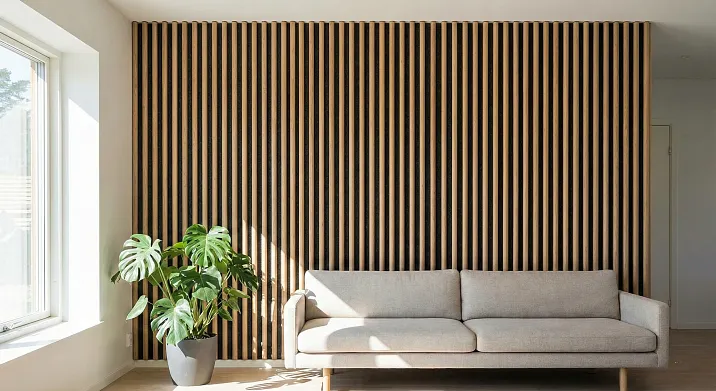
Have you ever noticed how an empty room seems to echo? Bare walls reflect sounds, create coldness, and strip a space of coziness. Now recall a space where the walls are clad in wood—there, the air seems to become saturated with warmth, sounds soften, and a sense of security emerges. Wood possesses a unique ability to alter the acoustics and atmosphere of a room. And one of the most spectacular ways to bring this magic into a modern interior is by using wall slats—parallel wooden strips that create a rhythmic texture on the surface.
SolutionBuy oak wooden planks for wallsToday, it's chosen not only by designers of premium interiors but also by apartment owners who value natural materials, tactile comfort, and visual complexity of space. Slatted cladding has become a symbol of modern Scandinavian style, eco-design, and Japanese minimalism. It works everywhere—in living rooms and bedrooms, offices and cafes, hotel lobbies, and private homes. AndRound wooden balusterscomplements this system, creating volumetric elements—handrails, decorative rails, stair railings—that harmonize with flat slats, forming an integral composition.



Why Wooden Slats Have Changed Modern Interior Design




From wall panels to slat systems
Wooden panels have been used in interiors for centuries. Classic boiserie, English wainscoting, Russian huts with hewn boards—all are predecessors of modern slat systems. But while traditional cladding created a solid wooden surface, slats work differently. They create rhythm, an alternation of wood and void, a play of light and shadow.
Why exactly nowWooden plankWhy has it become so popular? Because modern design values visual lightness. A solid wooden wall can seem heavy, oppressive, especially in small spaces. Slats, however, create an openwork effect—through the gaps, the base wall is visible, often painted in a contrasting color. Such a structure is perceived as light, graphic, and airy. At the same time, it retains the main advantages of wood—warmth, naturalness, tactility.
Our factory also produces:


Acoustic effect and comfort
Wooden slats not only decorate—they improve room acoustics. The alternation of solid slats and air gaps creates a surface that partially absorbs and partially scatters sound waves. Echo softens, reverberation becomes pleasant, and speech is perceived more clearly.
This is especially important in large spaces with high ceilings—studios, lofts, open-plan offices—where echo from bare walls creates discomfort.Wooden Planks for Wallssolve this problem naturally, without installing special acoustic panels, which often look artificial.
Moreover, wood has the ability to regulate air humidity. Solid wood absorbs excess moisture in high humidity and releases it in dry air. This creates a more comfortable microclimate in the room—especially relevant in winter when heating dries the air.
Get Consultation
Visual proportion correction
How to visually increase ceiling height in a standard apartment? Vertical lines.Price of wooden stripwhich varies depending on the species and cross-section, installed vertically from floor to ceiling, creates the illusion of a higher space. The eye follows the lines upward, making the ceiling seem farther away.
Horizontal slats, on the contrary, expand the space. A narrow room can be visually widened by installing horizontal strips on the long wall. Diagonal slats create dynamism, movement, and are especially effective in modern commercial interiors—bars, showrooms, galleries.
Combining directions creates complex geometric compositions. The lower third of the wall is clad with horizontal slats, the upper part with vertical ones. Or the central zone is designed with a diagonal pattern, and the sides with a vertical one. Such solutions turn the wall into an architectural element, an art object.
Wood species for slats: oak, beech, ash, larch
Oak—the classic of strength and texture
Oak slats are the benchmark. Oak density reaches seven hundred fifty kilograms per cubic meter, providing exceptional strength and wear resistance. Oak texture is expressive—clear annual rings create a natural pattern visible even without additional tinting.
Oak's color range is wide. Light oak has a golden-honey hue, ideal for Scandinavian interiors. Dark stained oak acquires a rich chocolate or almost black color, suitable for classic and loft interiors. Oak is easily tinted—any shade from bleached gray to deep wenge can be created.
Oak slats are not afraid of moisture due to the high tannin content in the wood. They can even be used in bathrooms with proper oil or varnish treatment. Oak does not deform with temperature and humidity fluctuations—this is especially important for slat constructions, where even slight warping of one plank disrupts the geometry of the entire composition.
Beech—Uniformity and Formability
Beech is distinguished by a fine-pored, uniform structure and a delicate pinkish hue. Beech texture is calm, without pronounced rings, creating a visual monolithic quality for the slatted wall. If oak slats draw attention to the wood's texture, beech ones create a neutral background on which other accents can be placed.
Beech density is comparable to oak—about six hundred eighty kilograms per cubic meter. This is a hard, durable wood that holds fasteners well and doesn't chip. Beech is excellent for processing—it can be sanded to perfect smoothness and absorbs tinting compounds evenly, without stains.
A feature of beech is its ability to bend after steaming. If you need to create a radius slat construction—to clad a bay window, arch, or semicircular partition—beech slats are ideal. After steaming at one hundred degrees Celsius, beech becomes pliable and can be bent to a radius several times smaller than the length of the blank.
The downside of beech is its hygroscopicity. It actively absorbs moisture from the air and releases it just as actively. With sharp humidity fluctuations, beech slats can deform. Therefore, beech constructions require a stable microclimate—humidity forty-five to sixty-five percent, temperature eighteen to twenty-four degrees Celsius.
Ash - Contrasting Texture and Resilience
Ash is similar in strength to oak but has a more contrasting texture - light and dark stripes alternate, creating a dynamic pattern. Ash color ranges from light gray to olive-brown. Ash pairs well with metal, concrete, glass - ideal for modern interiors in loft or industrial style.
The resilience of ash makes it preferable for elements experiencing impact loads - for example,Round 50 mm handrailmade of ash withstands intensive use without forming dents. Ash battens are resistant to mechanical damage, which is important for high-traffic areas - corridors, public spaces.
Larch - Coniferous Strength and Moisture Resistance
Larch is the only coniferous species comparable in density to deciduous wood. Six hundred to six hundred fifty kilograms per cubic meter, high content of natural resins that protect the wood from moisture, rot, insects. Larch is not afraid of water - historically it was used to build piers, bridges, the lower crowns of wooden houses.
Larch color is warm, golden-reddish, darkening over time to a noble ochre shade. The texture is expressive - annual rings are clearly visible, especially on a radial cut. Larch battens are ideal for wet rooms, verandas, terraces, balconies - anywhere ordinary wood would require aggressive chemical protection.
The downside of larch is that resin content can create problems during finishing. Resin seeps to the surface, hindering the absorption of oil and varnish. Therefore, larch battens require thorough deresination before final treatment.
Batten Dimensions and Cross-Sections: How to Choose the Right Proportions
Thickness: From Minimalism to Relief
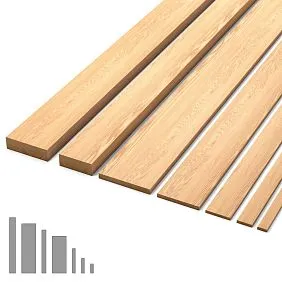
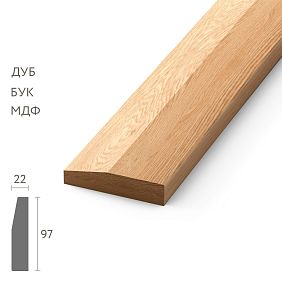
Batten thickness determines how deep the shadow will be in the gaps, how relief the wall will appear. Thin battens ten to fifteen millimeters thick create fine graphics, suitable for small rooms where massive elements would overload the space. Such battens barely protrude above the base wall, creating a light texture.
Medium thickness twenty to twenty-five millimeters is a universal option. Battens of this thickness create an expressive play of light and shadow, yet do not appear massive. This is the optimal choice for standard-sized living rooms - living rooms fifteen to twenty-five square meters, bedrooms twelve to eighteen square meters.
Thick battens thirty to forty millimeters form deep relief, create architectural expressiveness. They are appropriate in large rooms with high ceilings - halls, studios, commercial spaces. In a small room, massive battens will visually consume space, making the room cramped.
Width: Rhythm and Scale
Batten width sets the visual scale of the composition. Narrow battens twenty to thirty millimeters wide create a frequent rhythm, fine texture. Such cladding is perceived from a distance as an almost uniform surface with slight relief. Up close, the structure emerges - many parallel lines creating a graphic pattern.
Medium-width battens forty to sixty millimeters are a classic option. The rhythm is expressive enough to be perceived as an architectural element, but not intrusive. Such battens are readable both from afar and up close, creating visual interest at any distance.
Wide battens eighty to one hundred twenty millimeters form a slow, calm rhythm. They emphasize monumentality, create a sense of solidity. Wide battens pair well with narrow gaps - for example, a one-hundred-millimeter batten with a twenty-millimeter gap creates the impression of an almost solid wooden wall with thin shadow seams.
Installation Spacing: Density or Airiness
Installation spacing is the distance from the center of one batten to the center of the next. It determines how dense or airy the structure will be. Dense spacing - batten forty millimeters, gap twenty millimeters, spacing sixty millimeters - creates an almost solid wooden surface. The base wall is minimally visible, the structure is perceived as wooden cladding with slots.
Medium spacing - batten forty millimeters, gap forty millimeters, spacing eighty millimeters - creates a balance of wood and background. This is a universal option suitable for most interiors. Wood and base wall are present in equal proportions, creating a harmonious composition.
Sparse spacing - batten forty millimeters, gap eighty to one hundred millimeters, spacing one hundred twenty to one hundred forty millimeters - creates an airy, graphic structure. The base wall dominates, battens are perceived as thin vertical or horizontal accents. This technique suits minimalist interiors where visual lightness is important.
Round Wooden Molding: From Handrails to Decorative Elements
Diameters and their application
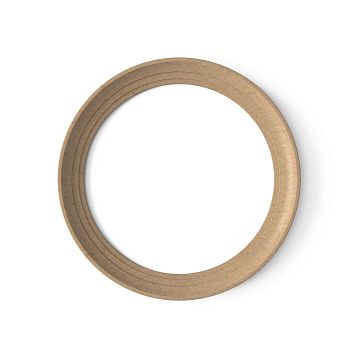
Round baluster 50is the standard diameter for stair handrails. Fifty millimeters is the optimal size for a comfortable hand grip. A handrail of this diameter provides reliable support while not appearing massive. It is suitable for children, adults, and the elderly.
Thin round molding with a diameter of twenty to thirty millimeters is used for decorative rails, light partitions, furniture rods. Such slats can be installed horizontally between vertical posts, creating openwork railings that do not block the view but define a boundary.
Large diameter seventy to one hundred millimeters - these are support posts, starting and ending posts of stair railings, decorative columns.Round oak balustradeof large diameter creates a sense of solidity, architectural significance.
Combining with Flat Battens
Round molding harmoniously combines with flat battens, creating multi-layered compositions. A wall is clad with vertical flat battens, and on top of them, at a height of nine hundred millimeters from the floor, a horizontal round handrail with a diameter of forty to fifty millimeters is mounted. Such a structure is functional - the handrail serves as support when moving along the wall - and decorative, adding a horizontal line that breaks the vertical rhythm of the battens.
In stairwells, round handrails are mounted on posts, and side panels are clad with flat battens. This combination unites the staircase and adjacent walls into a single composition. If using one wood species and one finish for handrails and battens, visual integrity of the entire space is created.
Radius Elements and Bending
Round molding can be bent to create smooth curves. Bent handrails for spiral staircases, curved balconies, and arched openings require special technology. The workpiece is steamed at a temperature of one hundred to one hundred ten degrees, becomes pliable, is placed in a mold with a specified radius, and is fixed until completely dry.
The minimum bending radius depends on the wood species and diameter. For beech with a diameter of fifty millimeters, the minimum radius is about four hundred to five hundred millimeters. For oak, which is more rigid, the radius is larger—six hundred to eight hundred millimeters. Larch and ash bend less well—for them, prefabricated structures made of short straight segments joined at an angle are preferable.
Installation of wooden slats: fastening systems and technology
Hidden fasteners: clips and guides
The aesthetics of a slatted wall require the fasteners to be invisible. Hidden clips are metal clamps that are attached to the base wall or frame, and the slat snaps into them. The clip has a groove into which the slat fits and a mounting hole for a screw or dowel.
The advantage of clips is quick installation and removal. If one slat is damaged, it can be removed and replaced without touching the adjacent ones. The disadvantage is that clips require a perfectly flat base wall or a carefully aligned frame. Any unevenness will cause the slats not to lie in the same plane.
The guide system consists of aluminum or steel profiles mounted horizontally with a spacing of forty to sixty centimeters. The slats are attached to the guides with screws from the back side. This system allows for leveling out the unevenness of the base wall—the guides are aligned with a level, creating a flat plane for mounting the slats.
Adhesive mounting: simplicity and limitations
Adhesive mounting is the simplest but has limitations. The slats are glued directly to the base wall with polyurethane adhesive or liquid nails. The adhesive is applied in a zigzag strip to the back of the slat, and the slat is pressed against the wall for a few seconds.
Advantages of adhesive mounting are speed, no visible fasteners, and the ability to work without special tools. Disadvantages are the inability to remove the slat without damaging it, high requirements for the flatness of the base wall, and limitations on the weight of the structure.
Adhesive mounting is suitable for thin, lightweight slats up to twenty millimeters thick, installed on perfectly flat walls—drywall, painted concrete, plaster. For massive slats and uneven walls, mechanical fasteners are necessary.
Frame system: versatility and reliability
The frame system is a wooden or metal lathing mounted on the base wall regardless of its flatness. The frame is aligned with a level, creating a perfectly flat plane. The slats are attached to the frame with screws.
Vertical slats require a horizontal frame—timbers with a cross-section of thirty by forty millimeters or forty by forty millimeters, secured horizontally with a spacing of forty to sixty centimeters. Horizontal slats require a vertical frame—timbers installed vertically with the same spacing.
Sound insulation or thermal insulation can be placed between the frame and the base wall, which additionally improves acoustic and thermal comfort. The frame system allows for mounting slats on any substrate—brick, concrete, old wooden walls, aerated concrete blocks.
Treatment of ends and joints
The ends of the slats are a weak point. They absorb moisture more actively than the longitudinal surface, so they require careful treatment. The ends are sanded with 240–320 grit abrasive, coated with primer or sealant, then with a finish—oil or varnish—in two to three coats.
Corner joints are designed differently depending on the style. The slats can be cut at a forty-five-degree angle and joined with a neat mitered seam. Corner trims can be used—wooden or metal corner pieces that cover the ends and create a decorative element. The ends can be left open, finished with a vertical or horizontal plank of a contrasting color.
Finish treatment: oil, varnish, staining
Oil: naturalness and tactile feel
Oil treatment preserves the natural texture and tactile feel of wood. Oil penetrates the wood pores, strengthening the surface layer but does not create a film. Slats treated with oil remain pleasant to the touch, non-slip, and warm.
Natural oils are used—linseed, tung—or special wood oils based on natural waxes. The oil is applied generously, rubbed in with a cloth or sponge, and after twenty to thirty minutes, the excess is removed. After a day, the surface can be polished with a soft cloth to enhance the shine.
Oil coating requires regular renewal—once every one to two years, depending on the intensity of use. Renewal is simple—the surface is cleaned, and a new coat of oil is applied. There is no need to remove the old coating or sand—the oil is absorbed, complementing the previous layers.
Finish: Protection and Shine
Varnish creates a durable protective film on the wood surface. Varnished slats are easy to clean, do not absorb dirt, and are protected from moisture and mechanical damage. Varnish is suitable for high-traffic areas—hallways, kitchens, commercial spaces.
Polyurethane varnishes are used—the most durable and wear-resistant, acrylic water-based varnishes—odorless, fast-drying, alkyd varnishes—a compromise option in terms of price and quality. Varnish is applied with a spray gun or brush in two to three coats with intermediate sanding.
The level of gloss is chosen according to taste and interior style. Glossy varnish creates a bright shine, emphasizes texture, but shows any surface defects. Matte varnish creates a subdued surface, hiding minor unevenness. Semi-matte is the golden mean, combining protective properties with a natural appearance.
Staining: changing the color
Staining allows you to change the color of the wood while preserving its texture. Stains on a water, alcohol, or oil base are used. The stain penetrates the wood, coloring it to the desired shade. The depth of color depends on the concentration of the stain and the number of coats.
Light species—beech, ash—are easily stained to any color. Dark species—oak—require preliminary bleaching to obtain light shades. Popular staining options are gray shades for Scandinavian style, dark brown for classic, black for contrasting modern interiors.
After staining, a protective coating—oil or varnish—must be applied. Stain itself does not protect the wood; it only changes the color. The finish coating fixes the stain, protects against fading, moisture, and mechanical damage.
Interior styles: where and how to use wooden slats
Scandinavian Style: Light and Minimalism
Scandinavian interiors value natural materials, light tones, and functionality.form the architecture of walls and ceilings, creating a play of light and shadow.In the Scandinavian style, this is light beech or oak, treated with white oil or light stain. The slats are mounted vertically with a medium spacing, creating a light texture.
The base wall is painted white or light gray, creating a contrast with the wood. The gaps between the slats remain light, creating a sense of airiness. Such cladding does not overload the space, preserves its visual lightness, while adding warmth and tactility.
Scandinavian interiors often use slats locally — one accent wall in the living room is clad, the headboard area in the bedroom, a wall fragment in the hallway. Full cladding of all walls is not typical — moderation, a balance of wood and neutral surfaces is important.
Loft and Industrial Style: Contrasts and Brutality
Loft combines rough industrial materials — concrete, brick, metal — with warm wooden elements. Wooden slats in a loft are dark stained oak, ash with contrasting texture, larch without finishing, preserving its natural color and resinous inclusions.
The slats can be deliberately rough — with preserved saw marks, uneven edges, varying widths. Such intentional carelessness emphasizes the industrial aesthetic. Or conversely — perfectly smooth, creating a contrast with the roughness of concrete and brick.
Fasteners in a loft can be exposed — black screws, metal brackets, steel railings supporting horizontal wooden planks. This emphasizes constructiveness, honesty of materials, and the absence of decorative illusions.
Japanese Minimalism: Meditative Simplicity
Japanese style values simplicity, naturalness, and meditativeness. Wooden slats in a Japanese interior are an element of traditional screens and partitions, adapted to modern space. Light wood is used — cedar, cypress, light oak — without bright tinting.
The slats are installed with sparse spacing, creating transparency, allowing light to pass through. Such a structure zones the space without blocking it, preserving a visual connection between zones. Japanese style avoids massiveness — the slats are thin, light, almost weightless.
Lighting integration is a characteristic technique. Hidden lighting — LED strip or spotlights — is mounted behind the slatted wall. Light passing through the gaps between the slats creates soft diffused lighting, emphasizes the wood texture, and adds depth to the composition.
Eco-Style and Biophilia: Connection with Nature
Eco-style and biophilic design strive to create a connection between humans and nature indoors. Wooden slats here are not just cladding, but a way to bring natural forms, textures, and aromas into the interior. Wood without aggressive treatment is used — oil or wax, preserving the natural smell of the wood.
The slats are combined with living plants — vertical gardens integrated into the slatted wall. The gaps between the slats are used to install planters with ferns, moss, succulents. A living wall is created where wood and plants interact, forming a natural microclimate indoors.
The color palette of eco-interiors is natural wood shades, green tones of plants, earthy colors of base surfaces. Artificiality is minimized — no bright colors, plastic, chrome. Natural materials dominate — wood, stone, linen, cotton.
Frequently Asked Questions: All About Wooden Slats and Round Molding
Which wood species is best for wall slats?
The choice of species depends on budget, interior style, and operating conditions. Oak is the optimal balance of strength, durability, and aesthetics, suitable for any interiors. Beech is a budget-friendly alternative to oak with a uniform texture, ideal for minimalist interiors. Ash has a contrasting texture, suitable for loft and contemporary style. Larch offers maximum moisture resistance, the choice for bathrooms and damp rooms.
Can wooden slats be installed independently?
Yes, installing slats is a feasible task for a home craftsman with basic woodworking skills and tools. Necessary tools: a miter saw or handsaw with a miter box for precise cutting, a drill or screwdriver, level, tape measure. When using a hidden fastening system, installation is simplified — the slats snap into clips without additional fixation.
The most important thing is thorough marking and alignment of the frame or guides. Even a slight deviation from vertical or horizontal will be noticeable after installing all the slats. Use a laser level for precise marking and control the plane at each stage of installation.
How to care for wooden slats?
Regular cleaning includes dry wiping with a soft cloth or vacuuming with a soft brush attachment once a week. Dust settles in the gaps between the slats, so it's important to clean not only the front surface but also the gaps.
Wet cleaning is allowed with a well-wrung cloth without excess water. Do not use aggressive detergents, abrasives, or solvents. To remove stains, use special wood care products.
Oil coating requires renewal every twelve to eighteen months. The surface is cleaned, a thin layer of oil is applied, and after thirty minutes, the excess is wiped off. Varnish coating is more durable — renewal is required every five to seven years.
What is the optimal spacing between slats?
The optimal spacing depends on the width of the slat and the desired visual effect. A universal rule — spacing one and a half to two times the width of the slat. For a forty-millimeter slat, the optimal gap is sixty to eighty millimeters.
To create an almost solid wooden surface, choose a gap less than or equal to the width of the slat. For an airy graphic structure — a gap two to three times the width of the slat. Experiment with mockups before installation — lay out several slats on the floor with different gaps, evaluate the visual effect.
Can wooden planks be used in humid rooms?
Yes, provided the correct choice of wood species and high-quality moisture-protective treatment. The best choice for bathrooms is larch, which contains natural resins that protect against moisture. Oak is also suitable due to its density and tannin content.
Treatment with moisture-resistant compounds is mandatory — special oils for wet rooms or yacht varnishes. Quality ventilation is necessary — forced exhaust that removes excess moisture. Avoid direct water contact with wooden surfaces — do not install battens in areas of direct contact with showers or bathtubs.
How much does wall cladding with wooden battens cost?
The cost depends on wood species, batten dimensions, cladding area, and installation method. On average, one square meter of wall cladding with oak battens costs 2,500–4,000 rubles for materials, plus 1,500–3,000 rubles for labor when hiring installers.
Beech battens are cheaper — 2,000–3,000 rubles per square meter for materials. Pine is even more affordable — 1,000–1,500 rubles. DIY installation reduces the total cost by half.
How to combine wooden battens with other materials?
Wood harmoniously combines with many materials. A classic combination — wood and white paint. The base wall is painted with white matte paint, onto which wooden battens in natural color or tinted in gray shades are mounted.
Wood and concrete — a characteristic combination for loft style. A concrete wall, rough or smooth, is complemented by wooden battens that soften industrial rigidity. Wood and brick — warm wood emphasizes the texture of brickwork.
Wood and metal — a contrast of warm natural material and cold industrial. Metal posts, rails, brackets are combined with wooden battens and round moldings, creating structural expressiveness.
Production of wooden battens and moldings at STAVROS
STAVROS specializes in producing high-quality moldings from solid natural wood. Our own modern production is equipped with high-precision woodworking machinery from European manufacturers, guaranteeing consistent product quality and accuracy of geometric dimensions.
The technological cycle includes chamber drying of wood to optimal moisture content of 8–12%, eliminating subsequent product deformation. Multi-stage sanding ensures perfect surface smoothness, ready for finishing. Strict quality control at each production stage guarantees absence of defects — cracks, knots, warping.
STAVROS assortment includes a wide selection of wooden battens of various cross-sections and lengths, round moldings with diameters from 20 to 100 mm, stair handrails, moldings, baseboards, cornices. Custom manufacturing of products to individual dimensions for specific projects is possible.
Professional consultations from STAVROS specialists will help choose the optimal solution for your interior, considering room features, stylistic preferences, and project budget. Delivery across Moscow and Russian regions ensures quick receipt of materials on site.
Choosing STAVROS products means investing in quality, durability, and aesthetics of natural wood. Each product is created with attention to detail, respect for woodworking traditions, and application of modern technologies. Wooden battens and round moldings from STAVROS — a solution that will last decades, preserving original beauty and functionality, creating comfort and coziness in your home.