












































































Article Contents:
- Biophilic Design: Nature as the Foundation of the Concept
- Philosophy of Connection with Nature
- Wood as a Tactile and Visual Anchor
- Wall Planks: Verticality and Structure
- Role of Planks in Space Zoning
- Vertical Planks: Visual Ceiling Lift
- Horizontal Laths: Expanding Space
- Materials, Cross-Sections, Spacing
- Plank Partitions: Mobile Zoning
- From Wall to Volume
- Static and Sliding Structures
- Function Integration: Shelves, Lighting, Greenery
- Furniture Handles: Tactile Continuation of the Concept
- Role of Handles in the Unified Concept
- Shapes and Styles of Wooden Handles
- Coordination with Planks by Wood Species and Color
- Size and Proportions of Handles
- Wooden Wall Decor: Completing the Composition
- What is Included in Wall Decor
- Wooden Panels and Molding
- Decorative Beams and Brackets
- Practical Zoning: Application Scenarios
- Studio: Separating Bedroom from Living Room
- Living Room: Accent Wall with TV
- Kitchen-Living Room: Visual Separation
- Entryway: Wardrobe Partition
- Bedroom: Headboard Made of Planks
- Choosing Wood Species: Character and Durability
- Oak: Nobility and Eternity
- Ash: Light Energy
- Nut: Warm Depth
- Spruce and Birch: Budget Naturalness
- Finishing and Coating: Preserving Naturalness
- Oil: Tactile Warmth
- Wax: Soft Sheen
- Varnish: Long-lasting Protection
- Brushing: Revealing Texture
- Installing Planks: Technical Aspects
- Mounting to Wall: Hidden vs Visible
- Lathing: Wooden vs Metal
- Ventilation: Gap Between Wall and Planks
- Psychology of Wooden Space
- Stress Reduction and Improved Well-being
- Improved Concentration and Productivity
- Creating Emotional Attachment to Home
- Popular questions
- Conclusion: Wood as the Language of Space

The modern interior of 2026 is a space where every element is meaningful and every detail contributes to the overall concept.wooden planks on the wallare no longer just a trend — they have become a tool for smart zoning, creating visual structure, and introducing natural textures into an urban environment. Combined withfurniture handles— made of natural wood,plank partitionsand other elementswooden wall decorthey create a unified concept, where natural materials form the logic of space, its character, and its emotional impact.
This approach is based on biophilic design — a philosophy that acknowledges humanity's innate need for connection with nature. Wood in interior design is not just a material; it is a psychological anchor, bringing us back to organic roots, reducing stress, creating a sense of safety, grounding, and home.


Biophilic Design: Nature as the Foundation of the Concept




Philosophy of Connection with Nature
Biophilic design stems from scientifically proven facts: contact with natural elements — wood, stone, plants, water, natural light — positively affects human physical and mental health. Cortisol levels (stress hormone) decrease, attention concentration improves, creativity increases, sleep normalizes, and immunity strengthens.
in an urban environment, where humans are disconnected from nature, biophilic design compensates for this deficit throughwooden items in the interior. wooden planks on the wall, wooden handles from solid wood, Slatted Partitionsbecome conduits of nature into the home, creating a micro-environment perceived by the brain as safe, calming, and harmonious.
Our factory also produces:



Wood as a Tactile and Visual Anchor
Natural wood possesses unique qualities that cannot be fully imitated. Visible texture with growth rings, knots, and natural color variations creates visual complexity that the brain interprets as organic and alive. The tactile warmth of wood, its uneven surface, and the scent of natural timber — all of these activate sensory channels, creating a multi-layered perception.
When present in the interior,wooden planks on the wall, Wooden Furniture Handles, Wooden wall panels create an environment rich in wood, where a person is constantly in contact with natural material — visually, tactilely, olfactorily. This forms a deep sense of comfort that is hard to describe in words but easily felt by the body.Wooden planks on the wall: verticality and structure
Get Consultation
Role of planks in zoning space
These are vertical or horizontal wooden planks mounted on the wall at a specific spacing, creating a rhythmic structure, volume, play of light and shadow. In 2026, they are used not as decorative elements but as functional tools for zoning open spaces.
wooden planks on the wallThey delineate functional zones without erecting load-bearing walls: separating the kitchen from the living room, the workspace from the bedroom, the entryway from the main studio space. They divide, but do not isolate, preserving visual continuity between zones, allowing light, air, and sight to pass through, while psychologically marking boundaries.
Wooden boards in interiorthey define functional zones without erecting load-bearing walls: separating the kitchen from the living room, the work area from the bedroom, the hallway from the main studio space. They divide, but do not isolate, preserving visual continuity between zones, allowing light, air, and sight to pass through, while psychologically marking boundaries.
Vertical planks: visual ceiling lift
Verticalwooden planks on the wallcreate an illusion of high ceilings. Vertical lines draw the eye upward, visually elongating the space. This is especially valuable in apartments with standard ceiling heights of 2.7–2.8 meters, where every centimeter of visual height counts.
Verticality of planks mimics the natural verticality of trees reaching for light. This organic movement is perceived by the brain as natural and calming. When verticalWooden slats on the wallare placed from floor to ceiling without breaks, they create monumentality and architectural expressiveness, transforming an ordinary wall into a sculptural object.
Horizontal boards: expanding space
HorizontalWooden planksHorizontal planks work in the opposite way — visually expanding the space, making the room appear wider. Horizontal lines calm, create a sense of stability, solidity, and grounding. This is a good choice for narrow, elongated rooms that need to be visually widened.
Horizontality of planks reminds of layered natural structures — geological strata, tree rings, waves on water. This is also a natural pattern, calming the nervous system, creating a sense of order, rhythm, and repetition.
Materials, cross-sections, spacing
Wooden plankis made from various species: oak, beech, pine, birch, walnut. Hardwoods (oak, beech) are more durable, resistant to mechanical damage, and have expressive texture. Softwoods (pine, birch) are more budget-friendly, easier to work with, and lighter in color.
The cross-section of planks is usually 20x40 mm, 30x50 mm, 40x60 mm — the thicker the plank, the heavier and more substantial the structure appears. For residential interiors, medium cross-sections of 30x50 mm are optimal, creating a balance between visual prominence and lightness.
The spacing between planks (distance from center to center) determines the visual character. A dense spacing of 60–80 mm creates a tight rhythmic structure, almost covering the wall. A medium spacing of 100–120 mm is a universal solution, balancing openness and enclosure. A wide spacing of 150–200 mm creates a light graphic structure, more suggestive of zoning than actually dividing.
Plank partitions: mobile zoning
from wall to volume
Slatted partitionare volumetric constructions made of wooden planks, standing independently from walls, dividing space into zones. Unlike planks attached to walls, a partition is a standalone architectural element that can be placed anywhere in the room, creating flexible zoning scenarios.
Plank partitions 2026differ in multifunctionality: they not only divide space but also serve as a base for vertical greenery, built-in lighting, open shelves, creating a multi-layered interior element.
Static and sliding constructions
StaticSlatted Partitionsare rigidly mounted to the floor and ceiling, creating permanent zoning. This solution is for situations where functional division of space does not change — separating the entryway from the living room, kitchen from dining room, workspace from bedroom in a studio.
Sliding partitions on rail systems allow changing the configuration of space depending on the situation. During the day, the partition is open, creating a single open space. In the evening, it is closed, isolating a private zone. This is flexibility, adaptability, multi-scenario functionality — key qualities of modern housing.
SlidingSlatted Partitionsconsist of panels on a frame (aluminum or steel), to which wooden planks are attached. Panels move along upper and lower guides, requiring high-quality execution for smooth, silent movement.
Integration of functions: shelves, lighting, greenery
ModernSlatted Partitionsare not just wooden planks, but multifunctional objects. Open shelves made of wood or glass are installed between planks, holding books, decor, plants. Shelves additionally connect space, create horizontal divisions, and add functionality.
LED lighting integrated into the partition — behind the slats, between them, below, above — creates a dramatic effect, emphasizes verticality, highlights the wood texture. Light passing through the slats creates striped patterns on the floor and walls, changing depending on the angle and intensity.
Vertical greening — climbing plants (ivy, scindapsus, monstera) wrapping around the slats — transforms the partition into a living green wall. This enhances the biophilic effect, improves air quality, creates visual softness, and natural growth dynamics.
Furniture handles: tactile continuation of the concept
Role of handles in a unified concept
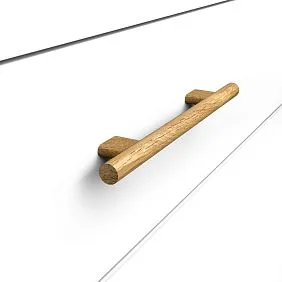
Furniture Handles— are elements with which people interact daily, repeatedly. Opening a cabinet, pulling out a dresser drawer, opening a buffet door — we touch handles, feel their shape, texture, temperature. WhenWooden Furniture Handles— are made from the same wood species aswall slats, a tactile and visual connection is created, unifying architecture and furnishings.
It is a subtle detail that guests may not consciously notice, but will inevitably subconsciously perceive. The brain registers repetition of material, texture, color, and interprets this as harmony, thoughtfulness, and professional design.
Shapes and styles of wooden handles
Wooden furniture handles— come in various shapes. Polished round or oval knobs — classic for dressers, side tables, small cabinets. 96–192 mm curved brackets — for kitchen sets, buffets, cabinets. Long 300–960 mm brackets — modern trend, creating graphic vertical or horizontal lines on facades.
Carved handles with floral ornaments, geometric patterns — for classic interiors where decoration matters. Simple geometric shapes — cylinders, rectangular bars, T-profiles — for minimalist spaces, where the handle should be noticeable by shape, not ornament.
Sculptural organic handles with asymmetrical shapes, resembling smooth stones, branches, waves — for biophilic interiors where connection to natural forms is important. Such handles become small sculptural objects, pleasant to hold in the hand.
Coordination with slats by wood species and color
Whenwooden planks on the wall— made from light oak,Furniture Handles— should also be made from light oak or a wood species of similar tone — ash, birch. If the slats are made of dark walnut, handles should be walnut, stained oak, or tinted to match.
Finish should be identical: if slats are finished with matte oil preserving wood’s tactility, handles should also be oiled. If slats are lacquered, handles should be lacquered. If slats are brushed with visible texture, handles should be brushed. Tactile and visual unity of material creates a powerful connection between architecture and furniture.
Size and proportions of handles
Sizefurniture handles— should match the scale of furniture and room. In spaces with high ceilings, large furniture, wideplank partitions— handles can be large and substantial. In compact spaces with elegant furniture, thin slats, handles should be delicate and proportionate.
When slat cross-section is 40x60 mm, polished knob handle diameter may be 35–40 mm, bracket width 20–25 mm. When slat cross-section is 20x40 mm, handles should be thinner — knobs 25–30 mm, brackets 15–20 mm. Proportionality — the foundation of harmony.
Wooden wall decor: completion of composition
What is included in wall decor
Wooden wall decor— includes a wide range of elements: carved panels, decorative outlets, inlays with ornaments, three-dimensional panels with relief, wooden beams on ceiling, moldings and cornices. All of them complementwooden planks on the wall, creating a multi-layered wooden environment.
In the concept of a unified styleWooden wall decor— should be made from the same wood species or similar tone as the slats and handles. This creates visual harmony between elements, enhancing the sense of thoughtfulness.
Wooden panels and moldings
Wooden wall panels — a more substantial alternative to slats, creating a solid wall covering. Panels made from solid oak, ash, walnut, laminated or veneered, mounted vertically or horizontally, creating rhythm, texture, natural warmth.
Wooden moldings— linear decorative elements framing walls, creating frames, panels, horizontal and vertical divisions. When molding profiles match slat cross-sections, a stylistic unity is created.
Decorative beams and brackets
Wooden beamsThe ceiling — a powerful decorative element continuing the theme of wood vertically. Beams replicate the species and color of wall planks, creating a visual frame for the room from above and along the sides.
Decorative bracketsShelves made of the same wood as the planks support open shelves, creating functionality and visual continuity. Brackets can be carved or simple geometric, depending on the interior style.
Practical zoning: application scenarios
Studio: separating the bedroom from the living room
In a studio apartmentSlatted partitionVertical wooden planks separate the sleeping area from the living room. The partition runs from floor to ceiling but does not reach the full wall width, leaving a passage 80–100 cm wide. This creates a visual and psychological boundary while maintaining physical continuity.
In the sleeping zone behind the partition, there is a bed with a wooden headboard and a chest ofwooden handlesmade of the same wood species as the planks. On the wall behind the bed —horizontal wooden planks, creating an accent wall. Unity of material unifies the zones, making the studio a cohesive space rather than a collection of disconnected corners.
Living room: accent wall with TV
Behind the TV in the living room — an accent wall with verticalwooden planks, mounted from floor to ceiling with a 100 mm spacing. The TV is mounted between the planks, becoming part of the composition. Under the TV — a low console with horizontalwooden handle bracketsmade of the same wood, continuing the vertical rhythm.
Opposite the TV wall — a sofa, behind which on the floor there is a lowSlatted partitionwall 120 cm high, separating the lounge area from the dining area. The partition serves as a base for climbing plants, creating a green wall. Wood planks + living greenery = a biophilic environment of maximum intensity.
Kitchen-living room: visual separation
Between the kitchen and living room — a verticalSlatted partition, running from floor to ceiling but occupying only part of the room’s width — approximately 2/3 — leaving a wide passage. The planks are spaced 120 mm apart, creating a visual boundary while allowing light and sight to pass through.
The kitchen unit is equipped withwooden handleslong brackets 400–500 mm made of the same wood species as the partition. This creates visual continuity between the architectural element (partition) and the furniture (kitchen unit). On the kitchen wall — horizontalWooden planksin the backsplash zone, protected by transparent tempered glass, continuing the wood theme.
Entryway: partition-closet
In an open-plan entrywaySlatted partitionperforms a dual function: separates the entry zone from the living room and serves as a base for an open closet. On one side of the partition (toward the entryway), hooks, hangers, and shoe shelves are built between the planks. On the other side (toward the living room), the partition appears as a decorative element.
The closet in the entryway is equipped withwooden knob handlesmade of the same wood as the partition. On the entryway wall — horizontalwooden planks, serving as a base for hooks, mirrors, and consoles. Unity of material transforms the utilitarian entryway into a thoughtfully designed space.
Bedroom: headboard made of planks
The wall behind the bed in the bedroom is decorated with vertical %s from floor to ceiling, creating an accent zone. The slats are spaced closely at 60 mm, forming almost a continuous surface. LED lighting is integrated behind the slats, creating a soft glow that shines between the boards.wooden planksThe bedside tables, chest of drawers, and wardrobe are made of %s. On the opposite wall —
The bedside tables, chest of drawers, and wardrobe are made of %s.wooden handles— %s creating a frame around the mirror or painting, continuing the wooden theme. The bedroom transforms into a wooden cocoon, calming, protective, creating a sense of safety.Wooden moldings, creating a frame around a mirror or painting, continuing the theme of wood. The bedroom transforms into a wooden cocoon, calming, protective, creating a sense of safety.
Wood species selection: character and durability
Oak: nobility and eternity
Oak — the king of wood species. Hard, dense, resistant to deformation, mechanical damage, and moisture. The texture is expressive with large growth rings and rays, creating a distinctive pattern. Color ranges from light yellow (young oak) to dark brown (worn oak).
OakRacks on the WallandFurniture HandlesThey create a sense of solidity, reliability, and connection to history. Oak is the choice for classic, neoclassical, and Scandinavian interiors, where durability and nobility are important.
Ash: light energy
Ash is lighter than oak, with a lighter tone and less contrasting texture. It creates a sense of airiness, lightness, freshness. Hardness is almost as high as oak, but visually ash appears softer, calmer, less dominant.
AshWooden planksandHandles— choice for light Scandinavian, minimalist, modern interiors, where visual lightness is important without sacrificing quality.
Walnut: warm depth
Walnut — a medium-hardwood species with a warm chocolate-brown tone, sometimes with purple or reddish notes. The texture is rich, noble, not overly contrasting. Walnut creates a sense of coziness, homeliness, warmth.
Walnut %srailsandFurniture Handles— choice for warm, cozy interiors, where emotional softness, intimacy, and a private atmosphere are important.
Spruce and birch: budget-friendly naturalness
Spruce and birch — soft species, less hard and durable, but significantly more affordable. Spruce has a yellowish tone with visible knots, creating a rustic, village-like character. Birch is light, almost white, with a delicate texture.
Forslats on the wallin living spaces where there are no high mechanical loads, spruce and birch are quite suitable. For %sfurniture handlesexperiencing constant exposure, it is better to choose hard species.
Finishing and coating: preserving naturalness
Oil: tactile warmth
Wood oil — the most natural finish, penetrating the wood, protecting it from moisture and dirt, while preserving its tactile quality, open pores, and natural texture. Oil does not create a film on the surface; the wood remains 'alive', breathing.
Wooden planksandHandlesThey feel pleasant to the touch, warm, slightly rough. Oil enhances the natural beauty of the texture, deepens the color, creating a noble matte finish.
Wax: soft sheen
Wax — a denser finish, creating a thin protective film that gives wood a soft silk-like sheen. Wax enhances the texture, makes the color richer, and creates a tactile smoothness.
Wax requires periodic renewal (every 1–2 years), but this is a simple procedure performed independently. %srailsandHandlesunder wax look well-maintained, noble, alive.
Lacquer: long-lasting protection
Lacquer creates a hard protective film on the wood surface, maximally protecting against moisture, scratches, and dirt. Lacquer can be glossy, semi-gloss, or matte. Glossy lacquer creates a shine, highlights the texture, but looks less natural. Matte lacquer preserves the natural appearance of the wood, but the protection is the same.
Forslats on the wallIn residential spaces, lacquer is not required — oils are sufficient. Forfurniture handlesthose experiencing constant tactile contact, lacquer provides maximum durability.
Brushing: revealing texture
Brushing — mechanical processing in which soft wood fibers are removed with stiff brushes, leaving hard annual rings raised. This enhances visual and tactile texture, creates an aged wood effect, and reveals the natural grain.
Brushed bathroomWooden planksandHandlesThey have expressive texture, are pleasant to the touch, look natural and noble.
Installing planks: technical aspects
Mounting to the wall: hidden vs visible
wooden planks on the wallThey are mounted in two ways: hidden and visible. Hidden mounting — through a metal frame, to which planks are attached with hidden clips or adhesive. Fasteners are not visible from the outside, creating a clean surface.
Visible mounting — through screws driven through the planks into the frame. Screws are countersunk, holes are filled with wooden plugs or left visible as part of an industrial aesthetic. Visible mounting is simpler, faster, cheaper, but less elegant.
Frame: wooden vs metal
Frame — a structure to which planks are attached. Wooden frame made of 40x40 mm or 50x50 mm beams — traditional solution, eco-friendly, but requires wall leveling. Metal frame made of profiles — modern solution, more precise, allowing compensation for wall irregularities.
Frame is mounted horizontally (for vertical planks) or vertically (for horizontal) with a 40–60 cm spacing. Planks are attached to the frame with a specified spacing, creating the final composition.
Ventilation: gap between wall and planks
A ventilation gap of 10–20 mm between wall and planks is mandatory, provided by the frame thickness. This prevents moisture accumulation, mold growth, and wood rot. Ventilation is critical for the longevity of wooden structures, especially in humid rooms.
Psychology of wooden space
Stress reduction and improved well-being
Scientific studies confirm: being in a room with natural wood reduces cortisol levels (stress hormone), normalizes pulse and blood pressure, improves mood. Visual contact with wooden texture activates the parasympathetic nervous system, responsible for relaxation and recovery.
When present in the interior,Wooden planks on walls, wooden furniture handles, Slatted PartitionsPeople constantly reside in a biophilic environment, receiving therapeutic effects simply by being at home.
Improved concentration and productivity
Wooden elements in the workspace enhance concentration, reduce cognitive fatigue, improve creative thinking. Studies of office workers showed: presence of wood in interior design increases productivity by 8–12%, reduces errors, improves overall well-being.
Home office withwooden plankson the walls, wooden desk,wooden handleson cabinets becomes a space where it is easier to focus, work effectively, and avoid burnout.
Creating emotional attachment to home
Interior with natural wood creates a deeper emotional connection to home. Wood — a warm, living material that ages beautifully, develops patina, and carries history. People form stronger attachments to wooden elements than to artificial ones, because wood is perceived as part of nature, as something valuable and unique.
House withwooden planks, handles, partition walls— this is a home where you want to be, which becomes a refuge, a source of renewal, a place you are drawn back to.
Popular Questions
Yes, but under certain conditions. It is necessary to choose moisture-resistant wood species (teak, larch, thermowood), ensure quality moisture protection, and provide good ventilation. Modern technologies allow using wood even in bathrooms and saunas.
Yes, if you choose moisture-resistant species (teak, larch) and treat with protective compounds (oil-wax, yacht varnish). Good ventilation and gap between wall and planks are mandatory.
How to care for wooden panels?
Wipe with dry or slightly damp cloth, avoid aggressive chemicals. Renew oil or wax coating every 1–2 years to maintain protection and appearance.
Is it necessary for plank and furniture handle species to match?
Not necessarily exact match, but similar shades and textures are preferred. Light oak pairs well with ash, dark walnut with stained oak.
How much does concept implementation cost?
Price of wooden stripDepends on species, cross-section, and length. Oak is more expensive than pine but more durable. Installation increases cost by 30–50%. Budget for a 20 m² room: from 40,000 to 150,000 rubles depending on species and complexity.
Where to buy quality materials?
STAVROS company offersWooden planks, Furniture Handles, wooden decorative elementsVarious species and cross-sections. Possibility to select elements in a unified style, installation consultations.
Conclusion: Wood as the language of space
wooden planks on the wallandFurniture HandlesIn 2026 — these are not decorative elements, but tools for creating a biophilic space, where natural materials shape character, atmosphere, and emotional impact of the interior. A unified zoning concept through wood transforms the home into a cohesive organism, where architecture and furnishings speak the same language — the language of nature, organic design, and life.
Slatted Partitions, Wooden wall decorCoordinated by species and color with furniture hardware, they create a space where a person feels calm, safe, and at home. This is a home that heals, restores, and inspires.
The company STAVROS offers all necessary elements to realize the biophilic concept:Rails of various cross-sections, Furniture Handles, Decorative Inserts, beams, MoldingsCreate a space where nature lives within the walls.


