Article Contents:
- The Role of Natural Wood in Creating Interior Premiumness
- Solid Wood vs. Imitations: How to Tell the Difference
- Elite Wood Species: Hierarchy of Value
- Elite Solid Wood Furniture: Criteria of Authentic Quality
- Construction: Joints and Geometry
- Finishing: From Sanding to Varnishing
- Carving and Inlay: A Sign of Handcrafted Work
- Hardware: Hidden Luxury
- Wooden Decor Items: Panels, Overlays, Carved Elements
- Wall Panels: Boiserie as a Symbol of Classicism
- Coffered Ceilings: Geometry and Volume
- Carved Overlays and Cartouches: Accents on Doors and Walls
- Polyurethane Molding: Classic Style Without the Weight of Stone
- Ceiling cornices: framing the space
- Ceiling rosettes: central accents
- Moldings and Pilasters: Vertical Accents
- Furniture Hardware: Details That Create Status
- Types of Elite Hardware
- Hidden Hardware: Push-to-Open
- Comprehensive Approach: Furniture, Decor, Molding in Harmony
- Example 1: Classic Living Room in a Country House
- Example 2: Study in English Style
- Frequently Asked Questions: Answers for Discerning Clients
- Conclusion: Create a Prestigious Interior with STAVROS
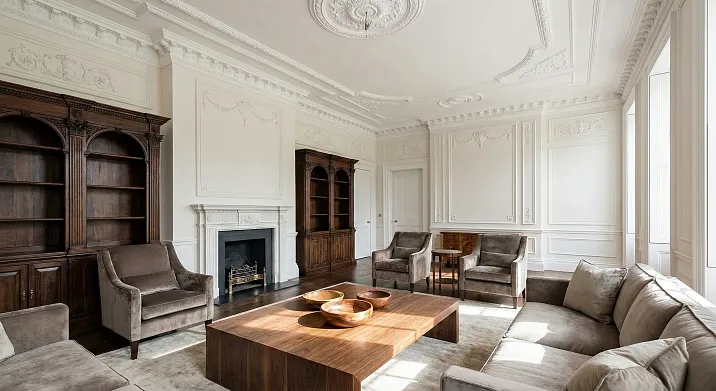
Status. A word that evokes admiration in some, a skeptical smile in others. But the fact remains: an elite interior is not just an expensively furnished space; it is an environment where every detail speaks of taste, affluence, and an understanding of the true value of things.wooden decor in interiorof a premium home is not a random choice, but a conscious decision by an owner who knows that solid oak, ash, or Karelian birch carries an energy that cannot be imitated by plastic or MDF with laminate.Luxury furnituremade of solid wood with hand-carved details, inlay, and patination are works of art that serve for decades, are passed down through generations, and become family heirlooms.
But furniture is only part of the concept. A status interior is a symphony where every instrument plays its part.Wooden decoris manifested in carved wall panels, door overlays, massive baseboards 150-200 mm high, coffered ceilings, beams made of aged oak.Polyurethane moldingscomplements wooden elements by adding classic accents: ceiling cornices 200-300 mm wide, rosettes 800-1200 mm in diameter, pilasters, moldings framing wall panels. EvenFurniture HandlesIn an elite home, it's not generic store-bought hardware, but exclusive solid wood pieces with carving, brass patinated, custom-made from individual sketches.
This article is a guide for those creating or updating the interior of a status home, penthouse, or country residence. We'll examine why natural wood is indispensable in premium interiors (and why imitations are obvious from a mile away), which wood species are considered elite (spoiler: not just oak), how to chooseexclusive furniturehandcrafted (quality criteria, what to look for, what to avoid), how to combine wooden decor with stucco (balancing the warmth of wood and the strictness of classical forms), which details reveal the genuine status of an interior (furniture hardware, finish quality, exclusivity of elements).


The Role of Natural Wood in Creating Interior Premiumness
Why does solid wood cost many times more than MDF or particleboard, even when veneered? Because wood is a living material with a unique texture (no two boards are absolutely identical, each has its own pattern of growth rings, its own play of light and shadow), with natural warmth (wood is physically warm to the touch, while metal or plastic are cold), with energy (the tree grew for decades, absorbing sun, rain, wind—this memory of the material is transferred to the interior).




Solid Wood vs. Imitations: How to Tell the Difference
Visually: solid wood has a three-dimensional texture (the fibers go deep into the material, revealing new nuances of the pattern under different lighting). Veneer (a thin slice of wood 0.5-1.5 mm thick, glued onto a base) has a flat pattern, especially noticeable on the ends (the end of solid wood shows the wood grain, the end of a veneered piece shows the layered structure of the base + a thin layer of veneer). PVC film (wood imitation on MDF) is frankly artificial, with a repeating pattern (the same texture on different pieces is a sign of printing, not natural material).
Tactilely: solid wood is slightly rough (even polished, it retains the micro-relief of the wood pores), warm (quickly warms from the hand). Plastic, film—smooth, cold, slippery.
By weight: solid wood is heavy (density of oak 700 kg/m³, an oak solid wood chest of drawers weighs 80-120 kg). MDF is lighter (density 600-800 kg/m³, but the parts are thinner, final weight of a chest 40-60 kg). Particleboard with film—the lightest (density 550-650 kg/m³, chest 30-50 kg).
By sound: tap the front with your knuckle. Solid wood—a muted, noble sound. MDF—more resonant. Particleboard with film—a hollow, cheap sound.
Our factory also produces:


Elite Wood Species: Hierarchy of Value
Oak—the classic of elite furniture. Density 700-750 kg/m³, high hardness (resistant to impacts, scratches), legendary durability (oak furniture lasts 100-200 years). Expressive texture (large pores, contrasting growth rings, medullary rays—light stripes appearing on a radial cut). Color from light honey (natural oak) to dark brown (bog oak—wood that has lain in water for hundreds of years, acquired a black-gray hue, considered especially valuable). Price of oak furniture: chest of drawers 150,000-500,000 rubles, dining table 200,000-800,000 rubles, wardrobe 400,000-1,500,000 rubles.
Ash—a light alternative to oak. Density 650-700 kg/m³, texture similar to oak, but lighter (cream, beige, light brown tones), smoother (pores are finer). Ash is flexible (suitable for bentwood furniture—Vienna chairs, curved chair backs), strong. Price comparable to oak or 10-20% lower.
Walnut—dark luxury. Density 600-650 kg/m³, chocolate-brown color with dark veins, medium-expressive texture (elegant, without the coarseness of oak). Walnut polishes well (achieving a mirror shine), easy to carve (suitable for intricate carving). Price is high: American walnut (light) 15,000-25,000 rubles/m³, European walnut (dark) 25,000-40,000 rubles/m³.
Karelian birch—an exclusive of Russian forests. Not a separate species, but a growth anomaly of common birch (wood fibers form a marble pattern—dark swirls on a light golden background). Grows only in Karelia and Finland, reserves are limited, harvesting is controlled. Density 600-650 kg/m³, texture unique (each tree is a work of nature, no two patterns are alike). Furniture from Karelian birch—a sign of a collector, a connoisseur of rarity. Wood price 80,000-150,000 rubles/m³, furniture—from 500,000 rubles for a chest of drawers.
Mahogany (redwood)—a symbol of colonial luxury. Grows in the tropics (Africa, South America), density 500-600 kg/m³, reddish-brown color (from light pink to dark burgundy), fine texture, wood is stable (does not warp from humidity), easy to cut (ideal for carved furniture, shipbuilding). In Russia, mahogany is used in custom elite furniture, price 40,000-80,000 rubles/m³.
Get Consultation
Elite Solid Wood Furniture: Criteria for Genuine Quality
Luxury furniture—is not just beautiful, it is technically flawless, ergonomic, durable. Let's examine the criteria that distinguish genuine elite furniture from marketing fluff under a premium label.
Construction: Joints and Geometry
Mortise and tenon joints—the classic of joinery craftsmanship. Parts are joined with wooden tenons (protrusions on one piece fit into grooves on another), glued, forming a monolithic structure. Mortise and tenon joints are stronger than nails, screws, and last for decades. In elite furniture, the tenons are dovetail (trapezoidal, widening, maximum tensile strength), through or hidden.
Frame: elite furniture has a massive frame made of solid blocks with a cross-section of 40×40 mm, 50×50 mm (not particleboard, not plywood). The frame is assembled with mortise and tenon joints, glued, additionally reinforced with corner blocks.
Geometry: all angles are 90 degrees (checked with a square), surfaces are flat (without waves, sagging—checked with a long straightedge placed on the surface), gaps between doors and the carcass are uniform (3-5 mm around the entire perimeter).
Finishing: From Sanding to Varnishing
Sanding: surfaces are sanded sequentially with sandpaper grit 80 → 120 → 180 → 220 → 320. Final sanding with grit 320 gives a silky smoothness that doesn't retain fingerprints, pleasant to run a hand over.
Staining (toning): if the furniture is stained (e.g., light ash stained to resemble dark walnut), the stain should penetrate deeply (2-3 mm), not lie as a film on the surface. Check: if you scratch an inconspicuous spot (the inside end of a drawer)—the scratch should be the same color as the surface, not light.
Varnishing or oiling: elite furniture is coated either with polyurethane varnish (5-7 coats, each coat sanded, the final one polished to a mirror shine—this is the classic technique used in piano production), or with oil (Danish oil, oil-wax—3-5 coats, rubbed in, creates a matte silky surface, emphasizes the wood grain). Poor-quality varnishing—thick uneven layer, drips, cloudiness.
Carving and Inlay: Signs of Handcrafting
Carving in elite furniture is either hand-carved or high-quality CNC. Hand carving (a master works with chisels) is more expensive (cost of a carved front 200×400 mm—from 30,000 rubles), the carving is unique (no absolutely identical elements, each leaf, scroll is individual). CNC carving (computer numerical control machine) is cheaper, but the detail is lower (small elements are simplified, lacking the subtle relief transitions that a master's hand gives).
Inlay (intarsia) — inserts made from other types of wood (e.g., a pattern of walnut, ash, or rosewood plates on an oak tabletop), mother-of-pearl, or metal. The inlay is set flush with the surface (neither protruding nor recessed) and polished together with the base. A hallmark of high-end craftsmanship is complex scenes (landscapes, portraits, coats of arms) composed of dozens of small elements.
Hardware: hidden luxury
In luxury furniture, hardware (hinges, drawer slides, lifting mechanisms) is European (Blum, Hettich, Grass), silent (soft-close mechanisms close doors and drawers smoothly and quietly), and durable (rated for 100,000 open-close cycles).
Drawers in luxury dressers and cabinets are mounted on full-extension slides (the drawer extends 100%, revealing all contents up to the back panel) with soft-close mechanisms (the drawer self-closes for the last 5 cm, gently and quietly). Drawer bottoms are made of birch plywood or solid wood (not fiberboard).
Furniture HandlesIn luxury furniture, handles are often exclusive, custom-made: cast brass with patina (artificial aging, antique effect), carved from solid wood (oak, walnut, matching the furniture), or leather (vegetable-tanned natural leather, hand-stitched).
Wooden decorative items: panels, overlays, carved elements
wooden decor in interiorThe decor of a prestigious home is not limited to furniture. Walls, ceilings, doors, arches, columns—all these surfaces can and should be adorned with wooden elements to create an atmosphere of luxury, warmth, and monumentality.
Wall panels: boiserie as a symbol of classicism
Boiserie (boiserie) is a French technique of decorating walls with wooden panels featuring carved frames, moldings, and raised panels. Panel height is 120-180 cm from the floor (the upper part of the wall remains free—for wallpaper, paint, or plasterwork). Panels are made from solid oak or walnut (18-25 mm thick), framed with profiled frames (60-100 mm wide), with raised panels inside the frames (flat or with relief, sometimes carved).
Boiserie is mounted on a frame attached to the wall (the wood does not directly contact the wall—an air gap remains, allowing the wood to breathe and preventing deformation from wall moisture). Panel color is natural (varnish, oil, highlighting the wood grain) or painted (classic colors: white, gray, dark green, burgundy).
Boiserie in a luxury interior is a sign of knowledge of design history and respect for European aristocratic traditions (wall panels have been used in French, English, and Italian palaces since the 17th century).
Coffered ceilings: geometry and volume
A coffer is a recess in the ceiling framed by beams. A coffered ceiling is a system of intersecting beams (cross-section 100×150 mm, 150×200 mm) forming a grid of squares or rectangles measuring 600×600 mm to 1200×1200 mm. Inside each square is a recess (real or simulated) 50-150 mm deep, often with a carved rosette in the center and perimeter lighting.
Beams are made from solid oak, ash, or larch (if load-bearing) or high-density polyurethane (if decorative—wood imitation, painted, stained). A coffered ceiling visually lowers the room's height (suitable for rooms with 3.5-4.0 meter ceilings), adds monumentality and luxury, and improves acoustics (coffers dampen reverberation).
Carved overlays and cartouches: accents on doors and walls
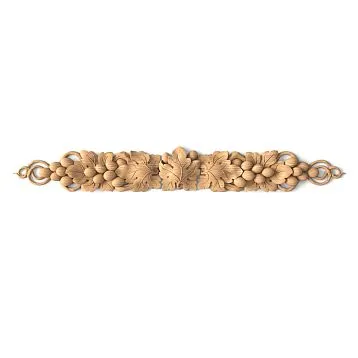
Carved overlays are separate elements ranging from 100×100 mm to 500×800 mm, attached to doors, furniture fronts, or blank wall sections. Patterns: acanthus leaves (Baroque classic), grapevines, cartouches (oval or rectangular frames with scrolls), coats of arms, cornucopias.
Overlays are made from solid linden (soft, easy to carve, ideal for intricate work), oak, or beech (hard, carving lasts longer, resists wear). Mounted with wood glue + sometimes hidden screws (if the overlay is large and heavy).
Finish treatment of overlays: gilding (imitation gold leaf, gold leaf), silvering, patination (artificial aging—recesses darkened with black patina, raised areas light—effect of centuries-old dust settled in crevices), painting to match walls or in a contrasting color.
Polyurethane moldings: classicism without the weight of stone
Polyurethane moldingsIn luxury interiors, polyurethane moldings are not a budget compromise but a rational solution. Plaster moldings are heavy (a 2-meter-long cornice, 200 mm wide, weighs 20-30 kg, requires robust fasteners, overloads structures). Polyurethane moldings are lightweight (the same cornice weighs 3-5 kg), mounted with adhesive, and require no reinforcement.
Ceiling cornices: framing the space
Cornice—a horizontal strip 100-400 mm wide, mounted along the ceiling perimeter, creating a transition from wall to ceiling. In luxury interiors, cornices are wide (200-350 mm), with deep relief (protruding 30-80 mm from the wall), and complex profiles (dentils—rows of small rectangular teeth, flutes—vertical grooves, beads, coves, modillions).
Material: high-density polyurethane (350-400 kg/m³—sharp relief, doesn't dent when pressed), white primed (ready for painting any color) or factory-painted (matte white, ivory, silver, gold).
Installation: with polyurethane adhesive (750 ml tube, coverage 1 tube per 4-6 meters of cornice), joints filled with putty, sanded (joint becomes invisible). Additional fixation with dowels (if cornice is wide, over 250 mm).
Effect: cornice visually completes the space, makes the ceiling expressive (especially if backlit—LED strip behind the cornice, light reflects off the ceiling, creating a floating effect).
Ceiling Rosettes: Central Accents
Rosette—a round or oval element 400-1500 mm in diameter, mounted in the center of the ceiling, under a chandelier. Rosette relief: from simple (concentric circles with simple ornament) to Baroque (acanthus leaves, putti—angel figures, floral garlands, deep relief 50-100 mm).
In luxury interiors, rosettes are large (diameter 800-1500 mm, for rooms with 3.5-4.5 meter ceilings), painted (white, gold, silver, patinated—combination of two colors, e.g., white + gold on raised areas).
Rosette installation: with ceiling adhesive, center of rosette has a hole for chandelier wiring. Rosette should be proportional to the chandelier: for an 800 mm diameter chandelier—rosette diameter 900-1200 mm (rosette 20-40% wider than chandelier, creating a visual frame).
Moldings and pilasters: vertical accents
Molding—a horizontal or vertical strip 40-120 mm wide, framing walls, doors, arches. In luxury interiors, moldings are used to create frames on walls (inside frames—wallpaper, fabric, decorative plaster, contrasting paint), framing doors (instead of casings—wide moldings 80-150 mm wide with carved ornament).
Pilasters—flat vertical elements imitating columns, protruding 30-80 mm from the wall, height from floor to ceiling or floor to cornice. Pilasters divide walls into sections, create rhythm and vertical accents. Consist of a base (widened lower part), shaft (plain or fluted middle part), capital (upper part with ornament—Corinthian, Ionic, Doric capitals correspond to classical orders).
Furniture Hardware: Details That Create Status
Status is in the details. You can buy expensive solid oak furniture, but if it has plastic handles from a hardware store for 50 rubles — the status is destroyed.Furniture HandlesIn an elite interior — exclusive, selected, or custom-made for the project.
Types of Elite Hardware
Patinated Brass Handles: cast brass (copper and zinc alloy), patination (artificial oxidation, creates a bronze, green, or black patina — an antique effect). Shapes: rings (round ring handles on lion heads — a classic antiquity style), brackets (U-shaped handles 100-200 mm long), round or shaped knobs. Weight of a brass handle: 150-400 grams (the heft is felt in the hand — a sign of quality). Price: 2000-8000 rubles/piece.
Crystal Handles: handles with crystal or glass inserts (cut glass imitating diamonds, or colored Murano glass). Base — brass or stainless steel, insert — crystal with a diameter of 30-50 mm. Crystal handles sparkle in the light, adding glamour and luxury. Used in classic, Art Deco, and glamorous interiors. Price: 3000-12000 rubles/piece.
Carved Wooden Handles: handles made of solid oak, walnut, or ash with hand carving (flowers, leaves, geometric patterns). Custom-made to individual sketches, painted or stained to match the furniture. Carved wooden handles blend organically with solid wood furniture, supporting the style. Price: 4000-15000 rubles/piece (hand carving is expensive).
Leather Handles: handles covered with vegetable-tanned natural leather (thick leather 3-5 mm, hand-stitched with a saddle stitch). Shapes: loops (a leather strip forming a loop to pull a drawer), overlays (leather glued onto a wooden or metal base). Leather handles are tactilely pleasant, warm, used in modern, loft, and high-end Scandinavian interiors. Price: 3000-10000 rubles/piece.
Concealed Hardware: Push-to-Open
In minimalist elite interiors, handle-less fronts are used (smooth, only the seams between doors are visible). Opening — via push-to-open mechanisms (press the front — the door opens 10-15 mm, pull — opens fully). Such mechanisms are expensive (a quality push-to-open set for one door costs 2000-5000 rubles), but create an effect of conciseness, technological sophistication, and hidden luxury.
Comprehensive Approach: Furniture, Decor, Molding in Harmony
An elite interior is not a collection of expensive items, but a thoughtful composition where each element complements the others.
Example 1: Classic Living Room in a Country House
Walls: lower third (120 cm from the floor) — boiserie made of solid oak, painted matte white, with gilded carved frames. Upper part of the wall — light beige silk wallpaper with a gold floral pattern.
Ceiling: painted white, perimeter — polyurethane cornice width 250 mm, classic profile with dentils, painted white + gilding on protruding elements. Center of the ceiling — a rosette diameter 1200 mm, Baroque style, white with gold, under the rosette — a crystal chandelier diameter 900 mm.
Floor: solid oak parquet, herringbone pattern, stained to match walnut, coated with high-gloss lacquer. Wooden oak baseboard height 150 mm, carved, painted white (to match the boiserie).
Furniture:Luxury furniturehandmade — a solid oak chest of drawers with carved fronts, patinated (white + gold patina in the carved recesses),Furniture Handlespatinated brass handles on lion heads. Sofa and armchairs — carved oak frame, upholstered in beige silk velvet. Coffee table — Calacatta marble top (white with gray veins), carved gilded legs.
Decor: above the chest of drawers — a mirror in a carved gilded frame (frame width 150 mm, Baroque ornament). On the walls — sconces with crystal pendants. On the chest of drawers — brass candlesticks, porcelain vases (Meissen, Sèvres).
Result: a living room where every element speaks of status, taste, and understanding of classical canons. Wood (boiserie, furniture), molding (cornice, rosette), textiles (wallpaper, upholstery) intertwine into a symphony of luxury.
Example 2: Study in English Style
Walls: fully paneled with solid dark oak panels (fumed oak or wenge stain), panel height from floor to ceiling, panels with raised panels, carved frames. Ceiling — coffered, beams made of solid dark oak, inside the coffers — recesses lit by spotlights.
Floor: solid oak plank flooring, dark oak, matte oil finish (no shine). Baseboard height 180 mm, solid oak, classic profile.
Furniture: writing desk made of solid oak size 180×90 cm, tabletop thickness 50 mm, massive turned legs. Leather Chesterfield armchair (deep button tufting, natural brown leather). Built-in bookcases, solid oak, doors with glass (beveled glass), carved cornice on top.Furniture Handlespatinated brass handles, shape — classic brackets.
Molding: ceiling cornice made of polyurethane, painted to match the oak color (imitating wood, visually continues the panels), width 150 mm.
Decor: on the desk — a brass desk lamp with a green glass shade (banker's lamp style). On the walls — paintings in dark wooden frames (landscapes, hunting scenes). Persian wool rug under the desk.
Result: a study dominated by dark wood, creating an atmosphere of seriousness, concentration, and respectability. This is a space for decision-making, working with important documents, and confidential negotiations.
Frequently Asked Questions: Answers for Discerning Clients
How much does it cost to furnish a 40 m² living room with elite furniture and decor?
The budget depends on the level of elitism. Average level of elite furniture (solid oak, factory production with CNC carving): chest of drawers 200,000 rubles, dining table 250,000 rubles, chairs 6 pcs at 40,000 rubles each = 240,000 rubles, wardrobe 400,000 rubles, total furniture 1,090,000 rubles. Decor (wall boiserie, coffered ceiling, molding) — 500,000-800,000 rubles. Total 1,600,000-1,900,000 rubles. Highest level (custom-made handmade furniture, Karelian birch, mahogany, inlay) — multiply by 2-3, total 3,500,000-6,000,000 rubles for the living room.
Can wooden furniture be combined with polyurethane molding, or does it cheapen the interior?
It is possible and necessary. High-quality polyurethane molding is visually indistinguishable from plaster or wooden molding, and the advantages (lightness, moisture resistance, price) are enormous. The main thing is to choose dense molding (350-400 kg/m³) with clear relief, install it correctly (joints perfectly puttied), and paint it with high quality. In elite interiors in Europe and the USA, polyurethane molding is used everywhere.
How to check if furniture is truly solid wood and not veneered?
Ask to see the end of the part (for example, a door). On the end of solid wood, the wood grain is visible across the entire thickness (fibers run through the part). On the end of a veneered part, the structure of the base is visible (MDF is homogeneous, chipboard has large particles) + a thin layer of veneer 0.5-1.5 mm. Also ask for a wood certificate (the manufacturer indicates the material — solid oak, oak veneer on MDF, etc.).
How long does elite furniture last, and can it be restored?
Solid wood furniture with proper care lasts 50-150 years. Oak furniture made in the 19th century is still in use in castles and museums. Restoration is possible: scratches and dents are sanded and repolished. Cracks (from drying out) are filled with wood putty, sanded, and tinted. Carved elements (chipped) are glued or recut. Restoration of elite furniture is a separate profession; in large cities, there are workshops specializing in this.
How to care for wooden furniture and decor to maintain their appearance?
Wipe with a dry or slightly damp soft cloth (microfiber) once a week (dust removal). Every 2-3 months — furniture polish (spray or cream containing waxes, oils — nourishes the wood, refreshes the color, creates a protective film). Avoid direct sunlight (wood fades, dark wood lightens, light wood yellows — use curtains, blinds). Maintain air humidity at 40-60% (in winter with heating, humidity drops to 20-30% — wood dries out, cracks — use humidifiers). Do not place hot objects (cups, plates) on wood without coasters (white steam marks remain, difficult to remove).
Where to order elite furniture and decor with a quality guarantee?
From specialized manufacturers and dealers with a reputation, a portfolio of completed projects, showrooms (where you can see samples in person), guarantees (at least 5 years for solid wood furniture), and service (delivery, assembly, installation, restoration if necessary).
Conclusion: create a status interior with STAVROS
wooden decor in interiorAn elite home is not just finishing; it is a philosophy based on respect for natural materials, craftsmanship, and traditions.Luxury furnitureFurniture made of solid oak, ash, walnut, Karelian birch is an investment that pays off over decades of impeccable service, aesthetic pleasure, and the possibility of being passed down as an inheritance.Exclusive furnitureHandmade furniture with carving, inlay, patination are works of art that emphasize the individuality, status, and taste of the owner.Polyurethane moldingsHigh-quality polyurethane molding complements wooden elements, adding classical accents, completeness, and monumentality.Furniture HandlesExclusive handles — patinated brass, carved wooden, crystal — details that reveal the genuine status of the interior.
Company STAVROS is a leading Russian manufacturer and supplier of elite furniture, decorative elements made of solid wood, polyurethane molding, offering comprehensive solutions for status interiors.
STAVROS elite furniture — collections in classic, baroque, neoclassical, modern styles, made from solid oak, ash, walnut, wood moisture content 8-10% (stability, no deformation), dovetail joinery (maximum strength), European hardware (Blum, Hettich — smooth silent closing, 100,000 cycle lifespan), impeccable finishing (sanding to 320 grit, 7-layer varnishing with polishing or 5-layer Danish oil). Hand and CNC carving of the highest quality, patination, gilding, inlay — to choose from. 5-year warranty on construction, 3-year warranty on coating.
Custom manufacturing — individual projects based on customer or designer sketches: any dimensions (for a specific room), any wood species (including rare ones — Karelian birch, mahogany, rosewood to order), any decorative techniques (carving, inlay, marquetry — mosaic from veneers of different species). Production time 8-16 weeks (depends on complexity), consultations at all stages (material selection, sketch approval, adjustments).
STAVROS wooden decor — wall panels (boiserie made of solid oak, walnut, painted or natural), carved overlays (from 50×50 mm to 600×800 mm, classic, baroque, modern ornaments), ceiling coffers (beams made of solid wood or polyurethane, painted to look like wood), high baseboards (100-200 mm, solid oak, beech, ash, profiles from simple to carved). Installation by partner teams — professionally, neatly, with a guarantee.
STAVROS polyurethane molding — density 350-400 kg/m³ (clear relief, strength), cornices width 100-400 mm (profiles from simple to baroque), rosettes diameter 400-1500 mm (classic, baroque, modern), moldings, pilasters, columns, capitals, brackets. Color white primed (ready for painting in any RAL color) or factory-painted (white, ivory, silver, gold, patina). Installation with adhesive, invisible joints (professional puttying, sanding).
STAVROS furniture handles — patinated brass (casting, weight 150-400 grams, antique bronze, green, black patina), carved wooden (oak, walnut, hand carving, toning to match the furniture), combined (wood + brass, wood + leather), crystal (brass base + faceted crystal insert). Exclusive custom handles — according to your sketches, individual design, piece production.
Design project services — STAVROS designers will develop a concept for an elite interior: select furniture, decor, molding, create 3D visualization (you will see the result before work begins), calculate an estimate. The cost of a design project starts from 50,000 rubles per room, included in the order cost when purchasing for an amount from 500,000 rubles.
Delivery and installation — STAVROS own logistics, individual furniture packaging (each part wrapped, protected from scratches, impacts), delivery at an agreed time, floor lifting (loaders, rigging), assembly and installation (masters with experience in elite furniture), packaging removal. 3-year warranty on installation.
Service maintenance — furniture care (polishing, coating renewal every 5-10 years), restoration (in case of damage — chips, scratches, cracks), hardware replacement (due to wear or to update appearance). STAVROS accompanies clients for years, ensuring the long life of furniture and interior.
By choosing STAVROS, owners of elite real estate, architects, designers choose world-class quality (European standards implemented in Russian production), exclusivity (individual approach, unique projects), reliability (guarantees, service, reputation, proven by thousands of projects).
Create an interior worthy of your status. With furniture, decor, molding, hardware from STAVROS, your home will become the embodiment of elegance, luxury, taste — a space where every detail is perfect, where wood, stone, metal, textiles intertwine in harmony, where you live not just comfortably, but surrounded by beauty that inspires every day!