Article Contents:
- Skirting Board Selection Criteria: Wood Species, Profile, Height
- Wood Species: Oak, Ash, Beech, Pine
- Skirting Board Profile: Classic, Straight, European
- Skirting Board Height: From 60 to 200 mm
- Modern Furniture and Wooden Skirting Boards: Photo Examples of Harmony
- Minimalism: Straight Profiles and Light Tones
- Scandinavian Style: White Skirting Boards and Wooden Furniture
- Neoclassical: Profiled Skirting Boards and Elegant Furniture
- Polyurethane Molding as an Accent: Molding for Wall Zoning
- Molding for Creating Panels
- Moldings for zoning
- Molding for Frames Around TVs, Mirrors, Paintings
- Battens and Skirting Boards: Combining Wall Batten Cladding with Floor Framing
- Vertical Battens and Wide Skirting Board
- Horizontal Battens and Narrow Skirting Board
- Combined Option: Battens + Molding + Skirting Board
- Color Solutions: Dark Skirting Board and Light Furniture or Vice Versa
- White Skirting Board + Any Furniture = Versatility
- Dark Skirting Board + Light Furniture = Contrast and Drama
- Skirting Board Matching the Floor = Horizontal Unity
- Skirting Board Matching the Walls = Visual Expansion
- How to Avoid Mistakes in Selection: Practical Tips
- Rule 1: Skirting Board — Last
- Rule 2: Skirting Board Species = Floor Species (or Neutral)
- Rule 3: Skirting Board Height Depends on Ceiling Height
- Rule 4: Skirting Board Profile Corresponds to Interior Style
- Rule 5: Skirting Board Color Connects Floor, Walls, Furniture
- Where to Buy Wooden Skirting Boards and Molding: Photo Gallery and Assortment
- Installation and Care: For Skirting Boards to Last Decades
- Installing Wooden Skirting Boards: Glue or Fasteners?
- Caring for wooden skirting boards
- Caring for Polyurethane Moldings
- Frequently Asked Questions: Answers to Popular Queries
- Conclusion: Create Your Dream Interior with STAVROS
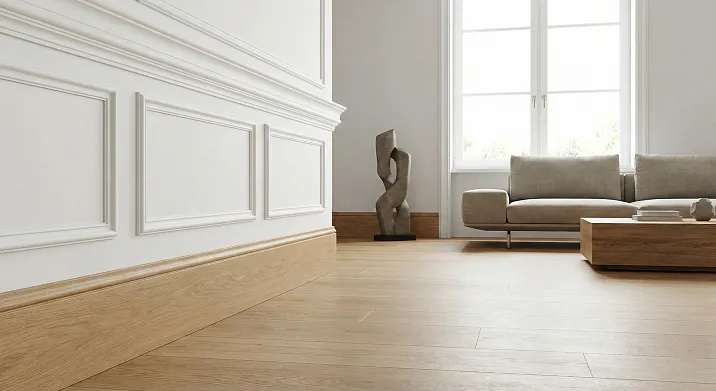
How to design an interior where every detail serves the overall concept—where the floor molding doesn't just cover the gap between the wall and floor but becomes an architectural accent? Where modern furniture with clean lines coexists with classical molding without creating visual chaos? Where wall slat cladding echoes the profile of the baseboard? The answer lies in thoughtful selection of materials, proportions, and color combinations. Today, we'll explore how to correctly chooseWooden skirting, which wood species to prefer, which profile and height to select, how to integrate them into a space withmodern furnitureandpolyurethane moldings on the walls.
Skirting boards are not a secondary detail. They are the frame that completes the floor composition, creates a transition to vertical planes, and sets the scale of the room. Choosing between oak and pine, between a tall and narrow profile, between white painted and natural stained, you define the character of the entire interior. Let's break it down point by point — methodically, professionally, with specific recommendations.



Skirting Board Selection Criteria: Species, Profile, Height
Choosing a wooden skirting board isn't just about browsing catalogs and pointing at a picture you like. It's a conscious decision based on three key parameters: wood species, cross-section profile, and plank height. Each parameter affects aesthetics, durability, cost, and compatibility with the rest of the interior.




Wood Species: Oak, Ash, Beech, Pine
Oak — a classic that needs no introduction. Density 700-800 kg/m³, Brinell hardness 3.7-4.0 HB, expressive grain with large rays on radial cut. Oak is strong, stable, moisture-resistant (contains tannins, natural antiseptics).Oak floor skirting boardslast for decades without warping, are not afraid of scratches, and withstand cleaning with a damp cloth. The color of natural oak ranges from light yellow (young oak) to brownish-ochre (mature). Oak stains easily with oils — you can achieve any shade from light gray to black ebonized.
When to choose oak? When maximum durability is needed. When there are pets, children, or high foot traffic in the home. When the floor is already oak (parquet, solid wood, engineered wood) — matching skirting creates unity. When the budget allows — oak is 2-3 times more expensive than pine, but it's an investment for 30-50 years.
Ash — the Scandinavian alternative to oak. Density 650-700 kg/m³, hardness 4.0-4.1 HB (the hardest among common species).Ash skirting boardstronger than oak, but the grain is more contrasting — dark latewood and light earlywood growth zones create a striped pattern. The color of natural ash is light gray, grayish-beige, cool (unlike the warm ochre of oak). Ash is ideal for Scandinavian interiors that value light, cool wood tones, minimalism, and naturalness.
When to choose ash? When a light wood species is needed without staining (ash already looks bleached). When the floor is ash or light oak. When the interior is modern, minimalist, in a gray-beige palette. When you want the strength of oak but with a cooler aesthetic.
Beech — warm, dense wood. Density 650-750 kg/m³, hardness 3.8 HB. The grain is fine, uniform, without large pores (unlike oak). The color of natural beech is light pinkish, beige-pink. Beech takes paint well, accepts patina, and stains easily to any shade.Solid beech skirting boardsare strong, stable, and suitable for classic interiors where solid quality without excessive ornamentation is valued.
When to choose beech? When a dense wood with uniform grain is needed (without oak's large pores). When planning to paint in a dark or bright color — beech takes paint better than oak. When the floor is beech (parquet, solid wood). When the interior is classic but without pomp — beech is noble yet calm.
Pine — an affordable softwood. Density 400-500 kg/m³, hardness 1.6-2.5 HB (soft wood). The grain is expressive — resin canals, growth rings, contrast between earlywood and latewood.Pine wooden skirting boardcosts 2-3 times less than oak, making it popular for budget projects. The color of natural pine is light yellow with a pinkish tint. Over time, pine darkens, acquiring an amber hue (resin oxidation process).
When to choose pine? When the budget is limited. When painting is planned — the wood species isn't visible under opaque paint. When the interior is rustic, country, or Provence — pine's knotty texture creates a natural casualness. When the load on the skirting is low (bedroom, study, guest rooms).
Our factory also produces:


Skirting Board Profile: Classic, Straight, European
Profile — the cross-section of the skirting board, its shape in cut. The profile determines the style, visual massiveness, and ability to hide wall imperfections.
Classic profiled skirting board — the most common type. The cross-section includes several elements: a lower straight part, a middle convex or concave part, and an upper rounded or stepped part. A profiled skirting creates play of light and shadow, looks voluminous, and visually richer than a simple rectangular one. Suitable for classic, neoclassical, and traditional interiors. Complements profiled door casings, ceiling cornices, and wall moldings.
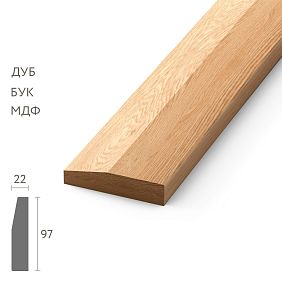
Straight skirting board — a minimalist option. The cross-section is rectangular or slightly slanted (trapezoidal). No rounding, grooves, or protrusions. Pure geometry.straight wooden baseboardideal for modern interiors — minimalism, Scandinavian style, loft, industrial. It doesn't distract attention, emphasizes clean lines, and creates a sense of order. A straight profile is easier to install (no need for meticulous joint fitting) and simpler to maintain (no recesses where dust accumulates).
European (English) skirting board — a wide, tall profile (120-200 mm) with a rectangular or slightly profiled cross-section. Characteristic of British and American interiors. Creates monumentality, visually expands walls, and makes the transition from floor to wall smooth. Suitable for spacious rooms with high ceilings (from 3 meters). In standard apartments with ceilings of 2.5-2.7 m, such a skirting board can visually 'eat up' the height.
Get Consultation
Skirting board height: from 60 to 200 mm
Skirting board height is a critical parameter affecting the perception of space.
60-80 mm — standard height, suitable for most interiors. Such a skirting board does not dominate, does not draw excessive attention, and performs its function quietly and delicately. Suitable for rooms with ceilings of 2.5-2.7 m, for small rooms, and for modern minimalist interiors where conciseness is valued.
100-120 mm — increased height, creating a more pronounced horizontal accent.Wide wooden floor skirting boardA height of 100-120 mm is suitable for rooms with ceilings of 2.8-3.2 m, for classic interiors, and for spacious rooms (living rooms, dining rooms, halls). Such a skirting board visually stabilizes the space, emphasizes scale, and creates a sense of solidity.
140-200 mm — a tall skirting board of the English type. Suitable only for rooms with high ceilings (from 3.5 m), for mansions, and for interiors in British or American style. In standard apartments, such a skirting board will look out of place — too massive, disproportionate.
How to choose the height? A simple formula: the height of the skirting board should be approximately 1/20 of the ceiling height. For a ceiling of 2.6 m, the optimal skirting board height is 130 mm (in practice, 100-120 mm). For a ceiling of 3.0 m — 150 mm (in practice, 120-150 mm). For a ceiling of 4.0 m — 200 mm.
Modern furniture and wooden skirting boards: photo examples of harmony
How to combine minimalistmodern furniture with photoswith wooden skirting boards so that no stylistic conflict arises? The key lies in clean lines, coordinated proportions, and color harmony.
Minimalism: straight profiles and light tones
In a minimalist interior, every detail counts. There is no place for decorative excess here.Modern furniture with minimalist design— low sofas without legs, tables with metal hairpin legs, cabinets with smooth fronts without handles — requires similar restraint from the skirting board. A rectangular profile with a height of 80-100 mm made of light ash or bleached oak is an ideal choice. Color — white (painted with enamel) or light gray (tinted with oil). No rounding, grooves, or decorations. Only pure geometry.
Photo examples: a living room with white walls, a light gray sofa on low legs, a coffee table made of light wood on metal supports. Floor — engineered board in light oak. Skirting board — straight profile with a height of 100 mm, painted white. The transition from floor to wall is delicate, unobtrusive. The skirting board does not compete with the furniture but complements its conciseness.
Another example: a bedroom in gray-beige tones. A bed with a soft headboard without legs (platform), bedside tables on metal supports, a minimalist lamp. Floor — laminate under light ash. Skirting board — straight profile made of ash with a height of 80 mm, covered with colorless oil. The wood texture is visible, but the color is cold, grayish-beige. Total harmony.
Scandinavian style: white skirting boards and wooden furniture
Scandinavian interior is built on the contrast of white and wood. Walls are white, ceiling is white, skirting boards are white. Furniture — wooden (pine, birch, ash), with minimal processing, simple shapes.White Wooden Baseboardcreates a clean contour, separating the light floor from the white walls. Height 70-100 mm, profile straight or slightly rounded at the top.
Photo example: a living room with white walls, light parquet (birch or ash), a wooden shelf made of unpainted pine, a sofa with gray upholstery. Skirting board white, painted with matte enamel, height 80 mm. The whiteness of the skirting board continues the whiteness of the walls, visually raises them, and creates a sense of air. Wooden furniture against this background looks like a warm accent without overloading the space.
Neoclassicism: profiled skirting boards and elegant furniture
Neoclassical interior is a balance between classical tradition and modern conciseness. Furniture is elegant, with graceful legs, symmetrical shapes, but without baroque opulence. The skirting board here can be profiled — with soft rounding, one or two grooves, height 100-120 mm.Designer furniture in a modern style and beautiful moldingscreate an exquisite atmosphere, and a skirting board made of oak, painted white or tinted gray, supports this line.
Photo example: a dining room with beige walls, parquet 'French herringbone' made of oak, a dining table on carved legs, chairs with soft upholstery. Skirting board oak, profiled, height 120 mm, painted light gray. The profile of the skirting board echoes the profile of the ceiling cornice, the legs of the table — with the shape of balusters (if there is a staircase). Everything is connected by a single thread of style.
Polyurethane moldings as an accent: moldings for wall zoning
How to incorporatepolyurethane moldings on walls with photosHow to integrate into an interior with wooden skirting boards? The main rule is that the profiles should echo each other. If the skirting board is profiled, then the wall moldings should also be profiled. If the skirting board is straight, then the moldings should be simple, geometric.
Moldings for creating panels
A classic technique is wall panels in the lower third of the wall.decorative wall moldingsThey form rectangular frames 80-120 cm high from the floor. Inside the frames, the wall can be painted in a contrasting color or wallpapered. Panels create structure, organize space, and visually lower the height of walls (useful in rooms taller than 3 m).
How to connect panels with the skirting board? The width of the vertical moldings of the panel should correspond to the width of the skirting board. If the skirting board is 100 mm high, then the panel moldings should be 60-80 mm wide. The profile should be similar or related. The color should be uniform (white skirting board + white moldings, gray skirting board + gray moldings).
Photo example: a living room with panels 100 cm high. The lower part of the wall is painted dark green, the upper part is light beige. The skirting board is oak, 120 mm high, painted white. The panel moldings are polyurethane, 70 mm wide, profiled, painted white. The horizontal molding separating the panel and the upper part of the wall is also white, 80 mm wide. All decor is of a uniform color, profiles are coordinated. The result is elegance without chaos.
Molding for zoning
In studios and open-space layouts, moldings help zone the room without physical partitions. Vertical moldings on the wall separate the living area from the kitchen area, the dining area from the hallway area.Interior moldings and profilesThey create visual boundaries without consuming space.
How to combine with the skirting board? Vertical moldings should be the same width or slightly narrower than the skirting board. If the skirting board is 100 mm, then the moldings should be 60-80 mm. The color should be uniform. The profile should be coordinated. The moldings start from the skirting board and go up to the ceiling cornice, creating a vertical rhythm.
Moldings for frames around TVs, mirrors, paintings
Frame compositions made from moldings are an accent technique. A rectangular frame on the wall highlights the TV, mirror, or painting, creating a focal point.Paintable moldings in interior designThey allow painting them in any color—matching the wall (tonal contrast) or contrasting (white moldings on a dark wall).
How to connect with the skirting board? The width of the frame moldings is 50-70 mm (slightly narrower than the skirting board). The profile is simple (if the skirting board is straight) or slightly profiled (if the skirting board is classic). The color is uniform. The frame on the wall visually echoes the skirting board at the bottom and the ceiling cornice at the top, creating integrity.
Battens and skirting boards: combining wall batten cladding with floor framing
Wall batten cladding is one of the main trends in modern design. Vertical or horizontalWooden railsbattens made of solid oak, ash, or pine create rhythm, texture, and accentuate zones. How to combine batten cladding with a skirting board?
Vertical battens and wide skirting board
VerticalDecorative wall slatsThey are mounted with a spacing of 5-10 cm, creating a striped texture. Typically, battens have a cross-section of 40×20 mm or 50×20 mm. The skirting board in such an interior should be wide (100-120 mm) to visually 'hold' the vertical rhythm of the battens. The thickness of the skirting board is 15-20 mm, corresponding to the thickness of the battens.
The wood species of the battens and skirting board should match. If the battens are oak, then the skirting board should also be oak. If the battens are ash, then the skirting board should be ash. The color should be uniform (natural with oil, tinted, painted).Interior skirting board and interior oak battencreate a premium finish where each element supports the other.
Photo example: a bedroom with an accent wall behind the bed headboard. The wall is clad with vertical oak battens, tinted gray, with a spacing of 7 cm. The floor is engineered oak plank. The skirting board is oak, 120 mm high, tinted the same gray. The battens start from the skirting board and go up to the ceiling. Visually, the skirting board is the base, the foundation from which the battens 'grow'. The integrity is perfect.
Horizontal battens and narrow skirting board
Horizontal battens on the wall create a different rhythm—calm, expanding the space. They are usually mounted in the middle or upper part of the wall. The skirting board in such an interior can be narrow (60-80 mm) so as not to compete with the horizontal rhythm of the battens.
The color and species should be uniform.Interior slats for wallsThe battens and skirting board form horizontal belts of different heights but of a uniform character.
Combined option: battens + moldings + skirting board
The most complex but effective option is combining batten cladding with moldings and a skirting board. For example: the lower third of the wall (up to 80 cm from the floor) is smooth, painted, framed with moldings (panels). The middle third is batten cladding. The upper third is smooth again. The skirting board at the bottom is wide (100-120 mm), the panel moldings are medium width (60-70 mm), the battens are narrow (40×20 mm). Everything is made from the same wood species, uniform color. The result is a complex but harmonious composition.
Color solutions: dark skirting board and light furniture or vice versa
The color of the skirting board is a powerful tool for creating the character of an interior. There are several classic strategies.
White baseboard + any furniture = versatility
White MDF baseboard for paintingor white painted wooden baseboard — the most universal solution. White goes with any furniture — light, dark, bright. It visually expands the space, creates a feeling of cleanliness, freshness, airiness. A white baseboard continues the whiteness of the walls, making the transition from floor to wall delicate.
When to choose white? When the walls are white or light. When the interior is Scandinavian, minimalist, modern. When the furniture is dark (contrast: dark furniture + white baseboard + light walls). When you want to visually enlarge the space.
Photo example: living room with white walls, light gray floor (laminate or luxury vinyl tile), dark blue sofa, coffee table made of black metal and wood. Baseboard is white, 100 mm high, straight profile. The contrast between dark furniture and white baseboard creates clarity, graphic quality, modernity.
Dark baseboard + light furniture = contrast and drama
A dark baseboard (black, dark brown, graphite) against light walls and light furniture creates contrast, graphic quality, drama. This is a bold solution requiring precise calculation. A dark baseboard visually 'weighs down' the lower part of the room, making it more stable, grounded. Suitable for interiors with high ceilings (from 3 m), for modern and industrial styles.
When to choose a dark baseboard? When the walls are light and the floor is dark (dark parquet, dark laminate) — baseboard matching the floor. When the furniture is light (beige, gray, white) — contrast makes it appear even lighter. When you want to create graphic quality, clarity of lines.
Photo example: living room with white walls, dark brown parquet (stained oak), light beige sofa, light coffee table. Baseboard — oak, stained black, 120 mm high, straight profile. The dark baseboard continues the dark floor, creating a dark frame at the bottom. Light furniture against this background looks airy, light.
Baseboard matching the floor = unity of the horizontal plane
The calmest, most classic solution — baseboard matching the floor. If the floor is light oak, then the baseboard is light oak. If the floor is dark ash, then the baseboard is dark ash. This creates unity of the horizontal plane, visually expands the floor, makes its boundary soft, unobtrusive.
When to choose a baseboard matching the floor? Always, if there is no specific designer intent. This is a fail-safe option that works in any style, with any furniture.
Baseboard matching the walls = visual expansion
A less common but interesting option — baseboard matching the walls. If the walls are gray, then the baseboard is gray. If the walls are beige, then the baseboard is beige. This visually 'lifts' the wall, makes it taller, expands the vertical. The floor then seems 'floating', without a clear boundary.
When to choose a baseboard matching the walls? When ceilings are low (2.5 m and below) — you need to visually raise them. When the floor is contrasting (dark or bright) — a baseboard matching the walls softens the contrast. When the interior is monochrome (gray, beige) — the baseboard continues the color scheme of the walls.
How not to make a mistake with the choice: practical tips
Choosing a baseboard is a balance between aesthetics, practicality, and budget. Here are a few rules to help avoid mistakes.
Rule 1: Baseboard — last
Don't choose the baseboard first. First determine the floor (material, color, texture), then the furniture (style, color, shapes), then the wall finish (paint, wallpaper, moldings), and only then — the baseboard. It should tie everything together, not exist on its own.
Rule 2: Baseboard wood species = floor wood species (or neutral)
If the floor is wooden (parquet, solid wood, engineered wood), then the baseboard should be chosen from the same species. Oak floor — oak baseboard. Ash floor — ash baseboard. If the floor is not wooden (laminate, luxury vinyl tile, tile), then you can choose a neutral baseboard — white painted, gray tinted, MDF for painting.
Rule 3: Baseboard height depends on ceiling height
Don't install a tall baseboard (120-150 mm) in a room with a 2.5 m ceiling. It will visually 'eat up' the height, make the room squat. For ceilings 2.5-2.7 m, the optimal height is 70-100 mm. For ceilings 2.8-3.2 m — 100-120 mm. For ceilings above 3.5 m — 140-200 mm.
Rule 4: Baseboard profile corresponds to the interior style
Classical interior — profiled baseboard. Modern interior — straight baseboard. Neoclassical — slightly profiled. Don't put an ornate profiled baseboard with curves in a minimalist interior — it will create dissonance.
Rule 5: Baseboard color connects floor, walls, furniture
The baseboard is a bridge between the floor and walls. It can match the floor (classic), match the walls (visual expansion), or be contrasting (graphic quality). When choosing a color, look at the overall picture: how the baseboard combines with the floor, walls, furniture, moldings, doors. Everything should work towards a single harmony.
Where to buy wooden baseboards and moldings: photo gallery and assortment
Choosing the right supplier is half the success. It's important that baseboards are made from quality wood, properly dried (moisture 8-10%), precisely processed (without knots, cracks, chips), with perfect geometry (tolerance no more than 0.5 mm). It's important that the assortment is wide — different species, profiles, heights, finish options. It's important that you can order related elements — moldings, cornices, architraves, battens — all in a unified style.
wooden baseboards are usedare presented in a wide assortment. Height from 60 to 200 mm, profiles from straight to complex classical, species — oak, beech, ash, pine. Finishing options available — natural oil (preserves wood texture), tinting (from light gray to black), enamel painting (white, colored), varnishing (glossy, matte, semi-matte).
Polyurethane moldings— over 150 profiles of moldings and cornices for walls and ceilings. Width from 30 to 200 mm, profiles ranging from simple geometric to classic with ornaments. Polyurethane is primed, ready for painting. Can be painted in any color from the RAL or NCS catalog.
Wooden Planks for Walls— cross-section 40×20 mm, 50×20 mm, 60×30 mm. Wood species — oak, ash, pine. Length 2.0-2.6 m. Finish — natural oil, tinting, painting.
Ceiling cornices: wooden and polyurethane— for finishing the upper part of the wall. Width 50-150 mm, profiles coordinated with skirting boards.
The photo gallery on the website showcases completed projects — interiors with wooden skirting boards of various heights and profiles, with wall moldings, with slatted finishes. You can see how a 120 mm high oak skirting board looks in a classic living room. How an 80 mm white straight skirting board appears in a Scandinavian bedroom. How vertical ash slats combine with a wide skirting board in a modern dining room. The photos are real, not renders. This helps make an informed decision.
Installation and care: ensuring the skirting board lasts for decades
The quality of a skirting board is not only about the material and profile, but also proper installation and competent care.
Installing a wooden skirting board: glue or fasteners?
There are two main installation methods: using adhesive (liquid nails) and using mechanical fasteners (screws, clips, brackets).
Adhesive installation is the simplest and fastest method. The wall must be level (deviation no more than 2-3 mm per linear meter), dry, and clean. Adhesive is applied to the back of the skirting board in a zigzag or dots spaced 30-40 cm apart. The skirting board is pressed against the wall and fixed for 10-15 minutes (can be propped with a weight). Joints are glued and sanded with fine sandpaper (grit 180-220). Corners are joined at 45 degrees (requires a miter saw with fine teeth).
Advantages: fast, no visible fasteners, the skirting board surface remains smooth. Disadvantages: if the wall is uneven, the skirting board will have gaps. If removal is needed (access to wiring, repairs), it must be torn off with risk of damage.
Installation with screws is a more reliable method. The skirting board is screwed to the wall with screws (spaced 40-50 cm apart). Holes slightly larger than the screw head are pre-drilled in the skirting board, then countersunk (widened at the top for a plug). Screws are driven in, and the heads are covered with wooden plugs (matched to the skirting board color) or filled (if the skirting board is painted).
Advantages: reliability, the skirting board fits tightly even to an uneven wall (screws pull it in). Possibility to remove and reinstall. Disadvantages: visible plugs (if the skirting board has a natural texture), labor-intensive.
Installation with clips or brackets — modern hidden fastening. A guide rail or individual clips are mounted on the wall spaced 40-50 cm apart. The skirting board snaps onto the clips. The fasteners are completely hidden, and the skirting board is easily removed and reinstalled.
Advantages: hidden fasteners, possibility of multiple removals, perfect skirting board surface. Disadvantages: requires a special skirting board with a groove for clips, higher cost.
Care for wooden skirting boards
Solid wood skirting boards coated with varnish, oil, or enamel do not require complex care. Wipe with a damp cloth once a week (or as needed). Do not use aggressive cleaning agents (alkalis, acids, solvents). Renew the coating every 3-5 years:
-
Varnished skirting board: lightly sand with fine sandpaper (grit 220-240), remove dust, apply a new layer of varnish (polyurethane or alkyd).
-
Oil-finished skirting board: clean, apply a new layer of oil (hard oil or oil-wax), polish.
-
Enamel-painted: touch up chips, scratches if necessary, or repaint completely (pre-sand for adhesion of the new layer).
For serious damage (deep scratches, dents, cracks), the area is sanded, filled (wood filler to match the tone), sanded again, and coated with a finishing compound.
Care for polyurethane moldings
Polyurethane moldings and cornices are even easier to care for. Wipe with a damp cloth. Do not use abrasives (may scratch). If dirty, wash with warm water and mild soap solution. If the coating fades, it can be repainted with water-based or acrylic paint. Polyurethane is moisture-resistant, does not deform, does not crack. Lasts 30-50 years without replacement.
Frequently asked questions: answers to popular queries
Which skirting board is better — oak or ash?
Both options are excellent. Oak is warmer in tone (yellow-brown), ash is cooler (gray-beige). Oak is slightly softer (hardness 3.7-4.0 HB), ash is harder (4.0-4.1 HB). They are equally durable. The choice depends on the interior color scheme: warm (beige, cream, brown) — oak; cool (gray, white, bluish) — ash.
Can pine skirting board be used in a living room?
Yes, if painting is planned. Under opaque paint (enamel), the wood species is not visible — pine will look the same as oak. If a natural finish (oil, varnish) is planned, then pine is suitable for budget or rustic interiors. For a premium living room, oak or ash is better.
What skirting board height is optimal for an apartment with 2.6 m ceilings?
Optimal height is 80-100 mm. A 120 mm skirting board is also possible if the room is spacious (over 20 m²). Skirting boards above 120 mm will be too bulky and visually lower the ceiling.
Is it necessary to paint a white skirting board if it is sold primed?
If the skirting board is MDF with white primer, it is advisable to paint it with a finish coat (acrylic enamel) in 1-2 layers. The primer protects against moisture, but the finish paint makes the surface more resistant to wear, dirt, and easier to clean. If the skirting board is wooden, factory-painted with white enamel, additional painting is not needed.
How to combine wooden baseboard with polyurethane wall molding?
The key is consistency in profiles and color. If the baseboard is profiled, then the moldings should also be profiled. If the baseboard is straight, then the moldings should be simple, geometric. The color should be uniform: white baseboard + white moldings, gray baseboard + gray moldings. The width of the moldings should be slightly less than the height of the baseboard.
Can baseboards be installed before painting the walls?
Yes, but it's not recommended. It's better to paint the walls first, wait for them to dry completely, and then install the baseboard. If you install the baseboard before painting, there's a risk of getting paint on it while painting the walls. You would have to protect it with painter's tape, which increases labor costs.
How to choose the color of the baseboard if the floor is gray and the walls are white?
Three options: 1) Baseboard matching the floor (gray) — creates horizontal unity. 2) Baseboard matching the walls (white) — visually raises the walls. 3) Contrasting baseboard (dark, black) — creates a graphic effect. The most universal is white.
How much does an oak wooden baseboard cost?
The price depends on height and profile. Oak baseboard with a height of 60-80 mm — from 1800-2500 rubles per linear meter. Height of 100-120 mm — from 2500-3500 rubles. Height of 140-160 mm — from 3500-4500 rubles. Prices are for unfinished baseboard (solid oak, sanded). With finishing (painting, tinting) the price increases by 20-40%.
How to care for a white baseboard to prevent it from yellowing?
Use high-quality opaque enamel (water-based acrylic) with UV protection. Cheap alkyd-based enamels may yellow over time. Do not clean the baseboard with aggressive agents (chlorine, alkalis). Wipe with a damp cloth and a mild soapy solution. Repaint every 5-7 years if necessary.
Can you use battens and baseboards made from different types of wood?
Not advisable. It's better for the battens and baseboard to be made from the same type of wood — oak, ash, pine. This creates unity in texture, color, and character. If the battens are oak and the baseboard is ash, the difference will be noticeable (oak is warmer, ash is cooler). If both are painted the same color with opaque paint, the wood type difference is not important.
Conclusion: Create your dream interior with STAVROS
Choosing a wooden baseboard, combining it with modern furniture, polyurethane molding, batten cladding — it's an art of balance. Balance between aesthetics and practicality, between classic and contemporary, between detail and the whole.wooden and MDF baseboardsshould not just cover the gap between the floor and the wall, but complete the composition, create a frame, set the tone for the space.
STAVROS is a leader in the Russian market for wooden millwork and interior decor. For over two decades, STAVROS has been creating products from solid oak, beech, ash, pine — baseboards, battens, moldings, cornices, casings, balusters. In-house production guarantees quality control at all stages: from wood selection to final finishing. Each plank undergoes chamber drying to 8-10% moisture content, is milled on high-precision equipment, sanded by hand (prestige line) or by machine (standard line), and coated with oil, varnish, or enamel as per the client's choice.
The STAVROS catalog features dozens of baseboard profiles: from narrow 60 mm to wide 200 mm, from straight minimalist to complex classic. Wood types — oak, beech, ash, pine, linden. Finishes — natural oil (preserves texture), tinting (from light gray to black), enamel painting (white, colored per RAL/NCS), varnishing (gloss, matte, semi-matte). Custom manufacturing based on client drawings is possible — non-standard profiles, unique sizes, special finishes.
Ceiling moldings for painting to buyat STAVROS — this is over 150 polyurethane profiles for walls and ceilings. Width from 30 to 200 mm, profiles from geometric to classic. High-density polyurethane, primed, ready for painting. Affordable price, premium quality. STAVROS moldings do not deform, do not crack, and last for decades.
Guide to Wooden Floor Baseboardson the STAVROS website will help you understand all the nuances: how to choose the wood type, profile, height, how to combine with the floor and furniture, how to install and care for it. Professional consultants will answer questions, help calculate the quantity, and select related elements — corners, end caps, fasteners.
Delivery across all of Russia — Moscow, St. Petersburg, regions. Pickup from warehouses in Moscow and St. Petersburg. Convenient payment methods — cash, card, bank transfer. Quality guarantee, compliance certificates, technical support.
By choosing STAVROS, you choose quality tested by time. You choose natural materials, precise geometry, impeccable execution. You choose a partner who understands your tasks and helps implement them. Create interiors where every detail — from the floor baseboard to the ceiling cornice — works towards the overall idea. Create spaces where living is easy, beautiful, harmonious. Trust the masters at STAVROS — and your home will acquire that unique character you've dreamed of.