












































































Article Contents:
- Philosophy of Wooden Decoration in the Modern World
- Return to the Roots
- Psychology of Natural Materials
- History of Moulding Craftsmanship
- From ancient temples to modern interiors
- Industrial Revolution and Its Impact
- Wood Species for Furniture Mouldings
- Oak - King Among Trees
- Beech - Embodiment of Elegance
- Ash - Combination of Beauty and Practicality
- Walnut - Aristocratic Species
- Modern manufacturing technologies
- Raw Material Preparation
- Milling of profiles
- Sanding and Surface Preparation
- Types of Finishes and Coatings
- Oil and Wax Finishes
- Lacquered finishes
- Staining and Toning
- Design and Stylistic Directions
- Classic style
- Modern minimalism
- Scandinavian Style
- Loft and Industrial Style
- Application in various types of furniture
- Kitchen furniture
- Furniture for the Living Room
- Bedroom furniture
- Children's Furniture
- Technical aspects of installation
- Preparatory work
- Mounting methods
- Joint Processing
- Maintenance and operation
- Daily care
- Protection against damage
- Restoration and repair
- Ecological Aspects
- Ecological Nature of Natural Wood
- Impact on room microclimate
- Economic Aspects
- Investment attractiveness
- Pricing factors
- Industry development trends
- Production digitization
- Product Personalization
- Ecological innovations
- Frequently Asked Questions (FAQ)
- Which Wood Species is Better to Choose for Mouldings?
- How to Determine the Quality of a Wooden Moulding?
- How long do wooden curtain rods last?
- Can a damaged crown be restored?
- How to Properly Care for Wooden Mouldings?
- Can the Color of a Moulding Be Changed?
- What Tools Are Needed to Install Mouldings?
- Do crowns affect furniture cost?
- Can crowns be used in humid areas?
- How to Calculate the Required Amount of Material?
- Conclusion
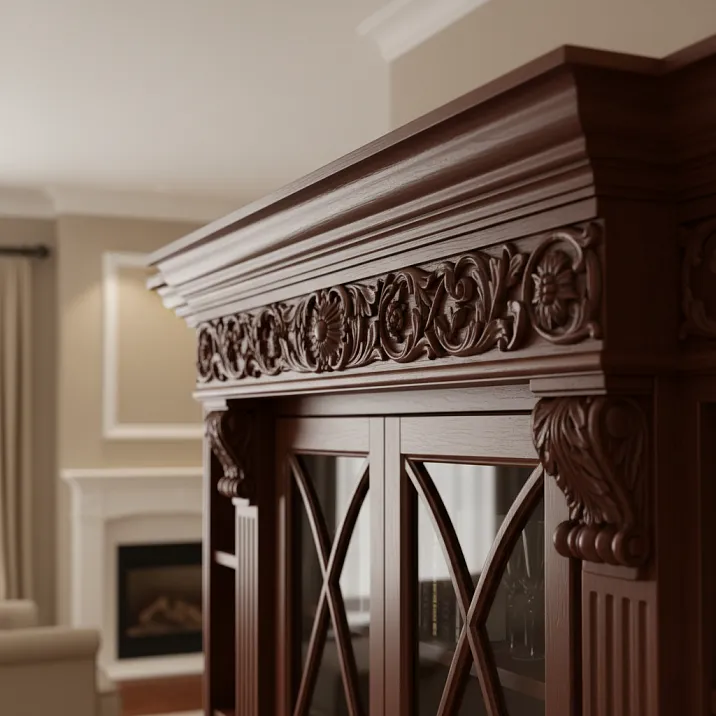
In the world of modern interior design, every detail plays its unique role in creating a harmonious space. A special place in this symphony of beauty is occupied bywooden cornices for furniture- elegant elements capable of radically transforming the perception of any piece of furniture. These decorative strips do not merely complete the furniture composition; they create that refined note which distinguishes furniture art from ordinary functional items.
What makes an ordinary wardrobe a work of art? Details. It is precisely those nuances that many people overlook, which create an atmosphere of luxury and respectability.wooden cornices for furnitureThey serve as architectural elements in miniature, creating smooth transitions between planes, adding volume and depth, emphasizing the style and character of the interior. Their use transforms simple case furniture into elegant pieces worthy of the most refined interiors.


Philosophy of Wooden Decoration in the Modern World




Return to the roots
In the era of plastic and composite materials, choosing natural wood becomes a kind of manifesto. This statement is about values, about understanding the difference between temporary and eternal, between fashionable and classic. Wood carries within it memories of centuries spent under sun and rain, of the strength of the earth and the wisdom of nature.
Each fiber of a wooden moulding tells its own story. The growth rings of oak speak of dry and rainy years, the texture of beech creates a unique pattern that cannot be artificially reproduced. When we touch wooden surfaces, we connect with nature, feel the warmth and life that no synthetic material can provide.
Our factory also produces:


Psychology of Natural Materials
Modern research confirms: natural materials have a positive effect on a person's psycho-emotional state. Wooden surfaces reduce stress levels, promote relaxation, and create a sense of coziness and safety. This is especially important in home environments, where we spend most of our lives.
wooden cornices for furnitureThey bring these beneficial properties into the interior, creating an invisible but tangible connection with nature. Even in an urban apartment surrounded by concrete and glass, wooden elements create an oasis of naturalness and harmony.
Get Consultation
The history of cornice craftsmanship
From Ancient Temples to Modern Interiors
The history of cornice use spans millennia. The earliest examples of these architectural elements are found in ancient Greek and Roman buildings, where they served not only decorative but also protective functions. Classical orders—Doric, Ionic, Corinthian—defined the basic proportions and forms that are still considered standards today.
In medieval Europe, carpentry masters adapted architectural principles for furniture production. Gothic and Renaissance cornices were distinguished by their complexity and ornate decoration; each element carried symbolic meaning and demonstrated the creator's skill.
The Baroque era brought theatricality and opulence to furniture decoration. Cornices became increasingly complex and expressive, incorporating carved elements, gilding, and inlay. Classicism then organized these forms, establishing strict canons of proportion and decoration.
Industrial Revolution and its impact
The 19th century radically changed the approach to furniture production. The advent of steam engines and machine tools enabled mass production of cornices, but simultaneously threatened traditional craftsmanship skills.
The 'Arts and Crafts' movement in England was a reaction to industrialization. Its followers championed the value of handcraft, the quality of natural materials, and the importance of traditional techniques. This movement had a profound influence on furniture design worldwide.
The 20th century brought new styles—modernism, art deco, functionalism. Each interpreted the role of decorative elements in furniture differently. Modernism transformed cornices into smooth, organic forms; art deco added geometry and contrast; functionalism reduced decoration to a minimum.
Wood species for furniture cornices
Oak—the king of trees
Oak rightfully ranks as the king among wood species used for making furniture cornices. Its unique properties make it the ideal material for creating durable and beautiful items.
Oak wood density reaches 700 kg/m³, providing exceptional strength and durability. Tangential shrinkage is only 8.6%, ensuring geometric stability of finished items. Oak cornices can last centuries without losing their aesthetic or functional qualities.
Oak's color palette varies from light yellow to dark brown depending on growing conditions and processing methods. Young oak has light tones; mature oak has richer, darker shades. Water-aged oak, having soaked for centuries, acquires a noble black-gray hue.
Oak wood texture is unique. Large pores create a distinctive pattern, while heartwood rays form beautiful radial stripes on radial cuts. These natural elements make each oak cornice a unique work of art.
Beech—embodiment of elegance
Beech occupies a special place among species used for making furniture cornices. Its uniform structure and pleasant pinkish hue make it ideal for modern interiors.
Beech wood density is 680 kg/m³, ensuring excellent workability with high strength. Beech easily accepts milling, allowing the creation of cornices with complex profiles and fine details. The material practically does not splinter during processing, ensuring a perfectly clean surface.
The color of freshly cut beech ranges from white to light pink. Under exposure to light and air, the wood gradually darkens, acquiring a noble reddish-brown hue. This natural aging process gives beech cornices a distinctive appeal.
Beech wood possesses natural antibacterial properties, making it especially suitable for use in children's rooms and areas with high hygiene requirements.
Ash—a combination of beauty and practicality
Ash represents an ideal balance between aesthetic and functional qualities. This species is especially popular in Scandinavian design due to its light hue and distinctive texture.
Ash wood density is 650–700 kg/m³, providing high strength relative to its relatively low weight. Ash exhibits high impact resistance, making it resistant to mechanical damage.
Ash color palette includes shades from cream-white to light brown. The contrasting texture with clearly defined annual rings creates an attractive pattern, especially striking on radial cuts.
Ash cornices readily accept staining and finishing, allowing any desired shade from white to dark brown. The species absorbs dyes well, ensuring even coloring.
Walnut—an aristocratic species
Walnut is traditionally considered one of the most valuable species for making furniture and decorative elements. Its rich color palette and unique texture make walnut cornices true works of art.
Walnut wood density is 600–650 kg/m³, providing an optimal balance of strength and workability. Walnut easily accepts carving, allowing the creation of complex decorative elements.
Walnut's color palette is strikingly diverse—ranging from light brown to dark chocolate with purple undertones. The sapwood is light, the heartwood dark, creating beautiful color transitions. Walnut with 'bird's eye'—small round spots that create a unique pattern—is especially prized.
Walnut wood exhibits high dimensional stability and excellent polishability. Walnut cornices acquire a beautiful natural luster that deepens over time.
Modern manufacturing technologies
Raw material preparation
The quality of the finished product is established even at the stage of raw material preparation. Wood for manufacturingwooden cornices for furnitureIt must be properly dried to a moisture content of 8-12%. This process requires time and special equipment.
Air drying is carried out in special drying chambers under controlled temperature and humidity parameters. The drying regime is developed individually for each wood species, taking into account its physical properties. Too rapid drying leads to cracking and deformation, while too slow drying results in fungal and mold damage.
After drying, the wood undergoes a conditioning period — stabilization of moisture content throughout the cross-section. This helps relieve internal stresses and prepares the material for mechanical processing.
Sorting timber by quality allows each board to be used as efficiently as possible. First-grade wood, free of defects, is used for visible surfaces of cornices, while material with minor imperfections is used for concealed structural parts.
Milling profiles
Creating complex cornice profiles requires high-precision equipment and specialized tools. Modern CNC routers ensure perfect geometric repeatability and high surface quality.
Cutting tools for cornice processing are made from high-speed steel or hard alloy. Cutting edges are sharpened with micron-level precision, ensuring clean processing and tool longevity. For complex profiles, sets of cutters are often used, each handling a specific part of the contour.
Cutting speed is individually selected for each wood species. Hardwoods require lower feed rates but can be processed at high spindle speeds. Softwoods are processed at higher feed rates but at lower spindle speeds.
Cooling the cutting zone prevents overheating of the wood and tool. Air cooling systems or minimal amounts of cutting fluid are used.
Polishing and surface preparation
After routing, cornices undergo careful sanding to remove marks from mechanical processing and prepare the surface for finishing. A multi-stage sanding system with gradually decreasing abrasive grit is used.
Initial sanding is performed with abrasive grit P120-P150 to remove rough defects and router marks. Special attention is paid to processing transitions between different profile elements.
Intermediate sanding with abrasive grit P180-P220 levels the surface and removes scratches from the previous operation. At this stage, it is crucial not to alter the profile geometry, especially on thin elements.
Final sanding with abrasive grit P240-P320 creates a perfectly smooth surface ready for coating. The quality of final sanding critically affects the appearance of the finished product.
Dust removal is the final stage of surface preparation. Industrial vacuum cleaners and compressed air are used to remove microscopic dust particles that could cause coating defects.
Types of coatings and finishes
Oil-and-wax coatings
Oil-and-wax coatings are a classic method of protecting and decorating wood. They highlight the natural beauty of the material, creating a warm, pleasant-to-the-touch surface.
Oils penetrate deeply into the wood structure, nourishing it and protecting against moisture. Wax forms a protective film on the surface, giving it a silky sheen. Such a coating does not hide the wood’s texture but rather emphasizes its beauty.
Modern oil-and-wax formulations contain UV filters that protect wood from sun bleaching. Antiseptic additives prevent fungal and insect damage. Fast-drying formulations reduce processing time to several hours.
Maintenance of oil-and-wax coatings is simple — it is enough to periodically renew the protective layer, which can easily be done at home. Such coatings are suitable for local repair without requiring complete rework.
Lacquer Coatings
Lacquering provides maximum protection for wood against external influences. Modern lacquers create a strong, wear-resistant film that reliably protectswooden cornices for furniturefrom moisture, contamination, and mechanical damage.
Polyurethane lacquers provide maximum coating durability. They are resistant to abrasion, chemical exposure, and temperature fluctuations. Drying time is 4-6 hours at 20°C, full curing takes 7-10 days.
Water-based acrylic lacquers are more environmentally friendly and have a mild odor. They dry quickly, do not yellow over time, and have good adhesion to wood. The drawback is lower wear resistance compared to polyurethane formulations.
Nitrocellulose lacquers are characterized by rapid drying and the ability to create a mirror-like gloss. They are widely used in furniture manufacturing due to ease of application and excellent appearance.
Staining and toning
Staining allows changing the natural color of wood while preserving its texture. Modern stains provide even coloring and a wide range of shades — from light to dark tones.
Water-based stains penetrate deeply into wood, ensuring even coloring. They are environmentally safe, odorless, and dry quickly. The drawback is that they raise wood fibers, requiring additional sanding.
Alcohol-based stains dry quickly and do not raise fibers. They provide bright, saturated colors and are well-suited for toning hardwoods. They require quick application to avoid spot formation.
Oil-based stains dry slowly but provide the most beautiful and deep shades. They are easy to apply, do not form spots, and allow for smooth color transitions.
Design and stylistic directions
Classic style
Classicwooden cornices for furnitureare based on the canons of architectural orders. Complex multi-level profiles with clearly defined elements create a sense of monumentality and grandeur.
Characteristic elements of classical cornices are moldings, quarter-rounds, and various-sized grooves. The proportions of elements are strictly regulated by classical canons. The height of the cornice should correspond to the overall dimensions of furniture and the room.
Color solutions in classical interiors tend toward noble shades of natural wood or white. Gold leaf is used as an accent element, highlighting the complexity of the profile and richness of the finish.
Carved elements — rosettes, acanthus leaves, and meanders — complement the main profile, creating unique compositions. The quality of carving determines the overall level of the piece and its artistic value.
Modern minimalism
Minimalist cornices are characterized by extreme simplicity of form and emphasis on material quality. Simple geometric profiles — rectangular, trapezoidal, with soft radii — create delicate shadows that accentuate the furniture's architecture.
The height of minimalist cornices is usually no more than 40–60 mm, creating a delicate accent that does not overload the composition. Profiles must be perfectly flat, without any surface defects.
Color solutions tend toward a neutral palette — white, gray, black, natural wood tones. Contrasting combinations require special care and flawless execution.
Functionality is a key principle of minimalist design. Cornices can integrate hidden lighting, cable channels, and systems for attaching additional elements.
Scandinavian style
Scandinavian cornices embody principles of Nordic aesthetics — simplicity, functionality, connection with nature. Light wood species, soft forms, and natural finishes create an atmosphere of coziness and harmony.
Scandinavian cornice profiles are usually simple, without complex decorative elements. Rounded transitions soften geometry, creating a sense of organicity. The height of cornices is moderate — 50–80 mm.
The color palette includes all shades of light wood — birch, pine, spruce. White and light-gray tones are also popular. Natural color is important, with no bright or artificial shades.
Ecological safety is a primary principle of Scandinavian design. Finishes should be safe, preferably water-based or natural oils and waxes.
Loft and industrial style
Industrial styles bring the aesthetics of industrial spaces into interiors. Loft-style cornices imitate metal structures, beams, and pipes. Rough textures and simple forms create a distinctive atmosphere.
Wooden cornices in an industrial style often have a weathered effect, scratches, and traces of mechanical processing. The contrast between rough forms and noble material creates special appeal.
The color palette includes dark tones — black, dark gray, dark brown. Metallic shades are achieved using special paints and patinas.
The functionality of industrial style implies visible fasteners, the ability to accommodate additional equipment, and integration of technical elements.
Application in various types of furniture
Kitchen Furniture
Kitchen cornices perform multiple functions simultaneously. They conceal ceiling imperfections, create a finished look for the cabinet set, and can integrate lighting and ventilation systems.
Kitchen conditions impose special requirements on materials and finishes. High humidity, temperature fluctuations, and exposure to kitchen steam necessitate the use of moisture-resistant wood species and special protective coatings.
Kitchen cornice dimensions should correspond to the overall proportions of the cabinet set. For modern kitchens, compact profiles of 40–70 mm height are relevant; for classical kitchens, more substantial 80–120 mm profiles are preferred.
Color solutions can either match the cabinet facades or contrast with them. White cornices are universal and suitable for any kitchen color. Wooden tones create a sense of warmth and coziness.
Living room furniture
In the living room, cornices often become the main decorative accent. Here, more expressive profiles, rich decoration, noble materials, and finishes are appropriate.
Bookcases with cornices create a sense of solidity and respectability. Tall, complex-profile cornices emphasize the monumentality of the structure and the high status of the owner.
Modular furniture requires uniform cornices to create a cohesive composition. Standardizing profiles allows combining different elements into a single system.
Display cabinets and sideboards with cornices take on characteristics of classical furniture. Glass doors combined with wooden cornices create an elegant contrast of materials.
Bedroom furniture
The bedroom requires a special approach to selecting decorative elements. Cornices should create an atmosphere of calm and relaxation, without overloading the space with unnecessary details.
Sliding-door cabinets with cornices appear more elegant and complete. Sliding doors combined with classical cornices create an interesting stylistic mix.
Nightstands with cornices become full-fledged furniture pieces, not just functional elements. A unified style across all bedroom elements creates a harmonious atmosphere.
Bathroom vanities with cornices become elegant interior pieces worthy of palace apartments. Mirrors in wooden frames complete the composition.
Children's furniture
Children's furniture requires special attention to the ecological safety of materials. All finishes must be certified for use in children's rooms.
Vivid color solutions for cornices can become accent elements in a child's room. However, it is important to maintain balance and avoid overloading the space with excessive color.
Structural safety is a priority when designing children's furniture. Cornices must be securely fastened, free of sharp edges and protruding elements.
Children's furniture functionality may include hidden storage systems in valances, integrated reading lighting, and elements for toy placement.
Technical aspects of installation
Preparation Work
Quality valance installation begins with careful preparation. Furniture surfaces must be leveled, cleaned of dust and grease. All dimensions are checked with measuring tools.
Marking installation locations is done using rulers, squares, and levels. Accuracy of marking is critically important for achieving a quality result. Even minor deviations will result in visible defects.
Tools must be in good condition and sharp. Dull saws leave chips and scratches; imprecise drill bits create oval holes. Tool quality directly affects work quality.
Methods of mounting
Mechanical fastening with screws ensures maximum connection reliability. Screws are installed into pre-drilled holes to prevent wood cracking.
Adhesive joints are used for lightweight valances or as a supplement to mechanical fastening. Modern polyurethane adhesives provide joint strength exceeding wood strength.
Combined fastening combines the advantages of both methods. Adhesive ensures tight contact across the entire surface, while mechanical fastening provides reliable connection.
Hidden fastening systems make valances practically invisible. Special clamps and profiles provide secure fixation without visible fasteners.
Joint Treatment
Corner joints require special precision. Angles are cut at 45 degrees using a circular saw or miter gauge. Cut quality determines joint quality.
Straight joints must fit perfectly together. Additional fitting may be done with a file or sandpaper if necessary.
Sealing joints prevents moisture and contaminants from penetrating. Acrylic sealants, matched to the base material color, are used.
Final finishing includes filling screw heads, sanding irregularities, and touch-up painting of damaged coating areas.
Care and Maintenance
Daily Care
Proper care extends the service life of wooden valances and preserves their original appearance. Daily dry wiping with a soft cloth removes dust and prevents its accumulation in relief.
Wet cleaning is done with a well-wrung cloth and minimal water. Excessive moisture may damage the finish or cause wood swelling.
Special wood care products nourish the wood and restore protective properties of the finish. Their application is recommended 2-3 times per year depending on usage conditions.
Polishes create an additional protective layer and give the surface a beautiful gloss. It is important to use compounds compatible with the valance's finish type.
Protection against damage
Main enemies of wooden valances are moisture, direct sunlight, mechanical damage, and sharp temperature fluctuations.
Moisture protection includes ensuring good room ventilation, controlling air humidity, and promptly addressing leaks and spills.
Ultraviolet rays cause fading and cracking of finishes. Protective curtains, blinds, and window films help minimize sun exposure.
Mechanical damage is prevented by careful handling of furniture, using protective pads, and proper space organization.
Minor damage to oak balusters can be repaired yourself using special wax pencils or wood putty. It is important to select the material to match the wood tone precisely for an undetectable repair.
Minor scratches and scuffs can be removed with matching color polishing pastes or wax pencils. Deep damage requires local finish restoration.
Peeling finish is removed by sanding the damaged area and applying a new layer. It is important to ensure good adhesion between old and new finishes.
Wood grain cracks are filled with wood-specific putty. After drying, the area is sanded and coated with a protective compound.
Replacement of individual parts may be required for severe damage. New parts must match existing ones exactly in profile and color.
Ecological aspects
Ecological purity of natural wood
Wood is a renewable natural resource that does not harm the environment when managed sustainably. FSC certification guarantees that wood is harvested from responsibly managed forests.
The carbon footprint of wooden products is significantly lower than that of synthetic materials. Wood absorbs CO2 from the atmosphere during growth and retains it in its structure.
Biodegradability of wood ensures environmentally safe disposal of products at the end of their service life. Wooden valances can be recycled or used as biomass fuel.
Energy consumption for producing wooden products is significantly lower than for producing plastic or metal. This reduces overall environmental impact.
Influence on room microclimate
Wood has the ability to regulate indoor air humidity. It absorbs moisture when humidity is excessive and releases it when humidity is low.
Natural wood's anti-static properties prevent dust accumulation on surfaces. This is especially important for allergy sufferers.
Natural wood aromas have a beneficial effect on the nervous system. Coniferous species possess bactericidal properties.
The absence of toxic emissions makes wooden cornices safe for use in residential spaces, including children's rooms.
Economic Aspects
Investment Appeal
wooden cornices for furnitureThey represent a long-term investment in interior quality. Their high cost is offset by a long service life and preservation of aesthetic qualities.
Furniture with high-quality wooden cornices has a higher resale market value. Buyers are willing to pay extra for items with natural decorative elements.
Ownership cost includes not only initial expenses but also maintenance costs. Wooden cornices require minimal care when properly used.
The versatility of wooden cornices allows their use in various stylistic solutions. When changing the interior, cornices do not need to be replaced; it is sufficient to change their finish.
Pricing Factors
The cost of wooden cornices depends on many factors: wood species, profile complexity, type of finish, order volume.
Rare and valuable wood species cost more than common ones. Exotic species require special transportation and storage conditions.
Profile complexity affects labor and tool costs. Simple rectangular profiles are cheaper than complex multi-level forms.
The type of finish also affects the price. Simple oil-based finishes are cheaper than multi-layer lacquer systems with decorative effects.
Order volume significantly affects unit cost. Large batches allow reducing cost through savings on equipment setup.
Industry development trends
Digitalization of production
The introduction of digital technologies fundamentally changes the industry of wooden cornice production. CAD/CAM systems allow creating complex profiles and optimizing production processes.
CNC machines ensure perfect repeatability of products and minimize human factor influence. Automation increases productivity and reduces cost.
3D modeling allows visualizing future products even during the design stage. Clients can see the result before production begins.
Production management systems optimize material usage, plan equipment loading, and control quality at all stages.
Product personalization
Modern consumers seek individuality and uniqueness. Flexible production systems allow manufacturing cornices according to individual sketches and dimensions.
Online configurators allow clients to create cornice designs themselves, selecting profile, material, finish, and dimensions.
Small batches of unique items become economically viable due to the flexibility of modern equipment.
Modularity of structures allows creating unique compositions from standard elements, reducing the cost of individual solutions.
Ecological Innovations
Growing consumer environmental awareness stimulates the development of eco-friendly production technologies.
Water-based finishes are replacing traditional organic solvent-based compositions. They are safer for health and the environment.
Zero-waste technologies minimize production waste. Sawdust is used to make fuel briquettes, shavings - for producing MDF.
Renewable energy sources reduce the carbon footprint of production. Solar panels and biogas installations provide energy for woodworking enterprises.
Frequently Asked Questions (FAQ)
Which wood species is better to choose for cornices?
The choice of species depends on interior style, usage conditions, and budget. Oak is ideal for classic interiors due to its strength and noble appearance. Beech suits modern styles, ash - for Scandinavian design. For humid rooms, it is better to choose more durable species or provide quality protective treatment.
How to determine the quality of a wooden cornice?
A quality cornice has a perfectly smooth surface without chips, cracks, or scratches. The profile geometry must be precise along the entire length. Wood moisture should not exceed 12%. The finish should be even, without runs, inclusions, or color changes. Joints between elements should be tight, without gaps.
How long do wooden valances last?
With proper use, quality wooden cornices can last for decades. Service life depends on wood species, finish quality, and usage conditions. Under normal conditions, cornices made of hardwood with quality lacquer finish last 20-30 years and more.
Can a damaged valance be restored?
Yes, wooden cornices are well suited for restoration. Minor defects are removed by polishing and touch-up. More serious damage requires sanding and reapplying the finish. In extreme cases, individual elements may be replaced. The key is to use materials compatible with the existing finish.
How to properly care for wooden cornices?
Regularly remove dust with a soft dry cloth. For wet cleaning, use a slightly damp cloth, avoiding excessive moisture. Apply special wood care products 2-3 times per year. Avoid aggressive cleaning agents, abrasives, and solvents. Protect from direct sunlight and heat sources.
Can the color of the crown be changed?
Yes, wooden crowns can be repainted and stained. To do this, remove the old finish, sand the surface, apply the desired stain, and then a protective coating. It is better to entrust this work to professionals to achieve a high-quality result.
What tools are needed to install crowns?
For installation, you will need: a miter saw or miter gauge for precise corner cuts, a drill with drill bits, screwdrivers or a drill driver, a level, a measuring tape, a pencil for marking, wood glue, screws or other fasteners. For complex profiles, special tools may be required.
Do crown moldings affect the cost of furniture?
Quality wooden crowns significantly increase the cost of furniture. They account for 5-15% of the total cost of the item, but their impact on perception is much greater. Furniture with crowns appears more expensive and prestigious, which affects its market price.
Can valances be used in humid rooms?
Wooden crowns can be used in rooms with high humidity provided they are properly protected. Use moisture-resistant finishes, ensure good ventilation, avoid direct contact with water. Ends and joints must be especially carefully protected from moisture.
How to calculate the required amount of material?
Measure the perimeter of all surfaces where crowns are planned to be installed. Account for waste from trimming — add 10-15% to the total length. For complex configurations with many corners, increase the reserve to 20%. Calculate corner elements and connectors separately.
Conclusion
In the world of modern interior design, every detail matters, andwooden cornices for furnitureoccupy a special place among elements capable of radically transforming any space. These elegant decorative strips do not merely complete the furniture composition — they create that very atmosphere of refinement and respectability that distinguishes true works of furniture art from mass-produced items.
Modern manufacturing technologies open up limitless possibilities for realizing the boldest design ideas. High-precision equipment, innovative coatings, eco-friendly materials — all this allows creating crowns that combine the traditional beauty of natural wood with the requirements of modern life. Digitalization of production makes mass customization possible, when each client can receive a unique item according to an individual project.
Investing in quality wooden crowns is investing in the longevity and beauty of the interior. With proper care, such items can serve for decades without losing their appeal. Moreover, they can adapt to changing stylistic preferences due to the possibility of updating finishes and restoration.
Choosing a reliable manufacturer is the guarantee of receiving products of the highest quality. Important are not only modern technologies and quality materials, but also long experience, understanding of the subtleties of furniture production, attention to every detail.
The company STAVROS embodies all these qualities. Long experience in producing wooden trim elements from natural wood, use of advanced processing technologies, strict quality control at every stage of production allow creating products that exceed the expectations of even the most demanding clients. The combination of traditional woodworking methods with innovative solutions, use of only eco-friendly materials and coatings, individual approach to each order — all this makes STAVROS a reliable partner for creating dream interiors, where every detail embodies perfection and impeccable taste.


