Article Contents:
- Why the interrelation of small elements matters
- Skirting boards as the basis of visual rhythm
- Rails and battens - lines forming structure
- Appliqués - accent and decoration points
- How to unify everything in one style and color
- Design techniques using STAVROS products
- Conclusion - balance of simplicity and expressiveness

Interior is formed not only by large architectural elements - walls, ceilings, floors, but also by numerous small details that seem secondary at first glance. It is precisely these details - skirting boards, rails, appliqués, battens - that create the completeness of space, structure visual perception, and imbue the interior with character and stylistic definition. A random assortment of disconnected elements turns a thoughtfully designed project into a chaotic composition, where each detail exists independently, not relating to the overall concept. A professional approach requires a systemic vision, where each element occupies its place, performs a specific function, relates to other details through proportional relationships, material unity, and color harmony.
Wooden interior details possess a unique advantage - live texture, tactile warmth, visual nobility of natural material. Wood creates a sense of coziness, comfort, connection to nature even in urban spaces of modern cities. The texture of wood, growth rings, natural coloring of various species add depth, richness of perception, individuality to each element. Two oak skirting boards will never be absolutely identical - nature does not create clones, each piece of wood is unique.
Combining various wooden details is an art requiring understanding of basic principles of proportion, material unity, stylistic consistency. A professional result is achieved not by intuitive selection of liked elements, but by systematic analysis of room parameters, functional tasks, aesthetic goals, and technological possibilities. A correctly arranged composition of wooden details transforms an ordinary room into a harmonious space, where each line, each accent contributes to the overall impression.


Why the interrelation of small elements matters
Human perception of interior is based on reading multiple visual signals, most of which are processed subconsciously. The brain automatically analyzes proportions, relationships, rhythms, color harmonies, material correspondences, constructing a holistic picture of space. A harmonious interior creates a sense of comfort, visual calm, aesthetic satisfaction at a level that is difficult to verbalize - simply it is pleasant to be in this space. A disharmonious interior causes vague discomfort, a feeling that something is wrong, although it is difficult for an unprepared person to pinpoint the problem.
Wooden details form the visual frame of the room - lines that direct the gaze, create rhythmic structure, mark boundaries of functional zones.Wooden baseboardmarks the boundary between the vertical wall and the horizontal floor, creating a visual base of the space.Railstructures flat surfaces of walls and ceilings, creating rhythmic divisions, depth, play of light and shadow.appliqueadd decorative accents, highlight compositional centers, enrich visual texture.
The interrelation of these elements manifests on several levels. Material unity implies using one wood species or species with similar color and texture for all interior details. An oak skirting board, oak rails on walls, oak appliqués on doors create a sense of material coherence. Proportional harmony requires relating sizes of different elements through mathematical relationships - rail width relates to skirting board height, appliqué size is proportional to door or wall panel scale. Stylistic unity dictates the character of processing, profiling, and finishing of all elements - a classical interior requires profiled skirting boards and appliqués with carving, a modern minimalist implies simple geometric forms.
Violation of these interrelations creates visual chaos. An oak skirting board combined with pine rails and linden appliqués destroys material unity - differences in color and texture of species are immediately noticeable. A massive 15 cm high skirting board with 2 cm wide rails creates a proportional dissonance - elements do not correspond to each other in scale. A classical profiled skirting board with modern flat rails creates a stylistic conflict - mixing eras without a unifying concept appears random.
Professional design considers wooden details as a unified system, where each element is part of the whole. Choosing one element determines requirements for others. The decision on skirting board material dictates the choice of species for rails and appliqués. Determining skirting board height sets the scale for other elements. The stylistic character of one detail extends to all others. A systemic approach ensures visual integrity, harmony, and completeness of the interior.




Skirting boards as the basis of visual rhythm
Wooden baseboardis a fundamental interior element, creating a visual base for vertical wall surfaces, marking the transition from floor horizontal to wall vertical. Functionally, skirting board protects the lower part of the wall from mechanical damage, covers the technological gap between floor covering and wall, necessary for compensating thermal expansion. Visually, skirting board creates a horizontal line encircling the room, establishing the basic rhythm of space perception.
Skirting board height determines its visual weight, degree of presence in the interior. A low skirting board 5-7 cm high creates a delicate boundary indication, not drawing attention. Such a skirting board suits modern minimalist interiors, where visual lightness, line purity, and subtlety of details are valued. A standard skirting board 8-12 cm high is universal for most interiors, creating sufficient visual base without dominance. A high skirting board 15-20 cm high is characteristic of classical interiors, adding solemnity, solidity, and spatial scale.
Skirting board profile affects the stylistic character of the interior. A simple rectangular skirting board with minimal profiling or no profiling at all corresponds to modern aesthetics, where form follows function without decorative excesses. Profiled skirting boards with complex curves - gussets, bulges, cabs - embody classical tradition, where each element receives architectural refinement. Asymmetric skirting boards with organic curves are characteristic of modernism, rejecting classical straight lines in favor of natural forms.
Skirting board wood species determines color palette, texture, visual massiveness. Light species - birch, beech, maple - create lightness, airiness, visually expand space. Medium tones - larch, light oak, cherry - are universal, compatible with most floor coverings and wall materials. Dark species - walnut, dark oak, wenge - add contrast, graphic quality, visual definition. Expressive oak texture with large pores adds additional decorative quality even with a simple profile. Uniform beech texture allows focusing attention on profile shape.
Skirting board sets the rhythm for other wooden interior details. Its height becomes a module to which other elements' sizes are related. Rail width may be half the skirting board height, creating proportional connection. Appliqué size relates to skirting board through multiple ratios. Skirting board color and texture extend to other wooden elements, creating material unity. Skirting board profiling determines the character of processing other details - a simple skirting board requires simple rails and appliqués, profiled allows decorative refinement.
Our factory also produces:


are universal elements creating linear structure on flat surfaces of walls, ceilings, doors, furniture facades. A rail is a thin long plank with rectangular or profiled cross-section, mounted on a base to create vertical or horizontal divisions. A batten is an element with square or nearly square cross-section, used for both decorative and structural purposes - creating frames, lattices, and frames.
RailandBlockUniversal elements creating linear structures on flat surfaces of walls, ceilings, doors, and furniture facades. A rail is a thin, long rectangular or profiled bar mounted on a base to create vertical or horizontal divisions. A block is a square or nearly square-sectioned element used both decoratively and structurally—for creating frames, grids, and supports.
Vertical rails create rhythmic wall structure, visually increase room height, add dynamism to static surfaces. Installing rails with equal 30-50 cm intervals creates a frequent graphic rhythm, characteristic of modern interiors. 60-100 cm intervals form a more calm rhythm, suitable for living spaces. Rails running the full height of the wall from skirting board to ceiling cornice maximally direct the gaze upward. Rails interrupted at mid-wall height create zoning - separating panel sections from main surfaces.
Horizontal rails structure ceilings, create a sense of spatial direction, visually expand the room. A slatted ceiling with 5-10 centimeter intervals between the rails creates a semi-transparent structure behind which engineering utilities and built-in lighting can be concealed. Rails mounted perpendicular to the long wall of a room visually expand narrow spaces. Diagonal placement of rails adds dynamism and a non-standard perception.
The width of the rails determines their visual mass and the degree of surface structuring. Thin rails 2-3 centimeters create graphic lines, delicately structuring the plane without dominating. Medium rails 4-6 centimeters form an expressive rhythm, clearly readable from any distance. Wide rails 8-12 centimeters create a large-scale structure, suitable for large rooms with high ceilings. Combining rails of different widths — alternating wide and narrow — adds complexity and richness to the rhythmic structure.
The thickness of the rails affects the depth of relief and the play of light and shadow on the structured surface. Thin rails 1-1.5 centimeters create minimal relief, barely noticeable texture. Medium 2-3 centimeters form expressive play of light and shadow under side lighting. Thick 4-5 centimeters create deep relief, dramatic contrasts between lit and shadowed areas. The choice of thickness depends on the desired degree of relief, the lighting character of the room, and the overall interior concept.
Planks are used to create more substantial structures — frames for wall panels, door and window casings, corner elements. Square-sectioned planks 4x4 or 5x5 centimeters create visual stability and geometric clarity. Planks can be mounted as frames surrounding wall panel panels, creating a classic structure. Corner planks protect exterior wall corners from mechanical damage while simultaneously highlighting corners as compositional elements.
The ratio of rail and skirting board dimensions is critical for proportional harmony. The classical rule: the width of the rail is half the height of the skirting board. With a 10-centimeter-high skirting board, an optimal rail width is 4-5 centimeters. This ratio creates visual balance, where the skirting board as the base element dominates, and the rails complement and develop the established scale. Violating proportions — massive rails with thin skirting boards or vice versa — destroys cohesion and creates a sense of random element selection.
Get Consultation
Plates — accent and decorative points
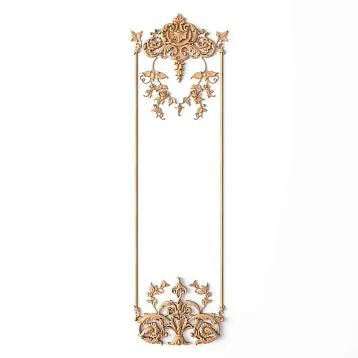
appliqueDecorative elements mounted on flat surfaces to create visual accents, enrich texture, and highlight compositional centers. Unlike extended linear elements — skirting boards and rails — plates have compact forms, placed point-wise at locations requiring decorative emphasis. Rosettes, cartouches, corner elements, carved panels, ornamental fragments — all fall under the category of plates, transforming neutral surfaces into decorated ones.
Door plates decorate smooth door panels, imitating louvered structure or adding ornamental accents. Rectangular frames made of thin rails 2-3 centimeters, mounted on a smooth door, create an illusion of louvers. A central rosette or small carved panel can be placed within each frame. Corner plates are mounted at the corners of the frames, completing the composition. The size and quantity of plates depend on the door size — a standard door 200 centimeters high and 80 centimeters wide is optimally decorated with 2-4 rectangular frames.
Furniture plates decorate cabinet, chest, and buffet facades, transforming standard cabinetry into individual pieces. A central plate on a cabinet door becomes a compositional focus, attracting attention. The plate size should correspond to the facade scale — for a 40x60 centimeter door, an optimal plate diameter or width is 15-20 centimeters. Corner plates at the four corners of the door create a framed composition, structuring the plane.
Wall plates decorate panels, create accents on neutral surfaces, highlight functional zones. In classical interiors, walls are divided into panels by rails or moldings, with a central rosette or ornamental plate placed within each panel. Plate size is proportional to panel size — for an 80x120 centimeter panel, a 20-25 centimeter plate is suitable. Above doorways, above fireplaces, in niches, larger plates or carved panels are placed, creating compositional climaxes.
The character of plate carving determines the interior style. Classical plates reproduce antique motifs — acanthus leaves, laurel wreaths, palmettes, rosettes. Carving is deep, meticulously detailed, with botanical accuracy reproducing plant forms. Baroque plates are characterized by opulence — volutes, garlands, putti create rich ornamentation. Modern plates have asymmetrical organic forms — stylized irises, female profiles with flowing hair. Contemporary plates lean toward geometric abstraction — circles, squares, linear compositions without botanical motifs.
Plate size should correspond to the scale of other wooden interior elements. If the skirting board height is 10 centimeters and rail width is 5 centimeters, door plate size logically should be in the 15-20 centimeter range — a multiple of the base module. Too small plates 5-8 centimeters with large skirting boards and rails disappear, failing to create sufficient accent. Excessively large plates 30-40 centimeters with thin skirting boards and rails create disproportion and visual overload.
The density of plate placement determines the degree of interior decoration. Single plates at key points — above fireplaces, in the center of a grand cabinet door — create delicate accents against overall restraint. Multiple plates on all doors, in each wall panel form a richly decorated interior, characteristic of classical and baroque styles. Modern interiors lean toward minimal use of plates, preferring clean surfaces.
How to unify everything in one style and color
Visual unity of wooden interior elements is achieved through material, stylistic, and color consistency of all elements. Random selection of liked elements without considering their mutual compatibility creates an eclectic chaos, where each element exists in isolation. A systematic approach considers all elements as parts of a single composition, where the choice of one element determines requirements for the others.
Material unity implies using one wood species for all visible wooden elements. An oak skirting board requires oak rails, oak plates, and oak door casings. Unity of species creates color and texture consistency — all elements have similar shades, comparable grain patterns, and identical texture expression. Mixing species — oak skirting boards, pine rails, walnut plates — destroys unity, creates patchiness, and a sense of randomness.
It is permissible to use different species provided color tones are close and finish is uniform. Beech and ash have similar light tones and can be combined with a uniform tinting or staining. Oak and walnut belong to dark species and allow combination in interiors where contrast of various brown shades is valued. Key condition — uniform finish of all elements creates visual kinship even with different original materials.
Stylistic unity requires conformity of processing, profiling, and decoration of all elements to a common style concept. A classical interior implies profiled skirting boards with complex profiles, rails with bevels or simple rounding, plates with antique motifs carving. All elements speak the language of classical architecture, reproducing forms proven over centuries. A modern minimalist interior requires simple rectangular skirting boards without profiling, flat rails with sharp edges, geometric plates without ornamentation.
Mixing styles is permissible in eclectic interiors provided there is a unifying principle. Classical plates can coexist with modern rails if all elements are painted in a single color and patinated with one technique. Uniform finishing neutralizes stylistic differences, creating an impression of unified creation time. Without such a unifying principle, mixing styles appears random and unprofessional.
Color solution determines visual unity or contrast of wooden elements. Monochromatic solution implies painting all elements in one color — white, gray, black, neutral beige. Wood texture may be preserved with transparent stains or concealed with covering paints. Monochromaticity unifies elements of different sizes and functions into a visual whole.
Natural solution preserves the natural wood color, enhanced by transparent lacquer or oil. All elements demonstrate the natural beauty of the material — color, texture, grain pattern. This solution requires flawless wood quality, absence of defects, and color consistency across different elements. Uniform wood species is critical for a natural solution.
Contrast solution highlights certain elements by color, creating visual accents. A dark skirting board with light rails and plates creates an expressive base. Light skirting boards and rails with dark plates highlight decorative accents. Contrasts add dynamism, structure space, but require a sense of measure — excessive contrast creates visual chaos.
Patination unifies all elements with an effect of noble aging. Light base color with dark accents in profile grooves and carving creates an illusion of centuries-old patina. The technique works for both classical and modern interiors, adding historicity, depth, and character.
Interior design techniques with STAVROS products
A full range of wooden interior elements in various profiles and sizes from solid oak, beech, and ash creates a visual foundation for the interior.Wooden baseboardVarious profiles and sizes from oak, beech, and ash arrays create the visual foundation of the interior.RailandBlockAllow structuring walls and ceilings, creating linear composition.appliqueAdd decorative accents, completing the ensemble.
A classical interior is formed by a profiled skirting board 12-15 centimeters high from solid oak with a traditional profile. Walls are divided into panels by vertical and horizontal rails 5-6 centimeters wide of the same species. Within panels, carved plates with classical motifs are placed. Unity of wood species, proportional scales, and stylistic definiteness create a harmonious composition.
Neoclassical interior uses more restrained dimensions while preserving proportional relationships. Skirting board 8-10 centimeters high with simplified profile. Rails 4-5 centimeters wide create large panels with a calmer rhythm. Plates are used selectively — only on accent doors, key wall points. Uniform light neutral tones unify elements.
Modern interiors lean toward minimalist detailing with expressive texture. A simple rectangular skirting board, 7-8 cm high, made of ash or whitewashed oak. Vertical strips, 3-4 cm wide, spaced 40-60 cm apart, create a graphic structure on an accent wall. No overlays are used — the purity of surfaces is valued. Natural finish with transparent oil preserves the wood texture.
Scandinavian style uses light woods — birch, ash, whitewashed oak. A skirting board 6-8 cm high with simple shape. Horizontal strips on the ceiling, spaced 10-15 cm apart, create a slatted structure. Vertical strips on walls are applied locally for zoning. Overlays are minimal. Whitewashing or light toning creates airiness and light, typical of Scandinavian aesthetics.
Loft combines rough, untreated wood with industrial materials. A massive oak skirting board, 10-12 cm high, with deliberately rough finish, preserving knots and cracks. Strips of varying widths (4-8 cm) with uneven spacing create a dynamic structure. No overlays — authenticity of material and lack of decoration are valued. Dark toning or natural oil finish highlights the texture.
Combining various STAVROS elements into a unified composition requires adherence to basic principles. Wood species selection is determined by interior style and color concept. Element sizes are harmonized through proportional relationships — skirting board height as a base module, strip width as a derivative, overlay size as a multiple. Profiles and finish correspond to the chosen style. Final finish visually unifies all elements — single paint, toning, or lacquering creates material unity.
Conclusion — balance of simplicity and expressiveness
The art of combining wooden interior details is based on seeking a balance between simplicity and expressiveness, functionality and aesthetics, tradition and modernity. Minimalist simplicity is valued in contemporary interiors, where each element must be functionally justified, visually restrained, and materially authentic. Decorative expressiveness is in demand in classical interiors, where details create richness of texture, ornamental abundance, and historical continuity.
Professional results are achieved not by the number of details, but by their quality and mutual harmony. Three elements — skirting board, strips, overlays — correctly selected by size, wood species, finish character, and color — create a complete composition surpassing visually a dozen randomly chosen details. A systematic approach, where each element occupies its place, performs a specific function, relates to others through proportional relationships, ensures harmony.
Wooden baseboardSets the basic rhythm, creates the visual foundation of space, defines the scale for other elements.RailandBlockStructure planes, create linear composition, add depth and relief.appliquePlace accents, enrich texture, highlight compositional centers.
Material unity — using one wood species for all elements — creates color and texture harmony. Proportional relationship — size ratios through mathematical dependencies — ensures visual balance. Stylistic consistency — unified profile and finish — guarantees holistic perception. Color harmony — monochromatic, natural, or contrasting palette — visually unites elements.
STAVROS company provides a full arsenal of wooden details, enabling implementation of any interior concept, from classical to ultra-modern. Professional consultations help select elements with correct proportions, harmonized characteristics, and unified style. Quality of solid oak, beech, ash ensures longevity, beauty of natural material, and various finishing options.
Create interiors where wooden details form a harmonious composition, each line has its place, each accent contributes to the overall impression. Find the balance between simplicity and expressiveness, functionality and beauty, tradition and innovation. Choose STAVROS — choose quality natural wood, variety of profiles and sizes, traditions of craftsmanship embodied in every interior detail.