












































































Article Contents:
- What a wooden stair railing consists of — balusters, posts, handrail
- Support posts — load-bearing base
- Balusters — rhythmic row of the railing
- Handrail — top horizontal line
- Bottom rail — connecting horizontal
- Types of balusters: turned, carved, flat, square — styles
- Turned balusters: classic rhythm
- Carved balusters: three-dimensional decor
- Square flat balusters
- Twisted and spiral balusters
- Balusters with carved overlays
- Support posts at the beginning and end of the flight — structure and dimensions
- Cross-section and height
- Structure of post attachment to floor and step
- Decorative post cap
- Baluster spacing standard according to GOST — safe distance
- What the standard says
- Recommended spacing values for residential stairs
- Distance between railing posts for wooden handrails and visual rhythm
- Methods of attaching balusters to steps: threaded stud, dowel, glue
- Method 1: M8 threaded stud
- Method 2: Wooden dowel
- Method 3: Angled cut (for slanted mounting on stringer)
- Top attachment of baluster to handrail
- Calculating the number of balusters per stair flight — formula
- Calculation formula
- Verification calculation by gap
- Calculation table by flight length
- Baluster price: how to budget for a set
- Painting and varnishing — how to achieve a uniform tone for all steps
- Surface preparation before painting
- Oil and oil-wax: warm natural tone
- Polyurethane varnish: maximum protection
- Painting in white
- Combined solution: white balusters, dark posts and handrail
- Wooden railing system: connection with overall decor
- How to integrate the staircase with the rest of the decor
- FAQ - answers to popular questions
- About the Company STAVROS

A staircase is not just a corridor between floors. It is the architectural center of the house, the first thing guests see upon entering the hall, and the last thing they notice when leaving. That is why a staircase deserves the same level of attention as any other architectural element: thoughtful proportions, proper materials, and a well-designed railing system.wooden balusters and posts— is the railing of the staircase, its rhythm and its face. It is they that transform a simple ascent structure into a work of architectural decor.
This article is a practical and professional guide. We will cover everything: what a railing system consists of, what types of balusters exist, how to calculate spacing and quantity, how to attach them to steps, and how to paint them correctly. We will also answer questions that typically arise during the work process — when it's too late to change anything.




What a wooden staircase railing consists of — balusters, posts, handrail
Before selecting individual elements, it is important to understand the system as a whole.Wooden railing of a staircase flight— is not a set of separate parts, but an architectural structure where each element plays its role.




Support posts — load-bearing foundation
A wooden staircase support post is the main load-bearing element of the entire railing system. It is installed at the beginning of the flight (at the first step), at the end of the flight (at the last step), and on each intermediate landing. The post bears the main load from the handrail and lateral forces that occur when leaning on it with a hand.
In the STAVROS catalog, L-series posts are available in several formats. Post L-019 (from 1,760 rub.) — basic, laconic, without complex decor: suitable for modern and Scandinavian interiors. Post L-097 (from 3,000 rub.) — with a soft turned profile, appropriate for classical and neoclassical interiors. Post L-117 (from 3,340 rub.) — more expressive, with an elaborate turned pattern. For monumental grand staircases — posts L-041 (from 6,230 rub.) and L-028 (from 6,490 rub.) with rich decor.
Post cross-section — standardly 100×100 mm or 80×80 mm. Height — from the floor or from the step to the lower plane of the handrail. With a handrail height of 900 mm from the step (standard norm), the post height is 920–950 mm (accounting for handrail seating).
Our factory also produces:


Balusters — rhythmic row of the railing
balusters and posts— is a pair where the post sets the scale, and the baluster fills the rhythm. Intermediate staircase balusters are installed between support posts at equal intervals, creating a continuous 'grille' of the railing. They serve a decorative function and partially a structural one — transferring lateral load to the handrail and lower rail.
Baluster cross-section — typically 45×45 mm or 50×50 mm at the lower part, tapering toward the upper end (in turned variants). The working height of the baluster — from the upper plane of the step to the lower plane of the handrail.
Get Consultation
Handrail — top horizontal line
Wooden handrail for staircase— is the top horizontal (or sloped along the flight) element that is grasped by the hand when moving on the stairs. It rests on posts at the attachment points and on balusters along its entire length. The handrail cross-section should be comfortable for the palm to grip: optimal width is 50–70 mm, height 30–45 mm, with a rounded top surface.
Lower rail — connecting horizontal
On sloped flights, balusters are attached not only to steps from below but are often connected by a horizontal or sloped lower rail — a stringer or horizontal handrail at a lower level. This is a structurally rigid solution that prevents balusters from wobbling. On flights with open steps (without a stringer) — balusters are attached directly to the end or top plane of each step.
Types of balusters: turned, carved, flat, square — styles
When people say 'baluster,' most imagine a turned spindle shape — a barrel-shaped center tapering toward the upper and lower ends. But this is only one of many types. Let's examine all main types with their stylistic applications.
Turned balusters: the classic rhythm
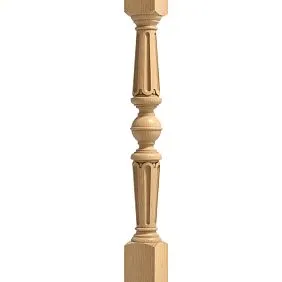
turnedwooden handrails and balustersare produced on a lathe: the workpiece rotates around its axis, and the cutting tool removes material according to a specified profile. The result is a symmetrical shape with distinct horizontal levels of narrowing and widening.
The pattern of a turned baluster is read as a series of 'nodes'—expanded spherical or barrel-shaped forms separated by thin 'necks'. The number and shape of the nodes determine the style: two or three large round nodes—classic; many small nodes with sharp transitions—Baroque; one central expansion with straight necks—strict Neo-Renaissance.
In the STAVROS catalog, turned balusters: L-019 (from 1,760 rub.)—simplest profile, two nodes, strict; L-020 (from 2,220 rub.)—three nodes, slightly richer; L-021 (from 2,880 rub.)—more developed pattern with five zones; L-056 (from 2,860 rub.)—elongated elegant shape with a pronounced central thickening; L-118 (from 3,390 rub.)—round baluster with an accentuated center.
Carved balusters: three-dimensional decor
Carved railing posts are created using 3D milling: a CNC machine processes the workpiece along a multi-axis trajectory, reproducing a complex relief ornament. Acanthus leaves, flutes, spiral flutes, plant tendrils—all are possible with an accuracy of ±0.1 mm.
A carved baluster is an element of the upper price segment. Balusters L-030 (from 7,310 rub.), L-041 (from 6,230 rub.), L-046 (from 6,380 rub.)—examples of developed decor with several levels of ornament. They are suitable for Baroque, Neoclassical, Renaissance, and Empire interiors. For such balusters, the post must be proportionate—no smaller than L-028 (from 6,490 rub.) or L-025 (from 6,370 rub.).
Square flat balusters
A square baluster is a post with a square cross-section, without turning or carving: straight edges, minimal chamfers. The simplest type, read as a graphic vertical line. Suitable for loft, minimalism, industrial style, Scandinavian design. Often used in combination with horizontal crossbars—creating a 'grille' pattern instead of 'posts'.
Twisted and spiral balusters
A twisted baluster is created on a lathe with simultaneous longitudinal displacement of the cutting tool—resulting in a spiral pattern along the entire height. Models L-047 (from 5,280 rub.), L-048 (from 5,300 rub.)—balusters with spiral fluting, organically fitting into Neo-Renaissance and Empire interiors.
Balusters with carved overlays
A separate group—balusters with decorative carved overlays: a flat or square shaft is complemented by an overlay decorative element on the central part. Models L-099.1 (from 3,980 rub.), L-054 (from 3,980 rub.)—are exactly such a solution: basic form + decorative accent.
Support posts at the beginning and end of a flight—construction and dimensions
A staircase support post is the most loaded element of the entire balustrade. It is to this that the handrail is attached, and it bears the main lateral force when leaning on the railing. The requirements for the construction and dimensions of the post are stricter than for balusters.
Cross-section and height
The minimum cross-section of a support post for a residential staircase is 80×80 mm. Recommended—100×100 mm. For a flight height over 3.0 m or with a wide handrail exceeding 80 mm—120×120 mm.
The post height is determined by the staircase design: from the installation level (step or landing floor) to the lower plane of the handrail. Standard—900 mm from the step level to the top of the handrail. Post height = 900 mm minus the handrail cross-section height (30–45 mm) = 855–870 mm working part. To this, add the mounting part: 50–100 mm into the step or floor.
Post attachment to floor and step construction
The post is attached in one of three ways. First—with a threaded stud: a groove is milled in the lower end of the post, an M12 nut is glued into it, an M12×100 mm stud is screwed into the step or floor, the post is placed over it and tightened. This is the most reliable method for load-bearing support posts.
Second—with an M10×120 mm anchor bolt: a blind hole 11 mm in diameter, 80 mm deep is drilled in the bottom of the post, the anchor is screwed into the step, the post is placed over the anchor. A less monumental but practical solution.
Third—with a wooden dowel + mounting adhesive: for posts that do not bear significant load (e.g., a decorative post at the end of a staircase on a landing where there is no flight). Dowel 16 mm in diameter, 100 mm long, with D3 adhesive.
Decorative post cap
The upper end of the support post is covered with a decorative 'cap'—a finial. This is a flat or shaped element: pyramidal dome, spherical finial, carved cap. In the catalogcomponents for staircases STAVROSfinials are selected to match the style of the main post. For L-041 and L-028—developed finials with decorative relief. For L-019 and L-020—concise pyramidal caps.
Baluster spacing norm according to GOST—safe distance
Baluster spacing is not a matter of aesthetics. First and foremost, it is a safety issue regulated by normative documents.
What the norm says
In accordance with current building codes (GOST R 53254-2009 and SP 17.13330) for residential buildings, the clear distance between balusters must not exceed 150 mm. This value is chosen for child safety reasons: a child should not be able to push their head between the guardrail posts.
For facilities with increased safety requirements (children's institutions, public buildings)—clear distance no more than 100 mm.
For private residential houses, a distance of up to 200 mm is technically permissible — but this is a boundary that is better not to balance on: a child aged 3–4 years can easily pass through a gap of 180–190 mm.
Recommended step values for a residential staircase
For a baluster cross-section of 45×45 mm: baluster axis step 140–160 mm (clearance 95–115 mm). For a cross-section of 50×50 mm: step 140–160 mm (clearance 90–110 mm). The last two values are the standard, which ensures safety and creates the correct visual rhythm of the railing.
Distance between wooden railing posts and visual rhythm
In addition to safety, the baluster step affects the visual perception of the staircase. A sparse step (160–180 mm) makes the railing 'airy' — balusters are read as separate verticals against the background of space. A frequent step (100–120 mm) creates a monumental 'palisade' — a more closed, heavy railing. The optimum for most residential staircases is a step of 130–150 mm.
Methods of attaching balusters to steps: threaded stud, dowel, glue
Attaching balusters is a technical issue, the solution of which determines the service life and rigidity of the entire railing.
Method 1: M8 threaded stud
This is the most reliable method for attaching intermediate balusters. A blind hole with a diameter of 9 mm and a depth of 60–70 mm is milled or drilled into the lower end of the baluster. An M8 nut is glued in (using ED-20 glue or a two-component construction adhesive). An M8×120 mm stud with a washer is screwed into the step. The baluster is placed onto the stud and tightened with a wrench through a hole in the lower part (later covered with a decorative plug).
Advantages: maximum rigidity, possibility of disassembly for replacement, does not require vertical glue. Disadvantages: labor-intensive, requires precise marking.
Method 2: Wooden dowel
Aligned holes with a diameter of 16 mm and a depth of 50–60 mm are drilled into the lower end of the baluster and the surface of the step from each side. A 16×120 mm dowel is coated with PVA or D3 glue, inserted into the step, and the baluster is mounted onto it. Each baluster is held in a vertical position until the glue dries — using painter's tape to adjacent balusters or a special template.
Advantages: simplicity, speed, does not require additional elements. Disadvantages: non-demountable connection, rigidity is somewhat lower than with a stud.
Method 3: Angled cut (for inclined mounting on a stringer)
When mounting balusters on an inclined stringer (the side board of the staircase), the lower end of the baluster is cut at the angle of the flight — typically 30–40°. Connection: dowel + glue. The lower end of the baluster lies in the plane of the stringer, the upper end is vertical. This method is visually neat but requires precise calculation of the angle for each baluster.
Upper attachment of the baluster to the handrail
The upper end of the baluster is attached to the handrail in one of two ways: mortising into the handrail (a 45×45 mm groove along the length of the handrail) or bottom overlay (a lower rail with a groove). The first option is more monumental and rigid: the handrail is placed over the entire row of balusters. The second is faster to install: balusters are attached to the lower rail, then the handrail is installed on top.
Calculating the number of balusters for a staircase flight — formula
This is the most practical section — here is the mathematics you need to know before going to the warehouse.
Calculation formula
Number of balusters = (flight length in mm / baluster axis step in mm) + 1
Flight length — horizontal projection from the center of the first support post to the center of the last. Axis step — distance between the centers of adjacent balusters (150 mm is standard).
Example: flight length 3,600 mm, step 150 mm. (3,600 / 150) + 1 = 25 balusters. This includes balusters at the posts: if the posts are separate, you need 25 minus 2 = 23 intermediate balusters + 2 support posts.
Verification calculation by clearance
After calculating the number of balusters, check the actual clearance. Clearance = axis step − baluster width. With a step of 150 mm and a baluster of 45 mm: clearance = 105 mm. Norm — up to 150 mm. Verification passed.
If the clearance exceeds 150 mm — reduce the step. If it turns out to be more than 170–180 mm — this is already unsafe.
Calculation table by flight length
| Flight length | 130 mm pitch | 150 mm pitch | Step 170 mm |
|---|---|---|---|
| 2,400 mm | 19 pcs. | 17 pcs. | 15 pcs. |
| 3,000 mm | 24 pcs. | 21 pcs. | 18 pcs. |
| 3,600 mm | 29 pcs. | 25 pcs. | 22 pcs. |
| 4,200 mm | 33 pcs. | 29 pcs. | 26 pcs. |
The data includes the end balusters at the posts. If the posts are separate, subtract 2 from each value.
Baluster price: how to budget for a set
The cost of a railing set consists of three items: posts, balusters, handrail. Balusters make up 60–70% of the total cost. When choosing a model, it's important to look at the price per piece, considering their quantity.
For 25 balusters: L-019 (from 1,760 rub./pc.) = 44,000 rub. per row, L-021 (from 2,880 rub./pc.) = 72,000 rub., L-045 (from 4,860 rub./pc.) = 121,500 rub. Add posts (2–3 pcs.): L-097 (from 3,000 rub.) × 3 = 9,000 rub. Handrail — from 800–1,500 rub./linear m.
Painting and varnishing — how to bring everything to a uniform tone with the steps
A staircase railing only looks monolithic when the balusters, posts, and handrail are in the same color or tone. This can be a 'step-matching' tone (a uniform color for the entire staircase), a 'wall-matching' tone (the railing as an extension of the room's palette), or a contrasting solution (white balusters + dark handrail).
Surface preparation before painting
Newwooden handrails and balustersoak or beech elements are supplied with sanding of the 'Standard' category (P120–P180) or 'Prestige' (P220–P240). For final finishing, pre-finish sanding with P280–P320 along the grain is required in any case.
For oak elements — a sealer primer is mandatory: tannins can 'bleed through' thin coatings, especially white and light ones, causing yellow stains. A shellac- or acrylic-based sealer primer is applied in a thin layer, dries for 1–2 hours, after which the final coating can be applied.
Oil and oil-wax: warm natural tone
Oil coating maximally reveals the wood grain. For oak — oil with a warm brown pigment will give a honey-amber tone, close to the natural color of oak. For a darker shade (walnut, wenge) — oil with brown or black pigment.
Application: with a brush in one direction, remove excess with a cloth after 15 minutes. Let dry for 8–12 hours. A second coat — if needed to deepen the tone. Maintenance: refresh every 2–3 years under normal use.
Polyurethane varnish: maximum protection
Polyurethane varnish is the most wear-resistant coating for staircase railings. Stairs are a high mechanical load area: hands, clothing, sometimes bag impacts. Varnish creates a hard protective film that withstands all this without visible damage for 10–15 years.
Technology: primer + P320 sanding + second coat + P400 sanding + final coat. Three coats are mandatory. Two — minimum. One coat is a setup for repair in a year.
Tinting with varnish: add 5–10% of stain of the desired tone to the varnish. The first coat of tinted varnish gives a light tone. Each subsequent coat intensifies it. This way you can achieve an exact match of the tone of the balusters and steps.
Painting white
White balusters on a dark handrail — one of the most effective classic solutions. Technology: sealer primer → P320 sanding → two coats of white acrylic enamel with intermediate P400 sanding. For turned balusters with developed relief — only with a brush: in the recesses of the relief there must be paint, not voids.
Combined solution: white balusters, dark posts and handrail
This is a classic architectural solution found in English and American country houses. Dark (wenge, walnut, dark oak) support posts and handrail define the tectonics and 'weight' of the railing. White balusters create airiness and rhythm. The contrast makes the staircase architecturally expressive even in a small space.
Wooden railing system: connection with the overall decor
A staircase does not exist separately from the interior. When choosingbalusters and postsIt's important to consider the overall architectural theme of the room.
How to integrate the staircase with the rest of the decor
If the hallway has installed Wooden pilasters, the staircase balusters should be made from the same wood species and in the same tone. If the walls feature Wooden moldings, their profile 'language' should echo the baluster decor: simple moldings + simple balusters, richly decorated moldings + carved balusters.
wooden ceiling cornice in the hallway and wooden floor baseboard — these are the upper and lower horizontal bands. The baluster row is the vertical decor. Together they create the architectural system of the hallway, where the staircase is the central element, not just a functional structure.
FAQ — answers to popular questions
How many balusters are installed per step?
Standard — one or two balusters per step. One baluster — for a wide step up to 250 mm and a baluster spacing of 130–150 mm. Two balusters — with a spacing of 150–180 mm on a step of standard depth. Three per step — rarely, only on a very wide flight (over 1,500 mm).
Can balusters be attached without dowels — using only glue?
For intermediate balusters — acceptable if using structural glue D4 and a dowel to prevent shifting. But for support posts, glue without a dowel is insufficient: the post bears lateral load, and a glued joint without mechanical reinforcement can gradually fail.
How is an oak baluster better than a pine one?
Oak density — 650–750 kg/m³ compared to 430–540 kg/m³ for pine. An oak baluster is more resistant to wear, mechanical loads, and deformation due to humidity changes. The downside of oak — higher price. For dachas and temporary housing — pine. For permanent country houses, cottages — oak or beech.
How to fix a baluster that is installed at an angle?
While the glue is still wet (within 15–20 minutes) — simply adjust with a level. If the glue has dried — carefully remove by twisting, clean the base, and reinstall with new glue.
What baluster spacing is correct for child safety?
Maximum clear gap — 100 mm for children's areas, 150 mm for general living areas. With a baluster cross-section of 45 mm: center-to-center spacing no more than 195 mm for living areas, 145 mm for children's areas. A spacing of 130–140 mm is recommended — with a safety margin.
Is it necessary to treat balusters with antiseptic for an outdoor staircase?
Absolutely. For terraces and outdoor staircases, all wooden elements — including stair flight railing — are impregnated with deep-penetration antiseptic (at least two coats) before installation. After installation and assembly — final coating with weather-resistant varnish or oil for exterior use.
How much does a full set of wooden railing for a stair flight cost?
Benchmark for a 3.5 m flight with 23 balusters and 3 posts: balusters L-021 (2,880 rub.) × 23 = 66,240 rub., posts L-097 (3,000 rub.) × 3 = 9,000 rub., handrail (1,200 rub./linear m) × 4 linear m = 4,800 rub. Total from 80,000 rub. in the mid-range segment.
About the company STAVROS
A staircase is a long-term project. The balusters you choose today should last 30–50 years, withstand the daily load of thousands of touches, and maintain their appearance. That's why it's important to work with a manufacturer who takes responsibility for every element.
STAVROS — a Russian manufacturer of wooden staircase components since 2002. The STAVROS catalog features over 50 models of balusters from 1,760 rub., support posts, handrails, as well as a full range of architectural decor: pilasters and columns, Wooden cornices, MoldingsandTrimming Items made from solid oak and beech. All elements are produced on European equipment with a tolerance of ±0.1 mm, from certified wood with 8–12% moisture content. Delivery across Russia. Complete project orders — with a discount and from a single wood batch.


