Article Contents:
- Evolution of balusters: from antiquity to modernity
- Regional Production Features
- Classification of wooden balusters by shape and purpose
- Round turned balusters
- Square and rectangular balusters
- Flat decorative balusters
- Wood species for making balusters
- Coniferous species: accessibility and practicality
- Broadleaf species: prestige and beauty
- Manufacturing and processing technologies
- Turning processing
- Milling and carving
- Baluster elements of staircases: functionality and aesthetics
- Calculating quantity and placement
- Balcony baluster: features of operation
- Protective Treatment
- Wooden balusters for balconies: design solutions
- Classic style
- Modern minimalism
- Ethnic Motifs
- Balusters for staircases: how to install and mount
- Preparatory work
- Mounting methods
- Features of installing flat balusters
- Care and Maintenance of Wooden Balusters
- Regular maintenance
- Preventive maintenance
- Repairing damage
- Economic Aspects
- Pricing factors
- Long-Term Economic Efficiency
- Trends and innovations
- Ecological requirements
- Technological Innovations
- Conclusion
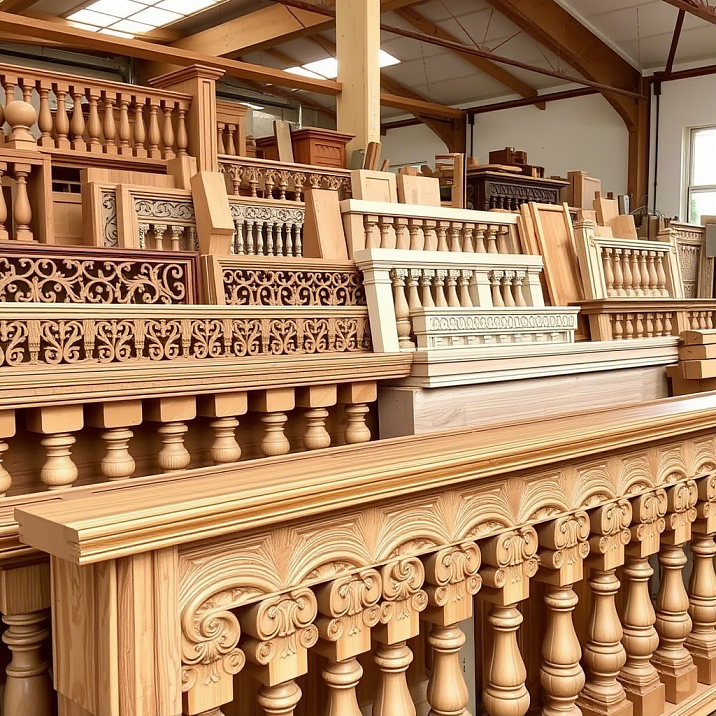
Imagine morning coffee on the balcony, where every detail breathes the warmth of natural wood, and elegant wooden balcony balusters create a unique atmosphere of coziness and safety. These architectural elements have transformed from simple functional details into true works of art, capable of radically transforming the exterior appearance of any building.
In the modern world, where technology is rapidly developing and synthetic materials fill the market, wood remains a symbol of reliability, eco-friendliness, and eternal beauty. Wooden balusters are not just protective elements—they tell the story of craftsmanship, traditions, and impeccable taste of their owners.
Each wooden baluster is the result of centuries of carpentry art, embodied in modern manufacturing technologies. From selecting the type of wood to the final surface treatment—each stage of creating these elements requires deep knowledge, skill, and attention to the smallest details.


Evolution of balusters: from antiquity to modernity
The history of balusters dates back to the Renaissance, when Italian architects first began using these elements to decorate palace balconies. The name comes from the flower balsam, whose bud shape resembles the classic silhouette of a baluster. Interestingly, in ancient Greece and Rome, such elements did not exist—they preferred massive columns and pilasters.
Initially, balusters were used exclusively for balcony railings, and only in the 15th century did they begin to be applied to staircases. Since then, these architectural elements have undergone a long evolution, adapting to various styles and eras, yet invariably preserving their primary function—ensuring safety and aesthetic appeal.




Regional Production Features
Modern production of wooden balusters is developing in various regions of Russia, each with its own features and traditions. If you plan to buy a baluster in Barnaul, you will have access to products made from Siberian wood, which is distinguished by exceptional density and strength due to the harsh climate of the region.
Altai craftsmen specialize in creating balusters from pine and larch, which grow in ecologically clean areas. Local wood has unique characteristics: high resin content, which provides natural protection against insects and fungi, as well as a beautiful texture with distinct annual rings.
Central regions of Russia also offer quality products. Those who buy a baluster in Kaluga can expect products made from oak, ash, and birch, which grow in temperate climates and possess optimal characteristics for use in the middle belt.
Our factory also produces:


Classification of wooden balusters by shape and purpose
Get Consultation
Round turned balusters
Round balusters represent a classic variant that never goes out of style. They are made on lathe machines, creating elegant profiles with smooth transitions between different elements. Such items are ideally suited for traditional interiors and exteriors where classical beauty and proportion harmony are valued.
The process of manufacturing round balusters requires high skill from a turner. Each profile element—from the base to the capital—must be crafted with jewel-like precision. The slightest deviation in proportions may disrupt the overall harmony of the composition and reduce the aesthetic value of the item.
Square and rectangular balusters
Square balusters have gained popularity due to their versatility and modern appearance. They fit perfectly into minimalist interiors, where functionality and clean lines are valued. Such items are easier to manufacture compared to round ones, allowing them to be offered at more affordable prices.
Rectangular balusters are often used in modern architecture, where the goal is to create a sense of strictness and order. They can be decorated with milled grooves, creating an interesting play of light and shadow, or left smooth to emphasize a minimalist style.
Flat decorative balusters
Flat balusters occupy a special place, representing wide boards with carved or milled decoration. Many are interested in the question: how to install flat balusters correctly? These elements are installed closely together, creating a continuous decorative surface that not only looks beautiful but also provides reliable protection against wind and precipitation.
Flat balusters are especially popular for decorating verandas, terraces, and open balconies. Their continuous construction creates a sense of privacy and protection, which is particularly important for outdoor relaxation. The carved patterns on such balusters can be highly diverse—ranging from simple geometric ornaments to complex floral compositions.
Wood species for making balusters
Coniferous species: accessibility and practicality
Spruce remains the most popular wood species for manufacturing balusters due to its optimal price-to-quality ratio. Spruce wood is easy to process, has a beautiful texture with distinct growth rings, and possesses natural antiseptic properties due to its high resin content.
Spruce balusters are ideal for use on balconies and terraces, as the resinous nature of the wood provides natural protection against moisture and insects. When properly treated with protective compounds, such items can last for decades while retaining their original appearance.
Larch is an elite material among coniferous species. Its wood is distinguished by exceptional density and durability, as well as a beautiful golden hue that develops into a noble patina over time. Larch balusters can withstand the harshest climatic conditions without additional protective treatment.
Hardwood species: prestige and beauty
Oak is rightfully considered the king among wood species for manufacturing balusters. Oak products symbolize reliability, prestige, and eternity. The unique texture of oak wood, with its striking medullary rays, creates an unmistakable pattern on every baluster.
Oak's strength is legendary—oak balusters can withstand extreme loads without losing their shape or beauty. They are ideal for creating grand balconies and terraces, where a combination of functionality and elegance is required.
Ash attracts designers with its versatility and beautiful contrasting texture. The light-colored ash wood with dark veins creates an eye-catching visual pattern, which especially looks striking in modern interiors and exteriors.
Birch represents an optimal combination of beauty and affordability. Its light, uniform wood is perfect for staining and painting, allowing balusters to be created in virtually any color according to the designer's vision.
Manufacturing and processing technologies
Turning Processing
Turning remains the primary method for creating round balusters. Modern CNC turning machines allow for reproducing complex profiles with micron-level precision, ensuring identical elements across a series.
The turning process begins with preparing the blank. The wood must be properly dried to a moisture content of 8–12%, ensuring dimensional stability of the finished product. The blank is mounted on the machine and processed with special cutters to create the desired profile.
Carving and milling
Milling is used to create complex decorative elements on balusters. Modern multi-axis milling machines allow for creating three-dimensional compositions, transforming ordinary functional elements into works of art.
Hand carving remains an unmatched method for creating unique decorative elements. Experienced carvers are capable of producing balusters that are true works of art, each one unique and irreplaceable.
Baluster elements for staircases: functionality and aesthetics
Baluster elements for staircases perform several important functions simultaneously. Primarily, they ensure safety—balusters prevent falls from height and serve as support while moving along the staircase. The standard height of the railing is 90–100 cm, ensuring comfortable and safe use.
The second important function is decorative. Balusters define the style of the entire staircase structure and can dramatically alter the perception of space. Properly selected balusters can transform an ordinary staircase into an architectural focal point in the interior.
Calculating Quantity and Placement
When planning the installation of balusters, it is important to correctly calculate their quantity and spacing. The optimal spacing between adjacent balusters' axes is 12–15 cm. This spacing ensures sufficient structural strength and prevents slipping between elements.
To calculate the number of balusters, measure the total length of the railing and divide it by the chosen installation spacing. Add support posts to the result, which are installed at the beginning and end of the staircase run.
Balcony baluster: operational characteristics
Balcony baluster is subjected to more aggressive environmental exposure compared to internal elements. Temperature fluctuations, humidity, ultraviolet radiation, precipitation—all these factors require special attention to material selection and protective treatment methods.
For balcony balusters, it is recommended to use more durable wood species, such as larch, oak, or teak. These species possess natural resistance to moisture and temperature fluctuations.
Protective treatment
Quality protective treatment is the key to the longevity of balcony balusters. Modern protective compounds form a durable film on the wood surface, preventing moisture penetration and protecting against ultraviolet radiation.
The protective treatment process includes several stages: priming with antiseptic compositions, applying a base protective layer, and finishing with varnish or oil. Each layer must be fully dry before applying the next.
Balusters for balcony made of wood: designer solutions
Balusters for balcony made of wood They open up wide possibilities for creating unique designer solutions. Depending on the architectural style of the building and the owner's personal preferences, one can choose classic, modern, or ethnic design options.
Classic style
Classic balusters are characterized by strict proportions and restrained decoration. They consist of three main parts: base, shaft, and capital. Each part has its own proportions based on classical architectural canons.
Classic balusters are perfect for decorating balconies in historic buildings or houses built in a traditional style. They create a sense of stability and nobility, highlighting the owner's status.
Modern minimalism
Modern minimalist balusters are distinguished by simple forms and the absence of excessive decoration. They may have square, rectangular, or round cross-sections with minimal surface treatment.
Such balusters fit perfectly into modern architecture, where functionality and clean lines are valued. They do not distract from the overall composition but rather emphasize its geometry.
Ethnic motifs
Ethnic balusters reflect the cultural traditions of various peoples. They may be adorned with traditional ornaments, stylized depictions of plants and animals, and geometric patterns.
Such items create a special atmosphere on the balcony, emphasizing the connection with cultural heritage and traditions. They are especially popular in country houses, where owners strive to create an authentic atmosphere.
Balusters for stairs: how to install and mount
Question Balusters for stairs: how to install and mount Many homeowners are concerned about this. Quality installation is a guarantee of safety and longevity of the entire structure.
Preparation Work
Installation of balusters begins with careful marking. It is necessary to determine the exact position of each element, taking into account the total length of the railing and the chosen installation spacing. Marking is done using a tape measure, level, and pencil.
Special attention should be paid to installing support posts, which are mounted at the beginning and end of the stair run. These elements bear the main load and must be secured especially securely.
Methods of mounting
There are several ways to mount balusters, each with its own advantages and area of application.
Mounting with dowels – a traditional carpentry method ensuring strong and inconspicuous connections. Holes are drilled in the end of the baluster and in the base, into which a wooden dowel, previously coated with glue, is inserted.
Mounting with metal bolts – a more modern method ensuring exceptional connection strength. A threaded bolt is screwed into the base, and the baluster is screwed onto it from above.
Mounting with screws – the fastest installation method, but less aesthetic. Screws are screwed in at an angle through the end of the baluster into the base. The mounting points are covered with decorative caps.
Features of installing flat balusters
Flat balusters require a special approach to installation. They are mounted on special guide rails (baluster supports), which ensure accurate positioning and secure mounting.
A baluster support is a planed rail with a groove into which flat balusters are inserted. This mounting system allows for quick and quality installation of a large number of elements, ensuring their precise alignment.
Care and maintenance of wooden balusters
Regular Maintenance
Wooden balusters require regular but simple maintenance. Daily cleaning consists of removing dust with a soft dry cloth. Special attention should be paid to decorative elements and recesses, where dirt may accumulate.
Weekly wet cleaning is performed using special wood care products. It is important not to use excessive amounts of water, as this may damage the protective coating or cause wood deformation.
Preventive Maintenance
It is recommended to conduct a preventive inspection of all balusters once a year to identify possible defects or weakened fasteners. Timely detection and elimination of minor issues can prevent serious damage in the future.
Updating the protective coating is performed as needed, typically every 3-5 years, depending on usage conditions. Modern coatings allow updating the protective layer without completely removing the previous coating.
Damage Repair
Minor damage to wooden balusters can be repaired yourself. Scratches and scuffs can often be masked using special wax pencils or touch-up markers of the appropriate color.
More serious damage, such as cracks or chips, requires professional repair. In some cases, it is easier to replace the damaged element entirely than attempt to repair it.
Economic Aspects
Pricing Factors
The cost of wooden balusters depends on many factors. The main pricing factor is the type of wood. Pine balusters are the most affordable option, while oak and ash products are significantly more expensive.
Processing complexity also significantly affects the price. Simple turned balusters are cheaper than carved or milled items. Handmade work is always valued higher than machine processing.
Order volume plays an important role in pricing. Large quantities are usually manufactured at a lower price per unit, making it advantageous to order all necessary elements simultaneously.
Long-term economic efficiency
Investments in high-quality wooden balusters pay off in the long term. Properly manufactured and installed items serve for decades, requiring minimal maintenance.
Quality balusters also increase property value. Beautiful and functional railings for balconies and staircases are an important factor when potential buyers evaluate real estate.
Trends in development and innovation
Ecological Requirements
Modern consumers are increasingly paying attention to the ecological properties of materials. This encourages manufacturers to use wood from sustainably managed forests and environmentally safe coatings.
FSC certification is becoming an important factor when choosing wooden balusters. Consumers are willing to pay more for products guaranteed to be produced in accordance with ecological standards.
Technological Innovations
The introduction of new manufacturing technologies allows creating balusters with increasingly complex shapes while maintaining affordable prices. 3D modeling and CNC machines open new possibilities for designers and manufacturers.
Advancements in finishing technologies allow creating coatings that not only protect wood but also impart new decorative properties. Coatings that mimic various textures and shades are emerging.
Conclusion
Wooden balusters for balconies and staircases represent a unique combination of functionality, beauty, and eco-friendliness. Choosing quality products from reputable manufacturers means investing not only in safety and comfort but also in the aesthetic value of your home.
The modern market offers a wide range of wooden balusters to suit any needs and budgets. From simple pine posts to exclusive oak works of art — everyone can find a solution that perfectly fits the interior and reflects the owner’s individuality.
Correct selection, quality installation, and regular maintenance will ensure the longevity and beauty of wooden balusters for many years. These elements will become not just functional details, but true ornaments of your home, creating an atmosphere of comfort, safety, and elegance.
STAVROS is a recognized leader in the production and supply of high-quality wooden balusters. Years of experience, use of advanced technologies, and strict quality control at every stage of production allow STAVROS to offer clients products that fully meet the highest standards. Every baluster from STAVROS is the result of meticulous work by skilled craftsmen who pour a part of their soul and professional expertise into each item, creating products capable of decorating any home and lasting for many decades.