












































































Article Contents:
- What is a Wooden Batten: Definition and Basic Characteristics
- Types of Wooden Battens: From Rough Planed to Elegant Profiled
- Planed Batten: Basic Universal
- Sanded Batten: Ready for Finishing
- Profiled (Molded) Batten: Decorative Options
- Wooden Batten Cross-Sections: From Delicate 10x10 to Massive 50x50 mm
- Thin Battens 10x10, 10x20, 15x15 mm
- Medium Battens 20x20, 20x30, 20x40, 25x25 mm
- Thick Battens 30x30, 30x40, 40x40, 40x50, 50x50 mm
- Wood Species for Battens: From Budget Pine to Premium Ash
- Pine: Affordable Classic
- Spruce: Light Northern Character
- Oak: Monumentality and Durability
- Beech: pinkish warmth
- Ash: strength and expressive texture
- Application of Wooden Battens in Construction: Structural Foundation
- Frames and Lathing
- Counter-Battening and Ventilation Gaps
- Beacons and Guides
- Wooden Battens in Decor: The Aesthetic Revolution of Simplicity
- Batten Ceilings: Airy Graphics Overhead
- Batten Wall Panels: Verticals and Horizontals
- Partitions and Zoning
- Furniture fronts
- Bed Headboards
- Decorative Radiator Screens
- Wood Treatment: Protection from Moisture, Fire, Biological Damage
- Antiseptic Treatment: Combating Fungi and Mold
- Fire Protection: Reducing Flammability
- Moisture Protection: Varnishes, Oils, Waxes
- Installation of Wooden Battens: Technological Secrets
- Foundation Preparation
- Marking: Accuracy is the Key to Success
- Guide Rail Mounting
- Installation of Decorative Planks
- Gap Compliance
- Processing corners and joints
- Painting and Varnishing of Slats: Finishing
- Surface Preparation
- Priming
- Painting
- Varnishing
- Oil Treatment
- Wooden Slat Prices: Market Benchmarks for 2026
- Spruce and pine
- Oak
- Oak
- Ash
- Frequently Asked Questions about Wooden Slats
- What is the optimal moisture content for wooden slats?
- Can planks be used in wet areas?
- Do planks need to be treated before installation?
- What is the optimal spacing between slats?
- Can wooden slats be bent?
- How to attach slats to a concrete wall?
- How much do wooden slats weigh?
- Can planks be installed by oneself?
- How to care for lath structures?
- Where to buy quality wooden slats?
- STAVROS Company: Woodworking Craftsmanship Since 2001

There are materials that endure through the ages, remaining relevant and in demand. The wooden slat is one of them. A simple rectangular block of solid wood—what could be simpler? But it is precisely this simplicity that conceals a versatility of application that the most sophisticated decorative materials would envy. From frames and battens to elegant slatted ceilings and loft-style wall panels—wooden slats work everywhere where naturalness, strength, and expressiveness of lines are required.
In 2026, wooden slats are experiencing a real boom in popularity. Architects and designers are discovering their plastic possibilities: rhythmic vertical slats on walls visually elongate a room, horizontal ones create dynamism, diagonal ones add drama.Wooden slat for decorationhas transformed from a utilitarian construction element into a full-fledged artistic tool, capable of changing the character of a space through rhythm and direction of lines alone.


What is a Wooden Slat: Definition and Basic Characteristics
A wooden slat is a linear wood product made from solid wood with a rectangular or square cross-section of small dimensions (typically from 10x10 to 50x50 millimeters), with a length from 1 to 6 meters. Unlike a board (which has a width significantly exceeding its thickness) or a beam (which has a substantial cross-section from 50x50 mm and above), a slat occupies an intermediate position—thin enough for flexible application, yet strong enough for structural tasks.
The production technology for slats is simple but requires precision. A log is sawn into boards, and the boards are sawn into slats. This is followed by drying to a moisture content of 8-12% (for interior applications) or 15-18% (for construction work). The dried slats are planed on four-sided machines, ensuring geometric accuracy—all four faces become perfectly flat and parallel. Further sanding is possible to obtain a smooth surface for painting or varnishing.
A quality slat has a strictly rectangular cross-section with a tolerance of no more than 0.5 millimeters, straightness without bends or twists, a clean surface without loose knots, cracks, or rot. Moisture content is critical: a slat that is too wet will shrink after installation, creating gaps; an overly dry one will absorb moisture and warp. The ideal is a stabilized moisture content of 10-12%, corresponding to normal living conditions.




Types of Wooden Slats: From Rough Planed to Elegant Profiled
The classification of slats depends on the degree of processing and the profile of the cross-section.
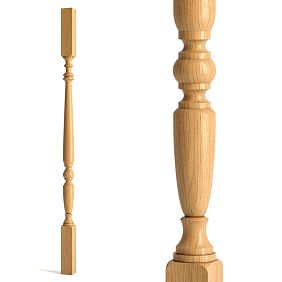
Our factory also produces:



Planed Slat: The Basic Universal
A planed slat has only undergone mechanical processing on a planing machine. All faces are even, but the surface retains traces of the cutter—barely noticeable longitudinal grooves. The surface feels slightly rough to the touch.
Application of planed slats: frames for cladding (e.g., base for drywall, paneling), roof battens, rough structures, packing crates. For decorative applications, a planed slat requires additional sanding and finishing.
Advantages: low price (20-30% cheaper than sanded), sufficient quality for invisible structures.
Disadvantages: surface unsuitable for finish work without additional processing.
Get Consultation
Sanded Slat: Ready for Finishing
Planed battens are sanded using abrasive belts or drums after planing. The surface becomes smooth, pleasant to the touch, and ready for painting or varnishing.
Uses of sanded battens: decorative wall and ceiling panels, furniture frames, visible structural elements, base for artistic treatments (brushing, patination, burning).
Advantages: perfect surface, saves time on finishing preparation, aesthetic appearance even without a final coating (oil will emphasize the wood grain).
Disadvantages: price is 20-30% higher than planed.
Shaped (profiled) batten: decorative options
A shaped batten has a non-rectangular, complex cross-section — with chamfers, roundings, longitudinal grooves, relief. It is manufactured on milling machines using special profiles.
Types of shaped battens:
-
With two chamfered edges (corners cut at 45°, cross-section resembles an elongated octagon) — soft profile for glazing beads, overlays
-
With rounded edges (radiused treatment) — pleasant tactile feel, no sharp corners
-
With decorative grooves (longitudinal indentations on the edges) — imitation of complex molding profiles
-
Wedge-shaped (one edge wider than the other) — for creating conical structures
Uses of shaped battens: decorative overlays, glazing beads for windows, framing, furniture elements, architectural decor.
Advantages: ready-made design solution, interesting play of light and shadow on the relief.
Disadvantages: high price (40-60% more expensive than rectangular), highly specialized application.
Cross-sections of wooden battens: from elegant 10x10 to massive 50x50 mm
The cross-section size determines the strength and visual perception of the batten.
Thin battens 10x10, 10x20, 15x15 mm
The most elegant. Used for decorative grilles, small glazing beads, modeling, crafts. No load-bearing capacity, decorative only. Bend easily, suitable for curved elements.Solid wood battenof such cross-sections is ideal for openwork partitions.
Medium battens 20x20, 20x30, 20x40, 25x25 mm
Universal size range. 20x20 mm cross-section — a bestseller for slatted ceilings and wall panels. Thin enough not to look bulky, strong enough for spans of 60-80 cm without sagging. 20x40 mm cross-section provides pronounced volume — battens protrude 4 centimeters from the wall, creating deep shadows.
Thick battens 30x30, 30x40, 40x40, 40x50, 50x50 mm
Massive elements. 40x40 and 50x50 mm cross-sections — practically timber, possessing serious load-bearing capacity. Used for frames under heavy loads, battens for heavy materials, accent decorative elements where monumentality is needed.
Visually, thick battens are perceived as independent volumetric elements. A wall made of 40x40 mm battens with a 10 cm spacing is no longer a light graphic of thin lines, but a powerful architectural structure.
Wood species for battens: from budget pine to elite ash
The choice of species determines appearance, strength, durability, and price.
Pine: affordable classic
Pine is the most common wood species for battens. Light wood with a yellowish tint, pronounced annual ring grain, resinous aroma.
Advantages of pine: low price (basic level), good workability (easy to cut, plane, sand), availability (huge volumes of stock), natural resistance to biological damage (resinousness protects against fungi).
Disadvantages: softness (dents easily appear from impacts), resinousness can manifest as droplets when heated (unacceptable for saunas without special treatment), knotty grain (many small knots requiring attention during sorting).
Pine slats are ideal for frames, battens, decorative panels for painting (the texture is hidden by paint, only the shape remains).
Spruce: the bright northern character
Spruce is similar to pine but lighter, almost white, less resinous, with a finer texture. Strength is slightly lower than pine.
Application: same as pine, plus situations where maximum wood lightness is important (under clear varnishes in Scandinavian interiors).
Oak: monumentality and durability
Oak is the king among woods. Hard, heavy, dense, with an expressive texture of large pores. Color ranges from light brown to dark chocolate.
Advantages of oak: maximum hardness and wear resistance, noble texture (emphasized by oils, varnishes), durability (centuries without loss of properties), moisture resistance (oak contains tannins that protect against rot).
Disadvantages: high price (3-5 times more expensive than pine), weight (density 700 kg/m³ vs. 500 for pine), difficulty in processing (quickly dulls tools), tendency to crack with improper drying.
Oak slats are used in premium interiors where visual solidity and tactile pleasure from touching noble wood are important.
Beech: pink warmth
Beech is a hardwood, close to oak in strength. Color is light with a pinkish or peach tint, texture is fine and uniform.
Advantages of beech: high density and strength, beautiful warm hue (especially under oil), uniform structure without large pores, good workability (despite hardness, cuts cleanly).
Disadvantages: hygroscopicity (beech actively reacts to humidity changes, can warp), price (2-3 times more expensive than pine), lower durability in damp conditions compared to oak.
Beech slats are ideal for interior decor in rooms with stable humidity — living rooms, bedrooms, studies.
Ash: strength and expressive texture
Ash surpasses oak in hardness, has a beautiful contrasting texture with pronounced annual rings. Color ranges from light beige to grayish-brown.
Advantages of ash: maximum strength and elasticity (traditionally used for spear shafts, tool handles), impressive texture (especially with radial cut), resistance to loads.
Disadvantages: high price (comparable to oak), demanding protective treatment (can darken without coating).
Ash slats are the choice for interiors where visual texture dynamics and guaranteed durability under loads are important.
Application of wooden slats in construction: structural foundation
Frames and battens
Slats with cross-sections of 20x40, 25x50, 30x40 mm are the foundation for frames under wall cladding with drywall, paneling, or panels. Mounted vertically or horizontally with a spacing of 40-60 cm, creating a load-bearing structure.
Roof battens made of 25x50, 30x50 mm slats are nailed to rafters, serving as a base for attaching roofing materials. Requirements for batten slats are stricter — large knots and cracks are unacceptable (risk of failure under load).
Counter-battens and ventilation gaps
Slats 20x30, 20x40 mm are used as counter-battens in roofing and facade systems — they create a ventilation gap between insulation/membrane and final cladding. Air circulates in the gap, removing moisture and preventing structural rot.
Screeds and guides
Slats serve as temporary guides when pouring screeds or plastering walls. Straight, even slats are fixed level, and the space between them is filled with mortar flush with the slats.
Wooden slats in decor: the aesthetic revolution of simplicity
Slatted ceilings: airy graphics overhead
Slatted ceilings are a trend of recent years that remains relevant. Parallel slats are mounted on a base ceiling (concrete, drywall) with a specific spacing (usually equal to the slat width or 1.5-2 times larger).
Slatted ceiling installation technology: transverse guides (wooden blocks 40x40 mm or metal profiles) are attached to the base ceiling with a spacing of 60-80 cm. Decorative slats with cross-sections of 20x20, 20x40, 30x30 mm are attached to the guides with screws or adhesive. Gaps (slits) remain between the slats, through which the dark base ceiling or hidden lighting is visible.
Visual effects of slatted ceilings:
-
Elongating space in the direction of the slats (longitudinal slats make a room appear longer)
-
Reducing visual height (a slatted ceiling appears 10-15 cm lower than a solid one)
-
Creating rhythm and dynamism (regular alternation of slats and gaps)
-
Possibility for hidden lighting (LED strips between slats create soft, diffused glow)
-
Improving acoustics (slats with gaps partially absorb sound, reducing room echo)
Color solutions: natural oiled wood (Scandinavian style), white paint (modern classic), black paint (loft, minimalism), contrast (light slats on a dark background or vice versa).
Slatted wall panels: vertical and horizontal
Slats on walls work similarly to ceiling ones, but the effects differ in direction.
Vertical Rails:
-
Visually raise the ceiling
-
Make the room narrower (in the direction perpendicular to the slats)
-
Create strict, static graphics
-
Ideal for accent walls behind a bed headboard, sofa, or TV
Horizontal slats:
-
Visually expand the space
-
Reduce the perception of height (the wall appears lower)
-
Create dynamism, horizontal movement
-
Suitable for narrow corridors, elongated rooms
Diagonal slats:
-
Maximum dynamism and drama
-
Break the static nature of the space
-
More complex to install (all joints are at an angle)
-
Suitable for modern, eclectic interiors
The spacing between slats varies: dense (20 mm slat, 20 mm gap) creates uniform graphics, sparse (20 mm slat, 80-100 mm gap) gives lightness and airiness.
Partitions and zoning
Slatted partitions are a way to divide space without solid walls. Vertical slats are attached to ceiling and floor tracks, creating a semi-transparent screen. Light passes through the gaps, preserving the sense of a single volume, but zones are visually separated.
Applications of slatted partitions: separating the hallway from the living room, zoning a studio (kitchen-living room), designating a study in a bedroom, decorative framing of stairs.
Furniture facades
Slats are used to create facades for cabinets, dressers, and sideboards. Vertical or horizontal slats are assembled on a frame or glued to a base of plywood or MDF. The result is a facade with rhythmic texture, tactilely pleasant and visually interesting.
Bed headboards
A slatted headboard is an accent element in a bedroom. Vertical slats are mounted on the wall behind the bed from floor to ceiling or at a height of 1.5-2 meters. Hidden lighting between the slats is possible, creating a romantic atmosphere.
Decorative radiator screens
Slats are assembled into a frame, covering the heating radiator. Gaps between the slats ensure warm air circulation, and the appearance becomes aesthetic.
Wood treatment: protection from moisture, fire, biological damage
Wood is a living material that requires protection.
Antiseptic treatment: combating fungi and mold
Antiseptics are chemical compounds that prevent biological damage. They are mandatory for slats in damp rooms (bathrooms, saunas, steam rooms, basements), facades, and structures in unheated spaces.
Types of antiseptics: water-soluble (eco-friendly, penetrate 1-2 mm), organic-solvent (deep penetration 5-8 mm, but strong odor), oil-based (maximum protection, but darkens the wood).
Application: slats are impregnated in a bath (full immersion for 30-60 minutes) or treated with a brush in 2-3 coats with intermediate drying.
Fire protection: reducing flammability
Wood is flammable, but treatment with fire retardants reduces the risk. Fire retardants release gases when heated, swell, and form a heat-insulating layer that delays ignition.
Application of fire retardants is mandatory in public spaces (cafes, offices), advisable in residential buildings with wooden floors. Slats are treated similarly to antiseptics.
Moisture protection: varnishes, oils, waxes
For interior slats not exposed to aggressive conditions, a decorative-protective coating is sufficient.
Varnish creates a hard film on the surface, protecting from moisture, dirt, and abrasion. Polyurethane and alkyd varnishes provide durable coatings, acrylic ones are more eco-friendly. Glossy varnishes highlight the texture, matte ones offer noble restraint.
Oil penetrates the wood pores, enhances the texture, and adds depth to the color. Oil finishes are more tactilely pleasant than varnish but less resistant to abrasion. Ideal for elements that are touched (handrails, furniture).
Wax provides a silky surface with a slight sheen, suitable for decorative elements without load.
Installation of wooden slats: technological secrets
Foundation Preparation
The base (wall, ceiling) must be level, clean, and sturdy. Significant unevenness (more than 5 mm per meter) is leveled with plaster or drywall. Dust is removed, and the surface is primed.
Marking: accuracy is the key to success
For slat structures, marking is critical. Use a laser level and a chalk line. For ceilings, mark lines for mounting guides (usually perpendicular to future slats with a spacing of 60-80 cm). For walls, mark lines for mounting slats or guides.
Important: the first and last slats must be strictly parallel to the edge of the surface (wall, corner). Intermediate slats are marked with equal spacing, and parallelism is checked.
Mounting the guides
Guide battens (typically 40x40, 40x20 mm) or metal profiles are attached to the base surface. Guide spacing is 60-80 cm for slats with a cross-section of 20x20 mm, 40-60 cm for thinner ones.
Fastening with dowels (concrete, brick) or screws (wood, drywall). Guides are aligned in the same plane using a level—this determines the evenness of the final slat surface.
Installation of decorative slats
Slats are attached to the guides perpendicularly. Mounting methods:
Screws through the face: a simple method, the screw is driven through the slat into the guide. Screw heads are visible; they can be left as a design element or filled with wood-colored putty.
Hidden mounting with clips: special metal brackets, one side attaches to the guide, the other fits into the groove of the slat (slats must have a groove). The mounting is invisible.
Gluing: slats are glued to the guides with construction adhesive (liquid nails, polyurethane adhesive). Pros—no visible fasteners, cons—impossibility of disassembly.
Maintaining gaps
Calibrated gaps are left between slats. Temporary spacers (cut pieces of slats of the required width) are used, inserted between the already installed and the mounting slat, ensuring equal spacing.
Corner and joint processing
In room corners, slats are cut at 45° (for a neat joint) or 90° (simpler but less aesthetic). Lengthwise joints (when a slat is shorter than the wall) should ideally be staggered, not aligned.
Painting and varnishing slats: finishing treatment
Surface preparation
Even sanded slats are recommended to be additionally sanded with P180-P220 abrasive before painting. Dust is thoroughly removed with a vacuum cleaner, then with a tack cloth.
Priming
Primer improves paint adhesion, evens out absorbency, and enhances the wood grain. For water-based paints — acrylic primer; for alkyd paints — alkyd or universal primer.
Primer is applied with a brush along the grain, excess is blended. After drying (2-4 hours), light sanding with P320 is possible to remove raised fibers.
Painting
Paint is applied in 2-3 coats with intermediate drying. The first coat — semi-transparent (reveals defects that can be filled), the second and third — opaque/covering.
Slat painting technique: wide faces are painted with a roller (quickly, evenly), narrow ends — with a brush. Strokes along the grain, without drips.
Colors: white (most popular for modern interiors), black (loft, contemporary), gray (Scandinavian, minimalism), pastels (Provence, shabby chic), bright accent colors (eclectic).
Varnishing
To preserve the natural wood texture, slats are coated with varnish. Pre-treatment with stains or oils for tinting is possible to change the shade (walnut, wenge, whitewashed oak).
Varnish is applied in thin coats with a brush or spray gun. First coat — diluted (10-15% thinner), penetrates deeply. After drying — sand with P320 to remove raised fibers. Second and third coats — undiluted, finishing coats.
Number of coats: 2-3 for decorative elements without load, 4-5 for items subject to wear (tabletops, handrails).
Oil treatment
Oil — an alternative to varnish, more natural. Oil is applied generously with a brush or rag, rubbed into the wood. After 10-15 minutes, excess is removed with a dry cloth. After drying (12-24 hours), a second coat is applied.
Oil enhances the grain, deepens the color, gives a matte silky surface. Ideal for premium species (oak, ash).
Wooden slat prices: market benchmarks for 2026
Prices depend on wood species, cross-section, and degree of processing.
Spruce and pine
Planed slat 20x20 mm: 30-50 RUB/m
Planed slat 20x40 mm: 50-80 RUB/m
Planed slat 40x40 mm: 90-130 RUB/m
Sanded slat 20x20 mm: 40-70 RUB/m
Sanded slat 20x40 mm: 70-110 RUB/m
Oak
Planed slat 20x20 mm: 120-180 RUB/m
Planed slat 20x40 mm: 200-300 RUB/m
Sanded slat 20x20 mm: 150-220 RUB/m
Sanded slat 20x40 mm: 250-380 RUB/m
Beech
Sanded slat 20x20 mm: 80-120 RUB/m
Sanded slat 20x40 mm: 140-200 RUB/m
Ash
Sanded slat 20x20 mm: 130-200 RUB/m
Sanded slat 20x40 mm: 220-340 RUB/m
Bulk purchases (from 100 linear meters) reduce the price by 15-25%.Buy wooden skirting boardOptimally from the manufacturer — fresh assortment, adequate prices, cut to size.
Frequently Asked Questions about Wooden Slats
What is the optimal moisture content for wooden slats?
For interior applications — 8-12%. This corresponds to the equilibrium moisture content in heated rooms. Slats with this moisture content are stable, do not dry out or swell after installation.
Can boards be used in humid areas?
Yes, but with mandatory protective treatment. Antiseptic treatment will prevent mold, varnish or oil coating will protect against direct contact with water. The best wood species for wet areas are oak, larch (contain tannins).
Do you need to treat the boards before installation?
Preferably. Pre-installation treatment is more convenient — all edges are accessible, no risk of staining walls/ceilings. Exception — if a solid paint job of the already installed structure is planned.
What is the optimal spacing between slats?
Depends on the effect. For a dense graphic pattern — spacing equals slat width (slat 20 mm, gap 20 mm). For a lighter look — spacing 2-4 times the width (slat 20 mm, gap 40-80 mm).
Can wooden slats be bent?
Thin slats (10x10, 10x20 mm) can be bent cold for a small radius. For significant bending, steaming or soaking with subsequent fixation in a mold until dry is required. It's easier to use flexible materials (plywood, MDF) for curved elements.
How to attach slats to a concrete wall?
Via guide battens secured with dowels. Direct attachment of slats to concrete is impractical — difficult to align in one plane, high fastener consumption.
How much do wooden slats weigh?
Pine with a density of 500 kg/m³: a 20x40 mm slat weighs about 400 grams per linear meter. Oak with a density of 700 kg/m³: the same slat weighs about 560 grams/m.
Can planks be installed by oneself?
Yes, the technology is accessible. Requires care, precise marking, basic tools (screwdriver, handsaw or miter saw, level). Installing a 4x5 m room takes 1-2 days.
How to care for strip structures?
Dry cleaning with a soft brush or vacuum once a month. Wiping with a slightly damp cloth once a quarter. Do not use abrasives, aggressive detergents.
Where to buy quality wooden slats?
From specialized manufacturers of wooden products. Company STAVROS offers slats of various sections made of pine, oak, beech, ash — planed and sanded, ready for installation or finishing.
Company STAVROS: woodworking craftsmanship since 2001
When it comes to quality wooden products, the name STAVROS sounds like a mark of reliability. A quarter of a century in the market, thousands of completed projects, impeccable reputation among designers, builders, private clients.
The STAVROS production complex in the Moscow region is equipped with high-precision European-level woodworking equipment. Four-sided planers ensure perfect slat geometry with a tolerance of ±0.3 mm. Wide-belt sanders create a 'furniture-grade' surface — smooth, fuzz-free, ready for finishing. CNC milling machines allow manufacturing shaped profiles of any complexity.
Raw materials — solid wood of selected species. Pine and spruce from northern regions (Arkhangelsk, Vologda oblasts) — dense fine-grained wood with minimal knots. Oak from Krasnodar Krai — large-pored textured wood of noble shade. Beech from the Caucasus — uniform structure with pinkish warmth. Ash from central Russia — contrasting texture with pronounced strength.
Production technology begins with drying. Own drying chambers operate in a gentle condensation drying mode — wood is brought to 8-10% moisture content without cracking or warping. Dried material is conditioned in the warehouse for at least a week to stabilize stresses. Only after this does mechanical processing begin.
Quality control at every stage. Raw materials are inspected upon receipt — wood with rot, cracks, large loose knots is rejected. After planing, geometry is checked — every tenth slat is measured with a caliper. After sanding, surface cleanliness is controlled. Finished products are packed in shrink film, protecting against contamination and mechanical damage during transportation.
The STAVROS assortment includes dozens of slat sizes — from elegant 10x10 mm to massive 50x50 mm, from five wood species, planed and sanded. Standard lengths 2, 2.5, 3 meters, custom cutting to any size is possible. Minimum shipping batch — from 1 piece, convenient for both large construction companies and private craftsmen.
Delivery in Moscow and Moscow region with own transport on the day of order or the next day. Delivery to Russian regions by transport companies — terms 2-7 days depending on distance. Reliable packaging prevents damage in transit.
Technical support is the hallmark of STAVROS. Consultants will help calculate the number of slats for your project, suggest the optimal cross-section and wood species for a specific task, explain the nuances of installation and finishing. In the Moscow showroom, you can see samples of all products, assess processing quality, feel the wood texture.
Choosing STAVROS, you choose confidence in quality. Every slat is the result of professional work, the embodiment of attention to detail and respect for the customer. Create interiors that please the eye and last for decades. With STAVROS products, your projects gain a reliable foundation and the noble beauty of natural wood.


