












































































Article Contents:
- Staircase as the Architectural Centerpiece of a Country House
- Staircase in the Entryway: The First Impression
- Staircase in the Living Room: Open Space
- Staircase as a Zoning Boundary
- Carved Solid Wood Balusters: From Antiquity to the Present Day
- History of Balusters: From Italian Balustrades to Russian Estates
- Types of Balusters: Turned, Carved, Turned-and-Carved
- Wood Species for Balusters
- Baluster Finishing: Oil, Varnish, Paint, Patina
- Decorative Elements for Staircases: More Than Just Balusters
- Support Posts: The Columns of the Staircase
- Carved Risers Overlays
- Carved Brackets Under Treads
- Rosettes on Posts and Walls
- Polyurethane Molding on Walls Along the Staircase Flight
- Horizontal Moldings: Dividing the Wall into Tiers
- Vertical Moldings: Frames for Art
- Ceiling Cornice Along the Flight
- Wall Rosettes and Medallions
- Combination of Wood and Polyurethane: Materials That Work Together
- Color Harmony
- Stylistic unity
- Frequently Asked Questions: A Staircase Without Mistakes
- Conclusion: Create Your Dream Staircase with STAVROS

Imagine: you open the door of a country house, step over the threshold — and the first thing that catches your eye, makes you pause in admiration — is the staircase. Not just a structure of steps and railings, but an architectural masterpiece where every baluster is a sculpture, every post is a column, every step is a podium.Wooden Staircase Decorwhose design is thought out to the smallest detail, becomes the center of the house, a magnet that attracts attention, a symbol of status, taste, and an understanding of beauty. And when carved oak balusters are complemented byPolyurethane moldingson the walls along the flight — moldings framing the ascent, rosettes creating accents, cornices completing the composition — the staircase transforms from a functional element into a theatrical set, where every ascent becomes an event and every descent a ceremony.
Why is the staircase the main element of a country house? Because it is visible from everywhere: from the entryway, the living room, often from the kitchen and dining room. Because it is large-scale — two stories high (5-6 meters), the length of the flight (3-4 meters), the number of elements (15-20 balusters, 2-4 posts, dozens of meters of handrails). Because it is tactile — every day you touch the railings, your feet feel the steps, your gaze glides over the balusters. The staircase is not a background, not a detail, but the main character of the interior, andto buy balustershigh quality, thoughtful decor, adding molding — means creating a work that will serve for generations, impress guests, and make the house unique.




Staircase as the Architectural Centerpiece of a Country House
In city apartments, there are no stairs (except for duplex apartments). Movement between floors is via an elevator—anonymous and utilitarian. In a country house, stairs are an inevitability, a given of the layout. But this given can be turned into an advantage, into a focal point that organizes the space.




Staircase in the hallway: the first impression
When the staircase is located in the hallway (a classic layout), it is the first thing a visitor sees. A grand carved staircase with white balusters, massive newel posts, and a wide flight creates the impression of a palace, a manor, a house with history. Even if the house was built a year ago, the right staircase adds decades, if not centuries, of visual history to it.
The hallway is usually double-height (ceiling height 5-6 meters), the staircase rises to the second floor, along a wall or freely (cantilevered construction). The wall along the flight is a huge vertical plane that cannot be left empty. This is where the role of moldings appears: moldings divide the wall into sections, create a rhythm parallel to the rhythm of the balusters, mirrors or paintings in molding frames turn the wall into a gallery.
Our factory also produces:


Staircase in the living room: open space
In modern layouts, the staircase is often open to the living room (the first-floor studio space—hallway, living room, dining room are combined). Here, the staircase is not hidden but, on the contrary, put on display like an exhibit. This requires maximum quality of execution: every baluster must be perfect, every newel post a turned masterpiece, every step smooth, every joint invisible.
An open staircase in the living room creates a vertical dominant, visually raises the ceiling, adds volume. But it can also clutter the space if the decor is excessive. Balance is key: carved balusters yes, but not overloaded with ornament; moldings on the wall yes, but not a solid carpet, rather point accents.
Get Consultation
Staircase as a boundary of zones
Even if the staircase is not in the center but to the side, it divides the space into zones. The area under the stairs—a storage room, bathroom, wine cabinet. The space above the stairs (double-height)—a visual connection between floors. The staircase is not just a path upstairs, but an architectural element that organizes the house.
Carved balusters from solid wood: from antiquity to the present day
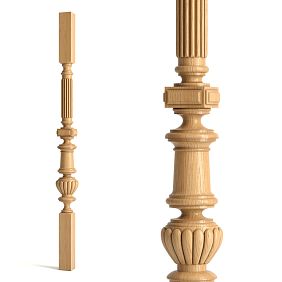
A baluster is a vertical element of a staircase railing, located between the steps and the handrail. The function of a baluster is safety (to prevent falling from the stairs), but in classical architecture, function is secondary, the main thing is aesthetics.
History of balusters: from Italian balustrades to Russian manors
Balusters appeared during the Renaissance in Italy. The balustrade (a railing made of balusters) adorned the terraces of palazzos, balconies, and staircases. The classic Renaissance baluster has a vase-like shape: a narrow base, an expansion in the middle (a sphere or vase), and a narrowing at the top. This shape provides strength (wide middle part) and visual lightness (narrow ends).
In the 17th-18th centuries, balusters became carved. Baroque added plant scrolls, rocaille, acanthus leaves. Classicism simplified the form, returned to geometry, but preserved carved bands. Empire style added military motifs—laurel wreaths, swords, eagles. In Russia, balusters adorned the palaces of St. Petersburg, noble estates, and merchant mansions.
In the 20th century, balusters went out of fashion—modernism, constructivism demanded simplicity. Staircases were made with metal railings, glass, concrete. But in the 21st century, a return occurred: people grew tired of cold minimalism, wanted the warmth of wood, the beauty of carving, the tactility of natural materials.
Types of balusters: turned, carved, turned-and-carved
Turned balusters—created on a lathe. The wood rotates, a cutter removes layers, forming the profile: spheres, bands, cones, vases. Turned balusters are symmetrical, repeatable, relatively inexpensive (machine production). Suitable for neoclassicism, where purity of lines, rhythm, and repeatability are important.
Carved balusters—created by carving (manual or CNC milling). Carving is asymmetrical, unique, complex. Plant motifs (acanthus, grapevines, oak leaves), geometric patterns (meander, rhombuses), animalistic themes (lion masks, griffins).A carved wooden baluster—is a piece product requiring skill, time, but the result is a work of art, turning the staircase into a masterpiece.
Turned-and-carved balusters—a hybrid: the base is turned (symmetrical profile), with carved elements on the surface (ornaments, rosettes, scrolls). Turned-and-carved balusters combine the strength of turned ones (clear geometry, no weak points) and the beauty of carved ones (decorativeness, uniqueness). This is the optimal choice for most classic interiors.
Wood species for balusters
Oak—the king of stair balusters. Density 700 kg/m³, high hardness (3.7 on the Brinell scale), natural resistance to rot. Oak balusters last for centuries (oak staircases from the 17th century have been preserved in European castles). Oak texture is expressive (large pores, rays), color from light (young oak) to dark brown (bog oak). The price of oak balusters is 800-2000 rubles/piece (depends on profile complexity).
Beech—an alternative to oak. Density 680 kg/m³, hardness comparable to oak, but texture is finer, more uniform. Beech balusters are good for painting (texture does not dominate, color is even). Beech is cheaper than oak (600-1500 rubles/baluster), but less resistant to moisture (requires mandatory protection).
Ash—a light-colored wood with contrasting texture (dark and light stripes). Density 700 kg/m³, strength like oak, but ash is more elastic (does not crack from impacts). Ash balusters are suitable for modern interiors (light tone, graphic texture). Price—700-1800 rubles/piece.
Larch—a coniferous wood with high density (650 kg/m³) and natural resistance to moisture. Larch balusters are cheaper than oak (500-1200 rubles/piece), but less decorative (coniferous texture, resin pockets). Suitable for budget projects, porches, terraces (moisture resistance is critical).
Finishing of balusters: oil, varnish, paint, patina
Balusters are supplied sanded, ready for final finishing. Options:
Oil—impregnation of wood with oil (linseed, tung) with natural waxes. Oil emphasizes the texture, makes it more contrasting, protects from moisture, does not create a film (wood breathes). Oil requires renewal every 3-5 years (wipe, apply a new layer). Suitable for interiors where naturalness is important.
Varnish—creating a protective film on the surface. Yacht varnish (alkyd-urethane)—durable, water-resistant, long-lasting. Three to four coats of varnish protect balusters for 10-15 years. Varnish creates gloss or matte (depending on type), emphasizes texture, but the wood does not breathe.
Paint—opaque finish, hiding the texture. White balusters—a classic of French, English interiors. Gray, black, colored—a modern interpretation of classic. Paint is applied over primer, two to three coats, finish matte or semi-matte. Painted balusters are durable (renewal every 10-15 years), but lose the connection with wood (visually they could be made of any material).
Patina is artificial aging. A base coat of paint (white, gray) is applied, followed by a patinating composition (wax with gold, silver, or copper pigment), which is partially wiped off (remaining in the recesses of the carving). This creates an antique effect, as if the balusters have been in use for a century. Patina is suitable for classic, Baroque interiors.
Decorative elements for stairs: more than just balusters
carved wooden decorative elementstransform an ordinary staircase into an artistic object. What to add besides balusters?
Support posts: the columns of the staircase
A support (starting, entry) post is a massive vertical element installed at the beginning of a flight, at turns, and on landings. The post is thicker than a baluster (cross-section 100×100 mm, 120×120 mm) and taller (1100-1400 mm compared to 900-1000 mm for balusters). The post bears load (handrails are attached to it), but its main function is aesthetic, architectural.
Posts for staircaseTypes include:
-
Turned — a classic profile with balls, belts, cones. Suitable for Neoclassicism.
-
Carved — with plant scrolls, acanthus capitals, animal masks. Suitable for Baroque, Empire style.
-
Twisted — the post is twisted in a spiral (a twisted column). Complex lathe work, visually dynamic. Suitable for luxurious interiors.
-
Square with overlays — a straight post with a square cross-section, featuring carved overlays (rosettes, cartouches). Suitable for modern classic style.
The top of the post is finished with a finial — a decorative element (ball, vase, pyramid, carved capital). The finial is the final accent, visible from afar.
Carved overlays on risers
A riser is the vertical plank between steps. Usually smooth and painted. But on grand staircases, risers are decorated with carved overlays — planks sized 150×1000 mm (the width of the step) with carved ornamentation. The overlays create a rhythm repeated on each step, turning the ascent into a visual journey.
Carved brackets under steps
If the staircase is cantilevered (steps are attached to the wall without visible support), a carved bracket — a support protruding from the wall — is mounted under each step. The bracket is functional (it holds the step) but looks decorative (carving with scrolls, leaves). Brackets create the illusion that massive oak steps are floating in the air, supported by elegant carved brackets.
Rosettes on posts and walls
Carved rosettes are round or square overlays with a diameter of 80-150 mm, featuring relief ornamentation (flower, rosette, acanthus). Rosettes are placed on posts (in the center of a square post), on walls along the flight (as accents between moldings), and on risers (in the center of an overlay). Rosettes are small decor, but noticeable, attracting the eye up close.
Polyurethane molding on walls along the staircase flight
The wall along the staircase is a vertical plane 5-6 meters high, 3-4 meters wide. Leaving it empty is a crime against design.Moldings made of polyurethanetransform the wall into an architectural element, creating structure, rhythm, depth.
Horizontal moldings: dividing the wall into tiers
Divide the wall into three horizontal tiers with moldings:
-
Lower tier (from the floor to a height of 100-120 cm) — the plinth zone. Can be painted darker than the upper part or finished with panels.
-
Middle tier (from 120 cm to 2.5-3 m) — the main zone. Here, paintings, mirrors, and sconces are placed.
-
Upper tier (from 3 m to the ceiling) — the frieze zone. Can be painted in a contrasting color or left white.
Horizontal moldings 60-80 mm wide are mounted at the boundaries of the tiers, creating belts parallel to the ascent of the staircase.
Vertical moldings: frames for art
Create vertical frames from moldings (rectangles or squares), repeated every 3-5 steps. Inside the frames — paintings, mirrors, wallpaper with patterns, or simply contrasting paint. The frames create rhythm, upward movement, visually guiding the eye along the staircase.
The width of frame moldings is 40-60 mm, with a simple profile (rectangular cross-section with a bevel). Frames should be proportional: width 60-80 cm, height 100-150 cm (ratio 2:3 or close).
Ceiling cornice along the flight
If the ceiling above the staircase is sloped (following the angle of the flight), the ceiling cornice is mounted along this slope, creating a transition from the wall to the ceiling. The cornice is 100-150 mm wide, with a classic profile (cavettos, beads). The cornice visually completes the wall and makes the ceiling appear higher.
If the ceiling is horizontal (a double-height ceiling at the second-floor level), the cornice is mounted around the perimeter at a height of 5-6 meters. This requires scaffolding or ladders, but the result is impressive—the cornice frames a vast space, creating architectural character.
Wall rosettes and medallions
Polyurethane rosettes with a diameter of 300-500 mm are placed on the wall as accents: above the staircase landing, in the center of a molding frame, on the frieze. Rosettes create focal points, breaking the monotony of the surface. The rosette ornamentation is floral (acanthus, laurel), geometric (circular patterns), or classical (rosettes, palmettes).
Combination of wood and polyurethane: materials that work well together
How to combine wooden balusters and polyurethane moldings so they look cohesive? Through color and style.
Color Harmony
Option 1: White on white. Balusters are painted with white enamel, wall moldings are white, walls are white or light gray. A monochrome scheme creates purity, airiness, and visually expands the space. The accent is on texture (the relief of the baluster carving, molding profiles) and light (play of shadows).
Option 2: Natural wood + white moldings. Balusters and newel posts are natural (oak with oil finish), handrails are natural, treads are natural. Wall moldings are white, walls are light (beige, light gray). The contrast of warm wood and cool white creates balance and depth.
Option 3: Dark wood + gold patina. Balusters are made of dark oak (fumed or stained), newel posts with gold patina. Wall moldings are white with gold patina (gold in the recesses of the profile). Walls are dark (graphite, dark green, burgundy). A luxurious, palatial scheme for spacious homes with high ceilings.
Stylistic unity
The carving ornament of the balusters should match the profile of the moldings. If the balusters have acanthus leaves (Baroque), the moldings should also be Baroque (complex profiles, ornamental bands). If the balusters are simple turned (Neoclassical), the moldings should be simplified (straight lines, minimal details).
Frequently asked questions: staircase without mistakes
How Many Balusters Are Needed for a Staircase?
Standard: two balusters per tread (one at the beginning of the tread, one at the end). For a staircase with 15 treads—30 balusters. You can install one baluster per tread (saves money, but the railing is less frequent, gaps are wider—not suitable if there are children in the house). You can install three balusters per tread (maximum frequency, luxurious, but more expensive).
What height should balusters be?
Standard: railing height (from tread to top of handrail)—900 mm. The height of the baluster depends on the staircase's slope and the method of handrail attachment. Typically, balusters are supplied with a height of 900-1000 mm and are trimmed during installation to the required angle.
Can different baluster models be combined?
Yes, this is a common technique. After every 3-5 regular balusters, one accent baluster (more carved, complex, expensive) is placed. Or two models are alternated (simple-complex-simple-complex). This creates rhythm, variety, and saves budget (fewer accent balusters, which are more expensive).
How much does it cost to decorate a staircase with carved balusters and moldings?
Example: staircase with 15 treads, one flight, wall 4×6 meters.
-
Carved balusters (30 pcs)—1200 rub/pc × 30 = 36000 rub
-
Newel posts (2 pcs)—8000 rub/pc × 2 = 16000 rub
-
Wooden handrails (8 linear meters)—2000 rub/m × 8 = 16000 rub
-
Oak treads (15 pcs)—5000 rub/pc × 15 = 75000 rub
-
Polyurethane wall moldings (60 m)—500 rub/m × 60 = 30000 rub
-
Ceiling rosettes (2 pcs)—3000 rub/pc × 2 = 6000 rub
-
Fasteners, adhesive, finishing—20000 rub
-
Total materials: 199000 rub
-
Labor (staircase installation, moldings, finishing): 150000-250000 rub
-
Total: 349000-449000 rub
Can moldings be installed on a sloped wall along the flight independently?
More difficult than on a horizontal wall. Requires a stable stepladder, precise angled marking (moldings must be parallel to the flight), and precise miter cuts. If you have experience working with moldings—yes, it's possible. If not—it's better to hire professionals (risk of crooked installation, wasting material).
How to care for a wooden staircase with carved balusters?
Wipe with a dry or slightly damp cloth (remove dust). Oil-finished balusters should be refreshed every 3-5 years (wipe, apply a thin layer of oil). Painted balusters can be touched up locally as needed. Stair treads experience wear (abrasion) and may require sanding and refinishing every 10-15 years.
Is it mandatory to paint balusters or can they be left natural?
Natural oil-finished balusters are a classic, highlighting the oak's texture. But they require maintenance. Painted balusters are more practical, suitable for interiors where color is more important than texture (white balusters - French style, gray - Scandinavian, black - modern). The choice depends on the home's style and willingness to perform upkeep.
Conclusion: Create your dream staircase with STAVROS
Wooden staircase with decor— is not just a way to get to the second floor. It's an architectural statement, a symbol of the home, a work that will last for centuries. Carved balusters from solid oak, massive posts with capitals, polished treads, handrails that glide under the hand — all this transforms the staircase into a sculpture. AndMoldings made of polyurethaneon the walls along the flight complete the composition, frame the ascent, create theatricality and grandeur.
Company STAVROS — a leading Russian manufacturer of staircase elements and interior moldings with over twenty years of history. STAVROS creates products for those who understand: the staircase is the heart of a country home, and it deserves the best materials, craftsmanship, and attention to detail.
balusters for staircasesfrom STAVROS — solid oak, beech, ash of class A, turned on modern machines or hand-carved. The catalog features over 50 models: from simple turned (price from 600 rubles/piece) to luxurious carved with acanthus scrolls and animal motifs (price up to 3000 rubles/piece). Each baluster undergoes straightness control (deviation no more than 1 mm per meter), surface smoothness check (sanded with 180-220 grit), and strength testing (withstands a load of 150 kg without deformation).
— more massive vertical elements installed at key structural points and carrying increased load.from STAVROS — turned, carved, twisted, square with overlays. Height from 1000 to 1500 mm, cross-section from 80×80 to 150×150 mm. Posts are equipped with finials (balls, vases, capitals) creating a finished look. Possibility of custom post manufacturing based on your sketches subject to production quantity.
Carved Decorative Elementsfrom STAVROS — riser overlays, rosettes, brackets, cartouches, capitals. All are made from solid oak or beech, undergo hand sanding, and are ready for finishing. Carving is done on CNC machines (relief precision) or by hand (uniqueness, one-of-a-kind).
polyurethane moldingsfrom STAVROS — wall moldings with widths from 30 to 150 mm, ceiling cornices, rosettes with diameters from 300 to 1500 mm, pilasters, coffers. Polyurethane density 300-350 kg/m³, white primer (ready for painting), moisture resistance, frost resistance (can be used in unheated spaces). The range includes over 200 profiles from simple to Baroque.
Staircase kit service: order everything you need from a single source. STAVROS designers will calculate the quantity of balusters, posts, treads, risers, handrails, and moldings for your staircase. You will receive a kit, ready for installation, with instructions, fasteners, and finishing recommendations.
Professional partner crews of STAVROS perform turnkey staircase installation: installation of balusters and posts, mounting of treads, installation of handrails, mounting of moldings on walls, puttying, painting. Work duration for a single-flight staircase — 7-10 days. Material warranty 5 years, workmanship warranty 3 years.
Choosing STAVROS, you choose the quality of natural wood, proven by generations of craftsmen. You choose modern processing technologies that make classic design accessible. You choose a partner who understands: a staircase is not just a structure, but a symbol of the home, its vertical axis, uniting spaces and generations.
Create a staircase that will become a legend of your home. A staircase that your children and grandchildren will ascend. A staircase that guests will photograph, admiring the carving of the balusters and the play of light on the moldings. With the materials and craftsmanship of STAVROS, your dream of a grand staircase becomes reality!


