Article Contents:
- Philosophy of Industrial Chic: When Loft Meets Nature
- Materiality as Value
- Wooden Beam: Architectural Dominance of Industrial Chic
- Sizes and proportions
- Finishing and Texture
- Color and Staining
- Quantity and Rhythm of Beams
- Heavy Furniture Handles: Tactile Accents
- Wooden Handles: Warmth Among Metal
- Metal Handles: Industrial Brutality
- Leather Hinges: Softness in Brutality
- Legs for Tables: Heavy Supports as Sculpture
- Wooden Legs: Brutal Geometry
- Metal Legs: Industrial Classic
- Combining Heavy Legs and Countertops
- Creating a Unified System: From Ceiling to Furniture
- Material unity
- Scaling Consistency
- Unified Finishing
- Color Palette of Industrial Chic
- Base Colors
- Accent Colors: Natural Wood
- Practical Aspects: Installation, Maintenance, Durability
- Installation of Wooden Beams
- Installation of Heavy Legs and Handles
- Caring for Wooden Items in Industrial Style
- Common Mistakes and How to Avoid Them
- Frequently Asked Questions
- Is Industrial Chic Suitable for Small Apartments?
- Can Wooden Beams Be Combined with a Suspended Ceiling?
- What Budget Is Needed to Create an Industrial Interior with Wooden Elements?
- How to Care for Unfinished Steel to Prevent Staining?
- Can wooden beams be painted in bright colors?
- Is it necessary to use real wood, or can imitation be used?
- How long does it take to install wooden beams?
- What mistakes are most commonly made when creating an industrial interior?
- Conclusion: Materiality as a counterpoint to virtuality

Look at a modern interior, and you'll see a paradox: the more technologically advanced the world becomes, the more we yearn for the natural, tangible, material. In 2026, this paradox finds embodiment in an unexpected alliance — industrial aesthetics with natural materials.Wooden beamOn the ceiling, rough, with preserved knots and texture, coexists with concrete and metal, creating a contrast between warm and cold.Furniture HandlesMassive, wooden or metallic, they become not just functional elements, but sculptural accents.Legs for tablesRoughly processed mass contrasts with smooth surfaces, creating visual intrigue. This style is neither cold minimalism nor rustic village charm. It is industrial chic, where the brutality of metal and concrete is softened by the warmth of natural wood, where every detail — from ceiling beams to furniture handles — tells a story of material, craftsmanship, and function.


Philosophy of industrial chic: when loft meets nature
Industrial style was born in the 1950s in New York, when artists and creative people began inhabiting abandoned factories and warehouses, transforming them into living spaces. High ceilings with exposed beams, brick walls, metal structures, large windows — all became aesthetics. But the original loft was harsh, cold, and austere.
In 2026, industrial style has evolved. Retaining its brutality — concrete, metal, exposed structures — it adds warmth from natural wood. Not polished, not lacquered to a shine, but alive, with natural imperfections, visible texture, and history.Wooden beamBecomes the central element of this alliance — an architectural dominant that softens industrial rigidity.
MassiveWooden itemsBeams, furniture legs, handles, countertops — create a visual and tactile contrast with cold materials. This contrast is not conflict, but symbiosis. Wood makes an industrial space inhabitable, human, cozy. Metal and concrete give wood context, emphasizing its organic, natural qualities.




Materiality as value
Industrial chic in 2026 values materiality — the visible presence of material, its texture, weight, tactility. A wooden beam with a 150x200 mm cross-section weighs 25-40 kg per linear meter — this is physically perceptible mass. A massive wooden handle with a 40 mm diameter made of oak feels substantial in the hand. A table on thick wooden legs 100x100 mm appears and feels like a monolith.
In a world where most of our lives occur in virtual screen space, materiality acquires special value. Running a hand over a rough wooden beam, feeling its roughness, natural irregularities — this is a physical anchor, returning us to reality. Gripping a massive wooden handle, feeling its weight, warmth — this is tactile confirmation that the world is material and real.
Our factory also produces:



Wooden beam: architectural dominant of industrial chic
Beams on the ceiling — key element of industrial aesthetics. In original lofts, these were structural beams, actually supporting floors. In modern interiors, decorative beams are more commonly used — they do not carry loads, but create a visual effect of industrialism, structure space, and add character.
Get Consultation
Dimensions and Proportions
A 120x120 mm cross-section — the minimum size for creating an industrial effect. Thinner beams appear as decorative strips, not creating the necessary weight. A 120x120 mm beam is visually significant but does not overwhelm space.
Suitable for rooms with ceilings 2.7-3.0 meters. In a typical apartment of 40-60 sq.m, this is an optimal choice — sufficiently powerful to create an industrial character, but not overwhelming a small space.
A 150x150 mm cross-section — classic industrial size. A massive, weighty beam creating a dramatic effect. Suitable for ceilings 3 meters and higher. In spacious rooms — living rooms of 30-50 sq.m, studio kitchens — beams of this cross-section create proper proportions.
The weight of a 150x150 mm oak beam — about 30 kg per linear meter. A 4-meter beam weighs 120 kg — this requires strong mounting and professional installation. But it is precisely this massiveness that creates credibility, a sense of constructive necessity.
A 180x180 mm and larger cross-section — extreme sizes for rooms with ceilings 3.5-4 meters and higher. Commercial spaces, restaurants, commercial lofts use such beams to create monumentality.
In residential interiors, beams over 180 mm are rare — they require enormous spaces to avoid visually overwhelming. But in homes with double-height living rooms, in suburban residences with high ceilings, such beams create an impressive industrial-rustic character.
Processing and texture
Industrial chic requires rough, natural wood processing. No polishing, no gloss.Wooden beamsThey should look as if they were pulled from an old factory and installed on the ceiling, preserving all traces of time.
Brushing — processing with a metal brush, revealing texture. Soft wood fibers are removed, hard ones remain, creating a relief surface with clearly visible annual rings. A brushed beam is tactilely interesting, visually textured, it catches light, creating shadow play.
Oak, ash, larch — the best species for brushing. They have a pronounced texture with contrasting hard and soft layers. Beech is harder to brush — it has a more uniform structure.
Saved knots, cracks, irregularities — things considered defects in furniture manufacturing, become assets in industrial style. A knot 30-50 mm in diameter, a crack along the growth ring, natural curvature — all of this creates authenticity and the material’s history.
Important: knots and cracks must be stable, not falling out or expanding. Large cracks are filled with epoxy resin (often tinted black for contrast), and knots are secured. This preserves the aesthetic of imperfection while ensuring strength.
Charring (Shou Sugi Ban technique) — a Japanese method of burning wood for protection and decoration. The beam’s surface is charred with a torch until it turns black, then the soft soot is scraped off, leaving a deep black-brown color with enhanced texture.
Charred beams create a dramatic effect — nearly black color contrasts with white or gray ceilings. This is the most industrial, brutal aesthetic. Moreover, charring protects wood from rot and insects — historically, this technique was used precisely for longevity.
Color and Staining
Natural wood color — the most honest choice. Oak (from light brown to medium brown), ash (light with a yellowish tint), larch (reddish). A transparent finish with oil or matte varnish highlights the texture, protects against moisture and dirt.
Natural color creates warmth, organic feel, softens industrial rigidity. A golden-brown oak beam against a gray concrete ceiling — contrast of warm and cool, living and industrial.
Dark stains — dyes or tinting oils in dark brown, wenge, nearly black shades. A dark beam creates graphic contrast and drama. On a white ceiling, a dark beam becomes a clear horizontal line, structuring the space.
Dark beams visually lower the ceiling — if ceilings are very high (over 3.5 m), dark beams make the space feel more intimate and cozy. However, in rooms with 2.7–3.0 m ceilings, dark beams may create a sense of pressure.
Gray stains — trend for 2026. Gray wood — modern, industrial, neutral. Gray beams on light gray or white ceilings create monochromatic elegance. Gray wood pairs well with concrete, steel, glass — key materials of industrial style.
Gray can be achieved through staining (special gray dyes or oils) or patination (creating an artificial patina mimicking weathering).
Number and Rhythm of Beams
One beam — minimalist accent. A single massive beam centered on the ceiling or above a specific zone (above a kitchen island or dining table) creates focus without overwhelming space. Suitable for small rooms where multiple beams would create claustrophobia.
3–5 beams — classic industrial rhythm. Beams run parallel with 80–150 cm spacing, creating rhythmic structure. This is the optimal number for 25–40 sq. m rooms — enough to create an industrial character without being excessive.
The rhythm must be regular — beams evenly spaced. Irregular rhythm creates chaos and disrupts industrial clarity.
7–10 beams and more — dense rhythm for large spaces or dramatic effect. Beams every 60–80 cm create nearly continuous ceiling texture. Suitable for high ceilings (3.5 m and above), where many beams do not feel oppressive.
Frequent beam rhythm visually lowers the ceiling, creates intimacy and coziness. In restaurants and cafes, this creates an intimate atmosphere despite large areas.
Massive furniture handles: tactile accents
If beams — architectural scale of industrial chic, thenFurniture Handles— object-based. Industrial-style handles are not delicate or miniature. They are large, massive, substantial — visual and tactile accents on furniture facades.
Wooden handles: warmth among metal
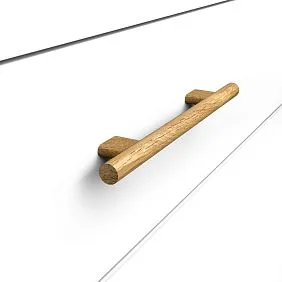
Wooden handles create contrast with industrial surroundings — warmth amid coldness. A massive wooden knob handle 40–50 mm in diameter or a round-sectioned handle 30–40 mm in diameter — this is a serious weight category.
Shape: simple geometry without ornamentation. Cylindrical knobs, round or square handles, sometimes slightly conical (widening toward the base for visual stability). No carved patterns or classical profiles — only pure form, emphasizing the material.
Finishing: rough, emphasizing naturalness. Brushing reveals texture. Light sanding removes splinters but retains a sense of unprocessedness. Matte oil finish protects the wood but does not give gloss.
Knots, cracks, color variation — welcomed. Each handle is unique, with an individual wood grain pattern. This is the opposite of mass production, where all handles are identical.
Color: dark stains (dark oak, wenge, charred wood) create graphic contrast against light facades. Natural wood color — warmth, organic feel. Gray-stained wood — modern restraint.
Combining wooden handles of different shades on one kitchen is acceptable in industrial style — this emphasizes the individuality of each element, highlighting a handmade aesthetic.
Metal handles: industrial brutality
Metal handles — classic of industrial style. But not elegant, polished — rather rough, massive, utilitarian.
Black steel is the main material. Matte black steel (powder coating or anodizing) creates an industrial graphic look. Handles in square or round section, 12-20 mm diameter/side, 160-320 mm long — heavy, substantial.
Black metal is universal — it pairs with any facade color (white, gray, wooden, colored), concrete, brick, wood. It creates clear graphic lines and structures facades.
Unfinished steel — raw metal without coating, naturally forming rust patina. This is the most industrial, authentic aesthetic — metal living its own life, changing over time.
Unfinished steel requires accepting change — handles will rust, form spots and streaks. This is part of the aesthetic. To stabilize rust (so it doesn’t stain hands), a matte lacquer or wax coating is used.
Brass and copper — warm metals creating contrast with cold industrial surroundings. Unfinished brass or copper oxidizes, darkens, forms patina — this creates vintage, time-worn effects.
Brass handles in industrial style — heavy, rough shapes, unpolished. Matte or patinated brass, heavy brackets 15-20 mm in diameter — weight and warmth simultaneously.
Leather hinges: softness in brutality
Leather hinges instead of traditional handles — an unexpected solution in industrial interiors. Rough leather in natural tones (brown, reddish, black) creates tactile softness, contrasting with the hardness of metal and concrete.
Wide leather strips (30-50 mm wide) are attached to facades with two screws, forming a loop for gripping. Leather is tactilely pleasant — warm, soft, with natural texture. Over time, leather darkens, wears, develops a patina of use — this is part of the aesthetic.
Leather handles are especially relevant on wooden facades — the combination of two natural materials creates organic harmony within an industrial environment.
Legs for tables: massive supports as sculpture
Legs for tablesIn industrial style — not delicate, precision elements, but massive supports creating a sense of monumentality and weight.
Wooden legs: brutal geometry
Square or rectangular solid wood legs with cross-sections of 80x80, 100x100, 120x120 mm — serious scale. Such legs suit large dining tables, work tables, kitchen islands.
Finishing: minimal. Straight beam, slightly sanded to remove splinters, but retaining roughness. 2-3 mm chamfer on edges softens sharpness, making legs safer, yet not removing brutality.
Knots, cracks, color unevenness are welcomed. Each leg has an individual character. If using four legs for one table, they may slightly differ — this emphasizes the naturalness of the material.
Color: dark tones create contrast with light countertops. Dark legs visually heavy, grounding, stabilizing. Natural wood color — warmth, organic feel. Gray-toned wood — modernity.
Construction: legs can be simply four beams at the corners of the countertop. Or more complex construction — two massive leg panels at the ends of the table (A-shaped or H-shaped). Such leg panels create sculptural, architectural qualities.
Metal legs: industrial classic
Metal legs — key element of industrial style. Table frame from black steel, profiled pipe, creating constructive clarity.
Square-section profiled pipe 40x40, 50x50, 60x60 mm — main material. Welded construction — four vertical posts connected by horizontal braces. Welds are not ground or hidden — they are part of the aesthetic, demonstrating the construction.
Matte black finish (powder coating) creates graphic effect. Unfinished steel with patina — authentic industrialism.
Constructive solutions:
-
Four straight legs at corners — classic
-
Two trapezoidal frames at table ends — stability, visual lightness (more space under table for legs)
-
X-shaped or A-shaped supports — dynamism, constructive expressiveness
-
One central massive table support from welded pipes — for round or square tables
Combination of wood and metal: vertical wooden posts, horizontal metal connectors. Or metal frame with wooden inserts. Material combination creates visual complexity, dialogue between warm and cold.
Combination of massive legs and countertops
Massive legs require proportionate countertops. A thin 18-mm countertop on 100x100 mm legs looks disproportionate. A thick countertop is needed — minimum 40 mm, preferably 50-60 mm.
Thick wooden top made from solid oak, ash, or larch, 40-60 mm thick — weight, solidity. Such a top weighs 60-100 kg (for a 180x90 cm table) and requires sturdy legs.
Top surface treatment — rough, brushed, with preserved natural imperfections. Edges may be straight (strict geometry) or natural, with bark (maximum naturalness, characteristic of rustic industrial style).
Slab top — longitudinal cut of a whole tree trunk, preserving the natural shape of the edges. A slab 50-80 mm thick on massive legs — this is no longer just a table, but a sculptural object, the focal point.
Creating a unified system: from ceiling to furniture
Industrial chic requires consistency of elements. Ceiling beams, table legs, furniture handles must work in a unified style, creating a visual system.
Material Unity
IfWooden beamsOn a ceiling of dark oak, it is logical to use dark oak for table legs and wooden handles. Unity of species and color creates a natural connection between architectural and object scale.
If beams are gray-toned, furniture may have gray wooden elements or black metal — monochromatic industrial palette.
Scale coordination
Massive beams 150x150 mm require massive table legs — minimum 80x80 mm, preferably 100x100 mm. Large handles — minimum diameter 30-40 mm. Small, delicate elements will create disproportion against massive beams.
Rule: all large-scale elements (beams, legs, handles) must be visually proportional, creating the impression of a unified scale family.
Uniform treatment
If beams are brushed with emphasized texture, legs and handles should also be brushed. If beams are charred, use charred legs or dark-toned handles.
Uniform level of surface roughness — all elements are either rough, emphasized natural, or more restrained with light sanding. Mixing very rough and polished elements creates visual conflict.
Color palette of industrial chic
Industrial chic has a characteristic palette where natural wood plays a key role.
Base colors
Gray — color of concrete, metal, base of industrial palette. Light gray walls, gray concrete floors, gray ceilings create a neutral background.
Black — graphic quality, clarity. Black metal elements (legs, handles, lights), black window frames, black accents structure the space.
White — contrast, light. White walls (painted brick, plaster) brighten industrial space, preventing it from being gloomy.
Accent colors: natural wood
Against a monochromatic gray-black-white palette, natural wood becomes a color accent. Golden-brown oak, reddish larch, warm walnut create warmth, life, organic quality.
Wood should not be everywhere — this would overload and destroy industrial clarity. Accent use — ceiling beams, tabletops, individual furniture elements, table legs — creates the right balance.
Dark wood (dark oak, wenge, charred) works almost like a black accent — graphic with warmth. Light and medium wood — warm contrast to cool palette.
Practical aspects: installation, maintenance, durability
Installation of wooden beams
Massive beams require strong mounting. A 150x150 mm beam 4 meters long weighs 100-120 kg — this is a serious load.
Mounting to concrete ceiling: anchor bolts 10-12 mm in diameter, 100-150 mm long. Minimum two anchors per meter of beam length. For a 4-meter beam — 8-10 mounting points.
Beam is mounted through metal angles or strips, hidden inside the beam or masked with decorative plates. Important: mounting should be inconspicuous or stylistically appropriate (e.g., visible black metal plates with bolts — part of industrial aesthetics).
Mounting to wooden ceiling: strong wood screws 100-150 mm long, screwed through the beam into the joists. Important to hit load-bearing beams, not just the sheathing.
Hollow decorative beams: lightweight, mounted on a wooden beam base attached to the ceiling. The beam-box is slipped over the beam and secured from the inside with screws. Easier to install, lighter, cheaper, but less convincing up close.
Installation of heavy legs and handles
Heavy wooden legs 100x100 mm are mounted to the countertop with strong bolts or screws. Connection via mortise-and-tenon (traditional joinery) or via metal brackets and plates from the inside.
Important: the countertop and legs must be made of the same wood species or compatible (same expansion/contraction with humidity changes), otherwise the connection will loosen over time.
Heavy handles with a diameter of 40-50 mm require strong mounting — bolts with a diameter of 6-8 mm and length of 50-70 mm. For wooden handles — through-bolt mounting with nuts from the inside of the facade.
Care for industrial-style wooden items
Roughly processed wood with natural defects requires minimal but proper care.
Regular cleaning: dry wiping of dust. Brushed surfaces accumulate dust in texture grooves — use a vacuum cleaner with a soft brush or a dry brush.
Wet cleaning: once a month, with slightly damp (not wet!) cloth. Excess moisture is harmful to wood, especially for rough-sawn wood with open pores.
Finish renewal: wood with oil finish requires renewal every 2-4 years (depending on usage intensity). Surface is lightly sanded with fine grit (240-320), cleaned, and fresh oil is applied.
Lacquered wood lasts without renewal for 7-10 years, but if the lacquer is damaged, it requires full re-lacquering.
Accepting changes: industrial aesthetics value the patina of time. Wooden elements will darken, develop scratches and scuffs — these are not defects, but signs of use, part of the aesthetic. Do not strive for perfect condition — imperfection is part of the style.
Common mistakes and how to avoid them
Error 1: Mixing industrial with Provencal or classic styles. Carved handles, turned legs, ornate beams destroy industrial aesthetics. Solution: stick to simple geometric forms and rough processing.
Error 2: Small-scale elements. Thin beams 80x80 mm, elegant legs 40x40 mm, small handles with 20 mm diameter do not create an industrial effect. Solution: enlarge — minimum 120x120 for beams, 80x80 for legs, 30-40 mm for handles.
Error 3: Excessive polishing. Glossy wood and polished metal contradict industrial roughness. Solution: use matte finishes and emphasize natural texture.
Error 4: Lack of contrast. All wood or all metal creates monotony. Solution: combine materials — wooden beams with metal legs, wooden handles against concrete.
Error 5: Ignoring light. Industrial space with dark beams and insufficient lighting becomes gloomy. Solution: plenty of light — large windows, powerful fixtures, light-colored walls.
Frequently asked questions
Is industrial chic suitable for small apartments?
Yes, but with adaptation. Use a lighter palette (white walls, gray tones, light wood), fewer beams (1-3 instead of 5-7), avoid overloading with details. Heavy elements are acceptable, but in moderation.
Can wooden beams be combined with a suspended ceiling?
Technically difficult. Suspended ceiling is a thin film that cannot support beam weight. Possible to mount lightweight hollow beams on a hidden frame before installing the suspended ceiling, but this requires careful planning. Simpler to use a standard ceiling (concrete or drywall).
What budget is needed to create an industrial interior with wooden elements?
Wooden beamSolid oak 150x150 mm — from 4000-6000 rubles per linear meter. For a 30 sq.m. living room with 4 beams of 4 meters each — 64,000-96,000 rubles for beams only.Legs for tablesHeavy 100x100 mm — from 2500-4000 rubles per piece, set of 4 pieces — 10,000-16,000 rubles.Furniture HandlesHeavy — from 500-1500 rubles per piece. Total budget for wooden elements in a 60-80 sq.m. apartment — from 150,000 to 300,000 rubles.
How to care for uncoated steel so it doesn't stain?
Uncoated steel will rust. To stabilize rust (so it doesn't stain hands or clothes) use matte lacquer or special metal patina products. Apply after the metal has reached the desired level of rust. This will fix the process.
Can wooden beams be painted in bright colors?
Technically yes, but this will destroy the industrial aesthetic. Industrial style requires a restrained palette — natural wood, gray tones, black, white. Bright colors are characteristic of pop art, maximalism, eclecticism, but not industrial chic.
Is real wood mandatory or can imitation be used?
For authenticity, better to use real wood or high-quality imitation. Cheap wood-patterned laminate film is immediately visible and destroys the effect. If budget is limited, better to use fewer but quality elements rather than many cheap imitations.
How long does it take to install wooden beams?
For experienced craftsmen, installing one 4-meter beam takes 1-2 hours (marking, drilling, fastening). For a set of 5 beams — 1 working day. But this assumes a pre-prepared ceiling and all necessary tools. Self-installation without experience will take 2-3 times longer.
What mistakes are most commonly made when creating an industrial interior?
Main mistakes: excessive ornamentation (carvings, patterns), small-scale elements, glossy finishes, lack of material contrast, insufficient lighting, mixing styles (industrial with classic or Provence).
Conclusion: Materiality as a counterpoint to virtuality
Industrial chic with natural materials is more than a stylistic choice. It is a philosophical statement in a world striving toward dematerialization.Wooden beamA weight of 30 kg per linear meter — this is physically tangible mass, presence, reality.Massive table legs100x100 mm — this is stability, reliability, groundedness.Large wooden handles— this is tactile contact with the material, with texture, with the warmth of wood.
In an era when most of our lives occur in virtual screen space, where we interact with dematerialized digital objects, physicalWooden itemsattain special value. They bring us back to the material world, reminding us that reality is tangible, weighty, textured.
Industrial chic connects two poles — the cold rationality of industrial production (metal, concrete, sharp geometric forms) and the warm organic nature of natural materials (wood with its texture, natural imperfections, vitality). This union creates spaces where technology does not oppose nature, but complements it. Where brutality is softened by warmth. Where functionality combines with aesthetics.
Company STAVROS has been creatingSolid wood products— which make industrial chic convincing and long-lasting.Wooden beamsof various cross-sections from oak, ash, larch — from classic to roughly processed with bark and knots.Massive table legssquare and rectangular cross-sections, capable of bearing any load and creating monumentality.Large furniture handlesfrom solid stock — buttons, hinges, overlays — of various shapes and sizes.
The possibility of custom manufacturing to your dimensions and requirements means that each element will be exactly as needed for your project. Non-standard beam cross-sections, unique leg heights, individual handle diameters — all of this is achievable. Professional consultants will help select the correct proportions, coordinate elements by color and finish, calculate quantities and costs.
Material quality — solid hardwood stock, natural drying, meticulous processing, durable finishes. Craftsmanship — traditional joinery techniques combined with modern equipment. Variety of choices — from rustic to more restrained modern styles. All of this is STAVROS — a company that understands: industrial chic requires not imitation, but real materials, real craftsmanship, real weight.
Choosing STAVROS, you choose materiality over virtuality, weight over weightlessness, reality over imitation. You choose interiors where wooden beams create architectural structure, massive legs provide table stability, large handles offer tactile comfort. Create spaces where industrial brutality is softened by the warmth of natural wood, where every element — beam, leg, handle — has physical weight, texture, history. Because in the world of digital dematerialization, materiality becomes luxury, a statement, a philosophy. AndSolid wood products — beams, Legs, Handles— are tools for creating real, weighty, materially significant spaces. This is industrial chic in 2026 — where cold and warm, technological and natural create a union that makes interiors not just beautiful, but alive, inhabitable, human.