Article Contents:
- Zoning in modern interior: philosophy and necessity
- Historical context: from closed rooms to open spaces
- Psychology of zoning: territoriality and comfort
- Functional necessity: separation of incompatible areas
- Aesthetic task: creating visual interest
- Wooden slats and panels: vertical boundaries of space
- Slatted partitions: transparent division
- Half-height panels: horizontal division of walls
- Horizontal slats: directing gaze
- Diagonal and shaped solutions: artistic zoning
- Polyurethane moldings: architectural logic of transitions
- Horizontal moldings: boundaries on walls
- Vertical moldings: pilasters and divisions
- Ceiling zoning: boxes and cornices
- Architectural elements: softening boundaries
- Material combination: wholeness through diversity
- Material hierarchy: wood dominates, polyurethane complements
- Color bridges: shades connect zones
- Rhythmic repetitions: motifs transition from zone to zone
- Examples of zoning: specific scenarios
- Living room-dining room: combining social functions
- Bedroom-office: privacy and work in one space
- Kitchen-living room: isolating functions while maintaining visual connection
- Installation and color solutions: practical implementation
- Installation of slatted partitions: precision and reliability
- Installation of wall panels: alignment and mounting
- Installation of polyurethane moldings: ease and neatness
- Color selection: color harmony of zones
- Lighting as a zoning amplifier
- Acoustic aspects: sound absorption and diffusion
- Conclusion: openness through structure

The open layout of modern apartments and houses requires new approaches to organizing space. Solid walls destroy the sense of spaciousness, fragment the house into isolated cells, hinder the circulation of light and air.Decorative PlanksMade of natural wood, they create visual boundaries without physical isolation — sight defines the zone, but light and air pass freely.Wall zoningStructures planes with panels of different heights, colors, textures, marking functional areas.Polyurethane moldingCreates architectural logic of transitions at the boundaries of zones, completing compositions. Combinationof oak panelsandof beech panelswith polyurethane elements creates architecture without partitions — spaces where each zone is clearly defined, yet the overall integrity is preserved, and freedom of layout is combined with functional organization.





Zoning in modern interiors: philosophy and necessity
The concept of zoning evolved from physical division of rooms by walls to visual structuring of open spaces. Understanding this evolution explains the relevance of flexible zoning tools.




Historical context: from closed rooms to open spaces
Traditional architecture before the 20th century was based on the principle of isolated rooms — each function in a separate room with walls, doors, and locks. Dining room, living room, office, bedrooms — all closed, private, protected. This approach reflected the social structure with servants, formal relationships among family members, and the need to demonstrate status through the number of rooms.
The 20th century brought open layouts — a concept where kitchen, dining, and living areas exist in a single space. Modernism, with its ideas of free plan, maximum light, and minimum walls, destroyed the traditional grid-like structure. Practical reasons — cost reduction, space savings. Ideological reasons — democratization of daily life, informal communication, visual simplicity.
The 21st century retains open layouts but adds an understanding of the need for zoning. A completely open 80-square-meter space without structure disorients — where to cook, where to eat, where to rest? Kitchen sounds interfere with movie viewing, living room light wakes sleeping people. Zoning structures openness, making it comfortable, functional, and understandable.
Our factory also produces:


Psychology of zoning: territoriality and comfort
Humans are territorial at an instinctual level — each person needs their own zone, controlled, safe, personalized. In open spaces without zoning, anxiety arises — the absence of boundaries creates a sense of vulnerability. Zoning restores psychological comfort, giving each family member their own territory while preserving the shared space.
A child needs a corner for play — separated but under supervision. An adult’s workspace — concentrated but not fully isolated.Decorative PlanksBetween the living room and children’s zone, they create a visual boundary — parents can see the child, but the child feels privacy in their space. The partition works psychologically with minimal physical presence.
Spatial ritualization is critical for comfort. A place for morning coffee, evening reading, Sunday breakfast. Zoning anchors rituals to specific locations, creating predictability and structure in daily life. The dining area, separated from the living room by wooden panels, becomes a place for family meals — the ritual of gathering around the table is associated with this specific zone.
Get Consultation
Functional necessity: separation of incompatible functions
Some functions are incompatible in one space without zoning. The kitchen generates smells, noise, humidity — all of which should not penetrate the relaxation zone. A workspace requires silence and concentration — impossible with a television on in the same room. A sleeping zone requires privacy and darkness — unattainable in a fully open space.
Zoning isolates incompatible functions with minimal physical barriers.Wall zoningHigh panels between the kitchen and living room delay odors, reduce noise, but do not fully block light. A louvered partition between the bedroom and living room in a studio creates visual privacy — from the sofa, the bed is not visible, yet the space remains unified in perception.
Acoustic zoning is also important. Wooden panels and louvered elements diffuse and partially absorb sound due to the porous structure of natural wood. A television in the living room, separated from the bedroom by a louvered wall, is less audible — sound is diffused and loses direction. Full sound insulation is not achieved, but a 15–25 percent reduction in volume makes coexistence of different modes more comfortable.
Aesthetic task: creating visual interest
Large open spaces without structure are visually dull — empty white walls, flat ceilings, uniform flooring. The eye has nothing to focus on, and the space is perceived as unfinished and temporary. Zoning creates visual complexity, layering, rhythm.
Vertical accents made of wooden louvered panels divide horizontal planes, creating contrast. Panels of different heights on different walls form a hierarchy — tall behind the sofa, medium behind the dining table, low in the entryway.Polyurethane moldingEmphasizes transitions at the boundaries of zones, making them architecturally intentional.
Color zoning enhances the effect. Living room zone with dark oak panels, dining area with light beech, workspace with white polyurethane moldings. The difference in wood color indicates functional distinctions, creating visual variety while maintaining material continuity — wood everywhere, but varying in appearance.
Wooden slats and panels: vertical boundaries of space
Decorative Planksandoak panelsorbeechCreate physical yet permeable boundaries. Their placement, rhythm, and transparency determine the degree of zone isolation.
Slatted partitions: transparent division
Vertical slatted construction from floor to ceiling — the most common tool for zoning open spaces. Slats with cross-sections of 40x40, 50x50, or 40x60 millimeters are installed vertically with a 100–200 millimeter spacing between the lower and upper horizontal rails. The structure is anchored to the floor and ceiling, forming a self-supporting wall without side-wall support.
The transparency of the partition is determined by the ratio of slat width to spacing between them. A 40 mm slat with 80 mm spacing — density 33% (40/(40+80)) — provides high visual isolation. A 40 mm slat with 160 mm spacing — density 20% — makes the partition nearly transparent. For dividing a living room and bedroom, a density of 30–40% is recommended — sufficient privacy while preserving light.
Partition height is critical. Full height from floor to ceiling maximally isolates, but may feel oppressive, especially with dense slat installation. Partial height of 180–220 cm (above human height but below ceiling) creates zoning at eye level, leaving the upper zone open — visually, the space remains unified, functionally divided.
The shape of the partition affects perception. A straight vertical wall clearly divides space into two — left zone, right zone. An angular or L-shaped construction creates a semi-isolated niche — three sides of slats, one open. For a bedroom in a studio, an L-shaped construction provides maximum privacy without full isolation.
Wood for slatted partitions is selected based on durability and aesthetics. Oak is harder, more durable, more prestigious, but darker — a massive dark oak structure visually appears heavy. Beech is lighter, creates a sense of airiness, but requires quality protective treatment. For dry living areas, beech is optimal; for humid areas (kitchen, hallway), oak is more reliable.
Partial-height panels: horizontal division of walls
oak panelsorbeechPanels 100–150 cm high on walls create horizontal zoning — they do not fully divide space, but structure vertical elements. Panels in the dining area at 120 cm height mark this zone without isolating it from the living room.
Differences in panel height across zones enhance zoning. Living room — 150 cm panels behind the sofa and on side walls, creating a framing for the relaxation zone. Dining area — 100 cm panels, less dominant. Hallway — 80 cm panels, practical, protecting walls from dirt. The gradation of height is read as a hierarchy of zones — tall panels in the main zone, medium and low in secondary zones.
Panel color also differentiates. Dark oak panels in the living room create an accent, solidity. Light beech panels in the dining area — lightness, freshness. White or light-gray painted panels in the hallway — practicality, non-staining. Color variety with a single material (wood) maintains zone connection while differentiating them.
Texture adds variety. Smooth, lacquered panels in the living room — elegance, gloss. Brushed, textured panels in the dining area — tactile quality, expressiveness. Slatted (a set of narrow vertical strips) in the hallway — modernity, dynamism. Different textures with the same wood species create visual variety without color chaos.
Horizontal slats: direction of gaze
Horizontally oriented slats on walls create direction, guiding the gaze along the axis. Wide slats 80–120 mm with 30–60 mm spacing (painted wall segment) on the dining area wall create a rhythmic striped structure. Horizontal lines visually expand the zone, making it appear more spacious.
Differences in slat orientation between adjacent zones enhance their distinction. Living room — vertical slats, elongating space upward. Dining area — horizontal, expanding. Perpendicular orientations are perceived as functional differences, creating a visual boundary without a physical barrier.
Transition from vertical to horizontal slats on a single wall creates zoning within a zone. A 4-meter-long wall: left half with vertical slats (TV zone), right half with horizontal (reading zone). Changing direction marks a functional boundary — left side active with moving images, right side calm with books.
Diagonal and shaped solutions: artistic zoning
Diagonal slats at 45 degrees create dynamism, movement, modernity. Diagonal lines visually elongate space, creating an illusion of greater size. For narrow zones — corridors, elongated living rooms — diagonal slat placement compensates for elongation, making space more harmonious.
Shaped compositions of slats — geometric patterns, waves, directional transitions — transform zoning into an art object. A wall between living room and bedroom with slats forming a large geometric ornament — triangles, rhombuses, zigzags. Functionally divides, aesthetically accents, creates uniqueness in interior design.
Execution complexity of shaped solutions is high — numerous angled cuts, precise marking, professional installation. Cost is 2–3 times higher than simple vertical slats. But the result — a unique artwork, transforming utilitarian zoning into decorative paneling.
Polyurethane moldings: architectural logic of transitions
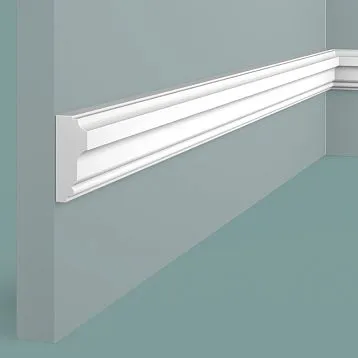
Polyurethane moldingIn zoning, performs the role of architectural framing, creating logic of transitions, completion of compositions, classical order.
Horizontal moldings: boundaries on walls
Horizontal polyurethane molding 6–10 cm wide, running along walls at 100–120 cm height, separates lower from upper zones. If the lower zone in the living room is clad with oak panels, the molding becomes the completion of the panel composition, an architectural boundary. Above the molding, the wall is painted or covered — the transition from wood to paint is logical due to the molding.
In the dining area, the same molding at the same height creates visual connection with the living room — the horizontal line of the molding runs through the entire space, unifying zones. But below the molding in the dining area, there are no panels, but painted walls or wallpaper — difference while maintaining connection at the molding level.
Changing molding height indicates a zone change. Living room — molding at 120 cm. Hallway — at 90 cm (lower, corresponding to lesser zone significance). A 30 cm difference is read as hierarchy — main zone higher, secondary zone lower.
Vertical moldings: pilasters and divisions
Vertical polyurethane pilasters at the corners or boundaries of zones create vertical structure. The corner between the living and dining areas is framed by a pilaster from floor to ceiling, 8-12 cm wide, with a base and capital. The pilaster marks the corner as an architecturally significant element, emphasizing the zone boundary.
Pair of pilasters on both sides of the dining table, extending from floor to ceiling, create a portal framing the dining area. The view interprets the space between the pilasters as a distinct, architecturally defined zone. In classical interiors, pilasters add order; in modern interiors (with simple design without capitals), they provide structure.
Ceiling zoning: boxes and cornices
Ceiling zoning: boxes and moldings
Suspended gypsum ceiling boxes with polyurethane cornices around the perimeter create vertical zoning — each zone has its own ceiling level. The living room’s central ceiling is lowered by 15 cm, while the perimeter remains at the main level. A 12 cm wide polyurethane cornice at the level transition emphasizes the height difference.
The color of polyurethane elements matches the overall palette. White moldings and cornices — a universal solution compatible with any wood tone. Wood-toned elements create monochromatic harmony — oak panels, oak-colored moldings. Contrasting — dark moldings with light beech panels — create graphic clarity and structural definition.
Vertical rails in the living room with a 120 mm spacing. Vertical polyurethane moldings in the dining area with the same 120 mm spacing, forming frames. The rhythm repeats, the material changes — connection through rhythm despite material difference. For perception, this is read as zonal affinity.
Architectural elements: softening boundaries
Rectangular openings between zones are complemented by polyurethane arches, creating classic softness. The 2-meter wide, 2.4-meter high opening between the living and dining areas is framed by a 100 cm radius polyurethane arch. The arch softens the rectangularity, adding classic elegance.
For modern interiors, arches are replaced by rounded corners — 5-10 cm radius instead of a sharp angle. Polyurethane is flexible, can be soaked and bent to the desired radius, creating smooth transitions. Wood is harder to bend, requires steaming; polyurethane solves the problem more simply.
Material combination: wholeness through diversity
Successful zoning combines wood and polyurethane so that material diversity does not destroy unity, but enriches it.
Material hierarchy: wood dominates, polyurethane complements
Basic strategy — natural wood in zones of maximum visual attention, polyurethane in framing, transitions, ceiling decor. Living room — oak panels behind the sofa, beech rails, wooden furniture. Polyurethane moldings frame the panels, ceiling cornice completes the composition. Wood dominates in area and visual mass, polyurethane creates architectural structure.
In the dining area, wood is limited to the table and chairs. Walls are painted with polyurethane moldings forming frames. Ceiling with polyurethane cornice and rose around the chandelier. Polyurethane dominates in finishes, wood in furniture — balance is maintained at the level of the entire space.
Dark oak panels in the living room. Polyurethane moldings, painted in oak tone, in the dining area. The color of wood is repeated in polyurethane, creating visual connection. Light beech rails in the work zone. White polyurethane cornices across the entire ceiling. Gradation from dark oak through light beech to white polyurethane creates a color palette linking zones.
Monochromatic solution — all wood and all polyurethane in one tone (e.g., painted white) — creates color unity with textural diversity. Wood retains visible texture even under paint, polyurethane is smooth. Textural difference marks zones, color unity links them.
Rhythmic repetitions: motifs transition from zone to zone
Vertical rails in the living room with 120 mm spacing. Vertical polyurethane moldings in the dining area with the same 120 mm spacing, forming frames. Rhythm repeats, material changes — connection through rhythm despite material difference. For perception, this is read as kinship between zones.
Vertical rails in the living room with a spacing of 120 millimeters. Vertical polyurethane moldings in the dining area with the same spacing of 120 millimeters, forming frames. The rhythm repeats, the material changes — connection through rhythm despite material difference. For perception, this is read as kinship between zones.
Horizontal division of walls with molding at 110 cm height in all zones. In the living room, below the molding — wood, above — paint. In the dining area, both above and below are painted, but molding at the same height. In the hallway, below — practical dark tone paint, above — light, molding at the same 110 cm. Repeated molding height creates a horizontal connecting line running through the entire space.
Examples of zoning: specific scenarios
Theoretical principles are concretized in real zoning scenarios of typical spaces.
Space 35 square meters, rectangular 7x5 meters, ceilings 2.7 meters. Living room zone 4x5 meters with sofa, chairs, TV. Dining area 3x5 meters with 6-8 person table, buffet. Zoning without physical partitions, preserving unity while indicating functional differences.
35 square meter space, rectangular 7x5 meters, ceiling height 2.7 meters. Living area 4x5 meters with sofa, chairs, TV. Dining area 3x5 meters with a 6-8 person table and buffet. Zoning without physical partitions, preserving unity while indicating functional differences.
Living room: wall behind the sofa clad with oak panels 150 cm high, full wall width. Dark stained oak panels create an accent wall, backdrop for the sofa. White 8 cm wide polyurethane molding frames panels above and on sides. Side walls of the living room painted beige with three vertical polyurethane frames framing pictures.
Dining area: wall behind the buffet painted the same beige. Polyurethane moldings form a 100x80 cm grid of frames — four frames, inside wallpaper with delicate pattern. Buffet oak with polyurethane inlays — connection to living room through furniture material. Table oak, chairs beech with beige upholstery.
Zone boundary: between living and dining areas, polyurethane cornice 10 cm wide, running across the room from wall to wall. Not a full partition, but an architectural element marking the boundary from above. LED lighting beneath the cornice can highlight the boundary.
Floor is unified — oak parquet throughout the space. But in the dining area, a 2.5x2 meter rug under the table creates a tactile boundary, marking the zone. Difference in floor texture (wood in living room, rug in dining area) is perceived as a functional boundary.
Bedroom-office: privacy and work in one space
Bedroom studio 25 square meters, square 5x5 meters, ceiling height 2.8 meters. Sleeping area with a bed requires privacy. Working area with a desk needs concentration and light. Zoning creates both zones while preserving the unity of the room.
Vertical birch slats create lightness, do not press down. Light passes through the gaps, the bedroom does not become a dark hole. But visually isolated — the bed is not in view, privacy is preserved. Inside the sleeping area, the wall behind the headboard is clad with birch panels 120 cm high — tactile warmth, soft texture.
Working area: corner by the window with maximum natural light. L-shaped oak desk occupying the corner. Walls behind the desk are painted light gray — neutral background, non-distracting. Polyurethane moldings form a frame around the desk — horizontal molding 80 cm high on two walls, vertical on the sides. The frame defines the work zone, structuring the walls.
Transition zone: space between sleeping and working areas — 2 meters — remains open. Different flooring — parquet in the working area, carpet in the sleeping area — tactile boundary. Ceiling is one white, but above the sleeping area, recessed warm lights (for evening relaxation), above the working area — neutral (for concentration). Light difference marks zones from above.
Kitchen-living room: functional isolation while maintaining visual connection
Space 40 square meters, rectangular 8x5 meters, ceiling height 2.6 meters. Kitchen 3x5 meters with cabinetry, working zone. Living room 5x5 meters with sofa, TV. Problem — kitchen smells and noise should not dominate the living room. Zoning isolates functionally while preserving visually.
Bar counter as physical boundary: counter 110 cm high, 50 cm wide, 2.5 meters long separates kitchen from living room. Working surface from the kitchen side, seating area for bar stools from the living room side. Oak countertop on polyurethane base (polyurethane legs, stained to match oak, weighing 30 kg vs 80 kg oak).
Vertical slats above the counter: from countertop to ceiling, vertical birch slats 40x40 mm with 80 mm spacing, 150 cm long (from 110 cm counter to 260 cm ceiling). Slats partially block view of kitchen from living room, hold back odors, reduce noise. But do not fully isolate — 33% permeability preserves visual connection.
Ceiling zoning: suspended ceiling lowered 20 cm over kitchen, built-in spotlights for working lighting. Polyurethane cornice 8 cm wide around lowered section. Over living room, main ceiling level, chandelier in center, polyurethane rose 70 cm diameter. Difference in ceiling levels enhances zoning, creates architectural logic.
Color differentiation: kitchen — cabinets with glossy white fronts (practicality, light reflection, visual expansion of compact space). Living room — dark oak panels behind TV, furniture with wooden elements. Contrast between light kitchen and dark living room marks functional difference, creates dynamism.
Installation and color solutions: practical implementation
Zoning theory materializes through quality installation and thoughtful color selection.
Installation of slat partitions: precision and reliability
Base of slat partition — top and bottom guides, between which vertical slats are mounted. Guides — 50x50 mm beams of the same wood species as slats, or MDF. Bottom guide is mounted to floor with screws spaced 40-50 cm apart. Top guide is mounted to ceiling similarly. Important — guides must be strictly parallel, distance between them constant, otherwise slats will be unevenly long and partition will lean.
Slats are inserted into grooves in guides or secured with screws/clamps. Groove 15-20 mm deep is milled into guides at spacing matching slat spacing. Slat is inserted into lower groove, tilted, inserted into upper groove, aligned. Fixed with glue in grooves. Method provides perfectly clean surface without visible fasteners.
Screwing slats into guides — simpler but less aesthetic method. Screw is inserted at an angle through end of slat into guide. Screw head is recessed, covered with wooden plug or left visible (acceptable for loft style). Faster than milling grooves, but screw points are visible.
Finish of slats is done before or after installation. Before — simpler, each slat is treated separately, but ends in grooves remain untreated. After — more complex, but all surfaces including ends are treated. Oil is applied with brush, excess wiped off. Lacquer is sprayed or applied with roller. For residential spaces, oil finish is preferable — breathable, tactile warmth, easily renewable.
Installation of wall panels: alignment and mounting
Wooden panels are mounted on 40x40 mm beam grid or directly on flat walls with adhesive. Grid is preferable — compensates wall irregularities, creates air gap preventing condensation. Beams are mounted horizontally with 50-60 cm spacing, aligned to one plane with shims.
Panels are mounted to grid with screws, nails, or clamps. For visible surfaces, hidden clamp mounting is preferable. For panels behind furniture, where fasteners are not visible, screws are simpler. Adhesive mounting without grid — panel is glued with mounting adhesive to flat wall. Faster, but requires perfectly flat wall, removal is difficult.
Different panel heights in different zones require precise marking. Laser level projects horizontal lines on all walls — lines marking top of panels in each zone. Grid is mounted up to these lines. Panels are cut to size and mounted. Panel tops are perfectly horizontal along laser line in all zones — critical for perceived neatness.
Installation of polyurethane moldings: ease and neatness
Polyurethane moldings are glued with polyurethane-specific adhesive or acrylic mounting adhesive. Surface is cleaned and degreased. Adhesive is applied to back of molding with zigzag or stripes. Molding is pressed against wall per marking, secured with painter’s tape until set (24 hours). Light moldings hold with glue, heavy ones (width over 12 cm) are additionally secured with finish nails.
Corners are mitered at 45 degrees using miter saw. Precision of cutting is critical — gaps in corners are unacceptable and noticeable. Joints are filled with acrylic putty, sanded, and painted together with molding. Well-treated joint is invisible after painting.
Molding painting is done after installation and puttying. Priming improves adhesion. Two to three coats of acrylic paint with roller on flat surfaces, with brush on textured surfaces. Color matches overall palette — white is universal, wood tone for monochrome, contrasting for graphic accents.
Color selection: color harmony of zones
Monochromatic strategy — all wood of one species and tone, all polyurethane one color. Light birch in all zones, white polyurethane. Simplicity, consistency, calmness. Optimal for Scandinavian and minimalist interiors. Zoning through difference in panel height, slat direction, element density, not through color.
Gradient strategy — wood color darkens from zone to zone. Entryway — light birch. Living room — medium oak. Office — dark stained oak. Gradation creates hierarchy, movement from entry into the house. Polyurethane one color (white) links zones despite wood variation.
Gradient strategy — wood color darkens from zone to zone. Entryway — light beech. Living room — medium oak. Office — dark stained oak. Gradation creates hierarchy, movement from entrance into the house. Polyurethane of uniform color (white) connects zones despite differing wood.
Contrast strategy - dark and light wood in adjacent zones. Living room - dark oak panels. Dining area - light beech. Contrast highlights functional difference, creates dynamism. Polyurethane can be neutral (white) or enhance contrast (dark in living room, white in dining area).
Accent strategy - main wood of one tone, another tone as accent in one zone. Entire house light beech, office dark oak. Office stands out by color, marked as a special zone - place of concentration and seriousness, contrasting with the rest of the light airy space. Polyurethane white everywhere for unity.
Textural strategy - one species, different treatment in zones. Oak in all zones. Living room - smooth lacquered finish. Dining area - brushed relief. Office - stained dark with visible texture preserved. Same species creates material continuity, different treatment marks zones. Polyurethane adapts to each zone - smooth in living room, ornate in dining area, simple in office.
Lighting as a zoning enhancer
Different color temperatures in zones intensify their distinction. Living room - warm light 2700K creates coziness, invites relaxation. Dining area - neutral 3500K shows food in natural colors, creates alertness. Work zone - cool 4500K stimulates concentration, energizes. Transition between zones is accompanied by light color change - subconscious interprets this as a shift in functional mode.
Lighting brightness also differentiates. Living room - dimmed soft light for relaxation. Dining area - bright accent above table. Work zone - maximum brightness on table. Dimmers allow adjusting brightness, adapting to time of day and activity. Evening - all zones dimmed, morning - work zone bright, others medium, day - natural light dominates, artificial off.
Direction of light reveals wood texture, polyurethane relief. Spotlights angled 30-45 degrees along slat partition cast long shadows from each slat - structure revealed maximally. Diffused overhead light creates soft short shadows - structure read delicately. Combination creates variable perception throughout the day.
Backlighting behind wooden panels or slats - hidden LED strip - creates floating effect. Panels visually detach from wall, slats glow from within. For zoning, this enhances visual effect - backlit slat partition becomes a luminous object, active interior element, not passive wall.
Acoustic aspects: sound absorption and diffusion
Wooden slats and panels improve room acoustics through sound diffusion on multiple surfaces. Slat partition between living room and bedroom diffuses TV sound - instead of reflecting off flat wall, sound passes through gaps, reflects off slats at different angles, loses directionality. Noise reduction of 10-15 decibels makes coexistence of different modes more comfortable.
Slat partition density affects sound absorption. Density 40-50% (wide slats, small spacing) gives maximum noise reduction - 15-20 decibels. Density 20-30% (narrow slats, large spacing) gives 5-10 decibels. For critical cases - bedroom next to living room - dense partition, for decorative zoning - sparse.
Sound-absorbing materials behind slats enhance effect. Acoustic foam 30-50mm thick, placed on wall behind slat partition, absorbs sound passing through gaps. Visually invisible due to slats, functionally effective - noise reduction down to 25-30 decibels. For studios where zoning must ensure acoustic isolation, combination of slats and foam is optimal.
Polyurethane elements are acoustically neutral - neither absorb nor amplify sound. Their role in zoning is visual, not acoustic. But textured polyurethane surfaces diffuse sound better than smooth ones - ornate moldings create multiple reflective surfaces at different angles, preventing echo.
Conclusion: openness through structure
Zoningdecorative slatsandoak panelsorbeech, supplemented bypolyurethane moldingscreates architecture without partitions - spaces where each zone is functionally defined, visually marked, yet integrity preserved. Light circulates freely, air is not blocked, view penetrates through structures, sense of spaciousness remains.
Wall zoningWooden panels of different heights create vertical hierarchy - main zones with high panels, secondary with low ones. Slat partitions form physical yet permeable boundaries - privacy achieved while maintaining visual connection. Polyurethane moldings frame, structure, create architectural logic of transitions.
Material combination enriches space with textural variety while preserving material continuity through natural wood. Color strategies - monochromatic, gradient, contrast, accent - provide tools for creating desired character. Lighting enhances zoning through differences in color temperature, brightness, and light direction in different zones.
Practical implementation requires precise installation - straight slat partition guides, horizontal panel top lines, neat polyurethane molding joints. But technologies are accessible - framing, self-tapping screws, adhesive, basic tools. For simple vertical partitions, DIY installation is feasible; for complex shaped compositions, professionals are necessary.
Durability of wooden and polyurethane zoning elements is high. Oak slats and panels serve for decades, restored by sanding and re-finishing. Polyurethane moldings retain shape and color without maintenance. Investment in quality zoning pays off through years of comfortable living in structured yet open space.
Zoning evolves with family life. Child zone, separated by slats, becomes teenage, then guest zone over years. Slat partition easily dismantles, relocates, modifies. Flexibility of zoning - its advantage over solid walls. Space adapts to changing needs without radical reconstruction.
Psychological comfort of zoned space exceeds that of monolithic open space. Each family member has their zone while maintaining sense of shared home. Visual boundaries work at subconscious level - territoriality satisfied, anxiety reduced. Functional organization frees from constant decision-making - each zone has purpose, habits become fixed to places.
Aesthetic pleasure from zoned spaces exceeds that from empty rooms. Rhythm of slats, wood texture, polyurethane molding relief create visual richness, layering, objects for contemplation. Space is not dull - there is much to observe, to delight the eye daily.
Create architecture without partitions, where openness does not contradict structure, freedom connects with organization, spaciousness complements privacy. Wooden slats and panels, polyurethane moldings - tools transforming empty space into zoned composition, each with its character, all together forming a whole home. Your space deserves such thoughtfulness, such harmony of function and form.