












































































Article Contents:
- Archaeology of meanings: what patterns tell about humanity
- First symbols at the dawn of civilization
- Sacred geometry in everyday life
- Cultural geography of ornament: patterns as passport of civilization
- Eastern refinement versus Western geometry
- Slavic motifs: connection with nature
- Material embodiment of the ideal: technologies of pattern creation
- Tree as a living carrier of information
- From sketch to masterpiece: modern creation process
- Psychology of perception: how patterns influence consciousness
- Neuroaesthetics of decorative forms
- Color symbolism in ornament
- Stylistic paradigms: patterns in the context of epochs
- Classicism: triumph of reason and order
- Modernism: nature as a source of inspiration
- Minimalism: beauty of simplicity
- Technological evolution: from handcraft to digital production
- Traditional methods: craftsmanship of generations
- Digital revolution in ornament
- Functional aesthetics: practical application of patterns
- Furniture decoration: from utility to art
- Architectural ornament: dialogue with space
- Production philosophy: quality versus quantity
- Mass production: democratization of beauty
- Individual approach: return to roots
- Cultural memory in modern context
- Preservation of traditions in the digital age
- Globalization versus local identity
- Ecological Ethics in Decorative Arts
- Sustainable Development and Beauty
- Second Life of Materials
- Economics of Beauty: Investment Attractiveness of Ornament
- Added Value of Decoration
- Investments in Longevity
- Future of Ornament: Forecasts and Trends
- Digital Art and Virtual Reality
- Biotechnology in Decorative Arts
- Frequently Asked Questions
- Conclusion: STAVROS — Keeper of Traditions and Innovator of Modernity
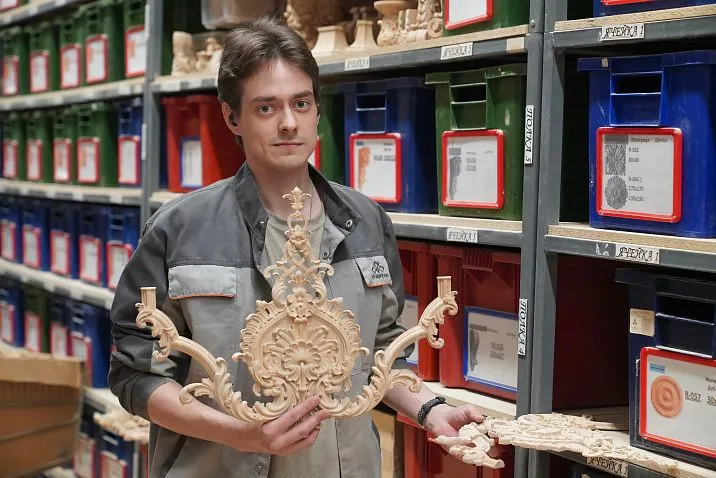
Is there a language understandable to all peoples and cultures without translation? Absolutely. It is the language of patterns — the oldest form of human self-expression, permeating millennia and linking modernity with the origins of civilization. Decorative ornaments patterns are not merely aesthetic elements of interior design, but encoded messages, symbols reflecting deep archetypes of human consciousness.
Why, looking at a spiral, do we feel the movement of time? Why does a geometric rhombus evoke a sense of stability, while a plant motif conveys life energy? The secret lies in the fact that patterns are not merely beautiful images, but a universal code written into our genetic memory. Every line, every curve carries information about the structure of the world, about the connection between humans and nature, about eternal laws of harmony.
In the era of digital technologies and artificial intelligence, it is especially important not to lose touch with this ancient language of beauty. Modern wooden patterns decoration interior become a bridge between the past and the future, between tradition and innovation, between soul and mind.






Archaeology of Meaning: What Do Patterns Tell Us About Humanity
Our factory also produces:


First Symbols at the Dawn of Civilization
When a primitive human first drew rhythmic strokes on a cave wall, he created not merely decoration — he laid the foundations of symbolic thinking. Archaeological findings show: patterns appeared before writing, before agriculture, before metallurgy. They were the first way for humans to organize the chaos of the surrounding world.
The spiral — one of the oldest symbols — represented the cyclicity of time, seasonal changes, movement of celestial bodies. The zigzag symbolized lightning, water, life energy. The circle embodied the sun, the moon, the idea of infinity. These basic elements, combined with each other, created complex compositions telling about the cosmogonic beliefs of ancient peoples.
Modern decorative inlays for furniture preserve this connection with original meanings. Plant ornaments still symbolize life force, geometric ones — order and stability. Choosing a particular pattern for one’s home, we unconsciously turn to the deepest archetypes.
Get Consultation
Sacred Geometry in Everyday Life
What do Gothic cathedrals, Persian carpets, and carved wooden ornaments have in common? All of them adhere to the laws of sacred geometry — a system of proportions considered to reflect divine order. The golden ratio, Fibonacci sequence, regular polygons — these mathematical principles lie at the foundation of the most beautiful patterns in the world.
Ancient masters intuitively felt these proportions, creating ornaments that still mesmerize with their harmony. Modern science has confirmed: the human eye and brain are tuned to perceive certain mathematical ratios as beautiful and harmonious.
Cultural Geography of Ornament: Patterns as a Passport of Civilization
Eastern Refinement versus Western Geometry
Each culture created its own unique language of patterns. Islamic art, restricted by religious canons from depicting living beings, achieved incredible heights in abstract ornamentation. Arabesque — an infinitely developing plant pattern — symbolizes the unity and infinity of divine creation.
Chinese and Japanese ornaments differ in philosophical depth. Each element carries symbolic meaning: dragon — imperial power, phoenix — rebirth, chrysanthemum — nobility, bamboo — resilience. The combination of these elements creates complex semantic compositions.
European decorative art underwent a long evolution from strict geometric ornaments of the Romanesque style to lavish floral compositions of the Baroque. Carved wooden decoration Distinguished by rational construction, clear forms, and mathematical precision of proportions.
Slavic motifs: connection with nature
Slavic ornamental tradition is unique in its closeness to nature. There are no abstract symbols — each element has a specific natural prototype. Birch leaves, pine branches, field flowers, river waves — all surrounding nature found reflection in decorative art.
The peculiarity of Slavic patterns is their emotional richness. If Eastern ornaments are meditative, and Western ones are rational, Slavic ones are emotional and soulful. They tell stories, convey moods, create atmospheres.
Material embodiment of the ideal: technologies for creating patterns
Wood as a living carrier of information
Why exactly wood became the ideal material for embodying patterns? The answer lies in the very nature of this material. Wood is alive — it breathes, changes over time, reacts to the environment. A pattern carved into wood gains additional life force.
Each type of wood has its own character. Oak — strong and majestic — is ideal for monumental compositions. Lime — soft and pliable — allows creating delicate details. Beech — dense and uniform — ensures clear lines. Material choice becomes part of the artistic concept.
Modern woodworking technologies have opened incredible possibilities. High-precision milling machines reproduce the most complex ornaments with micron accuracy. Laser cutting allows creating intricate compositions of unimaginable complexity. But technology is merely a tool. The soul of the pattern still comes from the master.
From sketch to masterpiece: modern creation process
How is a modern decorative pattern born? The process begins with studying historical analogs, analyzing symbolic meanings, understanding cultural context. The designer does not copy old patterns but creatively reinterprets them, adapting them to modern realities.
Computer modeling allows seeing the future pattern within the interior context even before its creation. 3D visualization helps assess proportions, select scale, calculate interaction with surrounding elements. But the final decision always remains with the human — their taste, intuition, understanding of beauty.
Psychology of perception: how patterns influence consciousness
Neuroaesthetics of decorative forms
Modern brain science has revealed amazing patterns of pattern perception. Certain ornamental structures activate specific brain zones, trigger specific emotional reactions, influence a person's psychophysical state.
Repetitive rhythmic elements soothe the nervous system, similar to meditative practices. Spiral forms stimulate creative thinking. Vertical lines create a sense of upward movement, horizontal lines — stability and calm. This is not mysticism, but scientifically proven facts.
Decorative ornaments patterns In interiors, they function as sorts of psychological programs, tuning consciousness to a certain mood. Choosing an ornament for one's home is practically programming one's own emotional state.
Color symbolism in ornament
The color of a pattern is no less important than its form. Each color has its own psychological characteristic, symbolic meaning, and effect on consciousness. Red activates, blue calms, green harmonizes, yellow stimulates intellectual activity.
In traditional cultures, color symbolism was strictly regulated. Certain color combinations could be used only by members of specific social groups. Violating the color code was considered a serious offense.
Modern design is freer in choosing color solutions, but basic psychological patterns remain unchanged. decorative elements for furniture They must not only look beautiful, but also create the proper emotional impact.
Stylistic paradigms: patterns in the context of epochs
Classicism: triumph of reason and order
Classical ornament is based on principles of ancient art: symmetry, proportionality, mathematical precision. There is no room for chance — each element has its strictly defined place within the overall composition.
Main motifs of classical ornament: palmettes, rosettes, meanders, acanthus, laurel wreaths. Each symbol has deep semantic meaning. Palmette symbolizes the tree of life, rosette — the sun, meander — eternity, acanthus — overcoming difficulties, laurel wreath — victory.
Classical Inlays for furniture Create an atmosphere of solemnity and respectability. They are suitable for prestigious interiors where it is important to emphasize the owner's status and good taste.
Modern: nature as a source of inspiration
The modern style revolutionized decorative art, abandoning the copying of historical motifs and turning to living nature. Curves of branches, flower petals, insect silhouettes became the basis for creating fundamentally new ornamental forms.
A feature of modernism is asymmetry as a deliberate artistic technique. While classical patterns are strictly symmetrical, modernist compositions imitate the natural asymmetry of organic forms. This creates a sense of movement, growth, and development.
Modern floral ornaments differ from classical ones in greater naturalism. Here you can identify specific plant species, guess the season, feel the breeze. Decorative ornaments patterns In the modern style, interiors are transformed into blooming gardens.
Minimalism: the beauty of simplicity
The minimalist approach to ornamentation may seem paradoxical — how can one decorate while rejecting decoration? But this is precisely the philosophy of minimalism: to find beauty in simplicity, expressiveness in conciseness, richness in the scarcity of means.
Minimalist patterns are based on the simplest geometric forms: lines, circles, squares. But it is precisely this simplicity that makes each element significant. There is no room for randomness — every line is precisely calibrated, every angle calculated.
In minimalism, special attention is paid to the quality of execution. A simple form does not forgive imperfections — any inaccuracy immediately stands out. This requires the highest level of craftsmanship from the artisans.
Technological evolution: from handcraft to digital production
Traditional methods: craftsmanship of generations
For thousands of years, patterns were created exclusively by hand. Master carvers spent years mastering their craft, studying traditional motifs, developing their personal style. Each item was unique, bearing the imprint of the creator's individuality.
Handcrafted work has a special energy. Modern buyers are willing to pay premium prices for hand-made items, valuing their uniqueness and soulfulness. In the age of mass production, handmade objects become especially valuable.
But hand production has limitations: high cost, long manufacturing times, dependence on the skill of a specific artisan. Not everyone can afford to order a unique carved item.
Digital revolution in ornamentation
The advent of computer numerical control machines fundamentally changed the situation. Now, even the most complex patterns can be reproduced with absolute precision in any quantity. This made high-quality decoration accessible to a broad range of consumers.
Modern technologies allow creating ornaments that could not be executed by hand. Multi-level compositions with variable relief depth, incredibly complex lace-like structures, perfectly calculated mathematical ornaments — all of this has become reality.
3D printing opens up even more fantastic possibilities. You can create patterns that exist only in virtual space, materialize mathematical formulas into physical objects, experiment with impossible forms.
Functional aesthetics: practical application of patterns
Furniture decoration: from utility to art
Furniture is not just utilitarian items, but an important part of a person's living space. Carved wooden elements transform ordinary cabinets or chests into works of art, making each item unique and memorable.
The functional purpose of furniture determines the character of decoration. A bedroom requires calm, soothing ornaments. An office — strict, emphasizing seriousness and professionalism. A child's room — cheerful, playful, stimulating imagination.
The modern approach to furniture decoration implies harmony between form and function. The pattern should not interfere with the item's intended use. Decorative elements are placed to highlight the furniture's structural features, not to conceal them.
Architectural ornament: dialogue with space
Architectural ornaments perform more complex tasks than furniture ones. They must not only decorate a building but also solve compositional tasks: highlight the main elements, unify disparate components, create rhythm, scale space.
The placement of ornaments on the facade follows strict rules of architectural composition. Horizontal elements emphasize the building's length, vertical elements — its height. Corner decorative elements mark the boundaries of volumes, creating transitions between planes.
Interior ornaments work more subtly. They create an intimate atmosphere, emphasize the purpose of rooms, form an emotional backdrop. Decor for Molding can radically change the perception of space, making it grand or cozy, formal or homey.
Production philosophy: quality versus quantity
Mass production: democratization of beauty
Modern mass-production technologies have made decorative elements accessible to a broad range of consumers. What was once a privilege of the aristocracy is now affordable to the middle class. This is an undeniable progress — beauty must be democratized.
Standardized production ensures stable quality, predictable delivery times, reasonable prices. The consumer can choose an appropriate ornament from a catalog and receive it in the shortest possible time. This is convenient and practical.
But mass production has its downside — loss of individuality. When the same ornament is reproduced in thousands of copies, it loses its uniqueness and becomes banal. There is a danger of uniformity, standardization of beauty.
Individual approach: returning to the roots
Growing demand for individual solutions compels manufacturers to seek a balance between mass production and uniqueness. Modern technologies allow creating custom items without significant cost increases.
Parametric design allows creating variations of basic ornaments, adapting them to specific customer requirements. The same motif can be executed in different scales, levels of detail, and proportions.
Customization has become a new trend in decorative art. Consumers want not just beautiful things, but things that reflect their individuality, tell their personal story, and create a unique atmosphere.
Cultural memory in the modern context
Preserving traditions in the digital age
How to preserve traditional ornamental motifs in the age of globalization and digitalization? This is one of the most important tasks of modern decorative art. Simply copying historical samples leads to museumification, while creative reinterpretation risks losing authenticity.
The optimal path is the synthesis of tradition and innovation. Modern masters study historical ornaments not for blind imitation, but to understand the principles of their construction. Mastering these principles allows creating new ornaments in the spirit of tradition, yet meeting modern aesthetic needs.
Digital technologies help in studying and preserving ornamental heritage. Museums create digital archives, researchers analyze pattern structures using computer programs, and designers use neural networks to generate new ornamental compositions.
Globalization versus local identity
Globalization erases cultural boundaries, creating a unified global space. On one hand, this enriches the palette of available ornamental motifs — designers can freely combine elements from different cultures. On the other hand, there is a danger of losing national identity.
Decorative ornaments patterns becomes a way to preserve cultural memory. Choosing ornaments linked to one’s native culture allows people to emphasize their belonging to a particular tradition and maintain a connection to their roots.
The modern trend is not rejecting the global in favor of the local, but harmoniously combining them. An interior can include elements from various cultures, unified by a common aesthetic concept. This creates a rich, multi-layered atmosphere.
Ecological ethics in decorative art
Sustainable development and beauty
Modern society is increasingly thinking about the ecological consequences of its activities. This applies to decorative art as well. How to create beauty without harming nature? How to make the production of ornamental elements ecologically responsible?
Using renewable materials is one way to solve this problem. Wood, when managed properly, is an ecologically clean and renewable resource. It is important to choose wood from certified forests where responsible forestry practices are carried out.
The longevity of products is another important aspect of ecological responsibility. High-quality decorative elements serve for decades, without requiring replacement. This reduces resource consumption and decreases waste.
Second life of materials
Modern recycling technologies open new opportunities for ecologically responsible production. Wood processing waste can be recycled into composite materials, sawdust is used to produce fuel briquettes, and old furniture is dismantled into parts for creating new items.
Restoration and renovation of historical ornaments is another way to extend the life of materials. Antique carved elements can be restored and used in new projects, combining historical value with modern functionality.
Economics of beauty: investment attractiveness of ornament
Added value of decoration
Decorative elements radically change the perception and cost of items. A simple wooden cabinet adorned with quality ornamentation may cost several times more than a similar item without decoration. At the same time, material costs increase only slightly — the main added value comes from design and craftsmanship.
This makes the production of decorative elements an attractive business. Small workshops can compete with large factories by offering unique, handmade items. Handicraft production is experiencing a revival precisely due to the high added value of decorative elements.
Investments in durability
Quality decorative elements are a long-term investment. They serve for decades without losing their aesthetic appeal. Moreover, over time they may acquire additional value as antique or vintage items.
Furniture and interiors adorned with quality ornamentation retain their value better when resold. Buyers are willing to pay extra for beauty and uniqueness. This makes investments in decorative elements not only aesthetically, but also economically justified.
The future of ornament: forecasts and trends
Digital art and virtual reality
The development of digital technologies opens new horizons for ornamental art. Virtual and augmented reality allow creating ornaments that change over time, react to human presence, and interact with the surrounding environment.
Imagine a pattern on the wall that changes color depending on the time of day, or an ornament that comes alive as a person approaches. This is not science fiction — such technologies already exist and are gradually being integrated into practice.
Artificial intelligence can generate an infinite number of ornamental variations by analyzing user preferences and creating personalized decorative solutions. Machine learning allows computers to study historical ornaments and create new ones in the same style.
Biotechnology in decorative art
The development of biotechnology may revolutionize the production of decorative materials. Today, scientists already grow wood in laboratory conditions, create biodegradable plastics, and develop materials with programmable properties.
In the future, we will be able to grow decorative elements like we grow plants. Materials will self-organize into required shapes, self-repair upon damage, and adapt to changing conditions.
Frequently asked questions
How to choose the right ornament for a specific interior?
Choosing an ornament should consider the interior style, room size, functional purpose, and personal preferences. Traditional plant and geometric motifs suit classic interiors. Modern styles require more minimalist solutions. It is important to maintain proportions — large ornaments are suitable for large spaces, small ones for compact spaces.
Can ornaments from different cultural traditions be combined?
Yes, eclectic solutions can be very expressive, but require a professional approach. It is important to find a unifying element — color, scale, execution style. It is better to use no more than two or three ornamental traditions in one space to avoid chaos.
How to care for carved decorative elements?
Wooden ornaments require careful maintenance. Regular dry cleaning with soft brushes removes dust from recessed areas. Wet cleaning should be done carefully, using slightly damp cloth. It is recommended to periodically treat items with special compositions to protect the wood.
Do ornaments affect the perception of a room's size?
Absolutely. Horizontal ornaments visually expand space, vertical ones increase height. Small, regular patterns can make a room appear larger, large ones — smaller. Light ornaments on a dark background expand space, dark ones on a light background — narrow it.
Can an ornament be ordered according to a custom design?
Modern technologies allow manufacturing unique ornaments according to custom sketches. The cost of such items is higher than mass-produced ones, but not critical. It is important to provide a quality sketch or detailed technical specification.
How long do modern decorative elements last?
Quality wooden decorative elements, with proper care, last for decades. Polyurethane items are even more durable — they do not fear moisture, do not crack, do not lose shape. Service life largely depends on usage conditions and manufacturing quality.
Are there ornaments that never go out of fashion?
Classic plant and geometric motifs, based on natural forms and mathematical patterns, are practically timeless. They may change stylistically, but their basic principles remain unchanged. Fashion mainly concerns the ways of interpretation, not the motifs themselves.
How do ornaments affect property value?
Well-executed decor generally increases property value. Unique interiors are in demand in the luxury housing market. However, it is important to maintain moderation — overly specific decor may limit the pool of potential buyers.
Conclusion: STAVROS — keeper of traditions and innovator of modernity
In a world where beauty is often sacrificed for functionality, and uniqueness is standardized, it is especially important to find a company that understands the true value of decorative art. The company STAVROS has remained faithful to its mission of creating genuinely beautiful things for many years — things that not only adorn space, but also enrich the human soul.
The philosophy of STAVROS is based on a deep understanding of cultural traditions and bold use of modern technologies. We do not merely produce decorative elements — we create connecting threads between the past and the future, between craftsmanship and art, between function and beauty.
Our team includes art historians studying historical ornaments, designers creating modern interpretations of classical motifs, technologists bringing the boldest ideas to life in material, and artisans who pour their soul into every piece.
STAVROS's production facility is equipped with the most modern equipment, enabling us to create decorative elements of any complexity with unparalleled quality. At the same time, we never forget that technology is merely a tool, and true value is bestowed upon the item by the craftsmanship and love for beauty invested in it.
Each project for us is an opportunity to tell a unique story through the language of ornament. We help our clients create interiors that reflect their individuality, highlight their status, and create an atmosphere of harmony and beauty.
Choosing STAVROS means choosing not just decorative elements, but fragments of cultural heritage adapted to modern realities. Our products will not only adorn your home, but also become an investment in beauty that will delight you and your descendants for many years.


