Article Contents:
- Comprehensive Approach: The House as a Unified Work of Art
- Unified Stylistic Language: From Gable to Porch
- Materials and Technologies: Quality Proven Over Time
- Color Harmony: Accents and Nuances
- Facade Elements: The Face of Your Home
- Gable: The Crown of Architectural Composition
- Window Casings: Framing Windows as an Art
- Pilasters: Vertical Accents of the Facade
- Corbels: Function and Beauty
- Facade Corner Elements: Decorating Building Edges
- Entrance Group: Portal to Your World
- Sundial: Protection and Decoration
- Carved Door: When the Entrance is a Work of Art
- Door Overlays: Simple Update
- Porch: The Stage Before the Entrance
- Terrace and Veranda: Open Spaces with Character
- Balusters: Rhythm and Safety
- Railings: Where Function Meets Beauty
- Carved Columns: Verticals Defining Space
- Unified Stylistic Language Inside and Out
- Materials and Care: Durability of Decor
- Choosing Wood Species
- Protective Wood Treatment
- Installation Considering Wood Movement
- Conclusion: When the House Tells Your Story
- Start Small, Create Gradually
- Draw Inspiration from Traditions, Create Modernity
- Frequently Asked Questions About Private Home Decor
- Your Home is Your Creation
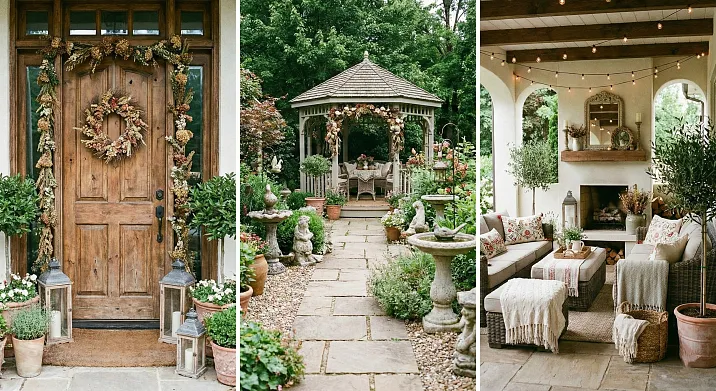
There are houses you cannot pass without stopping. Your gaze catches on a carved gable, glides over elegant window casings, lingers on the massive balusters of the terrace. Such houses tell a story—about the owners' taste, about traditions, about how beauty is created through details.decorative home ornaments— it's not an extravagance, but the language of architecture through which a building converses with its surroundings.
Why do two houses with identical layouts feel completely different? One looks bland, like a box with windows. The other attracts, captivates, and is memorable. The difference is in the details.Decorating the house facade gable with decorative elements, a carved entrance group, and turned veranda posts transform a standard structure into a work of architectural art. And this doesn't require rebuilding the house from scratch—just adding the right accents.


Comprehensive approach: the house as a unified work
A common mistake is to decorate a house piecemeal, without an overall plan. You bought beautiful window trims—installed them. A year later, you decided to build a carved porch—made it in a different style. Then you added balusters to the terrace—and again, they didn't match. The result is an eclectic hodgepodge where each detail is good on its own, but together they fail to create harmony.
The correct approach is comprehensive. Even at the design stage (or before starting to decorate a finished house), a unified concept needs to be developed: choose a style, define key decorative elements, create a system of proportions. Only then will the facade, entrance group, terrace, and interior spaces be perceived as parts of a whole.




Unified stylistic language: from pediment to porch
Style is not just an aesthetic category. It's a system of rules defining the form, proportions, and ornamentation of decorative elements. A Russian terem and an English cottage use completely different details—and mixing them creates visual dissonance.
The Russian style employs carved window trims with floral and geometric patterns, bargeboards with solar symbols, towel-shaped pediments, and twisted or carved porch posts. The color palette is bright: red, blue, green, gold. Forms are flowing, fluid, with an abundance of small details.
Classical European style uses the order system: pilasters with capitals, cornices with modillions, pediments over windows and doors, balustrades with turned balusters. Ornamentation is restrained: acanthus leaves, meanders, rosettes. Colors are calm: white, beige, terracotta. Forms are strict, symmetrical, proportionally precise.
Scandinavian style leans towards simplicity: laconic trims with minimal carving, straight posts with facets, simple railings without extravagance. Wood retains its natural texture or is painted white, gray, dark brown. Forms are geometric, clear, without excessive decoration.
Choosing a style gives you a template that simplifies the selection of each element. All details must correspond to it—then the house will gain integrity.
Our factory also produces:


Materials and Technologies: Quality Proven Over Time
The second aspect of a comprehensive approach is the unity of materials. Wooden trims, polyurethane pilasters, a gypsum pediment—such a combination looks chaotic. Materials conflict, each with its own texture, response to light, and aging process.
The ideal option for a private house is natural wood for all decorative elements. Wood is a living material with texture, warmth, and the ability to age gracefully. Oak trims, beech balusters, and pine pediments will acquire a patina over 20 years, becoming even more expressive.
But wood requires maintenance. In climates with sharp temperature and humidity fluctuations, with heavy precipitation, wooden facade decor needs protection: impregnation with antiseptics, coating with varnish or paint, regular renewal of the coating. This is an investment of time and money.
An alternative is modern composite materials: high-density polyurethane, fiber-reinforced concrete, polymer concrete. They imitate wood or stone but lack the capriciousness of natural materials. Polyurethane trims don't rot, crack, or require painting. Fiber-reinforced concrete consoles withstand any frost without damage.
But there's a nuance: artificial materials lack the aura that natural wood provides. From a distance of 5-10 meters, the difference is unnoticeable. Up close—it's obvious. For the main facade, entrance group, where guests approach closely, wood is better. For elements viewed from afar (pediment, second-floor cornices), composites are suitable.
Get Consultation
Color harmony: accents and nuances
The third component of a comprehensive approach is the color scheme. Even elements perfectly matched in style and material can ruin harmony with incorrect coloring.
A classic technique is the contrast between the facade and decor. Light walls (white, cream, light gray) and dark wooden elements (brown, graphite, black). Or vice versa: dark walls and white decor. Contrast emphasizes details, making them graphic and expressive.
A nuanced technique is painting the decor to match the walls or with a slight deviation. Beige walls and milky-white decor. Gray walls and light-gray decor. This solution creates softness, delicacy, elegance. Details don't shout, they whisper.
An accent technique is bright coloring of individual elements. White facade, brown trims, red pediment. Or gray facade, white decor, blue balusters. Accents make the house memorable but require impeccable taste—it's easy to overload and slip into kitsch.
General rule: no more than three main colors on the facade. Primary color (walls), secondary (most decor), accent (individual details). This triad creates balance.
Facade elements: the face of your house
The facade is what's visible from the street, what the house is judged by as a whole. Skillful facade decoration transforms a standard box into an architectural object worthy of attention.
Pediment: the crown of the architectural composition
The pediment is the triangular or curvilinear part of the facade bounded by roof slopes. In classical architecture, the pediment crowned temples, signifying their sacredness. In residential architecture, the pediment serves the same function—it completes the building, creates a visual peak, attracts the eye.
A simple blank pediment is a missed opportunity. The huge triangular plane remains empty, bland.Decorating the house facade gable with decorative elements transforms it into the dominant feature of the facade.
Carved pediment framing is the most spectacular way of decoration. A carved board (bargeboard) with floral or geometric patterns is installed along the pediment's perimeter. The lower part of the pediment (the triangle's tip) is adorned with a hanging carved board (towel), creating a vertical accent. The center of the pediment may feature a rosette, cartouche, or coat of arms—a central decorative element.
Openwork pediment — a more complex solution. Here the carving is not applied, but through-cut: the ornament is carved into the board, creating a lace-like pattern. The sky or the wall behind the pediment shows through the openwork, creating an effect of lightness and airiness. Openwork pediments are characteristic of Russian wooden architecture — they adorned terems (traditional towers), merchants' mansions, and manor houses.
Pediment with a small pediment (pediment with a pedimentette) — a technique of classical architecture. On the main pediment, above the entrance or central window, a smaller pediment (a pedimentette or pedimented hood) is arranged, which creates an additional rhythm and emphasizes the center of the composition. The small pediment can be triangular, semicircular, or broken (with a break in the center for inserting a decorative element).
The dimensions of pediment decoration must correspond to the scale of the building. A house 6 meters high requires prichelins (decorative boards) 200-300 mm wide, towels (pendants) 1000-1500 mm long. A house 10 meters high — prichelins 300-400 mm, towels 1500-2000 mm. Details that are too small will get lost; those too large will overwhelm the proportions.
Window surrounds (nalichniki): framing windows as an art
Windows without surrounds look like slits in the wall — technologically necessary but aesthetically neutral. Surrounds turn the window into an architectural element that participates in the facade composition on par with doors and cornices.
Simple surrounds consist of four planks (two vertical, upper and lower horizontal) framing the window opening. The planks can be smooth or profiled (with coves, chamfers, beads). The profile creates a play of light and shadow, making the surround more three-dimensional.
Carved surrounds — a more complex variant. An ornament is carved onto the planks: geometric (diamonds, triangles, zigzags), floral (leaves, flowers, grapevines), zoomorphic (birds, dragons, mythical creatures). The carving can be flat (the pattern is recessed by 3-5 mm), relief (the pattern protrudes by 10-20 mm), or through-cut (the background is cut out completely).
Surround with a kokoshnik (pedimented top) — a characteristic detail of the Russian style. The upper part of the surround is made in the form of a semicircular, keel-shaped, or multi-lobed kokoshnik, reminiscent of a traditional women's headdress. The kokoshnik is decorated with carving, creating a lush crown above the window.
Surround with a pedimented hood (sundrik) — a technique of classical architecture. Above the window, on brackets or corbels, a small cornice (pedimented hood or sundrik) is installed, which protects the window from precipitation and creates architectural expressiveness. The hood can be straight, triangular, or segmental (in the shape of an arch).
Installing surrounds requires precision. Vertical planks must be strictly vertical (checked with a plumb line or level), horizontal ones — horizontal. The corners where planks join are mitered at 45° for a tight fit. Fastening is done with galvanized nails or screws with countersunk heads and subsequent puttying.
Pilasters: vertical accents of the facade
A pilaster is a flat vertical projection on a wall, imitating a column. It divides the facade plane into parts, creates a vertical rhythm, and gives the building architectural definition.pilasters— an element of classical architecture that is adapted to modern private houses.
The structure of a pilaster includes three parts: the base (lower expanded part), the shaft (main vertical part), and the capital (upper decorated part). The proportions of these parts are determined by the order system: Doric, Ionic, Corinthian. Each order has its own rules — capital height, base profile, shaft decoration.
Smooth pilasters have an even shaft without decorations. This is a minimalist option, suitable for modern facades where the strictness of lines is important. A smooth pilaster establishes verticality, structures the facade, but does not overload it with decoration.
Fluted pilasters have a shaft with vertical grooves (flutes). The number of flutes ranges from 8 to 24, depth — 10-20 mm. Flutes create a play of light and shadow, visually elongate the pilaster, making it more slender. This is a classical technique, characteristic of Greek and Roman architecture.
Carved pilasters are decorated with ornament along the entire height of the shaft or in separate zones. The ornament can be floral (twining stems with leaves and flowers), geometric (meander, interlace), or anthropomorphic (figures of atlantes or caryatids). Carved pilasters are a choice for luxurious facades in Baroque or Empire style.
Installing pilasters on a facade requires secure fastening. The base is attached to the plinth with anchor bolts. The shaft is fixed to the wall via metal brackets placed at 1/3 and 2/3 of the shaft's height. The capital is attached to the shaft and additionally fixed to the wall. All fastening points are concealed by decorative elements.
Corbels: function and beauty
A corbel is a projecting element supporting a cornice, balcony, or bay window. Structurally, the corbel works in bending, transferring the load from the overhang to the wall. But besides its structural function, the corbel performs a decorative one — it adorns the facade, creates volume, and emphasizes significant elements.
Simple corbels have the shape of a triangular or trapezoidal bracket. This is a minimalist solution where form is determined by function. Simple corbels suit modern facades where the purity of lines without excessive decoration is important.
Profiled corbels have an S-shaped or volute-shaped profile. The curved form creates visual lightness, turning the corbel from a mere support into a decorative element. Profiled corbels are characteristic of classical and Baroque facades.
Carved corbels are decorated with ornament: acanthus leaves, rosettes, scrolls, mascaron (faces of people or mythical creatures). Carving turns the corbel into a miniature sculpture that attracts attention, becoming a focal point of the facade. Carved corbels are a choice for luxurious mansions where decorativeness is more important than functionality.
The size of a corbel is determined by the size of the overhang it supports. For a cornice with a 400 mm overhang, the corbel should project from the wall by 300-350 mm (the remaining 50-100 mm is a safety margin). The height of the corbel is usually equal to or slightly greater than its projection, ensuring visual balance.
Facade corner elements: designing building edges
Building corners — areas that often go unnoticed. Yet it is precisely the corners that define the geometry of the volume, emphasize the three-dimensionality of the building, and create the edges that organize the perception of form.Facade Corner Elementsturn an inconspicuous line where two planes meet into an architectural accent.
Rusticated corners — a classical technique borrowed from stone architecture. Vertical elements imitating large stone blocks (rustication) are installed on the building corner. The blocks can be smooth or with a relief texture, with chamfers or without. Rustication creates an impression of massiveness and solidity, turning a wooden or plastered house into a semblance of a stone castle.
Pilasters on corners — a lighter solution. Instead of massive rustication, two pilasters are installed, turned 90° to each other. They frame the corner, create a vertical accent, and link the two facade planes into a single whole. Corner pilasters must be proportional to the other pilasters on the facade and have the same bases and capitals.
Applied corner boards — the simplest design option. Two boards 100-200 mm wide are applied to the corner, joined at a right angle. The boards can be smooth, profiled, or carved. This technique is characteristic of Scandinavian and North American architecture, where functionality and conciseness are valued.
Carved corner posts — a solution for houses in the Russian style. A massive carved post with a square or polygonal cross-section is installed at the corner, running from the plinth to the cornice. The post is decorated with carvings along its entire height or in specific zones. Such a post not only decorates the corner — it becomes a support (real or visual) for the entire building.
Entrance group: a portal to your world
The front door is the boundary between the outside world and your personal space. It is the first thing guests touch. It is what you pass through to return home every day. The design of the entrance group deserves special attention — here, decor does not just adorn; it creates an entry ritual, transforming a functional door into a portal.
Pediment: protection and decoration
A pediment is a horizontal protruding element above a door (or window) that serves a dual function: protective and decorative. The protruding cornice protects the door from rain and snow, prevents water from running down the door leaf, and stops ice from forming on the threshold. At the same time, the pediment decorates the entrance group, making it architecturally expressive.
A simple straight pediment is a horizontal board on brackets, protruding 300-600 mm above the door. The board can be smooth or profiled, with or without a soffit underneath. This is a functional solution suitable for modern minimalist facades.
A triangular pediment (small gable) is a classic option reminiscent of an ancient temple. A miniature gable is constructed above the door on two columns or pilasters. The triangle of the gable can be solid or decorated with carvings, a cartouche, or a coat of arms. Such a pediment transforms the entrance into a ceremonial portal.
A segmental pediment has the shape of an arc (a segment of a circle). This is a softer form compared to a triangle, creating a sense of hospitality and openness. Segmental pediments are characteristic of Baroque architecture, where curved lines were preferred.
A broken pediment is a more complex variant where the triangular or segmental gable has a break in the center. A decorative element is inserted into this break: a vase, urn, cartouche, coat of arms, or sculpture. A broken pediment is a sign of luxury, characteristic of palace architecture.
The pediment's structure must ensure reliable attachment to the wall and effective water drainage. The pediment's base consists of a wooden or metal frame anchored to the wall. The frame is clad with decorative boards forming the cornice. The lower plane of the pediment must have a slope of 2-3° away from the wall for water runoff. The front edge is equipped with a drip edge — a projection from which water drips down without flowing back toward the wall.
Carved door: when the entrance is a work of art
The door leaf is the central element of the entrance group, and its decoration deserves special attention. A simple smooth door is a missed opportunity to create an effect. A carved door transforms the entrance into a work of applied art.
A paneled door with carvings is a classic solution. The door consists of a frame (stiles and rails) and panels inserted into it. The panels can be flat with applied carvings or three-dimensional with relief carvings. Carving motifs are varied: plant ornaments, geometric patterns, heraldic symbols, scenes from mythology.
A fully carved door is a more complex and expensive option. The entire surface of the door is covered with carvings, creating a continuous carpet of ornament. Such doors are made from massive boards 60-80 mm thick, in which a relief 20-40 mm deep is carved. The weight of such a door is significant (80-150 kg), requiring reinforced hinges and a robust door frame.
An openwork door with through-carving is an exotic option for southern regions or for interior doors where thermal insulation is not required. The ornament is carved all the way through, creating a lace-like pattern. Behind the openwork door, an inner solid door or grille is usually installed to ensure security.
A door with glazing and carvings is a compromise between decorativeness and functionality. The central part of the door is glazed (plain or stained glass), and the framing is made of carved wood. Glazing provides natural light to the hallway; carvings ensure decorativeness.
Making a carved door is a labor-intensive process requiring high skill from the craftsman and time (from several weeks to several months). But the result justifies the investment — such a door serves for decades without losing value and can be passed down as a family heirloom.
Door overlays: a simple update
If replacing the entire door is not in the plans or budget, you can update the existing door with overlays — decorative elements that are attached to a smooth leaf, imitating a paneled or carved door.
Applied panels are frames made of profiled strips that are glued or screwed onto the door, creating an imitation of a classic paneled construction. Inside the frames, the door remains smooth or is covered with veneer, film, or painted in a contrasting color.
Carved overlays are three-dimensional elements (rosettes, cartouches, plant motifs) that are attached to the door in the center of panels or as independent accents. Even a few small overlays radically change the perception of the door, transforming it from utilitarian to decorative.
Moldings and trims are narrow profiled strips that are glued onto the door, creating frames, geometric patterns, and ornaments. Complex compositions can be assembled from moldings, achieving the effect of an expensive door at minimal cost.
Installing overlays is simple: the door surface is degreased, the overlay is coated with adhesive (carpenter's PVA for wood, construction adhesive for polyurethane), pressed into place, and fixed with weights or clamps during the setting time. After the adhesive dries, the overlays can be additionally secured with finishing nails (thin headless nails driven flush and filled).
Porch: the stage before the entrance
The porch is the intermediate zone between the ground and the door, a platform where a person pauses before entering. An architecturally competent porch is not just a few steps, but a composition of a platform, steps, railings, and a canopy that creates the solemnity of the entrance.
The size of the porch is determined by its function. The minimum platform is 1.5×1.5 meters, sufficient to open the door and enter. A comfortable platform is 2×2 meters or more, where several people can stand, benches can be placed, and flower pots can be arranged.
Porch steps should be comfortable for climbing. The optimal step height is 150-170 mm, depth is 300-350 mm. These proportions correspond to a person's natural stride, making the ascent comfortable. The number of steps should be odd (3, 5, 7) to start and end the ascent with the same foot.
Porch railings provide safety and simultaneously decorate the entrance. The railing height is 900-1000 mm, corresponding to the level of an adult's hand support. The structure includes posts (supporting vertical elements), balusters (filling between posts), and a handrail (the top horizontal part held onto).
A canopy over the porch protects from precipitation and sun, creating architectural completeness. The canopy can rest on posts, consoles, or be suspended from the wall on rods. The canopy's shape — single-pitched, gabled, hipped, or domed — should harmonize with the shape of the main building's roof.
Terrace and veranda: open spaces with character
Terraces and verandas are transitional zones between the house and the garden, where the boundary between interior and exterior blurs. Here, decorative elements must withstand atmospheric influences (like exterior ones) and create coziness (like interior ones).
Balusters: Rhythm and Safety
Balusters are the vertical posts of a terrace or veranda railing that fill the space between support posts. In addition to their safety function (preventing falls), balusters create visual rhythm, define the style of the space, and filter the view (protecting from prying eyes without completely blocking the vista).
Turned balusters are a classic option. On a lathe, a square-section blank is turned into a round-section piece with alternating thickenings and thinnings, beads, and coves. The shape can be strictly geometric or more free-form, organic. Turned balusters are characteristic of classical and colonial styles.
Carved balusters are adorned with three-dimensional carving: floral motifs, geometric patterns, animal figures. The carving can cover the entire height of the baluster or be concentrated in specific zones (the upper and lower thirds). Carved balusters are the choice for luxurious terraces in the style of a Russian terem or an Eastern palace.
Flat balusters are a budget option, where boards installed on edge are used instead of turned or carved elements. The boards can be smooth, profiled along the edges, or decorated with cut-out patterns. Despite their simplicity, flat balusters can look elegant with proper profiling and painting.
Combined balusters combine wood with other materials: metal, glass, rope. For example, wooden posts with steel cables stretched between them create a modern industrial look. Wooden posts with glass inserts provide safety without obstructing the view.
The spacing of balusters (the distance between adjacent elements) is determined by safety requirements and aesthetics. Building codes require that a 100 mm diameter sphere cannot pass between balusters (to protect children from falling). The aesthetically optimal spacing is 100-150 mm, which creates a rhythmic fill without overloading the space.
Handrails: Where Function Meets Beauty
The handrail (railing) is the top horizontal element of the guardrail, which one holds onto when moving along the terrace or stairs. In addition to its support function, the handrail crowns the guardrail, creating a horizontal line that ties the vertical elements into a unified whole.
The handrail's cross-section should fit comfortably in the hand. Optimal dimensions: width 60-80 mm, height 40-50 mm, with rounded top edges. A handrail that is too thin is uncomfortable to hold, one that is too thick is impossible to grip.
The handrail profile can be rectangular with chamfers, oval, or shaped. A shaped profile with coves and beads creates a play of light and shadow, making the handrail a decorative element. But it is important that the decorative aspect does not compromise function—the hand should slide along the handrail freely, without catching on protrusions.
Handrail joints at corners and connections are made with miter joints (at a 45° angle) with glue and reinforcement using dowels or metal inserts. A well-executed joint is invisible even upon close inspection—the handrail looks like a continuous element running along the entire perimeter of the terrace.
Handrail attachment to posts is done via hidden fasteners: metal plates recessed into the wood, or wooden tenons with glue. Visible fasteners (screws, bolts) are acceptable only in rustic styles, where the roughness of the construction is part of the aesthetic.
Carved Posts: Verticals Defining Space
The support posts of a terrace or veranda are not just structural elements supporting the roof. They are vertical dominants that organize the space, set the rhythm, and create architectural expressiveness.
Simple square posts with a cross-section of 150×150 or 200×200 mm are a minimalist solution for modern terraces. Posts can be smooth or with chamfered edges. The strict geometry is emphasized by painting: monochromatic or with contrasting highlighting of the edges.
Turned posts with a thickening in the lower third and tapering towards the top create visual stability, reminiscent of classical columns. Transitions between thickenings and tapers are decorated with beads, coves, and fillets, creating rhythm and plasticity.
Carved posts are covered with three-dimensional or openwork carving along their entire height or in specific zones. Carving subjects: floral motifs (climbing stems, leaves, flowers), geometric patterns (braids, diamonds, meanders), zoomorphic images (birds, dragons, bears), anthropomorphic figures (atlases, caryatids).
Posts with capitals are an option borrowed from classical architecture. The upper part of the post is decorated with a capital—an expanded decorative element that serves as a transition from the post to the roof beam. The capital can be simple (an abacus—a square slab) or complex (with volutes, acanthus leaves, rosettes).
Installing posts requires a solid foundation. The base of the post (the lower 300-500 mm) is either embedded in the concrete base of the terrace or attached to it via a metal shoe—a steel plate with a bolt cast into the concrete and a socket for the post. The shoe lifts the wood 20-30 mm above the surface, preventing contact with water and rot.
A Unified Stylistic Language Inside and Out
A terrace or veranda is a transitional zone, and its design should link the interior of the house with the exterior. The decorative elements of the terrace should echo both the exterior details (window surrounds, pediment) and the interior ones (stairs, doors, furniture).
If the house facade is decorated with carved window surrounds with a floral pattern, the terrace balusters should use the same ornamental motif. If turned balusters of a specific profile are used in the interior staircase, the terrace balusters should repeat that profile.
The color palette of the terrace should be an extension of the facade palette. If the window surrounds are painted dark brown and the walls beige, it is logical to make the terrace posts dark brown and the balusters and handrail beige or white.
Materials should also be coordinated. If the facade is finished with wood, the terrace should also be wooden. A combination of a wooden facade and a plastic terrace looks alien, disrupting the integrity of the house's perception.
This principle of unity extends to all zones of the house: from the pediment to the porch, from the window surrounds to the balusters. When all elements are subordinated to a single concept, the house is perceived as a work created by one author (even if physically it was built by different craftsmen at different times).
Materials and Maintenance: The Durability of Decoration
Exterior decoration and elements of open spaces (terraces, verandas) are exposed to harsh conditions: temperature fluctuations, humidity, ultraviolet radiation, mechanical impacts. The durability of the decoration depends on the correct choice of material and its maintenance.
Wood species selection
Oak is the king of exterior decoration. Its dense structure (density 700-800 kg/m³), high tannin content, and natural resistance to rot make oak ideal for exterior applications. Oak window surrounds, posts, and balusters last 50-70 years without replacement with minimal maintenance.
Larch is the best coniferous species for facades. Larch wood contains natural antiseptics that prevent rot and repel insects. Its density is comparable to oak (650-750 kg/m³), and it has high hardness. Larch darkens over time, acquiring a noble gray-brown hue.
Pine is a budget option that requires mandatory protective treatment. Without protection, pine on a facade lasts 10-15 years before it begins to rot, become affected by fungi, and crack. With quality impregnation and regular coating renewal, its service life increases to 30-40 years.
Exotic species (teak, iroko, merbau) possess outstanding durability due to their high oil and resin content. However, their high cost and processing complexity limit their use to custom items: carved doors, unique posts, exclusive elements.
Protective wood treatment
Even durable species require protection. Wood on a facade is exposed to moisture, sun, temperature fluctuations, and biological factors (fungi, insects). Comprehensive protection includes several stages.
Antiseptic impregnation protects against fungi, mold, and insects. Modern antiseptics penetrate wood to a depth of 3-5 mm, creating a protective barrier. Impregnation is performed before installing elements, in two to three layers with intermediate drying.
Priming creates a base for the finish coating, evens out the wood's absorbency, and improves paint or varnish adhesion. Primer is applied after the antiseptic has completely dried, in one to two layers.
The finish coating protects against moisture, UV radiation, and mechanical damage. Coating options:
Glaze (a tinting composition) penetrates the wood, colors it, but preserves the visibility of the grain. Oil- or wax-based glazes provide deep impregnation, a water-repellent effect, and a natural appearance. They require renewal every 3-5 years.
Paint creates an opaque coating that completely hides the wood grain. Modern acrylate facade paints form an elastic film that breathes (allows water vapor from inside to pass through but blocks water from outside), and does not crack due to wood deformation. The coating's service life is 7-10 years.
Varnish creates a transparent protective coating that emphasizes the wood grain. Yacht varnishes with a polyurethane base offer maximum resistance to atmospheric influences and can last 5-7 years without renewal.
Installation considering wood movement
Wood is a living material that changes geometry with humidity fluctuations. Annual humidity changes in facade wood range from 12-15% in summer to 18-22% in winter. This causes dimensional changes: swelling when moistened and shrinkage when dried.
Proper installation accounts for this movement. Long elements (trim, cornices, handrails) should not be rigidly fastened along their entire length. Fastening is done at several points allowing for longitudinal displacement. For example, a 2-meter trim is fastened at three points: rigidly in the middle (this point is fixed) and with a gap at the ends (here the trim can shift 3-5 mm with humidity changes).
Ends of components are the most vulnerable spots where moisture penetrates wood most intensively. Ends require particularly thorough treatment: impregnation in two layers, primer, and finish coating in two layers. Some craftsmen use special wax compounds to seal ends.
Joints between elements should be made so that water does not seep inside. Horizontal joints (e.g., between trim and pediment) are made with an overlap: the upper element overlaps the lower one by 10-20 mm, allowing water to run off the surface without entering the seam. Vertical joints are sealed with elastic sealants that compensate for wood movement.
Conclusion: When a house tells your story
A house without decorative ornaments is function without soul. A house with thoughtful, harmonious decor is a statement, a manifesto, a self-portrait of the owner. Every detail, from a carved pediment to turned terrace balusters, says something about who lives here: about their taste, their values, their understanding of beauty.
decorative home ornaments— is an investment not only in aesthetics but also in property value. A house with quality wooden decor is valued on the market 15-25% higher than a similar house without decor. Buyers are willing to pay for beauty, uniqueness, and the feeling of home created by well-chosen details.
But most importantly, decor creates an emotional connection with the home. Returning each evening, you see not a faceless box but your creation. The carved trim you personally selected. The entrance group with a pediment whose design you discussed with the craftsman. The terrace with balusters whose installation you supervised. This house is not just a roof over your head. It is your space, rich with meaning.
A comprehensive approach is key to harmony. Do not collect elements haphazardly, do not mechanically copy others' solutions. Develop a concept that matches your taste and the house's style. Select elements that work together, creating unity. Use quality materials and professional installation—cheap imitation will ruin all the beauty.
STAVROS Company has specialized in creating decorative elements for private homes for over twenty years. From miniature carved overlays to monumental pediments, from turned balusters to carved doors—each product is crafted with attention to detail and an understanding of wooden architecture traditions.
A wide catalog of ready-made solutions allows selecting elements for any style: from Russian terem to Scandinavian minimalism, from classic manor to modern chalet. The possibility of custom manufacturing provides the freedom to realize a unique concept, create elements from your sketches, and adapt classical forms to specific architecture.
Material quality guarantees durability. Oak and larch from trusted suppliers, kiln drying to stable moisture content, professional processing on modern equipment—all this ensures that elements will last for decades, preserving their original beauty.
Professional consultation assists at all stages: from style selection to installation. STAVROS designers will create visualizations showing how elements will look on your house. Technologists will suggest optimal solutions for your climate, recommend protective compounds, and explain installation nuances. Managers will calculate the required number of elements and help optimize the budget without compromising quality.
Delivery is organized throughout Russia—from Kaliningrad to Vladivostok. Careful packaging prevents damage during transport: each element is wrapped in protective film and placed in wooden crates with cushioning pads. Large elements (pediments, long cornices, posts) are delivered by special transport with the possibility of unloading by a manipulator.
Start small, create gradually
Decorating a house is not necessarily a large-scale, one-time project. You can proceed in stages, adding elements gradually, as opportunities and inspiration allow. Start with the entrance group—install a pediment and update the door with overlays. Evaluate the result, feel how the perception of the house has changed.
The next stage is framing windows with trim. This is a noticeable transformation of the facade that does not require huge investments. Choose two or three windows most visible from the street or gate, frame them first. The others can be completed later.
Then add pediment decor—carved framing or openwork valance. The pediment is visible from afar, it crowns the building, and its decoration creates a strong visual effect. Even a simple carved bargeboard radically changes the house's appearance.
If you have a terrace or veranda, the next step is to install balusters and finish the posts. This transforms the open space, turning it from just a platform into an architectural zone, a full-fledged part of the house.
Gradual decoration has its advantages: you spread the financial burden over time, have the opportunity to think through each element, and adjust the concept as you go. Each addition of details is an event, a small celebration of the home's transformation.
Draw inspiration from traditions, create modernity
Architectural decorative elements have a centuries-old history. Carved window surrounds adorned Russian huts since the 17th century. Classical order systems were refined by ancient architects two thousand years ago. Railing balusters have journeyed from Gothic castles to modern cottages.
This rich heritage is a source of inspiration. Study historical examples, analyze proportions, understand the logic of ornaments. But do not copy blindly. Mechanically reproducing old forms in modern conditions often looks like stylization, a museum exhibit, rather than living architecture.
The task of the modern approach is to take the essence of traditional forms and adapt them to today's realities. Simplify overly complex ornaments while preserving their rhythm. Use traditional proportions, but with modern materials and processing technologies. Combine classical elements with the minimalist planes of a modern facade.
The result is a house that respects tradition but lives in the present. One that uses forms tested by centuries but does not look anachronistic. One that speaks the language of architectural decoration, understandable both to today's viewer and to the connoisseur of classicism.
Frequently asked questions about private home decoration
How much does it cost to decorate a facade with wooden elements?
The cost depends on the scale and complexity. A minimal set for a small house (surrounds for 4-6 windows, gable framing, an entrance group) will cost 150-250 thousand rubles. Full decoration of an average house (all windows, gables, pilasters, cornices, entrance group, terrace) — 500-800 thousand rubles. An exclusive project with carved doors, unique elements, and complex compositions can reach several million.
How long do wooden facade elements last?
With proper treatment and regular maintenance, oak and larch elements last 50-70 years. Pine, with quality protection — 30-40 years. The key factor for longevity is regularly renewing the protective coating every 5-7 years for varnish and 7-10 years for paint.
Can wooden decor be installed on a plastered or brick facade?
Absolutely yes. Wooden elements are attached to any facade using metal fasteners: anchors, dowels, screws. It is important to provide a 10-15 mm gap between the wood and the wall for ventilation — this prevents moisture accumulation and rot on the back side of the element.
What style of decor to choose for a modern house?
For modern architecture with laconic forms, minimalist decor is suitable: simple profiled surrounds without carving, smooth pilasters, straight-line cornices. The contrast of a modern wall and classical details creates an interesting effect — provided the details are restrained in form.
Is a permit required for installing facade decor?
For a private house on your own plot, no permits are required — you have the right to decorate the facade at your discretion. The exception is houses with architectural monument status or located in monument protection zones: here any facade changes are coordinated with cultural heritage protection authorities.
Can wooden decor be painted in bright colors?
Technically — yes, modern facade paints come in any color. Aesthetically — it's risky. Bright colors (red, blue, green) are appropriate in the Russian folk style, where color saturation is part of the tradition. In classical and modern styles, restrained tones are preferable: white, black, gray, brown, beige.
How to protect decor from insect pests?
Quality impregnation with an antiseptic containing insecticidal additives at the manufacturing stage protects the wood from wood-boring beetles, bark beetles, termites. An additional measure is regular inspection of the elements (once a year) for the appearance of holes, frass (signs of insect activity). If found — treatment with special compounds injected into the tunnels.
Does a terrace with wooden balusters require special care?
Terrace balusters and railings are in more aggressive conditions than facade decor — they come into contact with hands, are subject to mechanical loads, and are often in the splash zone from rain. Care includes washing with a mild soapy solution once a month (in the warm season), renewing the protective coating every 3-5 years, and checking the strength of fastenings once a year.
Your home is your creation
In a world of standard development, where houses resemble each other like twins, the opportunity to create a unique dwelling is priceless.decorative home ornamentsis a tool for individualization, a way to say: "This is my home, unlike any other."
A carved gable that crowns the roof. Surrounds framing the windows like precious frames. An entrance group with a pediment and a carved door, turning an ordinary entrance into a ceremonial portal. A terrace with turned balusters, where the family gathers on summer evenings. All this creates not just beauty — it creates an atmosphere that is pleasant to live in.
Invest in details. Do not skimp on the quality of materials and the work of craftsmen. Cheap imitation discredits the very idea of decor — it's better to have fewer elements, but executed flawlessly, than an abundance of low-quality details. Remember: you are making decor not for a year or five years. This is an investment for decades, perhaps for a lifetime.
Work with professionals who understand the traditions of wooden architecture and master modern technologies. The company STAVROS combines these qualities: respect for classical forms and proportions is combined with the use of high-precision equipment, quality materials, and modern protective compounds.
Start transforming your home today. Visit the STAVROS catalog, choose elements that resonate with your taste. Order a consultation with a designer who will help create a concept. Take the first step — and in a few months, you will be returning not to a faceless building, but to a home that tells your story, reflects your individuality, and delights the eye every day.
A house with soul is created through details. Your home deserves to be more than just a roof over your head—it should be a masterpiece worthy of admiration.Decorating the house facade gable with decorative elements, Facade Corner Elements, carved entrance groups, terrace balusters—all of this is accessible, achievable, and awaits realization specifically for your home. Choose beauty. Create a house that no one can pass by without stopping in admiration.