Article Contents:
- Decorative slatted wall panels: what they are in precise terms
- Structural types: four varieties, four purposes
- Rigid panels on MDF backing
- Flexible panels on fabric base
- Panels made of half-round battens
- MDF panels for painting
- Material is an architectural choice, not a technical one
- MDF: geometry and color freedom
- Solid oak: living texture and tactile naturalness
- Slat profile: three geometries — three wall characters
- Rectangular profile: architectural rigor
- Semi-circular profile: organic softness
- Trapezoidal profile: dynamics and depth
- How decorative slatted panels manage space
- Application scenarios: specific spaces and specific solutions
- Living room: the focal point of the interior
- Bedroom: silence in material
- Hallway: the first impression
- Study: professional image
- Restaurant, cafe, bar
- Office and meeting room
- Showroom and boutique
- Finishing system: how slatted panels work in an ensemble
- Decorative slatted panels in interior styles
- Technical parameters: seven questions to ask before buying
- Mistakes worth acknowledging in advance
- About the Company STAVROS
- FAQ: Answers to Popular Questions

Ask yourself: when was the last time you entered a room and wanted to touch the wall? Not because you had to, but because the surface drew your hand—with its textured depth, rhythm, living tactility? That's exactly how decorative slatted wall panels work. They appeal not only to sight—they speak to tactile memory, to the sense of space, to that inner architectural feeling that people rarely put into words but always notice.
Since the early 2020s, slatted surfaces have firmly established themselves in modern interior design—and show no signs of leaving. There are several reasons, all substantial. A slatted wall simultaneously creates architectural relief where there was an ordinary plane, manages the visual scale of the room, improves acoustics, and—depending on material and color—operates in a range from harsh loft brutalism to gentle Scandinavian coziness.
This article is for those who are choosing seriously. Here you'll find not a description of 'slatted panels are beautiful,' but specifics: materials, construction, profiles, color strategies, application scenarios, and honest mistakes to avoid. And at the end—answers to questions that most often arise for those who have already decided but still have doubts about the details.


Decorative slatted wall panels: what they are in precise terms
Definition is not a formality. Precise terms help avoid confusion when choosing and prevent buying the wrong thing.
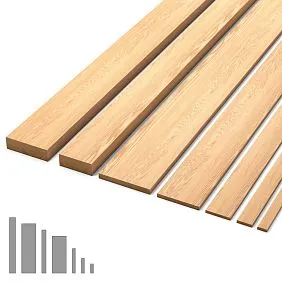
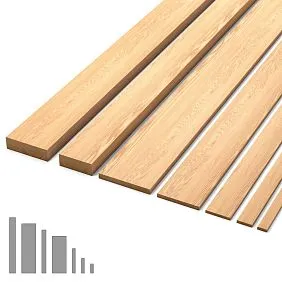
Decorative slatted wall panels—are structural modules made of parallel slats (battens, strips) with identical cross-sections, fixed at equal intervals on a backing or fabric base. The rhythm of equally spaced slats creates a linear graphic pattern, which under any side or directional lighting transforms into a three-dimensional sculptural surface with an expressive play of light and shadow.
Three keywords in the definition: rhythm, relief, light. It is this triad that ensures the visual effect for which the panels are chosen. Remove any of the three elements—and the result becomes fundamentally different. Slats without proper light—are just strips. Light without rhythm—is ordinary lighting. Rhythm without relief—is a flat surface with an applied pattern.
The word 'decorative' here does not mean 'just beautiful'. Slatted wall panels serve a functional purpose: they manage the visual proportions of a space, create an acoustic scattering effect, and act as furniture facades. Decorativeness is about the external result. Functionality is about the specific tasks being solved.




Structural types: four kinds, four tasks
Not all slatted panels are the same. And choosing the type of construction is the first, most fundamental step.
Our factory also produces:
Rigid panels on MDF backing
Classic. MDF or solid wood slats are fixed to a rigid MDF backing with factory-precision spacing. The module is absolutely flat, stable, with a geometrically precise structure.
Scope of application: straight walls, straight furniture facades, straight partitions. This covers 90% of standard tasks. The rigidity of the backing is an advantage, not a limitation: it guarantees that the installed surface will remain flat without warping or deformation.
The most important parameter is the precision of the slat spacing. With proper factory spacing, modules join so that the slats of one flow smoothly into the slats of the next without visible offset. The wall is perceived as a monolithic surface, not a set of separate sections. This is a property of the product, not the installer's skill.
Get Consultation
Flexible panels on a fabric base
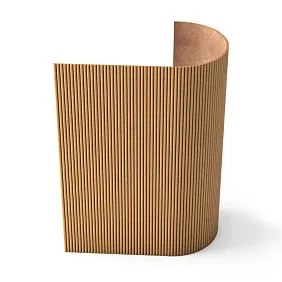
An engineering solution for curved surfaces. The slats are fixed not to rigid MDF, but to a fabric mesh backing: it allows the battens to change their angle relative to each other when bent. The panel wraps around columns, arches, rounded corners, S-shaped partitions — with a minimum radius from 100–150 mm, without deforming the slats and without breaking the pattern.
This is fundamental: a flexible panel cannot be replaced by a rigid one with 'on-site trimming'. A rigid backing cracks on a radius. A fabric backing does not. Therefore, decorative slatted wall panels on a flexible backing are the only correct solution for columns, arched spans, and non-standard geometry.
Panels made of half-round molding strips
A separate category — by slat profile, not by backing. The semi-circular cross-section of the batten scatters light along an arc: instead of sharp, clear shadows from a rectangular profile, there is a soft, smooth, diffused transition. The surface looks organic, natural, warm — even when made from synthetic MDF.
A crucial nuance: the semi-circular profile is available both in a rigid version on an MDF backing and in a flexible version — on a fabric backing. This is an independent parameter from the structural type.
MDF Panels for Painting
Structurally rigid, on an MDF backing. The feature is that the rail surface is sanded to Ra ≤ 1.6 µm and is ready for painting with any enamel: matte, satin, semi-gloss. This is the choice for precise RAL/NCS colors, monochrome solutions, corporate facilities with a brand palette, and any tasks where the natural wood grain is undesirable — a clean, uniform surface of the desired shade is needed.
Material is an architectural choice, not a technical one
Oak or MDF — this question is not about money. It's about what exactly you want your wall to say.
MDF: Geometric and Color Freedom
MDF with a density of 750–850 kg/m³ is a homogeneous engineered material. No knots, no resin pockets, no natural variability. An ideal base for painting: every square centimeter of the surface accepts paint uniformly. No 'revealing' of subsurface texture under the paint layer.
What does this give in practice? Any color from the RAL or NCS catalog — precisely, predictably, reproducibly from batch to batch. Monochrome 'wall-to-wall' — the panel dissolves into the color, only the relief remains. Two-color systems — rails in one tone, the backing (visible through the gaps) in another. Corporate RAL for an office or showroom without deviations.
MDF is also the right choice for flexible panels on a fabric base when precise color on a curved surface is needed.
Solid Oak: Living Grain and Tactile Naturalness
Oak is a species with a density of 700–750 kg/m³ and a pronounced grain pattern. Each rail carries a unique natural pattern — two adjacent battens never repeat each other. This is what is visible. And under the hand — the open pore of oak under oil: warm, slightly rough, a natural tactility that no synthetic material can imitate.
Oak finishes cover a wide range:
-
Light natural oiled — Scandinavian style, Japandi;
-
Gray Scandinavian — cold Nordic look;
-
Honey, golden — warm organic minimalism;
-
Tobacco, cognac — neoclassical, modern classic;
-
Wenge, graphite, anthracite — loft, strict modern interior.
Oak for decorative wall panels — the choice for those for whom natural material is the main theme. Not an imitation of nature, but nature itself.
| Parameter | MDF for painting | Solid oak |
|---|---|---|
| Color freedom | Any RAL/NCS | Limited to finishes |
| Natural texture | No | Yes, unique |
| Tactile | Homogeneous | Living, open pore |
| Wear resistance | Depends on the coating | High (species) |
| Future color change | Repainting without disassembly | Oil/varnish renewal |
| Style | Minimalism, office, monochrome | Japandi, Scandinavian, organic |
Rail profile: three geometries — three wall characters
Glazing bead cross-section profile — the least discussed parameter. And the one that radically defines the surface character.
Rectangular profile: architectural strictness
Sharp edges. Clear linear shadows. With any side lighting — a hard, disciplined, almost drafting-like graphic on the wall surface. No softness, no smooth transitions — only precise geometry.
This profile is for spaces with character: minimalism, loft, study, meeting room, office reception, restaurant with a brutal concept. White rectangular profile on a white wall — sophisticated monochrome, where relief exists only through shadow.
Semicircular profile: organic softness
Rounded edges. Light diffuses along the arc, shadows are smooth, transitions are soft. The wall looks warm, natural — alive. When lit from different angles — it changes, 'breathes'.
Semicircular profile — the choice for living spaces with a cozy atmosphere: bedroom, living room with a soft character, home library. Oil-finished oak with a semicircular profile — one of the most natural and tactilely rich interior images.
Trapezoidal profile: dynamics and depth
A cross-section that widens toward the substrate creates a more voluminous, multi-level relief. The shadow is complex, with several gradations. The surface is dynamic, attracting the eye.
The trapezoidal profile works in commercial spaces with high decorative demands: restaurants, showrooms, boutiques, lobbies. Where intense decorative density is needed without descending into chaos.
How decorative slat panels manage space
This is not a metaphor. It is a specific optical mechanics that must be understood—and used intentionally.
Vertical slats raise the ceiling. The eye follows the vertical lines upward. In a room with a 2.7 m ceiling, a vertical slat wall creates a sensation of 3 m and higher. This is the most valuable technique for apartments with standard ceiling heights: one decorative choice changes the perceived proportions of the room.
Horizontal slats expand a narrow space. The eye moves along the horizontals left and right. An end wall in a narrow corridor with horizontal slats visually 'pushes' the corridor apart sideways. Physically—nothing has changed. Spatially—a completely different sensation.
A dense rhythm creates tension, a sparse one—calm. Frequent slat spacing with narrow gaps: a saturated, active, 'boiling' surface. Attracts the eye, holds attention, creates a decorative accent. Sparse spacing with wide gaps: an airy, calm, monumental surface. For small rooms—always moderate or sparse spacing.
Relief gives a sense of depth. With side lighting, each slat casts a shadow into the gap—the surface is perceived as deeper than it is. The wall 'recedes' into space. A flat wall never creates such an effect.
Acoustics—a real physical effect. A relief surface scatters sound waves, disrupting their linear reflection. In rooms with hard floors, ceilings, and walls without decorative wall panels—pronounced reverberation, echo, discomfort during conversation. Decorative slat wall panels reduce reverberation. This is not a marketing claim—it is acoustic physics. In meeting rooms, restaurant halls, home theaters—a practically significant effect.
Application scenarios: specific spaces and specific solutions
Living room: the focal point of the interior
The wall behind the sofa or TV area. This is where the decorative slatted wall panel works at its maximum efficiency. One surface becomes the architectural anchor of the entire room—the eye finds a point of support, and the space is organized around it.
Scenario 1: oak slats in a natural tone + side lighting. A classic that is impossible to fall out of love with. Living texture + controlled light = an effect that works in the morning, evening, and under any lighting.
Scenario 2: anthracite MDF behind the TV in a white interior. The screen becomes part of the architectural object, not just 'a device attached to the wall.' The slatted background visually 'frames' the TV without a physical frame.
Scenario 3: white monochrome—panel matching the wall color. Relief only through shadow. A minimalist space where nothing is superfluous.
Bedroom: silence in material
The wall behind the bed headboard is the most delicate scenario. Color and profile should work towards calmness and naturalness, not tension and activity. A semi-circular profile, a neutral warm tone, and a moderate spacing.
LED strip along the lower perimeter of the panel: soft upward glow that emphasizes the relief from within. In the evening, the bedroom acquires an intimate, almost hotel-like character. This is one small technical technique—and one big spatial effect.
Hallway: the first impression
The hallway speaks before you say anything. What exactly it says is up to you. A slatted panel on the end or main wall of the hallway is an immediate architectural signal of the interior's level and intent. For a narrow hallway: horizontal installation on the end wall. For a hallway with normal width: vertical slats on the wall by the entrance.
Study: professional image
Wall behind the desk. Anthracite, dark blue, bottle green. Rectangular profile. A slatted surface is a background for video calls that says 'serious work happens here'. And it also reduces acoustic reverberation, making the sound in the frame cleaner.
Restaurant, cafe, bar
Decorative slatted wall panelsIn a restaurant, it's an atmosphere that cannot be created otherwise. Warm oak under directional lighting, the vertical rhythm of battens, reducing the acoustic load in the hall. Guests come to a restaurant for food, but they return for the feeling.
Office and meeting room
A reception with a slatted wall in corporate RAL is branding through architecture. Without banners or prints. A meeting room with slatted panels: business image + reduced reverberation = more comfortable and productive meetings.
Showroom and boutique
A slatted wall is a neutral, expensive background for any display. Oak slats or MDF in a neutral tone create a professional environment that does not compete with the product but emphasizes its level.
Finishing system: how a slatted panel works in an ensemble
A decorative slatted wall panel is not an isolated object. The more precisely it is integrated into the system, the more convincing the final result.
Molding along the upper perimeter. A horizontal strip above the slatted panel finishes the surface, creating a clear boundary between the relief and the smooth wall above. Without molding, the panel 'ends' in mid-air. With molding inwooden trima matching or contrasting tone, it becomes a finished architectural frame.
Baseboard.Wooden baseboardAt the base of an oak slatted wall — a unified material system. The same solid wood, the same tint, the same level of finish. Without a baseboard, the lower edge of the panel 'hangs' above the floor. With a baseboard — the surface gains a lower architectural boundary, the surface looks complete. For MDF panels for painting —Baseboard MDFin the same color.
Concealed doors. A door leaf with slatted panels that continue the rhythm of the wall — 'disappears' into the surface. The pattern of slats passes through the doorway continuously. This is one of the most architecturally convincing techniques: the wall remains monolithic, and the door is present only as a function.
Furniture fronts with slatted cladding. A wardrobe with slatted fronts in the rhythm of the wall panel — the furniture becomes part of the architecture. A built-in wardrobe dissolves into the slatted wall. A freestanding one — picks up the architectural theme.Furniture Handlesmade of metal — the only accent that 'denotes' the furniture object against the unified slatted surface.
Wooden decorative overlays. In neoclassical and classic interiors, a slatted panel as a central field is combined withdecorative inlaysaround the perimeter — creating an architectural 'frame' around the slatted surface. This is a modern interpretation of traditional wall paneling.
Lighting as part of the system. Side directional spotlights — sculptural shadow on rectangular slats. LED strip behind the top molding — soft downward light. LED in the gaps between slats — architectural lighting from within. Lighting is planned simultaneously with the choice of the panel — not after installation.
Decorative slatted panels in interior styles
The uniqueness of slatted surfaces lies in their versatility. The same principle, applied across different materials, profiles, and colors, works in completely different styles.
Scandinavian style – light oak with oil finish, slim rectangular profile, moderate spacing, vertical orientation. Warm, delicate, homely look.
Japandi – oak with gray tint or natural, horizontal orientation. Semi-circular profile. Wide spacing. The naturalness of Japanese aesthetics + Scandinavian restraint.
Minimalism – MDF for painting in monochrome. Rectangular profile. Wall of one color, relief only through shadow. Nothing extra.
Neoclassical – MDF in a warm neutral tone. Rectangular profile with classical proportions. Moldings made ofwooden trimaround the perimeter. The slatted pattern as a modern interpretation of classic wooden panels.
Loft – dark oak with matte varnish or MDF in anthracite. Aggressive rectangular profile. Black metal details. Brutal, masculine, self-sufficient look.
Organic minimalism – oak in a natural tone, semi-circular profile, rounded details. Natural materials nearby: linen, stone, untreated wood. The slatted panel is one voice in a natural ensemble.
Contemporary premium interior – solid oak or MDF in a deep, rich color. Built-in lighting. Expensive adjacent materials: brass, natural stone, leather. Decorative slatted wall panel as a marker of level.
Technical parameters: seven questions to ask before buying
Before ordering decorative slatted wall panels — make sure you have answers to these questions.
-
MDF substrate density — not less than 750 kg/m³. Loose MDF is unstable, holds fasteners poorly, and edges swell.
-
Slat pitch accuracy — deviation no more than 0.5 mm for seamless module joining.
-
Edge treatment — MDF edges must be sealed (primed or covered with film). Open edges absorb moisture.
-
Base type — MDF substrate (for flat surfaces) or fabric backing (for curved surfaces). Do not confuse when ordering.
-
Slat profile — rectangular, semicircular, trapezoidal. This is decided before ordering.
-
Slat orientation — vertical or horizontal. Affects spatial effect.
-
Compatibility with trim system — check if moldings, baseboards, and decorative elements from the same wood species and within the same production program are available.
Mistakes worth admitting upfront
Too many slatted surfaces. Four slatted walls in one room is not 'even more beautiful'. It's overload. One accent plane + three neutral ones = correct architectural proportion.
Wrong profile for the space. An aggressive rectangular profile in a child's room or bedroom creates tension instead of coziness. A soft semicircular profile in a meeting room is not strict enough. The profile is selected to match the character of the space.
Large relief in a small room. A dense rhythm with narrow gaps in a small room visually compresses the walls. For small rooms, use a moderate profile with a wide spacing.
Mismatched moldings. Oak slat panel + white plastic skirting board. This is a material conflict.with a classic profile creates a sense of solidity, reliability.from the same wood species is a mandatory element of the system.
Flat frontal lighting. Slats without side or directional lighting are just planks. Relief needs light at an angle. Planning the lighting and installing the panels is a single process.
Painting an MDF panel after installation with a roller. The gaps between the slats are not painted evenly when using a roller. Panels are painted before installation in a spray booth.
About the company STAVROS
The quality of a decorative slat panel is determined where it is not visible: in the precision of the slat spacing to tenths of a millimeter, in the density of the MDF substrate, in the quality of surface sanding, in the edge finishing. This is not visible in a catalog photo—it is visible after a year of use.
STAVROS is a Russian manufacturer of MDF and solid wood products for interior finishing and furniture production. The catalog features a complete line for creating a unified interior system: slat panels (rigid and flexible, rectangular and semicircular profiles), moldings, decorative overlays, furniture decor, and hardware. Over 4000 models, 20,000 modifications, 39 product groups.
Production standard: MDF from European factories with a density of 750–850 kg/m³, wood drying in climate chambers, a two-level quality system (Standard and Prestige), manual processing of decorative elements, precision control in every batch.
Shipment from one piece. Delivery across all of Russia. Professional consultation—before placing an order.
FAQ: Answers to popular questions
How do decorative slatted wall panels differ from clapboard?
Fundamentally, in construction and purpose. Clapboard is a facing board that covers a surface with a solid layer. A slatted panel is an open, rhythmic relief: slats are fixed with a gap, revealing the substrate or wall between them. Clapboard 'hides' the wall; a slatted panel 'builds' a new architectural surface over it. The decorative and spatial effects are fundamentally different.
Can decorative slatted panels be installed on a ceiling?
Yes, with frame installation, calculating the load-bearing capacity of the fasteners. The panel is attached to a metal profile with finishing nails or screws. Horizontal ceiling installation creates the effect of an acoustic coffered ceiling—relief facing downward, dispersing reverberation.
How to choose the color of an MDF slatted panel to match the interior?
Three strategies: (1) Monochrome—matching the wall color, relief only through shadow; (2) Tonal accent—2–3 shades darker than the main wall color; (3) Contrast accent—a fundamentally different color against neutral walls. For beginners—tonal accent: it rarely goes wrong.
What is the service life of decorative slatted wall panels?
MDF for painting with professional paint coating—10–15 years without replacement under household loads. The coating can be restored locally if damaged. Solid oak—virtually unlimited lifespan with regular renewal of oil or varnish (every 3–5 years).
Can slatted panels be installed in a bathroom?
Standard MDF—not intended for areas with constant high humidity. For bathrooms—only moisture-resistant MDF (MDF-H) with appropriate coating. For saunas—only natural wood of specific species (linden, alder, aspen).
Do you need a professional installer for panel installation?
For adhesive installation on a flat surface and experience with mounting adhesive — a person with basic repair skills can handle it themselves. For frame installation, non-standard geometry, and curved surfaces — a professional installer will ensure a more precise and reliable result.
How to ensure seamless joining of multiple modules?
This is determined at the production stage, not installation. With factory precision of step no more than 0.5 mm, the slats of one module continue the rhythm of the adjacent one without displacement. Choose a manufacturer with precision control — this is the only guarantee of a seamless result.