Article Contents:
- Creating frames from moldings: custom framing technology
- Choosing molding: profile defines style
- Material calculation: precision eliminates waste
- Frame installation: sequence of operations
- Ready-made frame elements: simplified installation
- Sets of four elements
- One-piece frames
- Framing wall panels: decorative frames as architecture
- Classical panel: symmetry and proportions
- Modern panel: asymmetry and contrast
- Frames for large-format photographs: author photography as art
- Gallery framing: minimalism and purity
- Multi-layer framing: depth and luxury
- Decorative frames on walls: empty compositions as art
- Single large frame: wall dominant
- Multiple frames: rhythm and structure
- Multi-level frame constructions: complexity and depth
- Two-level frame: outer and inner
- Three- to four-level frame: baroque luxury
- Frame painting: gold, patina, antique effect
- Gilding: Museum Luxury
- Patina: effect of antiquity
- Crackle: Cracks of Time
- Application in gallery hangings: systematic approach to framing
- Grid hanging: order and symmetry
- Chaotic hanging: freedom and individuality
- Frequently asked questions about polyurethane decorative frames
- Conclusion: frames as the language of visual culture
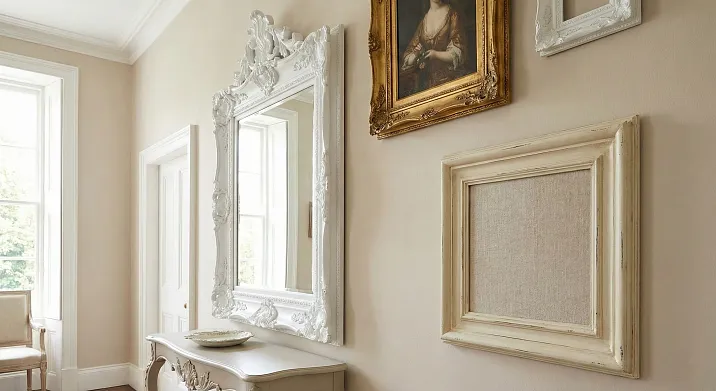
A painting on the wall is an island of imagery floating in space. A mirror without a frame is a utilitarian object reflecting reality but creating no aesthetics. A photograph in a standard plastic frame gets lost, deprived of significance.Polyurethane molding framestransform images into architectural objects that connect content with room space. A frame is not just a boundary between painting and wall (utilitarian function—holding canvas, glass, protecting from damage), but a compositional element, a dialogue between content and surroundings. A wide gilded frame around a Rembrandt reproduction turns a copy into an artifact worthy of a museum. A thin black frame around contemporary photography emphasizes graphic quality, the strictness of visual language. A white molding frame around a hallway mirror adds architectural solemnity to a utilitarian object; the mirror becomes a portal, a window into parallel space.
Polyurethane as a frame material synthesizes the advantages of traditional materials while eliminating their drawbacks. Wooden baguette frames are heavy (a 100x70 cm frame made of oak baguette weighs 3-4 kg, requiring sturdy mounting), expensive (linear meter of baguette costs 400-1800 rubles, a finished frame 5-20 thousand), and finicky (they absorb moisture, deform in bathrooms, kitchens, and rooms with variable humidity). Plaster frames are fragile (break when dropped, crumble during transport), heavy (a 1x1.5 m frame weighs 15-20 kg), and expensive (hand casting triples to quintuples the price). Plastic frames are light, cheap, but visually primitive (low detail, blurred relief, the material looks cheap and compromises the content). Polyurethane frames are as light as plastic (a 1x1.5 m frame weighs 1.5-2 kg, adheres to the wall without dowels), as detailed as wood and plaster (relief is reproduced with photographic accuracy, ornament depth up to three centimeters), durable (do not crumble, do not crack, withstand impacts), absolutely moisture-resistant (installed in bathrooms without degradation for decades), and affordable (2-5 times cheaper than wooden, 3-10 times cheaper than plaster).


Creating frames from moldings: custom framing technology
Ready-made frames (sold in stores, baguette workshops) are limited to standard sizes (30x40, 50x70, 70x100 cm — popular formats). A non-standard painting (80x120, 120x160 cm — panoramic photo, original canvas, full-wall mirror) requires a custom-made frame (a baguette workshop cuts the baguette, assembles the frame — lead time 1-2 weeks, cost is high).Polyurethane stucco framesare created independently on the wall — any size, any configuration (rectangular, square, oval, round, complex geometry), installation takes a few hours.




Molding selection: profile defines style
Frame molding is selected by width (from three to fifteen centimeters — narrow for minimalist frames, wide for classical), profile (flat, convex, concave, combined), and presence of ornament (smooth for modern interiors, ornamented with plant, geometric motifs for classical).
Narrow moldings (3-6 cm). Create thin frames, visually light, not competing with the content for attention. Profile is simple (flat with bevel, rounded, geometric without ornament). Application: modern interiors (Scandinavian style, minimalism, loft), framing photographs, graphics, posters where line purity is important. Coloring: white (universal, suits any walls), black (graphic, contrasting, emphasizes the border), gray (neutral, softens contrast).
Medium moldings (6-10 cm). Universal, suitable for most tasks. Profile varies (flat, convex, concave, with minimal ornament or smooth). Application: framing medium-sized paintings (50x70, 70x100 cm), mirrors in hallways, bathrooms, creating wall panels. Coloring: wall color (frame blends, creates subtle division), contrasting (gold, silver, colored — frame is an accent).
Wide moldings (10-15 cm and more). Create massive frames, dominant, attention-grabbing. Profile is complex (multi-tiered, ornamented with acanthus leaves, geometric patterns, plant garlands). Application: classical interiors (Baroque, Empire, English classic), framing large paintings, full-wall mirrors, creating gallery compositions. Coloring: gilding (gold leaf, gold paint — luxury, museum quality), patination (antique effect, nobility), white enamel (French classicism, elegance).
Our factory also produces:


Material calculation: accuracy eliminates waste
A rectangular frame requires four pieces of molding (two vertical, two horizontal). Length of vertical pieces equals frame height plus two molding widths (allowance for corner joints). Length of horizontal equals frame width plus two molding widths. Example: frame 100x70 cm, molding width 8 cm. Vertical pieces: 100 plus 16 (two molding widths) equals 116 cm, two pieces 232 cm. Horizontal: 70 plus 16 equals 86 cm, two pieces 172 cm. Total 404 cm (four meters four centimeters). Molding is sold in planks of 2-2.5 meters — two planks are required (total length 4-5 meters, remainder 60-90 cm — allowance for adjustment, error correction).
Get Consultation
Frame installation: sequence of operations
Wall marking. Frame position is determined (center of wall, offset left-right, height from floor). Dimensions are measured with a tape measure, frame corners are marked with a pencil (four points), lines are drawn between points (a spirit level ensures horizontality, verticality — deviations create visual discomfort, frame appears skewed). Lines are the outer contour of the frame, molding is glued along the lines outside or inside (depends on the task — framing a painting on the wall, molding is glued outside the marking; creating an empty decorative frame, molding is glued along the center of the line).
Molding cutting. Four pieces are cut at a 45-degree angle (a miter box or miter saw ensures accuracy). Vertical pieces: top end at 45 degrees to the left (for left plank) or right (for right), bottom end mirror. Horizontal: left end at 45 degrees down (for top plank) or up (for bottom), right end mirror. Precise cutting is critical (a half-degree deviation creates a 1-1.5 mm gap in corners, visible to the eye, requiring putty). Alternative to cutting — corner blocks (ready-made elements installed in corners, to which moldings are brought perpendicularly — simplifies installation, eliminates angled cutting).
Gluing. Acrylic or polyurethane glue (sets in 1-2 hours, holds firmly) is applied to the back of the molding (thin layer, evenly), molding is applied to the wall along the marking, pressed, fixed with painter's tape (strips every 30-40 cm hold the molding until glue sets). After 1-2 hours tape is removed, molding holds independently. Joints in corners (if moldings are cut precisely) are tight without gaps; if gaps exist — filled with acrylic sealant (white, paintable), sealant is applied into the gap with a spatula, excess removed, surface leveled, after drying (4-6 hours) sanded with fine sandpaper (grit 220-280), joint becomes invisible.
Painting. After installation, the frame is painted (if molding is factory white, requires finishing). Acrylic paint (matte, semi-matte, glossy — choice depends on style) is applied with a brush (for ornamented moldings — penetrates relief recesses) or roller (for smooth — faster, more even). Two coats (base and finish) with intermediate drying 4-6 hours. Decorative finish (gilding, patina, crackle) is applied after base painting, adds depth, luxury, antique effect.
Ready-made frame elements: simplifying installation
An alternative to assembling a frame from moldings — using ready-made frame elements.Decorative polyurethane framesare sold in kits (four pieces, cut at 45-degree angles, corner blocks for joining) or as single pieces (rectangular, square, oval, round frame cast as one piece — no joints, corners requiring cutting).
Kits of four elements
Kit includes four molding planks (two vertical, two horizontal), cut at 45-degree angles at ends, four corner blocks (square, round, decorated — hide joints, simplify assembly). Sizes are standard (50x70, 70x100, 100x150 cm — popular painting, mirror formats) or custom (on order — manufacturer cuts moldings to specified sizes, supplies corner blocks, ships as a ready set).
Kit advantages. Installation speed (no cutting required — planks ready, glued to wall immediately, frame assembled in an hour instead of 3-4 with self-cutting). Joint guarantee (planks cut precisely at factory — 45-degree angles perfect, joints tight without gaps, corner blocks compensate minor inaccuracies). Material economy (no waste from incorrect cutting — each plank used fully).
Single-cast frames
Frame is cast as one piece in a mold (pressure casting technology allows creating complex configuration without joints). Shape rectangular, square, oval, round, shaped (arched, with protrusions, wavy — designer frames for non-standard tasks). Sizes vary (from small 20x30 cm for photos to large 1.5x2 m for full-wall mirrors). Relief ornamented or smooth (classical motifs, plant patterns, geometric ornaments, minimalist profiles).
Single-cast frame advantages. No joints (frame is monolithic, corners cast — visually perfect, stronger than assembled from planks). Complex shapes (oval, round, shaped frames difficult to assemble from straight moldings, single-cast is molded in any configuration). Installation speed (frame glued to wall in minutes — no cutting, assembly, corner joining required).
Framing wall panels: decorative frames as architecture
An empty decorative frame (without painting, mirror inside) on the wall — a classical architecture technique creating plane division, rhythm, visual complexity.Frame elements from stuccoThey form panels — rectangular sections of the wall, highlighted by molding frames, inside which the color, texture, and material contrast with the rest of the wall.
Classical panel: symmetry and proportions
A living room wall three meters high and five meters long is divided into three horizontal zones (the lower third is one to one point two meters from the floor, the middle third is one to one point two meters, the upper third is sixty to eighty centimeters to the ceiling). The lower zone is decorated with molding panels (three to four rectangular frames along the wall, separated by vertical moldings, frame height seventy to ninety centimeters, width sixty to eighty centimeters). Inside the frames, the wall is painted in a contrasting color (dark green, burgundy, gray on light walls) or covered with textured wallpaper (silk, velvet, with patterns). The molding is wide (eight to twelve centimeters), ornamented or smooth, painted white, gold, or the color of the walls.
Panel proportions. Classical rule: the height of the panel equals one and a half to two times its width (vertical orientation visually raises the ceiling, creates solemnity). The distance between panels equals half the width of a panel (rhythm is uniform, not too dense, not sparse). Panel corners are decorated with corner blocks (square overlays with rosette or cartouche relief — emphasize corners, add ornamentation).
Modern panel: asymmetry and contrast
A minimalist interior uses panels sparingly. One large frame on an accent wall (a rectangle one and a half by two meters, horizontally oriented, on the wall behind the sofa). The molding is narrow (three to five centimeters), smooth, painted in contrast (black on a white wall, white on gray, gold on dark blue). Inside the frame, the wall differs (panoramic photo wallpaper, textured decorative plaster, wooden panels, mirror tiles — creating an accent zone that attracts the eye, becoming the room's focal point).
Asymmetric compositions. Several frames of different sizes (large one by one and a half meters, medium seventy by one hundred, small fifty by seventy) are placed on the wall asymmetrically (not on a grid, but intuitively — top edges are aligned horizontally, sides are offset). Inside the frames, the color is uniform or varies (gradient from light to dark, monochrome palette). The molding is uniform for all frames (width, profile, color identical — visual unity of the composition).
Large-format photo frames: author's photography as art
Author's photography (panoramic landscape, architectural shot, portrait) of large format (eighty by one hundred twenty, one hundred by one hundred fifty, one hundred twenty by one hundred eighty centimeters) requires appropriate framing. Ready-made frames of such sizes are rare, expensive (a frame workshop makes them to order — cost ten to thirty thousand rubles, timeframe one to two weeks). A frame made of polyurethane moldings is created independently on the wall around the photograph.
Gallery framing: minimalism and purity
The photograph is printed on canvas or photo paper, stretched on a stretcher (a wooden frame on which the canvas is stretched — stretcher thickness two to four centimeters, creates volume, the photograph does not lie flat against the wall but stands off). The stretcher is hung on the wall, and a frame of narrow moldings (three to four centimeters, smooth, painted black, white, gray) is created around it. The molding is glued to the wall flush with the edge of the stretcher (gap one to two millimeters — compensated with sealant, invisible after painting) or with an offset of five to ten centimeters (creating a field between the photograph and the frame — visually lightens the composition, the photograph appears to float).
Mat effect. The inner field between the photograph and the molding is painted in contrast (white field on a colored wall, black on a light one — imitation of a classic mat, which in a traditional frame separates the image from the molding, creates visual breathing, concentrates attention on the content).
Multi-layer framing: depth and luxury
The photograph is framed with several layers of moldings (inner narrow three centimeters black flush with the edge of the photograph, middle six centimeters gold with a five-centimeter offset from the inner one, outer ten centimeters white ornamented with a ten-centimeter offset from the middle one). Three frames are nested one inside the other, creating visual complexity, depth, luxury. Application: classical interiors where abundant decor is appropriate, the photograph has artistic value, worthy of museum framing.
Decorative frames on walls: empty compositions as art
An empty frame (without a painting, mirror, photograph inside) is a self-sufficient decorative element. Inside the frame, the wall is ordinary (color, texture identical to the rest of the wall) or contrasting (highlighted by color, wallpaper, material). The frame creates a visual accent, architectural division, rhythm on the wall plane.
Single large frame: wall dominant
A living room wall four by three meters (width by height) is decorated with one large frame (one and a half by two meters, horizontally oriented, positioned at the center of the wall at a height of one to one point two meters from the floor). The molding is wide (ten to fifteen centimeters), ornamented (classical profile with floral motifs, geometric patterns), painted in contrast (gold on a beige wall, white on dark gray, black on light blue). Inside the frame, the wall is painted a different color (dark inside a light frame, light inside a dark one — contrast emphasizes the boundary, the frame is perceived as a window, portal, spatial niche).
Function of an empty frame. Organizes the gaze (upon entering the room, the eye is drawn to the frame, focused on the center of the wall — creating a compositional center, an anchor of perception). Adds architectural complexity (a flat wall gains visual depth, layering — the frame as the foreground, the wall inside as the second, the rest of the wall as the third). Compensates for the lack of decor (in a minimalist interior with little furniture, textiles, accessories — an empty frame adds visual interest, the wall does not seem empty).
Multiple frames: rhythm and structure
A long corridor wall (eight to ten meters), narrow (width one to one and a half meters), high (three to three and a half meters) is divided by a series of frames (four to six rectangular, vertically oriented, sized sixty by one hundred centimeters, placed along the wall at intervals of one to one point two meters). The molding is medium (six to eight centimeters), smooth or with minimal relief, painted the color of the walls (blends in, frames are barely noticeable, creating subtle division) or contrasting (stand out, create a rhythm of verticals along the corridor). Inside the frames, the wall is ordinary or contrasting (every other frame dark, the next light — checkerboard rhythm, dynamism).
Gallery effect. Empty frames create a feeling of a gallery awaiting paintings. Later, paintings, photographs are placed inside the frames (added gradually, as acquired, created — frames are ready in advance, images are inserted without additional mounting).
Multi-level frame constructions: complexity and depth
Nested frames (one inside another, two-three-four levels) create visual depth, architectural complexity, turning a flat wall into a three-dimensional composition.
Two-level frame: outer and inner
Outer frame large (two by one and a half meters, wide molding twelve to fifteen centimeters, ornamented, painted gold, white) frames a section of the wall. Inside the outer frame, with an offset of twenty to thirty centimeters, an inner frame is smaller (one and a half by one meter, narrow molding six to eight centimeters, smooth, painted in contrast — black, gray). Between the outer and inner frames, the wall is painted an intermediate color (medium tone between the background of the rest of the wall and the area inside the inner frame — creating a gradient, transition from background to center). Inside the inner frame, a painting, mirror, textured plaster, photo wallpaper is placed.
Visual effect. Multi-layering (the frame is not just a boundary, but a sequence of boundaries — the gaze passes through levels, immerses into the composition). Depth (optical illusion of volume — outer frame in the foreground, inner deeper, content even deeper, the wall is perceived as a niche, spatial recess).
Three- to four-level frame: baroque luxury
Classical interior (baroque, rococo, empire) uses abundant decor. The wall is decorated with three to four frames, nested one inside another (outer large ornamented gold, second medium white with patina, third narrow black, inner thin silver). Between the frames are fields ten to twenty centimeters wide, painted in a gradient (from light outside to dark inside or vice versa). The center of the composition (inside the innermost frame) — mirror, painting, decorative panel, relief rosette.
Application. Formal rooms (living rooms, dining rooms, halls of palace interiors, where luxury, excess of decor is appropriate, expected). Accent zones (wall behind a fireplace, portal, niche — a multi-level frame emphasizes significance, turns a functional element into a work of art).
Frame painting: gold, patina, antique effect
Polyurethane molding frames come primed in white. The final paint finish defines the style, integrates the frame into the interior, and creates effects of luxury, antiquity, or modernity.
Gilding: museum luxury
Imitation gold leaf (imitation of gold leaf - thin sheets of metallized film) is applied with gold leaf adhesive. Technique: the frame is painted with a base color (red-brown, yellow-ochre - the underlayer shows through the gold leaf, creating tonal depth). After drying (four to six hours), the adhesive is brushed onto the raised parts of the relief (if the molding is ornamented - onto acanthus leaves, scrolls, dentils; the recesses remain unglued). After an hour, the adhesive becomes tacky (transparent, tackiness checked with a finger - it doesn't stick but is stringy). The gold leaf is applied to the adhesive (a sheet is placed, pressed with a soft brush, adheres to the raised areas, does not stick to recesses). Excess gold leaf is removed (brushed off, remains on the raised areas). Result: gilded raised areas, recesses remain the base color - the effect of an antique frame where gold has worn away in the recesses and remains on the raised areas.
Gilding variations. Full (the entire frame surface is covered with gold leaf - maximum luxury, a solid gold frame like a museum piece). Partial (only the raised relief areas - the relief is emphasized, depth is enhanced). Combined (gold leaf of two colors - gold and silver - on different relief elements, creates a play of metals, visual complexity).
Patina: effect of aging
Patina (dark paint diluted to translucency - brown, green, black, gray) is applied to a frame painted with a base color (white, beige, light gray). Technique: patina is applied generously with a brush (fills the recesses of the relief, covers the raised areas). After five to ten minutes, excess is removed with a rag (patina remains in the recesses, is removed from the raised areas; raised areas are light, recesses are dark). Result: recesses are shaded (create depth, the relief appears more three-dimensional), raised areas are light (appear illuminated, come to the foreground). The frame looks antique (patina imitates darkening, the patina of time accumulated in recesses over decades, centuries).
Patina colors. Brown (warm, classic - suitable for wood-look frames, beige, cream interiors). Green (cool, oxidized copper - for bronze-look frames, gray, blue interiors). Black (graphic, contrasting - for modern frames, black-and-white interiors). Gray (neutral, soft - universal, suits any base colors).
Crackle: cracks of time
Crackle varnish (a special compound that cracks upon drying) is applied to a frame painted with a light base color (white, cream, light gray). Technique: the varnish is applied with a brush in a thick layer (two to three millimeters). It dries in two to four hours (cracks appear - a network imitating cracked antique varnish). The cracks are rubbed with dark paint (brown, black - paint is rubbed in with a rag, filling the cracks). The surface is wiped (paint remains in the cracks, forming a dark network on a light background). Result: the effect of an antique frame that has endured centuries; the varnish has cracked, revealing the dark underlayer through the cracks.
Combination of effects. Gilding plus patina (gold leaf on raised areas, patina in recesses - maximum depth, luxury, antiquity). Crackle plus patina (cracks over the entire surface, patina in the relief recesses - a double aging effect, visual complexity). Gilding plus crackle (gold leaf is covered with crackle varnish, cracks reveal the underlayer - the illusion of gilding that has worn and cracked over time).
Application in gallery hangs: a systematic approach to framing
Gallery hang (a group of paintings, photographs, posters on one wall) requires systematic framing. Frames made from polyurethane moldings are created uniformly (molding width, profile, color identical for all frames) or variably (frames differ in size, but the style is unified), organizing disparate images into a composition.
Grid hang: order and symmetry
The wall behind a sofa (three meters wide, one to one point two meters of free height above the sofa) is decorated with nine frames (a three-by-three grid, each frame fifty by seventy centimeters, intervals between frames twenty to thirty centimeters). Frames are made from narrow moldings (four to six centimeters, smooth, painted black, white, gray - a single color for all). Inside the frames are black-and-white photographs (portraits, landscapes, architecture - theme unified or varied, the black-and-white palette unifies). Result: an ordered gallery where each image is in its place; frames organize chaos, create structure.
Grid hang variations. Symmetrical (all frames the same size, arranged in a grid - strictness, order). Asymmetrical (frames of different sizes, but top edges aligned horizontally, sides offset - dynamism, freedom while maintaining structure). Modular (one large frame in the center, four medium around it, four small in the corners - hierarchy, focus on the central image).
Chaotic hang: freedom and individuality
A staircase wall (sloping, along the stair flight, five to seven meters long) is decorated with frames of different sizes (from small thirty by forty to large eighty by one hundred twenty centimeters), arranged chaotically (not on a grid, but intuitively - lower-higher, left-right, creating a visual rhythm but not a strict structure). Frames are made from moldings of different widths (narrow, medium, wide) but painted uniformly (all white or all black - color unifies the diversity). Inside the frames are thematically related images (family photos, travels, hobbies) or diverse ones (create eclecticism, individuality, tell the owner's story).
Creating a chaotic hang. Layout on the floor (all frames are laid out on the floor in the planned configuration - moved, rearranged until visual balance is achieved, photographed). Transfer to the wall (using the layout photo, frames are hung on the wall in an identical configuration - pencil marking, installing fasteners, hanging). Rule: distance between frames is even (ten to twenty centimeters - too dense clustering creates chaos, too sparse disperses the composition).
Frequently asked questions about decorative polyurethane frames
Is it possible to create a frame of complex shape (oval, round, arched) from moldings?
Oval and round frames cannot be created from straight moldings (molding is rigid, does not bend; an oval requires curved lines). Solutions: flexible moldings (thin, flexible polyurethane strips that bend to a radius - for oval, round, arched frames; cost thirty to fifty percent more than rigid ones). One-piece cast oval frames (cast as a whole in a mold - available in standard sizes, custom configurations on order). Segmented moldings (short segments joined at small angles - approximating a curve with a broken line; curvature is visually perceived, but joints are noticeable upon close inspection).
How much does it cost to create a frame from polyurethane moldings compared to buying a ready-made picture frame?
A frame made from moldings is one and a half to three times cheaper than a ready-made picture frame for large sizes. Example: a frame one by one and a half meters. Ready-made picture frame: linear meter of medium-width molding is five hundred to eight hundred rubles, frame perimeter is five meters (1+1.5+1+1.5), linear footage is two and a half to four thousand, work of a framing workshop (cutting, assembly, glass, backing) three to five thousand, total six to nine thousand. Frame from moldings: linear meter of polyurethane molding is two to four hundred rubles, five meters is one to two thousand, glue two hundred rubles, self-installation (time three to four hours), total one and a half to two and a half thousand. Savings: three to six thousand (fifty to seventy percent). For small sizes (thirty by forty, fifty by seventy), a ready-made frame is comparable or cheaper (mass production, cost one to two thousand; moldings plus work are similar). But non-standard sizes are always more cost-effective to create from moldings.
How durable is a polyurethane molding frame glued to a wall?
Durability is sufficient for decorative frames (they bear no load, are glued to the wall, last for decades). Acrylic adhesive (recommended for polyurethane) creates a strong bond (pull-off strength five to ten kilograms per linear meter - a frame two by one and a half meters, perimeter seven meters, withstands thirty to seventy kilograms pull-off; the frame's own weight is one and a half to two kilograms, safety factor fifteen to thirty times). Corners (the most vulnerable spot, where moldings join at a forty-five-degree angle) hold firmly (adhesive fills the joint, after drying the connection is rigid, does not separate under thermal deformation, vibrations). Test of time: frames in classic interiors hang for decades (do not peel off, do not deform, retain geometry, appearance).
How to care for polyurethane frames to preserve the finish?
Minimal care required. Polyurethane does not absorb dust (surface is smooth, painted - dust settles but does not embed). Easy to clean (wiped with a dry or slightly damp cloth - dust removed without effort). Frequency: dry cleaning once a month or two (dust off with a soft brush, duster - especially on ornamented frames where dust settles in recesses). Wet cleaning once every six months to a year (wipe with a slightly damp cloth with neutral detergent - remove grease in the kitchen, condensation in the bathroom). Gilded, patinated finishes require delicacy (wipe with a soft, dry cloth without pressure - gold leaf, patina can wear off with aggressive cleaning; avoid wet products). Finish renewal: every five to ten years (if gilding has tarnished, patina faded, paint scratched - repaint, repeat decorative finish; the frame regains its original appearance).
Can polyurethane frames be used in bathrooms to frame mirrors?
Yes, and it is recommended. Polyurethane is completely moisture-resistant (does not absorb water, does not deform from condensation, does not mold in humid environments). The painted surface (acrylic paint, gilding, patina) is protected from moisture (paint forms a waterproof film, moisture does not penetrate the material). A bathroom mirror framed with a polyurethane frame hangs for decades without degradation (the frame does not swell, crack, lose color, retains geometry). Comparison with wooden frames: wood in a humid bathroom deforms in two to three years (absorbs moisture, swells, dries out with humidity fluctuations, cracks, paint peels). Polyurethane is stable (geometry unchanged, finish intact).
Conclusion: frames as a language of visual culture
Polyurethane molding framesFrames transform images into architectural objects that connect content with interior space. A framed painting ceases to be a random spot on the wall (becomes a compositional center, an anchor of perception, around which the rest of the decor is organized). A mirror in a molding frame acquires solemnity (a utilitarian object transforms into a decorative portal; the reflection becomes part of the artistic composition). A large-format photograph in an individual frame created on the wall attains the status of a work of art (an author's work deserves unique framing that emphasizes its value, individuality).
The technology for creating frames from moldings is accessible (requires no special skills - marking, cutting, gluing are done with household tools in a few hours). Economical (two to five times cheaper than ready-made picture frames for large, non-standard sizes). Universal (any size, any configuration, any style realized by choosing appropriate moldings, paint, decorative finish). Ready-made framing elements simplify the process (kits of four strips with corner blocks, one-piece cast frames eliminate cutting, guarantee joining, mount in an hour).
Framing wall panels with decorative frames creates architectural articulation of the surface (empty frames without content organize perception, add rhythm, visual complexity, compensate for the absence of furniture, textiles, and accessories in minimalist interiors). Multi-level frame constructions (two-three-four frames nested within each other) create an illusion of depth, spatial niches, and transform a flat wall into a volumetric composition.
Frame painting determines style and integrates into the interior: gilding (imitation gold leaf on relief protrusions — museum luxury, classical aesthetics of Baroque, Empire), patination (darkening recesses, lightening protrusions — antique effect, nobility, antiqueness), crackle (a network of cracks imitating aged varnish — maximum historicity, visual complexity), combined effects (gilding plus patina, crackle plus patina — multi-layeredness, depth, luxury).
Gallery hangings are systematized with polyurethane frames (uniform framing of a group of images creates compositional unity, grid hanging organizes order, chaotic hanging preserves freedom while maintaining visual balance). The moisture resistance of polyurethane makes frames ideal for bathrooms (framing mirrors, decorative panels without risk of deformation, mold, or coating degradation).
The company STAVROS offers polyurethane moldings for creating frames of any size, style, and configuration — over three hundred profiles (from narrow three-centimeter minimalist smooth to wide fifteen-twenty centimeter ornamented classical), flexible moldings for oval, round, and arched frames (bending radius from thirty centimeters, plank length two-two and a half meters), ready-made frame elements (kits of four planks with corner blocks in standard sizes fifty by seventy, seventy by one hundred, one hundred by one hundred fifty centimeters, solid-cast oval, round, rectangular frames with diameters/sizes from thirty centimeters to one and a half meters), decorative overlays (corner blocks, central rosettes, ornamental elements for decorating frames, enhancing decorativeness).
High-quality material: polyurethane density three hundred-three hundred fifty kilograms per cubic meter (maximum strength, relief detailing, geometric stability), factory primer (white acrylic primer — ready for final painting, gilding, patination without additional preparation), dimensional accuracy (deviations less than one millimeter per meter of length — tight joining of elements, minimal gaps, simplified installation).
Professional service includes consultations (STAVROS designers help select moldings for a specific task — frame size, interior style, type of object being framed, calculate material quantity, propose layout schemes), cutting to size (moldings are factory-cut at a forty-five-degree angle to specified lengths — the client receives ready-made parts, assembles the frame without cutting), painting (professional craftsmen paint moldings, apply gilding, patina, crackle before shipping — the client receives ready-painted elements, installs without additional finishing), delivery (by transport companies across Russia, by courier in Moscow — moldings are packed in rigid packaging protecting from damage, delivered intact), warranty (elements do not deform, yellow, or have blurred relief for two years — material defects replaced free of charge).
Additional materials: specialized acrylic adhesive for polyurethane (strong bonding, quick setting, white for painting), corner blocks to simplify installation (eliminate cutting moldings at forty-five degrees, guarantee perfect corner joints), acrylic sealant for filling gaps (white, paintable, elastic — compensates for micro-gaps in joints, invisible after painting), paints, varnishes, materials for decorative finishing (imitation gold leaf, patina, crackle compositions — STAVROS supplies everything necessary for creating and finishing frames).
Choosing STAVROS moldings for creating frames gives you freedom of realization (any size, style, configuration — from a minimalist thin black frame around a modern photograph to a luxurious multi-level gilded frame around a reproduction of classical painting), savings (two-five times cheaper than ready-made baguette frames for non-standard sizes, elimination of waste, defects), quality (European polyurethane, precise geometry, detailed relief, durability for decades), support (consultations, calculations, cutting, painting, delivery, warranty — full cycle from idea to realization). STAVROS polyurethane frames are a tool for transforming images into architectural objects, walls into galleries, interiors into spaces where every painting, mirror, panel is framed individually, significantly, artistically.