












































































Article Contents:
- History of brackets: from antiquity to modernity
- Types and shapes of wooden brackets
- Classic S-shaped brackets
- Neoclassical brackets with fluting
- Art Deco: Geometry and Luxury
- Minimalist geometric forms
- Sculptural brackets: art of support
- Materials and Manufacturing Technologies
- Oak: eternal strength
- Beech: Density and Uniformity
- Hand-carving technology
- Finishing
- Functional use of brackets
- Shelves: classic application
- Countertops and bar counters
- Fireplace shelves
- Cornices and decorative elements
- Choosing brackets to match interior style
- Classic Interiors
- Neoclassicism and art deco
- Provence and Country Style
- Modern style and minimalism
- Installing brackets: technology of reliability
- Wall preparation
- Marking and installation
- Installing a shelf
- Combination with Other Interior Elements
- Brackets and furniture hardware
- Brackets and wall decor
- Lighting and brackets
- Care for wooden brackets
- Regular Cleaning
- Protection against damage
- Humidity and Temperature
- Recoating
- Custom manufacturing: creating unique brackets
- Design
- Manufacturing
- Cost of custom order
- Errors in selecting and using brackets
- Size mismatch
- Stylistic Dissonance
- Incorrect Placement
- Insufficient mounting
- Frequently Asked Questions About Decorative Brackets
- What weight can wooden brackets hold?
- Can brackets be used in a bathroom?
- How many brackets are needed for one shelf?
- Can brackets be painted yourself?
- How to combine brackets of different sizes in one interior?
- Is it necessary to prepare new wooden brackets before installation?
- Which brackets are better — solid or ornate?
- Can brackets be mounted on a wooden wall?
- Are threaded brackets harder to maintain?
- Can brackets be used for purposes other than their intended use — simply as decoration?
- Modern Trends in Bracket Design
- Ecological and natural properties
- Minimalist Forms with an Emphasis on Texture
- Mixing Styles
- Functionality and Transformation
- Conclusion: Beauty That Holds

An architectural element that has lived for centuries. A detail that simultaneously holds and decorates. A bracket is not just a fastener — it is a philosophy of combining utility and beauty, born in ancient times and remaining relevant to this day. When function becomes art, when a holder transforms into a piece of carved craftsmanship, a special aesthetic emerges — an aesthetic of thoughtfully designed details that do not shout about themselves, but without which an interior loses its completeness.
Decorative brackets for shelvesToday, they are experiencing a true renaissance in interior design. Tired of the cold metal and soulless plastic of minimalism, people are returning to natural materials, handcrafted work, and details imbued with meaning. Wood, shaped by a master’s hands, retains the warmth and energy of living material. Carvings that replicate natural forms create a connection between the home and the world beyond its walls.



The History of Brackets: From Antiquity to the Present
The bracket did not originate in furniture workshops, but in grand architecture. Ancient architects faced a problem: how to support a projecting element — a cornice, a balcony, an arch — without a massive support that would clutter the space? Thus, the bracket was born — an elegant element working on bending and compression, transforming an engineering challenge into a possibility for creativity.
In ancient architecture, brackets adorned temples and palaces, supporting cornices and balconies. They were carved from stone, taking the form of plant scrolls, lion heads, human figures. Each bracket was a sculpture, every detail a manifestation of craftsmanship. In the Middle Ages, this tradition continued: Gothic cathedrals abound with stone consoles supporting vaults and galleries.
The Renaissance transferred brackets from stone to wood, from monumental architecture to palace interiors. Wooden brackets began supporting shelves, cornices, bed canopies. Baroque pushed decorative elements to the extreme: brackets were gilded, adorned with intricate carvings, becoming independent works of art. Classicism tempered the exuberance of Baroque, returning brackets to the strictness of proportions and restrained decoration.
The Industrial Revolution brought mass-produced metal brackets. Cheap, strong, but soulless, they displaced carved wood from ordinary homes. Brackets became mere fasteners, losing their artistic value. But today, the pendulum has swung back: people are tired of industrial sterility and are once again seeking beauty in details.




Types and Forms of Wooden Brackets
The variety of bracket forms reflects centuries of their development. Each era, each style left its mark on the forms of these elements.
Our factory also produces:
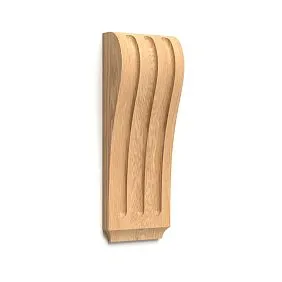
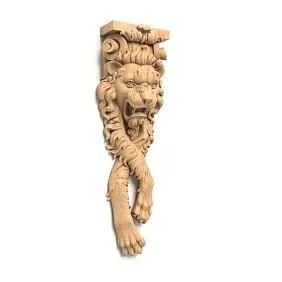
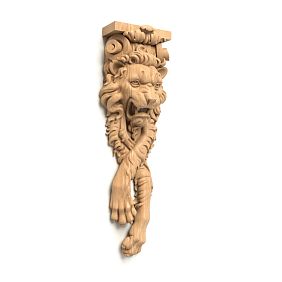



Classic S-shaped brackets
The smooth S-shaped line — the most recognizable bracket form. It arose from the logic of material behavior: wood bent in this way optimally distributes load, resisting bending. But engineering practicality did not prevent turning this form into a work of art.
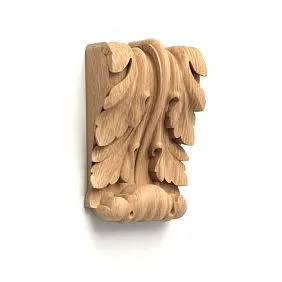
Classic S-shaped brackets are adorned with acanthus leaves — a favorite motif of antiquity and classicism. Acanthus leaves are carved in varying degrees of detail: from a suggestion of form to botanically accurate rendering of each leaf’s tooth. Scrolls — spiral curls — complete the composition, creating rhythm and movement.
Such brackets fit beautifully into classical interiors, where symmetry, proportions, and recognizable historical motifs are valued. They supportdecorative elementsthe interior, creating a unified style of space.
Get Consultation
Neoclassical brackets with fluting
Neoclassicism is classicism reinterpreted through the lens of modernity. Here, forms become more streamlined, decoration more restrained. Brackets in the neoclassical style are often adorned with fluting — vertical grooves running along columns.
Fluting creates a play of light and shadow, adds vertical rhythm, visually lightens the structure. Such a bracket looks elegant, not overwhelming the space with details. It is ideal for interiors that require a classical foundation but in a modern interpretation — light, airy, with large windows and minimal furniture.
Art Deco: geometry and luxury
Favorite motifs — stylized sun rays, zigzags, trapezoids, rhombuses. All of this is intricately carved in wood, creating a jewel-like effect. Art Deco demands contrast: dark wood — wenge, stained oak — combines with gold leaf, inlays, lacquered surfaces. Such brackets become interior accents, drawing attention with their ornate beauty.
Minimalist geometric forms
Minimalist geometric forms
Not everyone needs carving and decoration. For modern interiors — lofts, Scandinavian style, Japanese minimalism — brackets with simple geometric forms are created. Straight lines, right angles, no ornamentation. Beauty here lies in the purity of form, in the quality of surface finish, in the nobility of the wood.
Such brackets are made from light woods — ash, maple, birch. The surface is coated with oil or wax, highlighting the wood’s texture. No paints, patinas, gold leaf — only the natural beauty of the material. These elements pair beautifully withwooden wall plankscreating a unified natural wood aesthetic in the interior.
Sculptural brackets: art of support
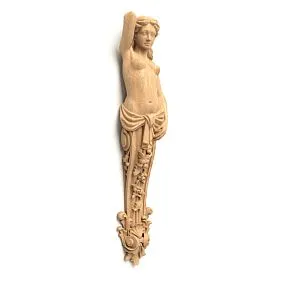
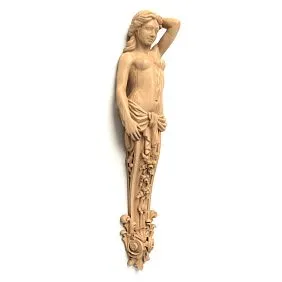
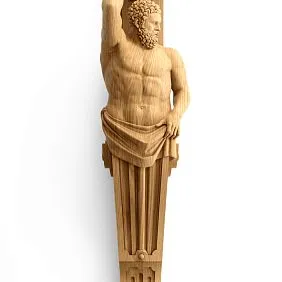
The pinnacle of craftsmanship — sculptural brackets in the form of figures. Atlantes bearing the vault of heaven on their shoulders. Caryatids supporting entablatures. Lions, symbols of strength and power. Griffins, chimeras, dragons — fantastic creatures frozen in the moment of exertion.
Such brackets are no longer just functional elements, but independent works of art. They require a high level of carving skill, capable of infusing life into wood, giving it expressiveness and character. Sculptural brackets are suitable for grand interiors, where every detail must astonish and delight.
Materials and Manufacturing Technologies
The beauty of a bracket begins with the choice of wood. Not every wood is suitable for carving and load-bearing functions simultaneously.
Oak: eternal strength
Oak is the king among species for making furniture and decor. Its wood is dense, hard, resistant to deformation and damage. An oak bracket withstands significant loads, does not sag, does not crack over time. At the same time, oak is highly suitable for carving: although it is hard, its fibers allow for creating clear, detailed forms.
The color of oak varies from light honey to dark brown depending on the method of treatment. Oak that has been soaked for decades in water acquires a noble dark gray, almost black hue. Such wood is especially prized for creating elements in the Art Deco style and modern minimalist interiors.
The texture of oak is expressive: annual rings are clearly visible, heartwood rays create a distinctive radial pattern. This texture is emphasized by transparent finishes — oils, waxes, lacquers. Oak pairs well with other solid wood interior elements:with matching legs, wooden cornices, baseboards.
Beech: density and uniformity
Beech is another excellent species for brackets. By density, it is close to oak, but has a more uniform structure without pronounced annual rings. This makes beech ideal for complex, detailed carving: fibers do not interfere with tools, allowing the creation of the finest elements.
The color of beech is light, rose-beige, warm. It takes staining beautifully, allowing for shades ranging from bleached wood to dark walnut. Beech is stable, does not warp, holds its shape well. Its only drawback — hygroscopic nature: in humid spaces, beech items require additional protection.
Beech brackets are often used in classical and neoclassical interiors, where light wood with a smooth texture is required. They pair well withbalusters, furniture handlesand other decorative elements made from the same material.
Hand-carving technology
A true bracket is born under the chisel of a master. The process begins with preparing the blank: a board of the required thickness is cut to the outline of the future item. Then begins the actual carving — a long, meticulous process requiring experience, sensitivity to the material, and artistic taste.
The carver uses various tools: flat and semi-circular chisels, gouges for removing deep sections, fine knives for delicate lines. Each tool leaves its mark, and the art of the carver lies in arranging these marks into a harmonious composition. The depth of carving varies: from barely noticeable relief to high relief, where elements are almost completely separated from the background.
After carving, the item is carefully sanded. All surfaces must be smooth and pleasant to the touch. Special attention is paid to hard-to-reach areas — recesses between carving elements, inner surfaces of volutes. The quality of sanding determines how beautifully the final finish will lie.
Final finishing
Protection and decoration — two functions of the final finish. The bracket operates in the interior for years, exposed to dust, humidity, temperature fluctuations. The finish must protect the wood while preserving its beauty.
Painting — the pinnacle of decoration. Several techniques exist: from leaf gold applied in sheets to gold paint mimicking precious metal. Gold can cover the entire bracket or only protruding parts of the carving, creating a play between matte wood and golden sheen.
For modern interiors, transparent finishes — oils, waxes, lacquers — are preferred. They preserve the natural wood texture, merely enhancing its contrast. Oil penetrates deeply into the wood, highlights the grain pattern, gives a matte, velvety appearance. Lacquer creates a protective layer on the surface, can be glossy, semi-matte, or matte.
For modern interiors, transparent finishes — oils, waxes, varnishes — are preferred. They preserve the natural wood texture while enhancing its contrast. Oil penetrates deeply into the wood, highlighting the grain pattern and giving a matte, velvety appearance. Varnish creates a protective film on the surface, available in glossy, semi-gloss, or matte finishes.
Functional Use of Brackets
The bracket holds. This is its primary function, which has not lost relevance over the centuries. But what exactly can it hold in a modern interior?
Shelves: Classic Application
Shelves mounted on brackets — a classic, time-tested solution. Brackets are mounted on the wall, and a board is laid on top — resulting in a shelf capable of bearing significant load. Books, tableware, decorative items — all of this finds its place on such shelves.
The advantage of brackets over concealed mounting is visual honesty of the structure. You see what holds the shelf, understand the logic of mounting. This creates a sense of reliability, solidity. Moreover, beautifulCarvedbrackets themselves decorate the interior, transforming a utilitarian shelf into a decorative element.
Bracket size is selected based on shelf thickness and expected load. For light decorative shelves, small brackets 15–20 cm high are sufficient. For bookshelves or storage shelves holding heavy items, robust brackets 30–50 cm high are needed, capable of supporting dozens of kilograms.
Countertops and Bar Stools
In kitchens and dining rooms, brackets support protruding parts of countertops, bar stools, and folding tables. Here, they operate at the limit of their capacity, supporting not only the weight of the structure itself but also dynamic loads — support, pressure during cooking, weight of dishes and food.
For such applications, the strongest brackets made of oak or beech, massive and with a safety margin, are chosen. They are mounted at intervals of 60–80 cm, ensuring even load distribution. Brackets under countertops are often made in simpler forms, without excessive decoration — here, functionality is paramount.
A folding table on brackets — an excellent solution for compact kitchens. In the folded position, it takes up no space; when needed, it folds out, resting on the brackets. After use, the table folds back, and the brackets remain visible as decorative elements.
Fireplace Shelves
The fireplace is the center of the living room, a place that attracts attention. A fireplace shelf must not only be functional but also beautiful, matching the status of the fireplace. The brackets supporting this shelf become part of the fireplace portal, elements of its decorative design.
Here, the most ornate, sculptural brackets — with acanthus leaves, volutes, figures — are appropriate. They can be part of a larger composition, where brackets transition into pilasters framing the firebox, and the top is crowned with a cornice. Such a portal transforms an ordinary fireplace into an architectural structure worthy of a palace.
Brackets for fireplaces must be heat-resistant. Oak and beech handle this task well, not deforming under heat. The only thing to ensure is a safe distance from the firebox and use fire-retardant treatments.
Cornices and Decorative Elements
Brackets can support not only horizontal surfaces but also other decorative elements. Heavywooden cornicecurtains require a reliable support — brackets handle this task while simultaneously decorating the wall.
Canopies over beds, decorative valances over doors, awnings over windows — all of these can rest on brackets. In large rooms, brackets are sometimes used purely decoratively, without load-bearing function, simply as elements of classic decor supporting the interior style.
Choosing Brackets by Interior Style
The bracket must match the overall style of the space. What looks great in a Baroque living room will be inappropriate in a Scandinavian kitchen.
Classic Interiors
Classic style loves symmetry, recognizable historical forms, quality materials. Here, appropriate are S-shaped brackets with acanthus leaves and volutes, painted white, cream, or antiqued. Size should be substantial — small brackets in a classic interior look out of place.
brackets support bookshelves in a library, fireplace shelves in a living room, dish shelves in a dining room. They harmonize with other elements of classic decor —on the walls, creating a complete classical composition.moldings,wooden wall decorIt is important to maintain material and finish unity: if brackets are made of oak, then other wooden elements should also be oak.
Neoclassicism and Art Deco
Neoclassicism is a lighter version of classicism, more airy, with less decoration. Brackets here also become simpler: fluting instead of acanthus, geometry instead of floral forms. Colors are light, pastel. Sizes are moderate — brackets should not dominate but rather support the overall elegance.
Art Deco demands geometric clarity and simultaneously luxury. Brackets in this style are adorned with stepped forms, zigzags, stylized sun rays. Material — dark wood, finish — gold leaf, silvering, lacquering to mirror shine. Such brackets become jewelry-like details of the interior.
Provence and country
Rustic styles love naturalness, simplicity, traces of time. Brackets here should look as if made by a local carpenter for their own home. Forms are simple, carving is not overly complex. Finish — transparent oils highlighting wood texture, or pastel coloring with a worn effect.
Provence prefers light shades — white, cream, lavender, mint. Brackets can be artificially aged: surface is sanded, painted, then partially worn away to reveal wood in areas where natural wear would be most likely. This creates the impression that the brackets are old, having served several generations.
Country style is more brutal: here, massive brackets made of rough wood with preserved tool marks, irregularities, and knots are appropriate. Finishing is minimal — oil or wax. Such brackets look great in country houses, dachas, and interiors with exposed beams and brick walls.
Modern style and minimalism
Modern interiors do not reject wood, but use it differently. Brackets here lack carving; their beauty lies in clean lines, quality of finish, and natural material texture. Shapes are simple: rectangles, triangles, smooth curves without ornamentation.
Material — light woods (beech, maple, birch) or, conversely, dark (wenge, stained oak), but necessarily with pronounced texture. Finish is transparent — oil or matte lacquer. Brackets pair withwooden planks, creating a unified language of natural materials in the interior.
Minimalism values functionality above all else. Here, the bracket is primarily a holder, and only secondarily a decoration. But even a functional element can be beautiful. Simplicity of form, perfect craftsmanship, nobility of material — this is enough for a bracket to become an ornament in a minimalist interior.
Bracket mounting: technology of reliability
A beautiful bracket is useless if it is poorly secured. Mounting is a critically important stage, determining whether the shelf will serve for years or collapse under load.
Wall preparation
The bracket is mounted to the wall, and the strength of the entire structure depends on the reliability of this mounting. The wall must be load-bearing or sufficiently strong to withstand the load. Gypsum board partitions require reinforcement — built-in beams installed during the frame assembly stage.
Before installation, the wall material is determined. For concrete and brick, screws with anchors are used. For wood — long screws driven directly. For aerated concrete — special anchors that expand into porous material. Incorrect choice of fasteners is the main cause of shelf collapse.
The wall surface must be flat. If there are significant irregularities, the bracket will not press tightly, creating gaps. In this case, the wall must be leveled with plaster or adjustable washers are placed under the bracket.
Marking and installation
Accuracy of marking determines whether the shelf will hang evenly. A level — bubble or laser — is used. Points for mounting the first bracket are marked, then the position of the second is determined using the level. The distance between brackets depends on the shelf length and expected load: for a light decorative shelf, 60–80 centimeters is sufficient, for a bookshelf, 40–50 centimeters is better.
Holes of the required diameter and depth are drilled. The drill bit diameter must match the anchor. Depth should exceed the anchor length by 5–10 millimeters to prevent concrete dust from interfering with installation. After drilling, holes are cleaned of dust — with a vacuum cleaner or compressed air.
Anchors are inserted, the bracket is placed, and screws are tightened. Screws should be tightened evenly, alternating between all screws. This ensures even contact between the bracket and the wall. Over-tightening is dangerous — it may strip the threads or crack the anchor.
Shelf installation
After mounting the brackets, a shelf board is placed on them. The board thickness must match the bracket size: for small brackets — 20–25 millimeters, for large ones — 30–40 millimeters. A too thin board will sag, while a too thick one will look bulky.
The board may lie freely or be screwed to the brackets from below. Free placement allows easy removal of the shelf for cleaning or repair. Screwing makes the structure stiffer, preventing shelf displacement. Screws are driven from below through the bracket into the board, so they are not visible from above.
It is important that the shelf rests on the brackets with its full width. If the shelf depth exceeds the bracket projection, the front edge will sag. Ideally, the bracket should be 60–80% of the shelf depth. For example, for a 30-centimeter deep shelf, brackets with a 20–25-centimeter projection are needed.
Combination with other interior elements
A bracket does not exist in isolation. It is part of a larger composition, and its beauty unfolds in combination with other elements.
Brackets and furniture hardware
Unity of details creates interior coherence. If there is furniture withwith matching legsclassical form in the room, brackets must support this style. Carving on legs and carving on brackets can echo, repeat the same motifs — acanthus leaves, volutes, fluting.
Furniture HandlesHandles on cabinets and chests should also match brackets in style and finish. If brackets are gold-plated, handles may be bronze or brass. If brackets are painted white, handles may be white ceramic or glass. This creates visual links, unifying disparate items into a single ensemble.
Brackets and wall decor
A shelf on brackets is a decorative element by itself, but it can be complemented by other wall decorations.decorative elements, placed next to the shelf, create a composition. It is important not to overdo it: if brackets are very ornate with abundant carving, additional decor should be restrained.
In classical interiors, above the shelf, a mirror or painting in a carved frame is often placed. The frame can echo the brackets in carving style. Below the shelf, moldings or friezes may be placed, creating a framed composition. All of this must be planned in advance so that elements support each other, rather than compete for attention.
Lighting and brackets
Light brings the carving to life, making it play and change character depending on direction and intensity. Carvings with deep relief are especially expressive under side lighting, when light and shadow emphasize the relief.
Wall sconces placed next to shelves on brackets create local lighting, highlighting this area. You can install an LED strip under the shelf, illuminating from below — this creates a floating, light effect. Spotlights directed at the brackets turn them into sculptural objects, drawing attention to the carving details.
Care for wooden brackets
Wood is a living material that requires care. Proper care extends the service life of brackets and preserves their beauty.
Regular cleaning
Dust settles on all surfaces, and carved brackets are no exception. Dust accumulates especially actively in the recesses of the carving. Brackets should be wiped once a month with a dry soft cloth or a brush with long soft bristles.
For more thorough cleaning, use a slightly damp cloth. Water should be slightly warm, without detergents. After wet cleaning, brackets should be wiped dry to prevent moisture from being absorbed into the wood. This is especially important for brackets with transparent coatings — water may leave stains on the wood.
Protection against damage
Wood fears impacts, scratches, and abrasion. Brackets are mounted on walls, usually above the active movement zone, but accidental damage is possible. When moving furniture or carrying large items, be careful not to hit the brackets.
If damage occurs — a chip, scratch, dent — it can be restored. Minor scratches on lacquered surfaces are polished with special compounds. Chips on painted brackets are touched up. Deep damage requires professional restoration — repairing the carving, resanding, and reapplying the finish.
Humidity and temperature
Wood reacts to changes in humidity and temperature. When humidity increases, it swells; when it decreases, it dries out. These fluctuations can lead to warping and cracking. The optimal humidity for wooden items is 40-60%, and temperature — 18-25 degrees.
In apartments with central heating, air is often overly dry in winter. This is bad for both people and wood. Using humidifiers solves the problem. In country homes, where humidity fluctuations can be significant, wooden elements require more careful protection — multi-layer coatings resistant to moisture.
Brackets should not be placed near heat sources — radiators, fireplaces, heaters. Heat dries out wood, coatings may crack, and carving may deform. The minimum distance from a heat source should be 50 centimeters.
Recoating
Any coating eventually wears out. Lacquer fades, oil washes out, paint fades. Renewing the coating restores brackets to their original appearance. This involves partially or completely removing the old coating, sanding the surface, and applying a new coating.
Transparent coatings are easier to renew: simply apply a new layer of oil or lacquer over the old one after light sanding. Painted brackets require complete removal of old paint, priming, and repainting. Gilding is the most complex finish to renew, often requiring professional skills.
Custom manufacturing: creating unique brackets
Standard catalogs do not always contain exactly what is needed for a specific interior. Sometimes an unusual size, special shape, or unique ornament is required. In such cases, brackets are manufactured to order.
Design
The process begins with discussing the task. The designer or client formulates requirements: style, dimensions, material, finish. It’s helpful if there are references — photos or drawings of brackets that appeal. This helps understand aesthetic preferences and direction.
Based on these data, a sketch is created — a drawing of the future bracket with dimensions and main carving elements indicated. The sketch is reviewed with the client, and adjustments are made. Sometimes several iterations are needed until a shape satisfying everyone is found.
After approving the sketch, a technical drawing with precise dimensions is made. The load-bearing capacity is calculated — whether the bracket can withstand the expected load. If necessary, the structure is reinforced — thickness is increased, or stiffening ribs are added.
Manufacturing
Carving begins with creating a blank. If the bracket has a complex shape, the blank is cut on a milling machine along the contour. Then the master carver manually refines details — leaves, volutes, decorative elements. This is meticulous work requiring time and skill.
To speed up the process, sometimes a combined technology is used: basic shapes are set on a CNC machine, while detailing is done by hand. This allows combining the precision of the machine with the liveliness of handwork. The machine cannot convey the nuances or energy that the master’s hand brings.
After carving, the bracket is sanded and coated with the chosen finish. The entire process from sketch to finished product may take from several days to several weeks depending on complexity.
Cost of custom order
Uniqueness has a price. A custom bracket costs more than a catalog one because it includes the cost of design, tooling, and the carver’s handwork. But the result is worth it: you receive an item specifically created for your interior, taking into account all nuances and preferences.
Cost depends on size, carving complexity, and material. A simple geometric bracket from beech may cost several thousand rubles. A complex sculptural oak bracket with gilding — tens of thousands. But compared to the overall cost of the interior, this is a reasonable investment in details that create uniqueness.
Errors in selecting and using brackets
Even beautiful brackets can spoil the interior if chosen or installed incorrectly. Let’s consider typical errors.
Mismatched sizes
Too small brackets under a large shelf look disproportionate and do not provide reliable support. Too large brackets under a narrow shelf create an overloaded effect. Size must match the task: the bracket should be 60-80% of the shelf’s depth.
The height of the bracket is also important. In a room with high ceilings, small brackets will be lost and go unnoticed. In a low room, large brackets will create a feeling of cramped space and visually lower the ceiling even more.
Stylistic dissonance
Baroque brackets with gilded acanthus leaves in a loft, minimalist geometric brackets in a classical interior — such combinations create a visual conflict. Brackets should support the overall style, not contradict it.
If the interior is eclectic, combining elements of different styles, brackets should be universal and neutral. Simple shapes, natural wood without excessive decoration — such elements work in most contexts.
Incorrect placement
Too large a distance between brackets — the shelf sags. Too small — material waste and visual overload. The optimal spacing depends on the shelf material and load: for MDF or particleboard — 40-50 cm, for solid wood — 60-80 cm, for glass — 30-40 cm.
The height of shelf placement is also important. Too high — inconvenient to use, too low — risk of hitting your head. In the living room, the optimal shelf height is 160-180 cm from the floor. In the kitchen — 50-60 cm above the work surface.
Insufficient fastening
Saving on fasteners is a path to collapse. A bracket must be secured with at least two, preferably three screws. Anchors must match the wall material. For heavy shelves, use reinforced fasteners — anchor bolts, chemical anchors.
If the wall is not strong enough (gypsum board, aerated concrete), you must locate structural elements — studs, beams — and attach to them. Alternatively, reinforce the wall with embedded elements. Ignoring these rules leads to unfortunate consequences.
Frequently Asked Questions about decorative brackets
What weight can wooden brackets support?
Load-bearing capacity depends on size, material, and mounting method. A typical oak or beech bracket, 25-30 cm high, mounted with three screws into concrete or brick wall, supports 30-50 kg. When installing two brackets spaced 60 cm apart, the shelf can support 60-100 kg — sufficient for books, dishes, decorative items.
Can brackets be used in a bathroom?
Yes, but additional protection is needed. Wood in humid areas requires multi-layer moisture-resistant finishes — oils with wax, yacht varnishes. Best wood species for bathrooms — oak and teak, naturally moisture-resistant. After each use, the bathroom should be ventilated to reduce humidity.
How many brackets are needed for one shelf?
For shelves up to 60 cm long, two brackets at the ends are sufficient. For 80-120 cm shelves — two brackets spaced 60-80 cm apart. For long shelves over 120 cm, three or more brackets are recommended to avoid sagging in the middle. For heavy bookshelves, spacing reduces to 40-50 cm.
Can brackets be painted yourself?
Yes, if you have basic woodworking skills. Unfinished brackets are purchased already sanded. They must be primed, then painted with 2-3 coats with intermediate drying. For patina, first apply a base dark layer, then a lighter one that partially wears off after drying, revealing the lower layer in recesses. Finish with a protective varnish.
How to combine brackets of different sizes in one interior?
Brackets can be of different sizes if they are in a unified style and finish. For example, large brackets for a bookshelf and small ones for a decorative shelf will harmonize if both have S-shaped forms with acanthus leaves and are painted white. It is important to maintain stylistic unity; sizes can vary according to function.
Do new wooden brackets need preparation before installation?
Ready-made brackets with final finish can be installed immediately. Unfinished brackets should be coated with a protective finish — oil or varnish — before installation. This prevents dirt, moisture absorption, and color changes. If painting is planned, it is easier to do it before mounting, when the bracket can be conveniently positioned on a workbench.
Which brackets are better — solid or ornate?
It depends on the task and style. Solid brackets are more reliable, support heavier loads, suitable for bookshelves, countertops. They fit classical and country interiors. Ornate brackets with delicate carving are more decorative, visually lighter, suitable for decorative shelves with light loads. They suit neoclassicism, Provence, where elegance is valued.
Can brackets be mounted on a wooden wall?
Not only can they be mounted, but it is also easier than on concrete or brick. Screws are driven directly into wood without anchors. It is important to hit a load-bearing beam, not the cladding. Screw length should be such that it enters the beam by at least 40-50 mm. For reliability, use screws with coarse thread pitch, designed for wood.
Are brackets with carving harder to maintain?
Deep carving does indeed collect more dust than a smooth surface. But regular cleaning with a soft brush or vacuum cleaner with a brush attachment solves the problem. Once a month — quick dry brush cleaning, every six months — more thorough cleaning with a damp cloth. Modern finishes — varnishes, oils — protect the carving, making it less susceptible to dirt.
Of course. In classic interiors, brackets are sometimes mounted on walls without shelves, simply as decorative elements. They create vertical accents, support the style, add volume. In this case, they can be of any size and shape, not limited by functional requirements. This is purely an artistic solution.
Modern trends in bracket design
Fashion changes, but classic forms remain. At the same time, new trends emerge that influence bracket design.
Demand is growing for solid wood items, free from synthetic materials. Customers are interested in the origin of the wood, processing methods, and types of finishes. Preference is given to natural oils and waxes instead of synthetic varnishes. Wood must breathe and retain its living nature.
Ecological and natural
This trend reflects the general movement toward conscious consumption. People want to know what they are buying, what it is made of, how it was produced. Handmade wooden brackets from local species fully fit into this philosophy.
This trend reflects the general movement toward conscious consumption. People want to know what they are buying, what it is made of, and how it was produced. Handmade wooden brackets from local species fully align with this philosophy.
Minimalist forms with emphasis on texture
Moving away from excessive decoration in favor of the beauty of the material. Wooden brackets with simple forms and expressive textures — such as knots, roots, or boards with burls — become self-sufficient decorative elements. It is not carving, but the very structure of the wood that becomes the ornament.
Such an approach requires careful material selection. Each bracket is unique because the texture of wood is irreplaceable. This is the opposite of mass production — handmade items, each with its own character.
Style mixing
Eclecticism allows combining classic brackets with modern furniture, rustic forms with industrial elements. The key is to find a unifying element: color, material, proportions. Properly selected brackets can become a bridge between different styles, uniting them into a cohesive whole.
Functionality and transformation
Modern spaces require flexibility. Brackets with built-in hooks, retractable elements, and the ability to change configuration are appearing. These are no longer just holders, but multifunctional storage systems.
Flip-up shelves on brackets, foldable tables, transformable consoles — all of this responds to the demand for city apartments, where every centimeter counts. Beauty combines with practicality, creating solutions for modern life.
Conclusion: beauty that holds
Decorative brackets for shelves— it is not just fastening, but a design philosophy where function and beauty are inseparable. In a world overflowing with soulless industrial products, a carved wooden bracket is a manifesto of individuality, a statement that details matter.
Wood processed by a master’s hands retains warmth and energy. Carving that repeats natural forms creates a connection between home and the living world. A bracket holding a shelf with favorite books or family photos becomes part of the home’s history, a witness to family life. Over decades, these elements will remind us of the time when homes valued real materials and quality craftsmanship.
Brackets combine with other wooden decor elements, creating a unified interior language.
Brackets combine with other wooden decor elements, creating a unified interior language.Furniture legs, balusters for staircases, decorative rose outlets, Furniture handles wooden— all these details, executed in one style, transform the home into a thoughtfully designed work of art, where each element has its place.
Modern technologies make high-quality wooden brackets accessible. The combination of machine processing and hand carving allows producing high-quality items at reasonable prices. At the same time, the soul of handcrafted work is preserved — that uniqueness which distinguishes a living product from a stamped one.
Installing brackets requires attention and precision, but is not a complex task. Basic skills in working with tools, following the technology — and a reliable, beautiful shelf will serve for decades. This is an investment that pays off over years of flawless service and aesthetic pleasure.
Care for wooden brackets is minimal. Periodic dusting, protection from excessive humidity and direct sunlight — this is enough to preserve the beauty of the wood. When necessary, the finish is renewed, returning the elements to their original appearance.
The company STAVROS has specialized in producing decorative elements from solid wood for more than twenty years. The catalog features over sixty models of brackets in various styles, sizes, and shapes. Classic S-shaped brackets with acanthus, elegant neoclassical models with fluting, authentic art deco brackets, minimalist geometric forms for modern projects, exclusive sculptural elements — each will find a solution for their interior.
All products are made from beech and oak — species proven over centuries in furniture production. Asymmetric models have mirrored versions, allowing the creation of symmetrical compositions. Each model is available in a wide range of sizes, adapted to different tasks — from miniature decorative shelves to large bookcases.
STAVROS products — premium quality at reasonable prices. In-house production allows controlling all stages — from selecting wood to final finishing. Special conditions and loyalty programs are available for designers, architects, and furniture manufacturers. Orders can be placed from one piece or in bulk. Ready products are shipped from the warehouse in Saint Petersburg the next day, with fast delivery to any region of Russia.
Wooden brackets STAVROS — a combination of functionality, beauty, and durability. These are details that make a home a home, transforming standard housing into a space with character and history. This is an investment in quality of life, in an environment that delights the eye and soul every day.
STAVROS wooden brackets are a combination of functionality, beauty, and durability. These are details that turn a home into a home, transforming standard housing into a space with character and history. This is an investment in quality of life, in an environment that delights the eyes and soul every day.


