Article Contents:
- The Philosophy of Surface: Why Walls Have Become the Main Focus
- Trend one: naturalness as a manifesto
- Wooden Overlays: The Warmth of Solid Wood on Walls
- Texture as the Primary Expressive Medium
- Trend Two: Geometry and Minimalism of Volumes
- Geometric Panels: Architecture on a Plane
- Linear Systems: Battens and Layouts
- Trend three: 3D panels and volumetric decor
- Technologies for Creating Volume
- Patterns and Textures of 2026
- Trend Four: Accent Walls with Moldings
- Large Formats: From Delicate to Dramatic
- Color as a Tool of Dramaturgy
- Trend Five: Combining Materials
- Wood Plus Metal: The Contrast of Warm and Cold
- Polyurethane Plus Lighting: The Architecture of Light
- Mirror as a Space Multiplier
- Relevant STAVROS Collections 2026
- Natural Collection: Organics and Texture
- Geometry Collection: Purity of Lines
- Linear Collection: Rhythm and Structure
- Relief Collection: Maximalism of Volume
- Classic Collection: Tradition and Modernity
- Application Practice: From Idea to Implementation
- Choosing the Type of Decor for the Task
- Material Quantity Calculation
- Installation Technology: Key Points
- Frequently Asked Questions About Wall Decor
- Can 3D Panels Be Used in Wet Areas?
- How Long Does It Take to Install Decor on One Wall?
- How to care for relief decor?
- Can decor be removed without damaging the wall?
- Where to buy decor from current 2026 collections?
- STAVROS: your partner in creating trendy interiors

What makes a space truly alive? Not the area, not the ceiling height, not the number of windows. Life is given to a space by relief, volume, and the tactility of surfaces. Preciselydecorative interior ornamentstransform a faceless box of concrete and plaster into an environment that evokes emotions, creates a mood, and tells stories. The year 2026 has brought a new wave of trends in wall decor — a time when minimalism meets texture, when technology allows any fantasy to be realized, when the naturalness of materials becomes not just an aesthetic choice, but a philosophy of life.


The philosophy of surface: why walls have become the main focus
Just ten years ago, decor was concentrated on furniture, textiles, and accessories. Walls remained a background — neutral, monochrome, as inconspicuous as possible. But in 2026, the situation has changed dramatically. Walls have come to the forefront, becoming the main tool for creating the character of an interior. Why? Because we are tired of mobility, of temporariness, of the feeling that everything can be replaced with one click.Buy wall decorationstoday — is an investment in stability, in creating a space that will stay with you for years, will evolve, acquire a patina of time, and become part of your personal history.
Walls occupy the lion's share of a room's visual space. With a ceiling height of 3 meters and a room perimeter of 20 meters, the wall area is 60 square meters. This is a huge canvas whose potential has long been ignored. Modern designers have realized: it is the walls that determine how we perceive the scale of a room, its proportions, its atmosphere. A smooth white wall creates a feeling of sterility, hospital-like cleanliness. A wall with relief, with a play of light and shadow, with a tactile texture — is a living surface that changes throughout the day with the movement of the sun, that looks different under natural and artificial lighting.
The psychology of perceiving volumetric surfaces is profound. Our brain evolved in an environment where every surface had texture — tree bark, stones, foliage. Absolutely smooth surfaces do not exist in nature; they are unnatural for our perception. When we surround ourselves with relief textures, the subconscious calms down, reading signals of naturalness, safety, and rootedness. This is not mysticism, but neuroscience — our brain reacts to visual and tactile stimuli that remind it of the natural habitat.




Trend one: naturalness as a manifesto
The main trend of 2026 is a return to natural materials, to their honest use without attempts at imitation or disguise. Wood looks like wood, with visible texture, with natural irregularities, sometimes even with knots and cracks that were once considered defects but are now perceived as proof of authenticity. Polyurethane does not try to pretend to be marble — it is painted in matte monochrome colors that emphasize form, not imitate non-existent materiality.
Our factory also produces:


Wooden overlays: the warmth of solid wood on walls
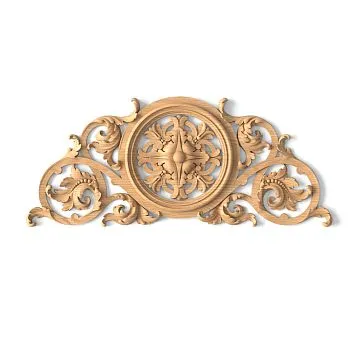
wall decor for interiormade of solid oak, beech, ash are experiencing a renaissance. The reason is simple: people miss the real, what can be touched and felt as different. A wooden overlay on a wall is not just beautiful — it is warm to the touch, it smells of wood, it has weight, a physical substantiality that cannot be faked.
The sizes of wooden wall overlays in the 2026 trend have increased. If elements of 150×150, 200×200 millimeters previously predominated, now overlays of 300×300, 400×600 millimeters are in demand — large-scale accents that do not get lost on the large planes of modern apartments with high ceilings. The depth of relief has also increased — overlays with protruding elements up to 40-50 millimeters are popular, creating a powerful play of light and shadow, especially effective with side lighting.
The style of wooden overlays in 2026 gravitates towards organic forms. Plant motifs are popular, not in classic baroque execution with perfect symmetry, but in a freer, more natural interpretation — branches with irregular bends, leaves with asymmetrical edges, bark textures, wood cuts with annual rings. This is decor that reminds us of nature not through stylization, but through direct quotation of its forms.
Get Consultation
Texture as the main expressive means
If in previous years wood texture was often hidden under dense layers of paint, the 2026 trend is transparent oils and varnishes that emphasize, not mask, the grain pattern. Oak with its large pores and expressive annual rings, ash with contrasting stripes, walnut with its noble dark texture — each wood species has a unique visual code that in 2026 is valued above any decorative effects.
Surface treatment — brushed wood, where soft fibers are removed and hard ones remain, creating a relief texture. This can not only be seen but felt tactilely — run your hand over the surface and feel the rhythm of the protruding lines. Thermal treatment of wood gives it a deep brown color without using stains, a pure result of a physical process, not chemical coloring. Smoking wood creates graphite-black shades with silvery iridescence — an effect impossible to achieve with painting.
Trend two: geometry and minimalism of volumes
Parallel to organic trends, the opposite direction is developing — strict geometry, minimalist forms, where decorativeness is achieved not through ornament, but through purity of lines and precision of proportions.Minimalist overlayson walls are squares, rectangles, triangles, hexagons with minimal relief of 5-15 millimeters, painted in monochrome colors.
Geometric panels: architecture on a plane
Geometric wall panels made of polyurethane or MDF with milled relief create rhythmic patterns that structure the wall, divide it into zones, create visual accents without visual noise. Popular motifs of 2026: honeycombs (hexagons connected by sides), cubes in isometric projection (creating an illusion of three-dimensionality on a flat surface), waves (horizontal or vertical lines with smooth curves), pyramids (regular tetrahedral protrusions arranged in a checkerboard pattern).
The sizes of geometric panels are standardized for easy installation — squares 500×500, 600×600 millimeters, rectangles 1000×500 millimeters. Modularity allows covering walls of any area with minimal trimming, creating seamless compositions. Panel thickness of 15-30 millimeters provides sufficient relief for creating a play of light and shadow, but does not consume room space.
Color solutions for geometric decor in 2026 are monochrome and nuanced combinations. White on white — panels a shade darker or lighter than the main wall, where relief is revealed only through shadows. Gray palette — from light gray to graphite, creating a calm neutral environment. Deep saturated colors — emerald green, ultramarine blue, terracotta, burgundy — for accent walls, where geometric relief enhances color intensity.
Linear systems: battens and layouts
Battens as wall decor— one of the most relevant trends for 2026. Wooden or MDF slats, 30-80 millimeters wide and 10-20 millimeters thick, are mounted on the wall vertically or horizontally with equal spacing, creating a rhythmic structure. This is not a solid covering — the gaps between the slats are 30-100 millimeters, revealing the base wall painted in a contrasting or nuanced color.
Vertical slats visually elongate a room, making ceilings appear higher. The optimal spacing for standard ceilings of 2.7-3.0 meters is 50-70 millimeters between slats. For high ceilings from 3.5 meters, the spacing can be increased to 100-120 millimeters. Horizontal slats, on the contrary, widen the space, making narrow rooms appear visually more spacious. Diagonal slats at a 45-degree angle create dynamism and movement but require careful calculation and precise fitting in corners.
Slat material — solid oak or beech for the premium segment, MDF with film coating or painted for budget projects. Color — natural wood under varnish, white, black, gray, sometimes contrasting combinations where slats of one color on a wall of another create a graphic composition. Lighting — LED strips placed behind the slats create a floating stripe effect, with light seeping through the gaps, producing soft ambient lighting.
Trend three: 3D panels and volumetric decor
CNC milling and pressure casting polyurethane technologies have enabled the creation of a new class of decor —3D wall panelswith relief depths of up to 80-100 millimeters. This is no longer decor in the conventional sense, but a three-dimensional sculpture covering the wall, creating the illusion of architectural elements — columns, arches, niches — while maintaining the wall's flat plane.
Technologies for creating volume
Polyurethane 3D panels are manufactured by casting in silicone molds. Liquid polyurethane is poured into the mold, where under pressure it fills all relief details, hardens in 10-15 minutes, and is extracted. This allows for replicating the most complex forms with precision to fractions of a millimeter, creating panels with undercuts impossible to achieve through milling. The weight of polyurethane panels is low — one square meter weighs 3-5 kilograms, simplifying installation and reducing load on walls.
MDF panels with milled relief are created on high-precision CNC machines. A cutter carves depressions and protrusions into the MDF mass according to a digital model. This is more expensive than polyurethane casting but allows for creating unique designs without making molds — a 3D model is sufficient, and the machine will reproduce any relief. MDF panels are heavier than polyurethane ones — one square meter weighs 12-18 kilograms, requiring more reliable fastening.
Gypsum 3D panels — the premium segment, where each panel is cast by hand in gypsum molds. Gypsum is a natural material; it breathes, regulates humidity, and creates a special microclimate. The surface of gypsum panels is matte, noble, with slight unevenness that emphasizes the handmade quality. The weight is significant — one square meter is 20-30 kilograms, and installation requires professional skills and reinforced fasteners.
Patterns and textures of 2026
Organic textures — imitation of natural surfaces: tree bark with deep cracks and growths, stone cuts with uneven edges and veins, water ripples with concentric circles, sand dunes with smooth waves. These patterns create associations with nature, calm, and ground the space. They are especially effective in monochrome execution — white gypsum or polyurethane, where the form is revealed only through light and shadow.
Geometric patterns — cubes arranged in isometric projection, creating the illusion of protruding and receding volumes; honeycombs of various scales — from small 30 millimeters to large 150 millimeters in diameter; waves with different amplitudes and frequencies; weaves resembling textiles or rattan. Geometry works in modern interiors where order, rhythm, and predictability of forms are valued.
Abstract compositions — chaotic combinations of protrusions and depressions without a clear pattern, creating a unique relief on each panel. These are art objects where each wall becomes a sculpture piece. Such panels are usually ordered based on individual sketches, manufactured in small series or even as a single copy. The cost is high, but the result is unique — no one in the world will have the same wall.
Trend four: accent walls with moldings
If 3D panels are the maximalism of volume, thenaccent walls with moldings— this is classicism reinterpreted for modernity. Moldings — profiled section millwork — are used to create frames, panels, and divisions on walls. This is an old technique, but in 2026 it received a new embodiment through altered proportions, unexpected color solutions, and integration with lighting.
Large formats: from delicate to dramatic
Traditional moldings were 40-60 millimeters wide — sufficient for creating a frame but insufficient for creating an architectural impression. The 2026 trend is moldings 100-150 millimeters wide, perceived not as decor but as architectural elements — pilasters, panels, rustication. Such moldings divide the wall into large sections of 1000×1500, 800×2000 millimeters, creating rhythm, scale, and structure.
The profile of moldings has simplified. Instead of complex multi-stage forms with alternating curves and beads, simple rectangular sections or profiles with one or two roundings are popular. This aligns with the general trend toward minimalism — not form for form's sake, but form for creating structure. The surface of moldings is smooth, without ornaments or carvings, color is monochrome — white, gray, black, sometimes matching the main wall color for a ton-sur-ton effect.
The placement of moldings on the wall follows not decorative but architectural principles. Vertical moldings from floor to ceiling with a spacing of 800-1200 millimeters create the rhythm of a colonnade. Horizontal moldings at a height of 900-1100 millimeters divide the wall into a panel and an upper part — a classic technique, but in a modern interpretation, the lower panel is painted in a rich dark color, the upper remains light. Rectangular frames made of moldings, placed symmetrically relative to the wall's central axis, create a classic boiserie composition.
Color as a tool of dramaturgy
White moldings on a white wall — a classic that never goes out of style. But 2026 brought new color solutions. Black moldings on a light gray wall create a graphic contrast, emphasize geometry, and make the composition more dramatic. Moldings the color of the wall but a tone darker or lighter — a delicate effect where structure is revealed through nuance, not contrast. Colored moldings on a neutral wall — emerald on white, terracotta on gray, gold on black — for interiors where maximum decorativeness is needed.
The technique of painting moldings has evolved. Besides classic opaque painting, decorative effects are used: patination — dark patina in the profile's recesses emphasizes the relief; gilding — gold leaf or gold powder for luxurious interiors; metallization — silver, copper, bronze paint for industrial style; ombre — a smooth color transition along the length of the molding, creating dynamism.Corner decorative elementscomplement moldings, masking joints and creating finished compositions.
Trend five: combining materials
One of the freshest trends of 2026 is the bold combination of different materials in the decor of a single wall. Wood plus metal, polyurethane plus glass, gypsum plus mirror — combinations that just a few years ago seemed eclectic are now perceived as natural, enriching the space with a variety of textures and light effects.
Wood plus metal: contrast of warm and cold
Wooden slats or panels are combined with metal inserts — steel, brass, copper, bronze. The metal can be matte or polished, creating a contrast with matte wood or harmonizing with it. A typical composition: vertical wooden slats of oak, 50 millimeters wide with an 80-millimeter spacing, between them — vertical brass strips 10 millimeters wide, creating golden accents. Or horizontal panels of ash, separated by horizontal steel profiles, emphasizing the layered composition.
Metal adds reflections, highlights, and liveliness to a static wooden surface. When the viewing angle changes or light sources move, the metallic elements play and create dynamics. This is especially effective in the evening under artificial lighting, when spotlights create bright highlights on polished metal, contrasting with matte wood.Wall decorative ornamentsCombined materials become focal points of the interior.
Polyurethane plus lighting: the architecture of light
One of the most technological trends for 2026 is the integration of LED lighting into decorative elements. Wide moldings and cornices are designed with internal cavities where LED strips are installed. The light is directed at the wall or ceiling, creating an effect of floating decor and a hidden light source. This is not just decoration, but a functional lighting element that works as ambient light, creates atmosphere, and zones the space.
A cornice 150-200 millimeters wide is installed under the ceiling at a distance of 100-150 millimeters from it. An LED strip is mounted inside the cornice, directed upwards. The light reflects off the ceiling, creating soft, diffused lighting that visually raises the ceiling, making it lighter. The light color is adjustable — warm white for a cozy atmosphere, cool white for work areas, colored RGB for special effects.
Wall-mounted moldings with integrated lighting create vertical or horizontal light strips that structure the space, highlight architectural features, and function as nighttime illumination. This low-level lighting doesn't strain the eyes, allows for comfortable nighttime movement, and creates an intimate atmosphere.Ceiling and wall cornicesSTAVROS are designed with the possibility of integrating lighting.
Mirror as a space multiplier
Mirror inserts in wall decor are a trend that has moved from commercial interiors to residential ones. Mirror strips between wooden slats create an illusion of additional depth, multiply light, reflect the opposite wall, visually expanding the space. Mirror overlays — elements with a mirror surface mounted on the wall together with wooden or polyurethane ones — create a contrasting composition where matte coexists with shiny, opaque with reflective.
Tinted mirrors — bronze, graphite, blue — create color reflections, tint reflections, and add mystery. They are less intrusive than regular mirrors, do not create a feeling of space doubling, but only hint at it through translucent reflections. Mirror tiles 100×100, 150×150 millimeters, mounted in a checkerboard pattern together with matte tiles of the same size, create a pixel pattern that changes depending on the viewing point.
Current STAVROS collections 2026
How to implement all these trends in a real interior? Where to find materials that meet current requirements for quality, aesthetics, and environmental friendliness?STAVROS decor collections 2026are developed taking into account all modern trends, offering ready-made solutions for any style and budget.
Natural collection: organic and texture
The Natural collection consists of wooden overlays and panels made of solid oak and ash, focusing on wood texture. The treatment is a brushed surface where soft fibers are removed, leaving only the hard wood that creates a relief texture. The coating is transparent oil, which emphasizes the grain pattern, gives a slight silky sheen, and protects against moisture and dirt. Color options: natural oak with a golden hue, tinted oak in gray tones, thermally treated ash with a deep brown color.
The forms of the Natural collection are large overlays 300×400, 400×600 millimeters with organic motifs: wood cross-sections with annual rings, branches with natural curves, bark textures. This is not a stylization of nature, but its direct quotation through forms taken from real natural objects and translated into decor. The relief depth of 30-50 millimeters creates an expressive play of light and shadow, especially effective with side lighting.
Geometry collection: purity of lines
The Geometry collection consists of polyurethane panels and overlays with geometric patterns. Forms: cubes in isometric projection, honeycomb hexagons of different scales, waves with varying amplitude, pyramids in a checkerboard pattern. Panel sizes are standard — 600×600 millimeters for easy installation and minimal cutting. A thickness of 20-25 millimeters provides sufficient relief to create a light and shadow effect.
The color scheme of Geometry is monochrome. Panels are supplied in white primer for painting in any color or pre-painted in popular shades: matte white, light gray, graphite, matte black. A tinting service is available for any color from the RAL catalog, allowing for precise matching to existing finishes. The panel surface is absolutely smooth, without pores or irregularities, creating a contrast with the relief of the form.
Linear collection: rhythm and structure
Linear is a system of wooden and MDF slats for creating linear compositions on walls. The slats come in three standard sizes: narrow 30×10 millimeters for frequent rhythm, medium 50×15 millimeters for universal application, wide 80×20 millimeters for large spaces. Material — solid oak or beech for the premium segment, MDF with film coating or painted for budget projects.
Linear colors: natural wood under varnish (oak, beech, ash), matte white, matte black, graphite gray, as well as the possibility of painting in any color. The system is equipped with mounting strips that are attached to the wall, and the slats themselves snap into the strips, ensuring easy installation and the possibility of removal without damaging the wall. Optionally, LED strips are offered for placement behind the slats, creating an effect of floating strips.
Relief collection: maximalism of volume
Relief consists of 3D polyurethane panels with deep relief up to 80 millimeters. Patterns: organic textures (bark, stone, water), geometric compositions (cubes, honeycombs, waves), abstract reliefs. Panel sizes — squares 500×500, 600×600 millimeters, rectangles 1000×500 millimeters. The weight of one panel is 1-2 kilograms, allowing them to be mounted on any walls, including drywall.
Relief panels are supplied in white primer for painting. The recommended technology is painting in a base color, then applying a second color using the dry brush method, where paint is applied to the protruding parts of the relief, and the recesses remain the base color. This creates a two-color effect that emphasizes volume, enhances the play of light and shadow. An alternative is painting in metallic colors (gold, silver, copper, bronze) to create a luxurious effect.
Classic collection: tradition and modernity
Classic — moldings andcorner elementsfor creating traditional panels and frames on walls, but in modern proportions. The width of the moldings is 100-150 millimeters — significantly larger than the traditional 40-60 millimeters. The profile is simple — rectangular cross-section with rounded edges, without complex curves and ornaments. The length of the strips is 2.5 meters, allowing for compositions on walls up to 3 meters high without horizontal joints.
The corner elements of the Classic collection — overlays measuring 100×100, 120×120 millimeters with a minimalist ornament or none at all, used to decorate the corners of molding frames.Ceiling RosettesThey complement the collection, allowing for the creation of full-fledged classic interiors. Color options: white, ivory, light gray, as well as the possibility of painting in any color or applying decorative effects.
Application practice: from idea to implementation
Trend theory is interesting, but how to apply it in practice? How to choose suitable decor for a specific room, calculate the quantity, install it, and achieve a result that will please for years? Let's break it down step by step.
Choosing the type of decor for the task
First question: what problem does the decor solve? If you need to visually increase the ceiling height — choose vertical elements: slats, vertical moldings, panels with vertical relief. If you need to widen a narrow room — horizontal slats, horizontal division with moldings. If you need to create an accent zone — one wall with volumetric decor, the others smooth. If you need sound absorption — relief panels that break up sound waves and reduce reverberation.
Second question: what interior style? For modern minimalism, geometric panels, slats, simple moldings are suitable. For neoclassicism — moldings with corner elements,ceiling rosettes, delicate overlays. For loft and industrial style — combinations of wood and metal, rough textures. For Scandinavian — natural light wood, minimal processing, simple forms.
Third question: what is the budget? Polyurethane is 2-3 times cheaper than wood, MDF occupies an intermediate position. Self-installation saves 30-50% of the project cost compared to hiring a crew. Local application of decor on one accent wall is cheaper than decorating the entire room. Using ready-made collections is cheaper than custom design. A realistic budget for decorating one wall with an area of 10-12 square meters is 30-80 thousand rubles depending on the chosen materials and installation complexity.
Material quantity calculation
For slats: the wall area is divided by the width of the slat plus the width of the gap, multiplied by the wall height. Example: wall 4 meters wide and 3 meters high, slat 50 millimeters, gap 70 millimeters. 4000 / (50+70) = 33.3 slats. Wall height 3000 millimeters, so each slat length is 3 meters. Total 33 slats of 3 meters = 99 linear meters. Add 10% for cutting = 109 linear meters.
For panels: the wall area is divided by the area of one panel. Example: wall 12 square meters, panel 600×600 millimeters = 0.36 square meters. 12 / 0.36 = 33.3 panels. Round up to 34 pieces. Add 2-3 panels for defects and cutting = 37 panels. If panels have a directional pattern (e.g., waves), consider the need to match the pattern, which increases consumption by 15-20%.
For moldings: measure the perimeter of each frame you plan to create, sum all perimeters, add 15-20% for cutting corners at 45 degrees. Example: planning 6 frames 800×1200 millimeters. Perimeter of one frame (800+1200)×2 = 4000 millimeters = 4 meters. Six frames = 24 meters. Add 20% = 28.8 linear meters. Moldings are sold in lengths of 2.5 meters, so 28.8 / 2.5 = 11.5, round up to 12 lengths.
Installation technology: key points
Wall preparation is critical. The surface must be level — permissible deviations no more than 2-3 millimeters per meter of length. Checking is done with a long straightedge or laser level. Significant unevenness is filled with leveling compounds, sanded. The wall is primed with a deep-penetration primer that strengthens the base, reduces absorbency, and improves adhesive adhesion.
Marking is the second critical stage. For slats, vertical or horizontal marking is done with a step equal to the slat width plus the gap. A laser level is used, projecting a line along the entire height or width of the wall. For panels, marking starts from the center of the wall so that trimmed panels at the edges are symmetrical. For moldings, frame outlines are marked with precise reference to wall dimensions.
Installation is done with adhesive — polyurethane for polyurethane elements, PVA or polyurethane for wooden ones. Adhesive is applied to the back of the element in a zigzag or dots, the element is pressed against the wall for 30-60 seconds, fixed with painter's tape until the adhesive sets. For heavy wooden elements, finishing nails or hidden fasteners are additionally used. Seams between panels are filled with acrylic sealant, excess is removed with a damp sponge.
Painting is done after the adhesive is completely dry — after 24-48 hours. The surface is sanded with fine sandpaper to remove burrs and roughness. Primer is applied — acrylic for polyurethane, alkyd or acrylic for wood. After 2-4 hours, the first coat of paint is applied with a roller or spray gun. Relief elements require additional brushing to paint the recesses. After 6-8 hours, the second coat is applied. To create decorative effects, the second coat can be a different color or applied using a dry brush technique.
Frequently asked questions about wall decor
Can 3D panels be used in wet areas?
Polyurethane 3D panels are completely moisture-resistant, they can be used in bathrooms, saunas, swimming pools. They do not absorb water, do not swell, do not deform. The only requirement is high-quality waterproofing of the base wall to prevent moisture from penetrating behind the panels. MDF panels are moisture-resistant only with a protective coating — varnish or paint applied to all surfaces, including edges. Gypsum panels are not recommended for wet areas — gypsum is hygroscopic and may lose strength with constant contact with moisture.
How long does it take to install decor on one wall?
For a professional crew of two people, installing a slat system on a 12 square meter wall takes one working day — 6-8 hours. Installing 3D panels on the same area — 4-6 hours. Creating a composition of moldings with frames — 8-10 hours including marking, cutting, fitting, installation. For self-installation without experience, the time increases 2-3 times. The difficulty is not in the physical work, but in the accuracy of marking, careful fitting, and patience when aligning elements.
How to care for relief decor?
Main care is dust removal. For smooth surfaces, a damp cloth is sufficient. For relief surfaces, brushes are needed — soft for delicate surfaces, medium stiffness for polyurethane. A vacuum with a brush attachment effectively removes dust from deep reliefs. Wet cleaning of relief surfaces is more difficult — water accumulates in recesses and requires wiping. Therefore, relief decor in areas prone to dirt (kitchen, hallway) should be protected with varnish, which creates a smooth, washable surface.
Can decor be removed without damaging the wall?
Decor installed with adhesive is removed destructively — elements are pried with a spatula and torn from the wall. In this case, a layer of adhesive remains on the wall, which needs to be removed by filling or sanding. The wall itself may be damaged — paint or plaster may peel off. Decor installed with mechanical fasteners (screws, battens) is removed without destroying the elements — screws are unscrewed, slats or panels are removed. Holes from fasteners remain on the wall, which are easily filled and painted over. Therefore, mechanical fastening is preferable if the possibility of removal is planned.
Where to buy decor from the 2026 current collections?
The company STAVROS offers a full range of modern wall decor — from classic moldings to innovative 3D panels.catalog of decorative elements includes thousands of items in different styles, materials, and price categories. The stock program ensures shipment of popular items on the day of request. Custom production allows obtaining elements of unique sizes, colors, and shapes within 10-20 working days.
STAVROS: your partner in creating trendy interiors
When it comes to quality decor that matches current trends, lasts for decades, and transforms spaces, STAVROS is the first name that comes to mind. This is a company with a 23-year history, backed by thousands of completed projects, millions of linear meters of produced decor, and hundreds of thousands of satisfied clients across Russia.
In-house full-cycle production—from raw material procurement to finishing—ensures quality control at every stage. Wood for wooden elements undergoes chamber drying to 8-10% moisture content, guaranteeing geometric stability. Polyurethane is sourced from European manufacturers, ensuring environmental safety and durability. Modern equipment—CNC milling machines, injection molding machines, painting booths—enables the production of decor of any complexity with high quality repeatability.
A team of professionals—designers, technologists, production craftsmen, sales specialists—works as a single organism, where each is responsible for their area, but all are focused on the common goal: customer satisfaction. Consultations during the selection phase help decide on material, style, and quantity. Technical support during installation resolves any issues that arise. Post-sale warranty service provides confidence in the manufacturer's reliability.
STAVROS logistics are fine-tuned to the smallest detail. Delivery in Moscow and the Moscow region is carried out by our own transport—quickly, carefully, with floor lifting if necessary. Delivery to Russian regions is handled through transport companies with professional packaging that ensures safety during long-distance transportation. International delivery to CIS countries and beyond for clients creating world-class interiors.
Choosing STAVROS means choosing not just a decor supplier, but a partner in creating a space that will delight you for years. You choose quality tested by time, innovations that match current trends, and service that makes the purchase and installation process simple and pleasant. You choose a company for which your result is the main measure of success.
Wall decorative ornamentsDecor from STAVROS is an opportunity to create an interior that reflects your taste, matches the spirit of the times, lasts long, and transforms space. It's an investment in beauty that pays off daily with the pleasure of being in a harmonious environment. It's the choice of people who understand the value of quality, who are unwilling to compromise when it comes to their home. Create the interiors of the future today—with STAVROS, it's realistic, accessible, and inspiring.