












































































Article Contents:
- Composition Fundamentals: Anatomy of Visual Harmony
- Visual Center: The Focal Point of Attention
- Symmetry vs. Asymmetry: Order or Dynamics
- Scale and Proportion: Proportionality of Elements
- Rhythm and Repetition: Musicality of Composition
- Contrast and Nuance: The Play of Differences
- Types of Ornaments: Language of Symbols and Forms
- Floral Ornaments: Nature in Stone and Wood
- Geometric Ornaments: Mathematics of Beauty
- Classical Antique Motifs: Legacy of Greece and Rome
- Baroque and Rococo Ornaments: Theatricality of Decoration
- Stucco with Ornament: Architecture of Decoration
- Carved Moldings: Linear Ornament
- Ceiling rosettes: the center of composition
- Consoles and Brackets: Decorative Support
- Pilasters and Half-Columns: Vertical Rhythm
- Wood Carving: The Soul of Material in the Hands of a Master
- Types of Wood Carving: Creation Techniques
- Ornaments on Classic Furniture: Dialogue of Form and Decoration
- Combining Wood and Polyurethane: Unity of Differences
- Forms of Decorative Elements: Geometry of Space
- Round and Oval Elements: Completeness and Harmony
- Rectangular and Square Elements: Structure and Order
- Arched and Segmental Elements: Architecturality
- Creating a Unified Ornamental Theme: Composition Methodology
- Step 1: Choosing a Basic Ornamental Motif
- Step 2: Distributing the Motif Across Elements
- Step 3: Controlling Ornament Density
- Step 4: Color Harmony of the Ornament
- Step 5: Testing the Composition
- Frequently Asked Questions about Ornamental Composition
- Can different ornamental styles be mixed in one interior?
- How many different ornamental motifs can be used in one room?
- Should furniture exactly replicate the ornamentation of the molding?
- What to do if the interior already has old furniture with a specific ornament?
- Should ornamentation be used on all walls?
- Where to find rare ornamental motifs?
- How to care for ornamented elements?
- Conclusion: Orchestrating Space – When Details Sing in Chorus
- STAVROS: Workshop of Ornamental Art

What distinguishes an ordinary dwelling from a home filled with soul? What transforms an impersonal space into a work of art? The answer lies in the details – in thosedecorative elements of compositionthat unite architecture, furniture, and textiles, creating a single ornamental narrative.
Imagine an interior as a symphony. Architecture is the bassline, the foundation of the sound. Furniture is the melody, the main theme of the piece. Andpatterns decorative elements, ornaments on moldings, wood carvings – this is the orchestration, the very magic that turns a sequence of notes into music that stirs the heart.
In classical interiors, where every detail matters, creating a harmonious composition ofornaments decorative elementsbecomes the highest level of design art. You cannot simply buy a carved rosette, glue it to the ceiling, place carved furniture – and expect harmony. Ornaments should echo, rhyme, create visual rhymes and repetitions, like stanzas in a poem.
But how to achieve this? How to choose ornaments that will complement each other? What laws of composition govern the placement of decorative elements in space? How to avoid visual chaos when each element is beautiful on its own, but together they do not work? How to create a unified ornamental theme, connectingpolyurethane moldingon the walls with carvings onclassic furniture?
In this article, we will dive into the world of ornamental composition. We'll start with the basics: what composition is, what principles govern the arrangement of elements, how to create visual balance. We'll study types of ornaments – from floral arabesques to strict geometry, from classical antique motifs to Baroque opulence. We'll analyze how to work with carved moldings and rosettes, creating an architecture of decor. We'll learn how to combine moldings with wood carvings on furniture so that they enhance each other. And in the end, we'll get a practical methodology for creating a unified ornamental theme for the entire interior.
Ready to become the conductor of a symphony of patterns? Then let's begin.



Basics of Composition: Anatomy of Visual Harmony
Composition is not the chaotic placement of beautiful things. It is the conscious arrangement of elements according to laws that the human brain perceives as harmonious.




Visual Center: The Focal Point
Any composition needs a main element – a visual center that attracts attention. In an interior, there can be several such centers (one per zone), but no more than three within a single room.
In a living room, the visual center often becomes the wall behind the sofa or the fireplace area. This is where the most expressivecomposition of decorative elementsis placed: a large carved panel framed by moldings with ornamentation, or a mirror in a carved frame surrounded by molded consoles. The other walls are decorated more restrainedly so as not to compete with the center.
In the bedroom, the visual center is the headboard. A large carved panel or a section of wall framed by ornamental moldings with a central overlay—a carved cartouche or rosette—is appropriate here. The ceiling above the bed can be complemented with a small plaster rosette, but it should be secondary to the headboard.
In the dining room, the center is the dining area. A ceiling rosette above the table (large, 80-120 cm in diameter, with an expressive pattern) becomes the main decorative accent. The walls are decorated rhythmically but restrainedly so as not to distract from the central composition above.
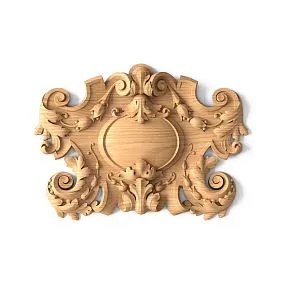
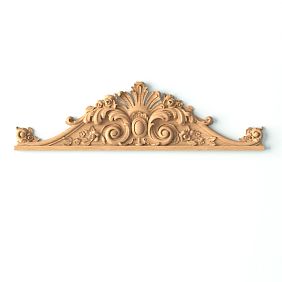
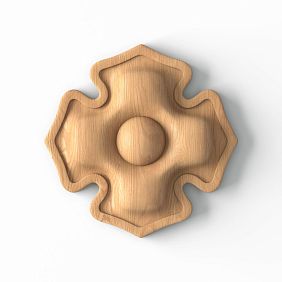
Our factory also produces:



Symmetry vs. Asymmetry: Order or Dynamics
A symmetrical composition is built around a central axis. Elements to the left and right of the axis mirror each other. Symmetry creates a sense of stability, formality, and classical harmony. Suitable for formal rooms (living rooms, dining rooms, studies), classical and neoclassical styles.
Example of a symmetrical composition: a wall 4 meters wide, 2.7 meters high. In the center—a vertical axis. On the axis (at the center of the wall)—a large decorative overlay 40×60 cm with a floral pattern. To the left and right of it, at a distance of 80 cm—two identical smaller overlays 25×40 cm with the same ornamental motif. The entire composition is framed by a rectangular molding frame 8 cm wide. Absolute symmetry, classical elegance.
An asymmetrical composition lacks a central axis or deliberately violates it. Elements of different sizes are placed at different points, creating dynamic balance (not mathematical equality, but visual balance). Asymmetry creates modernity, informality, and interest. Suitable for living rooms (bedrooms, personal studies), modern interpretations of classicism.
Example of an asymmetrical composition: the same wall. On the left, at one-third of the height—a large horizontal panel 120×80 cm, framed by moldings, with corner rosette overlays. On the right at the top—a group of three small square overlays 15×15 cm, arranged in a triangle. Visually, the composition is balanced (the large mass on the left is compensated by the group of small elements on the right), but it is not symmetrical.
Get Consultation
Scale and Proportion: Proportionality of Elements
The elements of the composition should be proportional to each other and to the space.
Rule of proportionality: the largest element of the composition should not exceed 1/8 of the wall area on which it is placed. If the wall is 10 m² (4m × 2.5m), the maximum size of the central element is 1.25 m² (e.g., a panel 100×125 cm or a rosette with a diameter of 125 cm).
Rule of gradation: if there are several elements of different sizes in a composition, the ratio between them should be at least 1:1.5 and no more than 1:3. That is, the medium element is 1.5-3 times smaller than the large one. The small element is 1.5-3 times smaller than the medium one. If the elements are too close in size (ratio 1:1.2), they compete, and the composition looks uncertain. If the difference is too great (1:5), the small elements get lost and seem random.
Rhythm and Repetition: The Musicality of Composition
Rhythm is the repetition of identical or similar elements at certain intervals. Creates visual musicality and order.
Uniform rhythm—elements repeat at equal intervals. Example: on a long corridor wall, a decorative overlay of the same size and pattern is placed every 120 cm. Creates calmness, predictability, suitable for passageways.
Accelerating rhythm—the intervals between elements decrease. Example: overlays are placed at 100 cm, then 80 cm, then 60 cm, converging towards the visual center. Creates dynamics, directs the gaze to the focal point.
Decelerating rhythm—the intervals increase. Creates a sense of expansion, calmness, used less frequently.
Contrasting rhythm—alternation of different elements. Example: large overlay, two small ones, large, two small. Creates complexity, interest, suitable for accent zones.
Contrast and Nuance: The Play of Differences
Contrast—a clear difference between elements (in size, shape, pattern, color). A smooth wall surface and a relief overlay—texture contrast. A simple rectangular molding and a carved overlay with lush ornamentation—contrast in complexity of forms. Contrast attracts attention, creates drama.
Nuance—a subtle, barely noticeable difference. Two overlays of similar size, with variations of the same pattern (one with oak leaves, the other with maple leaves). Nuance enriches the composition without destroying unity, requires careful examination, rewards the viewer with the discovery of details.
The balance between contrast and nuance defines the character of the interior. Lots of contrast—dynamic, spectacular, sometimes restless. Lots of nuance—refined, calm, can be somewhat boring. The ideal is contrast in large forms (large forms differ clearly), nuance in details (patterns within forms subtly echo each other).
Types of Ornaments: The Language of Symbols and Forms
Ornament is not just decoration. It is a visual language in which each motif has a history, symbolism, and emotional resonance.
Floral Ornaments: Nature in Stone and Wood
The most ancient and widespread group of ornaments. Leaves, flowers, fruits, vines, branches—nature has inspired craftsmen for millennia.
Acanthus (leaves of the acanthus plant)—a classical antique motif. Relief leaves with jagged edges, curled into scrolls, cover column capitals, friezes, rosettes. Acanthus symbolizes vitality, triumph over death (ancient Greek myth of acanthus growing through stone on a grave). Used inpolyurethane reliefclassical and neoclassical styles—cornices, consoles, rosettes.
Laurel—wreaths and branches of the laurel tree. Symbol of victory, glory, honor. Characteristic of the Empire style (Napoleonic imperial style, where military motifs dominated). Laurel wreaths adorn friezes, frame medallions, crown doorways.
Grapevine—creeping grape shoots with leaves and clusters. Symbol of fertility, abundance, joy of life. Popular in Baroque and Rococo styles, where opulence and love of life prevailed. Grapevines entwine mirror frames, wind along moldings, frame panels.
Roses and lilies—floral motifs. The rose symbolizes love, beauty, passion. The lily—purity, royal authority (the heraldic fleur-de-lis—symbol of the French monarchy). Flowers adorn overlays, centers of rosettes, and are used as accents in floral compositions.
Arabesques are stylized plant motifs intertwined into complex symmetrical patterns. Origin: Islamic art, where depiction of living beings is prohibited, and plant ornamentation reached the highest sophistication. In European classicism, arabesques are used to fill large flat surfaces—panels, friezes—creating carpet-like ornamentation.
Geometric Ornaments: Mathematics of Beauty
Geometry is the language of order, structure, rationality.
Meander is a continuous broken line forming rectangular scrolls. An ancient Greek motif symbolizing eternity, infinity (the line has no beginning or end). Used for bordering panels, framing mirrors, decorating friezes. Creates strictness, classical elegance.
Guilloche (interlacing) are intertwined ribbons forming a continuous pattern of circles or ovals. Symbol of connection, unity. Often used on cornices, moldings, creating a continuous decorative line.
Diamonds and squares are grid patterns of geometric shapes. Create rhythm, structure, used to divide large planes into ordered zones. Characteristic of Art Deco (style of the 1920s-30s, where geometry dominated).
Stars and geometric rosettes are multi-ray symmetrical figures based on a circle divided into equal segments (6, 8, 12 rays). Symbolize cosmos, harmony, divine order. Used as central elements of ceiling compositions, wall overlays.
Classical antique motifs: heritage of Greece and Rome
Egg-and-dart (ovolo) is an ornament of alternating egg-shaped forms and darts or leaves. Characteristic of the Ionic order, decorates capitals, cornices, creating a rhythmic border.
Modillions are decorative consoles under a cornice, often with volutes (spiral scrolls) or carved leaves. Imitate structural elements (beams supporting a roof overhang) transformed into decoration.
Antique rosettes are stylized flowers inscribed in a circle, with radial symmetry. Decorate the centers of coffers (recesses in the ceiling), wall overlays, furniture fronts.
Triglyphs and metopes are elements of the Doric order. Triglyphs are vertical rectangles with two full and two half grooves, metopes are square panels between them, often with relief images. In interiors, used as decorative division of friezes.
Baroque and Rocaille ornaments: theatricality of decoration
Cartouches are decorative shields or scrolls with curled edges, often framed by shells, ribbons, lush plant motifs. The center of a cartouche may contain a coat of arms, monogram, inscription, or simply decorative filling. Baroque loved cartouches for their theatricality, the possibility to create a complex multi-layered composition.
Rocaille are asymmetrical shell-like forms with wavy edges, often resembling seashells or grottoes. Gave the name to the Rococo style (rocaille). Create lightness, playfulness, capricious elegance.
Masks and heads are decorative masks (theatrical, mythological), heads of lions, rams, cherubs. Used as keystones (central element above an arch or window), overlays on furniture, elements of consoles.
Garlands are hanging chains of flowers, leaves, fruits, tied with ribbons. Create a sense of festivity, abundance. Decorate friezes, frame panels, link individual elements into a single composition.
Stucco with ornament: architecture of decoration
Carved moldings, ornamented rosettes, consoles, pilasters made of polyurethane—decorative elements of composition, creating architecture where there is none.
Carved moldings: linear ornament
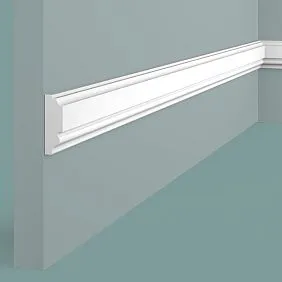
Molding with ornament performs a dual function: structures space (creates frames, divides zones) and decorates (introduces an ornamental motif).
Moldings with plant ornament are climbing stems, leaves, flowers running along the entire length of the molding. Used to create lush frames around panels, mirrors, paintings in Baroque, Rococo, Victorian styles. Width of such moldings is usually 6-12 cm, relief depth 5-15 mm. The more complex the ornament, the wider the molding.
Moldings with geometric ornament are meander, guilloche, egg-and-dart running along the top or bottom edge of the molding. Create classical strictness, used in neoclassical and Art Deco interiors. Width 4-8 cm, ornament usually occupies 1/3-1/2 of the width, the rest is a smooth surface.
Combined moldings are a combination of several ornamental motifs. For example: bottom row—egg-and-dart, middle—smooth strip, top—grapevine. Create richness, used for cornices where complex multi-layered ornamentation is needed.
Ceiling rosettes: the center of the composition
Ceiling rosette is not just decoration around a chandelier. It is the center of the ceiling's ornamental composition, often the most complex and expressive element.
Rosettes with radial symmetry—ornament radiates from the center in rays (usually 6, 8, or 12 rays). Each ray can be decorated with acanthus leaves, flower rosettes, scrolls. Between rays—filling (arabesques, geometric patterns, or smooth surface). Diameter from 30 to 150 cm, relief depth from 10 to 40 mm. Suitable for classical interiors of high solemnity.
Rosettes with concentric circles—ornament organized in circles radiating from the center. Inner circle—central rosette or medallion. Middle circle—main ornament (leaves, flowers, figures). Outer circle—border (guilloche, egg-and-dart, beads). Create order, calm solemnity.
Asymmetrical rosettes—ornament does not follow radial symmetry, rocaille forms, scrolls are arranged freely. Rococo style, where asymmetry was valued as a manifestation of artistic freedom. Now rarely used, in stylizations of the 18th century.
Consoles and brackets: decorative support
Console — a projecting element that visually supports a cornice, shelf, or balcony. In interiors, consoles are often purely decorative (not load-bearing) but create an illusion of structural integrity.
Consoles with volutes — S-shaped scrolls running from top to bottom, often with acanthus leaves along the edges. A classic motif of the Ionic and Corinthian orders. Placed under cornices, on either side of fireplaces, framing doorways.
Anthropomorphic consoles — in the form of figures (atlantes, caryatids — male and female figures supporting architectural elements). Used in pompous interiors where theatricality is desired.
Consoles with floral ornamentation — terminating in carved leaves, grape clusters, flowers. Create opulence, used in Baroque interiors.
Pilasters and half-columns: vertical rhythm
Pilaster — a flat vertical strip imitating a column, projecting from the wall by 2-5 cm. Half-column — volumetric, projecting by 8-15 cm. Both elements create vertical articulation of the wall, adding architectural character.
Pilasters with fluting — vertical grooves, as on ancient columns. Strict, classical, suitable for Neoclassicism.
Pilasters with ornamentation — the capital (upper part) is decorated with acanthus leaves, volutes, rosettes. The pilaster shaft can be smooth or decorated with vertical floral motifs (climbing stems). The base (lower part) often has horizontal articulations — fillets, small shelves.
Wood carving: the soul of the material in the hands of the master
Wood is a living material, and carving it is an art form millennia old.Ornament decorative elementsmade from solid wood possess warmth, tactility, and depth unattainable by polymers.
Types of wood carving: creation techniques
Bas-relief carving — the ornament projects 2-5 mm above the background. The background remains flat (not recessed), the ornament is slightly raised, edges are rounded. Creates soft shadows, delicate relief. Used for furniture fronts, wall appliqués, door panels.
Relief carving (with recessed background) — the background is recessed (by 5-15 mm), the ornament remains at the level of the original surface or slightly above. Creates deep shadows, expressive contrasting relief. Used for furniture in heavy styles (Baroque, Victorian) where drama is needed.
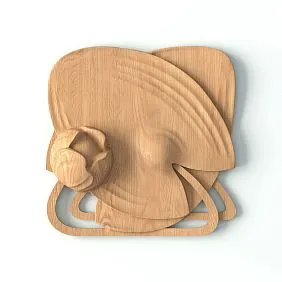
Openwork (pierced) carving — the background is completely removed, the ornament remains as an airy lattice. Light, airy, often used for chair backs, table aprons, decorative panels. Styles: Rococo (lace-like scrolls), Russian Art Nouveau (floral motifs).
Three-dimensional (sculptural) carving — the ornament has a three-dimensional form, like a small sculpture. Lion heads on armchair arms, cherub figures on bed headboards, animal paws on table legs. The pinnacle of a carver's skill, used for unique furniture.
Ornaments on classical furniture: a dialogue between form and decoration
Classic Furniture— a bearer of ornaments that must harmonize with the stucco in the interior.
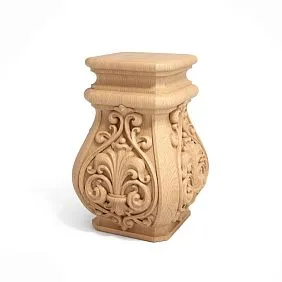
On the fronts of cabinets and chests of drawers — central appliqués with floral or geometric motifs. Often these are cartouches (oval or shield-shaped carved frames) filled with leaves, flowers, scrolls. Corner appliqués — rosettes or stylized leaves. If the interior uses stucco with acanthus, the furniture appliqués should also contain the acanthus motif (possibly in a simplified form).
On chair and armchair backs — vertical appliqués (balusters) with carved volutes, rosettes, leaves. The top rail of the back often has a central cartouche or crest. The ornament should be proportionate — not too small (it will get lost), not too large (it will overwhelm the chair's light structure).
On table and chair legs — vertical fluting, spiral scrolls (cabriole legs — curved, terminating in animal paws or scrolls). Ornament on legs should be elongated, emphasizing the vertical, not breaking up the form.
On aprons (horizontal connecting elements of furniture) — horizontal friezes with floral or geometric motifs. Often these are simplified versions of ornaments from moldings — the same meander, the same grapevine, but in a flatter execution.
Combining wood and polyurethane: unity in differences
How to combinepolyurethane moldingon the walls and carved wooden furniture so that they enhance each other, not conflict?
Rule of common motif: Choose one or two ornamental motifs that will be repeated in both the stucco and the furniture. For example: acanthus and rosettes. On the ceiling — a rosette with acanthus leaves. On the walls — moldings with acanthus. On the furniture — appliqués with the same acanthus leaves and small rosettes in the centers. The motif repeats, but in different scales and techniques (volumetric polyurethane stucco vs. relief wood carving), creating unity in diversity.
Rule of scale: Ornament on stucco (especially large elements — ceiling rosettes, wide cornices) can be larger and more detailed than on furniture. Furniture is closer to a person, viewed from a short distance, fine ornament is legible there. Stucco is higher, farther away, needs larger forms to be legible from 2-3 meters.
Rule of color: White or light-colored stucco pairs well with dark wooden furniture (walnut, mahogany, stained oak) — contrast emphasizes both materials. If the stucco is painted to match the walls (beige, gray), the furniture can be light or medium-dark — creating nuance, subtle harmony without sharp contrasts.
Rule of style: Stucco and furniture should belong to the same stylistic direction. Opulent Baroque stucco (cartouches, garlands, rocaille) requires Baroque furniture (curved forms, abundance of carving, gilding). Strict Neoclassical stucco (egg-and-dart, meander, restrained acanthus) requires Neoclassical furniture (straight lines, symmetry, moderate decoration).
Forms of Decorative Elements: Geometry of Space
The shape of an element influences perception no less than ornamentation.
Round and Oval Elements: Completeness and Harmony
The circle is a perfect form, having no beginning or end, a symbol of unity, eternity, harmony. Rounddecorative elements of compositionelements attract the eye, creating focal points.
Round rosettes — ceiling (around a chandelier) and wall (above fireplaces, in the centers of panels). Sizes range from 20 cm (small wall) to 150 cm (large ceiling). The round shape makes the rosette universal — it looks good on any wall, in any location.
Oval medallions — elongated horizontally or vertically. The oval is more dynamic than the circle, creating direction. Horizontal ovals are used as central elements above sofas, fireplaces (width 60-120 cm, height 40-80 cm). Vertical ones — on narrow wall sections between windows, on door panels.
Small round appliqués — with a diameter of 5-15 cm, placed in the corners of panels, at the intersections of moldings, as accents. They can be with ornament (rosettes, stars) or smooth (classical bead rosettes).
Rectangular and Square Elements: Structure and Order
The rectangle — a form of order, structure, rationality. Rectangular elements create clear spatial division.
Rectangular panels — the foundation of classical wall decor. Vertical rectangles (height 2-3 times greater than width) elongate the wall upward, suitable for low ceilings. Horizontal ones (width greater than height) widen the wall, suitable for narrow rooms. Square panels create calmness, stasis, used in symmetrical compositions.
Rectangular appliqués — placed in the centers of panels, above doors, on furniture fronts. Vertical appliqués (20×40 cm, 30×60 cm) often feature plant ornamentation elongated upward. Horizontal ones (40×20 cm, 60×30 cm) with horizontal friezes — grapevines, meanders.
Square panels — on doors, cabinet fronts. Size typically 30×30 cm, 40×40 cm. Filled either with carved ornamentation (bas-relief, so as not to protrude too much) or with appliqués (carved elements glued to the center of the panel).
Arched and Segmental Elements: Architecturality
The arch — an architectural form transferred into decor. Arched elements create solemnity, a connection with classical architecture.
Over-window and over-door arched elements — semicircular or segmental appliqués placed above openings. They imitate the keystone (central element of an arch) and radial sections. Sizes: width equal to the width of the opening (80-120 cm for doors, 100-180 cm for windows), segment height 15-30 cm.
Arched niches — decorative recesses in the wall, framed by a semicircular arch made of moldings. Inside the niche — a semicircular shell (fan-shaped relief) made of stucco. Niche sizes: width 60-100 cm, height 100-150 cm, actual depth 5-10 cm (decorative, not for placing objects).
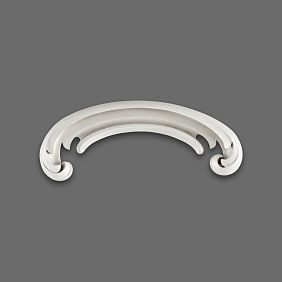
Fan-shaped appliqués — radially diverging rays, resembling an open fan or shell. Placed in the upper corners of panels, above fireplaces, in semicircular niches. Sizes: radius 20-40 cm, opening angle 60-120 degrees.
Creating a Unified Ornamental Theme: Composition Methodology
Theory studied. Now practice: how to create an interior where allpatterns decorative elementselements are connected by a single theme?
Step 1: Choosing a Basic Ornamental Motif
Define 1-2 ornamental motifs that will become the basis of the composition. Selection criteria:
Style compatibility — for Neoclassicism, basic motifs: acanthus, egg-and-dart, meander. For Baroque: cartouches, garlands, lush vegetation. For Art Deco: geometry, stylized plants, zigzags.
Scalability — the motif should look good in different sizes (large on a ceiling rosette, medium on moldings, small on furniture appliqués).
Personal preference — you must like it. If you don't like acanthus leaves (they seem too prickly to you), choose another motif — grapevine (softer, rounder) or laurel (simpler, more elegant).
Selection example: for a living room in French Neoclassical style, two motifs are chosen: rosettes (stylized flowers in circles) and laurel branches.
Step 2: Distributing the Motif Across Elements
Determine where and how the basic motif will be used.
Ceiling rosette — large, 80 cm in diameter, with a radial composition of laurel branches diverging from a central rosette-flower. This is the main, most expressive element, setting the tone for the entire composition.
Ceiling cornice — width 10 cm, along the lower edge runs a frieze of small rosettes (diameter 3-4 cm), alternating with short laurel branches. The motif repeats, but in a reduced, rhythmic variation.
Wall moldings — width 6 cm, frame rectangular panels on the walls. At the corners of the panels — applied rosettes (diameter 8 cm) with the same floral motif as in the center of the ceiling rosette. The motif is localized, does not run along the molding, but accentuates the corners.
Furniture — a chest of drawers with three drawers. On the central drawer — an oval carved overlay (30×20 cm) with a composition of laurel branches tied with a ribbon. On the side drawers — small round applied rosettes (diameter 5 cm). The motifs are the same, the technique is different (wood carving vs. polyurethane stucco), creating unity.
Textiles — curtains with embroidery or print, featuring stylized flowers (echoing the rosettes) and laurel leaves. Not an exact repetition of the stucco ornament (that would be overkill), but a stylistic echo.
Step 3: Controlling Ornament Density
The ornament should not be uniformly dense everywhere. Create a gradation from accent zones (dense ornament) to neutral zones (minimal or no ornament).
Accent zone (wall behind the sofa in the living room) — three vertical panels framed by moldings with corner rosettes. In the center of each panel — a large oval overlay with a laurel wreath. Ornament density is high.
Secondary zones (remaining walls) — baseboard and cornice with ornament, but walls are smooth, without moldings. Density is medium — ornament is present but not dominant.
Neutral zones (ceiling outside the rosette, most of the walls) — smooth painted surfaces, without ornament. They give the eye a rest, emphasizing the ornamented elements through contrast.
Step 4: Color Harmony of the Ornament
The ornament can be:
Monochromatic (same color as the background, readable only through relief and shadow). A modern, delicate approach. White stucco on white walls and ceiling. The ornament appears only with side lighting, creating a subtle play of light and shadow.
Contrasting (sharply different from the background). A classic approach: white or gilded stucco on colored walls (blue, green, burgundy). The ornament is clearly readable, attracts attention.
Polychromatic (multicolored, ornament elements painted in different colors). Rare, used in historical stylizations (Rococo, Victorian style). For example: green leaves, pink flowers, gold background. Requires high execution skill, easily risks becoming tasteless.
To create unity, choose one approach for the entire interior. Mixing monochrome and contrast in one room is risky — it can create visual discord.
Step 5: Testing the Composition
Before final installation, create a test composition.
Physical mockup: Order sample elements (small pieces of moldings, one overlay, a fragment of a rosette). Lay them out on the floor or temporarily attach them to the wall (with painter's tape), evaluate how they look together. Do the ornaments harmonize? Is it too busy? Is there enough unity?
Digital mockup: Create a 3D visualization or photomontage. Photograph the room, add images of decorative elements in a graphics editor (many manufacturers provide quality photos or 3D models of their products). Evaluate the result on screen.
If something is wrong (elements conflict, too much ornament, motifs don't echo) — make adjustments before installation. It's difficult to correct after installation.
Frequently Asked Questions about Ornamental Composition
Can different ornamental styles be mixed in one interior?
Technically yes, but it's risky. Mixing styles requires a deep understanding of their nature. For example, combining Classicism (strictness, symmetry) and Rococo (asymmetry, playfulness) creates conflict unless a connecting link is found (e.g., a common floral motif, interpreted differently).
It's safer to stay within one style or closely related styles (Neoclassicism + Empire, Baroque + Rococo). If you want variety, vary details within a style, rather than mixing different styles.
How many different ornamental motifs can be used in one room?
No more than three main motifs. One primary (the most expressive, repeating), two secondary (complement the primary, used less frequently). If there are more motifs, the composition falls apart, lacking visual unity.
Example: primary motif — acanthus (on the rosette, cornice, furniture). Secondary motif 1 — egg-and-dart (on moldings as edging). Secondary motif 2 — Greek key (on the baseboard). The three motifs echo each other, do not compete.
Should furniture exactly repeat the ornament of the stucco?
Not exactly, but it should stylistically echo. Exact repetition (a carved overlay on furniture being a copy of a stucco rosette) looks intrusive. A variation on the theme is better: if the stucco has acanthus leaves with scrolls, the furniture could have the same acanthus leaves but in a different arrangement, possibly simplified.
Connection through a common motif + difference in details = harmony without boredom.
What to do if the interior already has old furniture with a specific pattern?
Start from the existing furniture. Study its pattern, determine the style, motifs. Select moldings that will harmonize with this pattern. If the furniture has a grapevine pattern — look for moldings with the same or similar motif. If the furniture has Art Deco geometry — the molding should be geometric.
Attempting to impose a pattern on furniture that is alien to it through molding will lead to conflict. An interior is a dialogue of elements, not a monologue.
Is it necessary to use a pattern on all walls?
No, moreover — it is not necessary. The pattern should be an accent, not a background. One or two accent walls with patterned panels, the rest smooth — a classic scheme. All walls with a pattern — overload, museum-like feel, visual fatigue.
Where to find rare ornamental motifs?
From manufacturers specializing in classic and historical styles. Large factories have catalogs with hundreds of elements from different eras. If you need a unique motif (for example, your family crest) — order custom casting (for polyurethane) or carving (for wood). More expensive, but the result is exclusive.
How to care for ornamented elements?
Regular dry cleaning with a soft brush or vacuum cleaner brush (once a month) removes dust from the recesses of the pattern. Wet cleaning (once every six months) — with a soft sponge and soapy solution, then wipe dry. Avoid aggressive cleaning agents, abrasives — they damage the relief.
For wooden carved elements — care according to the type of finish (varnish, wax, oil). Varnished ones are wiped with a damp cloth. Waxed and oiled ones are refreshed with wax/oil once a year.
Conclusion: orchestrating space — when details sing in chorus
Decorative elements composition— is not a set of disparate decorations randomly placed in the interior. It is a precise system of visual connections, where each pattern echoes others, creating a symphony of forms, lines, shadows. WherePolyurethane moldingson the walls rhymes with the carving onclassic furniture, where plant motifs and geometric patterns intertwine into a single ornamental narrative.
We have journeyed from the basics of composition — visual center, symmetry, scale, rhythm — to a deep study of ornamental languages. We learned that acanthus speaks of vitality, laurel — of glory, meander — of eternity. We analyzed how carved moldings structure space, how ceiling rosettes become composition centers, how consoles and pilasters introduce architecturality.
We studied wood carving — from the delicacy of low relief to the sculptural quality of high relief. We understood how the pattern on furniture should echo wall decor, not duplicate, but harmonize. We mastered the forms ofdecorative elements composition— from round rosettes to rectangular panels, from arched elements to fan-shaped overlays.
We studied wood carving — from the delicacy of low relief to the sculptural quality of high relief. We understood how the pattern on furniture should echo wall decor, not duplicate, but harmonize. We mastered the forms ofdecorative elements composition— from round rosettes to rectangular panels, from arched elements to fan-shaped overlays.
And we received a practical methodology for creating a unified ornamental theme: choosing a base motif, distributing it across elements, controlling density, color harmonization, testing. Now you can create an interior where there will be no visual chaos, where every detail is in its place, where the pattern does not overload but structures, does not distract but guides the eye, does not tire but delights.
The key understanding: the beauty of a classic interior is not in the quantity of decor, but in the quality of connections between elements. Three well-chosen ornamented elements, harmonizing with each other, will create more beauty than twenty random ones, even if each individually is magnificent.
Create interiors wherepatterns decorative elementsintertwine into visual poetry. Where every acanthus leaf, every rosette, every meander curl is a word in the ornamental narrative. Where architecture, molding, furniture, textiles sing one song in different voices. Where space becomes a work of art, thought through to the last detail.
STAVROS: workshop of ornamental art
When we talk about decorative elements with deeply elaborated ornaments, about carving worthy of museum collections, about compositions verified with jeweler's precision, the name STAVROS sounds like a guarantee of craftsmanship. The company does not just produce decor — it creates a dictionary of the ornamental language with which you can write your interior poem.
Decor for solid wood moldings— a collection of carved elements that allows creating complex compositions on wooden surfaces. Corner elements with plant motifs (oak, maple, acanthus leaves), central overlays with cartouches and garlands, vertical inserts with fluting — each element is carved from solid wood (oak, ash, beech) with a relief depth of 5-12 mm, creating an expressive play of light and shadow.
Element sizes are designed for universal application: small overlays 50×50 mm, 80×80 mm (for corners of small panels, furniture fronts), medium 120×120 mm, 150×200 mm (for panel centers, mirror framing), large 250×350 mm, 400×600 mm (for accent zones, fireplace portals). Patterns are developed by professional carvers, combining historical authenticity (following classical canons) with modern clarity of execution (CNC milling ensures the identity of serial elements while preserving manual finishing for the liveliness of the relief).
Wooden Inlaysare presented in dozens of ornamental variations, covering the main historical styles. For Neoclassicism — rosettes with radial symmetry, acanthus leaves of strict proportions, egg-and-dart and meander. For Baroque — cartouches with curled edges, lush garlands of flowers and fruits, voluminous mascaron. For Art Deco — geometric compositions of rhombuses and zigzags, stylized plant motifs with clear graphics.
Production technology: elements are milled on 5-axis CNC machines using 3D models created based on museum samples and historical albums of ornaments. After milling, each element undergoes manual finishing by a carver — removing milling marks in hard-to-reach places, deepening small details, creating the lively imperfection that distinguishes carving from stamping. Then sanding (gradation from P120 to P220), preparation for final coating.
Polyurethane molding STAVROS— an extensive collection of ornamented elements for creating architectural compositions.
Moldings with ornament: over 50 profiles with various motifs. Moldings with grapevine (width 60-100 mm, vine runs in a continuous line along the entire length). Moldings with egg-and-dart (egg-shaped forms alternate with darts, classic antique motif, width 50-80 mm). Moldings with meander (Greek ornament, strict geometry, width 40-70 mm). Moldings with acanthus leaves (lush, deeply cut leaves, baroque opulence, width 80-120 mm).
Ceiling rosettes: diameters from 300 to 1200 mm, over 100 designs. Rosettes with radial symmetry on 6, 8, 12 rays, each ray adorned with floral ornament (acanthus, oak leaves, laurel). Rosettes with concentric circles of ornament (inner circle - central rosette-flower, middle - large leaves, outer - beaded or egg-and-dart border). Asymmetrical rococo rosettes (scrolls, shells, free composition for stylizations of the 18th century).
Corbels and brackets: height from 150 to 600 mm, width from 80 to 250 mm. Corbels with volutes (S-shaped scrolls, decorated with acanthus leaves along the edges). Anthropomorphic corbels (lion heads, masks, stylized human figures - for theater interiors). Corbels with floral ornament (topped with grape clusters, roses, lush bouquets).
Pilasters and half-columns: height 2000-3000 mm, width 100-200 mm (pilasters), 150-300 mm (half-columns). Capital options: Doric (simple, with geometric decor), Ionic (with volutes), Corinthian (with lush acanthus leaves). The shaft can be smooth, fluted (vertical grooves) or decorated with floral ornament.
Classic STAVROS furniture— items where carving and ornamentation achieve the highest quality of execution. Chests of drawers, sideboards, tables, armchairs with solid wood fronts, adorned with carved overlays created by the same masters and according to the same canons as decorative elements for architecture.
Chest of drawers fronts: central cartouche overlays sized 200×300 mm with compositions of leaves, flowers, ribbons, carved to a depth of 8-10 mm. Corner rosette overlays with a diameter of 60-80 mm in each drawer corner. All carving is executed in a unified style, which can be continued on the walls and ceiling of the interior using corresponding overlays and moldings.
Chair and armchair backs: vertical balusters with carved volutes, central crests with cartouches or garlands. The ornament does not interfere with ergonomics (the back is comfortable) but creates visual opulence.
Furniture legs: cabriole legs (curved, characteristic of Baroque and Rococo) with carved scrolls, terminating in stylized paws or shells. Straight legs (Neoclassical) with fluting and carved rosettes in the upper part.
Unified ornamental theme selection service — STAVROS designers will help create a harmonious composition for the entire interior. You describe the style, preferences (which motifs you like, which you don't), provide room layouts. The designer selects molding elements, wooden overlays, furniture so that the ornaments echo each other, creating unity.
A project album is created: photographs of selected elements, placement diagrams on walls and ceiling, 3D visualizations of key areas (fireplace group, headboard area in the bedroom, dining area in the dining room). You see the final result before work begins, can adjust, change elements, achieving perfect harmony.
Custom carving and casting — if the catalog does not have the desired ornament (for example, you want your family crest, monogram, unique floral motif), the STAVROS workshop will create custom elements. For wood: a carver hand-carves a master model, from which a series is milled (if several identical elements are needed). For polyurethane: a master mold is created (from plaster, silicone), elements are cast from polyurethane in it.
Production time for custom elements: 2-4 weeks (depends on complexity). Cost is higher than for serial items, but the result is exclusive — an ornament that no one else has.
Ornament quality control — each element undergoes visual inspection: clarity of relief (all ornament details are legible), absence of casting defects (voids, underfills for polyurethane), quality of carving (absence of chips, tear-outs for wood). Elements with defects do not go on sale, are remelted (polyurethane) or sent for reworking (wood).
Delivery of decorative elements — fragile ornamented elements (rosettes with thin petals, openwork carved overlays) are packed in individual packaging with cushioning. Wooden carvings are wrapped in bubble wrap, placed in boxes with soft filler. Polyurethane rosettes are packed in cardboard round tubes, preventing deformation. Transportation is careful, with control at every stage.
Create interiors where every ornament is a word of a poem, every composition is a stanza of visual narrative. Trust the craftsmanship of STAVROS — craftsmanship that turns stone and wood into music, lines and forms into emotion, space into a work of art. Ornament is not mere decoration. It is the soul of a classical interior, its breath, its voice. Speak this language skillfully, respecting traditions, but creating modern beauty. And your home will sing.


