Article Contents:
- The Essence of Decorative and Applied Art: The Philosophy of Functional Beauty
- Dual Nature: Utility Plus Aesthetics
- Historical Role: From Paganism to Modernism
- Types of Carving in Applied Art: Diversity of Techniques and Styles
- Flat Relief Carving: Balance Between Plane and Volume
- Openwork (Lace) Carving: Wooden Lace
- Sculptural Carving: Three-Dimensional Art
- Geometric Carving: The Language of Forms and Symbols
- Contour Carving: Graphics on Wood
- Materials in Decorative and Applied Art: Wood Selection
- Linden: The Classic of Carving
- Oak: strength and durability
- Walnut: Beauty of Texture
- Beech: The Universal for Furniture
- Birch: Accessibility and Karelian Uniqueness
- Ornaments and Symbolism: The Language of Applied Art
- Plant motifs: connection with nature
- Geometric Patterns: Cosmic Order
- Zoomorphic Images: Animals in Carving
- Anthropomorphic Images: Humans in Ornament
- Application in Interior: Where Applied Art Lives
- Furniture: Function and Form
- Doors: A Portal Between Worlds
- Walls and Ceilings: Architectural Decor
- Fireplaces: The Hearth and Altar of the Home
- Creation Technologies: From Handwork to CNC
- Hand Carving: The Master’s Soul
- CNC Machines: Precision and Repeatability
- Laser Cutting: New Possibilities
- Styles in Decorative and Applied Art of Carving
- Classicism: Harmony and Order
- Baroque: Luxury and Dynamism
- Modern: natural lines
- Russian Style: Roots and Traditions
- Frequently Asked Questions about the Decorative and Applied Art of Carving
- How is Applied Art Different from Fine Art?
- Can Carved Decor Be Used in Modern Minimalist Interiors?
- Which Types of Wood Are Best for Carving?
- How Long Does It Take to Create a Carved Element?
- How to Care for Carved Wooden Items?
- Can Carving Be Ordered Based on a Custom Sketch?
- Hand Carving or Machine Carving — Which Is Better?
- Is Carved Decor Suitable for Small Apartments?
- Is Wood Carving Eco-Friendly?
- How to Check the Quality of a Carved Item?
- Conclusion: Applied Art in Your Home with STAVROS

What unites beauty and utility? What turns an ordinary object into a work of art without depriving it of functionality? The answer is simple yet profound — applied art. And among all its manifestations, wood carving holds a special place, connecting ancient traditions with modern aesthetic needs, transforming wood into a living dialogue between the craftsman and nature, between function and form, between past and future.
Imagine an old Russian house, where every element — from window frames to cornices — tells a story. Or a modern apartment, where a carved overlay on furniture becomes an accent that catches the eye. In both cases, we are dealing with decorative and applied art — that amazing sphere of creativity where artistic value is inextricably linked with practical application.


The Essence of Decorative and Applied Art: The Philosophy of Functional Beauty
How is decorative and applied art different from just art? In that it can be used. A painting is hung on a wall — admired, but not touched. A sculpture is placed in a niche — admired from afar. But a carved box holds jewelry. A carved door opens and closes. A carved chair back supports the back. Beauty serves, and service is beautiful.




Dual Nature: Utility Plus Aesthetics
Decorative and applied art lives on the border of two worlds. On one hand, it is a craft — the skill of creating things needed in everyday life. On the other — creativity, the ability to infuse ordinary objects with soul, meaning, beauty. A wood carver is simultaneously a carpenter and an artist, a technician and a poet.
When you look at a carved window frame, you see two things. First — function: the frame covers the gap between the window and the wall, protects from drafts, completes the architectural composition of the opening. Second — art: patterns, ornaments, symbols that turn a technical detail into a cultural object, a bearer of tradition, an expression of worldview.
This is the magic of applied art: it does not ask for separate space, separate time, a special mood. It is present in life constantly, unobtrusively, organically. You use a carved chair without thinking — but subconsciously absorb its beauty, feel the harmony of forms, enjoy the tactile contact with natural material.
Our factory also produces:


Historical Role: From Paganism to Modernism
The decorative and applied art of wood carving in Russia has a thousand-year history. Our Slavic ancestors adorned idols, ritual objects, and utensils with carvings. Carved patterns served a protective function: they warded off evil spirits, attracted luck, and symbolized a connection with natural forces.
Solar signs — stylized suns — personified light, warmth, life. Floral motifs — leaves, flowers, grapevines — symbolized fertility, abundance, prosperity. Geometric patterns — diamonds, meanders, spirals — reflected cosmic order, the harmony of the universe.
With the adoption of Christianity, pagan symbolism did not disappear but transformed, enriched with new motifs. To the ancient signs were added crosses, floral ornaments of the Byzantine type, images of saints and biblical scenes. Wood carving became a crucial element of church decoration — iconostases, icon cases, church utensils were created using the most complex carving techniques.
In the 18th-19th centuries, during the era of Classicism and Empire, wood carving reached unprecedented heights. Palace interiors were adorned with carved panels, cornices, and baseboards. Furniture turned into works of art with gilded carvings and complex compositions.
Modernism of the early 20th century brought new forms — flowing, natural lines, asymmetrical compositions, stylized floral motifs. Carving became more laconic, expressive, freed from excessive detail.
The Soviet era was contradictory for applied art. On one hand, mass production displaced handcraft. On the other — artels and workshops were created where traditions of folk art were preserved. Khokhloma, Gorodets painting, Abramtsevo-Kudrin carving — all were supported by the state as examples of folk art.
Today we are experiencing a renaissance of interest in applied arts. People are tired of faceless mass production; they want individuality, they want objects with history, with soul, with character.artistic wood carvingis returning to our homes—not as a museum relic, but as a living element of modern interior design.
Get Consultation
Types of carving in applied arts: diversity of techniques and styles
Wood carving is not a monolithic phenomenon. It encompasses numerous techniques, schools, and regional traditions, each with its own characteristics, history, and place in applied arts.
Bas-relief carving: balance between plane and volume
Bas-relief carving is a technique where the image protrudes only slightly above the background, by 5-10 millimeters. The background remains flat or slightly recessed, while the pattern stands out, creating a soft relief and a play of light and shadow.
This technique is ideal for decorative overlays on furniture, door panels, and friezes. It creates expressiveness without overloading the surface, preserving the overall plane of the object. Bas-relief carving can feature rounded contours (soft transitions from pattern to background) or a recessed background (background recessed by 2-3 mm).
The most famous school of bas-relief carving is the Abramtsevo-Kudrino style, which emerged in the late 19th century in Abramtsevo near Moscow. Its founder, Vasily Vornoskov, developed an original style with characteristic swirls, stylized plants, and smooth lines. These patterns adorned boxes, ladles, panels, and furniture.
Bas-relief carving demands from the master a precise eye, a steady hand, and an understanding of light and shadow. The pattern must be 'readable' under any lighting, the composition must be balanced, and the transitions must be smooth.
Openwork (pierced) carving: wooden lace
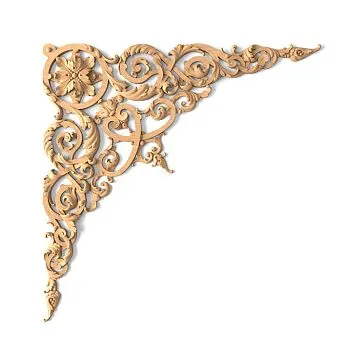
Openwork carving is a technique where the background is completely removed, leaving only the pattern. The object resembles lace woven from wood. Openwork carving can be simple (with geometric forms) or complex (with plant motifs, interweavings).
This technique was widely used in decorating window frames, cornices, and house pediments. The lace-like patterns let light through, creating wonderful effects when sunlight played in the interweavings of the carving. In the evening, when lights were lit inside the house, the window frames would glow, turning the windows into fantastic lanterns.
Openwork carving was often laid over a colored background—red, blue, green. The contrast between the wood and the bright background enhanced the expressiveness of the pattern. Sometimes openwork carving was gilded, creating an effect of luxury.
For openwork carving, the thickness of the board is important. Too thin—it's fragile, easily breaks. Too thick—it looks coarse, loses its lace-like quality. The optimal thickness is 15-25 millimeters for window frames, 10-15 for small decorative elements.
The modern application of openwork carving is diverse. It's not just for window frames, but also for decorative panels for space zoning, screens, bed headboards, cabinet doors.decorative elementswith openwork carving create a sense of lightness, airiness, and add sophistication to the interior.
Sculptural carving: three-dimensional art
Sculptural carving is the highest form of craftsmanship. Here, three-dimensional images are created—figures of people, animals, mythological beings. This is no longer just decoration, but a full-fledged sculpture, requiring a deep understanding of anatomy, proportions, and composition.
Sculptural carving was used in church wooden sculpture (crucifixes, images of saints), in ship carving (figureheads, stern decorations), and in garden and park sculpture (fountains, gazebos).
In applied arts, sculptural carving is used to create furniture legs in the form of lion's paws, griffins, caryatids. Door handles, armrests of chairs, finials of stair posts turn into sculptural elements that combine function and form.
Sculptural carving requires special wood—without knots, burls, or cracks. The best species are linden (soft, easy to carve, holds fine details), pear (hard, with uniform texture, ideal for miniatures), juniper (aromatic, dense, does not warp).
Geometric carving: language of forms and symbols
Geometric carving is the most ancient technique, based on the combination of simple forms: triangles, rhombuses, circles, lines. Despite its apparent simplicity, it requires precision, neatness, and a mathematical sense of proportion.
Geometric patterns often carry symbolic meaning. A rhombus with a dot inside is a symbol of a sown field, fertility. Triangles pointing towards each other symbolize earth and sky, feminine and masculine principles. The swastika (before its tragic use in the 20th century) was a solar sign, a symbol of the sun's movement.
Geometric carving is widely used in decorating utensils—distaffs, ladles, boards. It creates a rhythmic, repeating pattern that is pleasing to the eye, calming, and meditative.
In modern interiors, geometric carving is ideal for minimalist, Scandinavian, and ethnic styles. It does not overload the space but adds texture, depth, and cultural context.
Contour carving: graphics on wood
Contour carving is a technique where the image is created by lines cut into the wood. It is a kind of graphics on a wooden surface. Contour carving is used to create complex compositions—landscapes, portraits, ornamental panels.
The lines can be of different depths and widths, creating an effect of perspective and volume. Sometimes contour carving is combined with engraving or tinting, resulting in complex multi-layered images.
Contour carving requires a steady hand and confidence. The line must be even, without trembling or corrections. The master works like a calligrapher—one movement creates the form; it cannot be corrected.
In applied arts, contour carving is used to decorate boxes, picture and mirror frames, and decorative boards. It adds sophistication, intellectuality, and a connection to graphic arts to the piece.
Materials in decorative and applied arts: wood selection
Each wood species has its own character, its own possibilities, and its own area of application in applied arts. A master must know the wood, feel it, and understand what it is suitable for.
Linden: the classic carving wood
Linden is a favorite among carvers. Soft, homogeneous, without a pronounced grain, it is ideal for fine, detailed carving. Linden does not splinter, does not crack, and cuts easily in all directions. Its light wood takes staining, painting, and gilding beautifully.
Iconostases, church sculptures, and decorative panels are carved from linden. Linden boxes, frames, and overlays are classics of applied art. The disadvantage of linden is its softness. It scratches and dents easily, requiring careful handling. For functional items that bear loads, linden is not suitable.
Oak: strength and durability
Oak is the opposite of linden. Hard, dense, with a pronounced grain, it is difficult to work with, but the result is impressive. Oak carving is monumental, solid, eternal. Oak is not afraid of moisture, mechanical damage, or time. Centuries have no power over it.
Furniture, architectural details, and interior elements are made from oak. A carved oak staircase, doors, panels — these are investments for centuries. Oak is ideal for large forms, for carving with large planes and expressive volumes. Fine, detailed carving on oak is difficult — the wood splits and crumbles.
The color of oak varies from light yellow to dark brown. Bog oak, which has lain in water for decades, acquires a noble black color, special strength, and is highly valued.
Walnut: the beauty of grain
Walnut is an aristocratic wood. Its wood is beautiful in itself — chocolate-brown, with dark veins, and a play of shades. Walnut is dense but not excessively hard, cuts well, holds details, and polishes to a mirror shine.
Expensive furniture is made from walnut, where carving is combined with the natural grain. Walnut panels, doors, and tabletops do not require painting — their natural beauty is self-sufficient. Carving on walnut is expressive and contrasting — light and dark areas create depth.
The disadvantage of walnut is its price. The wood is rare, valuable, and used in premium projects. But the result justifies the cost — walnut pieces are passed down from generation to generation without losing their beauty.
Beech: the furniture universalist
Beech is strong, dense, with a delicate pinkish grain. It is excellent for furniture, load-bearing structures, and elements that bear loads. Beech takes staining well, imitating more expensive species like mahogany and walnut.
Carving on beech is clear and detailed. Beech does not crumble or split with proper processing.Carved beech inlays— a popular solution for furniture decor, combining accessibility, quality, and aesthetics.
The disadvantage of beech is its sensitivity to humidity. Without protective treatment, beech warps and swells. Beech is not suitable for humid environments; special impregnation is required.
Birch: accessibility and Karelian uniqueness
Birch is the most common wood species in Russia. Accessible, inexpensive, it is widely used in furniture production, utensil making, and decorative elements. Birch is light, with a silky grain, cuts well, and takes staining.
A special variety is Karelian birch with its unique patterned grain. Its wood resembles marble, with swirls and mother-of-pearl iridescence. Karelian birch is rare, expensive, and used in exclusive projects. Carving on Karelian birch is minimal — the grain is so expressive that overloading it with ornaments is impractical.
Ornaments and symbolism: the language of applied arts
Carving in decorative and applied arts is not just decoration. It is a language of symbols, conveying a worldview, values, and a connection to tradition.carved patternscarry meaning, readable by those who understand the code.
Plant motifs: connection with nature
Leaves, flowers, branches, and garlands are the most common motifs in carving. They symbolize life, growth, fertility, and the beauty of nature. The grapevine is a symbol of abundance, joy, and celebration. Oak leaves represent strength, power, and longevity. Acanthus leaves are a classical antique tradition, embodying grace and refinement.
Floral motifs are universal — they suit any style, from classic to modern. They create a sense of vitality, movement, and organicity. A wooden surface with a floral ornament 'breathes,' lives, and communicates with space.
In the Russian tradition, floral motifs are often stylized, simplified into graphic symbols. These are not botanically accurate depictions, but signs, hints, images. A flower can be generalized into a rosette of several petals. A branch — into a wavy line with offshoots. But the meaning is preserved, recognized, and works on a subconscious level.
Geometric patterns: cosmic order
Geometry in carving is not an abstraction, but a reflection of the deep laws of the universe. The circle is a symbol of the sun, eternity, and the cyclical nature of time. The square represents earth, stability, and the material world. The triangle symbolizes fire, dynamism, and upward striving.
The meander — a Greek ornament of broken lines — symbolizes infinity, the flow of the river of life. The spiral represents development, evolution, movement from the center to the periphery or vice versa. The checkerboard pattern symbolizes the duality of the world, the alternation of light and darkness, good and evil.
Geometric patterns create rhythm, structure, and order. They calm, organize space, and create a meditative effect. In applied art, geometry is often used in combination with floral motifs—strict forms are softened by organic elements.
Zoomorphic images: animals in carving
Depictions of animals and birds carry multi-layered symbolism. The lion—strength, power, royalty. The eagle—freedom, foresight, connection to the sky. The horse—a solar symbol, movement, energy. The snake—wisdom, secret knowledge, renewal.
In Russian tradition, birds are popular—roosters, peacocks, firebirds. The rooster—a symbol of awakening, light, victory over darkness. The peacock—beauty, pride, paradise gardens. The firebird—dream, the unattainable, the magical.
Animal motifs are often stylized, fantastical. These are not realistic depictions but mythological creatures—griffins, dragons, winged lions. They guard the home, ward off evil, attract good fortune.
In modern application, zoomorphic carving is characteristic of furniture legs (lion's paws), armrests (dragon heads), door handles (snakes, fish). This gives the item character, historicity, and a connection to myth.
Anthropomorphic images: humans in ornamentation
Depictions of humans in decorative carving are less common than plants or animals. But when they appear—they are always significant. These can be caryatids and atlantes—figures supporting beams, cornices, shelves. Symbolically, they bear the weight of the universe.
Mascarons—masks of human faces, often fantastical—adorn the keystones of arches, the centers of compositions. They can be cheerful or fearsome, young or aged. A mascaron is the face of the house, its character, its spirit.
In church carving, anthropomorphic images are saints, angels, biblical figures. Here, carving serves not merely as decoration but as theological text embodied in wood.
Application in interior: where applied art lives
Decorative and applied art of wood carving is not a museum relic. It lives in our homes, works, serves, and adorns everyday life. Where is its place in the modern interior?
Furniture: function and form
Furniture is a natural environment for carved decor.Carved elements for homeon furniture transform utilitarian objects into works of applied art.
Facades of cabinets, dressers, sideboards are adorned with carved overlays—central panels, corner elements, frames. They create composition, divide the plane, add depth. A smooth door is dull, but with carving—it is expressive, individual.
Legs of tables, chairs, beds—a field for sculptural carving. Turned legs with carved details, legs in the form of animal paws, balusters with ornaments make furniture architectural, significant.
Chair and armchair backs—a classic place for openwork carving. Pierced patterns create airiness, lightness, while providing sturdy back support. Carved backs are comfortable to the touch—wood is pleasant to feel, ergonomic.
Bed headboards turn into panels, the dominant feature of the bedroom. A carved headboard sets the tone for the entire interior, creates an atmosphere of luxury, coziness, security.
Doors: portal between worlds
A door is a boundary, a transition, an important symbolic object. A carved door is not just a function, but a statement. An entrance door with carving speaks of status, taste, respect for tradition. An interior carved door creates a sense of ceremony in the transition between rooms.
Carving on doors can be solid (covering the entire surface) or accent (central panel, upper transom). Solid carving creates a maximum effect of luxury but requires a corresponding interior—classical, baroque, empire. Accent carving is more versatile, suitable for various styles.
The theme of door carving is often related to protection, transition. Popular are solar symbols, protective signs, images of guardians (lions, griffins). In secular interiors—floral garlands, geometric compositions, coats of arms.
Walls and ceilings: architectural decor
Wooden moldings and corniceswith carving transform walls and ceilings into architectural structures, not just planes. They create divisions, proportions, rhythm.
Ceiling cornice with carving forms the transition from wall to ceiling, completes the vertical plane. A carved cornice can be simple (profiled with small details) or complex (with ornamental friezes, rosettes).
Wall panels with carving—a classic technique for interior design. Boiserie (wooden wall paneling with carved elements) creates a sense of respectability, warmth, acoustic comfort. Panels can cover the wall completely or partially (e.g., the lower third).
carved rosetteson the ceiling—accents that attract the eye. They are placed in the center of the room (often around the chandelier), in corners, at beam intersections. A rosette is a miniature work of art, concentrating the carver's skill.
Fireplaces: hearth and altar of the home
The fireplace is the symbolic center of the home, a gathering place for the family, a source of warmth and light. A carved fireplace portal is a frame for the fire, turning a technical device into a sacred object.
Fireplace portals are decorated with columns, pilasters, pediments, cornices, and carved panels. The carving style depends on the overall interior. A classical portal features acanthus leaves, meanders, and symmetrical compositions. A rustic one has simple forms and a rough texture. Art Nouveau features flowing lines and stylized plants.
The mantelpiece — a field for placing decorative objects — can itself be carved, with ornaments on the frontal part and on the supporting brackets.
Creation technologies: from handcrafting to CNC
How are carved elements of decorative and applied art created today? Traditional methods are combined with modern technologies, expanding possibilities while preserving quality.
Hand Carving: The Soul of the Craftsman
Hand carving is the highest form of craftsmanship. The carver works with a set of chisels, knives, and gouges (tools with curved blades for background removal). Each movement is unique, unrepeatable. Two identical hand-carved pieces do not exist — there are always nuances, features of the master's hand.
Hand carving requires years of learning, practice, and developing a feel for the material. The master must understand how wood reacts to the tool, where it cuts easily, where it resists, where it might split. This knowledge comes only with experience.
Hand carving is slow, labor-intensive, and expensive. But the result is priceless — an item created by the master's hands carries his energy, individuality, and skill. Such things are not mass-produced; they are unique, like works of art.
CNC machines: precision and repeatability
Computer Numerical Control (CNC) machines have revolutionized wood carving. A computer program controls the cutting tool, reproducing the most complex patterns with micron precision. One design can be repeated hundreds of times absolutely identically.
CNC does not replace the master — it assists him. The designer creates a sketch, models it in software, and sets carving parameters. The machine performs the physical work, freeing the master for creative tasks.
Advantages of CNC: speed (dozens of times faster than handwork), precision (repeatability to fractions of a millimeter), the ability to create the most complex patterns that are impossible or unprofitable to execute by hand.
Disadvantages: lack of individuality (all parts are identical), need for post-processing (after the machine, the item is sanded, finished by hand), limitations in depth and undercuts (the machine cannot do everything a hand can).
The optimal approach is combined: rough machining on CNC, final finishing by hand. This ensures productivity, affordability of price while preserving quality and individual nuances.
Laser cutting: new possibilities
The laser allows creating pierced patterns of fantastic complexity and precision. The light beam vaporizes the material, leaving perfectly smooth edges capable of reproducing the finest details of the design.
The laser works with thin material (plywood, MDF, veneer 2-10 mm). For thick wood, the power is insufficient. Therefore, laser cutting is used for decorative inserts, overlays, and openwork panels.
The advantage of the laser is the ability to create incredibly thin, delicate details that mechanical carving cannot handle. The disadvantage is that the cut surface is charred, requiring treatment, tinting, or it remains contrasting (which is sometimes used as an artistic technique).
Styles in the decorative and applied art of carving
Carving does not exist in a vacuum, but in the context of styles, eras, and cultural traditions. Each style imposes its own requirements on carved decor.
Classicism: harmony and order
The classical style draws inspiration from antiquity — Greek and Roman architecture. It is characterized by symmetry, proportionality, and the use of the order system (columns, capitals, cornices).
wooden ornamentsMotifs in classicism: meanders, acanthus leaves, palmettes, laurel garlands, rosettes. The carving is restrained, noble, not overloaded with details. Relief and bas-relief techniques predominate.
Colors: natural wood, white, cream, gilding. A classical interior with carved decor looks solemn, respectable, timeless.
Baroque: Luxury and Dynamism
Baroque is a style of excess, theatricality, and emotion. Carving in Baroque is abundant, complex, and multi-layered. Curvilinear forms, scrolls, shells, garlands of flowers and fruits, putti (little angels), masks.
The carving is deep, sculptural, creating powerful chiaroscuro contrasts. Gilding is mandatory — it enhances the drama, creates a sense of wealth. Baroque carving fills space with movement, energy, festivity.
Baroque requires large spaces, high ceilings. In small rooms, Baroque carving is overwhelming, creates a sense of crowding. But in spacious halls, on staircases, in formal rooms — it is a triumph of decorative art.
Modern: natural lines
Art Nouveau (Art Nouveau) of the late 19th — early 20th century is a style inspired by nature. Flowing, smooth lines, asymmetrical compositions, stylized plants (irises, lilies, bindweed), images of dragonflies, butterflies.
Carving in Art Nouveau avoids right angles, sharp transitions. Everything flows, bends, moves. The ornament does not repeat mechanically but develops organically, like a plant.
Art Nouveau colors: natural shades — green, lilac, golden brown, pearl gray. Carving is often combined with stained glass, forged elements, ceramics.
Art Nouveau requires refined taste — it's easy to slip into gaudiness. But when executed correctly, Art Nouveau creates interiors of fantastic beauty, connecting humans with nature.
Russian Style: Roots and Traditions
Russian folk style includes house carving, window surrounds, openwork cornices, and pediments. Symbolism of solar signs, bereginyas (protective spirits), and the tree of life. Bright colors — red, blue, green, white, gold.
Russian carving is open, joyful, festive. It is not aristocratic like classicism, nor luxurious like baroque. It is folk — close to the earth, nature, and peasant life.
In modern interiors, the Russian style is applied cautiously — there is a risk of creating a museum-like stylization. But individual elements — a carved window surround, an overlay with a traditional ornament — can become bright accents, connecting the modern space with cultural roots.
Frequently Asked Questions about the Decorative and Applied Art of Carving
How does applied art differ from fine art?
Applied art combines aesthetic function with utilitarian purpose. A carved box is not just beautiful — it stores things. A carved chair is not just decorative — you sit on it. Fine art (painting, sculpture) exists for contemplation.
Can carved decor be used in modern minimalist interiors?
Yes, but in moderation. One carved element — an overlay on furniture, a mirror frame, a decorative panel — becomes an accent without overloading the space. Choose restrained patterns, geometric or contour carving.
Which wood species are best for carving?
For fine, detailed carving — linden. For furniture and functional elements — oak, beech. For exclusive items — walnut, Karelian birch. For exterior use — larch.
How long does it take to create a carved element?
Depends on complexity and method. On a CNC machine, a simple overlay — 30-60 minutes. Hand carving of the same part — several hours. A complex panel by hand — days or weeks. Sculptural carving of a large form — months.
How to care for carved wooden items?
Wipe with a soft, dry cloth to remove dust. Do not use abrasives or aggressive cleaning agents. Periodically treat with special wood care products (waxes, oils) to refresh the finish. Avoid direct sunlight (fading) and high humidity (warping).
Can I order carving based on a custom sketch?
Yes, most workshops accept custom orders. You provide a sketch or description of the desired item — the master creates a project, agrees on it, and manufactures it. Custom carving is more expensive, but the result is unique.
Hand carving or machine carving — which is better?
Depends on the task. Hand carving — unique, carries the soul of the master, but expensive. Machine carving — precise, affordable, suitable for repeating elements. Optimal — a combination: machine work plus hand finishing.
Is carved decor suitable for small apartments?
Yes, but choose small elements, avoid massive carving. A carved mirror frame visually expands the space. Openwork carving on furniture creates lightness. Avoid dark wood — light tones are preferable.
Is wood carving eco-friendly?
Absolutely. Wood is a natural, renewable material. With proper forestry management, the production of carved items does not harm nature. Wooden decor does not emit harmful substances, is safe for health, and creates a healthy microclimate.
How to check the quality of a carved item?
Inspect the part. The carving should be clear, without chips or tear-outs. The surface is smooth (if sanding is intended). Symmetrical elements are truly symmetrical. The finish is even, without drips or missed spots. Mounting holes (if present) are neat, without cracks.
Conclusion: Applied Art in Your Home with STAVROS
The decorative and applied art of wood carving is a living tradition, connecting centuries and generations, craft and creativity, beauty and utility. By choosing carved elements for your home, you are not just acquiring decor — you are becoming part of a cultural continuum, preserving tradition, and supporting craftsmanship.
For over twenty years, STAVROS has been creating carved items of the highest quality, combining traditional craftsmanship with modern technology. The STAVROS catalog features hundreds of decorative element models for any interior and style.
The STAVROS assortment includes everything needed to realize the boldest design ideas. Carved overlays of all sizes and styles — from classical acanthus leaves to modern geometric patterns. Rosettes of various diameters — from miniature for furniture to large ceiling ones. Moldings, cornices, baseboards with carving — for creating architectural wall and ceiling decor.
All STAVROS products are made from selected solid oak and beech — species that ensure strength, durability, and beautiful grain. The wood undergoes kiln drying to an optimal moisture content of 8-10%, guaranteeing dimensional stability and absence of warping.
Production is carried out on modern equipment from European manufacturers using CNC technology. But technological advancement does not exclude manual labor — after machine processing, each item is finished by hand by masters with years of experience. This guarantees quality unattainable with fully automated production.
STAVROS works with both professionals (designers, architects, furniture factories) and private clients. The minimum order starts from a single item. Everyone can purchase exactly what they need without having to buy a set.
A special point of pride for STAVROS is the possibility of custom production. If the catalog doesn't have the element you need, the company will develop and manufacture it according to your sketch. STAVROS designers will help adapt the idea to production capabilities and offer optimal solutions.
The STAVROS website provides detailed information about each product — dimensions, material, finishing options, price. A convenient filter system allows you to quickly find what you need — by style, size, price. High-quality photographs show products from all angles, conveying texture and detailing.
You can place an order online on the website or by calling the hotline. Company specialists will advise on selection, help calculate the required quantity, and suggest installation and finishing options.
Delivery is carried out throughout Russia by reliable transport companies. Products are carefully packaged and protected from damage during transportation. For Moscow and St. Petersburg, pickup from company warehouses is available, where you can personally see the products, assess quality, and choose what you like.
STAVROS is not just a manufacturer of carved products. It is a team of enthusiasts in love with wood, carving, and the traditions of applied art. Every STAVROS product is created with an understanding of its role in the interior, with respect for the material, and with craftsmanship honed by years of practice.
By choosing STAVROS, you choose quality tested by time and thousands of satisfied customers. You choose traditions combined with innovations. You choose decor that will serve for decades, delight with beauty, and be passed on to future generations.
Turn your home into a space where applied art lives. Create an interior that combines functionality and beauty, modernity and traditions. Let carved wood from STAVROS fill your home with warmth, coziness, and a connection to cultural heritage. Applied art is not a museum — it is life adorned with craftsmanship!