Article Contents:
- Natural Wood in the Kitchen: Trend or Timeless Classic
- Why wood is perfect for the kitchen
- Wood species for kitchen furniture
- Facade decor: carved overlays and panels for classic kitchens
- Paneled facades: a genre classic
- Carved overlays: adding ornamentation
- Facade milling: built-in relief
- Wooden furniture handles: the detail that changes everything
- Types of wooden furniture handles
- Finishing wooden handles
- Replacing handles: the simplest kitchen upgrade
- Cornices and moldings: completing the kitchen set composition
- Wooden cornices for upper cabinets
- Polyurethane moldings for kitchen zoning
- Kitchen skirting: protection and floor decor
- Why a high skirting board is needed in the kitchen
- Skirting board material for the kitchen
- Kitchen set completion: creating a harmonious ensemble
- Principle of Material Unity
- Principle of pattern coordination
- Principle of proportions
- Frequently asked questions: wooden kitchen without mistakes
- Conclusion: create your dream kitchen with STAVROS
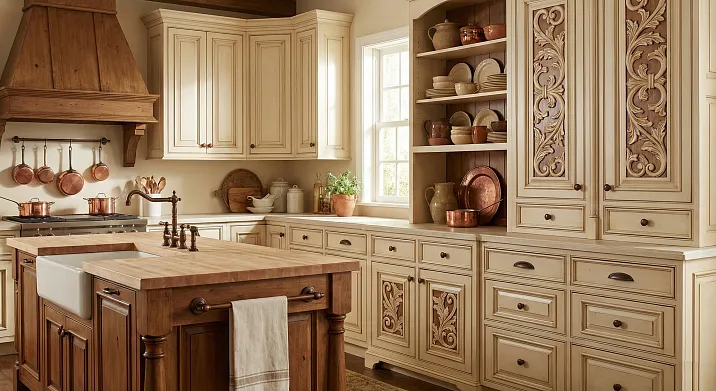
What makes a kitchen the heart of a home? Appliances? No. Functionality? Partly. But the main thing is the atmosphere created by details. When you open a cabinet door and feel the warm wooden handle under your fingers, when your gaze glides over the carved overlay on the facade, when morning coffee brews surrounded by natural oak—that's when the kitchen stops being just a cooking space and becomes a living space.Decor of a wooden kitchen— is a philosophy of returning to naturalness in the age of plastic and laminate, a choice for those who understand: true luxury is not in price, but in material quality, craftsmanship, in details that serve for decades and only become more beautiful with time.
Wood in the kitchen is not news. For centuries, kitchens were made from solid wood: oak, beech, pine. Then came the era of MDF, chipboard, plastic facades imitating everything from marble to zebrawood. Cheap, fast, practical. But the soul craves authenticity. And so in the 21st century, a return is happening:Classic Furnitureis back in fashion, natural wood is valued again, andFurniture Handlesmade from solid oak replace faceless metal brackets. Why? Because wood is alive. It breathes, smells, ages beautifully, creates tactile comfort that no plastic can provide.


Natural wood in the kitchen: trend or timeless classic
To call wood in the kitchen a trend is to misunderstand its essence. Trends come and go. Wood is a constant, a material that has proven its worth over millennia. However, forms, styles, and processing methods change, adapting to the era.




Why wood is perfect for the kitchen
Eco-friendliness. Solid oak, beech, ash are natural materials that do not emit toxins (unlike some types of particleboard with formaldehyde). Wood is hypoallergenic, safe for children, pets, and people sensitive to chemicals.
Durability. An oak kitchen lasts 30-50 years without losing functionality. The fronts do not delaminate (like laminated ones), do not crack (like low-quality painted MDF), and do not fade (the natural color of wood is stable). Scratches and dents can be sanded and refinished — the kitchen is renewed, not thrown away.
Tactility. Wood is warm to the touch (the surface temperature of wood is 2-3 degrees higher than room temperature due to low thermal conductivity). Touching a wooden handle, door, or countertop is pleasant and creates psychological comfort.
Acoustics. Wood absorbs sound (unlike metal and glass, which resonate). A wooden kitchen is quieter: closing doors and clattering dishes sound softer.
Aesthetics. The texture of natural wood is unique (no two identical boards), creating visual richness. Even smooth painted fronts on a wooden base look higher quality than plastic ones due to weight, thickness, and tactility.
Our factory also produces:


Wood species for kitchen furniture
Oak — the king of kitchen fronts. Density 700 kg/m³, high hardness (no dents from dishes or pots), expressive texture (large pores, rays), natural moisture resistance (oak contains tannins that prevent rotting). Oak fronts last for decades without restoration. The price is high (solid oak for a 600×400 mm front — 2500-4000 rubles per piece), but the investment is justified by durability.
Beech — an alternative to oak for those who want light wood with a fine texture. Density 680 kg/m³, hardness comparable to oak, fine-pored, uniform texture (paints well, sands to perfect smoothness). Beech is less moisture-resistant than oak (requires high-quality varnish or oil protection) but cheaper (2000-3500 rubles for a 600×400 mm front).
Ash — a light species with contrasting texture (alternating light and dark stripes). Density 700 kg/m³, strength like oak, higher elasticity (does not crack). Ash is suitable for modern classic kitchens where a light base with graphic texture is needed. Price — 2200-3800 rubles per front.
MDF veneer — a compromise between naturalness and price. The base is an MDF panel 16-19 mm thick, faced with natural oak, walnut, or ash veneer 0.6-1 mm thick. Visually indistinguishable from solid wood, natural texture, lighter weight (MDF density 700-800 kg/m³, but thickness is less), higher stability (MDF does not warp from humidity). Price — 1200-2500 rubles per front, making a wooden kitchen more accessible to a wider audience.
Get Consultation
Front decor: carved overlays and panels for a classic kitchen
Smooth fronts are functional but bland. A classic kitchen requires decor — elements that create volume, relief, and visual complexity.Decorating Wooden Doorsturns a simple cabinet door into a piece of applied art.
Paneled fronts: a classic genre
A panel is the central part of a front, enclosed in a frame. The frame (stile and rail) is made of solid wood with a cross-section of 60-100 mm, into which the panel (central panel) is inserted, made of MDF, plywood, or solid wood. The panel can be flat (recessed into the frame by 3-5 mm), raised (protrudes above the frame, creating volume), or carved (with an ornament milled on the surface).
Paneled fronts are one hundred percent classic. They create structure, division, and visually reduce the scale of large doors (a large plane is broken into a frame and center). In a kitchen with tall cabinets (front height 700-900 mm), a panel is essential — otherwise, the door looks like an industrial panel.
Carved overlays: adding ornamentation
A carved overlay is a decorative element 8-12 mm thick that is glued or screwed onto the front, creating relief. Overlays come in:
Corner — placed at the corners of the front (four overlays per door), creating a frame. Ornament — plant scrolls (acanthus, grapevine), geometric patterns (meander, diamonds). Overlay size 80×80 mm, 100×100 mm.
Central — placed in the center of the front, larger than corner ones (diameter 120-200 mm), ornament rosette, flower, cartouche. A central overlay is the focal point of the front.
Horizontal strips — narrow slats 30-50 mm wide, length matching the front width, placed horizontally in the upper or lower part of the door. Ornament repeating (grapevine, leaves, geometric meander).
Overlays are made from solid wood (oak, beech) on CNC machines (milling according to a program, relief accuracy 0.3-0.5 mm) or by hand (carving with chisels, custom work). Overlays are supplied sanded, ready for painting or oil coating. Attachment — with wood glue (PVA or polyurethane) + headless finishing nails (driven in, countersunk, holes filled).
Milling fronts: integrated relief
Instead of overlay elements, relief can be created directly on the front by milling. A CNC machine removes layers of wood or MDF to a depth of 3-8 mm, forming grooves, channels, and ornaments. A milled front is one-piece (nothing is glued on) but requires a thicker blank (22-25 mm instead of standard 16-19 mm).
Types of milling:
-
Flutes — vertical grooves, repeating at intervals of 30-50 mm, imitating a classic column.
-
Frame — a milled groove along the perimeter of the front at a distance of 40-60 mm from the edge, creating the illusion of a frame and panel.
-
Ornament — a complex plant or geometric pattern, milled in the center or at the corners of the front.
Milling is 30-50% more expensive than a smooth front (complexity of processing, machine time) but cheaper than overlay elements (no manual labor for installing overlays is needed).
Wooden Furniture Handles: The Detail That Changes Everything
You open a kitchen cabinet door dozens of times a day. Each time, your hand touches the handle. If the handle is a cold, mass-produced metal bracket, anonymous and generic, the contact is functional but brings no pleasure. If the handle is a warm oak cylinder with a smooth, polished surface and a visible, tangible texture, every touch becomes a micro-pleasure, a reminder of quality and the choice of natural material.
Types of wooden furniture handles
Knob handle — round or square, 30-50 mm in diameter, protrudes 20-30 mm from the front. Mounted with a single screw through the center. Suitable for small doors (up to 400 mm wide) and drawers. Finish options: smooth polished surface, carved edges, notches, relief pattern.
Pull handle — a horizontal bar, 96-128-160 mm long (standard center-to-center distances), mounted with two screws. More convenient than a knob for wide doors (you grasp it with your whole palm, not just fingers). Bar profile: round (20-25 mm diameter), oval, rectangular with rounded edges. Surface: smooth or with notches (anti-slip).
Recessed handle — flush-mounted, does not protrude from the front. A semicircular recess (radius 40-60 mm, depth 15-20 mm) is routed into the top of the door panel for fingers to grip. Suitable for minimalist kitchens where protruding elements are not desired (important in narrow passages where clothing can catch on handles).
Combined handle — a wooden insert in a metal base. The base (pull) is made of matte aluminum, brass; the central part is a wooden cylinder made of oak or walnut. Combines the strength of metal (won't break if yanked) with the warmth of wood (pleasant to hold).
Finishing of Wooden Handles
Oil. The handle is impregnated with oil (linseed, tung, Danish), then polished. Oil highlights the grain, makes the surface smooth, and provides moisture protection (but not absolute—wood under oil can breathe). Requires renewal every 2-3 years (sand with 320-grit sandpaper, apply a new coat of oil, polish). Color: natural (light oak, dark walnut) or tinted (oil with pigment—gray, black, brown).
Varnish. The handle is coated with polyurethane varnish (two to three coats), creating a durable film. Varnish fully protects the wood (moisture cannot penetrate), does not require renewal (lasts 10-15 years), but the wood cannot breathe. Can be matte (natural look, no shine), semi-matte (soft silky sheen), glossy (mirror shine—rarely used on handles, looks cheap).
Paint. The handle is painted with opaque enamel (white, gray, black, colored per RAL), hiding the wood grain. Painted handles suit kitchens where the fronts are also painted (monochrome scheme—all white, all gray). Practical (easy to clean, moisture-resistant), but the connection to wood is lost (visually, the handle could be made of anything).
Wax with patina. The handle is painted a base color (white, beige), then a wax patina (gold, silver, copper) is applied on top, partially wiped off, remaining in the recesses of carvings or notches. Creates an antique, aged effect. Patinated handles suit classic, baroque kitchens where an atmosphere of luxury and history is important.
Replacing Handles: The Simplest Kitchen Upgrade
If your kitchen has fronts in good condition but the handles are metal, anonymous, and generic—replace them with wooden ones. This is the simplest upgrade, giving an instant effect: the kitchen looks more expensive, warmer, more individual. Replacing handles takes 2-3 hours (unscrew old ones, screw in new ones), cost—300-800 rubles per handle (depends on size, profile complexity, wood species). For a kitchen with 15 fronts—4500-12000 rubles, which is many times cheaper than completely replacing the fronts or buying a new kitchen.
Cornices and Mouldings: Completing the Composition of a Kitchen Set
Upper kitchen cabinets hang on the wall; their top edge is just a horizontal line, a transition to the ceiling. Without finishing, it looks incomplete, truncated.Furniture crown moldingA cornice turns this line into an architectural element, creates a transition, visually raises the cabinets, and adds volume.
Wooden Cornices for Upper Cabinets
Cornice—a horizontal plank 80-200 mm high, attached along the top of the cabinets. Classic cornice profile: lower ogee (smooth transition from cabinet), straight shelf, upper torus or flutes (decorative band). Made from solid wood (oak, beech, ash) or MDF (for painting or veneer).
Wooden cornice is painted to match the fronts (color unity) or in contrast (white cornice on dark fronts, dark on light—emphasizes architecture). Mounting—to the top edge of cabinets with screws from inside (not visible from below) or with adhesive (if cabinets are flush to the ceiling).
A cornice can conceal LED lighting (LED strip placed behind the cornice, light directed upwards, creates a floating cabinet effect, illuminates the ceiling, visually raises it).
Polyurethane Mouldings for Kitchen Zoning
The kitchen is a space where several zones are often combined: work area (stove, sink, countertops), dining area (table), sometimes a lounge area (sofa, TV in a kitchen-living room). Zoning can be created not with partitions (which clutter) but visually—with mouldings on the walls.
Moldings made of polyurethanePolyurethane mouldings are lighter than wooden ones (density 300 kg/m³ vs. 700 kg/m³ for oak), moisture-resistant (polyurethane does not absorb water, does not swell—critical for kitchens with high humidity), paintable (primed white, can be painted with acrylic paint in any color).
In the kitchen, mouldings are used:
-
Around the backsplash perimeter—a 40-60 mm wide moulding frames the work area, creates a frame around the tile, porcelain stoneware, or glass backsplash panel. Visually, the backsplash becomes a picture, not just a protective panel.
-
Horizontal wall band—a moulding at a height of 120-150 cm from the floor divides the wall into a lower (plinth) and upper zone. The lower part is painted darker or covered with washable wallpaper, the upper part lighter. The band creates a classic structure characteristic of 19th-century dining rooms.
-
Ceiling cornice around the kitchen perimeter—a 100-150 mm wide moulding at the wall-ceiling junction completes the space, creates a transition. The cornice can conceal LED lighting (cove lighting for the ceiling).
Kitchen Skirting Board: Protection and Decoration at Floor Level
Wooden baseboardA skirting board is an element that covers the joint between the floor and wall, protects the lower part of the wall from splashes, mop hits, vacuum cleaner bumps, and hides cables (modern skirting boards often have a cable channel).
Why a High Skirting Board is Needed in the Kitchen
In the kitchen, baseboards endure greater stress than in other rooms: moisture from floor washing, grease from cooking (settles on all surfaces, including the lower part of walls), impacts from feet, carts, and chairs. A standard 60-70 mm high baseboard protects only the very bottom. A high baseboard of 100-150 mm protects the wall to a greater height, creates visual weight proportional to the high kitchen cabinets (if cabinets are 2.4 meters, a 60 mm baseboard looks stubby, 120 mm looks proportional).
Material for kitchen baseboard
Solid oak is the ideal choice. Oak is moisture-resistant (does not swell from wet cleaning), hard (does not dent from impacts), and durable. Oak baseboard is coated with yacht varnish (three layers), creating a water-repellent film. Color - natural (light or dark oak under oil) or painted (white, gray enamel to match the kitchen fronts).
MDF veneer is a budget alternative to solid wood. The MDF core is stable (does not warp), the veneered surface conveys wood texture, and the varnish coating protects against moisture. The price of MDF baseboard is 1.5-2 times lower than oak (400-600 rub/m vs. 800-1200 rub/m).
Polyurethane baseboard (for painting) - for minimalist kitchens where color is more important than texture. Polyurethane is completely moisture-resistant, does not rot, is easy to install (glued), and can be painted any color. But polyurethane lacks wood texture and feels colder to the touch.
Kitchen set composition: creating a harmonious ensemble
Classic kitchenis not a set of elements bought in different places, but a thoughtful ensemble where each detail complements the others.
Principle of material unity
If the fronts are made of solid oak, then the handles, cornice, and baseboard should also be oak (or at least painted in an identical tone). Unity of material creates integrity, a monolithic interior. Exception - contrasting accents (white fronts + dark oak handles), but this is a conscious stylistic decision, not an accident.
Principle of pattern coordination
If the fronts have carved overlays with acanthus leaves (baroque motif), then the cornice decor should be baroque (ornamental bands, complex profiles). If the fronts are simple paneled (neoclassical), then the cornice is simplified (smooth curves, minimal details). Mixing patterns from different eras creates eclecticism (which can be interesting), but requires designer skill.
Principle of proportions
Tall upper cabinets (900 mm) require a tall cornice (120-150 mm), otherwise it gets lost. Large fronts (600 mm width) require large handles (bracket 128-160 mm), small 30 mm button handles will be disproportionate.
Frequently asked questions: wooden kitchen without mistakes
Is a wooden kitchen afraid of moisture?
Solid oak with a quality varnish coating (three layers of yacht varnish) is absolutely moisture-resistant. Water does not penetrate the wood, fronts do not swell or warp. Critical: varnishing must be factory-applied (in a chamber, with layer thickness control), DIY brush varnishing is less reliable. High-risk areas (fronts near the sink, dishwasher) can be additionally protected with aluminum or plastic profiles along the bottom edge.
Can wooden fronts be washed with cleaning agents?
Yes, but with non-abrasive ones. Varnished fronts are washed with a soft sponge and liquid soap, dishwashing detergent, or special sprays for wooden furniture. Do not use abrasives (powders, hard scrubbers - scratch the varnish), solvents (acetone, alcohol - damage the varnish), chlorine-containing agents (bleach the wood).
How much does a classic wooden kitchen with decor cost?
Example: kitchen 3 meters (lower cabinets) + 2.4 meters (upper), paneled fronts MDF veneer oak, carved overlays, wooden handles, cornice, baseboard.
-
Lower fronts (8 pcs 600×720 mm) - 2200 rub/pc × 8 = 17600 rub
-
Upper fronts (6 pcs 600×720 mm) - 2000 rub/pc × 6 = 12000 rub
-
Carved overlays (40 pcs) - 250 rub/pc × 40 = 10000 rub
-
Wooden handles (14 pcs) - 450 rub/pc × 14 = 6300 rub
-
Wooden cornice (2.4 m) - 1200 rub/m × 2.4 = 2880 rub
-
Wooden baseboard (12 m) - 900 rub/m × 12 = 10800 rub
-
Cabinet carcass (chipboard, hardware, countertop) - 120000 rub
-
Total materials: 179580 rub
-
Labor (assembly, installation, finishing): 60000-90000 rub
-
Total: 239580-269580 rub
For comparison: a kitchen made of laminated chipboard without decor costs 100,000-150,000 rubles. The difference of 90,000-120,000 rubles is the price for naturalness, durability, and beauty.
Can an old kitchen be updated with decor?
Yes, if the cabinet is in good condition. Replace the fronts with new paneled ones or add carved overlays to existing smooth ones, replace handles with wooden ones, install a cornice. The upgrade cost is 50,000-80,000 rubles (instead of 250,000 rubles for a new kitchen). The kitchen looks like new, but you save 70% of the budget.
What color to choose for a wooden kitchen?
Depends on the house style, kitchen size, lighting. For small kitchens (up to 12 m²) — light tones (white, light gray, natural light oak), visually expanding the space. For spacious kitchens (15+ m²) — dark tones are possible (dark walnut, stained oak, graphite gray), creating drama and luxury. A universal option is a two-tone kitchen (lower cabinets dark, upper ones light), creating balance and visually grounding the structure.
How to care for wooden handles?
Oil-finished handles: wipe with a dry cloth (remove dust, grease), renew with oil once a year (apply a thin layer, polish with a dry cloth). Lacquered handles require no maintenance (washing with soap is sufficient). Painted handles with scratches: touch up locally (fine brush, acrylic paint to match).
Conclusion: create your dream kitchen with STAVROS
Decor of a wooden kitchen— is the art of transforming a utilitarian room into the heart of the home, a space where cooking becomes a pleasure and family breakfasts a ritual. Natural wood, carved overlays, warm wooden handles, high plinths, cornices completing the composition — all this creates an atmosphere that cannot be bought with money, it can only be created by choosing the right materials, thinking through the details, and putting your soul into it.
STAVROS is a leading Russian manufacturer of elements for kitchen furniture and interior decor with over twenty years of history. STAVROS creates products for those who understand: the kitchen is not just a place for cooking, but the center of family life, and it deserves the best materials.
carved inlays from solid woodOverlays from STAVROS — oak, beech class A, CNC carving (relief precision 0.3 mm) or hand carving (piece elements for premium projects). The catalog includes over 100 overlay models: corner (80×80, 100×100 mm), central (diameter 120-200 mm), horizontal strips (width 30-60 mm, length custom). Each overlay is sanded (grit 180-220), ready for finishing. Possibility of factory painting (any RAL color), patination (gold, silver).
wooden furniture handlesHandles from STAVROS — solid oak, walnut, ash, turned or carved. Types: knob handles (diameter 30-50 mm), pull handles (center-to-center 96-128-160 mm), drop handles (recessed). Finish — oil (natural color), lacquer (protection), paint (opaque), patina (antique). Price — from 280 rubles per knob, from 450 rubles per pull. For projects of 50+ handles — 15% discount.
Furniture cornices made of solid wood and MDFCornices from STAVROS — height from 80 to 200 mm, profiles from simple (one ogee) to complex carved (ornamental bands). Material — solid oak, beech, MDF for painting or veneer. Standard length 2.0-2.4-2.8 meters or custom to kitchen dimensions. Radius cornices for corner cabinets — radii R300, R242 mm. Price — from 900 rubles/m (MDF for painting) to 2500 rubles/m (solid carved oak).
Wooden skirting boardsPlinths from STAVROS — solid oak, beech, ash, height 80-150 mm, classic profiles (ogee, torus, flutes). Plinths are coated with lacquer (moisture protection), oil (natural texture), paint (color of choice). Plank length 2.0-2.5 meters. Mounting — screws through plinth into wall (dowels), holes filled and painted. Price — from 800 rubles/m (beech) to 1400 rubles/m (carved oak).
Polyurethane moldingsMoldings from STAVROS — width from 30 to 150 mm, profiles from simple to Baroque. Polyurethane density 300-350 kg/m³ (maximum relief clarity), white primer (ready for painting), moisture resistance (suitable for kitchens, bathrooms). Plank length 2.0 meters. Price — from 350 rubles/m (simple profile) to 900 rubles/m (Baroque ornament).
Kitchen fitting service: order all decorative elements from one source. STAVROS designers will calculate the quantity of overlays, handles, cornices, plinths for your kitchen, select profiles, coordinate colors. You will receive a kit ready for installation, with instructions, fasteners, and finishing recommendations.
Professional STAVROS partners will perform decor installation: mounting overlays on fronts, replacing handles, installing cornices, plinths, moldings, painting elements. Work duration for a 3-meter kitchen — 3-5 days. Material warranty 5 years, workmanship warranty 2 years.
Choosing STAVROS means choosing the quality of natural wood, proven by generations. You choose full-cycle production, controlling every stage from wood procurement to packaging of finished products. You choose a partner who understands: the kitchen is not a set of cabinets, but a living space where every detail matters.
Create a kitchen that will delight you for decades. A kitchen where morning coffee is brewed surrounded by natural oak, where every touch of a wooden handle reminds you of the right choice, where carved overlays on fronts catch the light and create a play of shadows. With STAVROS materials and craftsmanship, your dream of a classic wooden kitchen becomes a reality!