Article Contents:
- Anatomy of a Fireplace Portal: Elements of Classical Composition
- Columns or Pilasters — Vertical Elements Framing the Hearth
- Fireplace Mantel — Horizontal Element for Decoration and Functionality
- Frieze — a decorative strip under the shelf
- Plinth — Base of the Portal
- Central Decorative Element — Focal Point of the Composition
- Styles of Fireplace Portals: From Strict Classicism to Modern Minimalism
- Classicism: Symmetry and Antique Proportions
- Baroque: Opulence and Dynamic Forms
- Empire: imperial monumentality
- Neoclassicism: modern interpretation of classicism
- Minimalism: Portal Without a Portal
- Rustic and Country: Warmth of Natural Wood (or Its Imitation)
- Why Polyurethane Became the Material of Choice for Fireplace Portals
- Temperature Resistance: Safety for Electric and Bio-Fireplaces
- Non-Combustibility: Certification and Safety
- Lightweight: Installation Without Structural Reinforcement
- Detailing of Carving: Casting Reproduces the Finest Details
- Paintability: Any Color and Texture
- Trends 2026: Where Fireplace Portal Design is Heading
- Large-Format Portals: Monumentality in Fashion
- Dark and Contrasting Colors: Moving Away from White Monopoly
- Minimalism and Geometricity: Simplification of Forms
- Integration with Multimedia: Fireplace and Television
- Eco-Friendliness and Naturalness: Imitation of Natural Materials
- Installation of a Fireplace Portal: Step-by-Step Technology
- Preparation: Choosing the Location and Taking Measurements
- Foundation Preparation
- Portal Assembly: From Plinth to Mantel
- Sealing Joints and Preparing for Painting
- Installation of the Firebox
- Project cost: from budget-friendly solutions to premium portals
- Pricing factors
- Approximate pricing (2026, Russia)
- STAVROS: where carving traditions meet polyurethane technology
- Conclusion: the fireplace as the heart of the home

A fireplace in the living room is not just a source of heat. It is the compositional center around which the entire logic of the space is built. Sofas are turned towards it, armchairs face it, guests' gaze is inevitably drawn to the flames or the flicker of an electric firebox. And at this moment, it becomes critically important how the hearth's framing looks. A bare brick niche with a firebox is a functional minimum that says: people who are indifferent to beauty live here. A fireplace framed by a classic portal with columns, cornice, decorative elements is an architectural statement that communicates: traditions are valued here, the language of classicism is understood, a space for a dignified life is being created.
Historically, fireplace portals were carved from marble, limestone, and wood. Stone portals weighed hundreds of kilograms, required reinforced floors, cost as much as an artisan's annual income, served for centuries, but gradually cracked from temperature fluctuations. Wooden ones burned, warped from heat, and required constant maintenance. The 21st century offered a revolutionary solution.Polyurethane fireplace decorweighs ten times less than stone, is not afraid of temperatures up to 80 degrees (sufficient for any electric and bio-fireplace), does not burn, is installed in a day, costs like good furniture instead of a car's price, reproduces the finest carving details with casting precision.


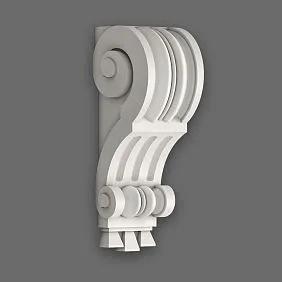
Anatomy of a fireplace portal: elements of classical composition




Columns or pilasters — verticals framing the hearth
The side posts of the portal are not just a frame. In classical architecture, they imitate columns or pilasters that visually bear the load of the upper part. Even if the portal is structurally supported by the wall, architectural logic requires creating visual support.
Fireplace portal columns are usually simplified compared to full-fledged architectural columns. They consist of a base (the lower expanded part), a shaft (the central vertical), and a capital (the upper termination). The shaft can be smooth, fluted (with vertical grooves), or twisted (with spiral grooves). The capital is most often Ionic (with volute scrolls) or Corinthian (with acanthus leaves) — the most decorative options that create richness in the upper part of the portal.
Pilasters are a flat version of columns that protrude from the plane of the portal by 3-5 centimeters. They create vertical articulation without taking up much space. For small fireplaces in modest living rooms, pilasters are the optimal choice, providing architectural expressiveness without massiveness.
The height of the side posts is determined by the height of the firebox plus 20-40 centimeters on top (for the mantel shelf and cornice). For a standard electric fireplace with a height of 60 centimeters, the total portal height is 100-120 centimeters. For a monumental bio-fireplace with a height of 80 centimeters, the portal can reach 140-160 centimeters.
Our factory also produces:

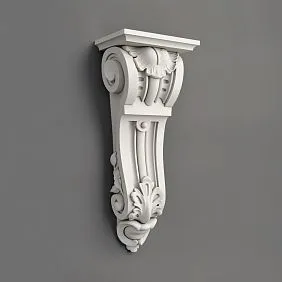
Mantel shelf — a horizontal for decor and functionality
The mantel shelf is the horizontal slab crowning the portal. It serves a dual function: architectural (completes the verticals of the columns, creates the upper boundary of the portal) and practical (serves as a place for decorative items — clocks, photographs, vases, candles).
The width of the mantel shelf is usually 15-30 centimeters greater than the width of the firebox on each side. For an 80-centimeter wide firebox, the shelf has a width of 110-140 centimeters. The shelf depth is 15-25 centimeters — enough to place decor, but not so much that the shelf looks bulky.
The shelf profile can be simple (a rectangular slab with a beveled edge) or complex (a multi-step cornice with curves, shelves, drops). The richer the portal style, the more complex the shelf profile.
The material of a traditional mantel shelf is solid wood, marble, granite. A polyurethane shelf imitates these materials in appearance but weighs ten times less. A solid oak shelf measuring 140×25×5 centimeters weighs 12-15 kilograms, a marble one 40-50 kilograms, a polyurethane one 2-3 kilograms. This is critical for mounting on a drywall wall — a polyurethane shelf can be secured with standard dowels, a solid one will need to be anchored into the load-bearing wall through the cladding.
Get Consultation
Frieze — decorative strip under the shelf
The frieze is the horizontal element between the column capitals and the mantel shelf. In classical architecture, the frieze is part of the entablature, the middle section between the architrave (lower beam) and the cornice (upper projection). In a fireplace portal, the frieze often becomes the main decorative accent.
The frieze can be smooth (just a flat or slightly profiled strip), relief (with plant or geometric ornamentation), or narrative (with bas-relief images — putti, garlands, antique scenes). The frieze height is usually 10-20 centimeters, the length equals the width of the mantel shelf or slightly less.
Classical motifs for the frieze: meander (a continuous geometric band in the form of a broken line), acanthus leaves (stylized plant scrolls), garlands of flowers and fruits, putti (chubby infant angels), lion masks, rosettes.
Modern interpretations allow abstract geometric ornaments, minimalist reliefs, even smooth friezes with a color accent (the frieze is painted in a contrasting color relative to the rest of the portal).
Plinth — the base of the portal
The plinth is the lower part of the portal on which the columns or pilasters rest. It creates a visual foundation, raises the firebox above floor level, and forms completeness of the composition from below.
The plinth height is usually 10-25 centimeters. For portals where the firebox is installed directly on the floor, the plinth may be absent. For raised fireboxes (at a height of 20-40 centimeters from the floor, which is typical for bio-fireplaces), the plinth becomes a mandatory element that masks the podium under the firebox.
The plinth profile echoes the mantel shelf profile, creating the upper and lower frames of the portal. If the shelf has a multi-step cornice, the plinth often repeats these steps in mirror image.
Central decorative element — the accent of the composition
The center of the frieze or shelf is often adorned with a special decorative element that creates a focal point. This can be:
Cartouche — a decorative oval or rectangular shield with scrolls along the edges, often with a coat of arms, monogram, or ornament in the center. A cartouche creates Baroque opulence, suitable for luxurious interiors.
Keystone — an element imitating the central stone of arched masonry. It is larger than surrounding elements, protrudes more, and attracts attention. Suitable for portals with an arch above the firebox.
Rosette — a round or oval element with a relief floral or geometric ornament radiating from the center. Rosettes are characteristic of classicist portals.
Mascaron — a decorative mask of a human, lion, or fantastical creature. Mascarons add drama, creating the sensation that the portal is 'looking' at you.
Fireplace portal styles: from strict classicism to contemporary minimalism
Classicism: symmetry and antique proportions
A classicist portal is strict, symmetrical, and proportional. Two columns or pilasters on the sides, a straight frieze with a meander or garlands, a simple mantel shelf. Color — white marble or its imitation. Decoration is restrained, geometrically precise, without excess.
Proportions are strictly regulated: portal height is 1.5-1.8 times the firebox width, shelf width exceeds firebox width by 20-30 percent. Column capitals are Ionic or simple Doric. No scrolls, lavish carved elements, or gilding — only purity of lines and mathematical harmony.
Example: portal for an electric fireplace 90 centimeters wide. Two Ionic order pilasters 12 centimeters wide frame the firebox. Frieze 15 centimeters high with a relief meander. Mantel shelf — a simple rectangular slab with a bevel, painted white. Overall portal width 120 centimeters, height 110 centimeters.
Baroque: opulence and dynamic forms
A Baroque portal is maximally decorative. Columns are twisted or fluted, capitals are Corinthian with abundant carving. The frieze is covered with complex relief — garlands of flowers and fruits, putti, lion masks. The center of the frieze is adorned with a large cartouche with scrolls. The mantel shelf is massive, with a multi-tiered cornice.
Colors — white with gilding. Capitals, scrolls of the cartouche, protruding relief elements are covered with gold paint, creating an impression of luxury. Sometimes the entire portal is painted gold or imitates colored marble (green, black, red) with gold accents.
Asymmetry is permissible in details — a broken pediment above the portal, consoles of different shapes on the sides of the shelf. This creates Baroque dynamism, a sense of movement in frozen forms.
Example: portal for a bio-fireplace 100 centimeters wide. Two twisted columns with Corinthian capitals. Frieze with garlands and putti, central cartouche with scrolls. Shelf with a multi-tiered cornice, carved consoles at the edges. Entire portal white, capitals and cartouche covered with gold paint. Overall width 140 centimeters, height 140 centimeters.
Empire: imperial monumentality
Empire — classicism brought to an imperial scale. Portals are massive, with large columns, monumental proportions. Decoration includes imperial symbolism — eagles, laurel wreaths, military trophies, antique motifs.
Columns are often Doric or Tuscan — maximally powerful, without excessive decorativeness. Capitals are simple but large. The frieze can be smooth or with bas-reliefs on military or antique themes. Colors — white, gold, dark green marble, black marble with gold elements.
Horizontal orientation is characteristic — the portal is wide but not tall, creating an impression of stability, monumentality, power.
Example: portal for a wide electric fireplace 120 centimeters. Two Doric columns, massive, smooth. Frieze with relief — laurel wreaths and eagles. Mantel shelf — a thick slab of imitation black marble. Overall width 160 centimeters, height 120 centimeters. Portal painted white, frieze and shelf — black with gold accents.
Neoclassicism: modern interpretation of classicism
Neoclassicism takes the proportions of classicism but simplifies details, modernizes materials and colors. Portals retain symmetry, columns, frieze, but carving is minimized, ornament simplified or absent.
Columns are smooth or with minimal fluting. Capitals are simplified — stylized Ionic scrolls without fine detailing. Frieze is smooth or with simple geometric relief. Mantel shelf is straight, without a complex cornice.
Colors — gray shades (from light gray to graphite), beige, taupe, black. White remains relevant but does not dominate. Monochrome solutions are popular — portal matching the wall color, creating soft relief instead of contrasting emphasis.
Example: portal for an electric fireplace 80 centimeters wide. Two smooth pilasters without fluting, simplified capitals. Smooth frieze. Mantel shelf — a simple slab. Entire portal painted medium gray (RAL 7038), walls light gray. Soft contrast, contemporary elegance. Overall width 110 centimeters, height 100 centimeters.
Minimalism: portal without a portal
A minimalist approach often rejects the classical portal altogether. The firebox is built flush into the wall, without protruding framing. But even in minimalism, framing is possible if it is extremely laconic.
The portal consists of flat slats 5-8 centimeters wide, framing the firebox around the perimeter. No columns, capitals, cornices. Just a geometric frame. Mantel shelf — a thin console slab, protruding from the wall 20-30 centimeters, thickness 3-5 centimeters.
Color — monochrome. Either matching the wall color (portal blends with the plane) or contrasting (black frame on a white wall, white on black).
Example: firebox 100 centimeters wide built into a white wall. Around it — a matte black frame 6 centimeters wide made of flat profile. Above the firebox — a thin black shelf depth 25 centimeters, thickness 4 centimeters. No decoration, only pure geometry. Overall frame width 112 centimeters, height from floor to shelf 90 centimeters.
Rustic and country: the warmth of natural wood (or its imitation)
Rustic and country portals imitate roughly processed wood.Decorative elements for the wall made of polyurethaneare painted to resemble wood texture — oak, walnut, aged wood with cracks and wear.
The portal is simple — a massive beam-shelf resting on two vertical posts of square cross-section. No capitals, friezes, or classical elements. Instead of carving — a rough texture imitating axe marks, knots, and cracks.
Colors — natural wood tones from light ash to dark walnut. The technique of artificial aging is popular — patination, brushing (highlighting the wood grain), waxing.
Example: a portal for a bioethanol fireplace. Two vertical posts 12×12 centimeters made of polyurethane painted to resemble aged oak. A massive beam-shelf 140×25×12 centimeters, also in oak finish. The texture is rough, with imitation cracks and knots. Overall width 140 centimeters, height 120 centimeters.
Why polyurethane became the material of choice for fireplace portals
Temperature resistance: safety for electric and bioethanol fireplaces
High-quality polyurethane withstands temperatures up to 80-90 degrees Celsius without deformation. Electric and bioethanol fireplaces heat the surrounding air to a maximum of 50-60 degrees at a distance of 10-15 centimeters from the firebox — a polyurethane portal is in the safe zone.
For wood-burning fireplaces with open flame, polyurethane is not suitable — the temperature in the firebox area reaches 300-500 degrees, which exceeds the material's degradation temperature. However, wood-burning fireplaces are prohibited in urban apartments due to fire safety regulations, and in country houses they are traditionally framed with stone or brick.
The vast majority of modern fireplaces are electric or bioethanol. They do not require a chimney, are safe, create a live flame (bioethanol fireplaces) or its imitation (electric fireplaces), and perfectly complement polyurethane portals.
Non-flammability: certification and safety
Polyurethane belongs to the group of low-flammability materials (G1-G2 according to GOST 30244). It does not support combustion — remove the source of fire, and the material extinguishes. When heated above the degradation temperature, it chars but does not ignite with flame formation.
For fireplace portals, polyurethane with flame retardants is used — chemical additives that further increase fire resistance. Upon contact with fire, flame retardants release gases that extinguish the flame and form a protective carbon film on the surface, preventing further combustion.
Fire safety certificates confirm that the material meets requirements for residential premises. Quality manufacturers, such as STAVROS, provide a complete package of documents, including test protocols for flammability, smoke generation, and toxicity of combustion products.
Lightweight: installation without structural reinforcement
A medium-sized marble portal (120×110×25 centimeters) weighs 150-200 kilograms. Its installation requires floor reinforcement, anchor fixation to a load-bearing wall, and a team of installers. In apartments on upper floors, installing such a portal is often impossible due to floor load limitations.
A polyurethane portal of the same dimensions weighs 15-25 kilograms. One person can lift it effortlessly. Installation on a drywall wall using adhesive and dowels takes 4-6 hours. No structural reinforcement, no special fasteners, no restrictions on installation location.
For the firebox (an electric fireplace weighs 10-30 kilograms), only a level surface is required — the floor or a podium. The polyurethane portal is mounted around the installed firebox, creating an architectural frame without altering load-bearing structures.
Detailing of carving: casting reproduces the finest details
Acanthus leaves of a Corinthian capital, volute scrolls, frieze garlands, mascaron faces — all this intricate carving is reproduced by polyurethane casting with an accuracy of tenths of a millimeter. The liquid composition flows into the micro-recesses of the silicone mold, hardens, and reproduces every detail of the master model.
After extraction from the mold, the element requires no finishing — it already has a completed form. For comparison: plaster carving requires manual finishing with chisels after hardening, which increases cost and production time. Stone carving is done entirely by hand by a sculptor, takes weeks, and costs tens of thousands for a single element.
Examine a high-quality polyurethane cartouche with scrolls. Each scroll is a complex three-dimensional curve that emerges from the plane, twists, and tapers towards the end. Transitions between elements are smooth and organic. After painting and patination, such an element is indistinguishable from a carved stone original.
Paintability: any color and texture
Polyurethane is supplied primed white. This is a universal base that accepts any paint. Want classic white marble — two coats of white acrylic paint. Want imitation Carrara marble with gray veins — marbleizing technique with a base white layer and veins applied with a sponge. Want wood — paints with wood texture effects or patination in wood tones.
Special painting techniques create effects unattainable with natural materials. Gradient painting — a smooth transition from a dark plinth to a light shelf. Gilding only the protruding carving elements while preserving the white background. Patination — rubbing dark patina into the recesses of the relief to emphasize volume.
Modern paints with metallic effects (bronze, copper, iron) transform a polyurethane portal into an imitation of metal forging. Paints with concrete effects create an industrial loft aesthetic. The possibilities are limited only by imagination.
Trends 2026: where fireplace portal design is heading
Large-format portals: monumentality in fashion
Modest portals one meter high are giving way to monumental structures 1.5-2 meters high. Portals are becoming architectural focal points, occupying an entire wall from floor to ceiling. The firebox is positioned centrally at a height of 60-80 centimeters from the floor, surrounded by framing of columns, friezes, and panels.
This approach transforms the fireplace area into an architectural portal, an object that dominates the space. The rest of the furniture and decor are arranged around this center.
Example: a living room wall 4×3 meters is fully decorated with a portal. A firebox 120 centimeters wide is centered at a height of 70 centimeters. On the sides — columns from floor to ceiling. Above the firebox — a mantel shelf and frieze. Below the firebox — a plinth with carved panels. The entire portal is painted white, the wall behind it is dark gray. This creates the impression of a majestic architectural structure inside the room.
Dark and contrasting colors: moving away from white monopoly
White portals remain classic, but dark ones are gaining popularity. Graphite, anthracite, and black portals on light walls create a modern dramatic contrast. This looks especially effective with bio-fireplaces, where the living flame against a dark portal creates a magical effect.
Two-tone solutions — dark portals with gold or bronze accents on carved elements. Dark blue, emerald, and burgundy portals on neutral walls to create a color accent.
Minimalism and geometricity: simplification of forms
Complex Baroque carving gives way to clean geometric forms. Portals become more laconic — straight lines, minimal decor, emphasis on proportions and materiality rather than ornament.
Geometric friezes — reliefs of simple shapes (squares, rectangles, circles), protruding 1-2 centimeters from the plane. Columns without capitals — simple pilasters of rectangular cross-section. Mantel shelves — thin cantilever slabs, floating above the firebox.
Integration with multimedia: fireplace and television
The modern living room often combines a fireplace and a television. Two visual centers compete for attention. The 2026 design proposes their integration: the television is positioned above the fireplace, incorporated into the portal composition.
The television is mounted on the wall above the mantel shelf. The portal is designed with this in mind — sufficient shelf height (minimum 60 centimeters from the firebox to the television for safety), the possibility of hidden cable routing through the portal columns, architectural framing of the television as part of the overall composition.
Some manufacturers offer portals with an integrated niche for the television — a recess in the wall, framed by the portal, housing both the firebox and the television within a single architectural frame.
Eco-friendliness and naturalness: imitation of natural materials
The trend towards eco-friendliness manifests in the pursuit of natural textures. Polyurethane portals are increasingly painted to resemble natural materials — limestone, sandstone, travertine, wood. This creates a sense of naturalness, warmth, and connection with natural materials.
Painting techniques become more complex — multi-layer coatings, patination, creating a non-uniform texture that imitates the natural texture of stone or wood. The result is a polyurethane portal that is visually and tactilely perceived as a natural material.
Fireplace portal installation: step-by-step technology
Preparation: choosing the location and taking measurements
The fireplace is positioned against a wall, preferably an interior wall (not an exterior one, which is colder in winter). Distance to furniture should be at least 80-100 centimeters for safety and convenience. An electrical outlet for an electric fireplace should be nearby, preferably hidden behind the portal.
Firebox measurements: width, height, depth. The portal is designed considering these dimensions plus ventilation gaps (usually 5-10 centimeters at the top and sides). For built-in electric fireplaces, a wall niche is required — its dimensions are also taken into account.
Marking on the wall: outlines of the portal, position of the firebox, mounting points. Verticals are checked with a level, horizontals with a laser level.
Foundation Preparation
The wall must be level, sturdy, and clean. Irregularities exceeding 5 millimeters per meter are unacceptable — the portal will not fit tightly. Weak plaster, loose materials are reinforced with deep-penetration primers.
For drywall walls, reinforcement is required at the portal mounting points — additional vertical studs in the frame to which heavy elements (columns, mantel shelf) will be attached. A standard drywall frame with stud spacing of 60 centimeters may be insufficient.
The floor under the portal must also be level and sturdy. For heavy fireboxes (over 50 kilograms), a solid base is required — screed, tile. Laminate or linoleum may sag, requiring a sturdy slab (metal, thick plywood) to be placed under the firebox.
Portal assembly: from the plinth to the shelf
The portal is supplied disassembled — individual elements are packed in boxes. Assembly proceeds from bottom to top.
Plinth: installed on the floor, leveled horizontally, attached to the wall with adhesive and dowels. Dowels are installed through pre-drilled holes, heads are countersunk, later filled.
Columns or pilasters: installed on the plinth, aligned vertically, attached to the wall. Adhesive is applied to the back surface in a zigzag pattern. The element is pressed against the wall, secured with painter's tape until the adhesive sets (15-20 minutes), then additionally fastened with dowels.
Frieze: installed between the upper parts of the columns, rests on the capitals. Attached with adhesive to the wall and to the columns. Horizontal alignment is checked with a level.
Mantel shelf: installed on the frieze or directly on the column capitals. This is the heaviest element, requiring reliable fastening. Adhesive plus dowels (minimum 4-6 pieces) through the shelf into the wall. If the wall is drywall, the dowels must enter the metal studs of the frame or special drywall anchors (molly, driva) must be used.
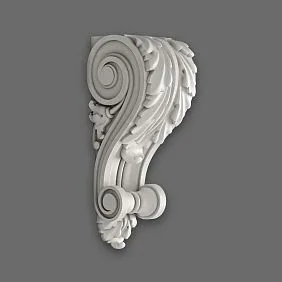
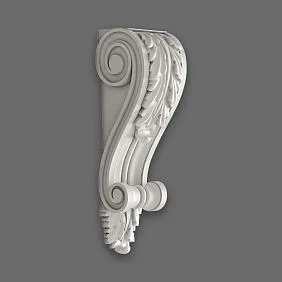
Decorative elements: cartouches, rosettes, corbels are installed after assembling the main structure. They are glued to designated spots, secured with tape until the adhesive dries.
Sealing joints and preparation for painting
Joints between elements are sealed with acrylic sealant or filler. Sealant is elastic, compensates for minimal movement of elements, does not crack. Filler is more rigid, used for wider gaps (over 2 millimeters).
Countersunk holes from dowels are filled, sanded flush with the surface after drying. Fine sandpaper (grit 180-240) is used to avoid scratching the polyurethane.
The entire surface of the portal is inspected for defects — chips, scratches, unevenness. Defects are filled with putty and sanded. After full preparation, the portal is degreased (wiped with a damp cloth), dried, and ready for painting.
Fireplace Insert Installation
An electric or bioethanol fireplace is installed after the portal is mounted. The insert is slid into the portal niche, leveled, and connected to the electrical supply (for electric fireplaces) or filled with bioethanol (for bioethanol fireplaces).
It is important to maintain ventilation gaps — there should be 5-10 centimeters between the insert and the portal elements for air circulation. Overheating of the portal due to poor ventilation can lead to deformation and paint discoloration.
For built-in electric fireplaces, wiring is laid concealed — through channels in the portal columns or in the wall behind the portal. The outlet is located behind the insert, and the cable is not visible.
Project cost: from a budget solution to a premium portal
Pricing Factors
Portal size — the larger the elements, the higher the price. A portal for a modest 60-centimeter-wide electric fireplace is cheaper than one for a 120-centimeter bioethanol fireplace.
Decorative complexity — a smooth portal with minimal carving is cheaper than a Baroque-style one with abundant relief, cartouches, and consoles.
Manufacturer — Russian manufacturers (STAVROS, Europlast) offer the best price-to-quality ratio. European imports (Orac, Gaudi Decor) are 30-50% more expensive.
Installation — DIY installation saves 40-60% of the cost. Professional installation guarantees quality but increases the budget.
Approximate rates (2026, Russia)
Simple portal for a 70 cm electric fireplace:
-
Two pilasters, frieze, mantel shelf, simple decor: 18,000 — 28,000 rubles
-
Adhesive, dowels, sealant: 1,500 — 2,000 rubles
-
Paint, primer: 1,000 — 1,500 rubles
-
Total materials: 20,500 — 31,500 rubles
-
Installation: 10,000 — 15,000 rubles
-
Total cost: 30,500 — 46,500 rubles
Classical portal for a 90 cm fireplace:
-
Two columns with capitals, frieze with relief, shelf, plinth: 35,000 — 55,000 rubles
-
Consumables: 2,000 — 3,000 rubles
-
Paint, patina: 2,000 — 3,000 rubles
-
Total materials: 39,000 — 61,000 rubles
-
Installation: 15,000 — 25,000 rubles
-
Total cost: 54,000 — 86,000 rubles
Luxurious Baroque portal for a 120 cm bioethanol fireplace:
-
Twisted columns, Corinthian capitals, carved frieze with garlands, cartouche, consoles, massive shelf: 70,000 — 110,000 rubles
-
Consumables: 3,000 — 4,000 rubles
-
Paint, gilding, patina: 4,000 — 6,000 rubles
-
Total materials: 77,000 — 120,000 rubles
-
Installation with painting: 30,000 — 45,000 rubles
-
Total cost: 107,000 — 165,000 rubles
For comparison: a marble portal of similar size and complexity costs 300,000 — 800,000 rubles (material only, without installation). Polyurethane provides savings of 3-5 times with a visually identical result.
STAVROS: where carving traditions meet polyurethane technology
Polyurethane fireplace decor from STAVROS is 23 years of experience with classical forms, embodied in modern material. The company started with wood carving, creating elements for the restoration of historical interiors. Work on the restoration of the Konstantinovsky Palace, the Hermitage, and the Alexander Palace provided a deep understanding of classical proportions, details, and technologies.
This experience has been transferred to the production of polyurethane decor. Each element of the fireplace portal — column, capital, frieze, cartouche — is created based on historical samples or original designs by the company's designers. Master models are cut on CNC milling machines or by hand by carvers with ten years of experience. Silicone molds are taken from the master models. Polyurethane is poured into the molds, hardens, and is extracted — a finished element with the finest carving details.
The STAVROS fireplace decor assortment includes ready-made portals in various styles and sizes, as well as individual elements for creating custom compositions. Columns of all orders — Doric, Ionic, Corinthian. Capitals of varying complexity. Friezes with classical ornaments — meander, acanthus leaves, garlands. Fireplace mantels of different profiles and sizes. Decorative elements — cartouches, consoles, rosettes, mascaron.
Material quality is confirmed by certificates. Polyurethane density 350-400 kg/m³, closed-cell structure, UV stabilizers, flame retardants, temperature resistance up to 90°C. Each batch undergoes final inspection — checking geometry, detailing, absence of defects.
The stock program ensures fast shipment. Popular portals and elements are in stock — order, and the products are yours in 1-3 days. Non-standard sizes and individual projects are made to order in 7-14 working days. Delivery throughout Russia — from Kaliningrad to Vladivostok. For Moscow and St. Petersburg — courier delivery or pickup.
Consulting support at all stages. STAVROS managers will help you choose a portal to fit the firebox size, select a style to match the interior, calculate the necessary elements, and provide recommendations for installation and painting. Call, describe your task — get professional advice from experts with 23 years of experience.
Conclusion: the fireplace as the heart of the home
A fireplace is more than a source of heat. It is a symbol of the hearth, a place where the family gathers, the center around which the life of the home is built. And this center must be beautiful. Polyurethane fireplace decor transforms a utilitarian firebox into an architectural work that creates atmosphere, sets the style, and speaks of the owners' taste.
Modern technologies have made classical fireplace portals accessible. No longer are tons of marble, months of masons' work, or a car's budget needed. Decorative elements for the wall made of polyurethane weigh kilograms instead of centners, are installed in a day instead of weeks, and cost like good furniture instead of luxury for the select few. At the same time, the detailing, beauty, and durability are not inferior to traditional materials.
Choosing a portal style — from strict classicism to baroque opulence, from rustic warmth to minimalist geometry — allows you to create a fireplace that will perfectly fit into any interior. Color solutions — from classic white to modern graphite, from marble imitation to wood textures — provide creative freedom.
Trends for 2026 expand possibilities. Monumental portals occupying an entire wall. Bold dark colors creating dramatic accents. Integration of the fireplace with multimedia. Eco-friendly textures imitating natural materials. All this is available today, turning fireplace installation from a complex project into a task achievable over a weekend.
Create interiors worthy of your life. Turn living rooms into spaces with character, where the fireplace becomes not just a heater, but the architectural heart of the home. Use Polyurethane fireplace decor from STAVROS as a tool for creating beauty, where 23 years of experience with classics combines with the advantages of modern materials.
Your fireplace is the face of your home, a place where guests are welcomed, the family gathers, and memories are created. Make it beautiful. Decorative elements for the wall made of polyurethane will help turn the dream of a classical fireplace into reality — affordable, practical, durable.