Article Contents:
- Fireplace portals: the architecture of fire
- Anatomy of a fireplace portal
- Portal styles: from classic to modern
- Material imitation: marble and wood
- Installing fireplace portal
- Door decor: transforming an opening into a portal
- Door casings: framing the opening
- Door panel overlays: three-dimensional decor
- Portals above doors: the grandeur of the entrance
- Pilasters and columns: vertical interior architecture
- Pilasters: flat columns
- Columns: three-dimensional verticals
- Half-columns: a compromise between pilaster and column
- Decorative corners: accents in corners
- Types of decorative corners
- Using corners in interior design
- Installing decorative corners
- Stone and marble imitation: visual luxury
- Marble imitation techniques
- Granite imitation techniques
- Patinated metal imitation
- Corbels and brackets: functional support
- Corbels for shelves
- Brackets for cornices
- Frequently Asked Questions
- Can a polyurethane fireplace portal be used with a real wood-burning fireplace?
- Can polyurethane pilasters bear weight?
- How to care for polyurethane decor?
- Can polyurethane decor be installed on uneven walls?
- How to combine polyurethane and wooden decor?
- Can polyurethane be painted with oil-based or nitro paints?
- How to dismantle polyurethane decor if replacement is needed?
- Conclusion: details that create character

Details create the image. A fireplace without a portal is just a heating appliance. A door without decorative framing is a technical hole in the wall. A wall without pilasters is a featureless plane.Polyurethane fireplace decortransforms a heater into the architectural center of the living room, around which the family gathers.Polyurethane door decorationtransforms a passage between rooms into a ceremonial portal, marking the boundary of spaces.Wall decor: polyurethane pilastersarticulates the vertical plane, creates rhythm, proportions, structure. Special decorative elements are not decoration for decoration's sake. They are architectural tools with which a designer shapes the character of a space. Polyurethane has made these tools accessible. What once required the work of a stone carver or plaster artist is now produced industrially while preserving the finest details of the ornament. The lightness of the material allows elements to be mounted where plaster or stone would create an unacceptable load. Moisture resistance expands the application—polyurethane decor is even installed in bathrooms, where plaster would develop mold within a month. How to choose the right elements for each zone of the interior? How to combine columns, corner pieces, portals so that the composition looks harmonious? How to install so that the decor lasts for decades? We dive into the world of special elements.


Fireplace portals: the architecture of fire
A fireplace is the emotional center of a room. Even an electric or bioethanol fireplace without a real chimney creates an atmosphere of coziness, a home hearth, a place where one wants to stop, sit down, and warm up not only physically but also spiritually.Polyurethane fireplace decorframes this zone so that it becomes a worthy center of attention.




Anatomy of a fireplace portal
A portal is a U-shaped structure framing the fireplace opening. Two vertical posts (columns, pilasters, or simply profiled strips) on either side of the opening. A horizontal beam (mantel shelf) above the opening, connecting the vertical posts. Optionally—a pediment (triangular or arched superstructure above the mantel shelf), a plinth part (horizontal strip below the opening), decorative inserts (ornamental panels on the vertical posts or above the shelf).
Portal dimensions are determined by the size of the fireplace opening. For a 60 cm wide electric fireplace, a standard portal has an inner opening of 65-70 cm (the fireplace insert fits with a 2-5 cm perimeter gap for ventilation), an outer width of 100-120 cm (vertical posts extend 15-30 cm beyond the fireplace on each side), and a height from floor to mantel shelf of 90-110 cm. For a wide fireplace 100 cm wide, the portal has an inner opening of 105-110 cm, an outer width of 140-180 cm, and a height of 100-120 cm.
The mantel shelf is the horizontal surface that completes the portal. Its depth (projection from the wall) for decorative portals without a real fireplace opening is 15-25 cm; for electric fireplaces, 20-30 cm (part of the shelf overhangs the opening, creating visual completeness). Clocks, photo frames, candelabras, vases are placed on the mantel shelf—it becomes a functional shelf and a compositional accent.
Our factory also produces:



Portal styles: from classic to modern
Classical portal with columns—vertical posts are executed as full columns with bases, fluted (with vertical grooves) shafts, and Ionic or Corinthian order capitals. The mantel shelf is massive, with profiled edges, the underside decorated with dentils (tooth-like ornaments) or modillions (brackets). A triangular pediment above the shelf is possible. Color: white or cream, possibly gilding of capitals and ornaments.
Such a portal is suitable for spacious living rooms of 25 m² or more in classic, neoclassical, Empire style. Ceiling height preferably from 2.8 m, so the monumentality of the portal does not overwhelm the space.
Portal with pilasters—vertical posts are flat, imitating pilasters (flat columns attached to the wall). Base, shaft (smooth or with light relief), simplified capital. Mantel shelf of medium massiveness, classic profile, but without excessive decoration. Pediment absent or minimal. Color: white, cream, possible painting to match the wall color (monochrome scheme).
Such a portal is universal, suitable for living rooms of 15-25 m² in neoclassical, contemporary classic, Scandinavian style. Ceiling height from 2.6 m.
Minimalist portal—vertical posts of rectangular cross-section without bases and capitals, smooth, without ornament. Mantel shelf is a simple rectangular strip, minimal profile (one bevel). Decoration is completely absent, emphasis on purity of lines, geometry, proportions. Color: white on a white wall (only volume and shadow are visible), black on a light wall (contrasting accent), gray on gray (delicate relief).
Such a portal is suitable for modern minimalist interiors, Scandinavian style, high-tech. Room size any, ceiling height from 2.4 m.
Portal with ornamental inserts—vertical posts are decorated with carved panels with plant motifs (acanthus leaves, grapevines), geometric patterns (meanders, braids), figurative elements (putti, mascaron). Mantel shelf is massive, with a rich profile. An ornamental frieze or pediment with decoration above the shelf is possible. Color: white with gilded ornaments, patination (darkening of recesses to enhance depth).
Such a portal is for luxurious interiors in Baroque, Rococo, Art Deco style. The room is spacious, ceiling high (from 3.0 m), overall decoration is rich.
Get Consultation
Material imitation: marble and wood
Polyurethane is easily painted, allowing imitation of any materials. Marble imitation—base coat with white or cream paint, then applying veins with gray, brown, green paint using a sponge, brush, special tools to create a marble texture. Veins are applied randomly, imitating the natural pattern of marble. After drying—varnishing with glossy acrylic varnish to imitate polished marble.
The effect is convincing from a distance of 1.5-2 m. Up close, the imitation is visible, but this does not reduce aesthetics—the portal looks expensive, solid. Advantage over real marble: weight of a polyurethane portal 10-15 kg vs. 150-200 kg for marble, installation in hours instead of days, price 10-15 times lower.
Wood imitation—base coat with brown paint of the desired shade (from light beige to dark brown), then applying wood grain texture using special tools (comb, rubber roller with texture) or a brush. After drying—varnishing with matte or semi-matte varnish to imitate natural wood with a protective coating.
Wood imitation is less convincing than marble (polyurethane is smooth, wood has texture and pores), but from a distance the effect is decent. Advantages: lightness, moisture resistance (wooden portal deforms from humidity, polyurethane does not), absence of biological damage (beetles, fungus).
Fireplace Portal Installation
The portal is mounted on a prepared wall (flat, primed). First, the firebox is installed (the electric fireplace is attached to the wall according to the manufacturer's instructions, the outlet is routed concealed or hidden behind the portal). Then the vertical portal posts are mounted. They are glued with polyurethane construction adhesive applied to the back of the post in a zigzag pattern at 10-15 cm intervals. The post is pressed against the wall, aligned vertically (checked with a level), and secured with temporary supports (blocks, stands) until the adhesive sets (15-30 minutes).
After the adhesive on the vertical posts has set, the mantel shelf is installed. The shelf rests on the top ends of the posts and is glued to them and to the wall. Additional fixation is provided by wall plugs through the shelf into the wall (holes are drilled, plugs are recessed, and the attachment points are filled with putty and painted over).
Decorative elements are optionally installed — a pediment above the shelf, a baseboard strip under the firebox, overlays on the vertical posts. All joints between elements are filled with acrylic putty, sanded after drying, and painted to match the portal color.
The final painting of the portal is done after installation using acrylic paint (if the portal is white or a solid color) or special techniques (marble imitation, wood imitation, patination).
Door decor: transforming an opening into a portal
A door connects spaces, but it can do so in different ways. A bare opening with a door leaf is functional but bland.Polyurethane door decorationtransforms the opening into an architectural element that signifies the importance of the transition from one room to another.
Casing: framing the opening
Casing is a vertical or horizontal strip that frames the door opening around its perimeter. Side casings are installed vertically on the left and right sides of the opening. The top casing runs horizontally above the door. The bottom casing is usually absent (replaced by a baseboard).
The width of the casing is chosen depending on the door size and interior style. For standard interior doors 70-90 cm wide — casings 6-10 cm wide. For wide double doors 120-160 cm wide — casings 10-15 cm wide. For entrance doors in halls, formal rooms — casings 15-25 cm wide.
The casing profile defines the style. Flat casing (rectangular strip) — minimalism, contemporary style. Casing with a bevel (slanted edge) — neoclassical, transitional styles. Casing with a bead (rounded convex shape) — classic interiors. Casing with ornamentation (floral scrolls, geometric patterns) — Baroque, Art Deco, eclectic.
Casing installation is performed after the door frame is installed. Casings are glued to the wall around the frame, covering the gap between the frame and the wall (the mounting joint filled with foam). Side casings are installed vertically from the floor to the top of the opening. The top casing is installed horizontally, its ends joined with the side casings at a 45° angle (for classic profiles) or at 90° (for minimalist flat casings). Joints are filled with putty, sanded, and painted.
Overlays on the door leaf: three-dimensional decor
In addition to framing the opening,polyurethane decorative cornersand other decorative elements are mounted on the door leaf itself, transforming the smooth door surface into a paneled structure. Overlays are moldings that form frames on the door, and corner elements placed at the corners of the frames.
Scheme for classic door paneling: a door leaf 200 cm high and 80 cm wide is divided by moldings into two or three sections. For a two-section door: a horizontal molding at a height of 100 cm divides the leaf in half. Vertical moldings along the edges (10-15 cm from the edge) and in the middle form frames in each section. Inside the frames — contrasting paint or panels (inserts of plywood, plastic).
For a three-section door: horizontal moldings at heights of 70 cm and 140 cm divide the leaf into three parts. Vertical moldings form frames in each part. The top section is usually shorter in height (50-60 cm), the middle and bottom are equal (60-70 cm each).
Corner overlays are installed at the corners of the frames, covering the joint of the moldings and adding a decorative accent. The size of corner overlays ranges from 3x3 cm for delicate doors to 8x8 cm for massive doors in formal rooms. The overlay ornament — rosette, acanthus leaf, geometric pattern — should match the interior style.
Installation of overlays on the door leaf: moldings are cut to the size of the sections and glued to the leaf with polyurethane adhesive or universal construction adhesive. Corner overlays are glued at the corners of the frames. After the adhesive dries, the door is painted together with the overlays in a single color, or the overlays are painted in a contrasting color.
Portals above the door: grandeur of the entrance
For formal doors (entrance doors to a house, doors to a living room, dining room, study), a portal is created — an architectural framing that includes not only casings but also additional elements. A portal can consist of vertical pilasters on either side of the door (pilasters from floor to ceiling, framing the door opening), a horizontal element above the door (a pediment, cornice, or entablature), decorative brackets supporting the horizontal element.
Portal pilasters have bases (lower widenings), shafts (vertical central parts, smooth or fluted), capitals (upper widenings with ornamentation — Ionic, Corinthian, Doric). The height of the pilasters equals the room height (from floor to ceiling) or the wall height (from baseboard to ceiling cornice). Pilaster width for standard rooms is 10-15 cm, for spacious formal rooms — 15-25 cm.
The pediment (or entablature) above the door is a horizontal cornice projecting 8-15 cm from the wall plane, creating a canopy. The pediment width is 10-20% greater than the door width (a 90 cm door — pediment 100-110 cm). The pediment height (its vertical dimension) is 10-20 cm depending on the portal scale. The pediment profile includes beads, grooves, dentils (for classic portals) or simple bevels (for contemporary ones).
Brackets under the pediment are decorative elements of S-shaped or triangular form, visually 'supporting' the pediment. Bracket size ranges from 8x12 cm for small portals to 20x30 cm for large formal ones. Brackets are installed at the edges of the pediment (one on each side) or symmetrically from the center (two brackets at a distance of 30-40 cm from the central axis).
Portal installation: first, the pilasters are installed (glued to the wall on both sides of the door, aligned vertically). Then the pediment is mounted (rests on the pilaster capitals, glued to the wall and capitals, additionally secured with wall plugs). Brackets are installed under the pediment, glued to the wall and the lower surface of the pediment.
Pilasters and columns: vertical interior architecture
Wall decor: polyurethane pilastersare not just decorative elements, but architectural tools for dividing space, creating vertical rhythms, and highlighting zones.
Pilasters: flat columns
A pilaster is a vertical flat projection of rectangular cross-section, imitating a column but attached to a wall. It consists of three parts: base (lower part 15-30 cm high, widened, with profiles — beads, tori, serves as a transition from wall to shaft), shaft (central vertical part constituting the main length of the pilaster, smooth or with flutes — vertical grooves), capital (upper part 20-40 cm high, widened, with ornamentation of the corresponding order — Ionic with volutes, Corinthian with acanthus leaves, Doric simple).
The height of a pilaster is determined by the height of the wall or the tier it divides. For standard rooms with a ceiling height of 2.7 m, a pilaster is 2.5-2.6 m high (from baseboard to ceiling cornice, excluding them). For high rooms (3.0-3.5 m), a pilaster is 2.8-3.3 m. For two-story spaces (halls, living rooms with double-height ceilings), a pilaster can run the full height of 5.0-6.0 m.
Pilaster width (its projection from the wall) for residential interiors is 8-15 cm, for public spaces — 15-25 cm. Thickness (cross-sectional dimension parallel to the wall) for standard pilasters is 12-20 cm, for massive ones — 25-40 cm.
Application of pilasters in interiors: in room corners (one pilaster in each corner, visually marking the boundaries of the space, creating an architectural frame), on either side of a fireplace portal (two pilasters frame the fireplace, turning it into an architectural composition), on either side of a door or window opening (pilasters turn the opening into a portal), at equal intervals along the length of a wall (create rhythm, divide the wall into sections — for example, a 6 m long wall is divided by three pilasters with 2 m intervals into two sections).
Between pilasters, wall sections are formed — areas of the wall that are decorated separately: with molding panels, wallpaper, contrasting paint, mirrors, paintings. Pilasters become the vertical boundaries of these zones, structuring the space.
Columns: three-dimensional verticals
Polyurethane stucco column— a three-dimensional cylindrical element, unlike a flat pilaster. Polyurethane columns are hollow (shell thickness 8-15 mm, hollow inside), which reduces weight to 3-8 kg at a height of 2.5-3.0 m and a diameter of 20-35 cm (a solid plaster column of the same dimensions weighs 80-120 kg).
A column consists of a base (lower part, transition from floor to shaft, height 20-40 cm, diameter 10-20% larger than the shaft), a shaft (central cylindrical part, smooth or fluted, constitutes the main height), and a capital (upper part, transition to the ceiling or cornice, height 30-50 cm, diameter 15-30% larger than the shaft, order ornament).
Column diameter for residential interiors — 15-30 cm, for public spaces — 30-50 cm, for monumental halls — 50-80 cm. Height corresponds to the room height.
Application of columns: freestanding in space (set back 50-150 cm from the wall, create porticos, galleries, frame passageways), in room corners (replace corner pilasters, create greater volume), flank zones (two columns mark the entrance to a living room, dining area, create a visual boundary without a physical partition).
The load-bearing capacity of polyurethane columns is limited (the material is not intended for load-bearing structures). If a column must support something (a beam, an arch), a load-bearing element is installed inside the polyurethane shell — a metal pipe with a diameter of 50-80 mm, a wooden beam with a cross-section of 100×100 mm. The load-bearing element is fixed to the floor and ceiling, the polyurethane shell is placed over it and glued. Visually, the column appears monolithic and load-bearing, but the actual load is borne by the hidden metal or wooden element.
Half-columns: a compromise between a pilaster and a column
A half-column is half a column, projecting from the wall by half its diameter. The cross-section is semicircular (unlike a rectangular pilaster). A half-column creates more volume than a pilaster but burdens the space less than a freestanding column.
Application of half-columns: on room corners (two half-columns form a corner, visually more voluminous and expressive than a corner pilaster), on either side of arches and niches (half-columns frame curved openings better than flat pilasters, echoing the arch's roundness), on accent walls (a row of half-columns with 1.5-2.0 m intervals creates a rhythmic structure).
Mounting half-columns is more complex than pilasters (a flat pilaster is easy to glue entirely to the wall, a semicircular half-column is glued only along the central vertical strip, the side parts overhang). Reinforced fastening is required: adhesive is applied to the entire back surface of the half-column, with additional fixation using dowels (holes are drilled through the half-column into the wall, dowels are sunk, and the spots are filled).
Decorative corners: accents in corners
polyurethane decorative corners— small L-shaped elements installed in the corners of frames, panels, furniture, creating a decorative accent at the junction of two planes.
Types of decorative corners
Flat corners — thin overlays 3-8 mm thick with relief ornament on the front surface. Size from 3×3 cm to 15×15 cm (length of each side of the corner). Ornament: rosettes (round floral motifs), acanthus leaves, scrolls, geometric patterns. Mounted on flat surfaces — doors, wall panels, furniture fronts.
Volumetric corners — thick elements 10-20 mm thick with deep relief, creating expressive volume. Size from 8×8 cm to 25×25 cm. Ornament is more complex, multi-tiered — combinations of plant and geometric motifs, mascaron (human or animal faces), cartouches (decorative shields). Mounted on elements with larger scale — fireplace portals, door portals, large furniture.
Corner rosettes — specialized elements for corners where the ornament is designed symmetrically relative to the angle bisector (diagonal). The pattern unfolds from the center of the corner to the edges, creating harmonious filling of the corner space. Used in classic interiors for panel corners, ceiling coffers, furniture fronts.
Application of corners in interiors
On wall panels — in the corners of rectangular frames formed by moldings. A frame sized 100×150 cm is framed by a molding 6 cm wide; in the four corners of the frame, corners sized 8×8 cm are installed, covering the joints of the moldings and adding a decorative accent. The color of the corners may match the molding (monochrome scheme) or be contrasting (gilded corners on white molding).
On door panels — in the corners of frames formed by applied moldings on the door. A door with two sections has eight corners (four corners in each section); a corner sized 5×5 cm or 6×6 cm is installed in each corner.
On furniture — in the corners of cabinet, dresser, and sideboard fronts. A cabinet door sized 60×120 cm is framed by molding; corners sized 6×6 cm are installed in the corners. A dresser drawer is framed by an applied frame; corners sized 4×4 cm are in the corners.
On fireplace portals — at the junctions of vertical posts with the horizontal mantel shelf. Large corners sized 15×15 cm or 20×20 cm create visual capitals, completing the vertical elements.
On ceiling coffers — in the corners of rectangular recesses formed by intersecting moldings. A coffer sized 80×80 cm is framed by molding; in the corners — corner rosettes with a diameter of 10-12 cm.
Mounting decorative corners
Corners are glued onto the surface after mounting the main elements (moldings, panels). The surface is cleaned, degreased (with alcohol or acetone — removing dust, grease, adhesive residue). Adhesive (polyurethane mounting or universal) is applied to the back of the corner in dots or a thin layer. The corner is pressed onto the surface in the corner, aligned (the bisector of the corner element must align with the bisector of the frame corner), and fixed with painter's tape or pins until the adhesive sets (15-20 minutes).
After the adhesive polymerizes (24 hours), the corner is painted together with the main elements or separately (if contrasting painting is required).
Stone and marble imitation: visual luxury
Polyurethane is easily painted and textured, allowing for convincing imitations of expensive materials—marble, granite, wood, metal.
Marble imitation techniques
The marble effect is achieved through multi-layer painting. The base layer—white or cream acrylic paint—is applied with a roller in two coats to create the background. Veins—gray, brown, green, or black paint—are applied with a brush, sponge, or feathering tool in random lines that mimic the natural pattern of marble. The veins should be uneven in thickness and intensity, brighter in some places and blurred in others.
Blending—while the veins are still wet, they are worked over with a damp sponge or brush, blurring the paint to create smooth transitions and color mixing. This adds realism (in real marble, veins are not sharp but blurred, blending into one another).
Gloss coating—after complete drying (12–24 hours), the surface is coated with glossy acrylic varnish in 2–3 layers. The gloss mimics polished marble and enhances the depth of the pattern.
Variations: white marble with gray veins (classic Carrara marble), cream with brown veins (travertine), black with white veins (black marble), green with dark green veins (verde antico).
Granite imitation techniques
Granite has a granular structure (unlike the veins of marble). Imitation: a base layer in the color of granite (gray, black, reddish, greenish). Granularity is created by spattering paint in contrasting colors. An old toothbrush or stiff brush is used—paint is loaded onto the brush, the bristles are pulled back with a finger and released, spattering the paint in fine droplets onto the surface. Several colors—white, black, gray—are applied to create a multi-colored granular effect.
After drying—coat with matte or semi-gloss varnish (granite is usually not polished to a mirror shine, unlike marble).
Patinated metal imitation
Bronze, copper, and brass with patina (oxidation) are imitated by first painting with a metallic base coat (gold, bronze, copper), then applying patina—green or blue paint—into the recesses of the relief with a sponge. The paint is applied and partially wiped away, remaining in the recesses to mimic metal oxidation in areas where air access is limited.
The aged metal effect is suitable for fireplace surrounds, columns, and pilasters in loft, industrial, or eclectic interior styles.
Corbels and brackets: functional support
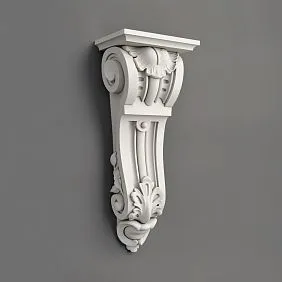
Corbels and brackets are decorative elements that visually support shelves, cornices, and beams. Polyurethane corbels do not have real load-bearing capacity (the material can support up to 5–8 kg for a corbel size of 20×30 cm), but they create a visual logic for the structure.
Corbels under shelves
A corbel is a triangular, S-shaped, or complex-shaped element installed under a shelf. The top plane of the corbel adjoins the lower surface of the shelf, and the back plane adjoins the wall. The corbel creates the illusion that the shelf rests on it, although in reality the shelf is held by hidden brackets or dowels.
The size of the corbel is chosen proportionally to the depth of the shelf. For a shelf 20 cm deep—a corbel 15–20 cm high and 10–15 cm wide. For a shelf 30 cm deep—a corbel 25–30 cm high and 15–20 cm wide.
Corbel ornamentation: classical with acanthus leaves, volutes; baroque with lavish carvings; modern geometric simplified designs.
Installation: the shelf is mounted on hidden brackets (metal angles secured to the wall with dowels). The corbel is glued under the shelf to the wall and the lower surface of the shelf. Visually, the shelf appears to rest on the corbel, but in reality, it is held by the hidden bracket.
Brackets under cornices
A bracket under a cornice (crowning cornice, pediment) creates visual support for the protruding element. Bracket sizes range from 10×15 cm for small cornices to 30×40 cm for large crowning cornices.
Shapes: S-shaped (the upper part is curved under the cornice, the lower part is pressed against the wall, the middle is curved), triangular (a right triangle with the hypotenuse facing outward and the legs adjoining the wall and cornice), ornate carved (complex shapes with floral or geometric motifs).
Brackets are installed at intervals of 50–80 cm along the length of the cornice. A cornice 3 m long requires 4–5 brackets (at the edges and evenly spaced along the length). Brackets are glued to the wall and the lower surface of the cornice, with additional fixation using dowels through the bracket into the wall.
Frequently asked questions
Can a polyurethane fireplace surround be used with a real wood-burning fireplace?
No, polyurethane is flammable (flammability group G2–G3) and cannot withstand high temperatures. When exposed to open flame or heated above +120°C, polyurethane deforms and may ignite. Polyurethane surrounds are intended only for electric fireplaces (without real fire), bio-ethanol fireplaces (with flame but without high surface temperature, with the surround placed 15–20 cm away from the flame), or purely decorative surrounds without any fireplace.
Can polyurethane pilasters bear load?
Decorative pilasters are non-load-bearing. They are glued to the wall and not connected to the building's structure. If a pilaster needs to support something (a beam, an arch), a load-bearing metal or wooden element is installed inside the polyurethane shell to bear the load. The polyurethane serves only a decorative function.
How to care for polyurethane decor?
Polyurethane is smooth and does not absorb dust or dirt. For cleaning, a damp cloth or sponge with soapy water (liquid soap, dishwashing detergent) is sufficient. Avoid abrasive cleaners (powders, stiff brushes) that can scratch the surface. Painted decor does not require coating renewal for decades, but if desired, it can be repainted with acrylic paint over the old coating.
Can polyurethane decor be installed on uneven walls?
Polyurethane is flexible, but to a limited extent. Minor irregularities (variations of 2-3 mm) are compensated by the elasticity of the material and adhesive. Major irregularities (variations of 5-10 mm or more) create gaps between the decor and the wall, spoiling the appearance. It is recommended to level the walls with plaster or drywall before installation.
How to combine polyurethane and wooden decor?
Harmoniously. Polyurethane can be painted any color, including to imitate wood. You can install wooden door trims and polyurethane pilasters painted to match the wood color. Or white polyurethane moldings on walls and wooden baseboards in a natural color—the contrast of materials adds interest. The main thing is consistency of style (classical polyurethane elements combine with classical wooden ones, modern with modern).
Can polyurethane be painted with oil-based or nitro paints?
Not recommended. Oil-based paints contain solvents that can soften polyurethane. Nitro paints contain acetone, which destroys polyurethane. Use water-based acrylic paints—they are safe for polyurethane, adhere well, do not emit harmful fumes, and dry quickly.
How to remove polyurethane decor if replacement is needed?
Polyurethane adhesive holds firmly, but removal is possible. Carefully cut the adhesive seam with a knife, inserting the blade between the decor and the wall, slowly peeling off the element. Small elements (overlays, corners) can be removed whole. Large ones (pilasters, columns) may crack during removal—polyurethane is strong in bending but not in breaking. After removal, adhesive residue on the wall is removed with a spatula, the wall is cleaned, primed, and a new element is installed.
Conclusion: Details that Create Character
Special decorative elements—portals, trims, pilasters, columns, corners—are not just ornaments. They are architectural tools that shape the character of an interior.Polyurethane fireplace decorturns a heating appliance into the compositional center of a living room, around which the entire setting is arranged.Polyurethane door decorationtransforms an opening into a portal, marking the transition between spaces, adding solemnity even to a simple interior door.Wall decor: polyurethane pilastersarticulates a wall, creates vertical rhythms, structures space, making it not chaotic but architecturally organized.
Polyurethane has democratized access to classical architectural stucco. What once required the work of master plasterers and stone carvers is now produced industrially while preserving the finest details. The lightness of the material allows elements to be mounted on any surface without structural reinforcement. Moisture resistance expands application—decor can be installed even in damp rooms. Durability ensures a service life of decades without deformation or loss of aesthetics.
The imitation capabilities of polyurethane open up an endless field for creativity. Painting to resemble marble, granite, wood, or metal creates visual luxury at minimal cost. A portal painted to look like white marble appears as genuine marble but weighs ten times less, installs in hours, and costs ten times less.
A systematic approach to using special elements creates interior integrity. A fireplace portal with Corinthian order columns combines with pilasters of the same order on walls, door portals with similar capitals, ceiling cornices with a similar profile. All this forms a unified architectural system where each element is in its place, where there are no accidents, where beauty serves to organize space.
STAVROS Company is a leading Russian manufacturer of polyurethane decor with a 24-year history, creating products that meet the highest world standards. In-house full-cycle production, use of European raw materials (polyurethane from BASF, Bayer, Huntsman with a density of 250-350 kg/m³), high-precision computer-controlled casting equipment, multi-level quality control—all this guarantees premium-class products at affordable prices.
The STAVROS assortment for special decorative elements includes over 600 items: ready-made fireplace portals of all styles (classical with columns from 35,000 rubles, with pilasters from 28,000 rubles, minimalist from 22,000 rubles), individual elements for fireplaces (columns 15-35 cm in diameter, 80-120 cm in height, capitals of all orders, fireplace mantels 120-200 cm long, 20-35 cm deep, brackets 15×20 cm to 30×40 cm), door trims 6 to 25 cm wide in dozens of profiles (flat, beveled, with bead, ornamented), door overlays 30×10 cm to 80×30 cm (moldings for paneling), pilasters 150 to 330 cm in height, 8 to 25 cm in width (smooth, fluted, with Doric, Ionic, Corinthian capitals), columns 15 to 50 cm in diameter, 200 to 350 cm in height (hollow, lightweight, with bases and capitals), half-columns 20 to 40 cm in diameter (half columns for corners and arches), decorative corners 3×3 cm to 25×25 cm (flat and three-dimensional, with ornaments of all styles), consoles 10×15 cm to 30×40 cm (for shelves, cornices), brackets 12×18 cm to 35×45 cm (S-shaped, triangular, carved).
STAVROS production technologies guarantee material density of 250-350 kg/m³ (maximum strength, clarity of relief, durability), geometric accuracy (deviation no more than 0.5 mm per meter of length for linear items, no more than 1 mm per dimension for piece elements), surface quality (uniform white primer without stains, drips, skips), absence of defects (pits, voids, chips—control at every production stage).
The STAVROS stock program ensures availability of popular items for immediate shipment. An order placed today ships tomorrow. Delivery within Moscow and Moscow Region by courier 1-2 days, within St. Petersburg and Leningrad Region by courier 2-3 days, to Russian regions by transport companies 3-10 days.
Professional, multi-layer packaging: elements are wrapped in bubble wrap (large portals and columns additionally reinforced with cardboard stiffeners), placed in rigid cardboard boxes or wooden crates (for large-sized elements), voids filled with cushioning material, boxes marked with top/fragile indicators. Damage rate during transportation less than 0.3%—result of a refined system.
STAVROS consultation support is available at all stages: designers will develop a concept for interior decoration using special elements (fireplace portal as a compositional center, pilasters for wall articulation, door portals for accenting passages), create 3D visualization, show how the space will look. Technical specialists will calculate the quantity of elements, select adhesive and fasteners, provide detailed installation instructions. The STAVROS website features video instructions for installing fireplace portals, pilasters, columns, a photo gallery of completed projects (over 800 interiors), and a calculation calculator.Custom manufacturing is available for exclusive projects. Need a fireplace portal of unique design? Pilasters of non-standard height? Columns of special diameter with custom ornament? STAVROS will create a master model (hand sculpting by a sculptor or 3D modeling with printing), make a silicone mold, cast the product. Minimum order from 10 elements (for linear items) or from 2 sets (for portals), production time 8-14 weeks, cost from 15,000 rubles per set depending on complexity.
STAVROS offers a 5-year warranty on all polyurethane products. If during the warranty period an element deforms, cracks, or loses shape (with proper use and installation according to instructions)—STAVROS will replace it free of charge. The warranty is documented, confirmed by certificates of compliance with GOST, sanitary-epidemiological conclusions, and fire safety certificates.
ChoosingPolyurethane fireplace decor, Door decor, pilasters, Columns, decorative cornersChoosing STAVROS, you choose quality proven by thousands of projects, the widest assortment for any style and scale, professional support from concept to final installation, the reliability of a leader with a 24-year reputation. You create interiors where every detail is thought out, where a fireplace becomes an architectural center, where doors turn into portals, where walls gain structure thanks to pilasters, where decor does not just decorate but organizes space. STAVROS is your partner in creating the architecture of details. Quality that is felt. Beauty that inspires. Reliability trusted by professionals.