Article Contents:
- Door decor elements: a dictionary of forms
- Door casings: framing the opening
- Overlays: decorative accents
- Moldings: creating panels
- Door cornices: the crowning element
- Furniture decor: a mirror of door forms
- Overlays on Furniture Fronts
- Moldings on furniture cases
- Cornices on furniture
- Creating a visual route: from door to door through furniture
- Entrance group: the first impression
- Through route across rooms
- Zoning through decor
- Stylistic coordination: one language for all elements
- Classicism: order logic
- Baroque: Opulence and Dynamism
- Modern: organic forms
- Modern classic: simplified forms
- Implementation practice: from project to realization
- Design: creating a decorative code
- Production: precision execution
- Installation: assembling the composition
- Frequently asked questions about door decor
- Can decor be added to already installed doors?
- Should all doors in the house be the same?
- How to coordinate doors and furniture if they are purchased at different times?
- How much does decorating doors and furniture in a unified style cost?
- Does Decoration Require Special Care?
- Conclusion: a symphony of forms from STAVROS

Imagine: you open a door and enter a space where every line, every curve, every carved detail speaks the same language. A door is not just an opening between rooms—it is an architectural accent that echoes with furniture, walls, creating a visual route throughout the entire house.Door DecorSolid wood decor transforms standard interior door panels into elements of a composition, where door overlays repeat the pattern of wardrobes, where the profile of architraves matches the profile of cornices on furniture, where everything is interconnected by invisible threads of stylistic unity.
Why is this connection needed? Because an interior is not a collection of separate items, but a symphony where every instrument must sound in harmony. A door designed in one style and furniture in another create cacophony, visual dissonance that subconsciously causes discomfort. When doors and furniture are united by common decorative motifs, harmony arises—the space is perceived as holistic, thoughtful, created according to a single concept. This is the hallmark of a true interior, not a random collection of purchased elements.


Door decor elements: a dictionary of forms
Before creating a dialogue between doors and furniture, it is necessary to understand what elements make up door decor. Each element has a function, form, and place in the composition.




Casing: framing the opening
Architrave—a strip framing the door opening around the perimeter, covering the joint between the frame and the wall. Functionally, the architrave masks installation gaps and protects the edges of wallpaper or plaster from damage. Aesthetically—it creates a frame that highlights the door from the wall plane, giving the opening a finished look.
The width of the casing varies from 50 to 120 millimeters. A narrow casing of 50-70 millimeters creates a delicate frame, characteristic of modern minimalist interiors. A medium casing of 80-100 millimeters is a classic option suitable for most styles. A wide casing of 110-120 millimeters forms an expressive frame, necessary for formal interiors.
The profile of the casing defines the style. A flat casing has a rectangular cross-section without relief. A beveled casing has a chamfered edge that softens the corners. A profiled casing features beads, coves, and flutes that create a play of light and shadow. A carved casing has a three-dimensional ornament, turning the casing into a decorative object.
The thickness of the casing, 10-18 millimeters, provides sufficient strength while maintaining elegance. A casing that is too thin looks flimsy, while one that is too thick appears bulky. Materials include solid oak, beech, or ash for premium solutions, and MDF with a coating for budget options.
Our factory also produces:


Appliques: Decorative Accents
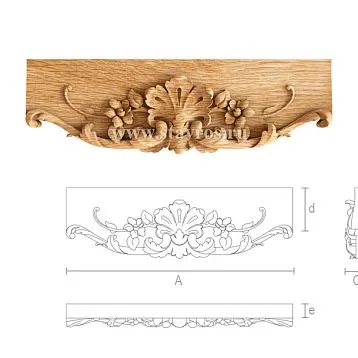
Decorative door appliques are small carved elements that are attached to the door leaf, creating three-dimensional accents. The size of appliques varies from 50×50 millimeters for small rosettes to 300×600 millimeters for large panels. The thickness is 8-20 millimeters depending on the depth of the carving.
Appliques serve a purely decorative function—they do not bear any structural load but create visual richness. Carved rosettes, cartouches, garlands, and geometric ornaments transform a smooth door leaf into a work of art.interior decorationin the form of appliques allows transforming a standard door into a unique object.
The placement of appliques follows symmetry and proportions. On a standard door with a height of 2000 millimeters and a width of 800 millimeters, the optimal placement is two to four appliques. Two appliques—in the upper and lower third of the door, symmetrically along the vertical axis. Four appliques—at the corners of a conditional rectangle in the central part of the leaf.
Appliques are attached with adhesive—carpenter's PVA for rooms with normal humidity, polyurethane for damp areas. Additional fixation with thin headless nails ensures reliability. It is important that the applique fits tightly against the leaf across its entire surface—gaps are unacceptable.
Get Consultation
Moldings: Creating Panels
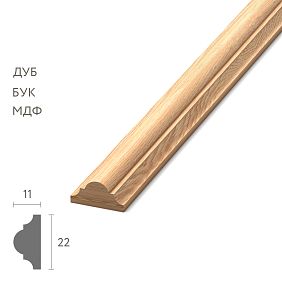
Moldings are profiled strips that are glued onto the door leaf, creating frames that imitate a paneled structure. An ordinary smooth door is transformed into a paneled one thanks to moldings that form rectangular sections.
The width of door moldings is 20-50 millimeters. Narrow moldings of 20-30 millimeters create delicate divisions, suitable for small doors. Wide moldings of 40-50 millimeters form expressive frames, characteristic of classic interiors. The profile height of the molding, 8-15 millimeters, provides sufficient relief for the perception of volume.
The composition of moldings on a door follows proportions. A standard solution is two vertical rectangles, with the upper one smaller than the lower one. A proportion of approximately 1:2 creates visual stability. The distance from the edge of the door to the molding frame of 80-120 millimeters provides sufficient field for the perception of the composition.
The color of the moldings can match the door leaf, creating a monochrome solution where only the relief is visible. Or it can contrast—white moldings on a dark door, dark on a light one. Contrast emphasizes geometry, creates graphic quality, characteristic of neoclassical interiors.
Cornices Above the Door: The Crowning Element
A door cornice is a horizontal element installed above the door opening, creating an architectural finish. The cornice above the door follows the logic of a ceiling cornice, but on a smaller scale. A width of 80-150 millimeters and a projection of 50-100 millimeters create a visor that casts a shadow.
The profile of the door cornice can be identical to the ceiling cornice or a simplified version. If the ceiling cornice has five levels of profiling, the door cornice may have three, retaining the main elements—the top shelf, central bead, and bottom cove. This creates a scale correspondence while maintaining stylistic kinship.
A cornice above the door is especially important in rooms with high ceilings—from 3 meters. In standard rooms of 2.5-2.7 meters, a cornice can visually lower the ceiling, so it is used cautiously. An alternative is an extended casing in the upper part of the opening, creating a semblance of a cornice without excessive projection.
The color and finish of the door cornice are coordinated with the casings. If the casings are made of natural oak with oil, the cornice should be the same. Material unity is critical for the perception of the integrity of the door framing.
Furniture Decor: Mirroring Door Forms
Furniture decoruses the same techniques and elements as door decor—appliques, moldings, cornices. The difference lies in scale and placement, the logic is the same. When furniture and doors are decorated with related elements, a visual connection arises.
Overlays on furniture facades
Carved appliques on cabinet doors, dressers, and sideboards perform the same role as on doors—they create three-dimensional accents, add carving, and form visual richness. The size of furniture appliques is usually smaller than door appliques—40-200 millimeters, but the character of the carving can be identical.
If interior doors have appliques with an acanthus leaf ornament, the furniture uses appliques with the same motif. The scale differs—a door applique is 200×300 millimeters, a furniture applique is 100×150 millimeters, but the pattern is the same. The eye reads the repetition of the motif and senses the kinship of the elements.
The placement of appliques on furniture follows the same logic of symmetry as on doors. The central axis of the facade, symmetrical placement relative to it. If four appliques on a door form a rectangle, the same scheme is used on a cabinet facade—four appliques placed similarly.
The technology for attaching furniture appliques is identical to door appliques—adhesive plus thin nails. The surface of the facade and the back of the applique are degreased, adhesive is applied, the applique is pressed, and fixed with nails. After the adhesive dries, the nails can be removed or left for additional strength.
Moldings on Furniture Cases
Moldings are used on furniture to divide the planes of facades, create frames, and frame panels. The width of furniture moldings is 15-40 millimeters—smaller than door moldings, corresponding to the smaller scale of furniture. The profile can be identical to door moldings or simplified.
Classic Furnitureoften has facades divided into sections by moldings. If interior doors are decorated with moldings creating two vertical panels, furniture facades can have a similar structure. Proportions are adapted to the size of the facade, but the logic of division is preserved.
The color scheme of moldings on furniture is coordinated with the doors. If door moldings are contrasting—white on a dark leaf, furniture moldings follow the same scheme. If door moldings match the leaf color, furniture moldings are also monochrome. This creates uniformity in the decorative language throughout the interior.
Furniture moldings are attached with adhesive. The molding is cut precisely to size, corners are mitered at 45 degrees for joining. Adhesive is applied in a thin layer, the molding is pressed, and fixed with painter's tape until dry. Precision in joints is important—gaps at the corners are unacceptable.
Furniture cornices
Furniture cornices crown cabinets, dressers, sideboards, creating a top architectural accent. The profile of a furniture cornice often repeats or echoes the profile of door and ceiling cornices. This creates a vertical dialogue — a single decorative motif runs from the floor through the furniture to the ceiling.
The width of a furniture cornice, 60-150 millimeters, depends on the height of the furniture. For a cabinet 2000 millimeters high, a 100-120 millimeter cornice is optimal. For a dresser 900 millimeters high — 60-80 millimeters. A proportion of cornice width to furniture height of approximately 1:15 - 1:20 creates visual balance.
If a door cornice has a specific profile — say, a torus, a scotia, and a top shelf, the furniture cornice repeats these elements. Even if the size is smaller, the sequence of elements is the same. This creates recognizability, a feeling that all interior elements belong to the same family.
Installation of a furniture cornice to the carcass is done with glue and screws. The cornice is installed on the top end of the carcass, fastened with screws from the inside or through the cornice from above with subsequent masking of the holes. Glue strengthens the connection and prevents squeaks.
Creating a visual route: from door to door through furniture
When door and furniture decor is linked by common elements, a visual route arises in the interior — a path along which the eye moves, noting repeating motifs. This route creates a sense of integrity, thoughtfulness, and stylistic unity.
Entryway group: first impression
The entrance door to an apartment or house is the first element a person sees. If the entrance door is wooden with carved overlays, this motif should be repeated further. In the hallway — furniture with similar overlays. Interior doors leading to the hallway — with the same decor.
Imagine: an entrance door made of solid oak with four carved rosettes forming a vertical rectangle. In the hallway — a sliding wardrobe with fronts decorated with similar rosettes. The door to the living room — with the same rosettes in the same composition. The eye moves from the entrance door to the wardrobe, to the interior door — everywhere recognizing one motif. A feeling arises that the entire space was created according to a single design.
Color and finish are also important. If the entrance door is tinted oak with oil, the furniture and interior doors should have the same tone and coating. Variation in shades is acceptable — the entrance door darker, the interior doors lighter, but the wood species is the same, the coating is the same.
Hardware is coordinated — if the entrance door has a brass handle of a classic shape, handles from the same series are used on interior doors and furniture. The style, material, and color of the hardware unite the elements no less than the decor.
Through route through rooms
Moving from room to room, a person should feel stylistic continuity. The door from the hallway to the living room, furniture in the living room, the door from the living room to the dining room — everything is connected by a common decorative language.Solid Wood Itemscreate material unity, decorative elements — compositional unity.
In the living room — display cabinets with fronts divided by moldings into panels. The doors to the living room have the same paneled structure. In the dining room — a sideboard with carved overlays on the doors. The door to the dining room is decorated with similar overlays. In the bedroom — a wardrobe with fluted pilasters at the corners. The door to the bedroom is framed by fluted architraves.
Repetition should not be literal — that would create monotony. Commonality of character, proportional correspondence, stylistic kinship is sufficient. Differences in details are acceptable and even desirable — they create variety while preserving unity.
Vertical dialogue is also important. Baseboards, doors, furniture, ceiling cornices — all levels along the vertical are linked by common motifs. The profile of the baseboard echoes the profile of the architraves. Architraves — with furniture moldings. Furniture cornices — with ceiling ones. A vertical route arises, organizing the space from floor to ceiling.
Zoning through decor
In open spaces of the studio type, door and furniture decor helps to zone functions. Living area — doors and furniture with classic panels, carving, cornices. Kitchen area — simpler decor, functional, with a minimum of carved elements. Office work area — strict fluting, symmetrical compositions emphasizing seriousness.
Differences in the character of the decor mark the boundaries of zones without physical partitions. A person moving from one zone to another reads the change in decorative language and understands the change in function. This is a subtle, delicate way of zoning, not cutting the space with rigid barriers.
Color zoning complements decorative zoning. Living room — light oak. Kitchen — medium-toned beech. Office — dark stained oak. The change in tone enhances the readability of the zones, creates visual variety while preserving material unity — all wood, all solid.
Stylistic coordination: one language for all elements
Each style has its own decorative language — characteristic forms, proportions, motifs. Coordinating door and furniture decor requires following this language.
Classicism: order logic
In a classicist interior, decor is built according to the canons of ancient orders. Door architraves have a capital in the upper part — an expansion with carved ornamentation of palmettes or acanthus leaves. The shaft of the architrave can be fluted — with vertical grooves. The base — an expansion in the lower part.
Furniture in a classicist interior follows the same logic. Pilasters on the corners of cabinets have capitals, shafts, bases that repeat the elements of door architraves. Panels on furniture fronts and doors have the same proportions — the golden ratio or simple ratios like 2:3, 3:5.
Carving is restrained, symmetrical, based on ancient motifs — meander, palmettes, rosettes, garlands. The same motif is used on doors and furniture, creating thematic unity. Color — light tones of natural wood or white enamel. Gilding is delicate, only on protruding carving elements.
Baroque: opulence and dynamism
Baroque decor is distinguished by complexity, abundance of carving, curved forms. Door architraves are not rectangular, but with wavy edges, scrolls, cartouches. Overlays on doors — high-relief carving with acanthus leaves, putti, masks.
Baroque furniture is equally lavish. Fronts are covered with carving, cornices are multi-tiered with voluminous ornamentation, legs are curved. Carving motifs on doors and furniture are identical — acanthus leaves of a specific shape, volutes, shells. Gilding is abundant — it covers all the carving, creating a play of light.
Color — dark wood (walnut, mahogany) with gilding or light wood (linden, chestnut), completely covered with colored enamel and gold. Doors and furniture are painted in the same palette — for example, doors and cabinets are turquoise with gold, creating luxurious unity.
Art Nouveau: organic forms
Art Nouveau decor rejects symmetry and straight lines, creating organic, natural forms. Door overlays feature stylized irises, lilies, and winding stems. Door casings have a wavy top edge and asymmetrical elements.
Art Nouveau furniture continues these motifs. Facades feature asymmetrical carved overlays, curved lines, and floral patterns. The same iris motif found on the door is repeated on the cabinet door. The same flowing lines organize the composition.
Art Nouveau color palette consists of complex muted tones. Gray-green, lilac, brown with a purple tint. Patina is used to create an aged effect. Doors and furniture are painted in coordinated tones, creating a soft color environment.
Modern classic: simplification of forms
Modern interpretations of classic styles preserve the structure—panels, frames, casings—but simplify the details. Casings are wide but with a minimal profile. Door moldings create panels but without excessive relief. Overlays are absent or minimized.
Furniture in modern classic style is also laconic. Facades feature flat panels that emphasize the wood grain. Cornices have a simple profile. Carving is minimal. The focus is on material quality, precise fitting, and clean lines.
Color palette features natural wood with a transparent finish or painting in modern shades. Gray, graphite, bleached oak. Doors and furniture are executed in a unified color scheme, creating a calm, elegant environment.
Implementation Practice: From Project to Realization
Creating stylistic unity between doors and furniture requires planning at the project stage. Accidental coincidence of elements is unlikely—a deliberate approach is necessary.
Design: Creating a Decorative Code
At the design project stage, the decorative code of the interior is determined—a set of forms, motifs, and profiles that will be repeated on different elements. A base molding profile is selected—for example, bead-flute-shelf. This profile is used on door casings, furniture moldings, and ceiling cornices.
A base carved motif is selected—say, a stylized palmette. This motif is used on door overlays, furniture, and in the carving of pilaster capitals. The scale varies, but the pattern is recognizable. A project element library is created—a set of moldings, overlays, and profiles from which all decor is assembled.
The color palette is also determined at the project stage. The main wood tone is light oak. The accent tone is dark walnut. All doors are light oak. Furniture is a combination of light oak and dark walnut. Baseboards and casings are light oak. This creates color coordination amidst diversity.
The designer creates visualizations where the interplay of elements is visible. A door with specific overlays, next to a cabinet with similar overlays. Casings of a certain profile, furniture cornices of the same profile. The client sees the system, understands the logic, and approves the concept.
Production: Precision Execution
After project approval, element production begins. It is critical to use a single manufacturer for all wooden elements—casings, moldings, overlays, furniture parts. This guarantees identical profiles, matching tones, and uniform processing quality.
If casings are ordered from one manufacturer, furniture moldings from another, and overlays from a third, discrepancies are highly likely. A profile claimed to be identical may differ by fractions of a millimeter—this will be noticeable during installation. Wood tone depends on the batch and tinting method—different manufacturers will yield different results.
A comprehensive order from a single manufacturer solves this problem. The manufacturer receives specifications for all elements, manufactures them from a single wood batch, with identical tinting and the same finish. Profiles are coordinated, colors are identical, and quality is uniform.
Quality control is critical. Before shipping to the site, all elements are checked—profile matching, tone matching, absence of defects. It is better to identify a problem at the factory than during on-site installation, where correction is difficult.
Installation: Assembling the Composition
Installation begins with doors—installing frames, hanging leaves, mounting casings. After the doors are installed, the decor is mounted—moldings on the leaves, overlays, cornices above openings. Sequence is important—first basic elements, then decorative ones.
Furniture is installed after finishing work is complete—when walls, ceilings, and floors are ready. Case furniture is assembled, placed in position, and facades with decor are mounted. Level alignment is critical—if a door has panels at a certain height, nearby furniture should have decorative elements at the same levels.
Final finishing—fitting, elimination of minor defects, retouching. Casing joints are filled, sanded, and tinted. Overlays with minor chips are restored. Everything must look perfect—sloppiness in details will ruin the impression of a well-thought-out concept.
Lighting plays an important role in the perception of decor. Light falling on carved overlays at the correct angle creates a play of shadows and emphasizes volume. Incorrect lighting can kill the entire effect. Therefore, lighting design is coordinated with the decorative design—light sources are positioned to reveal the beauty of carving and relief.
Frequently Asked Questions About Door Decor
Can decor be added to already installed doors?
Yes, decorating existing doors is a common practice. Moldings creating panels are glued onto a smooth leaf. Carved overlays are installed. Casings are replaced with more decorative ones. This allows updating the interior without replacing doors.
It is important that the door leaf is sufficiently smooth and sturdy. Old doors with swollen veneer, cracks, or deformations are poorly suited for decorating—overlays will not fit tightly, moldings will peel off. In such cases, it is easier to replace the door.
The color of the existing leaf is considered when choosing decor. If the leaf is dark, light moldings will create contrast. If light, moldings can be tinted to match or contrast. Painting the entire door after installing the decor is an option for creating a monochrome solution.
Do all doors in a house have to be identical?
Not necessarily identical, but stylistically related. All doors can share a common decorative language—one type of overlay, one casing profile—but differ in details. The living room door—with four overlays. The bedroom door—with two. The study door—with a different composition, but the same overlays.
Difference creates individuality in rooms while preserving the overall style of the house. Complete uniformity of all doors can be boring, monotonous. Variations within a unified system are more interesting.
Door colors can vary — public areas are lighter, private areas are darker. But the wood species, type of finish, and character of the decor are uniform. This creates diversity while maintaining integrity.
How to coordinate doors and furniture if they are purchased at different times?
If doors are already installed and furniture is purchased later, when choosing furniture, focus on the door decor. If the doors have carved overlays with a specific pattern, look for furniture with similar decor. If the doors are paneled, the furniture should have paneled fronts.
Keep a sample of the door overlay or a high-resolution photograph. When ordering furniture, show it to the manufacturer — let them select or produce overlays with a similar pattern. The profile of the architraves also sets a guideline — furniture moldings should have a related profile.
If the furniture is purchased ready-made and the door decor is planned later, do the opposite — choose door decor in coordination with the furniture. It is easier to adapt doors to furniture than vice versa.
How much does it cost to decorate doors and furniture in a unified style?
The cost depends on the number of elements, complexity of carving, wood species. Simple moldings for creating panels on one door cost 2000-4000 rubles including material and installation. Carved overlays — from 1500 rubles per piece. Replacing architraves with decorative ones — from 3000 rubles per door.
For an apartment with five doors, full decoration with moldings and overlays will cost 30,000-60,000 rubles. Coordination with furniture — ordering furniture fronts with similar decor — increases the cost of furniture by 20-40% compared to simple fronts.
Custom manufacturing of carved overlays based on sketches is more expensive than using ready-made ones — 2-3 times more. But it provides uniqueness and precise alignment with the concept. With a limited budget, use ready-made overlays, selecting the most suitable ones.
Does decor require special care?
Carved elements require more thorough care than smooth surfaces. Dust accumulates in the recesses of the carving — use a soft brush or a vacuum with a soft attachment once a month. Wet cleaning is acceptable for lacquered elements; oiled and waxed finishes should only be wiped with a dry cloth.
Gilding requires delicacy — do not use abrasives or aggressive cleaning agents. Special compositions for gilding care restore shine and remove oxidation. Every few years, the gilding can be renewed — apply a new layer of gold paint or gold leaf.
Mechanical damage to carving is repaired by restorers. A chipped element is restored — the missing part is sculpted with epoxy putty, modeled to shape, and tinted. Professional restoration makes the damage unnoticeable.
Conclusion: A Symphony of Forms by STAVROS
Door and furniture decor is not a set of random ornaments, but a thoughtful system that creates a unity of style throughout the entire home. From the entrance door to the bedroom wardrobe, a visual route is organized by repeating forms, motifs, and profiles. When overlays on doors echo overlays on furniture, when architraves coordinate with furniture cornices, harmony arises — the space is perceived as integral, created by a single design intent.
The company STAVROS offers a complete system of decorative elements made from solid oak, beech, and ash for doors and furniture. Production in St. Petersburg on modern CNC equipment ensures perfect profile accuracy, repeatability of elements, and the highest quality carving.
The STAVROS assortment includes hundreds of architrave options of various profiles and widths, dozens of molding types for creating panels, and an extensive collection of carved overlays from classical to modern motifs. All elements are united into style collections where profiles are coordinated, and forms belong to the same family.
STAVROS furniture decor — carved overlays, moldings, cornices, pilasters — allows for creating furniture fronts coordinated with door decor. One overlay for the door, the same (or scaled) for the furniture — all from the same batch, with identical carving, tinting, and finish.
Custom manufacturing is the specialization of STAVROS. If standard elements are not suitable, the company's designers will develop unique overlays, moldings, and architraves based on your sketches. Carvers will cut the ornament, precisely matching your concept. Minimum batches from 10 pieces make custom production accessible.
Consultative support at all stages — from concept to installation. STAVROS specialists will help create a decorative code for the interior, select elements for doors and furniture, calculate quantities, and prepare installation diagrams. Recommendations on color combinations, profiles, styles — expertise accumulated over two decades of work.
STAVROS works with private clients, interior designers, furniture factories, and construction companies throughout Russia and abroad. Logistics ensure delivery with a guarantee of preservation for each element. Showrooms in Moscow and St. Petersburg allow you to see decor samples, assess carving quality, and receive consultation.
By choosing STAVROS, you choose the quality of solid wood, production precision, a wealth of choice, and professional support. Create interiors where every element is connected to another by invisible threads of style, where doors and furniture speak the same language, where space achieves integrity and harmony. Decor is not superficial ornamentation, but architectural logic, turning a house into a work of art where beauty serves for decades.