Article Contents:
- Features of a Wooden House: What Interior Designers Need to Work With
- Wall Texture and Color: The Dominant Element of the Interior
- House Shrinkage: Structural Movement
- Humidity and Temperature Conditions
- Modern Furniture in a Wooden Interior: Contrast or Harmony?
- Minimalism: Clean Lines Against a Natural Texture Background
- Color Palette: Balancing Warm and Cool Tones
- Furniture Materials: Wood, Metal, Glass
- Textiles: The Connecting Element
- Wall Slats: Zoning and Accents in Open Floor Plans
- What Are Slat Structures
- Zoning the Living Room and Kitchen
- Accent Wall: Slats as Decor
- Ceiling Slats: Height Correction
- Polyurethane Ceiling Molding: Classic Style in a Wooden House
- When Molding Is Appropriate in a Wooden House
- Types of Molding for a Wooden House
- Installation: Accounting for House Movement
- Wooden Baseboard: A Tall Architectural Element
- Tall Baseboard: A Trend in Modern Interiors
- Baseboard Material: Solid Wood or Veneer
- Baseboard profile: from simple to carved
- Installing Baseboards in a Wooden House
- Comprehensive Solution: Creating a Harmonious Space
- Example 1: Scandinavian Minimalism in a Wooden House
- Example 2: Loft Eclecticism in a Log House
- Frequently Asked Questions: Solving Typical Dilemmas
- Conclusion: Create the Perfect Wooden Room with STAVROS
Wooden house. Say these words — and a picture appears before your eyes: log walls smelling of resin, massive beams under the ceiling, windows with a view of the forest. Romance, coziness, connection with nature. But there is a flip side: how to design the interior so that the house doesn't turn into a hunting lodge or a sauna? How to incorporatebuy modern furnitureinto a space dominated by wood texture? How to addwooden room decorwithout overloading the interior, maintaining a balance between tradition and modernity?
Wooden houses — log cabins, frame houses with interior cladding using tongue-and-groove boards or imitation timber, houses made of laminated veneer lumber — require a special approach to interior design. Wood itself is an active material: it has texture, color, smell, tactility. Adding decor to it means finding elements that will complement, not overshadow, the natural beauty of the wood.Wooden planks for decorationwalls create additional zoning, rhythm, and play of light and shadow against the backdrop of log walls.polyurethane ceiling stucco buycan be used to refine the transition from wooden walls to the ceiling, adding classical accents to a rustic space.Wooden baseboardtall, massive, becomes not just a functional element, but an architectural detail that connects the floor, walls, and furniture into a single whole.
This article is a practical guide for owners of wooden houses who want to create a modern, stylish, functional interior while preserving the authenticity of the wooden space. We will discuss what furniture is suitable for rooms in a log house (minimalism vs. country, loft vs. classic), how to use slatted structures for zoning open layouts, whether to install polyurethane moldings in a wooden house (spoiler: yes, if done correctly), what baseboard to choose (solid wood or veneer, tall or low, painted or natural). We will learn how to avoid visual overload (when wood on the walls, wood on the floor, and wooden furniture merge into one brown spot), how to add air, light, and modernity to a traditional space.





Features of a wooden house: what an interior designer has to work with
A wooden house is not an apartment in a panel building, where the walls are a blank canvas for any experiments. Here, the walls already have character, and you need to negotiate with that character.




Wall texture and color: the dominant feature of the interior
Walls made of logs (diameter 220-280 mm, rounded, with visible annual rings) or timber (square or rectangular cross-section 150×150 mm, 200×200 mm) create a powerful visual dominant. The color varies from light honey (fresh pine or spruce log house) to dark brown (old wood, stained with varnish, larch). The texture is three-dimensional: fibers, knots, cracks (natural, not defects, but part of the living material) are visible.
This texture and color set the tone for the entire interior. If the walls are dark — the room visually shrinks, becomes cozy and intimate, but requires compensation with light elements (ceiling, floor, furniture). If the walls are light — the room is spacious, airy, and you can add dark accents (furniture, textiles).
Our factory also produces:


House shrinkage: structural movement
Wooden houses, especially log cabins made of naturally moist logs, shrink during the first 1-3 years after construction (logs dry out, decrease in diameter, the house settles by 5-10 cm in height). This affects the finishing: rigid structures (drywall partitions, wall tiles) may crack. Therefore, sliding fasteners, expansion gaps, and flexible materials are used in wooden houses.
wooden room decormust take this into account: wooden moldings and baseboards are fastened with gaps in the corners (3-5 mm, filled with elastic sealant), polyurethane moldings are flexible and compensate for minor movements.
Get Consultation
Humidity and temperature conditions
Wood breathes — it absorbs and releases moisture depending on air humidity. In winter, when heating is on, humidity in the house drops to 20-30% (normal is 40-60%), wood dries out, and cracks may appear. In summer, humidity increases, and wood swells. These cycles are normal for a wooden house.
Furniture and decor should be stable: wood should be dried (moisture content 8-12%), polyurethane does not react to humidity. Natural textiles (linen, cotton, wool) regulate humidity, creating a comfortable microclimate.
Modern furniture in a wooden interior: contrast or harmony?
Paradox: a wooden house is associated with tradition, rustic style, country. But many owners want a modern interior — minimalist, functional, technological. Can they be combined? Yes, and the result can be impressive.
Minimalism: clean lines against a natural texture background
Modern furniture to buyfor a wooden house means choosing laconic forms that do not compete with the wall texture but contrast with it. A rectangular sofa with a low back, upholstered in plain fabric (gray, beige, graphite), against a log wall creates balance: walls — volume and texture, sofa — smoothness and geometry.
A dining table with a solid wood top (oak, walnut, thickness 40-50 mm) and metal legs (black, matte) combines wood (connection with the walls) and metal (industrial accent, modernizing the space). Chairs around the table — Scandinavian style (wooden seats, curved legs, simple backs without carving), or loft (metal frame, seat made of wood or leather).
Cabinets and shelves — built-in or freestanding, with smooth fronts (without milling, panels), painted in neutral colors (white, gray, black) or natural light-toned wood (oak, ash with oil finish). Open shelves with a metal frame (black) and wooden shelves (thickness 30-40 mm) — a hit in modern wooden interiors.
Color palette: balance of warm and cool
Wood is a warm material (yellow, orange, brown shades). To prevent the interior from becoming visually hot and stuffy, cool accents are added: gray (textiles, furniture), white (ceiling, decorative elements), black (metal, graphics). The result is a balance: the warmth of the wood is compensated by the coolness of neutral tones.
An alternative is monochrome: if the walls are dark (stained to resemble wenge, walnut), the furniture is light (white, beige, light gray). If the walls are light (natural pine, spruce), the furniture can be dark (graphite, black, dark blue). Contrast creates depth, volume, and prevents visual merging of elements.
Furniture materials: wood, metal, glass
Wood is a logical choice for a wooden house, but it's important to select a different species or finish so that the furniture doesn't blend into the walls. If the walls are made of light pine, use dark oak furniture. If the walls are made of larch (orange-brown), use ash furniture (light gray-beige).
Metal — an industrial accent that modernizes a wooden space. Black matte metal (table frames, chairs, shelving, lighting fixtures) is the most popular choice. Brass, copper (table legs, cabinet handles) — for warmer, more eclectic interiors.
Glass — coffee table tops, cabinet doors, partitions. Glass adds lightness, airiness, allows light to pass through, and doesn't visually clutter the space.
Textiles: the connecting element
Textiles soften the contrast between the rough texture of wood and minimalist furniture. Linen or cotton sofa cushions (natural gray, beige, terracotta shades), woolen throws (chunky knit, Scandinavian patterns), rugs with geometric patterns or solid colors (wool, jute, sisal).
Curtains — lightweight linen (allow light through, create soft diffusion) or dense cotton (blackout for bedrooms). Color neutral (white, beige, gray) or accent (terracotta, mustard, dark green) — depends on the overall interior palette.
Wall slats: zoning and accents in an open floor plan
Wooden houses are often built with an open floor plan: living room-kitchen-dining room — a single space without partitions. How to zone such a space without compromising openness?Wooden planks for decoration slats — an elegant solution.
What are slat constructions
Slats are thin planks with a cross-section of 20×40 mm, 30×50 mm, 40×60 mm (width × thickness), 2-3 meters long, attached vertically to a wall or frame with a specific spacing (usually 50-100 mm between slats). Mounted on a hidden frame (metal or wood, screwed to the wall) or on clips (quick installation, ability to remove slats without damage).
Slats create a semi-transparent partition: you can see what's behind it, but the spaces are visually separated. Light passes through the gaps between the slats, creating a play of light and shadow, dynamism, and volume.
Zoning the living room and kitchen
A classic technique: a slat partition between the living area (sofa, TV, coffee table) and the kitchen (work zone, table). Slats are installed from floor to ceiling (height 2.5-3.0 meters), not covering the entire wall, but a part of it (e.g., 2 meters wide). This creates a symbolic boundary that doesn't block the space, doesn't hinder communication between people in different zones, but creates visual separation.
Slat material: if the walls are light pine, use stained oak slats (contrast). If the walls are dark, use white painted slats (light accent on a dark background). Slat spacing 70-100 mm (not too dense — to avoid a cage-like feeling, not too sparse — so the zoning is clear).
Accent wall: slats as decor
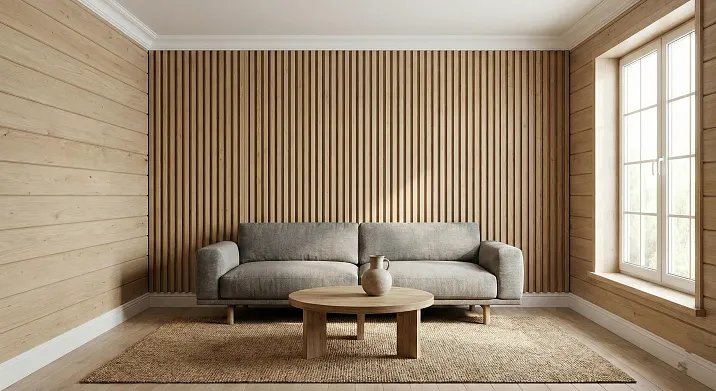
Slats on a solid wall (without a zoning function) create texture, volume, and an accent. One wall in the living room (behind the sofa or behind the TV) is decorated with slats against a smooth surface (painted wall, drywall). Slats are arranged vertically (elongating the space in height) or horizontally (widening it).
Backlighting between the slats (LED strip behind the slats, light passes through the gaps) creates impressive lighting in the evening: the slats turn into glowing lines, the room acquires an intimate, cozy atmosphere.
Ceiling slats: height correction
If the ceiling is too high (3.5-4.0 meters, as in double-height living rooms of wooden houses), slats on the ceiling visually lower it, making the space cozier. Slats are attached to the ceiling parallel to each other (spacing 100-150 mm), creating relief, hiding utilities (ventilation, wiring), improving acoustics (wood dampens echo, reverberation).
Slat color on the ceiling — usually light (white, light oak, ash) to avoid darkening the room. Dark slats on the ceiling (wenge, black) — only if the walls are light and there is plenty of natural light (panoramic windows).
Polyurethane ceiling molding: classic in a wooden house
Is it possible to installpolyurethane ceiling molding buy in a wooden house with log or timber walls? At first glance, it seems like a stylistic dissonance: molding is an element of classic stone palaces, while wood is the material of rustic huts. But a skillful combination creates eclecticism, richness, and individuality.
When molding is appropriate in a wooden house
High ceilings (from 3 meters): a polyurethane cornice under the ceiling (width 100-150 mm) visually completes the space, creates a transition from walls to ceiling. If the ceiling is painted white or a light color, and the walls are dark wood, a white cornice is a logical element connecting the light ceiling with the dark walls.
Classic furniture: if classic furniture is used in a wooden house (carved chests of drawers, high-back armchairs, tables with turned legs), molding supports the style. A ceiling rosette (diameter 600-800 mm) in the center of the ceiling, from which a chandelier (crystal or wrought iron) hangs, creates solemnity and grandeur.
Combined finishes: if the walls are partially clad in wood (e.g., the lower half — timber panels, the upper — painted or plastered), moldings can be installed on the painted part, creating frames, panels, classic divisions.
Types of molding for a wooden house
Ceiling cornices — strips 80-200 mm wide, mounted along the perimeter of the ceiling. Profile is simple (one or two curves, minimal ornamentation) or classical (dentils, beads, flutes). Color is white (contrasting with wood) or painted to match the ceiling tone (if the ceiling is not white, but beige, gray).
Ceiling rosettes — round or oval elements 400-1000 mm in diameter, installed in the center of the ceiling under a chandelier or as part of a composition (several rosettes on different sections of the ceiling, with a light fixture under each). Relief ranges from flat (simple geometric patterns) to deep (Baroque acanthus leaves, rosettes with putti).
Imitation coffers — a system of intersecting beams (moldings) creating a grid of squares or rectangles on the ceiling. Inside each square is a recess (imitation, the ceiling is actually flat) or a rosette. A coffered ceiling in a wooden house signifies luxury, monumentality, and a palatial style.
Installation: accounting for house movement
Polyurethane molding is flexible but mounted rigidly (with adhesive + sometimes dowels). In a wooden house, especially a freshly built log house (1-3 years after construction), the structure is mobile (settling). To prevent the molding from cracking or detaching, elastic adhesives (polyurethane, acrylic) are used, and expansion gaps are left in corners (3-5 mm, filled with elastic sealant).
Alternative — attach the molding not to wooden walls (logs, timber) but to an additional frame (drywall suspended ceiling, which is not rigidly connected to the logs and has sliding mounts). In this case, house settling does not affect the molding.
Wooden baseboard: a tall architectural element
Wooden baseboardin a wooden house — not just covering the gap between floor and wall, but a full-fledged architectural element linking the floor, walls, and furniture into a unified composition.
Tall baseboard: a trend in modern interiors
Height of a classic baseboard is 60-80 mm. A tall baseboard is 100-150 mm, sometimes up to 200 mm. A tall baseboard visually raises the ceiling (vertical lines elongate the space), creates solemnity, monumentality, and emphasizes the room's scale.
In a wooden house, a tall baseboard made of solid oak, beech, or larch (height 120-150 mm, thickness 18-22 mm, classic profile with chamfer and curve) looks organic: wood to wood, the massiveness of the baseboard corresponds to the massiveness of the walls. Baseboard color — either matching the floor tone (if the floor is wooden — oak, ash — the baseboard is made of the same species) or contrasting (dark floor — light baseboard, light floor — dark baseboard).
Baseboard material: solid wood or veneer
Solid wood baseboard (solid timber) — oak, beech, ash, larch. Durable, long-lasting (service life 30-50 years), repairable (can be sanded, repainted, restored). Price 800-2500 rub/m (depends on species, height, profile).
Veneered baseboard — base made of MDF or pine, with a veneer of valuable wood (oak, ash, wenge, walnut) glued on top. Externally indistinguishable from solid wood, 1.5-2 times cheaper, dimensional stability is higher (multi-layer structure compensates for wood stress). Disadvantage — not repairable (veneer is thin 0.5-1.5 mm, cannot be sanded). Price 400-1200 rub/m.
Baseboard profile: from simple to carved
Simple — rectangular cross-section with a chamfer on the top edge (45-degree angle). Minimalist, modern, suitable for Scandinavian, loft, contemporary interiors.
Classical — complex profile with curves (concave semicircular sections), beads (convex semicircular sections), shelves. Elegant, noble, suitable for classic, neoclassical interiors.
Carved — with ornaments (plant tendrils, geometric patterns) carved on the front side. Luxurious, palatial, suitable for Baroque, Empire, eclectic styles. Price of carved baseboard 2500-5000 rub/m.
Baseboard installation in a wooden house
Fastening with screws through the baseboard into the wall (not into the floor). Holes are pre-drilled in the baseboard (diameter 3 mm, spacing 50-60 cm), the baseboard is placed against the wall, the wall is drilled through the holes (if the wall is log — drill bit enters the log 30-40 mm), screws are driven in (length 60-80 mm). Screw heads are countersunk 3-4 mm, filled with wood filler (color matched to the wood), and sanded.
Alternative — adhesive (liquid nails, polyurethane adhesive), but only if the wall is even (plastered, drywall). Not suitable for log walls (uneven, rounded) — screws are needed.
Comprehensive solution: creating harmonious space
Individual elements (wooden room decor, Modern furniture to buy, Wooden planks for decoration, polyurethane ceiling stucco buy, Wooden baseboard) are tools. The task of the designer (or the owner doing the renovation themselves) is to assemble them into a harmonious composition.
Example 1: Scandinavian minimalism in a wooden house
Walls: light pine, treated with white oil (light whitish patina, wood grain visible but subdued). Ceiling: white painted. Floor: light oak, wide plank.
Furniture: gray fabric sofa (linen), coffee table with black metal legs and light oak tabletop, open shelving (black metal + shelves of light wood). Dining table solid oak with simple legs, light wooden chairs with gray soft seats.
Decor: Wooden planks for decoration white painted (cross-section 30×50 mm) on one accent wall (behind the sofa), spacing 80 mm, with built-in lighting. Wooden baseboard white painted, height 100 mm, simple profile. Ceiling cornice white polyurethane, width 80 mm, simple profile (one curve).
Textiles: light gray chunky knit wool blanket, natural beige linen pillows, round jute rug under the coffee table.
Result: a bright, airy, calm space where the wood of the walls is a background, not a dominant feature; concise furniture creates modernity; white elements (slats, baseboard, cornice) tie the interior into a unified whole.
Example 2: Loft-eclectic in a log house
Walls: dark logs (larch, stained to resemble wenge). Ceiling: dark wooden beams (visible load-bearing floor beams) against a white ceiling between them. Floor: polished concrete or porcelain tile imitating concrete (industrial accent).
Furniture: brown leather sofa (vintage style), solid wood coffee table with a slab (tabletop from a solid wood slice with bark on the edges, 60 mm thick) on a metal frame, black open metal shelving unit with shelves made of roughly processed wood. Massive dining table made of thick planks on metal trapezoid legs, industrial metal chairs.
Decor: polyurethane ceiling stucco buy— large ceiling rosette (diameter 800 mm, Baroque style) painted black (eclectic accent), from the rosette — a wrought iron chandelier with candle-style bulbs.Wooden baseboardmade of dark oak (wenge), height 120 mm, classic profile.
Textiles: faux fur rug under the sofa, leather and coarse linen cushions in gray-brown tones, no curtains (bare windows or minimalist gray Roman shades).
Result: a brutal, charismatic space where dark wood walls create intimacy, industrial elements (metal, concrete) add modernity, and an eclectic outlet is an unexpected attention-grabbing detail.
Frequently Asked Questions: solving typical dilemmas
Won't there be too much wood if the walls are wooden, the furniture is wooden, and the baseboard is wooden?
There will be, if everything is the same color and texture. Avoid this by playing with contrast: light walls — dark furniture, dark walls — light elements. Add antagonistic materials: metal, glass, textiles. Paint some wooden elements (baseboard, slats) white or gray — this breaks up the monotony.
Is modern furniture (minimalism, loft) suitable for a log house?
Yes, contrast creates interesting tension and eclecticism. The main thing is not to try to mask the logs (cover them with drywall, wallpaper), but on the contrary, emphasize their texture, making them a background for concise furniture. Log house + Scandinavian minimalism is one of the most popular styles for wooden houses in 2026.
Is molding necessary in a wooden house, given there's already a lot of texture?
Not mandatory, but it can add sophistication, classic notes. Molding is appropriate if the ceiling is smooth and painted (contrast with textured walls), if the house has high ceilings (cornice completes the space), if the interior style leans towards classic or eclectic. For minimalism, Scandinavian style, molding is excessive.
What color baseboard to choose: matching the floor or matching the walls?
Classic option — matching the floor (the baseboard visually continues the floor, expanding it). Modern option — contrasting (white baseboard with dark floor and walls — a bright, graphic line). In a wooden house, both options work; the choice depends on the overall interior concept.
Is it possible to install slatted partitions in a house with low ceilings (2.5 meters)?
Yes, but the slats must run from floor to ceiling without gaps (this visually elongates the space). The spacing of the slats should not be too frequent (80-100 mm), so as not to create a feeling of a cage that weighs on the psyche. The color of the slats should be light (white, light wood) — dark slats in a low room will enhance the oppressive effect.
Where to buy quality wooden furniture and decor for a wooden house?
From specialized manufacturers and dealers working with solid wood, offering guarantees, certificates, delivery, installation. Avoid no-name sellers offering suspiciously low prices (low price = low quality: green wood that will crack within a year, poor processing, lack of guarantees).
Conclusion: create the perfect wooden room with STAVROS
wooden room decor— the art of balance between the natural beauty of wood and the functional, aesthetic needs of modern life.Modern furniture to buyfor a wooden house means choosing elements that do not compete with the texture of the walls, but complement it, create contrast, and bring freshness.Wooden planks for decorationzone the space without destroying its openness, add a modern rhythm, play of light.polyurethane ceiling stucco buycan be used to introduce classic notes, finish high ceilings, create an eclectic accent.Wooden baseboardtall, massive, becomes a full-fledged architectural element, linking the floor, walls, and furniture into a single composition.
Company STAVROS — a leading Russian manufacturer and supplier of decorative elements, furniture, finishing materials for wooden houses, offering everything needed to create a harmonious, stylish, functional interior in one place.
STAVROS wooden moldings, cornices, baseboards — solid oak, beech, ash, larch, pine, dried to 8-12% moisture content (stability, no deformation), profiles from simple modern to complex classic and carved, any sizes (standard and custom), finish of choice (unpainted, primed, painted, stained). Baseboard height 60-200 mm — from standard to extra-high for formal interiors.
STAVROS wooden slats — cross-sections 20×40 mm, 30×50 mm, 40×60 mm, length 2-3 meters, material pine, oak, ash, antiseptic treatment, sanding, priming or painting (white, gray, black, natural tones). Kits for slatted partitions and walls — slats + frame + fasteners + installation instructions. Calculation of material quantity using the calculator on the website.
STAVROS polyurethane molding — cornices, moldings, rosettes, coffers, density 300-350 kg/m³ (sharp relief, strength), white primer (ready for painting in any color), lightness (easy installation with adhesive, does not overload the wooden house structure), flexibility (compensates for minor shrinkage). Classic, Baroque, modern profiles — for any taste and interior style.
Modern STAVROS furniture — tables, chairs, armchairs, sofas, cabinets, shelves made of solid wood (oak, ash, walnut) and combined (wood + metal, wood + glass). Styles: Scandinavian (concise forms, light wood, minimal decor), loft (industrial elements, rough texture, metal), modern classic (elegant proportions, noble materials, restrained decor). Custom-made to individual sizes and sketches — furniture will perfectly fit your space.
Design project services — STAVROS designers will develop an interior concept for a wooden house: select furniture, decor, color palette, create 3D visualization (see the result before renovation begins), calculate material costs. Project cost from 25,000 rubles per room (included in the order cost when purchasing materials worth from 200,000 rubles).
STAVROS partner installation teams perform turnkey installation: mounting slat structures, installing ceiling molding, attaching baseboards, assembling and arranging furniture. Material warranty: 5 years (wood) and 10 years (polyurethane), work warranty: 3 years. Service maintenance (repair, restoration, replacement of elements if necessary).
Delivery across Russia — STAVROS own logistics, work with federal transport companies, reliable packaging (protection against damage during transportation), cargo insurance. Delivery in Moscow and St. Petersburg by courier (1-3 days), to regions via transport companies (7-21 days depending on distance). Free delivery for orders from 50,000 rubles within the Moscow Ring Road and St. Petersburg Ring Road.
By choosing STAVROS, owners of wooden houses choose quality, proven by thousands of projects from Kaliningrad to Kamchatka, professionalism (consultations, design, installation), the widest range (everything in one place — saving time, money, nerves), guarantees and service (peace of mind for years to come).
Create an interior for a wooden house that will delight the eye, warm the soul, and inspire living. With materials, furniture, decor, and STAVROS expertise, your wooden house will become a work of art, where every detail is in its place, where wood, metal, textiles, and light intertwine in harmony!