Article Contents:
- Traditional finishing: why it wastes time and nerves
- Long drying cycles
- Dependence on the human factor
- Dirt, dust, health risks
- High cost for questionable results
- Dry finishing: the philosophy of speed and durability
- Installation in days, not months
- Factory quality instead of manual labor
- Ecological Safety
- Wall panels: wall architecture without plaster
- Classic boiserie — status and nobility
- Modular systems for quick installation
- Ability to hide utilities
- Variety of styles and finishes
- Trim profiles: interior graphics without molding
- Moldings — lines that define architecture
- Ceiling cornices — instead of plaster moldings
- Baseboards — functional and aesthetic detail
- Casing — framing openings with character
- Practical scenarios: where dry finishing performs best
- Country houses: speed in seasonal conditions
- Apartments in new buildings: without waiting for settlement
- Commercial premises: time is money
- Reconstruction of historical buildings: delicacy and speed
- Installation technology: how it works in practice
- Base preparation — minimal effort
- Panel installation — fast and clean
- Final finishing — without sanding and painting
- Economic feasibility: counting money and time
- Cost comparison: wood vs plaster+molding
- Time savings — the main asset
- Durability — an investment in the future
- Aesthetics and style: wood as a universal material
- Classic: palatial luxury
- Modern: clean lines and natural texture
- Eclecticism: freedom of combinations
- Why STAVROS is the right choice for fast finishing
- Frequently Asked Questions (FAQ)
- Can wooden panels be installed in winter?
- How long does it take to install panels in a 20 sq. m room?
- Can wooden panels be installed in a bathroom or kitchen?
- Do walls need to be leveled before installing panels?
- Can wooden panels be painted a different color?
- Is repairing a damaged panel expensive?
- Which wood species is better — oak or beech?
- Can panels and moldings be ordered in custom sizes?

Renovating an apartment or country house becomes a real ordeal when it comes to traditional "wet" processes. Plastering, puttying, priming, multi-layer painting — each stage stretches for weeks, requires technological breaks for drying, creates dust, dirt, and inconvenience. And if decorative molding is needed, months of waiting and astronomical sums in the estimate are added. But there is another way — fast interior finishing without wet processes usingwall panelsandprofiled moldings, which are installed in just a few days, create a flawless surface, and give the interior a premium-level finish.
This approach to wall finishing is gaining popularity among clients who value time, quality, and the durability of the result. Instead of leveling crooked walls with kilograms of plaster mixture, waiting weeks for each layer to dry, and risking cracks after six months of use, you can immediately install ready-made wooden panels or frame the walls with elegant moldings. Solid oak or beech, high-density MDF, precise geometry, factory finish — all this allows you to turn bare concrete or brick walls into an example of classic or modern interior in 5–7 days.
Why are traditional plaster and molding giving way to dry finishing? Because construction technologies are evolving, clients demand speed without loss of quality, and manufacturers have learned to create solutions that install quickly, last for decades, and look even more noble than "wet" classics. When ready-made panels with factory paint or varnish are delivered to the site, when installation takes days, not months, when no technological pauses for drying are needed — all this changes the very philosophy of renovation. The owner gets a finished interior dozens of times faster, craftsmen work in comfortable conditions without dirt and water, and the result is guaranteed stable because factory quality control eliminates the human factor.



Traditional finishing: why it wastes time and nerves




Long drying cycles
Classical plaster finishing is endless waiting. Applied the first layer of plaster — wait 3–5 days for drying. Then a second layer — another week. Then putty for painting — at least two days between layers. Primer, first coat of paint, second, third... Each stage requires a technological pause. As a result, from bare brickwork to a finished painted wall takes at least a month, and realistically — one and a half to two, considering winter temperatures or high humidity, which slow the process even more.
Molding decor adds several more months to this marathon. Gypsum molding is custom-made, requires manual work by highly skilled craftsmen, is installed on special adhesives that also take a long time to set. Each cornice, each rosette, each wall panel — is a separate story with its own schedule. As a result, project deadlines shift, the budget grows due to additional crew visits, and the client loses patience.
Our factory also produces:






Dependence on the human factor
The quality of plastering work entirely depends on the craftsman's skill. Even with the same crew, different sections of the wall can have varying degrees of flatness. Corners "wander," the plane "waves," and after painting, all defects appear with double force under side lighting. Fixing defects is difficult — layers must be removed, redone, and new drying waited for. Gypsum molding also has its own life: over time, micro-cracks may appear at joints, elements start to detach from the base, especially if humidity or temperature fluctuates in the room.
Working with "wet" processes requires ideal conditions: temperature not below +5°C, humidity within certain limits, no drafts. In winter, this becomes a problem — either you set up an expensive heat gun and burn electricity, or you freeze deadlines until spring. In country house construction, this is especially critical when the house shell is ready in autumn, but interior finishing can only start after the May holidays.
Get Consultation
Dirt, dust, health risks
Sanding putty creates a cloud of fine dust that penetrates everywhere: into neighboring rooms, ventilation, and the craftsmen's lungs. Even with an industrial vacuum and respirators, the work remains harmful. Plaster mixtures contain cement, gypsum, polymer additives — all of which create a specific odor and require ventilation. If people already live in the house (e.g., renovating one room), life becomes hell: dust, noise, odors, inability to cook or sleep normally.
Installing gypsum molding also doesn't happen without dirt: adhesive compounds, gypsum dust when fitting elements, constant need for cleaning. And if molding is installed on already painted walls, the risk of ruining the finish increases many times over. Protective films, painter's tape, carefulness — all this increases the cost and stretches the timeline.
High cost with questionable results
Quality plastering work with perfectly smooth walls for painting is expensive. Elite handmade gypsum molding is even more expensive, especially for complex bas-reliefs, coffered ceilings, or panel systems in classicism style. As a result, the client pays huge money and gets a result that in 3–5 years may start cracking, falling off, or requiring cosmetic repairs. Gypsum is hygroscopic, fears humidity, reacts to temperature changes. Painted walls require regular renewal, especially in high-traffic areas — hallways, corridors, children's rooms.
Drywall finishing: philosophy of speed and durability
Installation in days, not months
When you choose interior finishing without wet processes, work time is drastically reduced.Wall panels made of solid woodor MDF are mounted on battens or directly on the wall in 3–5 days in a standard room.Trim profiles — moldings, cornices, baseboards— are installed in 1–2 days. No drying breaks, no waiting for 'technological windows.' Materials delivered in the morning, room looks finished by evening.
Panel systems come with factory finishing: varnishing, enamel painting, patination, gilding — depending on the chosen interior concept. This means the space is ready for use immediately after installation. Furniture can be arranged, pictures hung, move-in ready. No paint smell, no risk of touching freshly painted surfaces, no months of waiting for 'the house to air out and settle.'
Speed isn't just time savings, but also money saved on housing rentals, hotels, temporary spaces. If renovation is done in an office or commercial space, each day of downtime is lost profit. Dry finishing allows business processes to start dozens of times faster than with traditional approaches.
Factory quality instead of manual labor
Factory productionof wooden wall panelsand trim elements guarantees consistent quality for each product. Chamber drying of wood to 8–12% moisture, processing on four-sided planers with ±0.1 mm tolerance per linear meter, multi-stage sanding with progressively finer abrasives, controlled application of primers and finishes in paint booths — all this eliminates human error and delivers results unattainable with manual methods on-site.
When a craftsman hand-plasters a wall, they work 'by eye.' Even with a laser level and straightedge, results depend on their fatigue, lighting, mood. Factory machines work with precision to tenths of a millimeter, each profile identical to the last, each angle maintained with mathematical strictness. When such elements are installed on-site, they fit together like a construction set, without gaps, warping, or 'finishing with a file.'
Factory finishing also surpasses anything possible on-site. Polyurethane varnishes, water-based enamels, or alkyd compounds are spray-applied in multiple layers with intermediate sanding. The result — a mirror-smooth, durable surface resistant to scratches, moisture, UV. Achieving such quality on a construction site is impossible: dust, temperature fluctuations, lack of professional paint booths — all reduce durability and aesthetics of the finish.
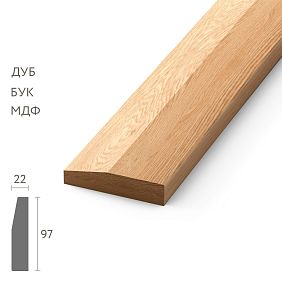
Oak skirting boards are an indispensable element of classic interior styles. In the English style, oak skirting boards with rich carving emphasize the aristocracy and solidity of the space. Dark wood tones harmonize beautifully with traditional materials — natural stone, leather, bronze.
Wood dry finishing is an environmentally clean solution. Solid oak, beech, natural oils, water-based varnishes — none emit harmful substances, create unpleasant odors, or require lengthy ventilation. Wood 'breathes,' regulates indoor humidity, creates a comfortable microclimate. Even high-density MDF with E1 emission class is safe for living spaces, children's rooms, bedrooms.
Unlike plaster mixes containing cement, gypsum, polymer additives, wooden panels don't dust, crumble, or require respiratory protection during installation. Work is clean, quiet, without using 'chemicals.' Installers arrive with a screwdriver, miter saw, PVA or polyurethane adhesive — and that's enough to cover an entire room in a day.
For people with allergies, asthma, sensitivity to chemical smells, wood finishing is the only sensible choice. No solvent fumes, formaldehyde, acrylates. Only the natural scent of wood, which dissipates quickly and causes no discomfort.
Wall panels: wall architecture without plaster
Classic boiserie — status and nobility
SystemBoiserie— is the French tradition of wall finishing with wooden panels, which came to Russia in the 18th century and remains a standard of elegance. Classic boiserie involves vertical and horizontal division of walls into sections using stiles (pilasters) and rails. Within frames are panels — smooth or carved, which can be adorned with patina, gilding, fabric, leather.
The main advantage of boiserie in the context of quick finishing — it's a ready system installed on any substrate without leveling. Brick wall with variations up to 5 cm? No problem — battens compensate for all irregularities, panels stand perfectly vertical and form an impeccable plane. Concrete wall with cracks and chips? Panels cover everything, create a new, noble surface that looks expensive and solid.
Boiserie made of solid oak or beech — is an investment for decades. Wood withstands mechanical loads, is easily restored, doesn't lose appearance over time. If after 15 years you want to refresh the color — just sand the surface and apply a new coating. Try updating plaster and paint as easily — you'll have to strip everything and redo it.
Modular systems for quick installation
ModernWall Panelsare designed as modular systems. The manufacturer develops standard panel sizes that easily join together, forming a cohesive composition. Panel height can be 2400 mm, 2700 mm, or custom for specific ceiling heights. Module widths — from 300 to 600 mm, allowing any wall width without cutting or with minimal cutting of only edge elements.
Installing modular panels — is an assembly process, not construction. Battens of wooden blocks or metal profiles are fixed to the wall. Panels are hung on battens using clips, screws, or special hidden fasteners. Joints are covered with decorative trims or remain as shadow gaps if a modern style is chosen. In one workday, a two-person crew can cover 20–30 sq. m of wall — a speed unattainable for plastering work.
Another advantage of modularity — possibility of local repair. If one panel is damaged (scratch, dent, chip), it can be removed and replaced without dismantling the entire wall. Try replacing a section of plastered wall as easily — you'll have to destroy a large area, replaster, fill, paint, and the result will still be noticeable.
Ability to hide utilities
When panels are mounted on battens, an air gap of 30–50 mm forms between wall and panel. This is more than enough to hide electrical cables, network wires, low-voltage lines. No need to chase walls, lay cables in conduits, fill chases with plaster. Everything is laid on the surface of the main wall, and panels cover it from the front.
If in the future you need to add a new outlet, run a cable for TV or speakers — just carefully remove one panel, lay the wire, reinstall the panel. All clean, quick, without dust or destruction. With plaster, you'd have to hammer the wall with a drill, create mess, replaster, paint — and the intervention spot will always be visible.
The air gap behind panels also improves sound insulation and thermal insulation of the space. Wood itself is a good thermal insulator, and the air layer enhances this effect. In a cold room with wooden panels, it feels subjectively warmer than with cold plastered walls.
Variety of styles and finishes
wall panels boiserieare available in a huge variety of styles. Classic carved boiserie with pilasters, capitals, rosettes — for palace interiors, studies, libraries. Concise panels with simple geometry, painted white or gray — for Scandinavian minimalism and modern spaces. Tall panels with vertical rhythm — for visually increasing ceiling height. Horizontal panels emphasizing wood texture — for creating coziness and natural aesthetics.
Panel finishing can be any: natural varnish highlighting oak or beech texture; matte enamel in noble shades (graphite, taupe, khaki, terracotta); glossy enamel for glamorous interiors; patination with an aging effect; gilding on poliment for maximum luxury; combination of wood with fabric, leather, mirrors — for exclusive projects.
Thanks to such variety, wooden panels fit into any interior concept, from historical styles to ultra-modern high-tech. There's no need to adapt to the limitations of plaster and paint — wood offers freedom of choice and guarantees a unique result.
Molding profiles: interior graphics without stucco
Moldings — lines defining architecture
Solid wood moldingsare molding elements that define the architectural graphics of a room without using heavy plaster stucco. Molding can be a thin framing profile 15–30 mm wide for creating frames around paintings, mirrors, doorways. It can be a medium profile 40–80 mm for forming panel systems on walls. It can be a wide architectural element 90–150 mm for dividing walls into tiers, creating pilasters, framing niches and portals.
The main advantage of wooden moldings over plaster stucco is installation speed and absence of 'wet' processes. Molding is glued with polyurethane adhesive or mounted with finishing nails, screws. Adhesive setting time is 15–20 minutes, after which work can continue. No days of waiting, as with plaster. An entire room with moldings, cornices, and baseboards is installed in 1–2 days.
Moldings allow creating classic panel compositions, dividing walls into plinth, main field, and frieze, forming vertical and horizontal divisions — everything that was previously done exclusively with plaster and stucco. But now it's faster, cleaner, more durable. Wood doesn't crack, fall off, or yellow over time like plaster. It can be painted, varnished, restored — and will last 30–50 years without losing appearance.
Ceiling cornices — instead of plaster moldings
Ceiling cornice is the most important element of classic interior, which visually completes the wall, creates transition from vertical to horizontal, masks the wall-ceiling joint. Traditionally cornices were made of plaster or polyurethane, but these materials are inferior to wood in strength, durability, and aesthetics.
Wooden ceiling cornices...are presented in a wide size range: from compact 45 mm for rooms with low ceilings to representative 200 mm for high halls and living rooms. Cornice profiles can be simple, with one-two cavettos, or complex, with carved elements, dentils (teeth), ovolos (egg-shaped elements), acanthus (stylized leaves).
Wooden cornice installation is performed with adhesive and mechanical fasteners. For heavy profiles, hidden brackets are used that take the main load. Corners are cut on a miter saw at 45° with accuracy to tenths of a degree, joined without gaps. After installation, micro-gaps are filled with elastic sealant that compensates for thermal deformation.
Result — perfectly even, durable cornice that looks like a solid architectural element, not glued decoration. Plaster stucco yellows over time, becomes covered with cracks, falls off. Wooden cornice can hang for centuries, just refresh the finish coating every 10–15 years.
Baseboards — functional and aesthetic detail
Wooden baseboardare not just a plank covering the floor-wall joint. This is an important architectural element that sets the room's scale, emphasizes interior style, protects walls from mechanical damage during cleaning or furniture rearrangement. Depending on ceiling height and room style, baseboard can be 50–60 mm high for small rooms or 110–140 mm for representative halls.
Wooden baseboards are made from solid oak, beech, or high-density MDF. Profiles can be simple rectangular — for modern minimalist interiors, shaped with cavettos and roundings — for classic spaces, carved with decorative elements — for Baroque and Rococo. Finish can be any: natural varnish, enamel, patina, gilding.
Baseboard installation — final stage of finishing that completes the entire composition. Baseboard is glued to wall with polyurethane adhesive or fastened with screws with subsequent fastener masking. Corners are cut at 45°, joined without gaps. Entire room perimeter is installed in half a day. No 'wet' processes, dust, waiting for drying.
Casing — framing openings with character
Wooden casingsis a finishing element that forms the completed appearance of door and window openings. Casing hides the frame-wall joint, masks installation gaps, creates visual framing that makes the opening an architectural accent. Casing width varies from 50 to 120 mm depending on opening size and interior style.
Casing profiles are diverse: flat rectangular for modern spaces, shaped one-sided with decoration on front for classic interiors, relief two-sided for through openings, telescopic sliding for walls of different thickness. Wooden casings are mounted with finishing nails or adhesive, corners joined at 45° to create solid framing.
In context of quick finishing without wet processes, solid wood casings are the optimal solution. No need to level slopes with plaster, wait for drying, paint. Casings are installed immediately after door or window installation, all openings in apartment or house are framed in one day. Finish coating is already applied at production, so result looks impeccable.
Practical scenarios: where dry finishing shows itself best
Country houses: speed in seasonal conditions
Country house construction often finishes in autumn when structure is ready, but interior finishing is postponed until spring due to impossibility of conducting 'wet' processes at sub-zero temperatures. House stands unfinished all winter, owners lose season, and by summer need to find crew again, agree on deadlines, wait months for work completion.
Dry finishingwooden panelsandwith molding elementssolves this problem radically. Installation can be conducted at temperatures from +5°C, and if house is heated at least minimally (heat gun or electric heater), work continues even in winter. In 2–3 weeks entire 150–200 sq. m house is paneled, moldings, cornices, baseboards, casings installed. By spring family can already move in and enjoy result.
Wood is ideal for country houses because it creates feeling of warmth, coziness, natural harmony. Solid oak or beech in living room, study, bedroom — this is not just finishing, but atmosphere that calms, relaxes, makes house a place you want to return to.
Apartments in new buildings: without waiting for settlement
Newly built properties undergo settling in the first few years, causing walls to crack and plaster to fall off. If you apply traditional 'wet' finishes immediately after the building is handed over, you'll have to redo the work in a year or two—filling cracks, repainting. This means extra expenses and wasted time.
Wooden panels and millwork profiles are not affected by settling. They are mounted on an independent frame (battens) that compensates for minor wall movements. If the house settles slightly, the panels stay in place, and the geometry remains intact. At most, minor fastener adjustments might be needed, but these are visually unnoticeable.
For apartments in new buildings where owners want to move in quickly and start living, drywall finishing is the ideal choice. It takes 3–4 weeks to go from bare concrete walls to a finished interior, compared to 3–4 months with plaster. The savings in time and stress are enormous.
Commercial premises: time is money
For restaurants, shops, offices, beauty salons, and clinics, every day of downtime means lost revenue. A prolonged renovation means the business isn't operating, rent is paid for nothing, and customers go to competitors. Therefore, timelines are critical in commercial projects.
Dry finishingwall panelsandmillwork profilesallows an establishment to open much faster. A 100 sq. m restaurant can be fully finished in 2 weeks. A 300 sq. m office—in 3 weeks. This includes installing panels, moldings, cornices, baseboards, casings, doors—a full range of work.
Wooden finishes in commercial spaces are also a matter of status. Clients appreciate quality, natural materials, and attention to detail. Oak panels in a law firm, beech moldings in a dental clinic, carved casings in a clothing boutique—all of this builds trust, highlights the establishment's level, and sets it apart from competitors.
Reconstruction of historical buildings: delicacy and speed
Restoring old mansions, estates, and architectural monuments requires a special approach. Walls in such buildings can be uneven, made of different materials, with cracks and deformations. Leveling them with plaster means creating a huge load on old structures, risking damage to historical masonry, and spending months on work.
Wooden panels and millwork profiles are mounted on an independent frame that doesn't load the walls, doesn't require their destruction or leveling. All defects can be hidden behind the panels while preserving the historical appearance of the interior. Carved moldings, classic cornices, and high baseboards recreate the atmosphere of the era, and installation is quick, neat, and without risk to the structures.
Installation technology: how it works in practice
Base preparation—minimal effort
Unlike plastering work, which requires a perfectly even base, installing wooden panels allows for significant unevenness in the base wall. Variations of up to 50 mm are compensated by battens—a system of vertical and horizontal wooden slats or metal profiles that create a new, perfectly vertical plane.
The battens are attached to the wall with dowels or anchors, leveled, and plumbed. The spacing between batten slats is typically 400–600 mm—the optimal step for reliable panel fixation. If the wall is very uneven, wooden shims or mounting plates are placed under the slats to compensate for irregularities.
The entire batten preparation process takes 1 day per room. No dirt, dust, or water. Just a drill, screwdriver, level, and tape measure.
Panel installation—quick and clean
Wall Panelsare hung on the battens using hidden fasteners—clips, screws through the groove, or locking connections. The fasteners are not visible from the front, creating the effect of a solid, monolithic wall without installation marks. Panels are joined together using a 'tongue-and-groove' principle or via a shadow gap—a 2–3 mm seam that visually separates modules and creates a modern graphic look.
Each panel takes 5–10 minutes to install. A team of two can install 20–30 sq. m per day. An entire 15–20 sq. m room is fully paneled in 1 working day. No breaks, technological pauses, or waiting for drying.
After installing the panels, finishing elements are added—Moldingscornices, baseboards, casings. They cover joints, corners, and transitions, creating a complete composition. Finishing elements are glued and additionally secured with finish nails—small headless pins driven with a pneumatic nailer that are almost invisible after installation.
Final touch-up—no sanding or painting
Since all elements arrive from production with the finish already applied, no sanding, painting, or varnishing is required on-site. At most, minor touch-ups at fastener points with a wood-tone wax pencil and filling micro-gaps at joints with elastic sealant matching the panel or molding color.
This work takes a few hours, not days. The room stays clean, with no paint smell or sanding dust. After a final vacuuming, the room is ready for use. Furniture can be arranged, pictures hung, and appliances installed immediately.
Economic feasibility: calculating money and time
Cost comparison: wood vs. plaster+molding
At first glance, wooden panels and millwork seem more expensive than plaster and gypsum molding. But if you calculate the total cost of ownership, the picture changes.
Plaster finishing for a 20 sq. m room 'turnkey' (leveling, puttying, priming, two coats of paint) will cost 50,000–80,000 rubles. Adding gypsum molding (cornices, moldings, rosettes) increases the price to 120,000–150,000 rubles. Completion time: 4–6 weeks.
Finishing the same room with wooden panels and millwork costs 150,000–200,000 rubles (depending on wood species, profile complexity, finish). But completion time: 1 week. In 3–5 years, the plaster will need refreshing (cracks, chips, paint wear), adding another 30,000–50,000 rubles. Wooden finishes during this time won't require any intervention at all.
If you consider a 20–30 year timeframe, wood turns out to be more cost-effective: you invest once and forget about it. Plaster requires regular updates, each time costing money, time, and causing inconvenience.
Time savings are the main asset.
Time is an irreplaceable resource. If a renovation drags on for months, it's not just money spent on temporary housing rent, but also nerves, stress, and the inability to live a normal life. A family with children cannot stay in an apartment where plastering is underway — dust, smell, noise. They have to rent an apartment, live with relatives, take children to kindergarten or school from another district.
Dry finishing allows living in adjacent rooms while work is being done in one. And if done in stages (first bedroom, then living room, then kitchen), the family can generally remain in the apartment without significant discomfort. Each stage takes a week, not a month.
For business, time is literally money. A cafe that opened a month earlier is already earning, while a competitor is still waiting for the plaster to dry. An office that became operational 2 months earlier saves on temporary premises rent, doesn't lose clients, and doesn't break contracts.
Durability — an investment in the future.
Solid oak or beech lasts 50+ years without losing its appearance. This is not an exaggeration — historic mansions have preserved wooden panels from the 18th–19th centuries that still look dignified. Wood can be restored indefinitely: sanded, varnish or paint renewed, local damage repaired. Try restoring plaster the same way — you'll have to redo everything.
Gypsum stucco cracks, yellows, falls off. Polyurethane stucco is cheaper and more durable than gypsum, but still can't compare to wood in strength and nobility. A wooden cornice will withstand an accidental impact, won't break under light mechanical stress. Gypsum, however, is a fragile material that requires careful handling.
Investing in high-quality wooden finishing is a contribution to the property's value. An apartment or house with wooden panels, solid wood moldings, carved architraves costs more than counterparts with ordinary plaster. When selling, such real estate sells faster and at a better price.
Aesthetics and style: wood as a universal material.
Classic: palatial luxury.
For classic interiors — Baroque, Rococo, Classicism, Empire — wood is indispensable.Carved boiserie panelswith pilasters, capitals, raised panels,rich moldingswith floral ornaments, high ceiling cornices with dentils and egg-and-dart motifs — all this creates an atmosphere of palatial luxury that cannot be achieved with plaster and paint.
Gilding on bole, patination, artificial aging — these finishing techniques emphasize the wood's relief, create play of light and shadow, add depth and volume. In a classic interior, wooden elements are not just finishing, but an architectural framework that sets the scale, proportions, rhythm of the entire space.
Modernity: clean lines and natural texture.
Modern interiors — minimalism, Scandinavian style, loft, eco-design — also actively use wood, but in a different aesthetic. Laconic panels without decoration, painted white, gray, graphite, create clean wall graphics. The natural texture of oak or beech, covered with matte varnish or oil, brings natural warmth into a minimalist environment.
Vertical wooden slats — a popular trend in recent years — form accent walls, zone space, improve acoustics. Horizontal panels visually expand a room, create dynamism. The combination of wood with metal, glass, concrete gives rise to a modern, yet warm aesthetic that is pleasant to live and work in.
Eclecticism: freedom of combinations
Wooden panels and millwork combine excellently with any other materials. Stone and wood — a classic for fireplace zones, kitchens. Wood and metal — for loft interiors. Wood and fabric (wall upholstery) — for bedrooms, studies. Wood and mirrors — for hallways, dressing rooms.
Eclectic interiors, where styles, eras, materials are mixed, also benefit from using wood. It serves as a unifying element that connects disparate details into a single composition. For example, in a loft space with brickwork and metal beams, wooden panels on one of the walls create an accent, add coziness, soften industrial harshness.
Why STAVROS is the right choice for fast finishing.
STAVROS is a Russian manufacturer of premium solid wood products, which since 2002 has been creating solutions for interiors of any complexity. Production facilities are located in Russia, ensuring quality control at all stages, flexibility in order fulfillment, and competitive prices without customs markups.
STAVROS offers a full range of products for fast interior finishing without wet processes:
-
wall panels boiseriefrom solid oak, beech, MDF — from classic carved systems to modern laconic modules.
-
Moldings, cornices, baseboards, architraves— over 40 standard profiles of varying complexity, possibility of custom manufacturing from individual drawings.
-
Interior and entrance doors — from solid wood, with carved panels, glass, leather.
-
Staircases — straight, spiral, with carved balusters and handrails.
-
Custom furniture — kitchens, cabinets, tables, beds in a unified style with wall panels.
STAVROS production expertise includes:
-
Chamber drying of wood to 8–12% moisture content, which eliminates deformation, cracking, and warping of products during use.
-
Processing on high-precision equipment — four-sided planers with a tolerance of ±0.1 mm per linear meter, CNC milling centers for creating complex profiles.
-
Multi-stage finishing — sanding with P80–P240 abrasives, priming under controlled conditions, application of finishing coatings (varnishes, enamels, oils, waxes) in paint booths.
-
Individual approach — ability to manufacture custom sizes, profiles, and finishes for a specific project.
STAVROS works with private clients, designers, construction companies, and developers. Delivery geography — all of Russia and CIS countries. The company has showrooms in Moscow and St. Petersburg, where you can see product samples, touch the wood, assess the quality of finishing, and get advice from specialists.
By choosing STAVROS, you get:
-
Guaranteed quality — 5-year warranty against manufacturing defects.
-
Adherence to deadlines — streamlined production process, extensive stock program, prompt shipping.
-
Professional support — assistance in material selection, quantity calculation, installation recommendations.
-
Durability — products made of solid oak and beech last 30–50 years, retaining their original appearance.
Frequently Asked Questions (FAQ)
Can wooden panels be installed in winter?
Yes, installation is possible at temperatures from +5°C. If the room is heated, work can be carried out at any time of year without restrictions. Wood is not afraid of low temperatures, unlike plaster mixtures, which require positive temperatures to set.
How long does it take to install panels in a 20 sq. m room?
Typically 1–2 days for panel installation plus 1 day for installing moldings, cornices, baseboards, and trims. In total, full room finishing takes 3–4 days compared to 4–6 weeks with plaster.
Can wooden panels be installed in a bathroom or kitchen?
Yes, but with the condition of high-quality moisture protection treatment. Oak is naturally resistant to moisture due to its high tannin content. Additional treatment with polyurethane varnish or oil with wax makes the panels even more resistant to water and steam. In the bathroom, good ventilation is important.
Do walls need to be leveled before installing panels?
No, that's the main advantage. Panels are mounted on battens, which compensate for unevenness up to 50 mm. The wall can be crooked, with variations, cracks — the panels will cover everything and create a perfectly smooth surface.
Can wooden panels be painted a different color?
Yes, wood can be easily repainted. It's enough to sand the old coating, apply new primer and paint. This can be done repeatedly over decades of use. Plaster cannot be updated as easily — you'll have to remove old paint, patch cracks, and re-putty.
Is repairing a damaged panel expensive?
Local repair is simple and inexpensive. Scratches are removed by sanding and touch-up painting. Dents are filled with wood putty. If a panel is seriously damaged, it can be removed and replaced with a new one without dismantling the entire wall. You can't do that with plaster.
Which wood species is better — oak or beech?
Oak — maximum strength, expressive texture, durability 50+ years, but high price. Beech — excellent formability for complex profiles, uniform structure, durability 30–40 years, affordable price. For classic interiors, oak is often chosen; for modern ones — beech or MDF.
Can panels and moldings be ordered in custom sizes?
Yes, STAVROS manufactures products according to custom drawings and sizes. Minimum order for non-standard profiles — from 50 linear meters. Production time — 10–21 days depending on complexity.
Fast interior finishing without wet processes is not a compromise, but a modern quality standard that saves time, money, and nerves.Wall Panelsandsolid wood moldingsare installed in days, last for decades, create a premium-level interior without dirt, dust, and endless waiting. By choosing STAVROS products, you invest in the durability, beauty, and comfort of your home.