Article Contents:
- What is a Stair Balustrade: Elements, Functions, System Logic
- Five System Elements and Their Role
- Balustrade as an Integral Ensemble
- Types of Balustrades: Open, Closed, Cantilever, and Other Types
- By Construction Type
- By material
- By Artistic Style
- Carved Balusters and Oak Balusters: Why This is a Special Topic
- Carved Balusters: Relief Born from Wood
- Oak Balusters: A Wood Species with Character
- Why Oak Specifically: A Direct Answer
- Balustrade Assembly and Installation Technology: From Marking to Handrail
- Stage 1: Design and calculation
- Stage 2: Step Preparation
- Stage 3: Installation of Support Posts
- Stage 4: Baluster Installation
- Stage 5: Laying the Sub-Baluster Rail
- Stage 6: Handrail Installation
- Stage 7: Finishing and Painting
- Safety Standards: What GOST and SP Say
- Main Regulatory Parameters
- Requirements for Homes with Children
- Checking the Strength of the Railing
- Wooden Balustrade Care: Long-Term Strategy
- Daily care
- Recoating
- Handrail: Special Attention
- FAQ: Answering Specific Questions
- STAVROS: Solid Wood Stair Components — All in One Catalog
There are things in architecture that we see every day and don't notice—until they disappear. Imagine a staircase without a railing. Just steps going upward. No handrails, no posts on the sides—emptiness. Anxiety immediately arises. Unconscious, biological, ancient. Because humans are wired to need a defined edge. They must see where safe space ends.
Staircase balustrade—is exactly what removes anxiety and adds beauty. Simultaneously. Vertical baluster posts, handrail, support posts—together they form an architectural ensemble that serves both the body and the eye. Reliability and aesthetics are inseparable here. That's why the best balustrades have always been works of art: they were created with the same attention as sculptures.
This article provides a complete breakdown of the balustrade from the inside: its anatomy, types and designs, the elite segment of carved and oak balusters, step-by-step assembly and installation technology, and safety standards. For those who build seriously.


What is a Stair Balustrade: Elements, Functions, System Logic
Before discussing beauty — let's talk about structure. A balustrade is not a single element, but a system. Every detail in it carries a load: physical or visual. More often — both at once.




Five elements of the system and their role
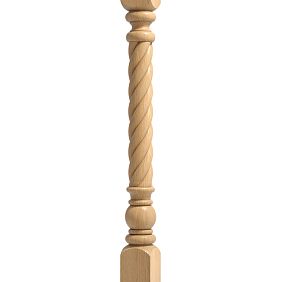
Balusters — rhythm and boundary. Vertical intermediate posts — the main 'fabric' of the balustrade. They create the visual rhythm of the railing, define its character and style. From a structural point of view, balusters work in bending under lateral impact. They are not load-bearing for the handrail like support posts — but it is through them that impact loads are absorbed during accidental contact.
Standard cross-section of wooden balusters — 45×45 mm, 50×50 mm, 60×60 mm. Height from the attachment point to the lower edge of the handrail — 880–900 mm. These are not arbitrary numbers — they are the result of years of regulatory practice, verified by human physiology.
Support posts (newel posts) — load-bearing frame. The support post is the anchor of the entire structure. It is installed at the beginning and end of each flight, on landings, at turns. It is the one that takes the main horizontal load from the system: when tested with a lateral pressure of 100 kg on the handrail — the post must withstand it.
Cross-section of a support post — from 100×100 mm. Fastening — exclusively through a metal stud or anchor into the step or floor. A post installed only with glue or on a wooden dowel — is a structural error with consequences.
Handrail — physical contact with the stairs. The handrail is the only element of the balustrade that a person touches with their hands every time they ascend or descend. This means requirements in two planes at once: ergonomic (shape, comfortable for gripping) and aesthetic (texture, color, proportions).
Optimal handrail width — 50–70 mm. Cross-sectional shape — oval or D-shaped: the hand grasps it instinctively. Handrail height from the step surface — 900–950 mm in residential premises.
Bottom rail — invisible foundation. The lower horizontal plank into which the lower ends of the balusters 'enter'. Aligns the placement of posts, hides fasteners, creates a unified lower line of the railing. In some designs, the bottom rail is replaced by a stringer or carriage, where balusters are fastened directly into grooves.
Turning elements — transitions and continuations. 'Gooseneck', 'turn', 'hook' — elements that ensure the continuity of the handrail when transitioning from an inclined flight to a horizontal landing and back. Without turning elements, the handrail 'breaks off' at each landing — this is both aesthetically unappealing and unsafe: the hand loses support at the moment of transition.
Our factory also produces:




Balustrade as an integral ensemble
The most important quality of a goodstair balustrade— is unity. Not just a technical connection of elements, but stylistic, material, and proportional unity. Balusters and posts of the same design, handrail — of the same wood species, bottom rail — of the same profile as the lower edge of the handrail. This unity is not created by chance, but is designed in advance — at the stage when not a single part has been purchased yet.
Get Consultation
Types of balustrades: open, closed, cantilever, and other types
Balustrade classification is multidimensional. They are distinguished by structural type, material, and artistic style. Let's examine all three dimensions.
By construction type
Open balustrade — a classic construction consisting of balusters, support posts, and a handrail. The space between balusters is open. Light passes through the railing, the staircase is 'readable' from any point in the room. This is the most common type for interior staircases in private homes.
An open balustrade visually 'lightens' the space — especially important in small houses, where a massive solid railing would make the staircase an oppressive dominant feature.
Closed balustrade (with stringer or paneling) — a construction where the side surface of the staircase is closed. Paneling can be wooden panels, carved flat inserts, glass. Creates a sense of solidity and 'enclosedness' of the stair space.
Used in interiors with heavy, massive architectural forms — Empire, Baroque, 'palatial' classicism — where the 'lightness' of an open balustrade would be a dissonance.
Cantilever balustrade — a technically complex type: steps are cantilevered from the wall without a side stringer. The railing in this case is mounted only on the open side, and the structure visually 'floats'. Requires precise engineering calculations for post attachment points — loads here are significantly higher than with a standard stringer.
Balustrade on a metal frame with wooden decor — a combined construction: load-bearing functions are performed by a metal core (studs, angles, sleeves), decorative functions — by wooden balusters, handrail, and posts. This is the optimum in terms of the ratio of structural strength and the aesthetics of wood.
By material
-
Wood — classic. Oak, beech, ash, pine. Warmth, texture, possibility of any shape.
-
Metal — wrought iron, stainless steel, brass. Strength, durability, 'industrial' or classic character.
-
Polyurethane — for facade balustrades and external galleries. Moisture resistance and frost resistance.
-
Stone — marble, limestone. For ceremonial rooms, terraces, external balustrades.
By artistic style
-
Classicism — symmetry, order system, dentils, fluting, acanthus leaves.
-
Baroque — curved lines, hidden movement, 'heavy' profiles, gilding.
-
Empire style — strictness, monumentality, geometry.
-
Provence — soft shapes, light tones, combination of wood with forged elements.
-
Minimalism — square cross-section, clean lines, minimal detailing.
-
Neo Art Deco — geometric patterns, contrast of materials, gold as an accent.
Carved balusters and oak balusters: why this is a special conversation
In the world of staircase decor, there are two phrases that make a knowledgeable person immediately understand — this is the highest level. These arecarved balustersandOak balusters. Sometimes these two concepts coincide in one product — and then you have an item that can outlive more than one generation.
Carved balusters: relief born from wood
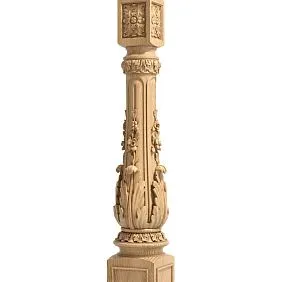
A carved baluster is not just a 'beautiful baluster'. It is a baluster whose surface carries a three-dimensional ornament: flutes (vertical grooves), acanthus leaves, twisted cords, garlands, rosettes, belts. This relief is created in one of two ways.
Hand carving — in unique and authorial projects. The master works with a chisel and mallet on a blank that has already undergone lathe processing. Each carved baluster is unique. This is precisely what is valued in historical objects and representative interiors.
3D CNC milling — in serial production. A multi-axis milling machine reproduces the master model with an accuracy of ±0.1 mm. All balusters in the series are identical — this is important for the rhythmic uniformity of the balustrade. With good programming and quality wood, a milled carved baluster is visually indistinguishable from a hand-carved one.
Carved balusters are used in staircases of Baroque, Classicism, Renaissance, and Empire styles. For Scandinavian minimalism or high-tech, they are excessive — there, pure geometry is needed. But in the right contextcarved balusters— it is not 'too much', but 'just right', because the richness of the relief is balanced by the strictness of symmetry and the unity of style.
Oak balusters: a species with character
Oak is not just 'hard wood'. It is a species with history, character, and unique properties that make it an ideal material for staircase balusters.
Hardness. The hardness of oak on the Brinell scale is 3.7–4.0 HB. This means high resistance to abrasion and impact. An oak baluster on an intensively used staircase will outlast a similar pine baluster by 3–4 times.
Texture. Oak has a characteristic texture with visible medullary rays (light shiny 'flashes' in the radial cut). This makes the oak surface lively and non-uniform — each baluster has its own pattern. No paint can reproduce this liveliness.
Natural tannins. Oak contains tannic acids — natural antiseptics. This provides increased resistance to biological damage: fungus, rot, insects. For outdoor staircases and loggias — a critically important property.
Staining. Oak responds exceptionally well to water-based and oil-based stains: tone and depth of color are achieved from the first application, without streaks or unevenness. This means — any finish: from dark 'wenge' to light 'bleached oak' — is reproduced consistently.
STAVROSOak balustersare presented in a wide range — from laconic turned forms to richly ornamented carved series. All products are made from solid oak of our own production, with a white acrylic primer.
Why exactly oak: a direct answer
If you are building a staircase once and for all — choose oak. If you are building for 10–15 years with the possibility of renovation — beech or ash. If the budget is limited and the staircase is for a dacha — pine with a good coating.
Oak is more expensive. But oak in the right staircase is a capital investment with an unlimited payback period.
Balustrade assembly and installation technology: from marking to handrail
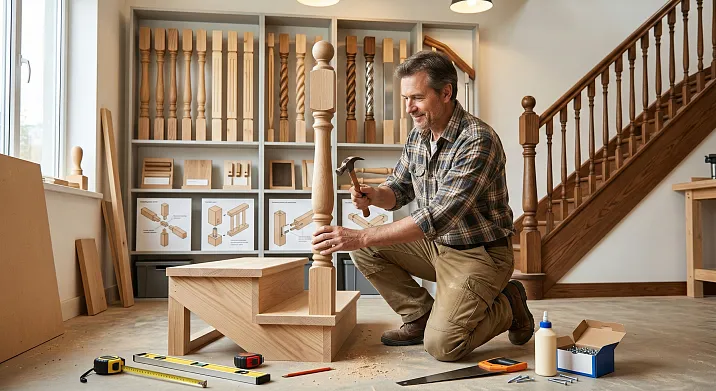
Installing a balustrade is a task that can be done by yourself if you have good tools, accurate measurements, and respect for the sequence of stages. Let's consider the full cycle.
Stage 1: Design and Calculation
Before any purchase — calculation. It consists of several steps:
Layout of posts. Support posts are installed at the beginning and end of each flight, on landings, at turns. For a standard two-flight staircase with a landing — at least 5 support posts.
Calculation of the number of balusters. Determine the spacing — optimally 120–140 mm along the baluster axis. Formula: N = (flight length − post diameter × 2) / spacing. Round the result up to the nearest whole number. Add a 10% reserve.
Baluster height. Determined by the condition: handrail height from the step surface = 900 mm (residential premises). Baluster height = 900 mm − handrail thickness (usually 55–70 mm) − thickness of the baluster shoe (if used, 20–30 mm). A standard 900 mm baluster fits most typical constructions.
Stage 2: step preparation
Steps for baluster installation must be:
-
Completely dry and secured (not "loose" under load)
-
Cleaned of dust and grease at attachment points
-
Pre-drilled for studs or dowels
Marking: each baluster gets its own axis, with equal spacing. A laser level is a mandatory tool for transferring marks along the entire length of the flight with equal distance from the step edge.
Stage 3: installation of support posts
This is the first installation stage and the most critical. A post installed inaccurately vertically or weakly secured will "pull" the entire handrail along with it.
Method of post attachment:
-
Drill a hole in the step or floor: diameter 14–16 mm, depth 80–100 mm.
-
Insert a metal sleeve.
-
Screw in an M12 stud with anchor adhesive or onto a dowel.
-
Place the support post onto the stud: there is a through hole at the base of the post.
-
Secure with a nut and decorative rosette or conceal the fastener under a baluster rail.
-
Check vertical alignment with a level in two planes.
Stage 4: installation of balusters
Before installation, each baluster on an inclined flight requires trimming: the lower end — at the angle of the flight's incline (leave perpendicular to the step), the upper end — at the same angle for tight contact with the handrail.
Methods of attaching balusters to the step:
-
Ø18–22 mm dowel + PVA glue: classic and reliable. Hole depth in the step — 50 mm, in the baluster — 50 mm.
-
M8 stud with double-sided threading: a stronger connection, used under high loads.
-
Hidden corner bracket: mounted from below to the step, the baluster is "slid on" through a groove.
Each baluster — along the axis, level (vertical). After installing the entire row — check the plane: stretch a string from the first post to the last. All balusters should touch the string.
Stage 5: laying the baluster rail
If the design includes a baluster rail — it is laid on top of the lower ends of the balusters or under them (depending on the attachment type). Attachment to steps — with hidden screws, PVA glue.
Stage 6: installation of the handrail
The handrail is the final element. It connects the system along the top, rests on the upper ends of the balusters and is supported by the support posts.
Attaching the handrail to posts: stud with decorative top plug or hidden bracket through a side hole in the handrail.
Attaching the handrail to balusters: PVA glue + screw from below through the baluster groove into the handrail.
On an inclined flight, the handrail is straight, with end cuts at the incline angle. On the landing — transition through turning elements ("gooseneck" or "turn"), which ensure a smooth change of direction.
Stage 7: final processing and painting
Sanding all joints and transitions: sandpaper grit 180, then 240. Filling gaps at joints: wood filler matching the wood species. Priming: one coat of acrylic primer. Final coating: oil or varnish in 2–3 coats with intercoat sanding.
Safety Standards: What GOST and SP Say
A wooden balustrade is not just about aesthetics. It must meet safety requirements. In the Russian Federation, the main standards are SP 54.13330.2022 'Residential Apartment Buildings' and GOST 23120-78 'Stair Flights'.
Main Regulatory Parameters
| Parameter | Residential Premises (Private House) | Public Buildings |
|---|---|---|
| Railing Height | ≥ 900 mm | ≥ 1100 mm |
| Maximum Gap Between Balusters | 120 мм | 100 мм |
| Minimum Load on Handrail (Horizontal) | 300 N/m | 800 N/m |
| Balcony Railing Height | ≥ 1000 mm | ≥ 1200 mm |
| Handrail Width | 50–70 mm | 50–70 mm |
Requirements for Homes with Children
If there are children under 5 years old in the house, the gap between balusters must not exceed 80–100 mm. With a standard baluster cross-section of 45 mm and a gap of 85 mm, the spacing along the axis = 45 + 85 = 130 mm. This means: two balusters per step with a width of 260 mm.
The design must not create a 'ladder' effect — meaning balusters must not provide an opportunity for climbing: there should be no horizontal crossbars or protrusions in the lower part of the railing.
Checking Railing Strength
After installation — mandatory testing. Apply a horizontal load of 100 kg to the handrail at the most loaded point (middle of the flight). The deflection must not exceed 10 mm. Noticeable 'play' in the railing is a sign of insufficient fastening of posts or balusters.
Caring for a Wooden Balustrade: A Long-Term Strategy
A wooden balustrade, with proper care, lasts 50–100 years. Improper care — and within 10 years, cracks, wear, and darkening will begin.
Daily Care
Dust on the handrail — use a soft cloth. Surfaces with carving — use a soft brush. Never use 'wrung-out' wet rags — only slightly damp ones. After wet cleaning — immediate dry wiping.
Recoating
Oil coating is renewed every 2–3 years: light sanding with 320 grit, applying a thin layer of oil, curing. Varnish coating — every 5–7 years. If the varnish film is damaged — immediate local restoration, otherwise moisture penetrates the wood.
Handrail: Special Attention
The handrail is the most 'used' element. It receives sweat, grease, and dirt from hundreds of touches. Every 6 months — treatment with special wood oil (teak or linseed). This nourishes the fibers and creates a protective layer.
FAQ: Answering Specific Questions
Can a balustrade be installed on a concrete staircase?
Yes — and this is one of the most common scenarios. Wooden balusters and posts are attached to concrete steps via metal anchor studs. Pre-drilling with a diamond bit, anchor chemical adhesive — and the connection is stronger than in wood.
Which handrail to choose: round or oval?
Oval (60×40 mm) — more ergonomically comfortable: the hand fully wraps around it. Round (Ø45–50 mm) — more classic visually, slightly less comfortable when moving. For elderly people and children — oval is preferable.
Are they needed fromcomponents for wooden staircasesone manufacturer or can they be mixed?
It is strongly recommended to use one manufacturer for the entire system: uniform wood species, uniform profile of connecting elements, uniform primer tone for finishing. Mixing manufacturers leads to size mismatches (different tolerances) and inconsistency in wood shade even with the same tinting.
How to calculate the number of balusters for a staircase with winder steps?
Winder steps have variable tread width. Calculate baluster spacing along the inner curve (minimum width) — this ensures compliance with the gap standard along the entire length. Balusters in the winder section may have different heights — they are trimmed individually.
What is the difference between the 'Standard' and 'Prestige' balusters in the STAVROS catalog?
'Standard' — quality sanding up to 120 grit, white acrylic primer. 'Prestige' — additional fine sanding up to 240 grit, improved clarity of relief details, more thorough elaboration of ornaments in carved positions.
Can you bend a handrail for a curved staircase yourself?
Solid wood handrail — does not bend (splits when bent). For curved staircases, turning elements made of several parts or handrails made of bent-glued blanks are used. STAVROS fulfills custom orders for non-standard turning elements.
Should balusters be painted before or after installation?
Correct answer: primer and main coating — before installation (more even on a horizontal surface). Final coat and joint sealing — after installation, to hide fastener marks and ensure coating continuity at connection points.
STAVROS: solid wood staircase components — all in one catalog
A good staircase is not a set of randomly purchased parts. It is a system designed as a single whole. And STAVROS is one of the few manufacturers that offers a truly complete line for this system.
In the catalogstaircase components STAVROS: balusters made of oak, beech, and pine— over 50 models,Support columns and pedestalshandrails, sub-baluster rails, turning elements. All from the same wood species, same production, with uniform tolerances.
Additionally — full interior decor:Molding and cornices made of solid wood, Decorative Inserts, carved elements for furniture and doors, and in parallel —full catalog of polyurethane decorfor those who combine wood and polyurethane in one project.
Delivery across Russia and CIS. Packaging — multi-layered, with corrugated cardboard, bubble wrap, and stretch film. Individual calculation of balustrade kit according to your staircase parameters — with a specialist.
Staircase balustrade— is what you look at every morning when approaching the staircase. It is what you touch every time you ascend. Let that touch and that gaze be pleasant. STAVROS helps ensure this.