Article Contents:
- Evolution of Technology: From Handcraft to Automation
- Revolution of the Machine Park
- Integration of digital technologies
- Material Science Foundations of Quality Production
- Classification of Wood by Technological Properties
- Coniferous species: accessibility and practicality
- Exotic Species: Exclusivity and Complexity
- Technological Process: From Rough Stock to Masterpiece
- Preparatory Operations: Foundation of Quality
- Turning Operations: The Heart of the Production Process
- Decorative Processing: Art in Technology
- Quality Control: Guarantee of Perfection
- Automated Control Systems
- Strength and durability tests
- Innovative Development Directions
- Artificial Intelligence in Production
- Robotics and Automation
- Ecological innovations
- Economic Aspects of Modern Production
- Optimization of production processes
- Marketing Strategies
- Future of the Industry: Challenges and Opportunities
- Personalization and customization
- Integration with Smart Homes
- Conclusion
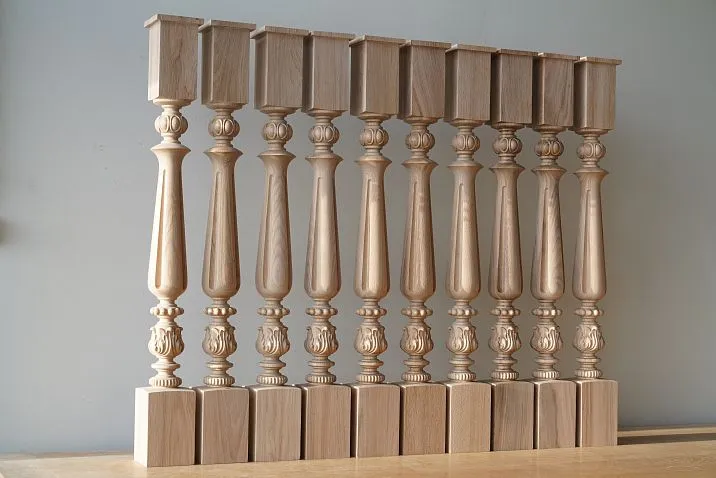
What turns an ordinary staircase into a work of art? What force causes awe at the sight of elegant vertical balusters supporting handrails? The answer lies in the craftsmanship of baluster production — a complex technological process where centuries-old woodworking traditions merge with modern innovations. Each baluster is born from the symbiosis of human talent and machine precision, transforming ordinary wood into an element of architectural poetry.
In today's world, where technology develops at dizzying speed, baluster production remains one of the few industries where manual craftsmanship still plays a key role. This unique blend of tradition and innovation creates products capable of enhancing any interior — from a modest country house to a luxurious mansion.
Modern baluster production represents a multi-stage process, where each stage demands flawless execution. From selecting the wood to the final polishing — every operation affects the quality of the final product. That is why understanding technological nuances becomes critically important for anyone striving to create truly high-quality stair railings.


Evolution of Technology: From Handcraft to Automation
The history of baluster production spans millennia, but the last decades have brought revolutionary changes to this traditional industry. Whereas in the past each baluster was crafted entirely by hand, requiring the artisan’s years of experience and artistic sense, today high-tech equipment enables unprecedented precision and productivity.




Revolution of the Machine Park
Modern CNC turning machines have fundamentally changed the approach to baluster manufacturing. These high-precision machines can reproduce the most complex profiles with accuracy down to fractions of a millimeter, ensuring consistency across mass-produced items. Programmable controllers allow storing hundreds of different profiles in memory, instantly switching between various baluster models.
CNC milling machines have opened new horizons in decorative processing. Multi-axis systems enable the creation of three-dimensional reliefs and ornaments that were previously accessible only to master craftsmen of the highest caliber. Special rotary devices transform the milling machine into a universal machining center capable of performing operations traditionally requiring different equipment.
Laser technologies have contributed to the industry’s development, providing ultra-precise marking and enabling the creation of complex decorative elements. Laser engraving allows applying delicate ornaments inaccessible through traditional processing methods.
Our factory also produces:


Integration of Digital Technologies
Computer modeling has become an indispensable part of modern baluster production. 3D CAD systems enable designers to create virtual models of future products, calculate their strength characteristics, and optimize the manufacturing technology even before physical production begins.
CAM (Computer-Aided Manufacturing) systems automatically generate control programs for CNC machines. This not only accelerates production preparation but also minimizes the risk of human-related errors.
Modern quality control systems use machine vision and laser scanning to automatically check the geometric parameters of finished products. This approach ensures 100% product control and guarantees compliance with the strictest quality standards.
Get Consultation
Material science foundations of quality production
Selecting wood for baluster production is an art requiring deep knowledge of the properties of different species and understanding of their behavior during processing. Each wood species has unique characteristics that determine not only the appearance of the finished product but also its manufacturing technology.
Classification of wood by technological properties
Hardwood species constitute an elite group of materials for baluster production. Oak, with its density of 700-800 kg/m³, provides exceptional strength and durability of products. Its complex texture with clearly visible growth rings creates a unique pattern on the surface of finished balusters. However, the high hardness of oak requires the use of special tools with carbide inserts and precise cutting regimes.
Ash does not fall short of oak in mechanical properties, but it has a more uniform structure, which simplifies mechanical processing. The light color of ash wood makes it a popular choice for modern interiors. The elasticity of ash allows creating items with thin elements without fear of their destruction during use.
Beech is distinguished by exceptional uniformity of structure and absence of pronounced texture. These properties make it an ideal material for carving, where ornament detail is crucial. The pinkish hue of beech wood gives products a special warmth and coziness.
Coniferous species: accessibility and practicality
Spruce remains the most accessible material for mass production of balusters. Its softness facilitates mechanical processing, but requires special attention to cutting regimes to prevent chipping and scratches. The resinous nature of spruce may cause problems during finishing, therefore requiring preliminary de-resin treatment.
Larch combines the accessibility of coniferous species with increased density and resistance to decay. Its natural moisture resistance makes larch balusters an ideal choice for humid environments and outdoor structures.
Cedar is valued for its antiseptic properties and pleasant aroma. The softness of cedar wood allows creating items with intricate carving, but requires caution during mechanical processing.
Exotic species: exclusivity and complexity
Production of balusters from exotic species requires special skill and equipment. Wenge, teak, rosewood, and other tropical species have unique decorative properties, but their high hardness and oily nature create serious technological challenges.
Processing exotic species requires the use of diamond tools and special cutting fluids. High content of tannins in some species may cause corrosion of metal parts of equipment, requiring tools with protective coatings.
Technological process: from blank to masterpiece
Modern baluster production represents a complex technological chain, where each operation is performed with jewel-like precision. Understanding all stages of this process is critically important for ensuring high quality of the final product.
Preparatory operations: foundation of quality
The technological process begins with careful selection and preparation of wood. Incoming inspection includes checking moisture content, absence of defects, and correctness of geometric dimensions of blanks. The moisture content of wood should be stabilized at 8-12% to ensure dimensional stability of finished products.
Material cutting is performed on multi-blade saws, ensuring the production of blanks with square cross-sections and high dimensional accuracy. Modern multi-blade saws are equipped with automatic feed and positioning systems, minimizing waste and ensuring consistent cutting quality.
Calibration of blanks on four-sided planers ensures precise dimensions and required surface finish. This operation is critically important for subsequent turning operations, as any deviation from square cross-section will cause imbalance and vibrations during blank rotation.
Turning operation: heart of the production process
Turning operation remains the primary forming operation in baluster production. Modern CNC turning machines are capable of performing complex profiles in a single setup, ensuring high productivity and consistent quality.
Programming turning machines requires deep understanding of wood processing characteristics. Cutting speed, tool feed, and cutting depth — all these parameters must be optimized for each specific wood species and type of profile being processed.
Modern turning centers are equipped with automatic tool-changing systems, allowing rough and finish operations without repositioning the blank. This not only increases productivity but also ensures high geometric accuracy of finished products.
Decorative processing: art in technology
After turning, many balusters undergo additional decorative processing. Ornament milling is performed on specialized CNC machines equipped with rotary devices. This allows creating complex three-dimensional reliefs and patterns inaccessible by traditional processing methods.
Hand carving remains the pinnacle of craftsmanship in producing exclusive balusters. Experienced carvers create unique works of art, where every detail bears the imprint of individual skill. Combining machine and hand processing allows achieving optimal balance between productivity and artistic value of the products.
Laser engraving opens new possibilities for creating delicate decorative elements. Computer-controlled laser beam allows applying complex ornaments with precision unattainable by traditional methods.
Quality Control: Guarantee of Perfection
Quality control system in modern baluster production covers all stages of the technological process — from incoming inspection of raw materials to final acceptance of finished products. Multi-level inspection system guarantees compliance of products with the strictest quality standards.
Automated control systems
Modern machine vision systems are capable of automatically detecting surface defects, dimensional deviations, and color discrepancies. High-speed cameras scan each product, comparing it with standard samples and automatically rejecting defective products.
Laser measurement systems provide control of geometric parameters with accuracy down to micrometers. Three-dimensional scanning allows creating digital models of finished products and comparing them with original drawings, identifying even minor deviations.
Automatic sorting systems classify products by quality classes, ensuring delivery of items precisely matching customer requirements and budget.
Strength and durability tests
Balusters, as load-bearing elements of stair structures, must withstand significant loads throughout their entire service life. Testing laboratories conduct comprehensive tests under static and dynamic loads, simulating real operating conditions.
Climate tests in specialized chambers allow evaluating product behavior under various temperature and humidity conditions. Cyclic changes in humidity and temperature reveal wood’s tendency to crack and warp.
Wear resistance tests determine the durability of protective-decorative coatings and their ability to retain original appearance throughout the warranty period.
Innovative Development Directions
Modern baluster production stands at the threshold of new technological breakthroughs. The introduction of artificial intelligence, robotics, and new materials opens boundless opportunities for industry development.
Artificial intelligence in production
Machine learning systems analyze vast datasets of technological processes, revealing hidden patterns and optimizing processing parameters. Predictive analytics enables forecasting equipment failure and scheduling preventive maintenance.
Neural networks learn to recognize wood defects and automatically adjust tool movement trajectories, avoiding problematic zones. This minimizes waste and increases yield of quality products.
Intelligent production management systems optimize equipment loading, minimize setup time, and ensure maximum resource efficiency.
Robotics and automation
Industrial robots are increasingly integrated into production processes, performing loading-unloading operations, inter-process transportation, and packaging of finished products. Collaborative robots operate in close proximity to humans, augmenting their capabilities and boosting labor productivity.
Automated warehouses with robotic storage and retrieval systems ensure precise adherence to technological regimes and minimize losses from improper storage.
Unmanned transport systems organize intra-plant logistics, ensuring timely delivery of materials and components to workstations.
Ecological Innovations
Modern baluster production increasingly focuses on ecological aspects. Near-zero-waste technologies allow utilizing nearly all mass of processed wood, converting sawdust and shavings into fuel granules or composite materials.
Water-based coatings replace traditional solvent-based compositions, reducing harmful emissions into the atmosphere. UV curing of coatings eliminates volatile solvents and ensures instant polymerization.
Heat recovery systems utilize energy from exhaust gases of drying chambers to heat production spaces, reducing overall enterprise energy consumption.
Economic aspects of modern production
The economic efficiency of baluster production depends on multiple factors: cost of raw materials and energy resources, level of automation, and workforce qualifications. Modern enterprises strive for an optimal balance between product quality and its cost.
Production process optimization
Lean production and the concept of lean manufacturing are actively adopted in the woodworking industry. Eliminating waste, reducing setup time, optimizing material flows — all these initiatives aim to enhance resource efficiency.
Enterprise resource planning (ERP) systems integrate all business processes into a single information system, ensuring transparency and control over production. Automation of planning allows optimal equipment loading and minimizes inventory levels.
Quality management systems based on international ISO standards ensure product characteristic stability and reduce costs associated with defect correction.
Marketing strategies
The modern baluster market is characterized by high competition and growing consumer demands for product quality and design. Successful manufacturers develop their own brands, invest in R&D, and create unique products without analogs on the market.
Digital marketing opens new opportunities for product promotion. Interactive configurators in online catalogs allow customers to select balusters according to their requirements and immediately receive a commercial offer.
Partnership programs with architects, interior designers, and construction companies ensure a steady flow of orders and allow influencing material selection already at the design stage.
Future of the industry: challenges and opportunities
Baluster production stands at the threshold of radical changes linked to digital economy transformation, shifting consumer preferences, and stricter ecological requirements. Enterprises that succeed in adapting to new conditions will gain competitive advantages and occupy leading market positions.
Personalization and Customization
Modern consumers increasingly demand individualized solutions reflecting their personal preferences and lifestyle. Mass customization technologies allow producing unique items with economic efficiency comparable to mass production.
Interactive design systems allow customers to create their own baluster designs by selecting shapes, sizes, and decorative elements from extensive component libraries. Automatic generation of CNC machine control programs ensures rapid production of custom orders.
Augmented reality technologies allow customers to visualize how selected balusters will look in their interiors before placing an order.
Integration with smart homes
The development of the smart home concept opens new opportunities for functional expansion of balusters. Built-in motion sensors, lighting systems, wireless mobile device charging — all of this can be integrated into the design of modern balusters.
The Internet of Things enables creating intelligent stair systems that automatically adapt to user needs, ensuring comfort and safety.
Biometric access systems integrated into handrails can provide an additional level of security in residential and commercial buildings.
Conclusion
Baluster production represents a unique industry where centuries-old craftsmanship traditions harmoniously combine with advanced technologies. Modern baluster manufacturers create not just functional elements of stair structures, but applied art pieces capable of decorating any interior and becoming a source of pride for owners.
Technological progress opens boundless opportunities for industry development. Automation of production processes, implementation of artificial intelligence, use of new materials and coatings — all this allows creating items that were once considered science fiction.
However, behind all technological innovations, one should not forget the main thing — the person who creates these artworks. The skill of the carver, the eye of the designer, the experience of the technician — these are precisely the factors that determine the true value of finished products.
For those who appreciate quality and beauty, we recommend familiarizing yourself with the products of leading manufacturers baluster production, where the best examples of modern woodworking craftsmanship are presented.
The future of the industry appears as a harmonious combination of traditions and innovations, where advanced technologies serve as tools for realizing creative visions, rather than replacing human craftsmanship. It is precisely this approach that allows creating items that not only fulfill their functional duties but also provide aesthetic enjoyment for many years.
For many years, STAVROS has been a recognized leader in creating exclusive wooden items for staircases. Combining centuries-old craftsmanship traditions with modern production technologies, our specialists create balusters the highest quality, which will adorn any interior and become a source of admiration for many years.