












































































Article Contents:
- Flat forms as a philosophy of modern space
- Evolution of staircase architecture: from Baroque to clean lines
- Structural features and technical advantages
- Wood species: character and performance properties
- Oak - a symbol of reliability and nobility
- Ash - elasticity and contrasting beauty
- Beech — European classic
- Larch - coniferous strength
- Pine — affordable naturalness
- Design variations: from minimalism to ornamentation
- Minimalist solid balusters
- Balusters with vertical slots
- Geometric cut-out ornaments
- Carved ornaments in the traditions of wooden architecture
- Integration into various interior styles
- Scandinavian style: simplicity and naturalness
- Minimalism: geometry and emptiness
- Loft: industrial aesthetics with a natural accent
- Modern Classicism: Balance of Traditions and Current Trends
- Eco-style: maximum naturalness
- Precision Manufacturing
- Wood preparation and drying
- Cutting and milling
- Sanding and Preparation for Finishing
- Finishing
- Installation of flat balusters: technology and nuances
- Preparation and Marking
- Mounting methods
- Handrail Installation
- Flat balusters in non-standard applications
- Terrace and balcony railings
- Decorative partitions and space zoning
- Decorative panels and bed headboards
- Care and maintenance: preserving beauty for years
- Regular Cleaning
- Periodic Coating Renewal
- Controlling microclimate
- Economic aspects: cost and value
- Cost Formation
- Comparison with alternatives
- Long-term value
- Safety issues and regulatory requirements
- Building codes and regulations
- Design features for safety
- Ecological sustainability and development
- Wood as a Renewable Resource
- Durability as eco-friendliness
- Low carbon footprint of production
- Psychology of space: how balusters affect perception
- Vertical rhythm and gaze direction
- Tactility and Emotional Connection with the Material
- Play of Light and Shadow as a Dynamic Element
- Combination with other staircase elements
- Handrail Selection: Form and Ergonomics
- Support Posts: Accents and Structural Necessity
- Shoe Rail: Functionality and Aesthetics
- Harmony with the Material of the Steps
- Frequently Asked Questions about Flat Wooden Balusters
- What distance should be between flat balusters?
- Which wood species is best for balusters?
- Can flat balusters be used for outdoor stairs?
- How many balusters are needed per meter of staircase?
- Can balusters be installed independently?
- How to care for wooden balusters?
- Can flat balusters be painted or stained?
- What makes flat balusters better than turned ones?
- How to combine flat balusters with other interior elements?
- How durable are wooden balusters?
- Conclusion
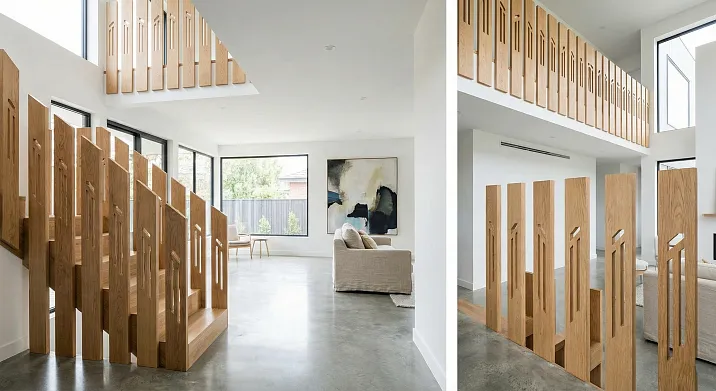
The architectural space of a residential house is always built on details. It is they that create character, shape the mood, and turn a set of structural elements into a living environment. When it comes to stairs, many immediately imagine classic turned balusters with their rounded shapes and traditional silhouette. However, modern interior design increasingly turns to a different solution —flat balusters modern style— become a true symbol of contemporary aesthetics, where minimalism combines with functionality, and the simplicity of form reveals the beauty of natural wood.
Flat balusters are vertical panels with a thickness of twenty to forty millimeters and a width of eighty to one hundred and fifty millimeters. Their geometry is fundamentally different from turned elements — instead of a round cross-section, a rectangular shape dominates here, which allows for a completely different visual composition of the stair railing. Such a design opens up unlimited possibilities for decoration — from absolutely smooth minimalist surfaces to complex carved ornaments that preserve the traditions of wooden architecture.




Flat Forms as a Philosophy of Modern Space
Why exactly do flat balusters capture the imagination of modern architects and interior designers? The answer lies deeper than it might seem at first glance. We live in an era where space is especially valued. City apartments are becoming more compact, country houses strive for open layouts, where every square meter should work to create a sense of freedom and airiness. In such a paradigm, massive stair railings with thick round balusters begin to be perceived as a visual overload, creating a feeling of heaviness and confinement.
Flat wooden balusterssolve this problem elegantly and effectively. Their thin profile creates a rhythmic vertical pattern that directs the gaze upward, visually increasing the height of the ceilings. At the same time, light freely passes through the gaps between the balusters, which is especially important for stairs located near windows or in the center of an open space. Such a design does not divide the room into isolated zones but delicately marks functional boundaries, preserving the integrity of the interior.
Another important aspect is the play of planes and shadows. When sunlight falls on a row of vertical flat elements, a dynamic chiaroscuro composition arises, which changes throughout the day. In the morning, when the sun is low, the balusters cast long horizontal shadows on the steps, creating a graphic pattern. At noon, the shadows become short and sharp, emphasizing the clarity of the geometry. In the evening, under artificial lighting, a completely different mood can be created by directing light from below or from the side — the balusters turn into sculptural elements that shape the atmosphere of the space.




Evolution of Stair Architecture: From Baroque to Clean Lines
The history of stair balusters spans several centuries. In the Baroque and Rococo eras, balusters were true works of art — turned on a lathe, they demonstrated the virtuosity of the master through numerous turnings, constrictions, balusters, and decorations. Each element was unique, created by hand, and required enormous labor. Such balusters perfectly matched the spirit of the time — lush, decorative, demonstrating the wealth and status of the homeowner.
With the advent of modernism in the twentieth century, a turn towards simplification of forms began. Bauhaus architects and followers of functionalism proclaimed the principle of 'form follows function.' Decoration for the sake of decoration began to be perceived as excess, and the honesty of materials and constructive logic came to the fore. It was during this period that interest in flat forms in architecture began — they are easier to manufacture, more economical in material consumption, and at the same time look modern and laconic.
Today we observe a synthesis of these approaches. Modernflat wooden balusterscan be either absolutely minimalist, without a single decoration, or contain decorative elements — cut-out ornaments, milled patterns, geometric compositions. But even when decoration is present, it is subordinated to the overall logic of the form, does not overload perception, and serves not to demonstrate skill for the sake of skill, but to create a harmonious visual image.
Our factory also produces:



Design features and technical advantages
Moving from aesthetics to the practical side of the issue, it is worth understanding how flat balusters differ from turned ones not only visually but also constructively. First of all, it is a matter of load distribution. A turned baluster works as a rod with a circular cross-section, which is equally strong in all directions. A flat baluster is a plate that is maximally strong in bending in the plane of its greatest stiffness.
With proper orientation — when the wide side of the baluster is perpendicular to the direction of possible load — the flat element demonstrates excellent stability and the ability to withstand lateral forces. This is especially important for stair railings, which must withstand not only the static load from the handrail but also dynamic impacts — leaning, accidental bumps, pressure from people moving on the stairs.
The thickness of flat balusters typically ranges from twenty to forty millimeters with a width of eighty to one hundred fifty millimeters. These proportions are not chosen arbitrarily—they ensure an optimal balance between strength, material consumption, and aesthetic perception. Balusters that are too thin will appear visually fragile and cannot provide the necessary structural rigidity. Those that are too thick will lose the main advantage of the flat form—lightness and airiness.
The height of standard balusters for stair railings is nine hundred millimeters, which complies with building codes and safety regulations. However, for special projects—such as terrace, balcony, or decorative partition railings—it is possible to manufacture elements of other sizes. Some manufacturers offer balusters with heights ranging from seven hundred to one thousand two hundred millimeters, allowing for the realization of the boldest design concepts.
Get Consultation
Wood Species: Character and Performance Properties
Choosing the wood species for manufacturing flat balusters is a decision that affects not only the appearance but also the durability, stability, and overall cost of the project. Each species has its own character, texture, mechanical properties, and behavior during use.
Oak — A Symbol of Reliability and Nobility
Oak is rightfully considered the royal species in the production of stair elements. Its wood is distinguished by the highest density (approximately seven hundred kilograms per cubic meter in dry condition) and hardness, ensuring exceptional wear resistance and durability. Oak balusters last for decades, maintaining their shape and strength even under intensive use.
The texture of oak is expressive and recognizable—large pores, contrasting annual rings, and characteristic medullary rays create a rich, deep pattern. On the flat surface of a baluster, this texture is revealed in all its glory, especially with radial sawing when the fibers are aligned along the length of the element. The color range of oak wood varies from light straw shades of young oak to rich brown tones of mature wood. When stained, oak can imitate almost any exotic species while retaining its unique texture.
An important advantage of oak is its stability. Oak wood reacts less to changes in air humidity compared to other species, meaning minimal warping and cracking over time. This is especially important for flat balusters, where any deformation immediately becomes visually noticeable.
Ash — Elasticity and Contrasting Beauty
Ash is similar to oak in its mechanical properties and even surpasses it in some parameters. Ash wood possesses special elasticity and toughness, making it extremely resistant to impact loads. This quality was known to our ancestors, who made tool handles, weapons, and sports equipment from ash.
The texture of ash is more contrasting and dynamic than that of oak. Light and dark stripes of annual rings create an expressive pattern that looks especially impressive on the wide flat surfaces of balusters. The wood color varies from light gray to yellowish-pink with a slight olive tint. With special treatment—such as brushing—the texture of ash becomes even more relief-rich and tactilely interesting.
Ash responds well to all types of mechanical processing — sawing, planing, milling. It produces pierced balusters with clean, chip-free hole edges. With proper drying and protective treatment, ash demonstrates good moisture resistance, allowing it to be used even for outdoor stairs and railings.
Beech — European Classic
Beech wood traditionally holds an honorable place in European furniture and joinery production. Its structure is homogeneous and fine-pored, ensuring a smooth, silky surface after sanding. The density of beech is comparable to oak (approximately six hundred eighty kilograms per cubic meter), and its hardness is even slightly higher, guaranteeing the durability of products.
The color of beech wood varies from pinkish-white to pinkish-brown with a characteristic warm hue. This natural warmth of color makes beech balusters an ideal choice for Scandinavian-style interiors, where coziness and natural authenticity are valued. The texture of beech is calmer and more uniform than that of oak or ash—small pores and thin medullary rays create a delicate, unobtrusive pattern.
Beech takes well to staining and painting. Its homogeneous structure allows for even coverage without spots or streaks. With steam treatment, beech wood acquires a more saturated pink-red hue, expanding the palette of design possibilities. The only point requiring attention is that beech is more sensitive to humidity than oak or ash, so beech balusters require high-quality protective finishing and are not recommended for damp rooms or outdoor use.
Larch — Coniferous Strength
Among coniferous species, larch holds a special place due to its unusually high density and resistance to rot. Its wood contains a large amount of resinous substances, which act as natural antiseptics and preservatives. The density of larch is about six hundred sixty kilograms per cubic meter—greater than that of pine or spruce and comparable to deciduous species.
The color range of larch includes shades from light yellow to reddish-brown. The annual rings are clearly defined, creating a beautiful, contrasting texture. Resin ducts on the radial cut form characteristic strokes, adding extra decorative appeal to the wood. Larch responds well to all types of mechanical processing, although due to its resinous nature, it requires sharp tools and certain skills.
The main advantage of larch is its exceptional resistance to moisture and biological damage. This species is ideal for manufacturing balusters that will be used in high-humidity conditions—on verandas, terraces, in saunas, or in homes near water bodies. Larch does not rot, is not affected by fungus or insects, and retains its properties for decades even without special protective treatment.
Spruce — accessible naturalness
Solid pine is the most budget-friendly material for manufacturing balusters, making it a popular choice for projects with limited budgets. At the same time, pine possesses quite decent performance characteristics—sufficient strength, ease of processing, and a pleasant appearance.
Pine wood has a light yellowish-pink hue with well-defined annual rings and resin pockets that give it a characteristic natural look. The texture of pine is simpler and less expressive than that of deciduous species, but with proper treatment—such as brushing, staining, or patinating—interesting decorative effects can be created from pine balusters.
The main disadvantage of pine is the relative softness of its wood. The density of pine is only about five hundred kilograms per cubic meter, making it more susceptible to mechanical damage—dents, scratches, chips. Therefore, pine balustersflat wooden balusters to buymake sense for interior stairs with moderate load, where they will last for many years with careful use.
Design Variations: From Minimalism to Ornamentation
One of the key advantages of flat balusters is the incredible variety of design solutions that can be realized based on this form. Unlike turned balusters, where decoration is created solely through the rotation profile, flat elements allow for the application of a whole arsenal of processing and decorating techniques.
Minimalist Solid Balusters
The simplest and simultaneously most modern option is completely smooth balusters without any decorations. A rectangular plank of solid wood, sanded to perfect smoothness, coated with clear oil or varnish that reveals the natural wood texture. No cutouts, no patterns—only pure geometry and the beauty of the material.
Such balusters fit perfectly into minimalist interiors, where the main principle is 'less is more.' They emphasize the architecture of the space without competing with it, allowing other interior elements to take center stage. At the same time, the correctly chosen wood species and high-quality finishing make even such simple balusters noble and expressive.
Smooth flat balusters pair well with modern materials—glass, metal, concrete. They can be combined with metal strings, glass inserts, creating complex compositional solutions. An important point—when using solid balusters, their installation spacing affects visual perception. Frequent installation creates an almost continuous plane, while sparse installation creates a rhythmic graphic pattern.
Balusters with Vertical Slots
Adding vertical slots is the next level of complexity and expressiveness. One, two, or three narrow slits cut along the baluster create an interesting visual effect without disrupting the overall minimalist aesthetic. Light passing through these slots creates additional light accents, and the structure itself appears lighter and more dynamic.
Slots can be positioned symmetrically—centered on the baluster or symmetrically relative to the central axis. They can also be asymmetrical, creating a more modern, unconventional look. Slot width typically ranges from ten to thirty millimeters, and length from two hundred to six hundred millimeters, depending on the overall baluster height and design concept.
An important technical point: slots must be positioned so as not to critically weaken the baluster structure. The top and bottom parts, where attachment to the handrail and base occurs, must remain solid. Slots are created by milling with careful edge finishing to avoid chips and tears.
Geometric slot patterns
A more complex and decorative option is balusters with slotted geometric patterns. Round holes of varying diameters, square and rectangular slots, triangular cutouts, diamonds—all these elements can be combined in endless variations, creating unique compositions.
Geometric patterns on flat balusters can be strictly symmetrical or asymmetrical, regular (repeating) or irregular. Modern CNC milling technology allows for creating complex compositions with the highest precision of repetition on each baluster.
Such balusters are particularly expressive with side lighting, when light passes through the slots, creating a complex pattern of light spots on the opposite wall or floor. During the day, this creates a lively, constantly changing picture; in the evening—a dramatic play of light and shadow under artificial lighting.
Carved ornaments in the traditions of wooden architecture
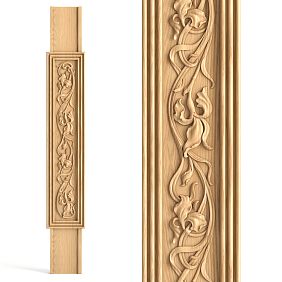
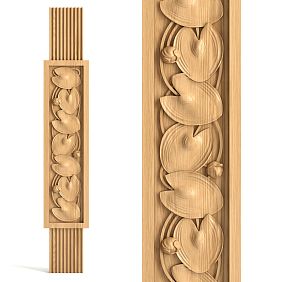
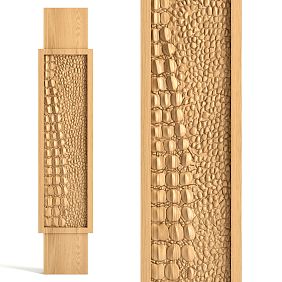
For those who value history and tradition, flat balusters can be adorned with carved ornaments referencing classical wooden architecture. Floral motifs, stylized flowers, intertwining vines, solar symbols, geometric patterns—all this wealth of decorative traditions can be adapted for modern flat balusters.
At the same time, modern carving differs from historical carving in being more stylized and concise. The ornament does not cover the entire surface of the baluster but is placed fragmentarily—in the central part or as a vertical strip. Carving depth is usually small—from three to eight millimeters—creating a delicate relief visible in side lighting but not disrupting the planarity of the form.
Carved balusters require high skill from craftsmen and significant labor input, which is reflected in their cost. However, the result is worth it—such elements transform a staircase into a true work of decorative and applied art, connecting tradition and modernity.
Integration into various interior styles
The versatility of flat wooden balusters is manifested in their ability to organically fit into a wide variety of stylistic directions. The correct choice of wood species, surface treatment type, and pattern design allows flat balusters to be adapted to any interior concept.
Scandinavian style: simplicity and naturalness
Scandinavian interiors are built on principles of functionality, naturalness, and connection with nature. Light wood species—pine, beech, ash without staining or with a light whitewashed effect—perfectly match this aesthetic. Flat balusters in Scandinavian style are usually devoid of decoration or have minimal geometric slots.
Finish treatment—clear oil or matte varnish, emphasizing the natural wood grain without creating a glossy shine. The goal is to preserve the tactile naturalness of the wood, its warmth and natural beauty. Combined with white walls, light floors, and plenty of natural light, such balusters create an atmosphere of calm and harmony.
An important detail of Scandinavian style is attention to detail and quality of execution. Balusters must be perfectly sanded, all edges rounded, the surface pleasant to the touch. No carelessness or roughness—only precision, neatness, and respect for the material.
Minimalism: geometry and emptiness
A minimalist interior requires even greater restraint than Scandinavian. Here, flat balusters become part of the architectural geometry of the space—strict vertical lines, clear proportions, complete absence of decoration. Wood can be stained in dark shades—wenge, fumed oak, black—or, conversely, bleached to an almost white color.
The key principle of minimalism—'less is more'—is evident in every detail. Balusters can be very narrow—only sixty to eighty millimeters wide—to maximally dissolve into the space. Installation spacing can be increased to two hundred to two hundred fifty millimeters, creating a sense of air between elements.
It is important that balusters are part of a unified concept—their color and texture should echo other wooden interior elements, if present, or contrast with the monochrome palette of walls and floors, creating the sole natural accent in a strict space.
Loft: industrial aesthetic with a natural accent
The industrial loft style is built on contrasts—rough brickwork and smooth concrete, metal structures and wooden surfaces. In such an interior, flat wooden balusters serve as a connecting link between the cold industrial foundation and the warmth of natural materials necessary for comfort.
For loft, balusters made of dark wood species—oak, ash, larch—with a pronounced grain are suitable. A brushed surface looks impressive, where soft wood fibers are removed with a brush, and hard ones remain, creating a textured relief. Such treatment emphasizes the natural origin of the material, its authenticity and character.
Flat balusters in a loft are often combined with metal elements—steel handrails, forged mounting details, metalsupport posts for the staircase. This contrast of materials—warm wood and cold metal—creates the expressiveness characteristic of the style.
Modern Classicism: Balance of Traditions and Current Trends
Modern classic is a style that takes the best from classical interiors (proportions, symmetry, nobility of materials) and combines it with modern conciseness and functionality. In such an interior, flat balusters can have elements of carved decoration, but executed in a restrained, stylized manner.
Balusters made of oak or ash, stained in classic shades—walnut, mahogany, dark oak—are suitable. Decoration can include symmetrical rosettes, stylized floral motifs, geometric patterns, but all must be executed with a sense of measure, without excess. Finish treatment—semi-matte or satin varnish, emphasizing the depth of color and nobility of the wood.
An important point is the combination of balusters with other staircase elements. In modern classicRound handrail 50millimeters in diameter made from the same wood species and with the same finish treatment will create a harmonious composition. Support posts can have a more complex form—with fluting, capitals, bases—but the overall stylistic approach should be unified.
Eco-style: maximum naturalness
Eco-style in interior design involves using maximally natural materials with minimal processing. For flat balusters, this means choosing light wood species without tinting, minimal protective coating (natural oils instead of synthetic varnishes), preserving the natural texture and even some natural wood features — knots, grain irregularities, color transitions.
Baluster design should be simple — no complex ornaments, maximum — a few geometric cutouts. Tactile pleasantness of the surface, its warmth and naturalness are important. In eco-interiors, a staircase with flat wooden balusters becomes a connecting element between floors not only functionally but also symbolically — it embodies connection with nature, with living growing trees, with the forest.
Larch balusters with their characteristic texture and natural resinous aroma that lasts for years look good in eco-style. Or pine, especially if using wood with pronounced annual rings and resin pockets.
Manufacturing Technology and Quality Control
The quality of flat balusters is determined not only by wood species selection but also by their manufacturing technology. The process includes several critically important stages, each affecting the final result.
Wood preparation and drying
Everything starts with proper wood selection and preparation. First or highest grade wood without serious defects — through knots, cracks, rot, insect damage — is used for baluster production. Only healthy small fused knots that don't affect strength and may even add decorative value are allowed.
The critically important stage — wood drying. Freshly cut wood contains forty to one hundred percent moisture (depending on species and season), and this moisture must be reduced to the optimal level of eight to ten percent. Only at this moisture level is wood stable — doesn't warp, crack, or change dimensions with indoor humidity fluctuations.
Quality drying occurs in special chambers where temperature, humidity, and air circulation are controlled. The process takes from several days to several weeks depending on species, material thickness, and initial moisture content. Too fast drying leads to cracking and warping, too slow — economically inefficient.
After chamber drying, wood must undergo an acclimatization period — lying in conditions close to future operating conditions to reach equilibrium moisture content. Only after this can further processing begin.
Cutting and milling
Dried and acclimatized wood is cut into blanks of required size. For flat balusters, this is usually boards twenty to forty millimeters thick, one hundred to one hundred fifty millimeters wide, and slightly longer than the final baluster height (with allowance for trimming).
When cutting, it's important to consider wood grain direction — they should run along the baluster length, not across. This ensures maximum bending strength and prevents cracking. Also during cutting, areas with wood defects are avoided or placed so they'll be removed during decorative milling.
If balusters will have cutout ornamentation, the next stage is milling. Modern CNC machines allow creating complex patterns with highest precision and complete repeatability. Milling programs are created on computers, and machines automatically cut specified patterns while controlling cutter feed speed, cutting depth, and movement trajectory.
After milling, all edges of cutouts and holes must be thoroughly processed — removing burrs, chips, irregularities. This is done manually with sandpaper or special grinding attachments. This processing quality is critically important — any roughness will be visible on the final product and may cause splinters during use.
Sanding and finishing preparation
Sanding — one of the most labor-intensive but absolutely necessary stages. Even if wood is already planed on a machine, its surface has micro-irregularities that must be eliminated. Sanding occurs in several stages with gradual reduction of abrasive grit.
First stage — coarse sanding with eighty to one hundred twenty grit abrasive. Removes milling and planing marks, levels the surface. Second stage — intermediate sanding with one hundred fifty to one hundred eighty grit abrasive. Final stage — fine sanding with two hundred twenty to two hundred forty grit abrasive, creating perfectly smooth, silky surface.
After sanding, the surface must be thoroughly cleaned of dust — removed with a vacuum and then wiped with a damp cloth. Dust remaining on the surface will create roughness when applying finishing materials and spoil the appearance.
If wood staining is planned, it's done after sanding but before applying the main protective coating. Water or alcohol-based stains are applied with a brush, pad, or spray, evenly distributed over the surface. After drying, light intermediate sanding may be required as water-based compositions raise wood fibers.
Final finishing
Final stage — applying protective-decorative coating. Coating type selection depends on operating conditions, desired visual effect, and personal preferences.
Oil — one of the most popular options for interior balusters. Oil coating penetrates wood structure, emphasizes its texture, preserves tactile naturalness. Oil-coated wood remains warm to the touch, breathes, regulates humidity. There are oils with wax that additionally enhance protective properties and create a light satin sheen.
Varnish creates a more durable coating, especially resistant to mechanical damage and moisture. Modern polyurethane varnishes have high wear resistance, don't yellow over time, can have varying degrees of gloss — from deep matte to high gloss. Varnish is applied in several layers with intermediate sanding, creating a strong protective film.
Wax — traditional material for wood finishing. Wax coating creates soft, warm shine, emphasizes wood's natural beauty, feels pleasant to the touch. However, wax is less resistant to mechanical impacts and moisture than oil or varnish, thus requiring periodic renewal.
Flat baluster installation: technology and nuances
Proper installation of flat balusters is as important as their manufacturing quality. Even perfectly executed balusters with improper installation may look sloppy, lose strength, or even create safety hazards.
Preparation and marking
Installation begins with thorough preparation and marking. First, the number of balusters needed for a specific staircase is determined. Building codes require that distance between adjacent balusters (clear distance, meaning between their nearest edges) not exceed one hundred twenty to one hundred fifty millimeters. This safety requirement — a small child's head shouldn't fit through such a gap.
Based on staircase flight length and required spacing, the exact number of balusters is calculated. Then installation locations are marked. On steps or on the baluster rail (if used), centers of each baluster are marked. It's important that marking is absolutely precise — even small deviations of several millimeters will be visually noticeable, especially when balusters are lined up in a long row.
For staircases with inclined flights, it's important to correctly determine cutting angles for upper and lower baluster ends. If balusters are installed vertically (most common), their upper end should be cut at an angle corresponding to handrail inclination angle, and lower end — at step inclination angle (or remain straight if balusters are attached to horizontal surface).
Methods of mounting
There are several main methods for attaching flat balusters, each with its advantages and applications.
Dowel fastening is a traditional and reliable method. A hole with a diameter of eight to ten millimeters and a depth of thirty to forty millimeters is drilled into the bottom end of the baluster. A corresponding hole is drilled into the step or sub-baluster. A wooden dowel (cylindrical rod) with applied glue is inserted into the hole in the base, then the baluster is mounted onto it. This method creates a strong connection, completely hidden from view.
Fastening with threaded studs works on a similar principle, but instead of a wooden dowel, a metal threaded stud is used. In the base, the stud is screwed into a pre-installed sleeve; in the baluster, it is screwed into a threaded hole. This connection is even stronger than dowel fastening and allows adjusting the baluster height by tightening or loosening the thread.
Fastening with screws is the fastest but visually less neat method. Screws are driven from below through the step or sub-baluster into the body of the baluster. It is important to accurately calculate the screw length—it must securely enter the baluster but not protrude from the front side. For greater strength, at least two screws per baluster are used.
Fastening via a sub-baluster is a specific method, particularly convenient for long spans and complex staircase configurations.Sub-balusteris a horizontal board with a cross-section of thirty by sixty or forty by eighty millimeters, which is attached to the steps. Balusters are installed on the sub-baluster, which significantly simplifies installation and ensures perfect alignment of all elements.
Handrail installation
After installing all balusters, the handrail is mounted—the final and functionally most important element of the staircase railing. The handrail should be comfortable to grip, strong, and securely fastened. The standard diameter of a round wooden handrail is fifty millimeters—this size is most ergonomic for most people.
The handrail is attached to the upper ends of the balusters in several ways. The most reliable is through hidden metal fasteners: a groove is milled in the handrail, into which special brackets are installed, then the handrail is mounted onto the balusters and secured through these brackets with screws. This fastening is invisible and provides high strength.
An alternative option is fastening with glue and dowels. In this case, the connection becomes non-demountable but, with quality execution, extremely strong. Holes are drilled in the upper ends of the balusters, and corresponding blind holes are drilled in the handrail. Dowels with glue are inserted into the balusters, then the handrail is mounted onto them.
An important point is connecting individual handrail sections to each other if the span length exceeds the length of a standard blank (usually three to four meters). The connection is made at a forty-five-degree angle using special connecting elements or simply with glue and dowels. The joint area is carefully sanded and finished so that the seam is invisible.
Flat balusters in non-standard applications
In addition to traditional use in staircase railings, flat wooden balusters find application in other interior and exterior elements where a combination of functionality, strength, and aesthetics is required.
Railing for terraces and balconies
Open terraces, balconies, and verandas of country houses require reliable and beautiful railings. Flat balusters made from moisture-resistant species—larch, oak, thermally treated ash—are excellent for this purpose. Their vertical orientation provides good visibility without creating a sense of enclosure, and the strength of the structure ensures safety.
For outdoor use, high-quality protective wood treatment is especially important. Special oils or exterior-grade glazes containing UV filters and antiseptic additives are used. Such compositions protect the wood from atmospheric influences, prevent fading, cracking, and damage from fungus and insects.
The design of outdoor balusters can be either minimalist or decorative. In traditional-style country houses, balusters with carved ornaments, referencing folk traditions of wooden architecture, look beautiful. In modern architecture, preference is given to clean lines and geometric shapes.
Decorative partitions and space zoning
Flat wooden balusters can be used to create decorative partitions that divide space into functional zones without complete isolation. Such a partition allows light to pass through, maintains a visual connection between zones, but clearly marks boundaries.
Partitions made from flat balusters with cut-out ornaments look especially impressive. With proper lighting, they create intricate shadow patterns on walls and floors that change throughout the day. Such a partition becomes not just a functional element but an independent art object that decorates the interior.
The height of decorative partitions can vary—from one meter (when simply marking a boundary but maintaining visibility) to the full height of the room (when more substantial space division is required). Balusters can be installed densely, creating an almost solid wall, or sparsely, forming a light, transparent structure.
Decorative panels and bed headboards
Individual flat balusters or panels assembled from them can be used asStylish interior decor—for example, as a bed headboard, decorative wall panel, or element of built-in furniture. The vertical rhythm of the balusters creates a dynamic composition, and the natural wood texture adds warmth and coziness.
For such applications, balusters of lesser height—from four hundred to seven hundred millimeters—are suitable. They can be mounted on a single base-backing, forming a ready-made panel, or installed independently at a certain pitch. The design can include alternating smooth and ornamented elements, combinations of different wood species, and playing with various tinting options.
Care and maintenance: preserving beauty for years
Flat wooden balusters, with proper care, retain their original appearance and functionality for decades. Wood is a living material that requires attention but gratefully responds to care.
Regular cleaning
The basis of care is regular removal of dust and dirt. Dust accumulates on the horizontal surfaces of the handrail and in the recesses of cut-out ornaments, if present. For cleaning, use a soft dry or slightly damp cloth that does not scratch the coating or leave lint.
For balusters coated with oil, special oil-based cleaning agents can be used—they simultaneously remove dirt and refresh the protective layer. For varnished surfaces, neutral detergents heavily diluted with water are suitable—it is important to avoid excess moisture, which can penetrate the wood through micro-cracks in the varnish.
It is not recommended to use abrasive cleaning agents, stiff brushes, or aggressive chemical compounds—all of these can damage the protective coating and the wood itself. Also, avoid excessive wetting—water should not remain on the wooden surface for long.
Periodic coating renewal
Over time, even a high-quality protective coating wears out—especially on the handrail, which constantly contacts hands. An oil coating requires renewal approximately every one to two years (depending on intensity of use). Renewal involves applying a thin layer of oil to a cleaned and lightly sanded surface.
A varnish coating is more durable and may not require renewal for five to seven years. However, if scratches, wear, or cloudiness appear on the varnish, more serious intervention will be needed—sanding the damaged area and applying a new layer of varnish. It is important to use varnish of the same type and brand as the original coating so that the renewed area does not stand out.
A wax coating requires the most frequent renewal—every three to six months. Wax is applied in a thin layer, rubbed with a soft cloth until a shine appears. This process does not require professional skills and can be done independently.
Microclimate control
Wood is sensitive to air humidity. When the air is too dry (humidity below forty percent), it can dry out and crack. When humidity is excessive (above seventy percent) — it can swell, deform, and become affected by fungus. The optimal air humidity for wooden interior elements is fifty to sixty percent.
In winter, when heating is operating, the air indoors often becomes overly dry. Using air humidifiers helps maintain comfortable conditions not only for people but also for wooden structures. In summer, in regions with a humid climate, conversely, air dehumidification may be required.
It is also important to avoid direct sunlight exposure on wooden balusters — ultraviolet light causes fading and degradation of the wood. If the staircase is located near large windows, it is recommended to use curtains or blinds during the sunniest hours of the day.
Economic aspects: cost and value
When deciding to install flat wooden balusters, it is important to understand the economic side of the matter — not only how much it costs, but also what value these elements add to the home.
Formation of cost
The cost of flat balusters consists of several components. The first is the material. The price of wood depends on the species and varies significantly. Pine is the most affordable option; oak and ash are considerably more expensive; exotic species can cost several times more than common ones.
The second component is manufacturing complexity. Smooth balusters without decoration are cheaper to produce than balusters with cut-out patterns or carving. CNC machining is faster and cheaper than hand carving but also creates a less unique product. Custom designs cost more than standard catalog models.
The third component is finishing. A simple oil finish is cheaper than multi-layer varnishing. Toning, patination, and brushing add to the cost. The fourth component is installation. Professional installation ensures a perfect result but increases the overall project expenses.
Comparison with alternatives
Compared to other stair railing options, flat wooden balusters occupy a middle position in terms of cost. They are more expensive than simple metal railings or turned pine balusters but cheaper than complex forged structures or hand-carved oak balusters.
At the same time, flat balusters provide an optimal price-quality-aesthetics ratio for modern interiors. They look contemporary and expensive, create a distinctive visual image, and do not require excessive investment. Glass railings, which are also popular in modern design, are usually more expensive and require more complex installation.
Long-term value
When assessing economic feasibility, it is important to look not only at the initial costs but also at the long-term value. High-quality wooden balusters last several decades with minimal maintenance. They do not go out of fashion, as wood is a timeless material in architecture. When selling a house, a high-quality wooden staircase with beautiful balusters becomes a significant argument, increasing the property's appeal to buyers.
Moreover, there is intangible value — aesthetic pleasure, comfort, a sense of quality and style. Every day, going up and down the stairs, touching the warm wooden handrail, passing by a beautifully arranged row of balusters, a person receives positive emotions. This daily joy from the beauty and quality of the surrounding space is a value that is difficult to measure in money but genuinely affects the quality of life.
Safety issues and regulatory requirements
Stair railings are not only a decorative element but also a crucial component of home safety. Flat balusters must not only look beautiful but also provide reliable protection against falls.
Building codes and regulations
There are clear regulatory requirements for stair railings. The railing height must be at least nine hundred millimeters from the level of the step or landing to the top of the handrail. For stairs over six meters high or in public buildings, this height increases to one thousand one hundred to one thousand two hundred millimeters.
The distance between balusters in the clear (between their nearest edges) must not exceed one hundred twenty to one hundred fifty millimeters. This requirement is dictated by child safety — a child's head should not fit through such a gap. For homes where small children are present permanently or temporarily, an even smaller spacing of ninety to one hundred millimeters is recommended.
The structural strength must be sufficient to withstand a horizontal load of at least one hundred kilograms applied to the handrail. This requirement is tested during stair system inspections. Balusters must be securely fastened, have no play, and not wobble when force is applied.
Design features for safety
Flat balusters, when properly designed, fully comply with all safety requirements. Moreover, their design has some advantages. The wide face of the baluster, positioned perpendicular to the direction of a potential fall, acts as a rigid plane, effectively resisting lateral loads.
It is important that any cut-out decoration, if present, does not create 'loopholes' for children to crawl through. Holes and cut-outs should be sufficiently small (no more than one hundred millimeters in any direction) or, conversely, sufficiently large and positioned high enough to not pose a danger.
All surfaces of the balusters must be thoroughly finished — no sharp edges, chips, or splinters that could cause injuries or snag clothing. The smoothness of the handrail is especially important — the hand should slide freely along it without encountering obstacles.
Ecological Sustainability
In the modern world, issues of ecology and sustainable resource use are becoming increasingly important. Wooden balusters, with a proper approach to production, are one of the most environmentally friendly options for staircase design.
Wood as a renewable resource
Unlike plastic, metal, and glass, the production of which requires significant energy consumption and is associated with greenhouse gas emissions, wood is a natural, renewable material. Trees grow, absorbing carbon dioxide from the atmosphere and storing carbon in their wood. By using wood in construction and finishing, we essentially sequester this carbon for decades.
It is important that the wood comes from legally managed forests where logging is compensated by new plantings and principles of sustainable forestry are observed. FSC or PEFC certificates confirm that the wood is sourced from responsibly managed forests.
Durability as eco-friendliness
Another aspect of eco-friendliness is durability. Products that last for decades are more environmentally friendly than those that require replacement every few years. High-quality wooden balusters, with proper care, can last fifty years or more, making them an environmentally responsible choice.
At the end of their service life, wooden elements can be recycled, reused, or simply composted — unlike plastic or metal structures, which require complex disposal processes. Wood is biodegradable; it returns to the natural cycle without polluting the environment with toxic substances.
Low carbon footprint of production
Wood processing requires minimal energy consumption compared to the production of alternative materials. Sawing, drying, milling, sanding — all these operations consume incomparably less energy than metal smelting or plastic production. Even considering the transportation of wood from the harvesting site to the production facility, the carbon footprint of wooden balusters remains significantly lower than that of products made from synthetic materials.
Finishes based on natural ingredients — linseed oils, waxes — further reduce the environmental impact. Modern water-based varnishes contain virtually no volatile organic compounds, making them safe for both the environment and human health.
Psychology of space: how balusters influence perception
Architectural psychology studies how spatial elements influence people's emotional state, behavior, and well-being. The staircase with its balusters is one of those elements that interact with a person daily and subtly shape their perception of the home.
Vertical rhythm and gaze direction
The vertical lines of flat balusters create a specific psychological effect. Verticality is associated with growth, development, and upward aspiration. A row of vertical elements directs the gaze upward, visually increasing the height of the space, creating a sense of spaciousness and freedom. This is especially important in homes with low ceilings or compact stairwells.
The rhythmic repetition of identical elements creates a sense of order, stability, and reliability. This works on a subconscious level—a person feels more comfortable in an ordered space. At the same time, small variations in baluster design (alternating smooth and ornamented ones, using different widths) add dynamism without disrupting the overall sense of harmony.
Tactility and emotional connection with the material
Wood is a warm material in both literal and figurative senses. Its thermal conductivity is low, so a wooden surface always feels warm to the touch, unlike cold metal or neutral plastic. When a person touches a wooden handrail while ascending the stairs, they receive tactile pleasure, which creates a positive emotional connection with the space.
The texture of wood, the visible fiber structure, the slight color non-uniformity—all this signals to the brain the natural origin of the material. Evolutionarily, humans are predisposed to perceive natural materials positively—they are associated with safety, naturalness, and health. This explains why wooden interiors are perceived as cozier, warmer, and more homely compared to interiors made of synthetic materials.
The play of light and shadow as a dynamic element
Flat balusters create an interesting chiaroscuro composition that changes throughout the day depending on the angle of sunlight. In the morning, long oblique shadows create a graphic pattern on the steps and walls. At noon, the shadows become short and sharp. In the evening, with artificial lighting, a completely different atmosphere can be created by lighting the staircase from below, from the side, or from above.
This dynamism, the constant variability of the light pattern, makes the space alive, not static. A person subconsciously registers these changes, which creates a connection with the time of day, the movement of the sun, and natural rhythms. This is especially valuable in the modern world, where many people spend most of their time in artificially lit rooms, losing touch with natural cycles.
Combination with other staircase elements
Balusters are an important, but not the only, component of the staircase composition. A harmonious combination of all elements—balusters,handrails, posts, treads, risers—creates a holistic and expressive image.
Handrail selection: shape and ergonomics
The handrail is the element with which a person has the closest contact. It should be comfortable to grip, pleasant to the touch, and securely fastened. The classic option is a round handrail with a diameter of fifty millimeters. This size is optimal for most people—the hand can freely grip the handrail, providing reliable support.
A round woodenStair Handrailmade from the same wood species as the balusters creates a harmonious composition. It is important that the shade and the nature of the finish match—if the balusters are oiled, the handrail should also be oiled; if the balusters are varnished, the handrail should be varnished with the same composition.
An alternative to a round handrail is an elliptical or teardrop-shaped profile. Such handrails are even more ergonomic—their shape anatomically corresponds more precisely to the shape of the gripping hand. However, they are more complex to manufacture and more expensive. For modern minimalist interiors, a rectangular handrail is sometimes chosen, continuing the geometry of the flat balusters, but it is less convenient to use.
Support posts: accents and structural necessity
At the beginning and end of a flight of stairs, as well as at turning points of the staircase, support posts are installed—more massive elements that serve as structural support for the entire railing and simultaneously as visual accents. The standard cross-section of a support post is one hundred by one hundred millimeters or one hundred twenty by one hundred twenty millimeters.
Support posts can be executed in the same minimalist style as the flat balusters—simply square-sectioned elements with minimal decoration. They can have a more complex shape—with a base and capital, with milled grooves, with carved details. The choice depends on the overall interior concept—simplicity is preferred in modern styles, while greater decorativeness is permissible in classical styles.
It is important that the posts are made from the same wood species and have the same finish as the balusters and handrail. This creates visual unity for the entire staircase structure. The height of the post usually matches the height of the railing or slightly exceeds it by fifty to one hundred millimeters, creating a clear vertical dominant.
Bottom rail: functionality and aesthetics
The bottom rail is a horizontal element to which the balusters are attached. It is not always used—balusters can be attached directly to the treads. However, the bottom rail has a number of advantages: it simplifies installation, ensures perfect alignment of all balusters, creates a visual base for the railing, and protects the edge of the treads from damage.
The cross-section of the bottom rail is usually thirty by sixty or forty by eighty millimeters. It is attached to the treads and forms a level platform for installing the balusters. The bottom rail can be hidden behind the balusters or, conversely, protrude beyond their plane, creating an additional horizontal line in the railing composition.
For flat balusters, the bottom rail is especially convenient—it allows all elements to be installed in a single line with perfect precision. When attaching balusters directly to the treads, achieving the same precision is more difficult, especially if the treads have irregularities or deviations from the horizontal.
Harmony with the material of the treads
A staircase is a composition of horizontal (treads, landings) and vertical (balusters, posts, risers) elements. Their material and color should combine to create a holistic image. The most harmonious option is when all wooden elements of the staircase are made from the same wood species and have the same finish.
However, contrasting combinations are also permissible. For example, treads made of dark oak and balusters made of light ash create an expressive contrast that emphasizes the geometry of the staircase. Or treads made of solid wood and balusters painted white—a classic combination characteristic of American colonial style and Scandinavian interiors.
It is important to avoid chaos—one should not mix more than two or three wood species or color solutions in a single staircase. Simplicity and consistency in material selection create a sense of thoughtfulness and style.
Frequently asked questions about flat wooden balusters
What distance should be between flat balusters?
Building codes require that the clear distance between balusters (between the nearest faces of adjacent elements) does not exceed one hundred twenty to one hundred fifty millimeters. This is a safety requirement that prevents children from squeezing through the railing. For families with young children, it is recommended to reduce this spacing to ninety to one hundred millimeters. In modern minimalist interiors, a wider spacing of up to two hundred millimeters is sometimes used — but this is only permissible in homes where there are no and no plans for young children.
Which wood species is best for balusters?
The choice of wood species depends on several factors. Oak is the optimal choice in terms of the balance of strength, durability, beauty, and cost. It is suitable for any interior and operating conditions. Ash is similar to oak in properties but has a more contrasting grain. Beech is a good choice for Scandinavian-style interiors, but it is more sensitive to humidity. Larch is ideal for damp rooms and outdoor applications due to its natural rot resistance. Pine is a budget option suitable for interior stairs with moderate loads.
Can flat balusters be used for outdoor stairs?
Yes, flat wooden balusters are excellent for railings on terraces, porches, and outdoor stairs. It is important to choose a suitable wood species — larch, oak, thermally treated ash — and ensure high-quality protective treatment. Use special oils or glazes for exterior work with UV filters and antiseptic additives. Renew the protective coating annually or every two years depending on climatic conditions. Properly treated wooden balusters outdoors last for decades.
How many balusters are needed per meter of staircase?
The number of balusters depends on their width and the required installation spacing. With a baluster width of one hundred millimeters and a clear spacing of one hundred twenty millimeters, approximately four to five balusters will be needed per meter of length. An exact calculation is performed for a specific staircase, taking into account its length, configuration, presence of turns, and landings. A professional designer or staircase manufacturer will perform an accurate calculation and suggest the optimal number of elements.
Can balusters be installed independently?
Installing flat balusters requires certain carpentry skills, but with the right tools and care, it can be done independently. Key points are precise marking, vertical installation, and secure fastening. Use a level and plumb line to control geometry. Choose a suitable fastening method — using dowels, threaded studs, or screws. If you are not confident in your abilities, it is better to entrust the installation to professionals — proper installation is critical for the safety and aesthetics of the staircase.
How to care for wooden balusters?
Regular care includes dusting with a soft cloth once every one to two weeks. For deeper cleaning, use a slightly damp cloth or special products for wooden surfaces. Do not use abrasives or aggressive chemicals. Renew oil finishes every one to two years; varnish finishes last five to seven years without renewal. Monitor indoor air humidity — optimally fifty to sixty percent. Avoid direct sunlight and heat sources near wooden elements.
Can flat balusters be painted or stained?
Yes, wooden balusters take well to staining and painting. Staining with water-based, alcohol-based, or oil-based stains allows you to change the color of the wood while keeping the grain visible. Painting with opaque paints completely hides the wood grain, creating a uniform colored surface. Painting white is especially popular for Scandinavian and classic interiors. Before staining or painting, the surface must be thoroughly sanded and cleaned of dust.
What makes flat balusters better than turned ones?
Flat balusters have several advantages. Visual lightness — the thin profile creates a sense of airiness without overloading the space. Modern aesthetics — flat forms better align with current design trends. Versatility — they fit into a wider range of styles, from minimalism to modern classic. Design variability — the possibility of creating pierced patterns, carvings, and combining different textures. Cost-effectiveness — with the same strength, flat balusters can be thinner than turned ones, saving material.
How to combine flat balusters with other interior elements?
Flat balusters should harmonize with the overall interior style. In minimalist spaces, choose smooth balusters without decoration made from light wood species or stained in neutral colors. In loft style, use dark brushed wood combined with metal. In Scandinavian style — light wood species with a transparent oil finish. In modern classic, decoration is acceptable but restrained. The color and texture of the balusters should echo other wooden elements — doors, flooring, furniture.
How durable are wooden balusters?
With proper manufacturing, high-quality protective treatment, and regular care, wooden balusters last for several decades. Balusters made of oak or ash in a home interior can serve for fifty years or more without loss of strength and aesthetics. Even balusters made of less durable pine, with careful use and periodic renewal of the finish, last twenty to thirty years. Key factors for durability are the quality of wood drying (prevents warping and cracking), reliability of fastening, protection from moisture and ultraviolet light, and regular maintenance.
Conclusion
Flat wooden balusters are not just a functional element of staircase railings. They are an expressive architectural accent that creates the character of a space. They embody modern aesthetics, where minimalism of form does not mean abandoning beauty but, on the contrary, reveals the natural perfection of the material. They are a technological solution that combines structural reliability with reasonable cost and ease of installation.
Choosingflat wooden balusters to buyBy choosing them, you are selecting not only a beautiful interior element but also a durable, eco-friendly, safe solution that will delight you and your family for many years. Properly chosen for wood species, design, and finish treatment, skillfully installed, and carefully maintained balusters become part of your home's history, witnesses to important events, silent companions of daily life.
Modern interiors require special attention to detail. And flat wooden balusters are one of those details that create the integrity of the image, turning a house into a space with meaning and character. The vertical lines rising from step to step lead us upward — literally and metaphorically. They remind us of our connection with nature, the value of natural materials, and the importance of quality in the things that surround us.
STAVROS specializes in the production of high-qualitywooden elements for staircases, including a wide range of flat balusters of various designs. Using selected wood from valuable species, modern equipment, and the many years of experience of its craftsmen, STAVROS creates products that meet the highest standards of quality and aesthetics. The company's catalog features both classic baluster models and exclusive designer solutions, allowing the realization of any architectural concept.
By turning to STAVROS, you receive not just a product but a comprehensive solution for your staircase — professional consultation on choosing optimal elements, accurate calculation of the required amount of materials, product quality guarantee, and the possibility of custom manufacturing to your dimensions and design. STAVROS is the traditions of carpentry craftsmanship, modern production technologies, and a sincere love for wood, embodied in every product.
When creating the interior of your home, you are creating a space for life, for happiness, for family. Let every detail of this space be of high quality, beautiful, and full of meaning. Flat wooden balusters from STAVROS are the choice of those who value genuine quality, understand the beauty of simplicity, and create homes where one wants to live.


