












































































Article Contents:
- Oak: When eternity is measured in centuries
- Beech: When elegance meets strength
- Ash: The bright force of nature
- Larch: When a coniferous species behaves like a deciduous one
- Spruce: Democratic beauty without compromise
- Texture: When wood grain becomes art
- Varnish: Classic transparent protection
- Oil: When wood remains alive
- Staining compounds: When transparency has a hue
- Patina: The nobility of lived time
- Relief: When surface acquires volume
- Durability: When decades become centuries
- Choice for specific conditions
- Maintenance and care
- Restoration and repair
- Frequently Asked Questions
- Conclusion

Wood lives. Even after being felled, sawn, dried, and processed — it continues to breathe, react to air humidity, change hue under light, emit a barely perceptible aroma. When you run your hand over a wooden baluster, you feel not just a cold surface — you feel the warmth of the material, the relief of the texture, the silkiness of polished wood. Wood is the only building material that creates a living connection between man and nature, between a man-made object and the organic world.
Wooden balustersThese are not just vertical supports of a staircase railing. They are embodiments of the species' character, revealing its inner beauty, demonstrating craftsmanship. Each species has its own voice: oak speaks of strength and eternity, spruce — of warm simplicity and accessibility, ash — of resilient energy and light elegance, beech — of gentle strength and nobility. The craftsman's task is not to mute this voice, but to amplify it, reveal it through proper processing, emphasize it with a finish, and preserve it for decades.
Choosing a wood species for balusters is not merely a matter of budget or aesthetic preference. It is a choice between different philosophies of durability, different approaches to beauty, different ways of interacting with material and space over time. An oak baluster will look the same after a hundred years — perhaps darker, with a noble patina, but equally strong and reliable. A spruce baluster will undergo changes over the same century — darken, acquire an amber hue, possibly develop minor scratches that become testimony to the life lived in the house. Both philosophies are beautiful, both deserve to exist. It is important to understand what you are choosing.


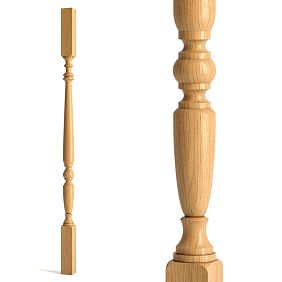


Oak: When eternity is measured in centuries
If there is an aristocracy among wood species, oak is its undisputed monarch. Millennia-old oak forests in Europe built fleets of empires, cathedral roofs, royal palace furniture. Oak wood combines qualities rarely found together: extreme hardness and moderate plasticity, dense structure and expressive texture, resistance to moisture and the beauty of its natural color.
Oak density ranges from 700-800 kilograms per cubic meter depending on growing conditions. This means an oak baluster is 1.5 times heavier than a spruce one, and when struck by hand, it sounds dull and heavy, like hitting solid stone. Hardness on the Brinell scale reaches 3.7-4.1 — a level at which a standard steel nail bends without penetrating the wood. Such hardness makes oak balusters practically indestructible under normal use. They do not dent from impact, do not scratch from accidental contact with sharp objects, do not wear down from constant touch.
Oak texture is instantly recognizable even to non-specialists. Large open pores create a characteristic rough surface that requires careful filling with pore fillers before final finishing. Annual rings are clearly visible, forming concentric circles on end grain and wavy lines on longitudinal sections. Heartwood rays — a unique feature of oak — create a distinctive shiny pattern, especially noticeable on radial cuts. These rays reflect light at a specific angle, creating an effect of internal wood glow.
Oak's color palette is impressive in its variety. Young oak is light, almost white with a yellowish tint. As the wood ages, it darkens, acquiring a golden hue, then a brown tone. Oak growing on moist soils is darker than that grown in dry conditions. Weathered oak — wood that has lain for decades or even centuries in water — takes on a dark gray, almost black color with a purple tint. Such oak is especially prized, used to create exclusive items.
Oak contains a high concentration of tannins — natural preservatives that protect wood from rot, fungi, and insects. Even without any chemical treatment, an oak baluster can remain in high-humidity conditions for decades without signs of decay. This makes oak an ideal choice for staircases in spaces with complex climates — on country homes without constant heating, in saunas, basements, and ground floors.
Processing oak is a test for tools and craftsmanship. The hardness of the wood requires sharp cutters made of hard alloys, powerful machines, and slow feed rates. When turning oak, the cutter heats up to a temperature that can cause burns. Each movement of the chisel requires significant effort. But the result justifies the difficulties — oakwooden balustersbalusters are produced with perfectly sharp edges, without fiber interruptions, with a smooth surface that, after polishing, acquires a silky sheen.
The only serious drawback of oak is its price. Oak balusters cost 2-4 times more than spruce ones. But if considering the purchase in terms of ownership cost over 50-100 years, oak proves economically advantageous — it does not require replacement, practically no repairs are needed, and retains its original appearance with minimal maintenance. An oak staircase is an investment not for oneself, but for children and grandchildren.




Beech: When elegance meets strength
Beech unjustly stands in the shadow of oak, although it does not fall short of oak in many parameters, and even surpasses it in some aspects. Beech wood density is 650-700 kilograms per cubic meter, hardness 3.4-3.8 on the Brinell scale — parameters close to oak. But the main difference of beech is the uniformity of its structure. If oak has clearly visible pores and a coarse texture, beech is fine-grained, with thin annual rings, creating a soft, unobtrusive pattern.
This uniformity makes beech an ideal material for creating balusters with complex profiles. When turned, beech does not produce splinters or tear-outs even on thin elements. When carved, it allows creating details several millimeters thick without risk of cracking. The fine-grained structure ensures a perfectly smooth surface after sanding — it is literally silk-like to the touch, pleasant to the hand, and warm.
The color of beech wood is delicate pink-cream or light brown with a peach tint. This warm palette creates a cozy atmosphere, especially when combined with classic interiors. In daylight, beech slightly yellows, acquiring a golden hue. The texture is softly expressed — small dots (annual rings in cross-section) create a characteristic dotted pattern, which becomes noticeable after finishing.
Beech sands and polishes exceptionally well. After abrasive treatment with 400-600 grit, the surface becomes so smooth it reflects light, creating a noble satin sheen. Beech accepts paint beautifully — its uniform structure ensures even coloring without streaks or spots. This makes beech balusters ideal for painted interiors where clean white, black, or any other color is needed.
Beech bends well when steamed — this is its unique property used in furniture manufacturing. For balusters, this means the ability to create curved elements for spiral staircases or turning sections. Steamed beech can be bent to a radius, fixed in shape until drying, and it will retain the curve without internal stresses.
But beech has its Achilles heel — hygroscopicity. Beech actively absorbs moisture from the air, swells when humidity increases, and shrinks when it decreases. Beech’s volumetric shrinkage coefficient is higher than that of oak or ash. This means beech balusters may deform, warp, or crack if installed in rooms with unstable climate or poorly protected by moisture-resistant coatings.
The solution to this problem is proper drying to 8-10% moisture and multi-layer application of moisture-resistant compounds. Modern hydrophobic impregnants penetrate deeply into the wood structure, blocking pores and preventing moisture penetration. Polyurethane varnishes create a dense, waterproof film on the surface. With proper protection, beech balustersBalusters for staircaseserve for decades even in ordinary residential spaces with central heating.
The price of beech balusters is 20-30% lower than oak, making them an attractive choice for mid-range projects where both quality and economic efficiency are important.
Our factory also produces:


Ash: the light strength of nature
Ash is a species that quietly competes with oak in mechanical properties, surpassing it in some aspects. Ash hardness is 3.5-4.0 on the Brinell scale, density 650-750 kg/m³. But ash’s main advantage is its elasticity. If oak may split under impact, ash will bend but not break. This elasticity makes ash balusters especially reliable under dynamic loads.
Ash texture is vivid and expressive. Wide annual rings create a characteristic striped pattern, especially noticeable on tangential cuts. Early wood (light stripes) is softer and more porous than late wood (dark stripes), creating a relief surface. After finishing, this relief becomes tactilely perceptible — running your hand over an ash baluster, you feel the alternating smooth and slightly rough areas.
Ash color ranges from nearly white to light golden, sometimes with a slight pink or olive tint. Sapwood (outer bark layers) is almost white, heartwood (central part) slightly darker. This lightness makes ash ideal for modern interiors dominated by light tones, minimalism, Scandinavian aesthetics. Ash balusters visually expand space, do not create a sense of heaviness, and allow light to pass through.
Ash polishes exceptionally well, acquiring a silk-like surface with a pleasant natural sheen. Its open-pored structure actively absorbs oils and stains, allowing for deep, rich tones. Stained ash can imitate expensive exotic species — walnut, wenge, padauk. At the same time, ash texture is preserved, creating a unique combination of color and pattern.
Ash processing requires sharp tools due to its elasticity. When turning, the tool must be perfectly sharpened; otherwise, the wood does not cut but compresses, creating a hairy surface. When technology is followed, ash balusters result with sharp edges, smooth transitions, and no defects. Ash’s elasticity is also an advantage in carving: thin elements do not break, and complex details retain strength.
Ash’s drawback is moderate biostability. Ash does not contain natural preservatives like oak or larch, so without protective treatment, it may be attacked by fungi, mold, insects, especially in humid conditions. The solution is mandatory impregnation with antiseptics before finishing and quality lacquer or oil coating. With proper protection, ash balusters last 30-50 years.
The price of ash balusters is comparable to oak or slightly lower — by 10-15%. This is a premium material for those who value the combination of strength, beauty, and light wood tones characteristic of modern design solutions.Beech balustersand ash are often considered alternatives when choosing light-colored species.
Get Consultation
Larch: when a coniferous species behaves like a deciduous one
Larch is a remarkable anomaly in the world of wood. It is a coniferous species, but in terms of density, hardness, and durability, it is closer to deciduous species. Larch density is 550-650 kg/m³, hardness 2.6-3.1 on the Brinell scale. This is significantly higher than that of pine and spruce, nearly on par with beech. But larch’s main unique property is its moisture resistance.
Larch contains a high concentration of resin — natural resin that protects wood from rot even under constant water contact. Moreover, larch becomes harder over time — the natural polymerization process of resin transforms old larch into a material approaching stone in hardness. This is why larch has been used for centuries for piles, bridges, piers, and shipbuilding. Venice stands on larch piles that have not rotted over centuries but have turned to stone.
For balusters, larch is the ideal choice if the staircase is located in a humid room, on an open terrace, in an unheated cottage, in a bath or sauna. Larch balusters do not fear water, steam, or temperature fluctuations. They do not rot, mold, or attract insects. This is wood for harsh conditions where other species quickly fail.
Larch texture is expressive and beautiful. Contrasting annual rings, clear distinction between early and late wood create a characteristic pattern. Resin channels — thin vertical channels filled with resin — add additional decorative effect. On tangential cuts, they appear as dark streaks, on radial cuts — as dots.
Larch color varies from golden-yellow to reddish-brown, often with characteristic dark streaks. Sapwood is light and narrow, heartwood has a rich warm tone. Over time, larch darkens, acquiring a noble amber hue. This natural aging adds character to the wood, making it even more attractive.
Larch processing has specific features. High resin content requires using sharp tools and periodic cleaning of adhered resin. During turning, resin heats up, becomes sticky, and clogs the tool. The tool must be regularly cleaned with a solvent. When technology is followed, larch balusters result in quality, with clear profiles and smooth surfaces.
Larch’s drawback is its tendency to crack during rapid drying. High density and resin content create internal stresses that, under improper drying, split the wood. Larch must be dried slowly, at low temperatures, with gradual moisture reduction. Poor drying leads to cracks that cannot be repaired. Therefore, when purchasing larch balusters, it is critically important to choose a manufacturer with modern drying equipment and technical knowledge.
The price of larch balusters is 30-50% higher than pine but lower than oak. This is the optimal choice for demanding operating conditions where durability and moisture resistance are more important than the aesthetics of premium species.
Pine: democratic beauty without compromises
Pine is the most accessible and widely used species for manufacturing balusters. But accessibility does not mean low quality. Pine has a unique set of characteristics that make it an excellent choice for many applications. Density 450-550 kg/m³, hardness 1.6-2.5 on the Brinell scale — parameters modest compared to oak, but sufficient for most residential staircases.
Pine’s main advantage is ease of processing. Soft wood cuts, turns, and sands easily, requiring no heavy equipment or special carbide cutters. This reduces production costs and allows creating balusters with complex profiles without significant price increase. Pine holds fasteners well — self-tapping screws and dowels enter easily, hold securely, and do not split the wood.
Pine texture is recognizable and attractive. Contrasting annual rings, clear distinction between light sapwood and resinous heartwood create a warm natural pattern. Resin pockets — a characteristic feature of pine — appear as amber inclusions, adding individuality to each baluster. No two pine balusters look exactly alike — each has its unique pattern.
The color of pine ranges from cream-yellow to reddish-brown. The sapwood is almost white with a yellowish tint, while the heartwood is a rich amber. Over time, pine darkens under the influence of light and oxygen, acquiring a noble golden hue. This natural patina of time makes old pine balusters especially attractive — they tell the story of the house, preserving the memory of touches.
Pine's resin is its natural defense. Resin contains terpenes — substances with antiseptic properties that protect wood from fungi and insects. Properly treated pine balusters can last for decades. However, resin creates problems during staining — without prior de-resining, resin will rise to the surface, creating spots and uneven coloration. De-resining is performed using solvents or alkaline solutions that remove resin from the surface.
Pine's drawbacks — softness and structural inhomogeneity. Soft wood is easily scratched, dented, or splintered upon impact. The difference in density between early and late wood creates inhomogeneity — some baluster areas are hard, others soft. This may manifest during sanding, when softer areas sand faster, creating a wavy surface. Solution — use abrasives of the correct grit and professional sanding techniques.
With proper protection — quality antiseptic treatment, priming, and multi-layer varnishing — pine balusters last 20-30 years. This is sufficient for indoor staircases in ordinary residential spaces.Buy wooden balustersMade from pine — you get a functional, reliable product at reasonable prices, without compromising on manufacturing quality or appearance.
Texture: when wood grain becomes art
Wood texture is not just a visual pattern. It is the story of the tree’s growth, recorded in annual rings, grain direction, pore and vessel arrangement. Each ring represents a year of life, each change in ring width is a response to that year’s weather conditions. Wide rings — a wet summer with abundant nutrients. Narrow rings — a dry year, a struggle for survival. Texture is the tree’s biography.
Texture relief is created by the difference in density between early and late wood. Early wood forms in spring, when the tree is actively growing. Cells are large, walls thin, density low. Late wood forms in summer and autumn. Cells are small, walls thick, density high. During processing, soft early wood sands faster than hard late wood, creating a relief surface.
Texture expression varies among species. In oak and ash, texture is clearly defined, contrasting, and relief-like. Running your hand over the surface, you feel waves corresponding to annual rings. In beech and maple, texture is soft, fine, almost imperceptible. Surface is smooth, relief minimal. In pine, texture is moderately expressed — noticeable but not dominant.
Cutting direction affects texture expression. Radial cutting (perpendicular to annual rings) creates a linear texture with parallel lines. Tangential cutting (along the tangent to annual rings) creates a wavy texture with a distinctive "cathedral" or "fountain" pattern. Most balusters are made from tangential or mixed cuts, as radial cutting is significantly more expensive.
Knots — natural texture elements that can be either defects or decorative features. Small healthy knots up to 5-10 mm in diameter add naturalness to wood, emphasizing its organic origin. In country or rustic styles, knotty wood is valued precisely for this naturalness. However, large knots, loose knots, or rotten knots are defects that reduce strength and aesthetics.
Texture expression depends on the final finish. Transparent coatings (varnish, oil) highlight texture, making it more pronounced. Semi-transparent coatings (stain) soften contrast, creating a more uniform appearance. Opaque coatings (paint) completely hide texture, leaving only the shape.wooden balustersWood with pronounced texture requires transparent finish for maximum effect.
Varnish: the classic transparent protection
Varnishing is the most common method of finishing wooden balusters. Varnish creates a transparent or semi-transparent film on the wood surface, protecting it from moisture, dirt, mechanical damage, UV radiation, while preserving the natural texture and color. Modern varnishes are complex multi-component systems, where each component performs a specific function.
Polyurethane varnishes are the most durable and wear-resistant among all types. They create a hard, elastic film that withstands intensive use, does not wear, scratch, or yellow over time. Polyurethane varnishes come in one-component (ready to use) and two-component (require mixing with hardener before application) types. Two-component varnishes are stronger but have a limited time for use after mixing — usually 4-8 hours.
Alkyd varnishes — a traditional type used for decades. They are cheaper than polyurethane, have good adhesion to wood, and create a warm amber tone. However, alkyd varnishes dry slowly (24-48 hours between coats), yellow over time, and are less resistant to abrasion. They are suitable for balusters in low-traffic indoor spaces.
Water-based acrylic varnishes — a modern alternative for eco-friendly interiors. They have no strong odor, dry quickly (2-4 hours between coats), do not yellow, and are safe for health. However, acrylic varnishes are less durable than polyurethane, handle water less well, and require more coats for adequate protection. They are optimal for staircases in bedrooms and children’s rooms, where eco-friendliness is important.
The varnishing process is multi-stage. First, the wood is sanded with 150-180 grit abrasives to remove contaminants and create a smooth surface. Then, the first coat of varnish, diluted 1:1 with solvent, is applied — it penetrates deeper into the wood, creating a base for subsequent coats. After the first coat dries (usually 4-6 hours), the surface is lightly sanded with 220-240 grit abrasive to remove raised fibers — microscopic fibers that rise upon contact with liquid.
Second and third coats are applied undiluted with intermediate drying. Each coat is applied thinly, evenly, without streaks or missed spots. Thick coats take longer to dry, are prone to cracking, and create an unnatural plastic appearance. Thin coats dry quickly, form a strong film, and preserve the natural wood appearance. The final coat is not sanded — it creates the final gloss or matte finish.
The gloss level of varnish is chosen based on aesthetic preferences. Glossy varnish (gloss >80%) creates an elegant, festive look, highlights wood texture, but shows scratches and fingerprints. Semi-matte varnish (gloss 40-60%) — a universal option, combining texture expressiveness with practicality. Matte varnish (gloss <20%) creates a restrained, noble look, hides minor defects, but slightly dulls texture.
The durability of varnished finish depends on varnish quality, number of coats, and usage conditions. Three coats of polyurethane varnish on balusters in a residential home last 10-15 years without visible wear. Signs of needing renewal: surface dullness, small scratches, wear in contact areas, loss of gloss. Renewal involves sanding the old finish and applying new coats.
Oil: when wood remains alive
Oil finish — a philosophy opposite to varnishing. While varnish creates a surface film isolating wood from the environment, oil penetrates deeply into the structure, leaving wood "breathing." Oiled balusters look natural, feel tactilely pleasant, are warm to the touch, and retain the wood’s natural moisture.
Wood oils are divided into natural and modified. Natural oils — linseed, tung, and sunflower — have been used for centuries. They deeply penetrate wood, polymerize under oxygen, creating internal protection. However, natural oils dry slowly (several days between coats), require multiple applications, and do not provide high moisture resistance.
Modified oils — modern formulations based on natural oils with synthetic additives that accelerate drying and improve protective properties. They dry in 8-12 hours, create a more durable finish, and better protect against moisture. Modified oils combine the eco-friendliness of natural oils with the practicality of modern technology.
Oil-wax is a combined composition where oil penetrates into the wood, and wax (beeswax, carnauba) remains on the surface, creating a protective film. Oil-wax provides more pronounced protection than pure oil, while preserving the natural appearance and tactile qualities of oiled wood. A surface treated with oil-wax has a silky gloss, is pleasant to the touch, and is not cold.
The oil application process differs from varnishing. Oil is applied generously with a brush or cloth, worked into the wood with circular motions. After 15-20 minutes, when the oil has been absorbed, excess is wiped off with a clean cloth — no oil should remain on the surface, otherwise it will be sticky. After the first coat dries (usually one day), the second coat is applied, and if necessary, a third. Each coat deepens the color, enhances protection, and reveals texture.
Oiled wood looks natural. Oil does not create a film, does not produce a plastic gloss, and does not alter tactile qualities. Running your hand over an oiled baluster, you feel the wood — warm, silky, alive. Oil highlights texture more strongly than varnish, reveals the finest details of the grain pattern, deepens color. Light wood becomes golden, dark wood gains richness and depth.
Advantages of oil finish — naturalness, eco-friendliness, beauty, ease of local repair. If a surface area is damaged, it’s sufficient to sand that area and re-oil it — the repair mark will be invisible. With varnish, this is not possible — you would need to re-varnish the entire baluster. Disadvantages of oil — less protection against moisture and dirt compared to varnish, need for periodic renewal (every 2-3 years), higher cost of quality formulations.
Oil finish is ideal for wood species with pronounced grain — oak, ash, walnut. It highlights every fiber, creates depth of color, and gives wood an elegant appearance.buy balustersOil finish — the choice for admirers of natural wood beauty.
Staining finishes: when transparency has a hue
Staining finishes (from German 'Lasur' — transparent paint) occupy an intermediate position between transparent varnishes and opaque paints. They change the color of wood while preserving the visibility of the grain. Staining finish contains pigments that impart the desired shade to the wood, and a binder that fixes the pigments to the surface.
Staining wood with staining finishes allows achieving any color while preserving the grain. Light pine can be stained to resemble dark walnut, ash to resemble stained oak, oak to resemble mahogany. This expands design possibilities, allows coordinating baluster colors with other interior elements, and creates the desired atmosphere. Meanwhile, the grain remains visible — annual rings are visible through the colored layer, natural irregularities are apparent, and the feeling of natural material is preserved.
Stains — the simplest type of staining finishes. They are solutions of dyes in water, alcohol, or solvent. Stains penetrate deeply into wood, coloring it from within. Water-based stains provide even color, but raise the fuzz — requiring subsequent sanding. Alcohol-based stains dry instantly, do not raise the fuzz, but are difficult to apply — may cause spots. Stains based on solvents combine the advantages of both types, but have a strong odor.
Pigmented oils — a modern type of staining finishes. They combine the tinting effect of stains with the protective properties of oil. Colored oil penetrates into wood, coloring it, while simultaneously creating protection. This results in both tinting and finishing protection in one product. Pigmented oils provide a natural matte appearance, emphasize the grain, and preserve the tactile qualities of wood.
Pigmented varnishes — another option for staining finishes. They contain a small amount of pigments that impart a hue to the wood, and film-forming components that create protection. Colored varnish allows simultaneously changing the color and protecting the surface. Advantage over stain plus varnish — time-saving, one product instead of two, guaranteed compatibility.
Patina effect — artificial aging of wood — is achieved using special staining finishes. Patination creates the impression that balusters have served for decades, acquiring noble wear from time. Patination technique: wood is stained with dark paint or stain, then the surface layer is partially sanded, revealing the lighter base. This creates an effect of uneven darkening — dark in recesses, light on protrusions. This mimics the natural accumulation of dirt and wear characteristic of old items.
Staining technique requires experience. The composition is applied in a thin layer, evenly, without streaks. If the layer is thick, the color will be uneven, and the grain will be hidden. If the composition is not worked into the wood, spots will remain. Problematic areas — recesses of carved profiles, carved elements — require special attention. The composition accumulates in recesses, creating darker areas. This can be used as a decorative effect (dark in recesses, light on protrusions) or fought against by carefully wiping off excess.
After staining with staining finishes, a protective coating — varnish or wax — is usually applied. Stain alone does not protect wood, only colors it. Clear varnish over stain fixes the color, creates protection, and may add gloss. Wax creates a matte silk-like surface, enhances color, and emphasizes the grain.
Patina: nobility of lived time
Patina — is a deposit that forms on the surface of a material over time due to oxidation, contamination, and wear. On wood, patina manifests as darkening, color change, accumulation of dirt in recesses, wear on protrusions. Natural patina forms over decades, but modern techniques allow creating a patina effect in a few hours.
Why artificially age new balusters? Patination creates a visual connection with history, adds depth, nobility, and a sense of time to the interior. Patinated balusters look like family heirlooms passed down from generation to generation. They harmonize with antique furniture, vintage elements, and create an atmosphere of 'lived-in' space, rather than new construction.
Chemical patination uses substances that react with wood, changing its color. Tannic acid, found in oak, reacts with iron salts, creating a gray-black hue. Ammonia (ammonia spirit) causes oak to darken to brown or black. Potassium permanganate gives a red-brown hue. Hydrogen peroxide lightens wood, creating an effect of weathered wood. Chemical patination is unpredictable — the result depends on the species, concentration of the reagent, and time of exposure.
Mechanical patination imitates wear and damage accumulated over years of use. Balusters are intentionally 'injured' — dents, scratches, chips, scuffs are created. Chains, nails, brushes, hammers are used. Then the surface is sanded, rounding sharp edges of damage, making them appear natural. This artificial 'worn' look creates a sense of lived life.
Colored patination — a multi-layer coloring technique with intermediate sanding. Base layer — dark paint or stain — is applied to the entire surface. After drying, a second layer — light paint — is applied. While the second layer is still wet, it is partially sanded in areas of natural wear — on edges, corners, protruding elements. This creates an effect: the dark base shows through the light worn top layer. This mimics repeated repainting and wear of paint, characteristic of old furniture.
Wax patination uses tinted wax. Dark wax is rubbed into recesses of carving and wood pores, remaining in these areas to create an effect of accumulated dirt. Protruding parts are polished, remaining light. The contrast between dark recesses and light protrusions creates depth, emphasizes relief, and adds dimension.
Patina with gold or silver — a decorative technique for luxurious interiors. Metallic powder (bronze, gold, silver), mixed with a binder, is applied to protruding elements. This creates an effect of gilded or silvered balusters, where metal appears on protrusions, and recesses remain dark. This is characteristic of Baroque, Rococo, and Classicism styles — styles where luxury is not hidden but displayed.
Technically, patination is more complex than simple painting. It requires artistic sense — understanding where patina should be pronounced and where minimal. Overdoing patination creates an artificial theatrical look. Insufficient patina makes the effect unnoticed. Proper patination looks natural, as if balusters truly served for decades.
Relief: when the surface acquires volume
Relief of wooden balusters is created in two ways: natural grain relief and relief created by profile shaping. Natural relief — is irregularities created by differences in density between early and late wood. With proper processing, this relief becomes tactile — running your hand over the surface, you feel the alternation of hard and soft areas, depressions and protrusions corresponding to annual rings.
Brushing (from English 'brush' — brush) — a technique for artificially enhancing natural grain relief. The wood surface is treated with a stiff metal brush, which scrapes away soft early wood, leaving hard late wood. This creates pronounced relief, where annual rings appear like waves on the surface. Brushed wood has a clearly defined texture, an antique look, and tactile appeal.
Brushing (from English 'brush' — brush) — a technique for artificially enhancing natural grain relief. The wood surface is treated with a stiff metal brush, which scrapes away soft early wood, leaving hard late wood. This creates pronounced relief, where annual rings appear like waves on the surface. Brushed wood has a clearly defined texture, an antique look, and tactile appeal.
Brushing is not suitable for all species. For oak, ash, larch with pronounced grain — ideal. For beech, maple with fine-grained structure — impossible, insufficient density difference. For pine — possible, but the result is less pronounced. Brushedbalustersare used in interiors of loft, rustic, country styles, where emphasized naturalness of the material is valued.
Relief of the profile is created by turning or carving. Turned balusters have rotational relief — protrusions and depressions symmetrically arranged around the axis. Balls, cylinders, cones, and moldings alternate, creating a three-dimensional form. The depth of relief varies: shallow relief (5-10 mm variation) creates a soft form with smooth transitions, deep relief (20-30 mm variation) creates an expressive sculptural form with sharp transitions.
Carved relief — the highest level of wood processing. Carving creates three-dimensional elements — leaves, flowers, scrolls, figures — that protrude above the surface or are carved into the depth. The depth of carving can reach 30-50 mm, creating almost sculptural compositions. Carved balusters transform stairs into artistic objects, requiring appropriate interiors and careful handling.
Relief affects maintenance and durability of the finish. A smooth surface is easy to clean, and the finish wears evenly. A relief surface is more difficult to maintain — dust accumulates in recesses, requiring brush cleaning. The finish in recesses lasts longer (no contact with hands), while on protrusions it wears faster. This creates natural wear patina, adding character to balusters.
Longevity: when decades become centuries
The longevity of wooden balusters is determined by three factors: quality of wood, type of protective finish, and usage conditions. Well-made and properly protected balusters from hardwood species can serve 100-150 years, preserving functionality and appearance. This exceeds the service life of most buildings.
Wood moisture is a critical parameter of durability. Wood dried to 8-10% moisture is dimensionally stable, does not warp, crack, or rot. Wood with moisture above 15% is unstable, may significantly change dimensions with changes in ambient humidity, and is prone to biological damage. Therefore, proper kiln drying is a mandatory condition for longevity.
Biostability — the ability of wood to resist fungal, mold, and insect damage. Oak and larch have high natural biostability due to tannins and resins. They can remain undamaged for decades under harsh conditions. Pine, beech, and ash have moderate biostability — require protective treatment with antiseptics. Without treatment, they may be damaged in humid conditions.
Protective coating — a barrier between wood and the external environment. A quality multi-layer coating (3-4 layers of polyurethane varnish or oil-wax) protects against moisture, dirt, UV radiation, and mechanical impacts. The service life of the coating depends on its type and usage conditions. Polyurethane varnish in a residential home lasts 10-15 years, oil 3-5 years. After wear, the coating is renewed — the surface is sanded and a new coating is applied.
Mechanical wear — gradual abrasion of the surface due to contact. Balusters constantly experience load — they are stepped on, grabbed, or brushed against while passing by. Hardwoods (oak, ash, beech) wear slower than softwoods (pine). But any wood will wear over time. Signs of wear: dulling of the coating in contact areas, scratches, abrasion of relief on protruding elements. Wear is a natural process that gives balusters character and tells the story of the house.
Operating conditions drastically affect durability. Balusters in a heated residential home with stable climate last the longest. Balusters on an unheated cottage with temperature and humidity fluctuations experience stress and last less. Balusters on an open terrace, exposed to rain, snow, frost, and sun, require special species (larch) and enhanced protection.
Proper care extends service life. Regular dust cleaning, avoiding excess moisture, using protective pads when moving heavy objects, periodic coating renewal — all of this increases durability.Wooden balusters for staircasesWith proper care, they serve generations and become part of family history.
Selection for specific conditions
Correct selection of species and coating depends on specific operating conditions. There is no universal solution — there is an optimal choice for each situation.
For a residential home with constant heating and stable climate, any species is suitable. If budget allows — oak, this is an investment for centuries. If a balance of price and quality is needed — beech or ash. If budget is limited — pine is quite functional. Coating — 3-layer polyurethane varnish provides protection for 10-15 years. For nature lovers — oil-wax, renewable every 3-5 years.
For a cottage with seasonal occupancy, where winter temperatures drop and summer humidity rises, a more durable species is needed. Oak or larch — optimal choice. Pine is possible but requires quality protection. Coating — moisture-resistant polyurethane varnish with UV filters (if there are windows allowing direct sunlight).
For an open terrace or balcony, where balusters are exposed to direct weather conditions, the choice is limited. Larch — practically the only species capable of enduring such conditions for decades without rotting. Coating — yacht varnish with UV filters and moisture resistance, or special exterior oils with wax additives. Coating renewal is mandatory annually or every two years.
For rooms with high humidity (bathrooms, saunas, pools), wood is not the best choice, but if the design concept requires wooden balusters, choose larch or oak and provide maximum protection. Deep impregnation with antiseptics protecting against mold and fungi is mandatory. Then apply a moisture-resistant primer blocking pores. Finish coating — 4-5 layers of yacht polyurethane varnish or special oils for humid spaces with wax. Critical importance is ventilation — stagnant humidity is destructive to any wood, even maximally protected.
For children's rooms, priority — eco-friendly coating. Water-based acrylic varnishes or natural oils without toxic solvents. Species — any, but preferably hard (oak, beech, ash), so balusters withstand active children's use without damage. Color — light, visually expanding space, or bright colored, creating a cheerful atmosphere.
For classic interiors with antique furniture, moldings, and parquet, balusters from noble species with pronounced texture are needed. Oak — ideal choice, especially if aged with patina or stained to resemble walnut. Coating — oil or semi-gloss varnish, highlighting texture. Glossy varnish is too modern for classic interiors. Baluster profile — classic turned profile with spheres and beads.
For modern minimalist interiors, light species — ash, beech, bleached oak are suitable. Profile — simple, square or rectangular cross-section without decorative elements. Coating — matte or semi-gloss, no gloss. Possible to paint white or gray, completely hiding texture, making balusters graphic elements rather than natural ones.
Care and Maintenance
Wooden balusters require regular care to maintain appearance and protective properties of the coating. Daily care is minimal — wipe with dry or slightly damp cloth to remove dust. Avoid excess moisture — wood does not like water. If liquid spills on a baluster, immediately dry it thoroughly.
Weekly cleaning is done with special wood surface cleaners. Modern polishes not only clean but also nourish wood, restore coating gloss, and create an additional protective layer. Avoid aggressive cleaning agents containing alcohol, acetone, or chlorine — they damage protective coating.
Check coating condition once a month. Inspect balusters under good lighting, especially in areas of frequent contact — upper part where hands grasp. Signs of wear: dulling, appearance of matte spots on glossy surface, minor scratches, roughness. If wear is localized, renew coating on damaged area. If wear is general — full renewal is required.
Oil coating renewal is performed every 2-3 years or as needed. Surface is lightly sanded with 320-400 grit abrasive to remove contaminants and create adhesion. Then fresh oil is applied, rubbed in, and excess is wiped off. After 24 hours, balusters are ready for use. The procedure takes several hours and can be done independently.
Lacquer coating renewal is more complex and required less frequently — every 5-10 years. Old lacquer is sanded or removed with special strippers. Surface is sanded, cleaned of dust, and new lacquer is applied in 2-3 layers with intermediate drying. The process is labor-intensive and requires professional tools and skills. Many prefer to entrust lacquer coating renewal to specialists.
Protection against mechanical damage is important for maintaining appearance. When moving heavy objects up stairs, use protective pads or wrap object corners with fabric. Children often hit balusters with toys, bicycles, scooters — explain that stairs require careful handling. Pets may scratch balusters with claws — this is inevitable, budget for periodic coating renewal.
Climate in the room affects wood condition. Optimal temperature 18-24 degrees, humidity 45-60%. In excessively dry air (below 30% humidity, often in winter with intense heating), wood dries out and may crack. Solution — use humidifiers. In excessively humid air (above 70%), wood swells and mold may start. Solution — improve ventilation, use dehumidifiers.
Direct sunlight causes wood fading and lacquer degradation. If balusters are near a window allowing direct sunlight, consider using curtains or blinds during peak sun hours. Or use lacquer with UV filters, which slows fading.
Minor damage to oak balusters can be repaired yourself using special wax pencils or wood putty. It is important to select the material to match the wood tone precisely for an undetectable repair.
Even high-quality balusters may require repair over time. Minor scratches on lacquered surfaces are removed by local polishing. Polishing paste is applied to the scratch and rubbed with soft cloth in circular motions. Paste fills the scratch, levels the surface, and restores gloss.
Deep scratches penetrating through lacquer to wood require more serious repair. Scratch is ground with fine abrasive, filled with touch-up pencils or mastics in wood color. After drying, the area is coated with lacquer. With proper color matching, repair is barely noticeable.
Cracks in wood — a more serious problem. Minor hairline cracks can be sealed by filling with liquid lacquer or epoxy resin. Deep cracks penetrating significant part of the cross-section weaken the structure. Such a baluster should be replaced. Attempts to glue a cracked baluster rarely yield reliable results — the glued joint remains a weak point.
Loose fastening — a common problem easily resolved. If baluster is secured with self-tapping screws, simply tighten the fasteners. If on dowels with glue — remove baluster, remove old glue, apply fresh glue, reinstall. If metal washers are used — adjust height to eliminate play.
Loose knots — a characteristic problem with pine balusters. Knot falls out, leaving a through hole. Hole is filled with a wooden plug glued in place. Plug is trimmed flush with surface, sanded, stained to match wood color, and coated with lacquer. With quality execution, repair is barely noticeable.
Darkening of wood due to mold indicates that the protection has been compromised and moisture has penetrated. Mold must be removed — the surface is sanded down to clean wood, treated with antiseptic, and dried. Then the source of moisture is eliminated — ventilation is improved, leaks are fixed. After this, the surface is re-coated with a protective finish.
Restoration of old balusters is an art requiring experience. Centuries-old balusters often have multiple damages, cracked finishes, darkened wood, and missing elements. Restoration begins with removing the old finish using chemical stripping or sanding. The wood is inspected and the extent of damage is assessed. Cracks are filled, missing elements are restored using carving. Then a new finish is applied — often with patination to preserve the historical appearance.
Replacing individual balusters requires precise selection of profile and size. If original balusters were made to an individual sketch, an exact replica must be ordered. This requires a sample that the turner uses as a reference. Modern CNC machines allow creating absolutely identical copies that are indistinguishable from the original.
Frequently asked questions
Which wood species is best suited for balusters?
The choice of wood depends on budget and usage conditions. For maximum longevity — oak, lasting over 100 years. For a balance of price and quality — beech or ash, lasting 30-50 years. For limited budgets — pine, lasting 20-30 years with proper protection. For humid conditions — larch, with its unique moisture resistance.
What is the difference between oil-based and lacquer finishes?
Lacquer creates a surface protective film, fully isolating the wood. It is more durable, lasts longer (10-15 years), better protects against moisture and dirt. Oil penetrates the wood structure, leaving it breathable. It looks natural, feels pleasant to the touch, can be locally renewed, but requires more frequent renewal (every 2-3 years) and offers worse protection against moisture.
Can wooden balusters be painted any color?
Yes, wood stains beautifully. To preserve the visible texture, tinting agents (stains, colored oils) are used. For complete color change with texture concealment — opaque paints. Proper preparation is essential: de-oiling (for coniferous species), priming, applying paint in 2-3 layers.
How often should baluster finishes be renewed?
It depends on the type of finish and usage intensity. Polyurethane lacquer — every 10-15 years. Acrylic lacquer — every 5-7 years. Oil — every 2-3 years. Painted finishes — every 4-6 years. Signs of needing renewal: dullness, wear, scratches, surface roughness.
Are wooden balusters safe for children?
Yes, if properly manufactured and installed. Important: baluster spacing should not exceed 100-120 mm (to prevent a child’s head from passing through), absence of sharp elements, thorough sanding (no splinters), eco-friendly finish (water-based lacquer or oil), secure mounting (to prevent children from loosening them). An additional child’s handrail at 500-600 mm height increases safety.
Can wooden balusters be installed by oneself?
Yes, if you have basic carpentry skills and necessary tools: miter saw for cutting ends at required angles, drill for drilling holes for fasteners, level for checking vertical alignment, tape measure for precise measurements. Critical importance is accurate marking and maintaining vertical alignment of each baluster. For complex staircases with turns, it is better to hire professionals.
What is patination and why is it needed?
Patination is artificial aging of wood, creating an effect of lived-in time. It is used to create a vintage, antique appearance. Patination techniques: chemical (chemicals change wood color), mechanical (creating scuffs and scratches), color (multi-layer staining with intermediate sanding). Patinated balusters harmonize with antique furniture, creating an atmosphere of history.
Why do balusters crack and how to prevent it?
Cracks occur due to internal stresses in wood caused by improper drying or sudden humidity changes. Prevention: purchase balusters made from properly dried wood (moisture content 8-10%), maintain stable indoor climate (temperature 18-24°C, humidity 45-60%), use protective finish that seals the wood. Species with high dimensional stability (oak, beech) crack less than softwoods (pine).
How to choose a finish for balusters in humid areas?
For high-humidity areas, special moisture-resistant finishes are required. Best choice — yacht-grade polyurethane lacquers with UV filters and moisture protection, applied in 4-5 layers. Alternative — special oils for humid areas with wax, creating a water-repellent surface. Mandatory preliminary deep treatment with antiseptics against mold and fungi. And most importantly — good ventilation, stagnant moisture is destructive.
What is the advantage of brushed balusters?
Brushing creates a pronounced texture relief, making the wood tactilely appealing and emphasizing the natural material. Brushed surfaces have an antique look, characteristic of vintage items. Advantages: unique texture, better coating adhesion (relief increases surface area), hiding minor defects (relief masks scratches). Suitable for loft, rustic, and country-style interiors.
Conclusion
Wooden balusters— this is for those who appreciate the natural beauty of the material, the warmth of live wood, connection with nature. Each species has its own character, history, unique properties. Oak speaks of strength and eternity, beech — of elegant durability, ash — of resilient energy, larch — of resilience against adversity, pine — of warm simplicity. Choosing a species, you choose not just material — you choose philosophy, aesthetics, longevity.
Wood texture is the tree’s biography, recorded in growth rings, grain direction, natural irregularities. Proper treatment reveals this texture, transforming it into a decorative element. Brushing enhances relief, patination adds depth, toning changes color while preserving the pattern. Each technique is a way to reveal the inner beauty of wood.
Finish coating is not just protection — it is a way to present wood. Lacquer creates brightness, depth of color, protects reliably and durably. Oil preserves naturalness, tactile appeal, the living breath of wood. Tinting agents allow changing color while preserving texture, expanding design possibilities. Patina adds the nobility of lived time, creating a connection with history. Each type of finish has its advantages, application area, philosophy.
The longevity of wooden balusters is measured in decades and centuries. Oak balusters installed in the 19th century still serve in historic European mansions. Pine balusters in Russian village houses endure generation after generation. Larch balusters in coastal cities withstand salty winds and humidity for decades. Longevity is achieved through proper species selection, quality drying, reliable protection, and regular maintenance.
Caring for wooden balusters is not burdensome — regular cleaning, periodic finish renewal, protection from excessive moisture and mechanical damage. In return, you get beauty that does not fade with time, but rather acquires a noble patina of age. Older wooden balusters are more beautiful than new ones — they preserve the memory of touches, tell the story of the house, create the atmosphere of living space.
Company STAVROS has been specializing in the production of natural wood products for over 20 years, including a full range ofstaircase components. The catalog features balusters in various species — oak, ash, beech, larch, pine — in classic and modern styles, turned and milled, simple and carved.
STAVROS's production is equipped with modern equipment from European manufacturers. CNC turning machines ensure the ideal geometry of turned balusters with precision down to tenths of a millimeter. Four-sided planers guarantee perfectly flat surfaces on blanks. Grinding equipment creates a silky surface ready for final finishing. Modern drying chambers ensure proper wood drying to 8-10% moisture content, guaranteeing dimensional stability and absence of deformations.
The wood undergoes strict incoming inspection — blanks with cracks, large knots, rot, or warping are rejected. Only high-grade wood meeting furniture manufacturing requirements is used. Each baluster undergoes final quality control before packaging — geometry, surface finish quality, and absence of defects are checked.
The STAVROS catalog features baluster collections in various styles. Classic collections include balusters with traditional turned profiles — spheres, cylinders, cones, and moldings — available in oak, beech, ash, and larch. Modern collections offer minimalist balusters with square or rectangular cross-sections featuring chamfers and rounded edges. Carved collections include exclusive balusters with floral ornaments, geometric patterns, and figurative elements.
STAVROS offers balusters with various final finishes. Lacquered balusters — with transparent protective coating preserving the natural wood color and texture. Oil-finished balusters — with natural matte appearance and tactile surface. Tinted balusters — with altered color while maintaining visible wood texture. Patinated balusters — with noble aging effect. Painted balusters — in white, black, or any other color from the RAL catalog.
In addition to standard catalog items, STAVROS manufactures balusters according to customer-specific designs. Provide a drawing or photo of the desired profile — master craftsmen will bring the project to life in the material. Any profile can be produced — from simple geometric shapes to complex carved compositions. Modern CNC equipment allows creating balusters with identical profiles in any quantity — from single pieces to large batches.
STAVROS consultants will help select balusters suitable for your specific staircase and interior. They will calculate the required quantity based on standard baluster spacing. They will recommend the optimal wood species for your usage conditions. They will suggest suitable final finishes. They will organize delivery to any region of Russia. They will provide samples for quality and color evaluation.
Choosing STAVROS means choosing quality proven over two decades of operation. You choose wood properly dried and quality-controlled. You choose manufacturing precision ensured by modern equipment. You choose a wide range of styles, species, profiles, and finish options. You choose professional consultations and reliable service.
Oak balustersOak, beech, ash, larch, and pine balusters from STAVROS — this is an investment in longevity, safety, and beauty of your staircase. These are elements that will serve for decades, preserving functionality and aesthetics. This is wood that becomes more beautiful over time, acquiring noble patina of age. This is a connection with nature, warmth of natural material, cozy living wood in your home.
A staircase with wooden balusters is not just a path between floors. It is an architectural element shaping the interior’s character. It is a family heirloom passed down from generation to generation. It is an investment in beauty and longevity, repaid over years of reliable service and aesthetic pleasure.


