Article Contents:
- Why Ordering Balusters Is Not a Whim but a Necessity
- From Idea to Sketch: The Beginning of a Custom Order Journey
- Manufacturing Technologies: From Hand Carving to Robotic Machines
- Choosing Wood Species: For the Task and the Style
- Non-Standard Sizes: When Every Millimeter Counts
- Wooden Balusters Video: Visualization Before Manufacturing
- Wooden Table Balusters: When an Architectural Element Becomes Furniture
- Custom Ornament: When Carving Tells a Personal Story
- Coloring and Patination Technology: Custom Color and Texture
- Combined Materials: Wood Plus Metal, Glass, Stone
- Order Logistics: From Measurement to Installation
- Cost of Custom Balusters: What Makes Up the Price
- Round Wooden Molding: Handrails as Part of a Baluster Set
- Frequently Asked Questions
- Conclusion: Uniqueness Created for You

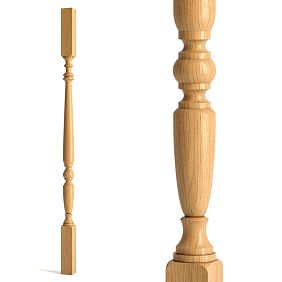
When you design a house or restore an old mansion, standard solutions sometimes seem bland, lacking individuality. You want the staircase not just to connect floors, but to tell a story, reflect the owner's character, and fit into the architectural concept as an organic part of the vision. It is in such cases thatWooden balusters made to orderbecomes the only right choice. Custom manufacturing allows you to realize any idea—from replicating historical samples to creating avant-garde forms, from miniature furniture elements to monumental posts for grand staircases. We explore how the custom production process works, what opportunities it opens up for the client, what technologies are used, and how to avoid mistakes when choosing a contractor.



Why Ordering Balusters Is Not a Whim but a Necessity
Standard catalog balusters work perfectly in typical projects: a staircase 90-100 centimeters wide, a slope of 30-35 degrees, a classic or modern style without special frills. But what if your staircase has a non-standard width, a complex configuration with winder steps, spiral sections? What if the house is built in the style of English Gothic, Russian terem, or French Rococo, where every detail must correspond to historical canons?
Restoration of old buildings requires accurate reproduction of original elements. Century-old balusters have unique profiles not found in any modern catalog. Sizes may differ from standard—height of 1100 or 750 millimeters instead of the typical 900, diameter of 70 or 40 millimeters, specific proportions. The wood species must match the original—if the house is built of Karelian birch or Siberian cedar, pine balusters will look alien.
Author's interiors by famous designers often involve exclusive solutions. The architect creates a unique project where balusters are part of the overall composition—their shape, size, and ornament are connected to other interior elements: cornices, door frames, furniture. Such balusters cannot be found ready-made—only custom manufacturing according to the designer's drawings.




From Idea to Sketch: The Beginning of a Custom Order Journey
The ordering process begins with formulating an idea. Sometimes the client comes with a ready-made vision: they have photos of liked balusters, measured dimensions, a clear idea of the desired result. More often—with a general direction: I want something classic but not banal, or modern but with the warm atmosphere of natural wood. The manufacturer's task is to translate vague wishes into a specific visual image.
The first stage is a consultation with the production company's designer. Stylistic preferences, functional requirements, and budget constraints are discussed. The designer shows examples of completed projects, catalogs of historical styles, samples of various wood processing techniques. Gradually, a general direction emerges: Baroque or minimalism, turned or carved, massive or elegant.
Based on the discussion, the first sketches are created—hand drawings or computer graphics showing the general appearance of the baluster. The sketches do not contain exact dimensions; they are a visualization of the concept. The client sees the proportions, the character of the profile, the ratio of decorative elements. At this stage, changes can still be easily made, different options tried, elements from different styles combined.
After approving the sketch, technical design begins. A working drawing is created with exact dimensions of all elements, indicating material and manufacturing technology. For complex carved balusters, a three-dimensional model is developed in CAD programs—it allows viewing the product from all angles, checking the fit of parts, and calculating material consumption. The 3D model is loaded into a CNC machine for automated processing.
Our factory also produces:


Manufacturing Technologies: From Hand Carving to Robotic Machines
Turning on a lathe is the basic technology for creating balusters with a round cross-section and symmetrical profile. Modern CNC lathes reproduce the most complex profiles with an accuracy of up to tenths of a millimeter. Coordinates of control points are entered into the program, and the cutter automatically turns the baluster to the specified shape. Productivity is high—up to 50-70 balusters per shift for complex profiles, up to 150-200 for simple ones.
Hand turning is used for single specimens or when absolute uniqueness of each baluster is required. A master turner works on a traditional lathe, shaping the profile manually using various cutters. This is slower—5-10 balusters per day—but allows achieving special plasticity of forms, barely perceptible nuances that cannot be programmed. Each baluster turns out slightly different from the others, which is valued in restoration projects and exclusive interiors.
CNC milling opens possibilities for creating flat balusters with complex contours, three-dimensional carvings, and combined forms. Five-axis milling centers process the workpiece from five sides simultaneously, creating three-dimensional ornaments: floral motifs, figurative images, geometric patterns. Processing accuracy is exceptional — deviation no more than 0.1 millimeters per meter of length.
Hand carving is the pinnacle of craftsmanship and the most expensive technology. A carver works on each baluster for weeks, creating detailed compositions: leaves with veins, flowers with petals, figures of animals or people. Hand carving is distinguished by its vitality — each cut is unique, the play of light on the surface is unpredictable, and the touch of a human hand is felt. Such balusters are works of art; their cost can reach tens of thousands of rubles per piece.
Get Consultation
Choice of wood species: for the task and for the style
Oak is the first choice for custom balusters in the premium segment. Dense, heavy wood holds its shape excellently, does not deform over time, and withstands heavy loads. The texture is expressive, with large medullary rays that appear on a radial cut. Oak stains easily, accepting any shade from light golden to almost black. For historical styles (Gothic, Baroque, Classicism), oak is indispensable — it was the primary material in European architecture of past centuries.
Ash is close to oak in strength but has lighter wood with contrasting annual rings. The texture is spectacular, dynamic — the alternation of light and dark stripes creates visual movement. Ash is good for modern interiors where graphic quality and purity of lines are valued. The wood is elastic, allowing the creation of thin elements without risk of breakage — balusters with necks 25 millimeters in diameter made of ash are stronger than those made of oak.
Beech is a species with light, uniform wood, almost without pronounced texture. Ideal for enamel coating — the smooth surface of beech creates a perfect base for paint, does not show through, and does not cause stains. For classic white or colored balusters, beech is the optimal choice. The wood is of medium hardness, processes well, and allows for clear profiles. Disadvantage — sensitivity to humidity, so beech balusters are used only indoors.
Larch is a coniferous species with unique properties. The wood is dense, resinous, resistant to rot and moisture. Color ranges from golden-yellow to reddish-brown, texture with clear annual rings. Larch is ideal for outdoor balusters — terraces, porches, gazebos. The resin preserves the wood from the inside, ensuring durability without chemical treatment. Hardness is high, which complicates processing but guarantees resistance to mechanical damage.
Non-standard sizes: when every millimeter counts
Custom production removes all size limitations. The height of balusters can vary from 300 millimeters (for furniture elements) to 2000 millimeters (for grand staircases with high ceilings). Diameter from 25 millimeters (miniature elements for decorative railings) to 150 millimeters (massive baluster posts for monumental structures). The cross-section of square balusters ranges from 30x30 to 120x120 millimeters.
Conical balusters are a non-standard solution where the diameter smoothly increases from top to bottom or vice versa. This shape creates visual dynamics, emphasizing the direction of movement on the staircase. The taper is usually 5-10 millimeters per meter of height — barely noticeable but perceptible. Manufacturing conical balusters requires special machine setup, so the cost is 20-30 percent higher compared to cylindrical ones.
Asymmetrical balusters in the Art Nouveau style have a profile that does not repeat along the axis of rotation. One side may be convex, the other concave, the upper part offset relative to the lower. Such balusters create a sense of organicity, growth, resembling plant forms. Manufacturing is possible only on multi-axis milling machines or by hand — lathe processing is not suitable due to the asymmetry of the form.
Wooden balusters video: visualization before manufacturing
Wooden balusters videohelps the customer see the future product before production begins. Modern 3D modeling technologies allow for photorealistic visualization: the baluster on the screen looks just as it will in reality — with wood texture, play of light, shadows from carved elements.
A video presentation shows the baluster in motion: the model rotates around its axis, the camera zooms in on carving details, demonstrates the connection with the handrail and steps. The customer sees the product from all angles, evaluates proportions, notices details that are not obvious in static drawings. If something is not liked — the color is too dark, the diameter is insufficient, the carving is overly saturated — changes are made to the model in a matter of hours.
Augmented reality is the latest visualization technology. A special application on a smartphone or tablet allows you to 'place' a virtual baluster in a real interior. You point the camera at the staircase — and on the screen, you see what the railing with custom balusters will look like. Scale, proportions, combination with the surroundings are assessed as clearly as possible. The technology eliminates disappointment from the mismatch between expectations and reality.
Production video documents the manufacturing process. Some manufacturers offer customers a video report: how the wood is selected, how the workpiece is installed on the machine, how the cutter turns the profile, how the master performs hand carving, how the coating is applied. This builds trust, confirms the quality of work, and turns the order from an impersonal transaction into an engaging process of participation.
Wooden balusters table: when an architectural element becomes furniture
Balusters from a wooden tableis an original application of staircase elements in furniture design. Massive dining tables, coffee tables, consoles use balusters as supporting legs. This creates stylistic unity in the interior — if the house has a staircase with balusters of a certain profile, furniture with similar elements ties the space together.
Structurally, balusters for tables differ from staircase ones. Height is less — 700-750 millimeters for dining tables, 400-500 millimeters for coffee tables, 850-900 millimeters for consoles. The load is different: a staircase baluster mainly experiences lateral pressure from the handrail, a table baluster experiences vertical compression from the weight of the tabletop and items on it. Therefore, the cross-section of the lower part of table balusters is increased — at least 80-100 millimeters in diameter to ensure stability.
Tables with balusters are especially effective in classic and historical interiors. A massive oak table on four turned balusters in the Baroque style becomes the center of the dining room, attracts attention, sets the tone for the entire room. Balusters are decorated with carving, patination, gilding — the same techniques used for staircase elements, but on a furniture scale.
Modern designers experiment with materials and forms. A glass tabletop on wooden balusters creates an effect of lightness — the massive supports seem to dissolve under the transparent surface. Contrasting combination — white enameled balusters and a tabletop made of dark walnut or wenge. Asymmetrical tables, where each baluster leg has a unique shape, turn furniture into a sculptural object.
Individual ornament: when carving tells a personal story
Custom carving allows filling balusters with personal meanings. Floral motifs — not abstract leaves, but specific plants significant to the family: oak leaves symbolize strength and longevity, grapevines — abundance and fertility, roses — love and beauty. The carver creates a composition where each element has symbolic meaning, turning the baluster into a carved story about the family's values.
Heraldic elements — family coats of arms, monograms, ancestral symbols — give balusters the status of a family heirloom. A coat of arms is carved in the upper part of the baluster, surrounded by decorative elements: ribbons, shield holders, motto scrolls. Such balusters become part of the family heritage, passed down from generation to generation, reminding of roots and family history.
Narrative carving is the highest level of skill. A mini-narrative unfolds on the surface of the baluster: hunting scenes, landscapes, mythological subjects. The master carves figures of people and animals 30-50 millimeters high with detailing of facial features, clothing, musculature. Such work takes weeks, requires jeweler-like precision and artistic talent. The cost of narrative carving can exceed 100,000 rubles per baluster, but the result is unique.
Coloring and patination technology: color and texture to order
The natural color of wood is beautiful, but sometimes a change in shade is required for harmony with the interior. Staining (coloring wood with tinting compounds that penetrate the structure without obscuring the grain) allows making light wood dark or giving neutral beech a warm honey, cool gray, noble chocolate shade. Stains on water, alcohol, or oil bases provide different color depth and drying speed.
Multi-layer tinting creates a complex color with transitions and shades. First, a base tone is applied — for example, brown. After drying, individual areas are covered with a second layer of a contrasting color — black or red. The top layer is partially wiped off, revealing the lower one — resulting in an effect of aging, depth, multidimensional color. On carved elements, tinting emphasizes the relief — recesses are darker, protruding parts are lighter.
Patination is artificial aging of the surface. Patina — a special composition that collects in recesses, emphasizes texture, creates an effect of years of use — is applied to a painted or stained baluster. Gold or silver patina on carved balusters adds luxury and theatricality — Baroque, Rococo, Empire style. Dark patina (bitumen, graphite) on a light base creates a vintage look, Provence or shabby chic style.
Enamel coating completely conceals the wood grain, creating a smooth, uniform surface with a rich color. White enameled balusters are a classic of neoclassical style, Scandinavian minimalism, and French chic. Colored enamels (blue, green, red, black) allow for creating bright accents or following fashionable interior trends. Enamel is applied in several layers with intermediate sanding for a perfectly smooth surface.
Combined materials: wood plus metal, glass, stone
Custom production allows combining materials, creating balusters with unusual properties and appearance. A wooden baluster with metal inserts—a steel rod runs inside the wooden body, providing increased strength. Only wood is visible from the outside, but the structure can withstand loads inaccessible to pure wood. Such balusters are used in public buildings with high traffic.
Metal inlay is a decorative technique where metal elements are set into the wooden surface: engraved copper plates, bronze overlays, aluminum inserts. The metal contrasts with the wood in color and texture, creating visual accents. The technology is labor-intensive: precise recesses are milled into the wood, metal parts are glued in with epoxy, and the surface is sanded flush.
Balusters with stone elements combine the warm texture of wood with the cold monumentality of stone. The base of the baluster is made of polished granite or marble, the body is wood, and the capital is again stone. The connection is made with hidden metal pins for strength. Stylistically, such balusters suit classic high-status interiors where a demonstration of solidity and taste is required.
Order logistics: from measurement to installation
Precise measurement is a critical stage of custom production. An error of a millimeter can result in balusters not fitting in place or the handrail being installed crookedly. Professional manufacturers offer an on-site visit by a measurer. The specialist measures the distance between support posts, the height from the steps to the intended handrail, the staircase's angle of inclination, and accounts for irregularities and deviations (real constructions never have perfect geometry).
Based on the measurements, the project is adjusted. If it turns out the distance between posts is 15 millimeters greater than calculated, the number or placement of balusters is revised. If the angle of inclination differs from the standard, the upper ends of the balusters are cut at the corresponding angle. All nuances are recorded in the specification—a document indicating the exact number of balusters, their dimensions, end treatment method, and fastening type.
Manufacturing takes from one week (for simple turned balusters from standard wood) to two months (for complex carved ones from exotic species with multi-stage painting). Deadlines are agreed upon at the contract signing stage. Serious manufacturers include penalty clauses for delays in the contract—this is a guarantee of responsibility. As the order progresses, photo reports are sent to the customer: wood selected, turning completed, carving finished, coating applied.
Delivery of large orders (over 50 balusters) is usually free within the region. Balusters are packed in corrugated cardboard, cushioned with bubble wrap, and placed in wooden crates. Fragile carved elements receive individual protection—each part is wrapped in soft material. Transportation by specialized vehicles with shock absorption minimizes the risk of damage.
Installation can be done by the customer themselves (if they have experience and tools) or by the manufacturer's crew. Professional installation guarantees correct setup, verticality of balusters, and tight fit of the handrail. Installers bring specialized tools: a miter saw for precise angle cutting, templates for marking holes, clamps for fixation during gluing. The work takes 1-2 days depending on volume and complexity.
Cost of custom balusters: what makes up the price
Design is paid separately or included in the order cost for a certain volume. Creating sketches, drawings, and 3D models requires time from a qualified specialist—from 3000 to 15000 rubles depending on complexity. If the order exceeds 100 balusters, design is often free. For small orders (10-20 pieces), design expenses can constitute a significant portion of the budget.
Material is the second expense item. Oak, ash, beech cost 40000-70000 rubles per cubic meter of dry wood. From a cubic meter, approximately 60-80 balusters of 900 mm height and 50 mm diameter are produced (accounting for processing waste). This results in 500-1200 rubles per baluster for material alone. Exotic species (wenge, meranti, teak) are 2-3 times more expensive. Pine is cheaper—15000-25000 per cubic meter, resulting in 200-400 rubles per baluster.
Processing is the main part of the cost. Simple turning on a CNC machine costs 300-500 rubles per baluster. Complex turning with many elements—600-1000 rubles. CNC milling carving—1000-3000 rubles depending on ornament density. Hand carving—from 5000 to 50000 rubles per baluster depending on complexity and detail. Hand turning—800-1500 rubles.
Coating adds 150-800 rubles per baluster. Simple varnishing—150-250 rubles (2-3 layers of varnish, intermediate sanding). Toning plus varnishing—300-400 rubles. Multi-layer toning with patina—500-800 rubles. Enamel coating—400-600 rubles (primer, 3-4 layers of enamel, interlayer sanding).
The final cost of a simple turned pine baluster with varnish coating is 800-1200 rubles. An oak baluster with complex turning and toning—2500-3500 rubles. A carved oak baluster with hand carving and patina—15000-80000 rubles. It's important to understand that ordering balusters is an investment in uniqueness and durability, the result of which will please for decades.
Round wooden molding: handrails as part of a set with balusters
Round wooden balusters— these are handrails that complement balusters, completing the railing functionally and aesthetically. When ordering balusters, it's logical to simultaneously order handrails from the same wood species, with the same coating shade. This ensures visual unity of the structure—all elements look like a cohesive ensemble, not disparate parts from different sources.
wooden round balusterswith a diameter of 50 millimeters is a standard solution, comfortable for an adult hand to grip. But custom production allows for handrails of non-standard diameter: 45 millimeters (for people with smaller palms), 60 millimeters (for those who prefer a more massive grip), 70 millimeters (for monumental staircases where visual weight is important).
Handrails with complex profiles are an alternative to a simple circle. Oval cross-section 50x70 millimeters (narrow side vertical, wide side horizontal) provides a comfortable grip and elegant appearance. Handrail with decorative grooves—longitudinal grooves 2-3 millimeters deep create light play, echoing the baluster profile. Handrail with carved inserts—short sections with ornament alternate with smooth zones, adding decorativeness without compromising functionality.
Bent handrails for spiral and curved staircases are made using bent lamination. Thin lamellas (3-5 millimeters thick) are glued into the shape of the required radius. After the glue dries, the blank is processed to the desired profile. A bent handrail is stronger than a solid curved one—the lamellas are arranged so the fibers work optimally under tension-compression. Minimum bending radius—400 millimeters for oak, 300 millimeters for beech.
Frequently asked questions
How long does it take to manufacture custom balusters from order to readiness? Simple turned balusters—7-10 days, CNC carved—15-20 days, with hand carving—30-60 days depending on ornament complexity and number of balusters.
Can I order a single baluster to replace a damaged one in an old railing? Yes, but the cost of a single order is high—machines need to be set up, wood selected, and a program created. Usually, the minimum order is from 5 balusters for economic feasibility.
How to check wood quality if the order is placed remotely? Serious manufacturers send wood samples before starting work or photos of blanks. Requirements are specified in the contract: moisture content no more than 10 percent, absence of knots over 10 millimeters in diameter, color uniformity.
What to do if finished balusters don't fit in size due to a measurement error? Responsibility depends on who performed the measurement. If the manufacturer's measurer—the manufacturer redoes it at their own expense. If the customer provided measurements—modification is paid separately. Therefore, it's better to entrust measurements to professionals.
Can the color of already finished balusters be changed if it's not liked after installation? Yes, if the coating is not enamel. Stain and varnish are removed by sanding (1-2 millimeters of thickness is lost), then a new coating is applied. Enamel is harder to remove—chemical stripping and deep sanding are required.
How much does delivery of custom balusters to another region cost? Depends on distance and volume. Usually 50-150 rubles per baluster for delivery over 500-1000 kilometers. Large orders (over 100 balusters) are often delivered free of charge.
Is a perfect color match of all balusters in an order guaranteed? Absolutely identical wood color does not exist—each tree is unique. Manufacturers try to select balusters from the same wood batch, close in shade. A tone variation within 10-15 percent is considered normal and is not a defect.
Can I order balusters that exactly replicate a historical sample from a museum or old building? Yes, if there is access to the original for taking measurements or high-quality photographs and drawings. Craftsmen create copies with millimeter accuracy, reproducing even minor profile details.
What is the minimum and maximum order that manufacturers accept? The minimum is usually 10-20 balusters (fewer is not cost-effective due to design and setup costs). The maximum is unlimited — manufacturers fulfill orders for thousands of balusters for large projects: hotels, administrative buildings, residential complexes.
How to care for custom carved balusters to preserve the details of the ornament? Dry cleaning with a soft brush once a month, wet wiping every six months. Carved recesses are carefully cleaned with a narrow brush. The coating is renewed every 3-5 years — varnish or oil is applied over the old layer without removal.
Conclusion: Uniqueness, created for you
Ordering wooden balusters is not just purchasing a building element, but participating in a creative process. You invest your ideas, taste, and vision of beauty into the project. Craftsmen bring the concept to life in material, turning wood into an architectural work. The result is a staircase or furniture that is unlike anything else, that reflects your individuality, and becomes part of the history of the home and family.
The company STAVROS has specialized in manufacturingcustom wooden balusterof any complexity — from simple turned to exclusive carved ones based on individual projects. STAVROS's production facilities include CNC lathes for high-precision turning, five-axis milling centers for three-dimensional carving, and a manual carving workshop where experienced carvers work.
The STAVROS design department consists of five designers and technologists who help clients develop a unique baluster design. You come with an idea — vague or detailed — STAVROS specialists will refine the concept, create professional drawings, 3D models, calculate structural strength, and suggest the optimal wood species and production technology.
STAVROS works with any wood species: oak, ash, beech, larch, pine in the standard range, exotic species (wenge, meranti, teak, rosewood) on order. The wood undergoes chamber drying to a moisture content of 8-10 percent, which eliminates deformation and cracking after installation. Each blank is checked for the absence of critical defects — large knots, cracks, rot.
STAVROS production performs any type of processing: turning of classic profiles, CNC carving for geometrically correct ornaments, manual carving by masters for projects requiring uniqueness. Finishes include staining in any shades, varnishing, patination, enameling, gilding, silvering — any technology is available.
STAVROS offers a full range of services: free consultation, on-site measurer visit (for orders from 50 balusters), project development, manufacturing, delivery, professional installation. Warranty on products — 2 years, on installation work — 1 year. STAVROS clients receive not just balusters, but confidence in quality, individual approach, and results that exceed expectations.
Over the years, STAVROS has implemented hundreds of individual projects: from modest country houses to luxurious mansions, from restoration of architectural monuments to modern designer interiors. By choosing STAVROS, you choose professionalism, reliability, and a creative approach. Your balusters will be one-of-a-kind — created specifically for you, embodying your dream of a perfect space.