Article Contents:
- Concept and Design: Where Form is Born
- Analysis of interior style
- Sketching and Visualization
- Development of a Process Chart
- Selection and Preparation of Wood: The Foundation of Quality
- Wood Species for Balusters
- Requirements for humidity and stability
- Selection and Cutting of Blanks
- Lathe Turning: Giving Birth to Form on a Lathe
- Preparing the Blank for Turning
- CNC Turning Process
- Hand Turning: The Craft of Tradition
- Creating Capitals and Carved Elements
- Capital: The Crown of the Baluster
- Wood Carving: From Sketch to Relief
- Combined Techniques
- Sanding and Preparing for Finishing
- Stages of Sanding
- Dust Removal and Quality Check
- Final finishing: protection and aesthetics
- Staining and Weathering
- Lacquering: Transparent Protection
- Oil and Wax: Natural Finishing
- Enamel Coating
- Quality control and packaging
- Staircase Components: Balusters in the System
- Posts and Newel Posts
- Pilaster in Staircase Decor
- Handrails and Underrails
- Frequently Asked Questions About Baluster Production
- How long does it take to make custom balusters?
- Can an antique baluster be reproduced?
- Which wood species is the most durable for balusters?
- What is the difference between the 'Standard' and 'Prestige' categories of balusters?
- Can different wood species be combined in one staircase?
- How to care for carved balusters?
- Are balusters made as one piece or can they be composite?
- Is it possible to make balusters of non-standard sizes?
- How are balusters attached to steps and handrails?
- Where to buy quality balusters and decorative elements?
- Conclusion: from concept to implementation

A staircase in a home is not just a functional structure for moving between levels. It is an architectural vertical, a visual accent, a demonstration of the owner's taste and status. ExquisiteWooden balusters with skillfully craftedcapital transform an ordinary staircase into a masterpiece of joinery, where each element carries not only a load but also an aesthetic message. But how is such beauty born? What path does the wood take from a raw timber to a turned or carved baluster adorned with an intricate capital? This path is a true production and creative adventure, where craft traditions, modern technologies, and artistic vision merge.
Creating balusters and decorative elements for staircases is a process that requires a deep understanding of wood, mastery of turning and carving techniques, precision in calculations, and a sense of proportion. From the designer's first sketch to the final coat of varnish or oil—every stage influences the final result. An error in wood selection, inaccuracy in machine programming, carelessness in sanding—all of this can turn a potential masterpiece into a mediocre product.


Concept and design: where form is born
Before a chisel or milling cutter touches the wood, there is an idea. Where does it come from? What factors determine the design of a baluster?




Analysis of Interior Style
The first step is understanding the context. For which house is the staircase being created? A classic mansion with a historical interior requires completely different solutions than a modern minimalist cottage.Balusters for staircase Baroque-style staircases abound with complex carved details, capitals adorned with acanthus leaves, scrolls, rosettes. Such a staircase is a theatrical space where details are intricate, abundant, and designed to amaze.
In contrast, Scandinavian or contemporary style prefers conciseness. A baluster may be turned, with soft, smooth transitions in cross-section, without carving, painted white or a natural light shade. The capital here is minimalist or absent altogether, replaced by a simple expansion of the upper part.
The designer or architect working on the project studies the overall style of the room, color palette, finishing materials, furniture. The balusters must fit into this context organically, becoming its continuation.
Our factory also produces:


Sketching and visualization
The modern design process begins with sketches. An artist draws the baluster by hand or in a graphic editor, experimenting with form, proportions, details. It is important to find a balance between aesthetics and functionality. The baluster must be sturdy, withstand loads, and comply with building codes regarding spacing between elements and railing height.
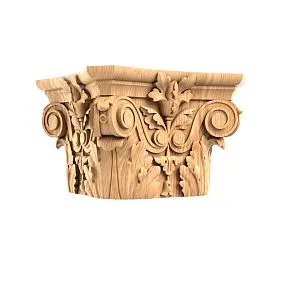
The capital of a baluster is the upper part that contacts the handrail or sub-rail. Its shape is determined not only by design but also by the fastening method. A classic capital may be square in plan with a round baluster shaft, forming a transitional element. Carved details on the capital—acanthus leaves, Ionic volutes, Corinthian motifs—require jewelry-like precision in execution.
After the sketch, a 3D model is created. Specialized software allows viewing the baluster in three dimensions, assessing proportions, and checking how it will look as part of the staircase. The client is shown photorealistic visualizations where their future staircase appears in all its glory. This is the stage of approval, making adjustments, and finalizing the design.
Get Consultation
Development of the technological map
The approved design is translated into technical documentation. For CNC lathes, a control program is created—a sequence of commands describing cutter movement, spindle rotation speed, and groove depth. For carved elements, a CNC milling machine is programmed, or templates for manual carving are prepared.
The technologist calculates the required amount of material, considering allowances for processing, possible defects, and a safety margin. The wood species, moisture content, and grade are determined. Each type of baluster—simple turned, complex carved, combined—has its own technology.
Selection and preparation of wood: the foundation of quality
The quality of the final product is 70% determined by the quality of the raw material. Incorrectly chosen or inadequately prepared wood will lead to defects at any subsequent stage.
Wood species for balusters
For manufacturingwooden balusters Hardwoods are used—oak, beech, ash, less commonly birch or exotic species. Softwoods (pine, spruce) are too soft, resinous, do not hold a clear profile when carved, and wear out quickly.
Oak is the king of staircase balusters. Density 650-750 kg/m³, Brinell hardness 3.7-3.9, expressive grain with large pores and medullary rays. Oak turns and mills excellently, holds fine carving details, and is resistant to mechanical damage. Tannins in the wood give it antiseptic properties, preventing rot and fungal attack.
The color palette of oak ranges from light honey to dark brown, and stained oak yields almost black shades with a noble silvery sheen. This allows selecting balusters for any interior concept without painting, preserving the natural grain.
Beech is comparable in hardness to oak and sometimes surpasses it (density up to 800 kg/m³). The grain is fine-pored, uniform, color—delicate pinkish or cream. Beech is ideal for painting—paint applies evenly, without stains or streaks. For classic white staircases, beech balusters are a frequent choice.
Nuance: beech is more hygroscopic than oak and requires thorough stabilization. Without proper drying and protective treatment, beech balusters can deform with changes in humidity.
Ash is similar to oak but lighter and has a more contrasting grain with distinct annual ring stripes. Strength is high, processing is clean. Ash is the choice for those who want expressive grain without the dark tones of oak.
Requirements for Humidity and Stability
Wood for balusters should have a moisture content of 8-12%. This is the equilibrium moisture content for heated interiors. Wood with higher moisture will dry out during use, leading to cracking, warping, and weakened fastenings. Drier wood may absorb moisture from the air and swell.
Achieving such moisture content requires kiln drying—a controlled process of moisture removal in special drying chambers. The drying regime is selected based on species, blank thickness, and required speed. Too rapid drying causes internal stresses and cracks. Proper drying takes weeks but guarantees material stability.
After drying, the wood is conditioned — kept in a room with normal humidity to equalize the moisture content throughout its thickness. Only after this can processing begin.
Selection and cutting of blanks
For balusters, pieces of wood without knots, cracks, rot, resin pockets, or wormholes are selected. Even a small healthy knot, acceptable in furniture panels, is unacceptable for balusters — it creates structural heterogeneity, may fall out during turning or carving, and spoils the appearance.
Blanks are cut with the grain oriented along the axis of the future baluster. This is critical for strength — a baluster with cross-grain breaks easily and cannot withstand loads. For turned balusters, the blank is usually square in cross-section; for carved ones, it can be rectangular, depending on the final shape.
The workpiece dimensions include machining allowances — 5-10 mm per side and along the length. This compensates for sawing inaccuracies, removes surface defects, and provides clamping allowance in the machine.
Turning: shaping on a lathe
Most balusters are turned products created on a lathe. This ancient technology, in its modern form, has achieved incredible precision thanks to computer numerical control.
Preparing the blank for turning
The square blank is secured in the lathe between centers or in a chuck. Precise centering is important — the axis of rotation must align with the axis of the future baluster; otherwise, runout and uneven walls will occur.
On manual lathes, the craftsman marks the blank, defining the main zones of the profile — base, shaft, transitions, expansions, capital. On CNC lathes, this marking is programmed, but visual inspection before starting is mandatory.
Turning process on CNC
A modern CNC lathe is a high-precision machine capable of creating the most complex profiles with accuracy to tenths of a millimeter. The blank is clamped, and the program is started. Cutting tools sequentially remove layers of wood, forming the specified profile.
Spindle rotation speed — 1500-3000 rpm depending on the blank diameter and wood species. Harder species require lower speeds to avoid overheating and chipping. The tool feed is also calculated: too fast gives a rough surface, too slow — overheating and scorching.
The turning process is accompanied by a characteristic sound — a steady hum of rotation and the rustling of removed chips. An experienced operator hears the slightest deviations that may signal a problem — blank runout, tool dulling, or wood heterogeneity.
The result is a baluster with a clear profile: base, shaft with section transitions, upper part for the capital. The surface is still rough, with tool marks, but the shape is already clear.
Manual turning: the craft of tradition
For exclusive projects, small batches, or unique designs, manual turning is used. The turner works on a manually controlled lathe using a set of tools — gouges, skew chisels, scrapers.
Manual turning is an art requiring years of practice. The craftsman feels the wood, sees how the tool interacts with the grain, instantly adjusts the angle, pressure, and movement speed. Such a baluster bears the imprint of the craftsman's individuality; no two will be absolutely identical, which is valued in exclusive interiors.
Creating the capital and carved elements
If the baluster involves carved decoration or a complex capital, the stage of carving or milling follows turning.
Capital: the crown of the baluster
Capital— is not just a thickening of the upper part of the baluster. In classical architecture, the capital carries symbolic and decorative meaning. Several orders of capitals are distinguished:
Doric — the simplest, with a round or square cushion (echinus) and a flat abacus on top. Minimal decoration, emphasis on proportions.
Ionic — decorated with volutes (spiral scrolls) on the sides. Requires precise symmetrical carving.
Corinthian — the most complex and decorated, with acanthus leaves, rosettes, and intricate relief. Creating a Corinthian capital is the pinnacle of carving mastery.
For stair balusters, the capital is usually simplified compared to architectural orders but retains stylistic motifs. A square capital on a round baluster creates a transition to the rectangular cross-section of the handrail.
Wood carving: from sketch to relief
Carved elements on balusters and capitals are created in two ways: hand carving and machine milling on CNC machines.
Hand carving is performed by a craftsman using a set of carving tools — chisels, gouges, Bogorodsk knives. The craftsman transfers the design from the sketch to the wood, then removes the background layer by layer, forms the relief, and works out the details. An acanthus leaf with its complex curves, veins, and multi-level relief may require hours of meticulous work.
Hand carving is unique, carries the energy of live labor, but is expensive and time-consuming. For serial production, machine processing is used.
CNC milling allows reproducing any shape with high precision and repeatability. A 3D model of a carved element is loaded into the program, and a multi-axis milling machine uses cutters of various diameters and shapes to remove wood, creating relief. Modern 5-axis machines can process the most complex three-dimensional surfaces, which are inaccessible to hand tools.
However, the machine does not completely replace the craftsman. After milling, manual finishing is required—cleaning up minor defects, refining fine details where the cutter couldn't reach, and final sanding.
Combined techniques
The highest level is the combination of turning, machine carving, and manual finishing. The baluster shaft is turned, the capital is milled on a CNC, then the craftsman manually refines the details, adds nuances, and removes the mechanical feel of the machine work. Such a product combines the precision of technology with the vitality of manual labor.
Sanding and preparation for finishing
After all processing operations, the baluster is covered with tool marks, has roughness, and unevenness. Sanding is a critically important stage on which the final perception of the product depends.
Sanding Stages
Sanding is carried out in several stages with a gradual reduction in abrasive grit:
-
Coarse sanding (grit 80-120) removes large unevenness, marks from cutters and mills. Sanding machines are used; for carved areas—special attachments that follow the profile.
-
Medium sanding (grit 150-180) evens out the surface, removing scratches from the previous stage.
-
Fine sanding (grit 220-320) creates a smooth surface ready for coating application. At this stage, the baluster acquires a silky feel to the touch.
-
Final sanding (grit 400-600) is used for premium-class products where impeccable smoothness under a transparent varnish coating is required.
Carved elements and capitals are partially sanded by hand using abrasive sponges, paper wrapped around shaped wooden blocks. Deep reliefs, narrow grooves, and internal corners require patience and care—one careless movement can blur the clarity of the carving.
Dust Removal and Quality Check
After sanding, the baluster is blown with compressed air and wiped with a damp cloth to remove wood dust. Dust left in pores and recesses will ruin the final coating, creating roughness and unevenness.
Visual quality control is conducted. Each baluster is checked for the absence of defects—chips, dents, unsanded areas, cracks. Defective products are rejected or sent for rework.
Finish: protection and aesthetics
The baluster is sanded but still vulnerable. Unprotected wood absorbs moisture, gets dirty, fades in light, and is susceptible to mechanical damage. The final coating solves these problems and emphasizes the beauty of the material.
Staining and bleaching
If it is necessary to change the color of the wood while preserving the texture, stains and toners are used. Water-based, alcohol-based, or oil-based compositions penetrate the wood structure, coloring it from within.
Staining allows turning light beech into an imitation of walnut, toning oak into dark chocolate shades, or creating a patina or aging effect. Even application is important—streaks and stains on balusters are unacceptable.
After staining, the wood is dried, then lightly sanded with fine abrasive (320-400) to remove raised fibers. This is an intermediate sanding before applying the protective coating.
Varnishing: transparent protection
Varnish creates a hard, transparent film on the wood surface, protecting it from moisture, dirt, scratches, and emphasizing the texture. For balusters, water-based polyurethane varnishes or alkyd varnishes are used—they form a durable, wear-resistant coating.
Varnish is applied in several layers (usually 3-5) with intermediate drying and sanding. The first layer is a primer, it fills pores and creates a base for subsequent ones. After drying, it is sanded with fine abrasive to remove roughness.
Subsequent layers are applied with minimal or no intermediate sanding. The final layer can be matte, semi-matte, or glossy depending on the design concept. Glossy balusters look luxurious, but scratches and fingerprints are noticeable on them. Matte finishes are more practical and create a sense of naturalness.
Oil and Wax: Natural Finish
Oil coatings penetrate the wood structure without forming a surface film. They emphasize the texture, give the wood depth of color, and create a velvety feel to the touch. Oil with hard wax has good wear resistance and water-repellent properties.
Oil is applied generously, rubbed in, left to absorb, and excess is removed. After polymerization (usually 24-48 hours), the surface can be polished to enhance shine. Oil coating requires periodic renewal—every few years—but this can be done easily without dismantling the balusters.
Painting with enamels
For interiors where it is necessary to cover the wood texture, enamels are used—white, colored, with various effects (metallic, pearl, patina). High-quality enamel creates a smooth, even surface and hides wood defects.
Painting includes priming (1-2 layers of acrylic primer), intermediate sanding, enamel application (2-3 layers), and final coating with protective varnish. The process is lengthy, but the result is perfectly smooth colored balusters that can become an accent in a modern interior.
Quality control and packaging
Finished balusters undergo final inspection. Dimensions, geometry, coating quality, and absence of defects are checked.decorative elementsThey must correspond to approved samples; repeatability in a series is one of the requirements of professional production.
Balusters are packaged individually or in groups in corrugated cardboard, bubble wrap, and stretch film. Carved parts and capitals are especially carefully protected—they are most vulnerable during transportation. For fragile parts, rigid spacers are used to prevent crushing.
Packaged products are labeled and placed in shipping containers. It is important that during delivery, even over long distances, the balusters arrive to the customer in perfect condition.
Staircase Components: Balusters in the System
A baluster is part of the staircase structure; it functions within a system alongside other elements: posts, handrails, sub-rails, and treads. All of them should be executed in a unified style, from the same wood species, with identical finishing.
Posts and Newel Posts
Support posts of a staircase are more massive elements on which the handrail rests. They often have a complex form with a base, shaft, and capital, echoing the design of the balusters but on an enlarged scale. Carved posts with figured capitals create vertical accents at the beginning and end of a flight of stairs.
Pilaster in Staircase Decor
Pilaster— is a flat vertical element imitating a column but projecting from a wall. In staircase structures, pilasters can frame openings under the stairs, decorate the under-stair space, and create architectural accents. The capital of a pilaster is executed in the same style as the capitals of the balusters, creating compositional unity.
Handrails and Sub-rails
A handrail is a horizontal element along which the hand slides during ascent. It must be ergonomically comfortable and harmonize with the balusters. Classic handrails have a complex profile, turned on a lathe. Sub-rails are horizontal strips between balusters, additionally reinforcing the structure and creating a decorative effect.
Frequently Asked Questions about Baluster Production
How long does it take to manufacture custom balusters?
Timelines depend on design complexity, order volume, and production workload. Simple turned balusters from the stock program are shipped within 1-3 days. Custom manufacturing with a unique design takes from 2 to 6 weeks. This includes sketch development, approval, equipment programming, actual production, finishing, and coating drying.
Is it possible to reproduce an antique baluster?
Yes, modern 3D scanning and modeling technologies allow for creating an exact copy of a historical baluster. The sample is scanned, a digital model is created, which is then realized on CNC machines or by hand. This is in demand for the restoration of historical interiors and the recreation of lost elements.
Which wood species is the most durable for balusters?
For interior stairs, oak and beech are practically eternal with proper care. For exterior stairs and gazebos, oak or exotic species (iroko, merbau, teak) with high natural resistance to atmospheric influences are preferable.
What is the difference between a 'Standard' category baluster and a 'Prestige' one?
The 'Standard' category implies quality processing, readiness for final finishing, and minor natural wood features are acceptable. 'Prestige' involves selection of the highest category wood, additional sanding, absolute uniformity within a series, and premium packaging. The price difference is justified for representative interiors where the flawlessness of every detail is important.
Is it possible to combine different wood species in one staircase?
Technically — yes, aesthetically — it requires a professional approach. For example, oak treads and beech balusters painted in a unified color. Or a contrasting combination: dark walnut and light ash. Logic is important: it should not create an impression of randomness or cost-saving.
How to care for carved balusters?
Regular dry or slightly damp wiping to remove dust. Avoid aggressive cleaning agents and abrasives. Varnished surfaces can be polished once a year with special wood care products. Oil-finished surfaces require renewal every 3-5 years — the surface is cleaned, and a fresh coat of oil is applied.
Are balusters made solid or can they be composite?
For standard heights (900-1100 mm), balusters are turned from solid timber. For taller ones (over 1200 mm), they can be composite: turned sections are joined with dowels or threaded rods. The joint is concealed with a decorative element. Composite balusters are stronger for great heights — there is less risk of warping.
Is it possible to manufacture balusters of non-standard size?
Yes, this is one of the advantages of custom production. Height, diameter, profile — everything is adapted to the specific project. Limitations are equipment capabilities (maximum processing length on the machine) and structural reasonableness (too thin, tall balusters will be fragile).
How are balusters attached to treads and the handrail?
There are several fastening systems: on dowels with glue, on threaded rods, on special fastening elements (baluster shoes). The choice depends on the staircase design, tread material, and the need for disassembly. Professional installation ensures rigidity, absence of squeaks, and durability.
Where to buy quality balusters and decorative elements?
The best choice is directly from a manufacturer with its own production cycle, quality control, and the possibility of individual orders. Purchasing through intermediaries increases the price, complicates communication, and limits customization possibilities.
Conclusion: From Concept to Realization
Creationwooden balusterswith an elegant capital — is a process where traditions of joinery craftsmanship, modern processing technologies, artistic vision, and engineering precision converge. From the first sketch to the final varnish coating, weeks of work pass, involving dozens of specialists: designers, technologists, machine operators, carvers, painters, and quality controllers.
Balusters for staircase— these are not just functional guardrail posts. They are the vertical rhythm of the staircase space, a decorative accent that sets the stylistic tone for the entire interior.Pilaster, complementing the composition, enhances architectural expressiveness, and creates a connection between the staircase and the surrounding space.
The quality of the final product is determined by every stage of production. You cannot skimp on wood and get a durable baluster. You cannot skip intermediate sanding and achieve a perfect surface. You cannot rush the coating application and get an impeccable result. This is a meticulous process where there are no minor details.
STAVROS company has specialized in the production ofdecorative elementsmade from solid wood. The full production cycle — from raw material procurement to finishing — under one roof. Modern equipment: CNC lathes and milling machines for precision and productivity, a hand-carving section for exclusive projects. A team of professionals for whom creating balusters is not just a job, but a calling.
The STAVROS catalog features dozens of baluster models in various styles: from strict classic to contemporary minimalism, from simple turned forms to complex carved compositions with capitals of all historical orders. Oak, beech, ash — only select kiln-dried wood. Custom design, 3D visualization, manufacturing based on the client's unique sketches. Delivery across all of Russia with a guarantee of safe transport.
By choosing STAVROS, you choose quality tested by time, technologies honed to perfection, and an approach to every project as a work of art. Because the staircase in your home is not just a structure; it is a legacy that will serve generations.