Article Contents:
- Specifics of Outdoor Balusters: What Distinguishes Them from Interior Ones
- Choosing Wood Species for Terrace Balusters
- Protective Treatment: Technologies for Extending Service Life
- Structural features of terrace railings
- Stylistic Solutions for Terraces of Wooden Houses
- Handrails for Terrace Railings
- Installing Balusters on a Terrace: Technical Nuances
- Balusters for the Porch of a Wooden House
- Caring for Terrace Balusters: Preservation for Decades
- Combining Materials: Wood Plus Metal and Glass
- Lighting for Terrace Railings
- Winter Use of Terraces: Specifics
- Restoring Old Balusters: A Second Life
- Frequently Asked Questions
- Conclusion: The Terrace as a Philosophy of Life
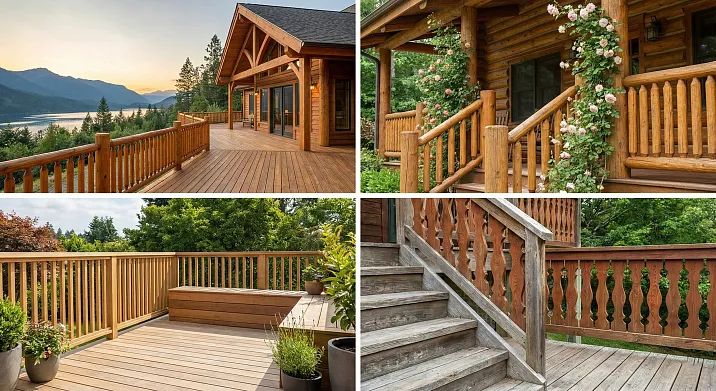
A terrace is more than just an addition to a house. It is a place where the boundary between the interior and nature blurs, where morning coffee becomes a ritual, and evening gatherings turn into philosophical conversations under the starry sky. Here, at the intersection of comfort and freedom, architectural details play a special role.wooden balusters for terraceBalusters are not just vertical posts of a railing, but elements that set the visual rhythm of the space, ensure safety, and create a sense of security without destroying the connection with the surrounding landscape. Choosing the right balusters for the terrace of a wooden house requires an understanding of the specifics of the material, knowledge of climatic conditions, and a sense of style. Let's delve into the nuances that turn an ordinary railing into a work of outdoor architecture.



Specifics of Outdoor Balusters: What Distinguishes Them from Interior Ones
Why can't you simply take balusters for an interior staircase and install them on a terrace? The operating conditions are fundamentally different.balusters in a wooden houseInterior balusters exist in a stable environment: temperature fluctuates within a range of +18...+24 degrees Celsius, humidity is maintained at 40-60 percent, and there is no direct exposure to precipitation or ultraviolet light. The wood is in comfortable conditions, hardly deforms, and protective coatings last for decades.
Terrace balusters face an aggressive external environment. In summer, the temperature of wood in the sun can reach +50...+60 degrees Celsius, while in winter it can drop to minus 30 and below. Daily temperature fluctuations during the off-season are 20-25 degrees. Humidity varies from 30 percent in dry heat to 90-100 percent during rain and fog. Rain, snow, and dew constantly moisten the wood, then it dries out—this cycle repeats hundreds of times per season.
Ultraviolet radiation destroys lignin—the natural polymer that binds wood fibers. Under the influence of UV rays, unprotected wood grays, becomes rough, and loses strength. Atmospheric dust, fungal spores, wood-boring insects—all of these attack wooden elements outdoors. Therefore, terrace balusters are made from more durable wood species, treated with special protective compounds, and have a more massive cross-section for a safety margin.




Choosing Wood Species for Terrace Balusters
Oak is the absolute leader for outdoor applications. Its dense, heavy wood with a high content of tannins naturally resists rot and fungal attack. Oak withstands repeated wetting-drying cycles without cracking or deformation. The grain is expressive, with large pores and distinct annual rings. The color varies from light golden (young oak) to dark brown (aged oak).
Over time, under the influence of sun and precipitation, oak darkens nobly, acquiring a silvery-gray hue that many find particularly attractive. If such color change is undesirable, oak is coated with protective compounds containing UV filters. The cost of oak balusters is higher than other species, but their durability and prestige fully justify the investment. Properly treated oak on a terrace lasts 30-40 years or more.
Larch is the optimal balance of price and moisture resistance. This coniferous species has a unique property: with prolonged contact with water, larch wood does not rot but becomes harder. In the old days, larch was used to build bridge piles, the lower logs of log houses, and piers. For terraces, larch is an ideal choice: it withstands constant precipitation, is not afraid of temperature fluctuations, and has a pleasant warm shade ranging from light yellow to reddish-brown.
Larch has a fine, uniform grain, with moderately expressed annual rings. The wood is quite hard, which complicates processing but ensures resistance to mechanical damage. Larch contains natural antiseptics that repel insects and prevent fungal development. In terms of the durability-price ratio, larch is the best option for terrace balusters in central Russia.
Ash is a species for lovers of contrasting grain. The wood is light, almost white, with a clear fiber pattern. In hardness, ash is close to oak but more elastic, allowing for the creation of balusters with complex shapes without the risk of cracking. Ash requires mandatory protective treatment for outdoor use—without it, the wood quickly darkens and loses its decorative appeal. However, with proper protection, ash on a terrace looks fresh and modern, especially when combined with whitewashed or gray house finishes.
Pine is the most affordable but not the most reliable option for terraces. Its soft wood is easy to work with but prone to cracking, chipping, and resin pockets. Without protective treatment, pine outdoors darkens, turns blue, and begins to rot within 2-3 years. With intensive impregnation with antiseptics and coating with weather-resistant varnish or oil, pine can last 10-15 years but requires regular coating renewal every 2-3 years. Pine balusters are a choice for temporary terraces, country buildings, or projects with a limited budget.
Our factory also produces:


Protective Treatment: Technologies for Extending Service Life
Even the most durable wood requires protection for outdoor use. The first stage is deep impregnation with an antiseptic. Modern compounds penetrate the wood to a depth of 5-10 millimeters, bind with the cellular structure, creating a barrier against fungi, mold, and insects. Impregnation is performed by immersion (balusters are placed in a bath with the solution for several hours) or vacuum impregnation (wood is impregnated under pressure in an autoclave).
After the antiseptic dries, a water-repellent composition is applied—a substance that repels water. The wood becomes impervious to rain and snow: droplets roll off the surface without being absorbed. This is critically important for preventing swelling-shrinkage cycles, which lead to cracking. The water repellent does not form a film; the wood remains vapor-permeable—moisture from inside can escape outward, preventing rot.
The final coating serves two functions: protects against ultraviolet light and provides decoration. UV filters in the varnish or oil absorb harmful radiation, preventing it from destroying the wood structure. Pigments give the desired shade—from natural to dark wenge or light bleached oak. The choice between varnish and oil depends on the desired effect.
Varnish creates a durable glossy or matte film on the surface, completely isolating the wood from contact with water and air. Such a coating is durable (3-5 years without renewal) but may crack and peel over time. Oil is absorbed into the wood without creating a surface film. The coating looks natural, emphasizes the texture, and is pleasant to the touch. Oil requires more frequent renewal (every 1-2 years) but is easier to maintain—simply apply a new layer over the old one.
Get Consultation
Structural features of terrace railings
Installing Wooden BalustersTerrace railings have their own nuances. The standard railing height is 900-1000 millimeters from the deck level. This ensures safety for adults and children, creating psychological comfort—a person standing at the edge of the terrace feels protected. For terraces located more than 1 meter above ground level, the railing height is recommended to be increased to 1100-1200 millimeters.
The cross-section of terrace balusters is usually larger than that of interior ones. If interior staircases require balusters with a diameter of 40-50 millimeters, then for terraces, elements of 50-70 millimeters at the widest part are used. This is due to greater wind loads and the need for a safety margin against atmospheric exposure. Massive balusters are visually more stable and evoke a sense of reliability.
The clear distance between balusters should be no more than 100-120 millimeters—this is a safety requirement, especially if there are small children in the house. A child's head should not be able to pass between the balusters. In practice, balusters are installed with a spacing of 120-150 millimeters on center (distance between the centers of adjacent balusters), resulting in a clear gap of 70-100 millimeters with standard baluster cross-sections.
Support posts on a terrace are installed more frequently than on staircases. If a staircase flight requires support posts only at the beginning and end, then on a long terrace, posts are placed every 1500-2000 millimeters. This ensures structural rigidity and the ability to withstand lateral loads and wind pressure. Posts have a cross-section from 100x100 to 150x150 millimeters and are attached to the terrace deck or to the frame's load-bearing beams using through bolts or anchors.
Stylistic solutions for terraces of wooden houses
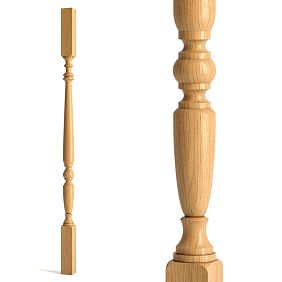
The style of balusters should harmonize with the house's architecture. For a classic wooden house made of logs or timber, turned balusters of traditional shapes are suitable. Symmetrical profiles with smooth transitions from thin necks to rounded bodies create rhythmic vertical graphics, do not visually overload, but add structural definition. Turned balusters are versatile—they look equally good on a small country house porch and on a spacious country estate terrace.
Carved balusters are a choice for houses in Russian style, terem architecture, and buildings stylized as antique. Three-dimensional carving with plant motifs, geometric patterns, images of animals or mythological creatures turns the terrace railing into a gallery of wooden sculpture. Carved balusters are labor-intensive to manufacture, require regular maintenance (paint or varnish in the recesses of the carving wears out faster), but create a unique character.
Flat balusters are a modern solution for houses in Scandinavian, eco, or minimalist styles. Vertical planks cut from a wide board can have strict rectangular contours or complex curvilinear silhouettes. Flat balusters are visually lighter than volumetric turned ones, create an effect of an openwork screen, and pair well with the horizontal planks of the deck. Often, flat balusters are painted in a contrasting color relative to the main house finish—white, graphite, deep blue.
Combined railings are gaining popularity. The lower part, 400-500 millimeters high, is made solid—from horizontal boards or vertical planks without gaps. The upper part consists of traditional balusters with a handrail. Such a design protects from wind, eliminates the possibility of small objects falling through the railing, and creates privacy—sitting on the terrace, you are not visible from the street, but standing you can admire the views.
Handrails for terrace railings
Round balusterRound handrails are a standard solution. The diameter is usually 50-60 millimeters—a comfortable grip for an adult's hand. A round handrail is pleasant to the touch, water does not linger on it (it drains quickly), and it is easy to clean from dust and dirt. For terraces, handrails made from the same wood species as the balusters are often used, with the same protective coating—this creates visual unity of the structure.
Round oak handrailOak handrails are a premium option for terraces of wooden houses. Oak handrails are strong, resistant to wear, and not afraid of impacts. Under the protective coating, the noble wood grain with characteristic rays in the heartwood shows through. Oak is tactilely pleasant—warm, smooth, with a barely perceptible pore texture. With proper care, an oak handrail retains its original appearance for decades.
An alternative to round handrails is rectangular or shaped handrails. The cross-section is usually 60x80 or 70x90 millimeters. The top plane is rounded for comfortable hand grip; the side edges may have chamfers or decorative profiles. A rectangular handrail is visually more massive than a round one, suitable for large terraces, and creates a sense of solidity. You can place a coffee cup on the top plane, lean your elbows—a wide handrail is functional.
Installation of balusters on a terrace: technical nuances
Attaching balusters to the terrace deck is performed considering the specifics of the structure. If the deck is made of terrace board 25-40 millimeters thick, direct attachment to the board is not sufficiently reliable—access to the joists (load-bearing beams of the frame) is needed. The optimal option is that at the installation points of support posts and balusters, joists are located directly under the deck. Attachment is performed using through bolts or lag screws that pass through the deck board and enter the joist to a depth of 60-80 millimeters.
For precise positioning, marking is done first. On the finished deck, the positions of all balusters are marked. The location of the joists is taken into account—balusters should land on or near the joists. If the configuration does not allow installing balusters directly on the joists, additional transverse reinforcements are mounted between the joists—short 50x100 millimeter blocks secured between adjacent joists. The balusters are attached to these blocks.
Drilling is performed strictly vertically. The hole diameter for the bolt is usually 10-12 millimeters for M8-M10 fasteners. The bolt passes through the deck, enters the joist, and is secured with a nut and wide washer from below. The bolt head is countersunk into the lower end of the baluster to a depth of 15-20 millimeters and covered with a wooden plug. An alternative is using special metal flanges (support plates) that are attached to the deck, into which the balusters are inserted and secured with side screws.
After installing all balusters, their verticality is checked with a long level. Deviations of more than 1-2 degrees are unacceptable—such a railing looks crooked and loses strength. Then, a handrail bracket or the handrail itself is attached directly to the upper ends of the balusters. All joints are glued with weather-resistant polyurethane adhesive—it is not afraid of moisture, retains elasticity during temperature fluctuations, and provides additional strength to the connections.
Balusters for the porch of a wooden house
The porch is the house's calling card, the first thing guests see. Balusters here perform not only a protective but also a decorative and representative function. The porch is usually small in area—2-4 square meters, the height above ground rarely exceeds 1 meter. The porch railing consists of two support posts (at the beginning and end of the staircase flight or at the corners of the platform), 6-12 balusters, and a handrail.
The style of balusters for the porch sets the tone for the entire exterior. If the house is executed in classical traditions, balusters with a rich turned profile are appropriate—alternating spheres, cylinders, cones creates dynamics and volume. For a house in chalet or country style, more rustic balusters of simple shapes are suitable—square or round cross-section with minimal processing, emphasizing the naturalness of the wood.
The support posts of the porch are often made more massive and decorative than the intermediate balusters. Cross-section 120x120 or 150x150 millimeters, height increased—the post runs from the base of the porch to the canopy or even supports the roof overhang. Such posts turn into architectural columns, sometimes adorned with carved capitals (upper parts), bases (lower expansions), fluting (vertical grooves).
Care for terrace balusters: preservation for decades
Proper care begins with regular cleaning. At least twice a year—in spring after the snow melts and in autumn before frost—the terrace railing needs to be thoroughly washed. Use a soft brush or sponge, warm water with the addition of a special wood cleaning agent. It is strictly forbidden to use abrasive agents, metal brushes, high-pressure washers—they damage the protective coating.
Special attention to horizontal surfaces: the upper ends of balusters, the handrail. Moisture accumulates here, dust settles, creating a breeding ground for moss and mold. After washing, all surfaces are wiped dry with a soft cloth—remaining water can penetrate micro-cracks in the coating and cause rot. Once a year, an inspection is conducted for damage: cracks, chips, coating peeling, signs of mold.
Renewing the protective coating is a key aspect of care. Varnish coating is renewed every 3-5 years depending on intensity of use and climate. Old varnish is removed with a scraper or fine-grit sandpaper (grit 180-220), the surface is degreased, and 2-3 layers of fresh varnish are applied with intermediate drying and sanding. Oil coating is simpler to maintain—every 1-2 years, a new layer of oil is applied directly over the old one after cleaning and light sanding.
In winter, snow should be regularly cleared from balusters with a soft brush or broom. Do not chip away ice with metal scrapers or crowbars—this damages the wood. If an ice layer forms, it's better to wait for a thaw or carefully pour warm water over it. Icing is especially dangerous for the ends of balusters—water penetrates the wood's capillaries, freezes, expands, and ruptures the fibers from within.
Combining materials: wood plus metal and glass
Modern terrace architecture often uses a mix of materials. Wooden balusters are combined with metal elements—steel cables, forged inserts, stainless steel pipes. This approach adds lightness, technological sophistication, and a contemporary feel to the structure. Metal takes on part of the load-bearing functions, allowing wooden elements to be more elegant.
A popular option is a railing made of vertical wooden balusters with horizontal steel cables 4-6 millimeters in diameter, stretched between support posts. Balusters are installed with a wide spacing (300-400 millimeters), creating a vertical rhythm. The cables pass through the balusters via pre-drilled holes and are tensioned with special screw tensioners. Such a railing looks weightless, doesn't obstruct the view, but is completely safe.
Glass screens between wooden posts—a solution for maximum view openness. Tempered glass 8-12 millimeters thick is installed in an aluminum or steel profile, which is attached between the supporting wooden posts. The handrail remains wooden and is placed on the top edge of the glass. The glass is completely transparent or tinted, and can have engraving or sandblasted patterns. Glass care requires frequent washing, but such a railing doesn't block panoramic views.
Lighting for terrace railings
Built-in lighting transforms the terrace into a cozy space for evening relaxation. LED lights are mounted in support posts, balusters, and handrails. Vertical channels for wiring are made in the posts, into which directional lights are installed. The light beam is directed downward to illuminate the decking or upward to create soft reflected lighting from the canopy or roof overhang.
An LED strip can be laid in the handrail using a special profile. The strip is mounted on the underside of the handrail, hidden from direct view but illuminating the space under the railing. This creates the effect of a handrail floating in the air—very impressive at dusk. The LED power is low (3-5 watts per meter), energy consumption is minimal, and the lifespan is 30-50 thousand hours.
Spotlights in the decking along the railing line create a light path, mark the edge of the terrace, and prevent accidental falls from height in the dark. Such lights must have a high moisture protection rating (IP65 and above), withstand the weight of a person, and be resistant to temperature fluctuations. The light should be warm white (2700-3000 Kelvin), soft, and not irritating to the eyes.
Winter use of the terrace: specifics
All-season terraces require a special approach to railing construction. If the terrace is used in winter, the railing is subjected to additional loads—snow weight, snowdrift pressure, and mechanical impacts during cleaning. Balusters should be more massive, fastenings reinforced, and protective coatings maximally durable.
Snow accumulating on the handrail should be regularly cleared; otherwise, it melts during the day under the sun, flows down, and freezes at night, forming ice on the balusters. Repeated freeze-thaw cycles are destructive to wood. Some owners install a self-regulating heating cable on the handrail—it prevents ice formation, melts snow, and allows water to drain down without lingering.
If the terrace is not used in winter, the railing can be partially protected from snow. A wooden canopy—a plank 80-100 millimeters wide, fixed at an angle—is placed on the handrail. Snow slides off the canopy and doesn't accumulate on the handrail. This simple solution extends the coating's lifespan by several years.
Restoration of old balusters: a second life
Terrace balusters often require restoration after 10-15 years of use. The coating deteriorates, the wood grays, cracks appear, and rot may begin. Complete replacement of the railing is an expensive undertaking. Restoration allows for the balusters to be repaired, saving significant costs.
The first stage is condition assessment. Balusters with deep rot, through cracks, or woodworm infestation must be replaced. Elements with surface defects can be restored. The old coating is completely removed by sanding or chemical strippers. The wood is treated with a deep-penetrating antiseptic that destroys fungi and insect larvae.
Cracks are filled with epoxy wood filler, which is sanded flush with the surface after drying. Local areas of rot are cut out with a chisel down to healthy wood and filled with a special repair compound based on epoxy resin and wood flour. After polymerization, the repaired areas are sanded, and the entire baluster is recoated with protective compounds.
Frequently Asked Questions
What wood is best for terrace balusters in central Russia? The optimal choice is oak or larch. Both materials are resistant to moisture and temperature fluctuations typical of this region. Oak is more expensive but more prestigious and durable. Larch offers a balance of price and quality.
Do balusters made of larch need to be treated? Absolutely. Even rot-resistant larch will gray under ultraviolet light without a protective coating, become rough, and lose its decorative appeal. At minimum, use an oil with UV filter.
Can wooden terrace balusters be painted with opaque paint? Yes, and it even extends their lifespan. Opaque paint completely hides the wood and creates a dense protective film. Use only special exterior wood paints with an elastic formula.
What should be the height of a second-floor terrace railing? Minimum 1100 millimeters, recommended 1200 millimeters. The higher the terrace is above ground, the higher the railing should be for psychological comfort and safety.
How many years before terrace balusters need to be replaced? With proper care, oak balusters last 30-40 years, larch 20-30 years, pine 10-15 years. The lifespan depends on climate, quality of treatment, and regularity of maintenance.
Can interior balusters be used on a covered veranda? If the veranda is completely protected from precipitation, has glazing, and is heated in winter—yes. On an open or semi-open veranda, only terrace balusters with enhanced protection are needed.
How to attach balusters to a concrete terrace? Via metal flanges secured to the concrete with anchors. The baluster's lower tenon is inserted into the flange and fixed with side screws. An alternative is chemical anchors with threaded studs.
What's the difference between oil and varnish for terrace balusters? Oil penetrates the wood, doesn't create a film, highlights the grain, and requires frequent renewal. Varnish forms a surface film, is more durable, but can crack and peel.
Are balusters needed on a terrace 30 centimeters above ground? From a safety standpoint—no, this height isn't dangerous. But balusters give the terrace architectural completeness, create a psychological boundary for the space, and add decoration.
Can balusters be installed in winter? Theoretically yes, but highly undesirable. Low temperatures hinder adhesive work, and wood may be damp from snow. The optimal season is late spring or early summer at temperatures of +15...+25 degrees Celsius.
Conclusion: the terrace as a philosophy of life
wooden balusters for terrace—are not just functional safety elements but an embodiment of the philosophy of country living. Each baluster, turned from solid noble wood, treated with protective compounds, installed with millimeter precision—is an investment in the quality of daily life, in the joy of communing with nature, in the comfort of your family.
Choosing the right balusters requires understanding the material, knowledge of technologies, and a sense of style. Oak or larch, turned or carved, with varnish or oil finish—each decision affects durability, appearance, and ease of maintenance. Don't skimp on wood quality and protective treatment—the costs will pay off with many years of flawless service.
Trust the professionals. STAVROS Company has specialized in manufacturing wooden elements for terraces, stairs, and facades since 2002. The STAVROS range features over 50 models of balusters made from oak, larch, ash, and beech — from classic turned to modern flat designs, from minimalist to richly decorated with carvings.
All STAVROS products are manufactured in-house using high-precision CNC equipment. The wood undergoes chamber drying to 8-10% moisture content, is impregnated with weather-resistant antiseptics, and coated with premium protective compounds with UV filters. Each baluster is checked for dimensional accuracy, absence of defects, and quality of processing.
STAVROS offers two processing categories — Standard for functional terraces and Prestige for projects with elevated aesthetic requirements. In the Prestige category, balusters undergo additional manual refinement, multiple sanding stages, and are coated with professional compounds in several layers. The result is impeccable appearance and maximum durability.
The company provides delivery throughout Russia and CIS countries. Packaging is done using multi-layer protection — bubble wrap, corrugated cardboard, stretch film, and rigid spacers for particularly fragile elements. This ensures product safety during transportation over any distance.
STAVROS specialists provide professional consultations on wood species selection, baluster styles, and protective coatings. They will help calculate the required number of elements, select accessories — posts, handrails, sub-rail strips, fasteners. They develop custom solutions for non-standard projects.
Choosing STAVROS means getting not just quality materials, but a comprehensive solution for creating your dream terrace — with durability guarantees, professional support, fair prices, and impeccable reputation confirmed by thousands of completed projects nationwide.
Your terrace is a space where the day begins with a cup of aromatic coffee and ends under the stars with a glass of wine. It's a place for gatherings with friends, family dinners, quiet evenings with a book. Make it safe, beautiful, durable. Trust STAVROS — and enjoy quality every day.