Article Contents:
- Structural Support
- From Renaissance to the Present Day
- Functional Purpose of Newel Posts
- Safety Above All
- Wooden Balusters: Warmth of Nature in Your Home
- Aesthetic Perfection
- Materials of Manufacture: From Classic to Innovations
- Concrete Balusters: Monumentality and Durability
- Metallic balusters: strength and elegance
- Other Materials: From Marble to Composites
- Modern Balusters: Functionality and Minimalism
- Variety of Forms and Styles: From Classicism to Avant-Garde
- Classic Balusters: Eternal Elegance
- Avant-Garde Balusters: Boldness and Originality
- Avant-garde balusters: boldness and originality
- Technical Specifications and Standards
- Sizes and proportions
- Calculating Quantity and Spacing Between Newel Posts
- Physical Parameters and Material Requirements
- Process of Choosing Ideal Balusters for Your Project
- Defining Style and Concept
- Considering Practical Aspects
- Combination with other staircase elements
- Installation and Mounting: From Theory to Practice
- Preparatory work
- Installation Process of Wooden Balusters
- Features of Installing Metal and Concrete Balusters
- Maintenance and Care: Preserving Beauty for Years
- Care for Wooden Balusters
- Maintenance of Metal and Concrete Balusters
- Pricing policy and economic aspects
- Wooden Balusters: Price-to-Quality Ratio
- Metal and Concrete Balusters: Investments in Durability
- Economic Efficiency of Various Solutions
- Design Solutions and Trends in Baluster Usage
- Minimalism and Geometry: Trends of Modernity
- Eclecticism and Mixing Styles
- Color and Texture: Play of Contrasts
- Practical Tips for Choosing and Purchasing Balusters
- What to Pay Attention to When Choosing
- Where to Buy Balusters: Recommendations for Choosing a Supplier
- Budget Calculation and Cost Optimization
- Innovations and Modern Trends in the World of Balusters
- New materials and technologies
- Ecological aspects and sustainable development
- Individualization and customization
- Balusters in Various Architectural Styles
- Classicism and neoclassicism
- Baroque and Rococo
- Modern and art deco
- Modern Styles: Minimalism, High-Tech, Loft
- Balusters in Different Parts of the House: From Stairs to Terraces
- Staircase Balusters: Functionality and Safety
- Balcony and Terrace Railings: Resistance to External Influences
- Furniture Balusters: Decorative Accent
- Practical Examples of Baluster Use in Interior Design
- Classic staircase in a country house
- Modern minimalist construction
- Eclectic solution for an urban apartment
- Conclusion: the art of choosing ideal balusters
In the world of architectural elements, there are details that simultaneously serve both practical and aesthetic functions. One such element is balusters — elegant vertical posts without which it is impossible to imagine an elegant staircase or refined railing. These architectural components do not merely support handrails — they create a unique atmosphere, highlight the status of the home’s owner, and ensure safety. Let us dive into the wonderful world of balusters and uncover their potential to transform your interior.
Have you ever considered how important these seemingly insignificant elements are in the overall perception of space? Properly selected buy balusters which can be obtained from reputable manufacturers, are capable of turning an ordinary staircase into a work of art, and a standard railing into an exquisite architectural ensemble.


Origin and evolution of balusters
The origin of balusters is shrouded in mystery and legends. According to one version, the word 'baluster' originated from the name of a flower, whose unopened bud resembles the shape of this architectural element. Another theory suggests that balusters are miniature copies of majestic columns used in ancient architecture.
Interestingly, balusters were not used in ancient Rome or Greece, despite the widespread use of columns and pilasters. These architectural elements began to appear only during the Renaissance, initially used exclusively for balcony railings.




From the Renaissance to the present day
The first balusters for staircases were installed only in the 15th century. From this moment, their triumphant march through the world of architecture and design began. By the end of the 15th century, they had firmly entered fashion, increasingly appearing in the interiors of palaces and mansions, in architectural ensembles, and even in the landscaping of parks and squares.
Over time, as architectural styles changed, so did the decoration of balusters. Baroque brought opulence and ornamentation, classicism — strictness and symmetry, modernism — smooth lines and natural motifs. However, balusters have never disappeared from the architectural lexicon, remaining an important and functional element in demand until today.
In modern design, balusters are experiencing a true renaissance, acquiring new forms and embodiments, combining traditions of the past with innovations of the present.
Our factory also produces:


Functional Purpose of Newel Posts
Despite their decorative nature, balusters perform several crucial practical functions, without which it is impossible to imagine a safe and reliable staircase or railing structure.
Get Consultation
Safety above all
The primary function of balusters is to ensure safety. Positioned between sections of staircase railings, they cover the space between handrails and support posts, eliminating the risk of falling from steps. This is especially important in homes where elderly people, children, or individuals with disabilities reside.
The distance between balusters is calculated based on the specific users of the staircase structure. If the house has small children or elderly people, the distance between posts is made minimal — usually no more than 15 cm. This prevents slipping between them and ensures maximum protection.
Structural support
The second most important function of balusters is supporting handrails. Handrails are attached to support posts and balusters, allowing the entire structure to be securely and firmly fixed. Without these vertical elements, handrails would be unstable and unable to withstand the load exerted on them during staircase use.
Aesthetic perfection
The third, but no less important function of balusters — decorative. The configuration of balusters may depend on both the type and shape of the staircase itself and the overall design of the room. Therefore, this element is often used as an addition to the overall decorative composition, giving it completeness and refinement.
Balusters can turn a staircase, balcony, or railing into a true work of art, giving space individuality and character. They can become an accent element of the interior or, conversely, harmoniously blend into the overall design concept, emphasizing its stylistic unity.
Materials of manufacture: from classics to innovations
The modern market offers balusters made from various materials, each possessing its own unique characteristics, advantages, and application specifics. The choice of material depends on many factors: interior style, budget, usage conditions, and personal preferences.
Wooden balusters: the warmth of nature in your home
Wood is a classic and most widely used material for manufacturing balusters. Wooden items possess a range of indisputable advantages:
- Ecological and natural — wood does not emit harmful substances, and the essential oils and organic resins contained within it have healing properties
- Ease of processing — the possibility of creating the most diverse forms and decorative elements
- Aesthetic appeal — the natural texture and warmth of wood create a cozy atmosphere
- Low weight — which simplifies transportation and installation
- Affordable cost — especially when referring to common wood species
- Ease of care - it is enough to periodically wipe the items with a damp cloth
For making wooden balusters, various types of wood are used: oak, beech, ash, pine, birch, larch. The choice of wood affects the color, texture, durability, and of course, the cost of the item. Oak balusters are considered the most durable and strong, but they are also the most expensive.
Depending on the method of manufacture, wooden balusters are divided into:
- Milled - covered with intricate carving done on milling equipment
- Turned - having an original shape due to turning and creating rounded grooves and recesses
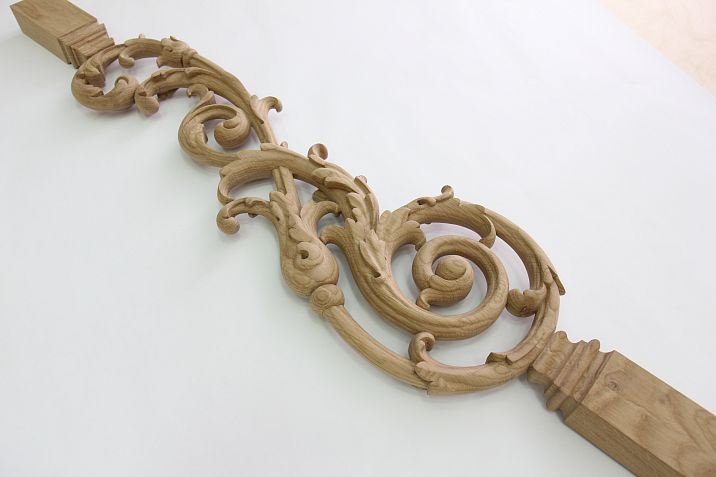
- Carved - with elements of hand or machine carving, creating unique decorative patterns
If you value natural beauty, eco-friendliness, and traditional style, then buy balusters made of wood will be an ideal solution for your interior.
Metallic balusters: strength and elegance
Metal balusters are a guarantee of durability and reliability. Such items combine well with wooden staircases, creating an interesting material contrast. The style of metal balusters can be absolutely any: from strict classicism to avant-garde modernism.
The high functionality of metal balusters is ensured by their simple mounting method. This once again proves the advantage of metal balusters over similar items made from other materials.
Wrought iron balusters look especially impressive and can become true works of art. Each such item is unique and bears the mark of its creator's craftsmanship. Thin wrought iron rails visually make the staircase structure more airy and light, which is especially relevant for small rooms.
Concrete balusters: monumentality and durability
Concrete is a material that is experiencing a true renaissance in architecture and design in recent years. Concrete balusters are distinguished by exceptional strength and resistance to atmospheric influences, while they are easy to process and allow creating figurative items of practically any shape.
Advantages of concrete balusters:
- Durability - service life up to 50-100 years due to the monolithic structure and modern protective compositions
- Possibility of self-manufacturing - with proper preparation, you can cast a support post yourself
- Economy - concrete items are more cost-effective compared to metal or premium wood analogs
- Variety of color palette and textures - modern technologies allow coloring concrete in various shades and creating interesting textures
- Resistance to precipitation and temperature fluctuations - concrete balusters do not absorb moisture, do not crack, and are not susceptible to corrosion
Concrete balusters are especially suitable for classical architectural styles such as Empire, Baroque, or Neoclassicism. They give the structure monumentality and solidity, emphasizing its status and significance.
Other materials: from marble to composites
In addition to wood, metal, and concrete, balusters are also made from other materials:
- Marble and granite - luxurious and durable materials, but they differ in high cost and complex processing
- Plastic - lightweight and inexpensive material, but it lags behind natural analogs in aesthetic and ecological characteristics
- Composite materials - a modern solution combining the advantages of various materials and possessing high resistance to external influences
Each material has its own characteristics and area of application. When choosing, it is important to consider not only aesthetic preferences but also practical aspects: operating conditions, maintenance requirements, compatibility with other structural elements.
Variety of forms and styles: from classicism to avant-garde
The world of balusters is amazed by its diversity of forms, styles, and design solutions. From strict classical lines to bold avant-garde experiments - everyone can find a variant perfectly matching their taste and overall interior concept.
Classic balusters: eternal elegance
Classic balusters are characterized by symmetry, proportionality, and restrained decoration. They usually have the shape of a vase or column with expansion in the central part. Such balusters fit perfectly into interiors in the styles of Classicism, Empire, Baroque, or Neorenaissance.
Balusters in the shape of 'Ella' have gained particular popularity, evoking ancient architecture with its harmony and perfection of proportions. These items usually have standard dimensions (for example, 50x50x900 mm) and are made from various types of wood, most often from high-grade pine.
Modern balusters: functionality and minimalism
Modern design tends toward simplicity of forms and purity of lines. Balusters in the modern or minimalist style usually have a concise geometric shape — these can be simple cylinders, parallelepipeds, or more complex geometric figures.
Avant-garde balusters: boldness and originality
Avant-garde balusters: boldness and originality
For those who are not afraid of experiments and strive to create a truly unique interior, there are avant-garde baluster options. These can be asymmetrical shapes, unusual materials, or bold color solutions.
For example, balusters can be made in the form of abstract sculptures, natural motifs, or geometric compositions. Such elements become a true focal point, bringing individuality and character into the interior.
Technical Specifications and Standards
When selecting and installing balusters, it is necessary to consider not only their aesthetic qualities but also technical parameters that ensure the safety and durability of the structure.
Dimensions and Proportions
The standard handrail height is 70-100 mm, and based on these measurements, the baluster size is chosen. Typical dimensions for wooden balusters:
- Height/Thickness: 50 mm
- Width: 50 mm
- Length: 900 mm
For more substantial structures, balusters of size 60x60x900 mm, 80x80x900 mm, or even 100x100x900 mm may be used. Initial posts typically have dimensions of 80x80x1200 mm or 100x100x1200 mm.
The allowable deviation in dimensions is usually ±2 mm, ensuring precise fitting during installation.
Calculating the number and spacing between balusters
The number of balusters is calculated based on the length of the staircase or railing. The optimal distance between posts is 15 cm. Thus, knowing the total length of the structure, you can easily calculate the required number of balusters.
Installing balusters less frequently is not recommended for several reasons:
- This reduces the safety of the structure
- It disrupts aesthetic harmony
- It reduces the strength of the entire railing
Physical parameters and material requirements
For wooden balusters, important parameters include:
- Wood moisture content: optimal value is 8% with allowable deviation ±2%
- Wood density: for pine, this value is approximately 520 kg/m³
- Material grade: it is preferable to use higher-grade wood (A, Extra)
- Weight: for example, a pine baluster of size 50x50x900 mm weighs approximately 1.17 kg
Metallic and concrete balusters also have their own technical requirements concerning strength, corrosion resistance, or frost resistance.
The process of selecting ideal balusters for your project
Choosing balusters is a responsible stage that requires consideration of many factors: from interior style to practical aspects of operation.
Defining style and concept
First of all, it is necessary to determine the style in which your home’s interior is executed or will be executed. Traditional turned wooden or marble balusters are suitable for classic interiors. For modern minimalist spaces, it is better to choose concise metal or glass constructions.
It is important that balusters harmonize with other interior elements: furniture, wall finishes, flooring. They should become an organic part of the overall design concept, rather than standing out from it.
Practical aspects
When selecting balusters, practical aspects must also be considered:
- Operating conditions: for outdoor structures, materials resistant to moisture and temperature fluctuations are required
- Usage intensity: in high-traffic areas, it is better to install more durable and wear-resistant balusters
- Presence of children or elderly people in the house: in this case, the distance between balusters should be minimal, and the balusters themselves should be as strong as possible
- Project budget: the cost of balusters may vary significantly depending on the material and complexity of execution
Combination with other staircase elements
Balusters must harmoniously match other elements of the staircase structure: treads, nosings, handrails, support posts. The material of the balusters is usually chosen depending on the material of the treads and handrails.
Combined options look interesting: for example, staircases made of natural stone, decorated with metal balusters combined with wooden handrails. Such solutions allow creating a unique and memorable design.
Installation and mounting: from theory to practice
Correct installation of balusters is the guarantee not only of aesthetic appeal, but also of the safety of the entire structure. The installation process depends on the type of balusters and the material they are made of.
Preparation Work
Before beginning installation, conduct thorough measurements and calculations. Determine the exact number of balusters based on the length of the staircase or railing and the optimal distance between them (about 15 cm).
Prepare all necessary tools and materials:
- Drill or screwdriver
- Drill bits of the appropriate diameter
- Wood glue (if using wooden balusters)
- Fastening elements (screws, bolts, nuts)
- Level for checking vertical alignment of installation
- Measuring tape and pencil for marking
Installation process for wooden balusters
Installation of wooden balusters usually proceeds according to the following algorithm:
- Marking the locations for baluster installation on the stringer of the staircase or on the floor (for railings)
- Drilling holes of the appropriate diameter
- Applying glue to the bottom of the baluster
- Installing the baluster into the prepared hole
- Securing the top part of the baluster to the handrail using glue and/or fastening elements
- Checking vertical alignment using a level
- Removing excess adhesive
- Final finishing (sanding, coating with varnish or paint)
Features of installing metal and concrete balusters
Installation of metal balusters has its own features. They are usually attached using welding or special fastening elements. It is important to ensure secure fixation, as this affects the safety of the entire structure.
Concrete balusters, due to their weight, require a special approach to installation. They are usually mounted on a special foundation or base capable of withstanding significant load. Fixation is carried out using cement mortar or special adhesive compositions.
Maintenance and care: preserving beauty for years
Proper care of balusters will help maintain their attractive appearance and functionality for many years.
Care for wooden balusters
Wooden balusters require regular maintenance to preserve their beauty and longevity:
- Regular cleaning from dust using a soft damp cloth
- Periodic treatment with special compositions to protect against moisture and pests
- Updating protective coatings (varnish, oil, wax) as needed
- Avoiding contact with aggressive chemicals
- Maintaining optimal humidity levels in the room
Maintenance of metal and concrete balusters
Metal balusters require protection against corrosion. Regularly inspect them for rust and treat with anti-corrosion compounds as needed. Wrought iron elements may require periodic renewal of protective coating.
Concrete balusters require virtually no special care. Simply clean them regularly of dust and dirt. When used outdoors, it is recommended to periodically treat them with hydrophobic compounds to protect against moisture.
Pricing policy and economic aspects
The cost of balusters can vary significantly depending on the material, complexity of execution, and manufacturer. Let's consider approximate price ranges for different types of balusters.
Wooden balusters: price-to-quality ratio
The cost of wooden balusters depends on the type of wood, dimensions, and complexity of processing:
- Spruce balusters 50x50x900 mm: from 270 to 300 rubles
- Spruce balusters 60x60x900 mm: from 360 to 400 rubles
- Larch balusters: approximately 1.5-2 times more expensive than spruce
- Ash balusters 50x50x900 mm: around 1000 rubles
- Initial posts from spruce 80x80x1200 mm: from 1000 to 1100 rubles
- Initial posts from spruce 100x100x1200 mm: from 1400 to 1500 rubles
More massive balusters and posts, as well as items made from expensive wood species (oak, beech), will cost significantly more.
Metal and concrete balusters: investments in longevity
Metal balusters usually cost more than wooden ones, especially if referring to handcrafted wrought iron items. Their price may start from 1000-1500 rubles per piece and reach several thousand depending on the complexity of execution.
Concrete balusters, despite their durability, are often more affordable. Their cost depends on dimensions, complexity of shape, and presence of decorative elements.
Economic efficiency of various solutions
When choosing balusters, it is important to consider not only their initial cost but also long-term economic aspects:
- Material lifespan
- Need and cost of regular maintenance
- Resistance to damage and wear
- Possibility of restoration or replacement of individual elements
Sometimes a more expensive solution proves more economically advantageous in the long term due to its long service life and minimal maintenance costs.
Design solutions and trends in baluster usage
Modern design offers numerous interesting and unconventional solutions for using balusters in interior and exterior spaces.
Minimalism and geometry: modern trends
In modern interiors, minimalist balusters with simple geometric shapes are gaining increasing popularity. These may include thin metal rods, glass panels with minimal fastening, or sleek wooden elements.
Such solutions create a sense of lightness and airiness, visually expanding the space and fitting perfectly into modern interiors in minimalist, high-tech, or Scandinavian styles.
Eclecticism and mixing styles
An interesting trend is mixing different styles and materials. For example, classic turned wooden balusters can be combined with modern metal railings, creating a unique and memorable look.
Such eclectic solutions allow creating a truly individual interior that reflects the personality and taste of the home owner.
Color and texture: play of contrasts
Modern material processing technologies allow experimenting with the color and texture of balusters. Wooden balusters can be painted in bright colors or, conversely, retain the natural wood grain. Metal balusters can have various finishes: from classic black to gold or bronze.
Contrasting combinations look especially striking: dark balusters with light handrails or vice versa. Such solutions add dynamism and expressiveness to the entire structure.
Practical tips for selecting and purchasing balusters
Selecting and purchasing balusters is a responsible process requiring attention to detail and consideration of multiple factors.
What to pay attention to when choosing
When selecting balusters, pay attention to the following aspects:
- Material quality: for wooden balusters, it is important to avoid knots, cracks, and other defects; for metal balusters, the quality of welded joints and coatings matters.
- Dimensional accuracy: deviations must not exceed allowable values (usually ±2 mm).
- Surface finish quality: the surface should be smooth, free of burrs and roughness.
- Style compatibility: balusters should harmonize with the overall design concept.
- Manufacturer reliability: prefer established companies with a good reputation.
Where buy balustersRecommendations for selecting a supplier
When selecting a baluster supplier, pay attention to the following points:
- Market experience: the longer a company has been operating, the greater the likelihood it provides quality services.
- Product range: a wide selection will allow you to find exactly what you need for your project.
- Custom manufacturing capability: if you require non-standard solutions, it is important that the supplier can implement them.
- Warranty availability: reputable manufacturers always provide a warranty on their products.
- Customer reviews: study the opinions of those who have already purchased products from this supplier.
One reliable supplier of quality balusters is the company STAVROS, specializing in producing staircase elements from various materials.
Budget calculation and cost optimization
When planning your budget for purchasing balusters, consider not only the cost of the items themselves, but also associated expenses:
- Delivery
- Installation (if you do not plan to install the balusters yourself).
- Additional materials (adhesives, fasteners).
- Final finishing (varnish, paint, protective coatings).
To optimize costs, consider the following options:
- Choosing more affordable wood species (pine instead of oak).
- Using standard models instead of custom orders.
- DIY installation (if you have the necessary skills).
- Purchasing balusters in bulk (many manufacturers offer discounts for large orders).
Innovations and modern trends in the world of balusters
The world of balusters is not static—it constantly evolves, offering new materials, technologies, and design solutions.
New materials and technologies
The modern industry offers innovative materials for manufacturing balusters:
- Composite materials combine the advantages of various materials, possessing high strength and resistance to external influences
- Glass and acrylic create an effect of lightness and visually expand the space
- 3D printing allows creating balusters of complex shapes with minimal costs
- LED lighting integrated into balusters not only serves a decorative function but also provides additional illumination for the staircase
Ecological aspects and sustainable development
Modern trends in design and construction increasingly focus on eco-friendliness and sustainable development. This is reflected in baluster production:
- Use of wood from renewable sources
- Application of non-toxic water-based paints and varnishes
- Development of technologies for recycling materials
- Creation of durable items that do not require frequent replacement
Individualization and customization
Modern consumers increasingly value individuality and uniqueness. In response to this demand, manufacturers offer extensive customization options for balusters:
- Creation of items based on custom sketches
- Combining various materials and techniques
- Integration of personalized elements (initials, family crests)
- Use of non-standard color solutions
This approach allows creating truly unique interiors that reflect the individuality and taste of the owners.
Balusters in various architectural styles
Balusters play an important role in forming the architectural style of a building or interior. Let's consider what types of balusters are characteristic of various stylistic directions.
Classicism and neoclassicism
In the classical style, balusters usually have the shape of symmetrical columns with expansion in the central part. They are characterized by strict proportions, symmetry, and restrained decoration. Materials for such balusters are often marble, wood of valuable species, or plaster.
Characteristic features of classical balusters:
- Symmetry and proportionality
- Vertical orientation
- Presence of base, shaft, and capital (as in columns)
- Restrained decoration based on classical motifs
Baroque and Rococo
Baroque and Rococo styles are characterized by opulence, abundance of decorative elements, and dynamic forms. Balusters in these styles usually have complex shapes with multiple curves, volutes, and plant motifs.
Such balusters are made of wood, marble, or metal with rich finishes (gilding, patina). Often, carving or casting techniques are used to create complex decorative elements.
Modern and Art Deco
The modern style is characterized by smooth lines, asymmetry, and use of natural motifs. Balusters in this style may have the shape of stylized plants, winding stems, or abstract wave-like forms.
Art Deco, on the contrary, leans towards geometric forms and clear lines. Balusters in this style usually have stepped or zigzag shapes, often using contrasting materials and colors.
Modern styles: minimalism, high-tech, loft
In modern styles, balusters acquire new, non-traditional forms. In minimalism, these may be simple vertical rods without any decoration. In high-tech style, metal or glass balusters with chrome finish are popular.
The loft style implies using rough, unprocessed materials: weathered wood, uncoated metal, concrete. Balusters in this style may be made of metal pipes, chains, or even industrial elements reinterpreted as decorative items.
Balusters in various parts of the house: from stairs to terrace
Balusters are used not only for stairs but also for other house elements requiring railing or decorative finishing.
Stair balusters: functionality and safety
Stair balusters are the most common application of these architectural elements. They ensure safety when ascending and descending, support handrails, and give stairs a finished look.
When selecting stair balusters, special attention should be paid to their strength and reliability of mounting, as they must withstand significant loads. The distance between balusters should not exceed 15 cm to prevent falls, especially if there are children in the house.
Balcony and terrace railings: resistance to external influences
Balusters for balconies and terraces must have enhanced resistance to atmospheric influences: moisture, temperature fluctuations, ultraviolet radiation. Materials typically used for such structures are non-corrosive and non-rotting: metal with anti-corrosion coating, larch, concrete.
The design of balcony balusters can be either classic or modern, depending on the building's architectural style. It is important that they harmonize with the facade and create a unified composition.
Furniture balusters: decorative accent
Balusters are used not only in architecture but also in furniture manufacturing. They can serve as legs for tables and chairs, supports for shelves, or decorative elements of cabinets and chests.
Furniture balusters are usually smaller in size compared to architectural ones and feature more refined detailing. They can be crafted in various styles: from classic to avant-garde, depending on the overall furniture design.
Practical examples of baluster use in interior design
Let's consider several specific examples of baluster use in various interior solutions.
Classic staircase in a country house
Imagine a spacious hall in a country house with a majestic wooden staircase. The treads and risers are made of dark oak solid wood. The balusters are turned, with an elegant expansion in the central part, also made of oak but with a lighter shade to create contrast.
The initial posts are more substantial, with decorative spheres at the top. The handrails have a smooth curve, following the staircase's contour. The entire structure is coated with matte varnish, highlighting the natural beauty of the wood.
Such a staircase becomes a central element of the interior, a symbol of the homeowners' status and good taste.
Modern minimalist construction
In a modern loft space, the staircase can look completely different. A metal frame with wooden treads, without risers, creates a sense of lightness and airiness. The balusters are thin vertical steel rods, evenly spaced from each other.
The handrails are a simple horizontal pipe without any decorative elements. The entire structure appears minimalist and functional, perfectly fitting into a minimalist interior.
Eclectic solution for an urban apartment
In an urban apartment styled in eclectic fashion, the staircase can combine elements of various styles. For example, a metal frame with wooden treads and wrought iron balusters with botanical motifs.
The handrails can be made of dark wood, contrasting with lighter treads. Such a solution creates an interesting visual effect and becomes a striking accent in the interior.
Conclusion: the art of choosing ideal balusters
Choosing balusters is not merely a technical task, but a true art requiring understanding of architectural styles, knowledge of various materials' properties, and a sense of harmony. Properly selected balusters can transform a space, giving it individuality and character.
When selecting balusters, it is important to consider not only their aesthetic qualities but also practical aspects: strength, durability, ease of maintenance. Attention should also be paid to the balusters' compatibility with the overall interior style and other staircase components.
The modern market offers a vast variety of balusters made from different materials, in various styles and price categories. This allows finding the ideal solution for any project, whether a classic country house, a modern urban apartment, or an eclectic loft space.
buy balusters High-quality balusters can be found at STAVROS, a company specializing in staircase elements and offering a wide range of products made from various materials. Experienced specialists will help you select the optimal solution that meets your requirements and budget.
Remember that balusters are not just a functional element but also an important detail shaping the overall impression of the interior. Therefore, approach their selection with full responsibility and attention to detail. Then your staircase or railing will become a true work of art, pleasing to the eye and inspiring admiration from guests.
STAVROS offers a wide range of balusters in various shapes, sizes, and materials. Years of experience, use of high-quality materials, and modern technologies enable STAVROS to create products meeting the highest standards of quality and aesthetics. Entrust your ideal staircase creation to professionals, and the result will exceed all your expectations!