












































































Article Contents:
- Philosophy of small forms: why details define the whole
- Scale and proportions
- Repetition rhythm
- Tactility
- Balusters: vertical sculpture in small scale
- Turned balusters: classic volumetric form
- Flat balusters: graphic silhouette
- Square balusters: minimalism of form
- Furniture handles: functional sculpture in miniature
- Types of furniture handles
- Materials and processing of wooden handles
- Creating unity: practical principles of combination
- Principle 1: Unity of wood species
- Principle 2: Consistency of finish
- Principle 3: Identical finish
- Principle 4: Profile rhyme
- Principle 5: Proportionality of scales
- Stylistic scenarios of unity
- Classic and neoclassic
- Scandinavian style and minimalism
- Loft and Industrial Style
- Eco-style and biophilic design
- Provence and chalet
- Furniture decor: expanding the concept of unity
- Decorative appliqués
- Furniture legs
- Moldings and milling
- Company STAVROS: partner in creating unity of small forms
- Balusters: Over One Hundred Models
- Furniture handles: wide assortment
- Possibility of coordination
- Consultations for creating unity
- Practical case: creating unity from staircase to kitchen
- Mistakes when creating unity
- Conclusion: small forms as the basis of great harmony

An interior consists not only of large objects — furniture, walls, ceilings. Its character, style, emotional impact are determined by details that many consider secondary: cabinet handles, balusters on staircases, door overlays, decorative elements on furniture. These small forms function like punctuation marks in a text — imperceptible at first glance, yet critical for meaning and rhythm. An incorrectly chosen furniture handle may ruin the impression of an expensive set. Balusters that do not match the interior style will turn an elegant staircase into an architectural dissonance.
In 2026, designers increasingly speak of the concept of unity of small forms — when all decorative details in a space are governed by a common logic, executed in a unified style, made from coordinated materials, with a shared language of forms. This is especially evident in the combinationwooden balustersand wooden furniture handles. At first glance, these elements perform completely different functions in different parts of the house. Balusters — vertical supports of a staircase railing, ensuring safety and creating the rhythm of ascent. Furniture handles — functional elements for opening cabinets, chests, and drawers. But if you look closer, a deep connection is revealed between them: both are repeating vertical elements of small scale, made of wood, defining the tactile experience of interaction with the interior, demonstrating the skill of material processing.
When the staircase balusters and kitchen cabinet handles are made from the same wood species, have similar profiles, processed in the same way, and coated with identical finishes — a visual and emotional unity of the space emerges. A hand gliding along the wooden handrail of the staircase in the morning, and during the day opening a cabinet with a handle of the same texture and warmth. This creates a subconscious sense of the home’s wholeness, meticulous attention to every detail, respect for the material and traditions of woodworking. In this article, we will thoroughly examine how to create this unity, which principles to use, what to pay attention to when selecting balusters and furniture handles, and which styles dictate their own rules for combining small forms.


Philosophy of Small Forms: Why Details Define the Whole
In classical architectural theory, there is a concept called 'order' — a system of relationships between building elements, where each detail is proportionally connected to others. The capital of a column relates to its diameter, the height of a pilaster to its width, the profile of a cornice to the thickness of the wall. This creates harmony that humans intuitively perceive, even without being aware of the mathematics of proportions. The same principles apply in interior design. Small forms — balusters, handles, decorative appliqués, sockets, moldings — are like capitals and cornices of domestic space. They must relate to each other in size, shape, material, and style.




Scale and proportions
A baluster typically has a diameter of forty to seventy millimeters and a height of nine hundred to one thousand millimeters. A cabinet handle with a bracket has a length of ninety-six to three hundred millimeters and a handle diameter of twelve to twenty millimeters. A cabinet handle with a knob has a diameter of twenty-five to fifty millimeters. These dimensions fall within the same scale range — elements that a person can grasp with their hand, with which they interact tactilely every day. When the diameter of a baluster and the diameter of a cabinet handle are close (for example, a baluster of fifty millimeters and a knob handle of forty millimeters), a visual rhyme emerges — both elements are perceived as parts of a single system scaled to the human palm.
Our factory also produces:



Rhythm of Repetition
Balusters and cabinet handles are repeating elements. On a staircase five meters long, thirty to forty balusters can be installed with a spacing of one hundred twenty to one hundred fifty millimeters. On a kitchen cabinet three meters long — twenty to thirty handles on the facades. This rhythm of repetition creates a visual pattern that organizes space. When the rhythm of balusters and the rhythm of handles harmonize (not necessarily identical spacing, but comparable frequency), space is perceived as ordered and thoughtfully designed.
Get Consultation
Tactility
Balusters and cabinet handles are the only interior elements with which a person constantly interacts by touch. The handrail of a staircase, supported by balusters, receives a hand daily when ascending or descending. A cabinet handle is touched dozens of times a day when opening cabinets. Tactile experience is critical for the emotional perception of home. Cold plastic or metal creates a sense of detachment. Warm wood evokes coziness, connection to nature, and homeliness. When both balusters and handles are wooden, with the same degree of sanding and identical finish, the hand receives a consistent tactile experience in different parts of the home.
Balusters: Vertical Sculpture of Small Scale
A baluster is not merely a utilitarian safety element. It is a vertical sculpture, repeated multiple times, creating a rhythmic pattern, demonstrating the craftsmanship of woodwork. Depending on the complexity of the profile, the type of wood, and the method of processing, a baluster can carry different stylistic codes.
Turned Balusters: Classic Form in Three Dimensions
A turned baluster is a piece of wood turned on a lathe into a complex profile with variable diameter. Bulges (ovoids), grips, rings, spherical elements alternate along the axis, creating a play of volumes. Such a baluster carries the code of classic carpentry craftsmanship, alluding to the traditions of Baroque, Classicism, and Russian terem. It is expressive, decorative, and demands careful observation — each profiled element creates its own shadow, its own rhythm.
Turned balusters pair well with cabinet handles of complex shapes: precisely turned wooden handles with spherical or cylindrical bulges, handles with decorative appliqués, knob handles in the form of spheres or ovoids. It is best to choose identical materials and species: if the balusters are made of oak, the handles should also be oak. If the balusters are finished with oil that highlights the texture, the handles should be finished with the same oil.
Flat Balusters: Graphic Silhouette
A flat baluster has a rectangular or trapezoidal cross-section. Decoration is created not by a three-dimensional profile, but by incised or carved patterns on a flat surface. This may be a geometric ornament, a botanical motif, Slavic carving. A flat baluster is graphic — it reads as a silhouette, as a two-dimensional pattern, repeated along the staircase. Such balusters are popular in ethnic styles, Scandinavian interiors, and modern spaces emphasizing clean lines.
Flat balusters harmonize with cabinet handles of simple, minimalist forms: rectangular profiled strips, recessed handles (integrated into the facade without protrusion), end handles (vertical strips on the end of the door). If the balusters have carved ornamentation, it can be repeated on wooden appliqués on the cabinet facades, creating a direct visual connection.
Square balusters: minimalism of form
A simple square-section block, forty by forty or fifty by fifty millimeters, with rounded or beveled edges. No decoration, maximum simplicity. All beauty lies in the quality of the wood, its texture, and color. Square balusters create a strict vertical rhythm, do not distract attention, and conform to the overall architecture.
Square balusters pair perfectly with minimalist cabinet handles: thin profiled rails, recessed handles, rectangular overlay strips. Choose light-colored wood (ash, birch), finish with bleaching or natural light tone, and apply matte oil. This will create a Scandinavian or minimalist aesthetic.
Cabinet Handles: Functional Sculpture in Miniature
A cabinet handle is one of the most frequently used elements in interior design. A person interacts with it dozens of times a day, each time receiving tactile and visual information about the quality, style, and thoughtfulness of the space.
Types of Cabinet Handles
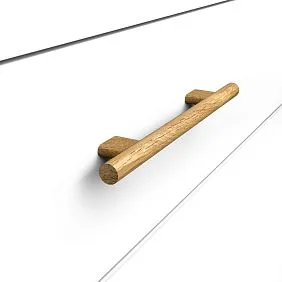
Bracket Handle — a classic type with two mounting points and a handle between them. Length varies from ninety-six millimeters (compact cabinets) to three hundred to four hundred millimeters (wide facades). A bracket handle can be straight, curved, or with decorative elements at the ends. A wooden bracket handle visually and tactilely resembles a miniature staircase handrail — the same cylindrical or oval shape, the same function of being grasped by hand.
Knob Handle — a small element with one mounting point, protruding from the facade twenty to forty millimeters. It may have the shape of a sphere, cylinder, cone, or ovoid. A wooden knob handle with a complex profile (with grips, rings) resembles a miniature baluster — the same principles of turning, the same rhythms of volume.
Recessed Handle — an indentation in the facade that can be grasped with fingers. It does not protrude above the surface, creating a minimalist effect. A wooden recessed handle is a milled groove with rounded edges, often contrasting with the main facade color.
Overlay Handle — a strip mounted on the facade surface along the entire height or width of the door. It creates a graphic vertical or horizontal accent. A wooden overlay handle can be in tone with the facade (integration effect) or contrasting.
End Handle — a vertical strip mounted on the end of the door. When the door is closed, it is almost invisible; when open, it displays the handle as an architectural element. A wooden end handle creates a clean aesthetic, suitable for minimalist and Scandinavian interiors.
Materials and Finishing of Wooden Handles
Wooden handlesThey are made from the same species as balusters: oak, ash, beech, walnut, spruce. This allows for material unity. Surface finishing can also be identical: brushing (highlighting texture by combing soft fibers), sanding to smoothness, toning in various shades, finishing with oil, varnish, or wax.
The effect is especially expressive when a wooden handle has the same profile as a baluster element. For example, a baluster with a spherical ovoid in the middle — and a knob handle in the shape of a sphere of the same diameter. Or a baluster with ring grips — and a bracket handle with similar rings at the ends. This creates a direct visual rhyme, a connection between the staircase and the furniture.
Creating Unity: Practical Principles of Combination
How to properly combine balusters and cabinet handles to create a sense of unity among small forms?
Principle 1: Unity of Wood Species
The most fundamental principle — use one wood species for balusters and handles. If balusters are made of oak,Furniture Handlesthen handles should also be oak. Uniform species creates consistency in texture (grain pattern, pore size, density) and color (oak is warmer than ash, walnut is darker than beech).
Combining species is permissible, but cautiously. The main species (e.g., oak) for large elements — balusters, large handle-plates. Accent species (e.g., wenge or walnut) for small details — handle-buttons, decorative inlays. But no more than two species in one space.
Principle 2: Surface Treatment Consistency
Balusters and handles must have the same surface finish. If balusters are brushed (texture emphasized, surface textured), handles should also be brushed. If balusters are smoothly sanded (silk-smooth surface), handles should also be smooth. Brushing creates tactile roughness and visual depth — suitable for rustic, eco, loft interiors. Smooth sanding creates silkiness and minimal texture — suitable for classic, Scandinavian, modern spaces.
Principle 3: Finish Uniformity
Oil, varnish, wax, stain — the finish determines the wood’s color, gloss, and tactile quality. Balusters and handles must be coated with the same type of finish. If balusters are oiled (matte surface, emphasized texture), handles should also be oiled. If balusters are varnished (glossy protective layer), handles should also be varnished.
Finish uniformity is especially critical for stained elements. If balusters are stained with walnut-colored stain, handles must be stained with the same stain to achieve identical shade. Differences in tone (some elements darker, others lighter) create visual dissonance.
Principle 4: Profile Rhythm
If balusters have complex turned profiles, handles may repeat elements of this profile in miniature. A baluster with a vase-shaped profile — a handle-button shaped like a sphere. A baluster with ring grips — a handle-plate with rings at the ends. A baluster with cylindrical sections — a handle with a cylindrical cross-section.
This does not mean copying the entire profile (a handle should not be an exact scaled-down copy of the baluster — it would look cartoonish), but repeating the key visual motif. If balusters are simple square shapes, handles should also be simple rectangular. If balusters are flat with carved patterns, furniture may feature wooden inlays with similar patterns.
Principle 5: Scale Proportionality
The handle size must be proportional to the baluster size. If a baluster is large (diameter 70 mm), handles should also be large (handle-plates 200–300 mm long, handle-buttons 40–50 mm in diameter). If a baluster is slender (diameter 40 mm), handles should be compact (handle-plates 96–128 mm, handle-buttons 25–30 mm).
Violation of proportions creates visual discomfort: oversized handles against slender balusters look grotesque, miniature handles in a space with massive balusters look undersized.
Stylistic scenarios of unity
Different interior styles dictate different approaches to combining balusters and furniture handles.
Classicism and neoclassicism
Balusters: Turned with classic profiles — vase, rings, grips. Species: oak, beech, ash. Finish: varnish or oil, preserving natural tone or slightly darkened with stain.
Handles: Spherical or vase-shaped handle-buttons, curved handle-plates with decorative elements at ends (spheres, rosettes). Same species as balusters. Possible combination with brass or bronze inlays (but wood dominates).
Unity: Handle-button profile repeats the baluster’s vase shape. Handle-plate grip diameter matches the baluster’s main body. Finish identical — semi-gloss varnish or satin oil.
Scandinavian style and minimalism
Balusters: Simple square or flat without decoration. Species: ash, birch, pine. Processing: bleaching or natural light tone. Finish: matte oil or clear varnish.
Handles: Vertical end panels, inset handles, surface-mounted profiles with rectangular cross-section. Light species (ash, birch). Simple shape, no decoration.
Unity: Simple forms, light tone, matte surface. Handle and baluster have similar square or rectangular cross-sections, same sanding level, identical finish. All wood in the space — light, clean, un-toned.
Loft and industrial style
Balusters: Square heavy or rectangular from dark stained oak. Possible combination with metal (metal support posts, wooden balusters). Processing: brushing, emphasizing rough texture, possible artificial aging.
Handles: Heavy rectangular handle-plates, surface-mounted panels from dark wood. Possible combination with metal (wooden grip, metal fittings). Surface brushed, stained in dark tones.
Unity: Heavyweight, dark tone, rough expressive texture. Wood processed identically — brushed, dark stain (wenge, stained oak), matte oil finish. Metal elements, if any — in unified style (matte black metal, aged steel).
Eco-style and biophilic design
Balusters: Any type, but with maximum natural processing. Possible balusters from untrimmed wood with preserved bark, knots, irregular shapes. Finish: oil or wax, preserving wood’s tactile quality, natural color without toning.
Handles: Natural-form wooden handles — possibly from branches (branch diameter 20–30 mm becomes a handle), from sawn ends (end cut of branch as handle-button), from unprocessed planks preserving natural texture. Finish minimal — oil, wax.
Unity: Maximum naturalness, minimal processing. Both balusters and handles showcase the natural beauty of wood — texture, knots, irregularities. All wood natural color, un-toned. Finish — oil emphasizing structure, or wax creating silkiness while preserving tactile quality.
Provence and chalet
Balusters: Turned classic from light wood (ash, pine) with aged effect. Possible patination (darkening with stain or wax into profile grooves, creating aged effect).
Handles: Spherical or mushroom-shaped handle-buttons, curved handle-plates. Light wood, possible patination. Alternative — combination of light wood with white paint (some handles natural wood, some painted white — creates Provençal lightness).
Unity: Light wood, aged effect through patination or light gray toning. Profiles soft, rounded (no sharp graphics). Finish matte — oil or wax, possibly with whitewashing effect.
Furniture Decoration: Expanding the Concept of Unity
In addition to balusters and handles, the concept of unity of small elements can be extended to other wooden furniture components: appliqués, panels, carved elements, legs.
Decorative appliqués
Wooden appliqués on furniture facades can replicate the profile or pattern of balusters. If the balusters are flat with carved Slavic ornamentation, similar carved appliqués are installed on cabinet doors. If the balusters are turned with ring grips, the appliqués may have a semi-circular convex profile, imitating the baluster’s cross-section.
Furniture Legs
Legs of tables, chairs, sofas, and chests — these are vertical elements, functionally and visually related to balusters. If the staircase balusters are turned with a specific profile, the dining table legs can be ordered with a similar profile from the same wood species. This creates a direct link between the staircase and the furniture.
Panels and Milling
Furniture facades can have milled frames creating relief. The profile of the milling can be coordinated with the profile of balusters or baseboards. For example, if the baseboards have a beveled top edge (angled at forty-five degrees), furniture facades are also framed with beveled strips.
STAVROS Company: Partner in Creating Unity of Small Elements
Implementing the concept of unity of small elements requires access to high-quality components made from identical materials with coordinated processing. STAVROS has been producing wooden interior items for over twenty years, offering a full range of elements to create a harmonious space.
Balusters: More than a hundred models
STAVROS catalog featureswooden balusters for staircasesof all types: turned classic, flat with carving, square minimalist, carved exclusive. Species: oak, beech, ash, larch, pine. Any finish is possible: brushing, sanding, toning, patination. Coating: oil, lacquer, wax — chosen by the client.
Furniture Handles: Wide Range
STAVROS producesWooden furniture handlesof all types: handles of various lengths (from ninety-six to four hundred millimeters), button handles of different shapes (spherical, cylindrical, mushroom-shaped), recessed handles, surface-mounted profiles, end handles. Species are the same as balusters — this guarantees the possibility of creating material unity.
Possibility of Coordination
The key advantage of working with STAVROS is the ability to order balusters and furniture handles from the same wood species with a unified finish and coating. You specify the desired species (e.g., oak), finish (brushing), toning (walnut stain), coating (matte oil) — and receive all elements identical in color, texture, and tactile feel.
For complex projects, STAVROS manufactures elements according to individual drawings. If you have balusters of a specific profile and wish for handles that replicate the key element of this profile — send a photo or drawing of the baluster, and STAVROS technicians will develop a handle design that harmonizes with it.
Consultations for Creating Unity
STAVROS specialists will help select balusters and handles that create a sense of style unity. Describe your interior (style, color palette, materials), send photos — receive recommendations on baluster and handle models that will harmonize with each other and the overall space.
Practical Case: Creating Unity from Staircase to Kitchen
Let’s consider a specific project: a country house in the modern chalet style. Staircase to the second floor made of solid oak, kitchen cabinetry made of oak veneer, living room with oak furniture. Task: create unity of small elements through balusters and furniture handles.
Step 1: Choosing Balusters. For chalet style, classic turned balusters are suitable, but not overly decorative. We select a model with a moderate profile: one central vase, two ring grips at the top and bottom. Species — oak. Finish — light brushing to emphasize texture. Toning — walnut stain (warm brown, not too dark). Coating — matte oil. Vase diameter — sixty millimeters, main body — fifty millimeters.
Step 2: Selecting Kitchen Cabinet Handles. For the kitchen cabinetry, we choose handles of two types. For upper cabinets — spherical button handles with a diameter of forty millimeters (repeating the vase shape of balusters in miniature). For lower cabinets — cylindrical handles of one hundred twenty-eight millimeters in length and fifteen millimeters in diameter (close to the main body diameter of balusters). Species — oak, finish — brushing, toning — walnut stain, coating — matte oil. Everything matches the balusters.
Step 3: Handles for Living Room Furniture. The console, sideboard, and console in the living room receive handles of the same type: spherical buttons for small doors, handles for drawers. Species, finish, coating — same as balusters and kitchen handles.
Step 4: Additional Elements. Dining table legs are ordered with a profile similar to balusters (central vase, ring grips), made of oak with the same finish. Wooden appliqués on the sideboard facades — brushed and toned to match the balusters.
Result: Entering the house, a person sees a staircase with brushed oak balusters in a warm walnut tone. Ascending to the second floor, the hand glides over an oak handrail with the same warm, rough texture. Descending, one walks to the kitchen — opens a cabinet with a brushed oak handle of the same tone and texture. Sits at the dining table with legs replicating the baluster profile. In the living room, opens a console — again, an oak handle. The entire house space is unified by a wooden thread of identical small elements. This is not noticeable as an intrusive technique, but is subconsciously perceived as wholeness, thoughtfulness, quality.
Errors in Creating Unity
What errors destroy the concept of unity of small elements?
Error 1: Inconsistent Species. Balusters made of oak, handles made of beech, baseboards made of pine. Different species have different textures and colors — visual unity is destroyed.
Error 2: Different Finishes. Balusters are smoothly sanded, handles are brushed. The tactile experience is inconsistent — the hand expects one texture, receives another.
Error 3: Mismatched Tone. Balusters are toned in light oak, handles — in dark walnut. Even with the same species, a difference in toning creates a visual break.
Error 4: Scale mismatch. Massive balusters with a diameter of seventy millimeters, miniature handle knobs with a diameter of twenty millimeters. Elements are perceived as belonging to different scaling systems.
Error 5: Stylistic inconsistency. Baroque turned classical balusters, minimalist rectangular handles. Styles conflict, there is no unity.
Conclusion: Small forms as the basis for great harmony
Unity of small forms in interior design is not a perfectionist’s whim, but a fundamental principle for creating a harmonious space. When stair balusters and furniture handles are made from the same wood species, processed identically, coated with the same finish, and repeat each other in profiles and proportions — a visual and emotional connection emerges between different parts of the house. The hand, daily interacting with these elements, receives a consistent tactile experience. The eye perceives the rhythm of repeating forms as order and thoughtfulness.
In 2026, when interior personalization, attention to details, and preference for natural materials become priorities, the concept of unity of small forms is especially relevant. It does not require massive budgets — the cost difference between randomly selected handles and handles coordinated with balusters is minimal. But the effect is incomparable. An interior with thoughtfully unified small forms is perceived as original, cohesive, and high-quality. An interior with a random assortment of details appears unfinished, chaotic, and cheap.
When creating your home, do not neglect details.wooden balustersandFurniture HandlesThey may seem like minor details against the backdrop of global decisions regarding layout and finishes. But it is precisely these details that interact daily with people, shaping tactile and visual experiences, and creating the emotional atmosphere of the home. Investing in high-quality wooden elements from a reliable manufacturer, selecting them with attention to material, form, and finish unity — you are investing in harmony, comfort, and beauty of your space for decades to come.


